
Life, 1904-09-01 · page 13 of 38
Life — September 1, 1904 — page 13: what you’re looking at
What you’re looking at
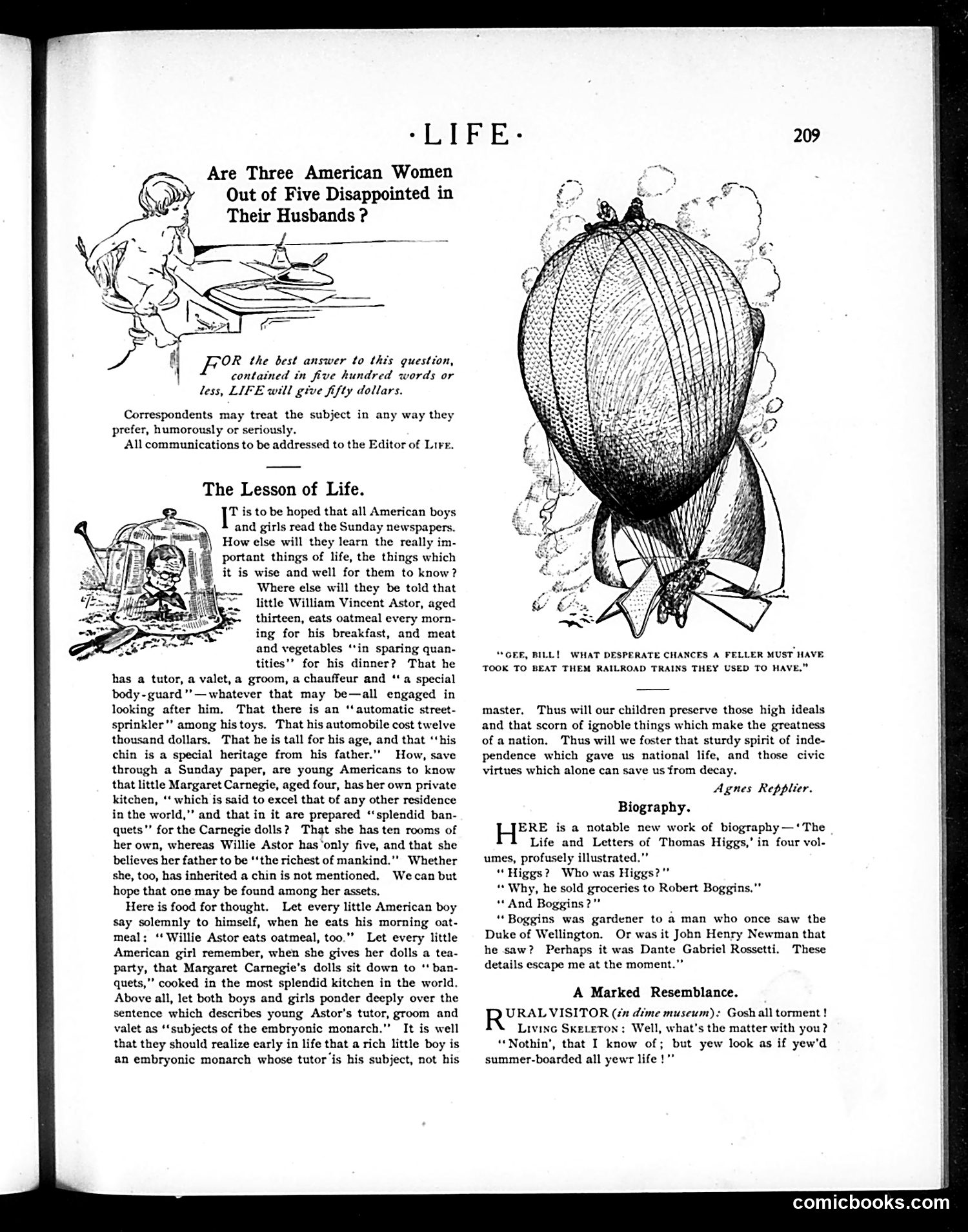
This page contains three satirical pieces mocking American society: **"The Lesson of Life"** (main essay by Agnes Repplier) sarcastically critiques how Sunday newspapers celebrate the extravagant lives of wealthy children like William Vincent Astor (age 13) and Margaret Carnegie (age 4). The piece mocks their excessive possessions—Astor's $12,000 automobile, Carnegie's private kitchen for dolls, their servants and tutors—while suggesting this teaches poor American children to accept class hierarchy as natural. The satire targets both sensationalist journalism and the implicit message that wealth creates a natural aristocracy ("embryonic monarch"). **"Biography"** ridicules inflated biographical works by satirizing how authors trace tenuous connections to famous people (a gardener who saw the Duke of Wellington). **"A Marked Resemblance"** (bottom) is a brief visual gag about a museum skeleton looking starved—likely commentary on poverty or exploitation. The page's header contest asks readers to answer whether three of five American women are disappointed in their husbands, offering $50 for the best response.
📄 Transcribed text from this page (OCR, searchable)
Machine-transcribed from the original scan — historical spelling and the odd misread are preserved.
“PEE Are Three American Women Out of Five Disappointed in Their Husbands ? For the best answer to this question, contained in five hundred words or less, LIFE will give fifty dollars. Correspondents may treat the subject in any way they prefer, humorously or seriously. All communications to be addressed to the Editor of Lire. The Lesson of Life. tc is to be hoped that all American boys and girls read the Sunday newspapers. \ How else will they learn the really im- portant things of life, the things which ) it is wise and well for them to know? ‘a Where else will they be told that little William Vincent Astor, aged thirteen, eats oatmeal every morn- ing for his breakfast, and meat and vegetables ‘‘in sparing quan- tities’? for his dinner? That he has a tutor, a valet, a groom, a chauffeur and ‘a special body-guard "’—whatever that may be—all engaged in looking after him. That there is an ‘automatic street- sprinkler’ among his toys. That his automobile cost twelve thousand dollars. That he is tall for his age, and that ‘this chin is a special heritage from his father." How, save through a Sunday paper, are young Americans to know that little Margaret Carnegie, aged four, has her own private kitchen, ‘‘ which is said to excel that of any other residence in the world,”’ and that in it are prepared ‘‘splendid ban- quets"’ for the Carnegie dolls? That she has ten rooms of her own, whereas Willie Astor has ‘only five, and that she believes her father to be ‘‘the richest of mankind." Whether she, too, has inherited a chin is not mentioned. Wecan but hope that one may be found among her assets, Here is food for thought. Let every little American boy say solemnly to himself, when he eats his morning oat- meal; ‘* Willie Astor eats oatmeal, too." Let every little American girl remember, when she gives her dolls a tea- party, that Margaret Carnegie’s dolls sit down to ‘‘ ban- quets,"’ cooked in the most splendid kitchen in the world. Above all, let both boys and girls ponder deeply over the sentence which describes young Astor's tutor, groom and valet as ‘‘subjects of the embryonic monarch." It is well that they should realize early in life that a rich little boy is an embryonic monarch whose tutor ‘is his subject, not his “GEE, BILL! WHAT DESPERATE CHANCES A FELLER MUST HAVE TOOK TO BEAT THEM RAILROAD TRAINS THEY USED TO HAVE.” master, Thus will our children preserve those high ideals and that scorn of ignoble things which make the greatness of anation. Thus will we foster that sturdy spirit of inde- pendence which gave us national life, and those civic virtues which alone can save us from decay. Agnes Repplier. Biography. ERE is a notable new work of biography —‘The Life and Letters of Thomas Higgs,’ in four vol- umes, profusely illustrated.”’ “Higgs? Who was Higgs?" “Why, he sold groceries to Robert Boggins.”” “And Boggins?” “Boggins was gardener to a man who once saw the Duke of Wellington. Or was it John Henry Newman that he saw? Perhaps it was Dante Gabriel Rossetti. These details escape me at the moment.” A Marked Resemblance. URAL VISITOR (én dime museum): Gosh all torment ! Livine SkeLeton ; Well, what's the matter with you? ‘Nothin’, that I know of; but yew look as if yew’d summer-boarded all yewr life !"" comicbooks.com