
Life, 1904-09-01 · page 22 of 38
Life — September 1, 1904 — page 22: what you’re looking at
What you’re looking at
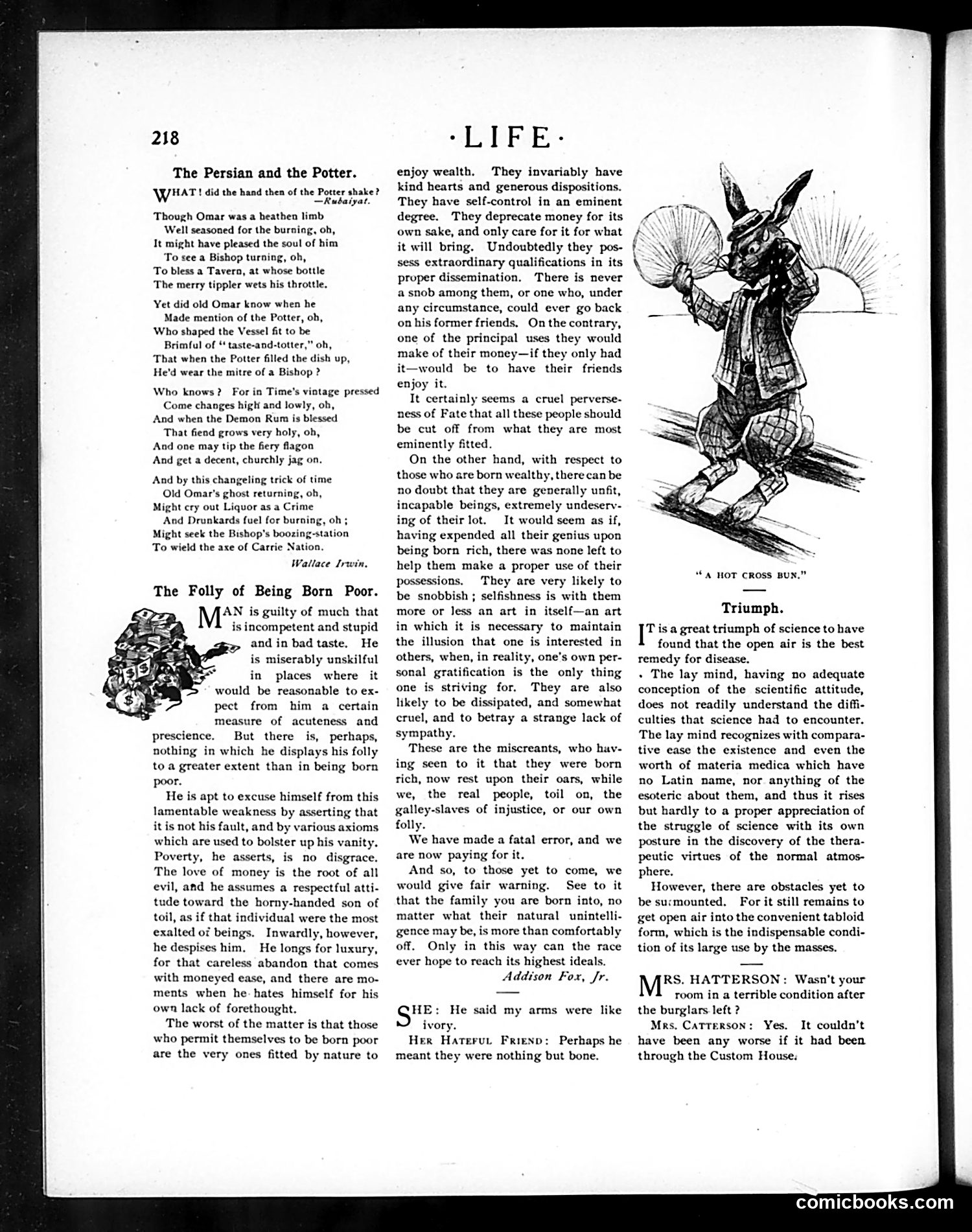
This page contains two satirical pieces attacking hypocrisy and social inequality in early 20th-century America. **"The Persian and the Potter"** (poem by Wallace Irwin) mocks religious hypocrisy regarding alcohol. It references Omar Khayyam's *Rubaiyat* (celebrating wine) and imagines if Omar's ghost returned to see bishops drinking—implying clergy who condemn alcohol while secretly indulging. The reference to "Carrie Nation" (the famous Prohibition activist) suggests ironic reversal: a stern reformer wielding an axe against drinking establishments. **"The Folly of Being Born Poor"** (essay with illustration) uses biting irony to critique class inequality. It sarcastically claims poor people are naturally virtuous, generous, and deserving of wealth, while the rich are inherently selfish and incompetent—yet circumstance prevents the worthy poor from accessing money. The essay exposes the hypocrisy of middle-class moralizing that blames poverty on personal failure while romanticizing "the horny-handed son of toil." Both pieces satirize American pretension and social injustice through ironic inversion of conventional wisdom.
📄 Transcribed text from this page (OCR, searchable)
Machine-transcribed from the original scan — historical spelling and the odd misread are preserved.
218 The Persian and the Potter. WHAT! did the hand then of the Potter shake? —Rubaiyat. Though Omar was a heathen limb Well seasoned for the burning, oh, It might have pleased the soul of him To see a Bishop turning, oh, To bless a Tavera, at whose bottle The merry tippler wets his throttle. Yet did old Omar know when he Made mention of the Potter, ob, Who shaped the Vessel fit to be Brimful of * taste-and-totter,” oh, ‘That when the Potter filled the dish up, He'd wear the mitre of a Bishop ? Who knows? For in Time's vintage pressed Come changes hig and lowly, ob, And when the Demon Rum is blessed That fiend grows very holy, ob, And one may tip the fiery flagon And get a decent, churehly jag on. And by this changeling trick of time Old Omar's ghost returning, ob, Might cry out Liquor as a Crime And Drunkards fuel for burning, oh ; Might seek the Bishop's boozing-station To wield the axe of Carrie Nation. Wallace Irwin, The Folly of Being Born Poor. Mes is guilty of much that is incompetent and stupid and in bad taste. He is miserably unskilful in places where it would be reasonable to ex- pect from him a certain measure of acuteness and prescience. But there is, perhaps, nothing in which he displays his folly to a greater extent than in being born poor. He is apt to excuse himself from this lamentable weakness by asserting that it is not his fault, and by various axioms which are used to bolster up his vanity. Poverty, he asserts, is no disgrace. The love of money is the root of all evil, and he assumes a respectful atti- tude toward the horny-handed son of toil, as if that individual were the most exalted of beings. Inwardly, however, he despises him, He longs for luxury, for that careless abandon that comes with moneyed ease, and there are mo- ments when he. hates himself for his own lack of forethought, The worst of the matter is that those who permit themselves to be born poor are the very ones fitted by nature to “LIFE: enjoy wealth. They invariably have kind hearts and generous dispositions. They have self-control in an eminent degree. They deprecate money for its own sake, and only care for it for what it will bring. Undoubtedly they pos- sess extraordinary qualifications in its proper dissemination. There is never a snob among them, or one who, under any circumstance, could ever go back on his former friends, On the contrary, one of the principal uses they would make of their money—if they only had it—would be to have their friends enjoy it. It certainly seems a cruel perverse- ness of Fate that all these people should be cut off from what they are most eminently fitted. On the other hand, with respect to those who are born wealthy, therecan be no doubt that they are generally unfit, incapable beings, extremely undeserv. ing of their lot. It would seem as if, having expended all their genius upon being born rich, there was none left to help them make a proper use of their possessions, They are very likely to be snobbish ; selfishness is with them more or Jess an art in itself—an art in which it is necessary to maintain the illusion that one is interested in others, when, in reality, one’s own per- sonal gratification is the only thing one is striving for, They are also likely to be dissipated, and somewhat cruel, and to betray a strange lack of sympathy, These are the miscreants, who hav- ing seen to it that they were born rich, now rest upon their oars, while we, the real people, toil on, the galley-slaves of injustice, or our own folly. We have made a fatal error, and we are now paying for it. And so, to those yet to come, we would give fair warning. See to it that the family you are born into, no matter what their natural unintelli- gence may be, is more than comfortably off. Only in this way can the race ever hope to reach its highest ideals. Addison Fox, Jr. HE: He said my arms were like ivory. Her Haterut Frienp: Perhaps he meant they were nothing but bone. “4 HOT CROSS BUN.” Triumph. I" is a great triumph of science to have found that the open air is the best remedy for disease. + The lay mind, having no adequate conception of the scientific attitude, does not readily understand the diffi- culties that science had to encounter. ‘The lay mind recognizes with compara- tive ease the existence and even the worth of materia medica which have no Latin name, nor anything of the esoteric about them, and thus it rises but hardly to a proper appreciation of the struggle of science with its own posture in the discovery of the thera- peutic virtues of the normal atmos- phere, However, there are obstacles yet to be sucmounted. For it still remains to get open air into the convenient tabloid form, which is the indispensable condi- tion of its large use by the masses. RS. HATTERSO Wasn't your room in a terrible condition after the burglars left ? Mrs. Catterson: Yes. It couldn't have been any worse if it had been through the Custom House: comicbooks.com