
Life, 1904-09-01 · page 26 of 38
Life — September 1, 1904 — page 26: what you’re looking at
What you’re looking at
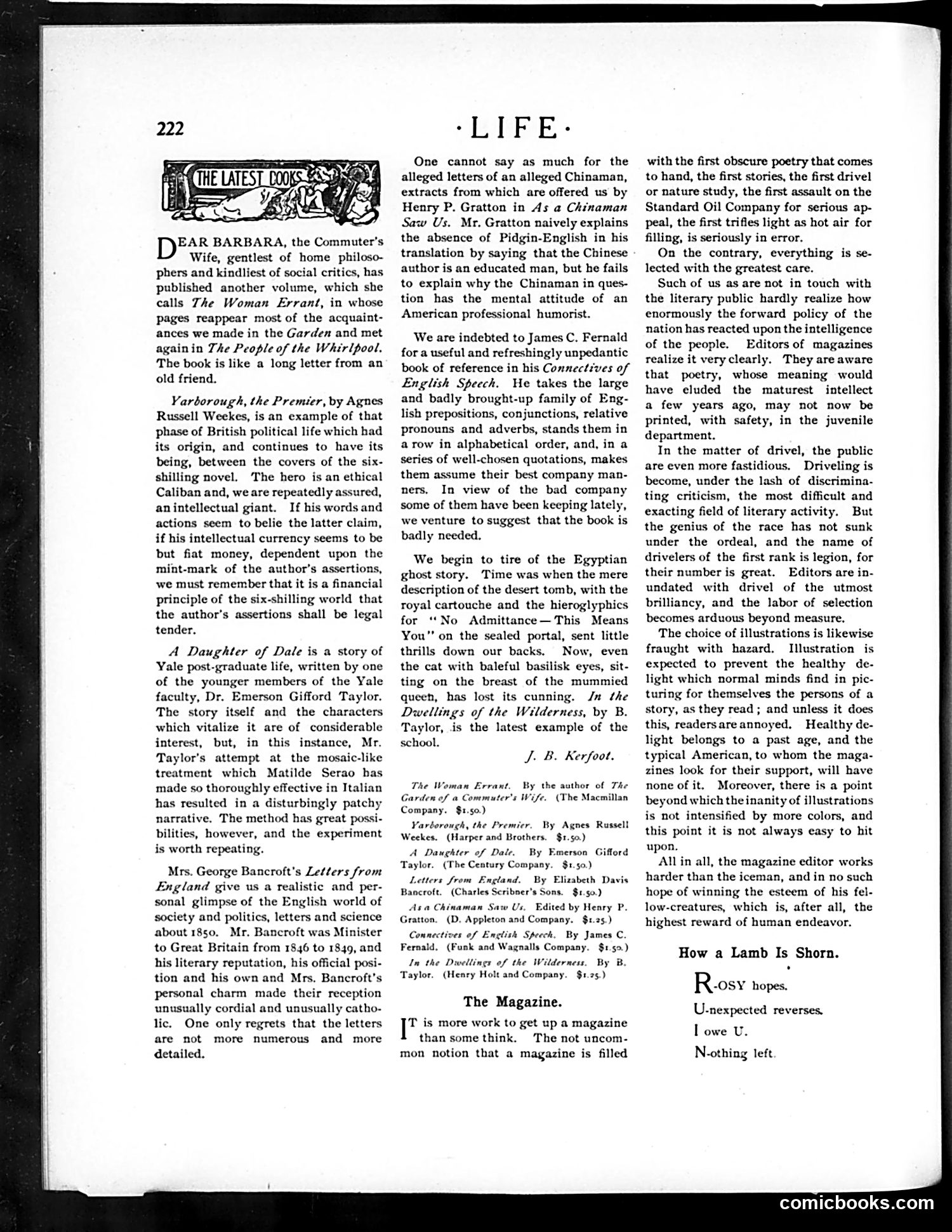
This is a book review section from *Life* magazine. There are no political cartoons here—it's literary criticism discussing newly published novels and reference works. The reviews reveal early 1900s literary tastes: critics praise character-driven narratives and personal correspondence (like Mrs. Bancroft's letters from 1850s England), while dismissing formulaic work. They mock "As a Chinaman Saw Us"—a book where a supposed Chinese author conveniently speaks like an American humorist rather than authentically, suggesting the author (Gratton) is using the "foreign perspective" as a thin disguise for familiar satirical humor. The repeated complaint about Egyptian ghost stories—that tomb descriptions and mummies have become clichéd—shows how quickly supernatural fiction became exhausted as a genre. The section titled "How a Lamb Is Shorn" appears to be a poem about lost hope, unexpected reversals, and emptiness, likely commenting on romantic or social disappointment common in the era's literature.
📄 Transcribed text from this page (OCR, searchable)
Machine-transcribed from the original scan — historical spelling and the odd misread are preserved.
EAR BARBARA, the Commuter’s Wife, gentlest of home philoso- phers and kindliest of social critics, has published another volume, which she calls The Woman Errant, in whose pages reappear most of the acquaint- ances we made in the Garden and met againin The People of the Whirlpool. The book is like a long letter from an old friend. Yarborough, the Premier, by Agnes Russell Weekes, is an example of that phase of British political life which had its origin, and continues to have its being, between the covers of the six- shilling novel. The hero is an ethical Caliban and, we are repeatedly assured, anintellectual giant. If his words and actions seem to belie the latter claim, if his intellectual currency seems to be but fiat money, dependent upon the mint-mark of the author’s assertions, we must remember that it is a financial principle of the six-shilling world that the author's assertions shall be legal tender. A Daughter of Dale is a story of Yale post-graduate life, written by one of the younger members of the Yale faculty, Dr. Emerson Gifford Taylor. The story itself and the characters which vitalize it are of considerable interest, but, in this instance, Mr. Taylor's attempt at the mosaic-like treatment which Matilde Serao has made so thoroughly effective in Italian has resulted in a disturbingly patchy narrative. The method has great possi- bilities, however, and the experiment is worth repeating. Mrs. George Bancroft's Letters from England give us a reali: and per- sonal glimpse of the English world of society and politics, letters and si about 1850. Mr. Bancroft was Minister to Great Britain from 1846 to 1849, and his literary reputation, his official posi- tion and his own and Mrs. Bancroft’s personal charm made their reception unusually cordial and unusually catho- lic. One only regrets that the letters are not more numerous and more detailed. mL) Oe One cannot say as much for the alleged letters of an alleged Chinaman, extracts from which are offered us by Henry P. Gratton in As a Chinaman Saw Us. Mr. Gratton naively explains the absence of Pidgin-English in his translation by saying that the Chinese author is an educated man, but he fails to explain why the Chinaman in ques- tion has the mental attitude of an American professional humorist. We are indebted to James C, Fernald for a useful and refreshingly unpedantic book of reference in his Connectives of English Speech. He takes the large and badly brought-up family of Eng- lish prepositions, conjunctions, relative pronouns and adverbs, stands them in arow in alphabetical order, and, in a series of well-chosen quotations, makes them assume their best company man- ners. In view of the bad company some of them have been keeping lately, we venture to suggest that the book is badly needed. We begin to tire of the Egyptian ghost story. ‘Time was when the mere description of the desert tomb, with the royal cartouche and the hieroglyphics for ‘*No Admittance—This Means You” on the sealed portal, sent little thrills down our backs. Now, even the cat with baleful basilisk eyes, sit- ting on the breast of the mummied queen, has lost its cunning. Jn the Dwellings of the Welderness, by B. Taylor, is the latest example of the school. J. B. Kerfoot. By the author of The (The Macmillan The Woman Errant. Garden of a Commuter's Wife. Company. $1.50.) Yarborough, the Premier Weekes. (Harper and Brothers. A Daughter of Dale. By Emerson Gifford Taylor. (The Century Company. $1.50.) Letters from England. By Elizabeth Davis Bancroft. (Charles Scribner's Sons. $1.50.) Asa Chinaman Saw Us, Edited by Henry P. Gratton, (D. Appleton and Company. $1.25.) Connectives of English Speech. By James C. Fernald, (Funk and Wagnalls Company. $1.52.) In the Dwellings of the Wilderness. By B. Taylor. (Henry Holt and Company. $1.25.) By Agnes Russel! $1.50.) The Magazine. T is more work to get up a magazine than some think. The not uncom- mon notion that a magazine is filled with the first obscure poetry that comes to hand, the first stories, the first drivel or nature study, the first assault on the Standard Oil Company for serious ap- peal, the first trifles light as hot air for filling, is seriously in error. On the contrary, everything is se- lected with the greatest care. Such of us as are not in touch with the literary public hardly realize how enormously the forward policy of the nation has reacted upon the intelligence of the people. Editors of magazines realize it very clearly, They are aware that poetry, whose meaning would have eluded the maturest intellect a few years ago, may not now be printed, with safety, in the juvenile department. In the matter of drivel, the public are even more fastidious. Driveling is become, under the lash of discrimina- ting criticism, the most difficult and exacting field of literary activity. But the genius of the race has not sunk under the ordeal, and the name of drivelers of the first rank is legion, for their number is great. Editors are in- undated with drivel of the utmost brilliancy, and the labor of selection becomes arduous beyond measure. The choice of illustrations is likewise fraught with hazard. Illustration is expected to prevent the healthy de- light which normal minds find in pic- turing for themselves the persons of a story, as they read; and unless it does this, readersare annoyed. Healthy de- light belongs to a past age, and the typical American, to whom the maga- zines look for their support, will have none of it. Moreover, there is a point beyond which the inanity of illustrations is not intensified by more colors, and this point it is not always easy to hit upon. Allin all, the magazine editor works harder than the iceman, and in no such hope of winning the esteem of his fel- low-creatures, which is, after all, the highest reward of human endeavor. How a Lamb Is Shorn. Rosy hopes. U-nexpected reverses. I owe U. N-othing left comicbooks.com