
Life, 1904-09-01 · page 4 of 38
Life — September 1, 1904 — page 4: what you’re looking at
What you’re looking at
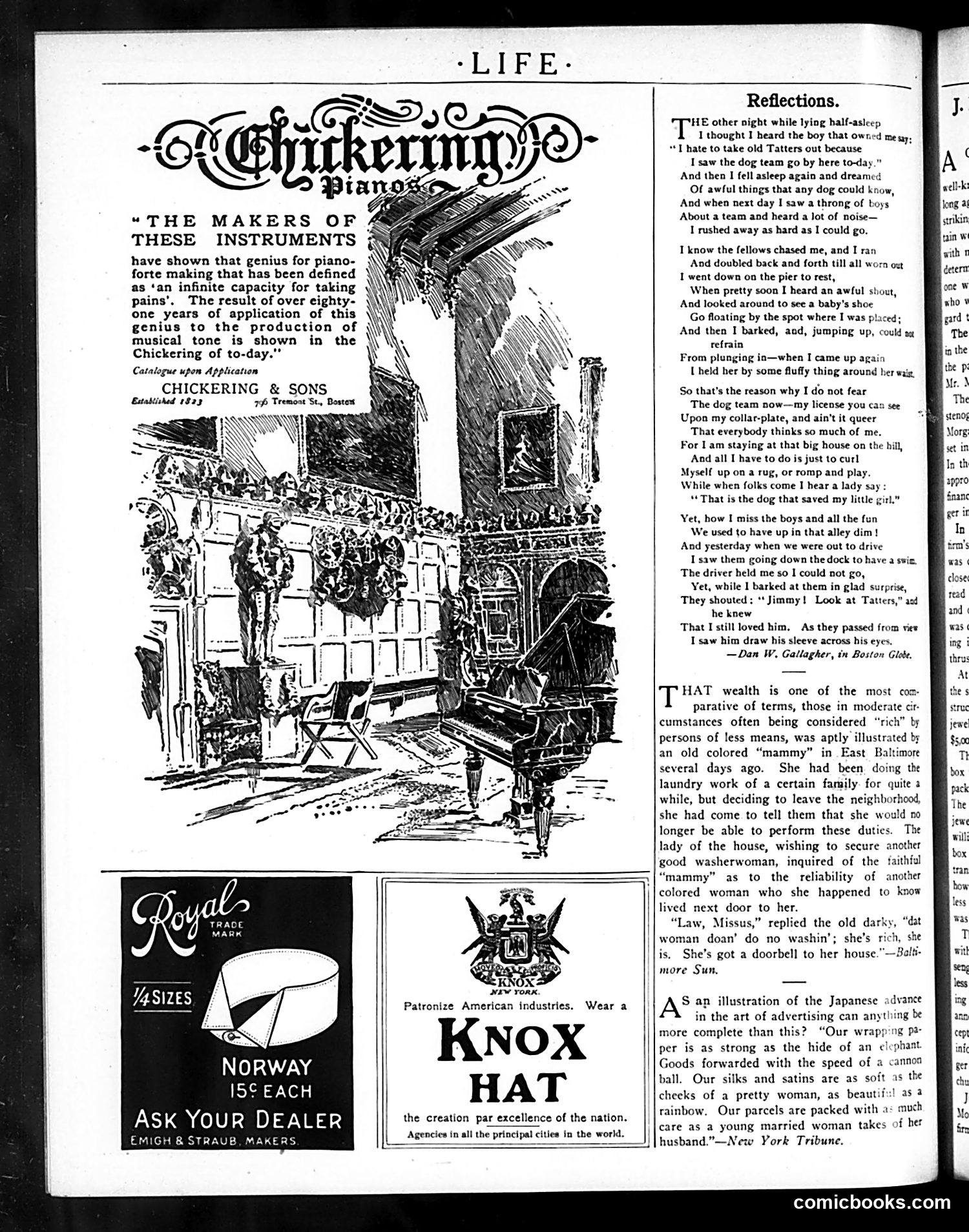
This page is primarily **advertising and fiction**, not political satire. The left side features a Chickering Pianos advertisement with an illustration of a crowded street scene—likely depicting urban life or commerce—meant to showcase the piano maker's prominence. The right side contains "Reflections," a short story or poem about a dog named Tatters that the narrator misses. It's sentimental in tone, describing childhood memories of the dog and boys in an alley. Below are ads for Royal Norway hats (15¢) and Knox Hats, promoting American-made goods. The page reflects early 20th-century Life magazine's mix of **light fiction, nostalgia, and consumer advertising**—common content for the era's middle-class readership. No significant political commentary is present.
📄 Transcribed text from this page (OCR, searchable)
Machine-transcribed from the original scan — historical spelling and the odd misread are preserved.
“THE MAKERS OF THESE INSTRUMENTS have shown that genius for piano- forte making that has been defined as ‘an infinite capacity for taking pains’. The result of over eighty- one years of application of this genius to the production of musical tone is shown in the \ Chickering of to-day.” Catalogue upon Application CHICKERING & SONS Established 1823 7 Tremont St, Bostox \\\ 1 YASI2ES ‘wD NORWAY I5¢ EACH ASK YOUR DEALER EMIGH & STRAUB, MAKERS NEW YORK. Patronize American industries. Wear a KNOX HAT the creation par excellence of the nation. Agencies in all the principal cities in the world. Reflections. HE other night while lying half-asleep I thought I heard the boy that owned messy; “T hate to take old Tatters out because I saw the dog team go by here to-day.” And then I fell asleep again and dreamed Of awful things that any dog could know, And when next day I saw a throng of boys About a team and heard a lot of noise— I rushed away as hard as I could go. I know the fellows chased me, and I ran And doubled back and forth till all worn ot I went down on the pier to rest, When pretty soon I heard an awful shout, And looked around to see a baby’s shoe Go floating by the spot where I was placed; And then I barked, aad, jumping up, could s refrain From plunging in—when I came up again U held her by some flufly thing around her wis, So that’s the reason why I do not fear The dog team now—my license you cas see Upon my collar-plate, and ain’t it queer ‘That everybody thinks so much of me. For I am staying at that big house on the bill, And all I have to do is just to curl Myself up on a rug, or romp and play. While when folks come I hear a lady say : “That is the dog that saved my little girl.” Yet, how I miss the boys and all the fun We used to have up in that alley dim! And yesterday when we were out to drive I saw them going down the dock to have a swiz, The driver held me so 1 could not go, Yet, while I barked at them in glad surprise, They shouted: “Jimmy! Look at Tatters,” acd he knew ‘That I still loved him, As they passed from view I saw him draw his sleeve across his eyes. —Dan W, Gallagher, in Boston Globe, HAT wealth is one of the most parative of terms, those in moderate cir- cumstances often being considered “rich” by persons of less means, was aptly illustrated by an old colored “mammy” in East Baltimore several days ago. She had been. doing the laundry work of a certain family for quite a while, but deciding to leave the neighborhood, she had come to tell them that she would no longer be able to perform these duties. The lady of the house, wishing to secure another good washerwoman, inquired of the faithful “mammy” as to the reliability of another colored woman who she happened to know lived next door to her. “Law, Missus,” replied the old darky, “dat ||woman doan’ do no washin’; she’s rich, she is. She’s got a doorbell to her house.”"—Balti- more Sun, S an illustration of the Japanese advance in the art of advertising can anything be more complete than this? “Our wrapp ng P? per is as strong as the hide of an elephant Goods forwarded with the speed of a cannoa \|ball. Our silks and satins are as soft as the cheeks of a pretty woman, as beautifu! as 4 rainbow. Our parcels are packed with as much care as a young married woman takes of her husband."—New York Tribune. steno, Morg: set in In th appro comicbooks.com