A complete issue · 54 pages · 1938
Judge — May 1938
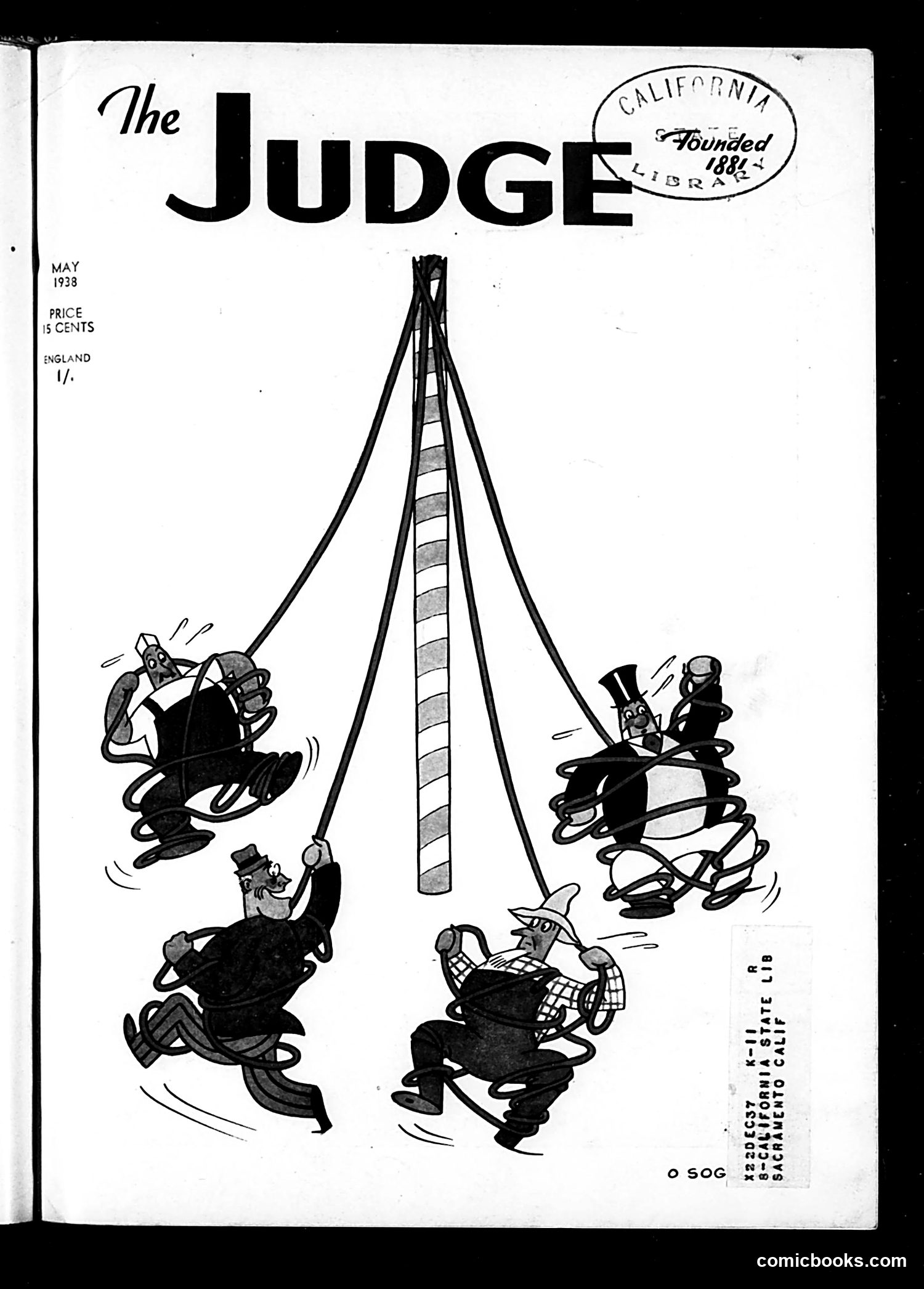
# The Judge Magazine Cover - May 1938 This political cartoon depicts four caricatured figures being swung around a central pole like a children's maypole game. The figures appear to represent political or world leaders of 1938, likely including references to European fascist dictators active during that period. The swinging motion suggests chaos, dizziness, or loss of control in international affairs. The specific identities of the figures are unclear from the image alone, but the overall message appears to satirize the tumultuous state of world politics in 1938—a year of significant international tension preceding World War II. The maypole device transforms a children's innocent game into commentary on dangerous political instability among world powers.
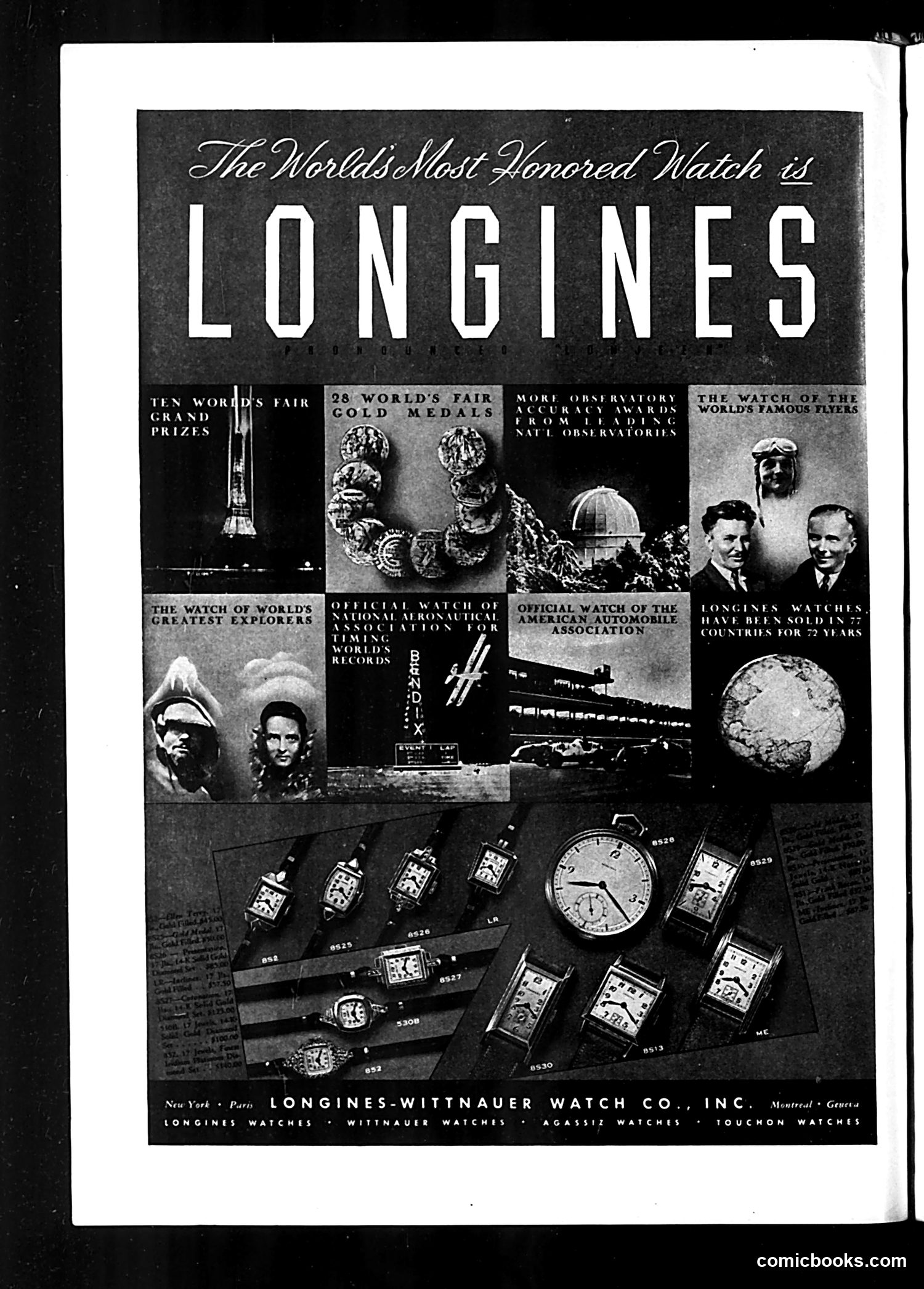
# Analysis This is **not a cartoon or satire page** — it's a **full-page advertisement** for Longines watches, circa early 20th century. The ad promotes Longines as "The World's Most Honored Watch" by showcasing prestigious endorsements and achievements: Ten World's Fair Grand Prizes, 28 World's Fair Gold Medals, Observatory accuracy awards from leading institutions, and use by famous explorers and aviators. Images include explorers, an astronomer with observatory equipment, and an automobile association official, establishing Longines as the trusted timepiece for serious scientific and adventurous pursuits. The bottom displays various Longines watch models available for purchase. This reflects the era's marketing strategy: associating luxury goods with prestige, achievement, and technological progress rather than satirizing contemporary politics or society.
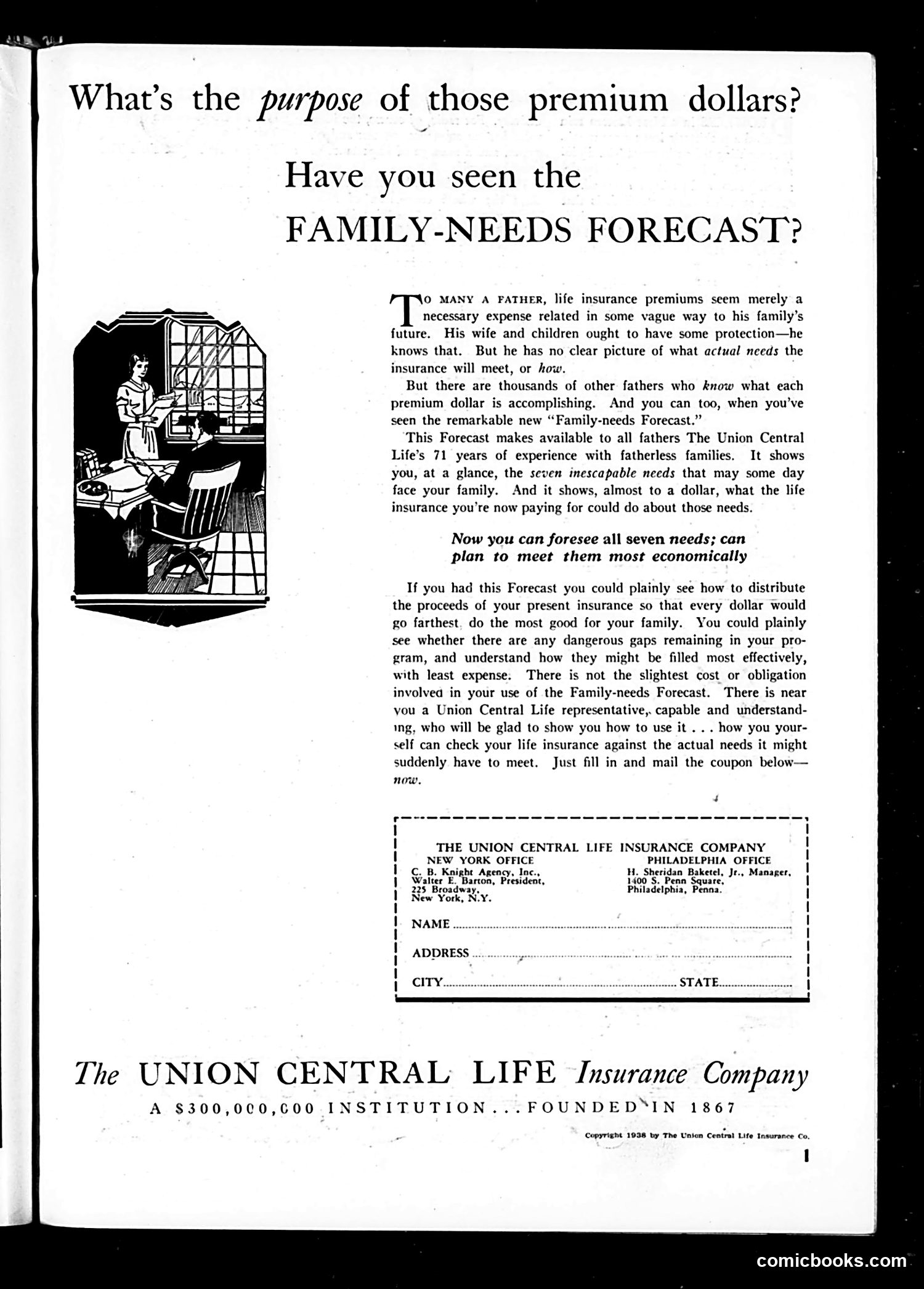
# Analysis This page is primarily **advertising, not satire or political commentary**. It's a 1938 advertisement for Union Central Life Insurance Company's "Family-Needs Forecast" product. The single illustration shows a **domestic scene**: a woman at a desk or table with a child nearby, suggesting a housewife managing family finances. This imagery appeals to fathers by implying their wives can plan prudently if given proper insurance tools. The ad's pitch is straightforward: the Forecast helps fathers understand their family's future financial needs and ensures insurance dollars are spent efficiently. There is no political satire, caricature, or social commentary—just marketing rhetoric common to Depression-era insurance advertising, emphasizing security and family protection. The page exemplifies how Judge magazine contained commercial content alongside its satirical material.
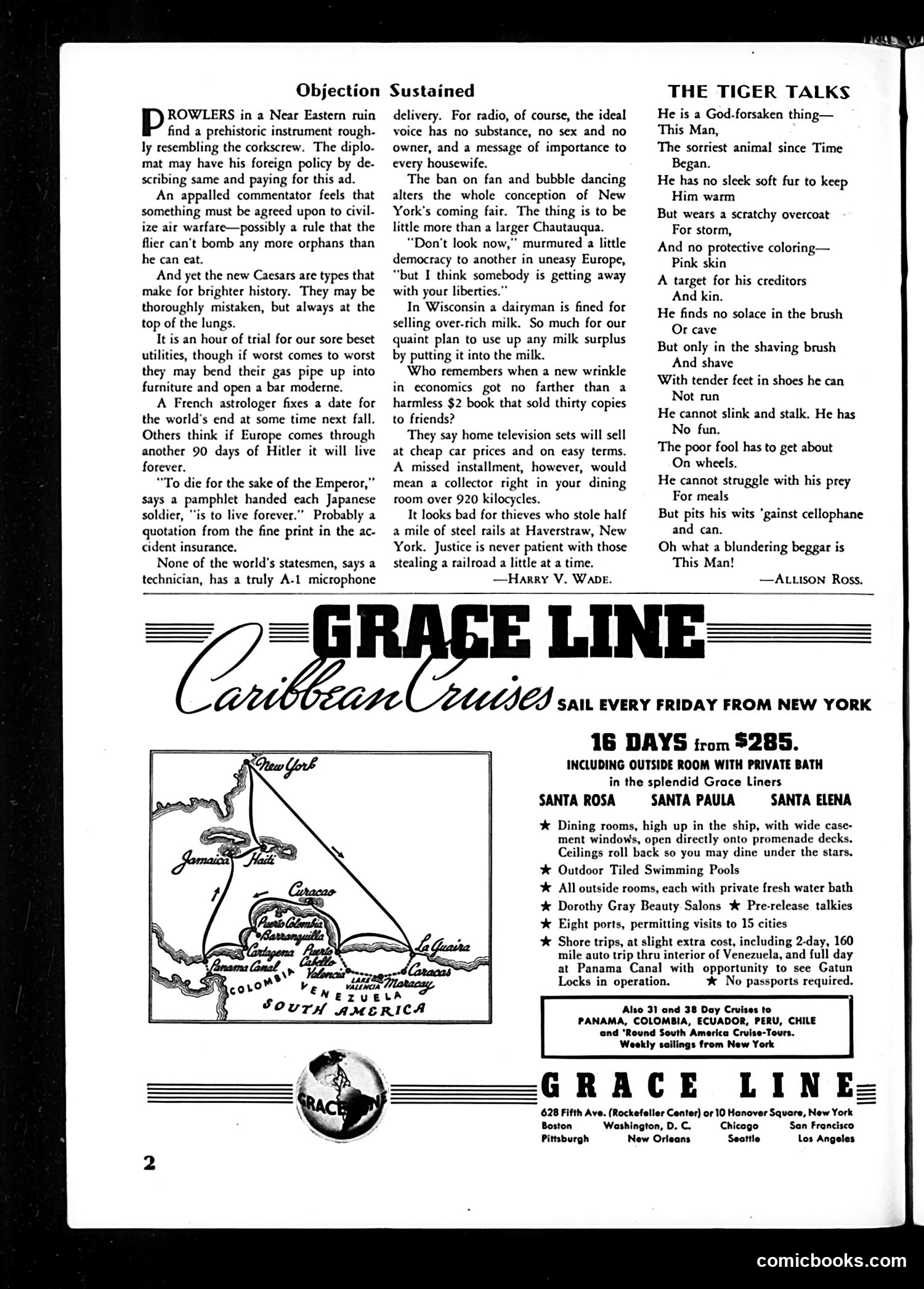
# Page Analysis This page is primarily **advertising** for Grace Line Caribbean cruises, featuring a map of cruise routes through the Caribbean and Central America. The upper portion contains editorial commentary rather than political cartoons. The "Objection Sustained" column discusses various contemporary topics: diplomatic policy, Wisconsin dairy regulations, economics, and social observations. "The Tiger Talks" (a poem by Allison Ross) appears to be satirical commentary on an unnamed subject's miserable circumstances. **No clear political cartoons or caricatures are present.** The content is mainly commentary on mundane 1930s-era issues (radio broadcasts, wrinkles in economics, home television sales, railroad theft) rather than major political events or figures. The page functions primarily as a magazine filler mixing light editorial commentary with the cruise line advertisement.
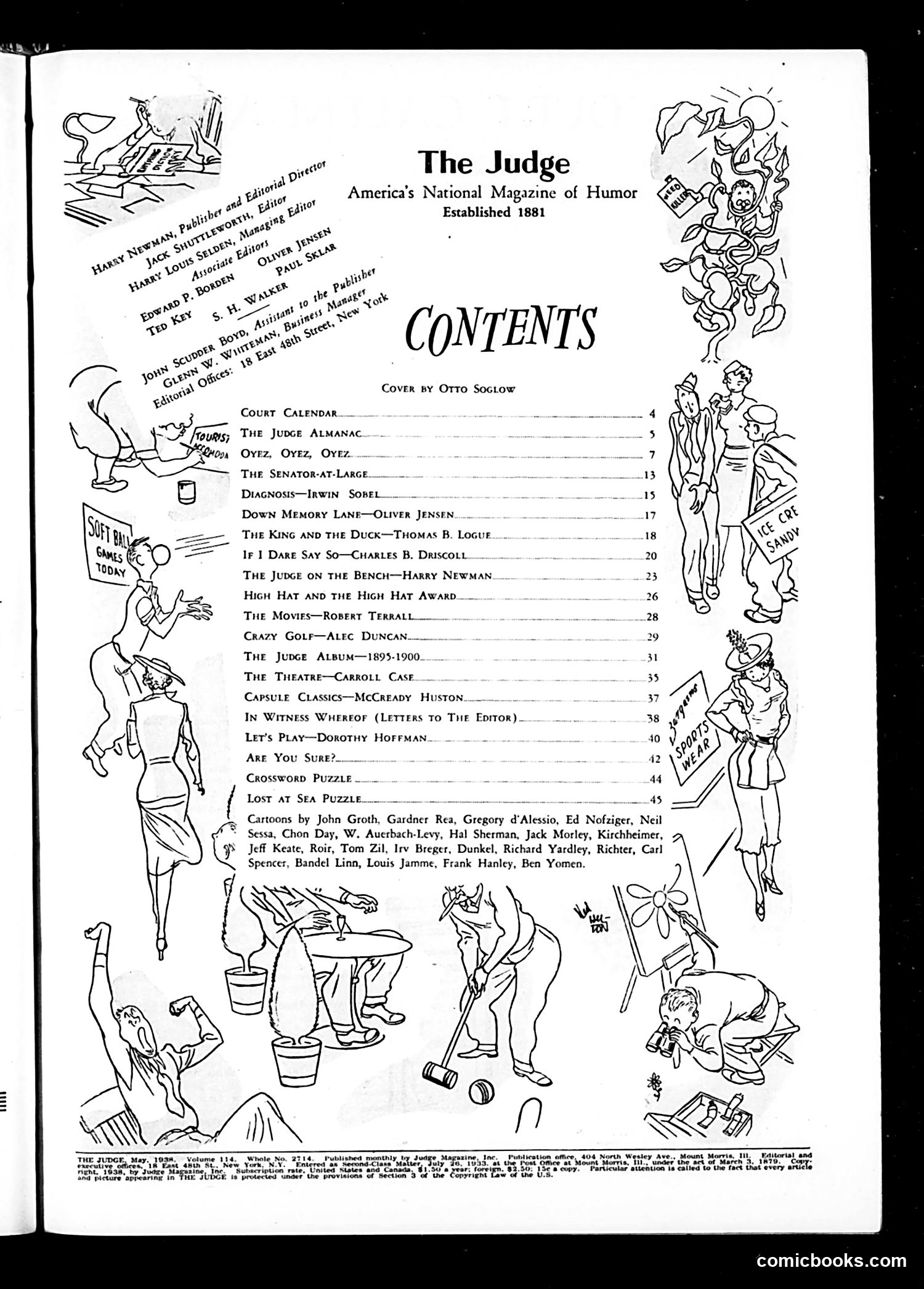
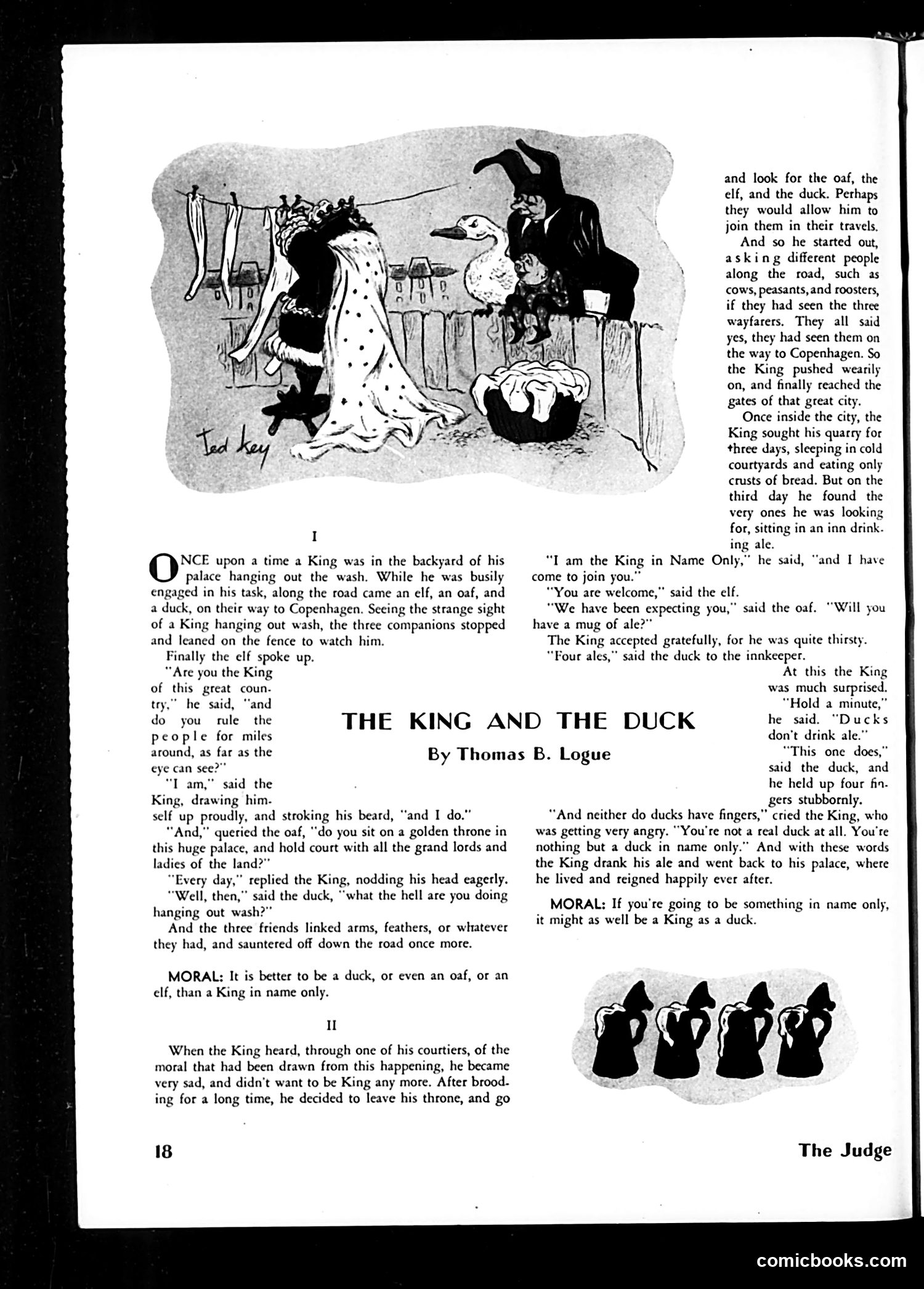
# Contents Page Analysis This is a contents/index page for *The Judge* magazine (May 1898), America's premier humor publication. Rather than political cartoons, it lists article titles and contributors for that issue. Notable content includes "The Judge on the Bench" by Harry Newman and "The King and the Duck" by Thomas B. Logue—likely satirical pieces on contemporary figures or events. The cartoonists credited (Groth, Sherman, Morley, and others) were prominent illustrators of the era. The decorative border illustrations depict various comedic scenes: socialites, children, sports activities, and leisure pursuits—typical *Judge* humor focusing on upper-class American life and social absurdities rather than explicit political commentary. The magazine's subtitle emphasizes "Humor" as its primary mission.
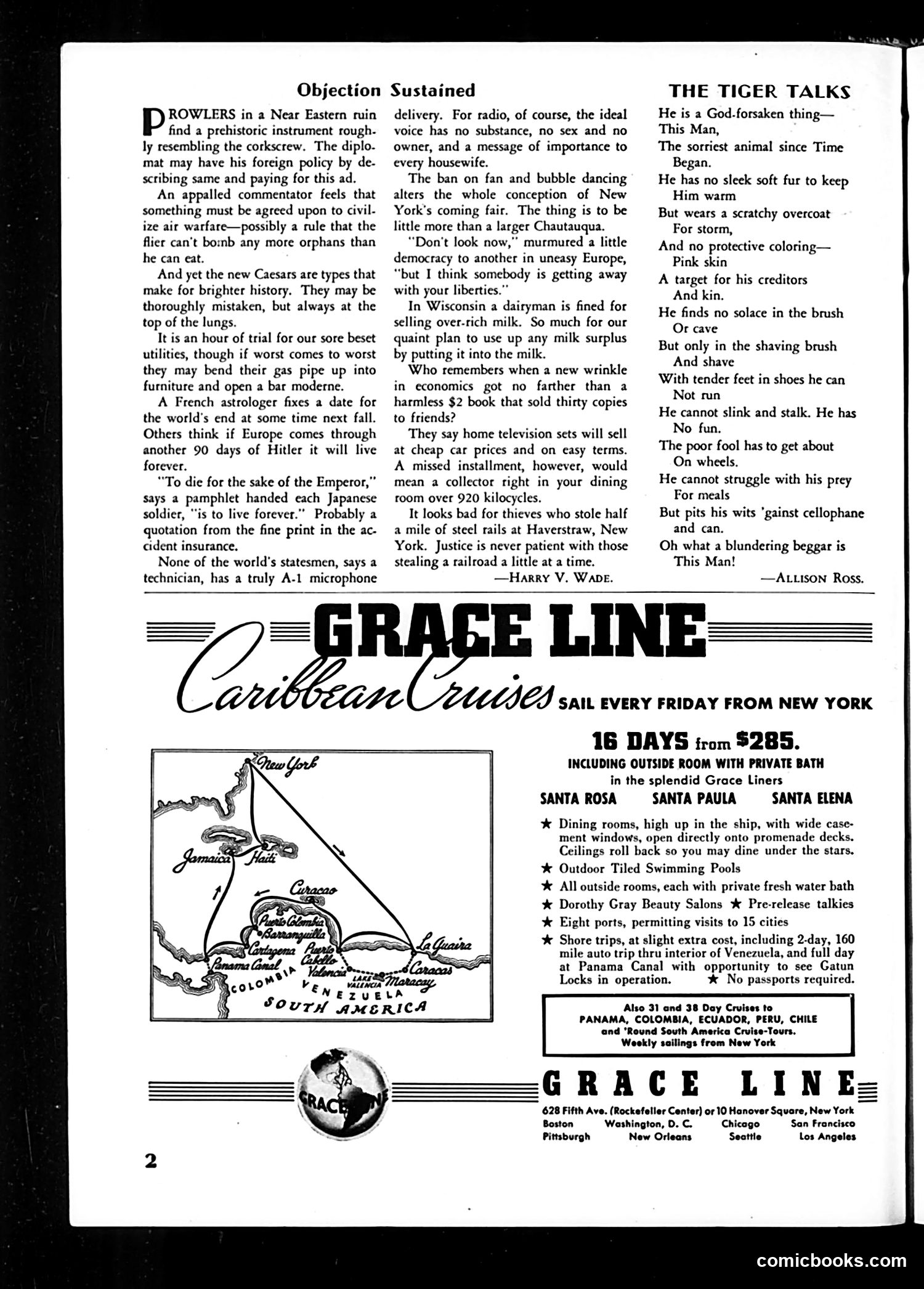
# Page Analysis This page is primarily **advertising** for Grace Line Caribbean cruises, occupying roughly two-thirds of the space with a detailed cruise itinerary and route map. The upper portion contains opinion columns and poetry. "Objection Sustained" by Harry V. Wade critiques various contemporary issues—government policy disputes, economic absurdities (like a $2 economics book selling only 30 copies), and social commentary. "The Tiger Talks" is a poem by Allison Ross depicting a poor, struggling man reduced to bare existence. The satirical content is **light and general** rather than targeting specific political figures. The humor addresses everyday 1930s concerns: economic hardship, government inefficiency, and consumer goods availability. No particular caricatured individuals are identified in the visible portions.
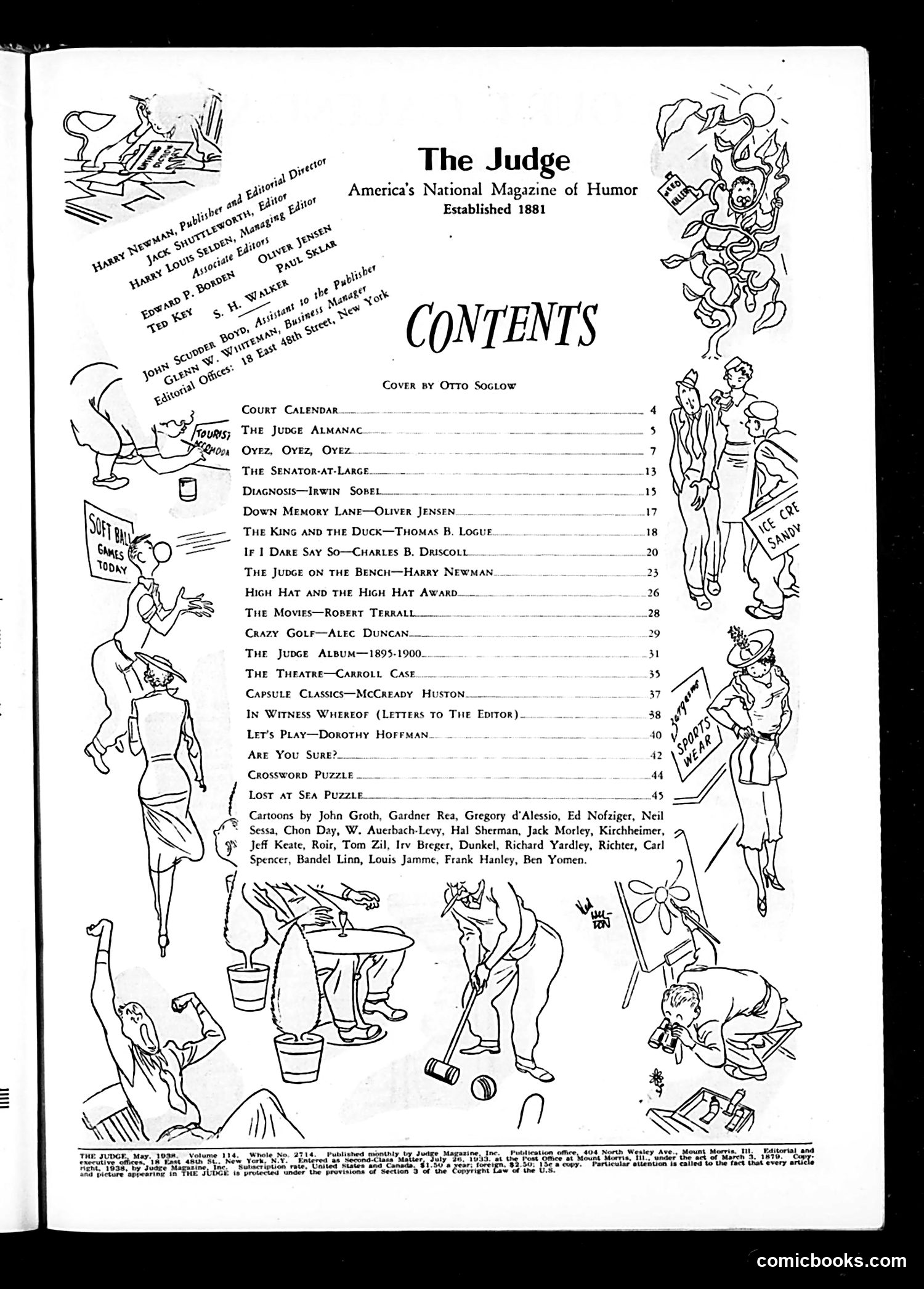
# Contents Page Analysis This is a contents page from *The Judge* magazine (established 1881), America's satirical humor publication. The page lists article titles and page numbers rather than displaying completed cartoons with identifiable political figures or clear satirical commentary. The visible cartoons are generic humorous illustrations—figures in various comedic situations (spring cleaning, golfing, beach scenes)—rather than pointed political satire. Without seeing the actual articles (like "Oyez, Oyez, Oyez" or "The King and the Duck"), we cannot identify specific satirical targets. The cartoonists listed (John Groth, Gardner Rea, Gregory d'Alessio, etc.) were *Judge*'s regular contributors. This page serves primarily as an index to the issue's contents rather than as satire itself.
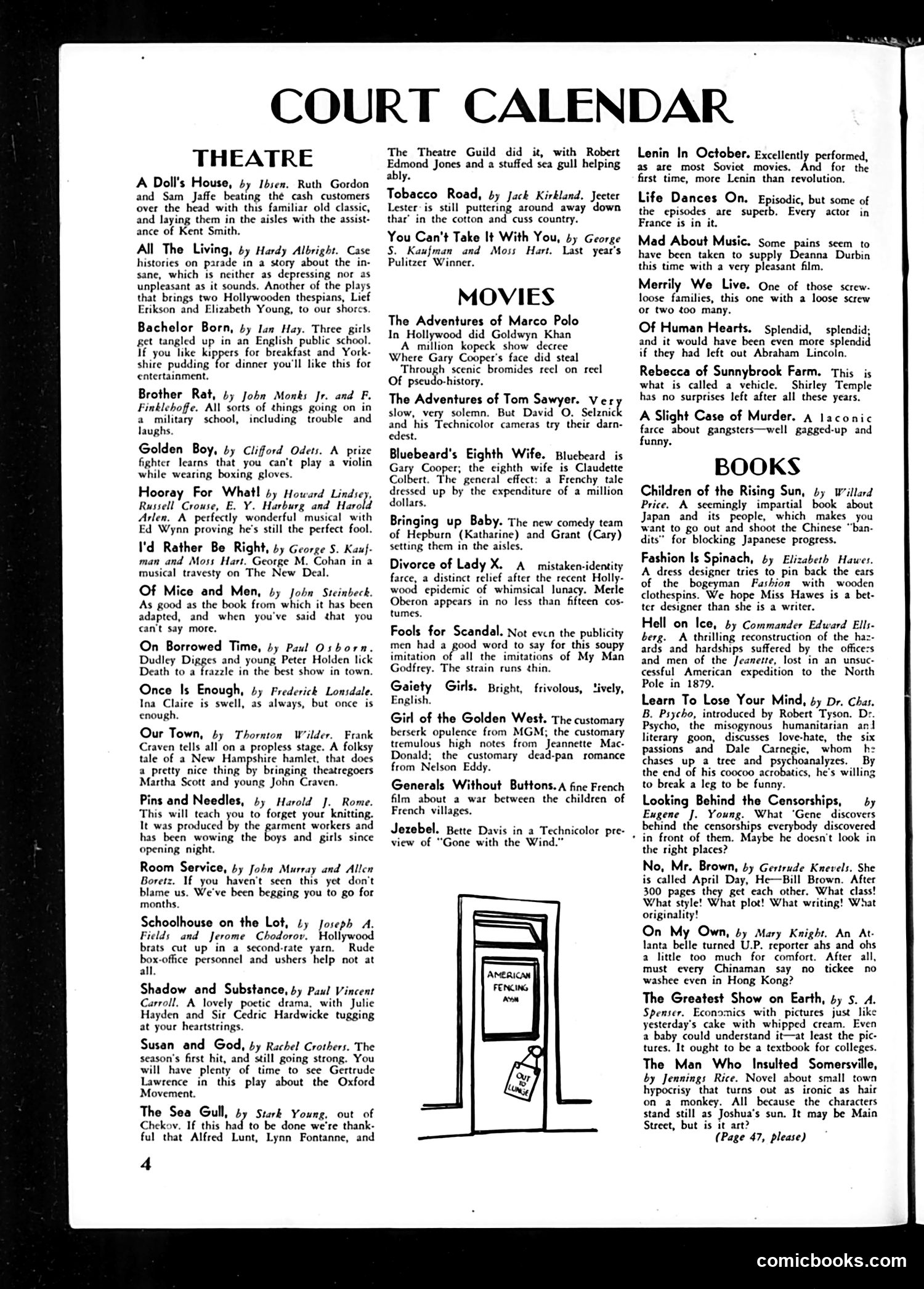
# Court Calendar Page Analysis This page from *Judge* magazine is primarily a **review section** rather than political satire. It contains capsule critiques of contemporary theatrical productions and films, plus book reviews. The single small cartoon visible shows a book or magazine titled "AMERICAN FOREIGN POLICY" being placed in what appears to be a mailbox or slot—likely a visual joke about the publication/distribution of political commentary itself. The reviews themselves constitute the satire: sharp, witty dismissals of plays and films. For instance, the critique of "You Can't Take It With You" notes it won "Pulitzer's Winner"—a sarcastic comment on its commercial success despite (implied) artistic mediocrity. Similar sardonic observations pepper reviews throughout. This represents *Judge*'s characteristic approach: sophisticated cultural criticism disguised as entertainment listings.
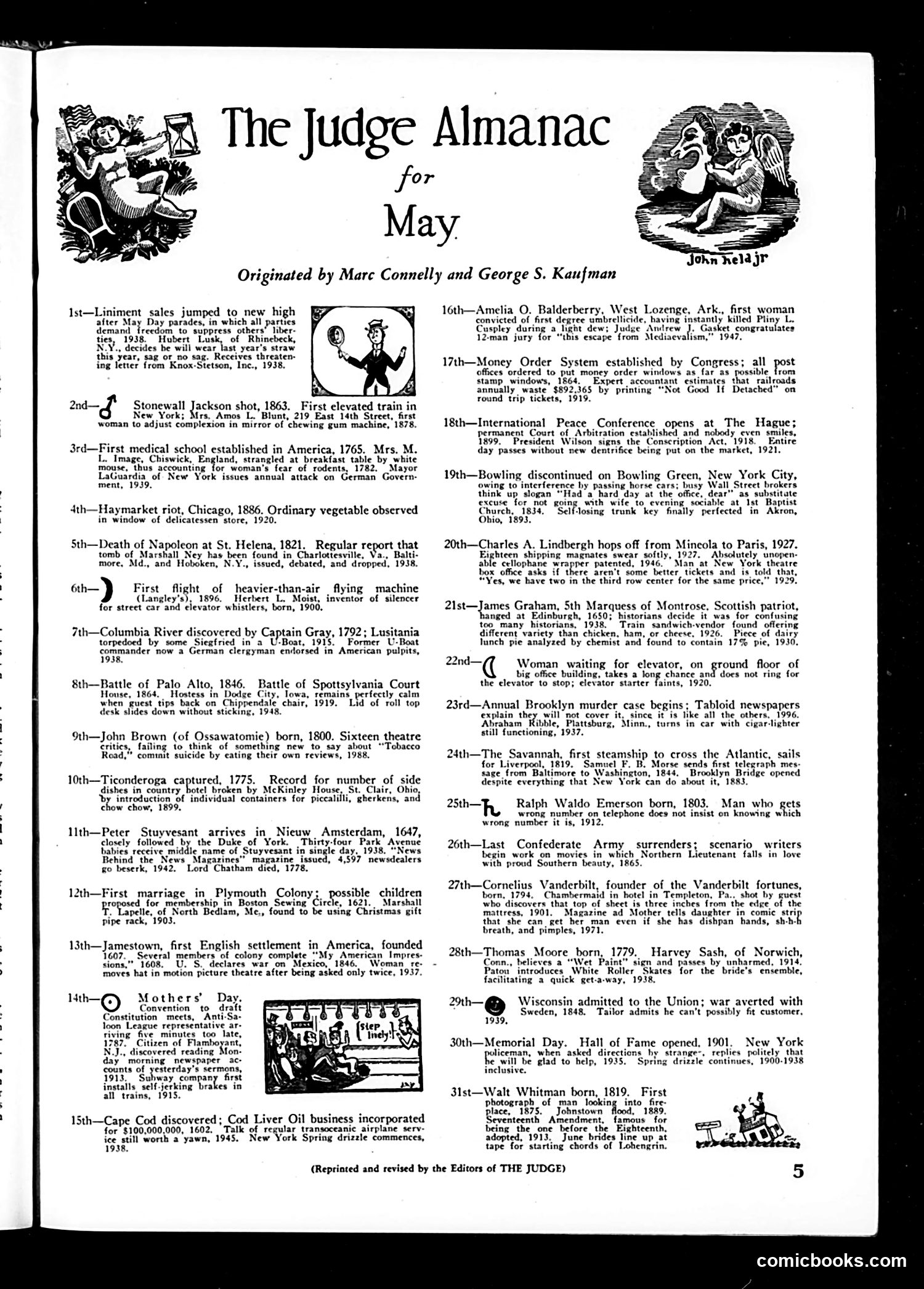
# The Judge Almanac for May This is a reference page listing historical events and trivia, not a satirical cartoon. The page contains 31 numbered entries for each day of May, created by Marc Connelly and George S. Kaufman. The entries mix genuine historical facts (Napoleon's death, 1821; Columbia River discovery, 1792) with humorous fictional or absurdist items (a woman complaining about mirror-adjusting on a train; a self-closing trunk that finally perfected itself in Akron, Ohio). The small illustrations scattered throughout are decorative vignettes typical of *Judge* magazine's style. This appears to be the almanac section—a common feature in satirical magazines—designed to entertain readers with a blend of factual and whimsical "historical" observations for the month ahead.

# Analysis This page is **advertising, not satire or editorial cartoon**. It's a Bell Telephone System advertisement positioned as an editorial endorsement in *Judge* magazine. The image shows a dramatic close-up of a person wearing a telephone headset, photographed in stark black-and-white to emphasize the technology and its importance. The ad makes a straightforward nationalist claim: American telephone service is superior in value and quality compared to the rest of the world. This reflects early-to-mid 20th century corporate advertising that used *Judge*'s editorial pages to promote products. The message is propaganda-like—asserting American technological and service superiority—rather than satirical commentary on society. No specific figures or jokes are present; this is pure product promotion.
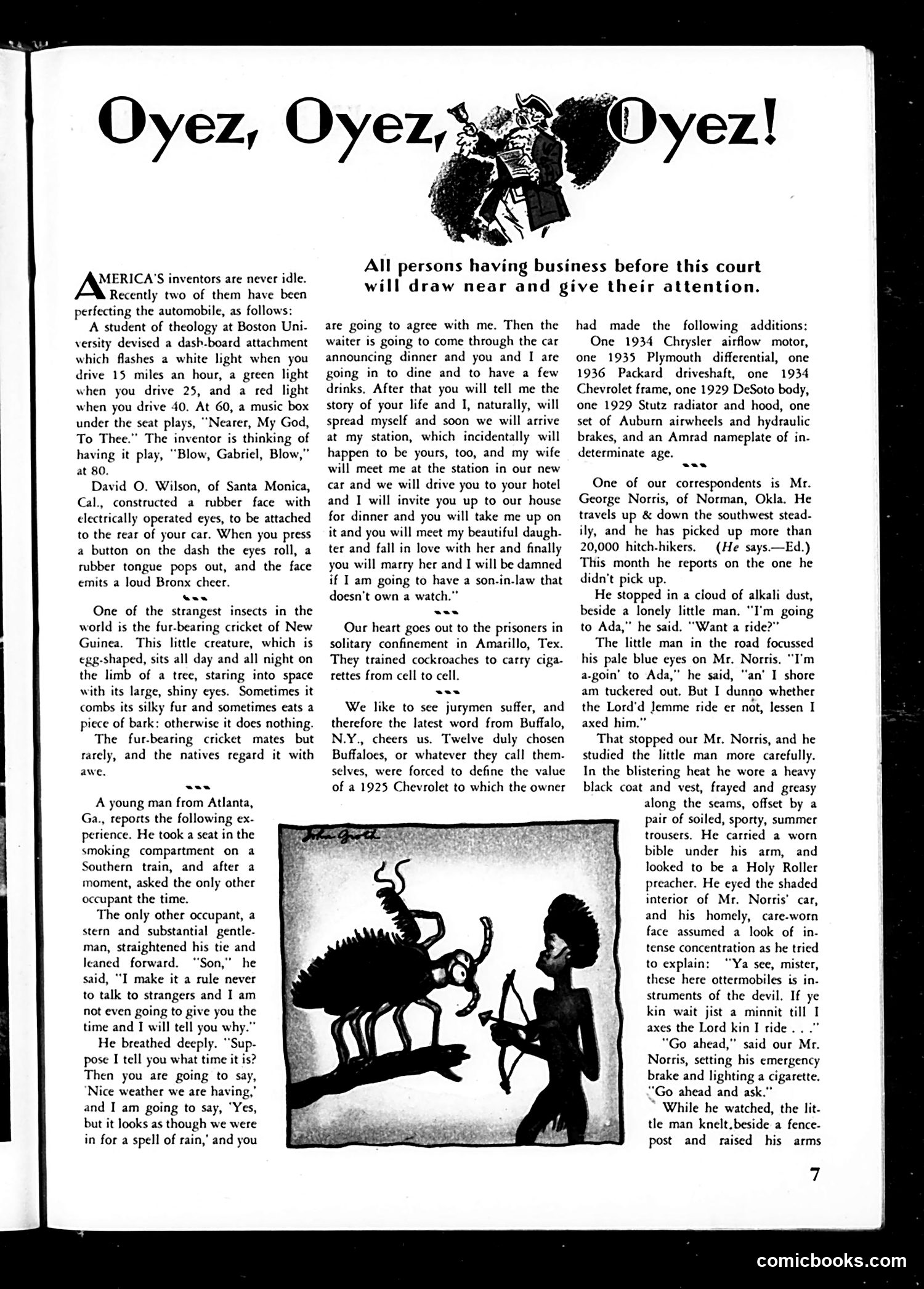
# Judge Magazine Satire Analysis This page from Judge magazine (a satirical publication) contains humorous short anecdotes mocking American invention, social pretension, and human nature. The main cartoon depicts a man encountering what appears to be a demonic or grotesque creature—likely illustrating one of the absurd inventor stories: David O. Wilson's rubber face device designed to attach to car rear bumpers, which makes rude gestures and sounds at other drivers. The surrounding text satirizes contemporary American excess and paranoia. Stories include: an overly cautious theology student inventing dashboard warning lights (mocking over-engineering), a train passenger's paranoid monologue about how casual conversation inevitably leads to marriage (satirizing social anxiety), and a jury tasked with valuating a Frankenstein car assembled from mismatched 1920s-30s automobile parts. The humor targets American mechanical obsession, automotive culture, social awkwardness, and the period's peculiar anxieties about casual human interaction.
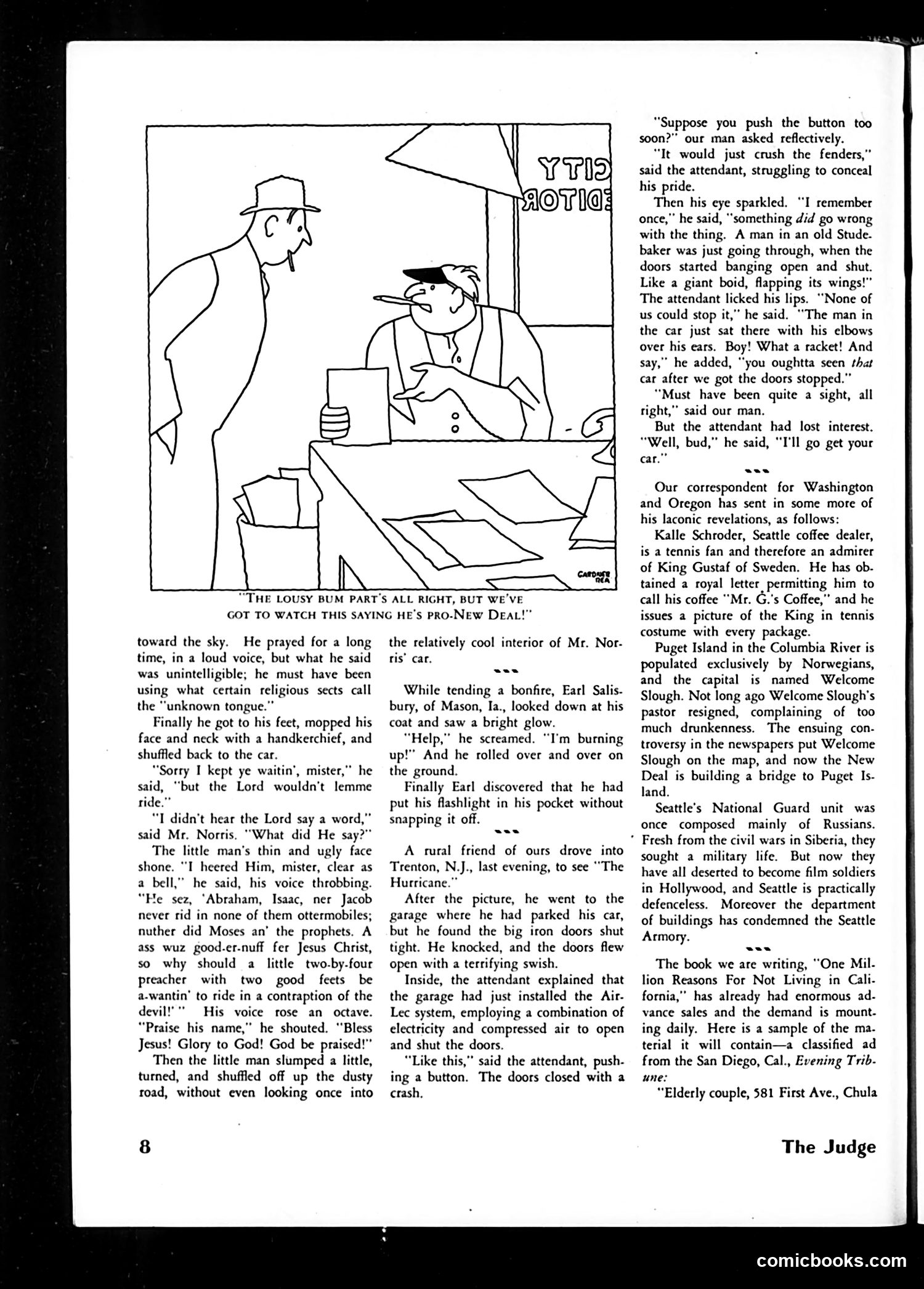
# Judge Magazine Page Analysis This page contains a cartoon and several humorous anecdotes typical of Judge's satirical content. **The Cartoon**: Shows two men in what appears to be a garage or office setting. One man warns the other: "The lousy bum part's all right, but we've got to watch this saying he's pro-New Deal!" The joke references Hollywood's political content—likely about casting or script approval. The concern is that while an actor's "lousy" performance might be acceptable, his public statements supporting Franklin D. Roosevelt's New Deal program could create controversy or boycott risk. **The Anecdotes** below include: - A religious fundamentalist refusing automobile rides as unbiblical - A man mistaking his flashlight's glow for fire - A garage attendant describing an automated door malfunction These stories mock rural/working-class attitudes toward modern technology and religious rigidity—common Judge targets during the 1930s-40s era when this appears published.