
Judge, 1938-05 · page 17 of 54
Judge — May 1938 — page 17: what you’re looking at
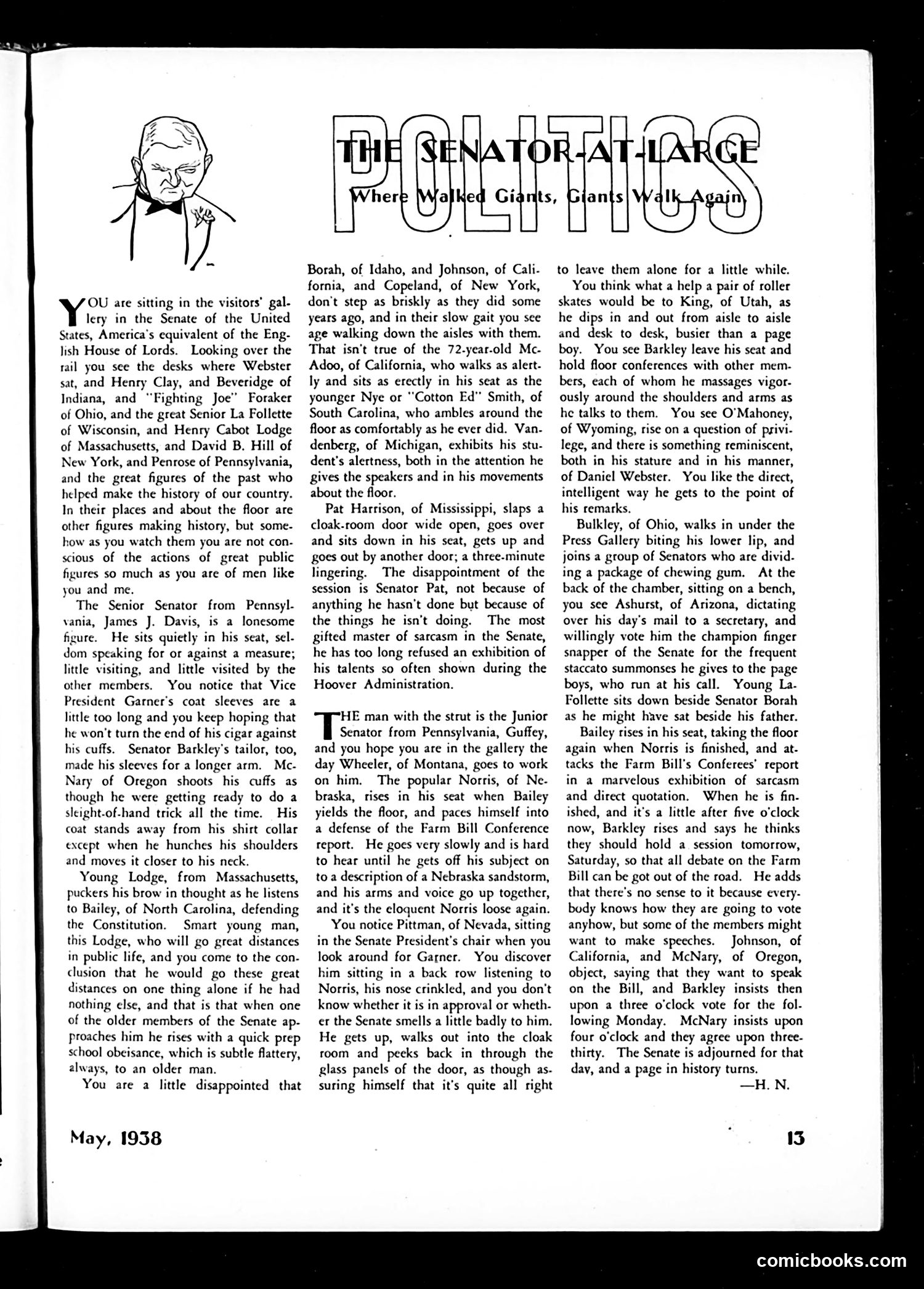
A restored page from Judge, 1938-05. Page through the whole issue in the reader above.
📄 Transcribed text from this page (OCR, searchable)
Machine-transcribed from the original scan — historical spelling and the odd misread are preserved.
OU are sitting in the visitors’ gal- lery in the Senate of the United States, America’s equivalent of the Eng- lish House of Lords. Looking over the rail you see the desks where Webster sat, and Henry Clay, and Beveridge of Indiana, and “Fighting Joe” Foraker of Ohio, and the great Senior La Follette of Wisconsin, and Henry Cabot Lodge of Massachusetts, and David B. Hill of New York, and Penrose of Pennsylvania, and the great figures of the past who helped make the history of our country. In their places and about the floor are other figures making history, but some- how as you watch them you are not con- scious of the actions of great public figures so much as you are of men like you and me. The Senior Senator from Pennsyl- vania, James J. Davis, is a lonesome figure. He sits quietly in his seat, sel- dom speaking for or against a measure; little visiting, and little visited by the other members. You notice that Vice President Garner's coat sleeves are a little too long and you keep hoping that he won't turn the end of his cigar against his cuffs. Senator Barkley’s tailor, too, made his sleeves for a longer arm. Mc- Nary of Oregon shoots his cuffs as though he were getting ready to do a sleight-of-hand trick all the time. His coat stands away from his shirt collar except when he hunches his shoulders and moves it closer to his neck. Young Lodge, from Massachusetts, puckers his brow in thought as he listens to Bailey, of North Carolina, defending the Constitution. Smart young man, this Lodge, who will go great distances in public life, and you come to the con- clusion that he would go these great distances on one thing alone if he had nothing else, and that is that when one of the older members of the Senate ap- proaches him he rises with a quick prep school obeisance, which is subtle flattery, always, to an older man. You are a little disappointed that May, 1938 Borah, of Idaho, and Johnson, of Cali- fornia, and Copeland, of New York, don’t step as briskly as they did some years ago, and in their slow gait you see age walking down the aisles with them. That isn’t true of the 72-year-old Mc- Adoo, of California, who walks as alert. ly and sits as erectly in his seat as the younger Nye or “Cotton Ed” Smith, of South Carolina, who ambles around the floor as comfortably as he ever did. Van- denberg, of Michigan, exhibits his stu- dent's alertness, both in the attention he gives the speakers and in his movements about the floor. Pat Harrison, of Mississippi, slaps a cloak-room door wide open, goes over and sits down in his seat, gets up and goes out by another door; a three-minute lingering. The disappointment of the session is Senator Pat, not because of anything he hasn't done but because of the things he isn’t doing. The most gifted master of sarcasm in the Senate, he has too long refused an exhibition of his talents so often shown during the Hoover Administration. 'HE man with the strut is the Junior Senator from Pennsylvania, Guffey, and you hope you are in the gallery the day Wheeler, of Montana, goes to work on him. The popular Norris, of Ne- braska, rises in his seat when Bailey yields the floor, and paces himself into a defense of the Farm Bill Conference report. He goes very slowly and is hard to hear until he gets off his subject on toa description of a Nebraska sandstorm, and his arms and voice go up together, and it’s the eloquent Norris loose again. You notice Pittman, of Nevada, sitting in the Senate President's chair when you look around for Garner. You discover him sitting in a back row listening to Norris, his nose crinkled, and you don't know whether it is in approval or wheth. er the Senate smells a little badly to him. He gets up, walks out into the cloak room and peeks back in through the glass panels of the door, as though as- suring himself that it's quite all right to leave them alone for a little while. You think what a help a pair of roller skates would be to King, of Utah, as he dips in and out from aisle to aisle and desk to desk, busier than a page boy. You see Barkley leave his seat and hold floor conferences with other mem. bers, each of whom he massages vigor- ously around the shoulders and arms as he talks to them. You see O'Mahoney, of Wyoming, rise on a question of privi- lege, and there is something reminiscent, both in his stature and in his manner, of Daniel Webster. You like the direct, intelligent way he gets to the point of his remarks. Bulkley, of Ohio, walks in under the Press Gallery biting his lower lip, and joins a group of Senators who are divid- ing a package of chewing gum. At the back of the chamber, sitting on a bench, you see Ashurst, of Arizona, dictating over his day's mail to a secretary, and willingly vote him the champion finger snapper of the Senate for the frequent staccato summonses he gives to the page boys, who run at his call. Young La- Follette sits down beside Senator Borah as he might have sat beside his father. Bailey rises in his seat, taking the floor again when Norris is finished, and at- tacks the Farm Bill's Conferees’ report in a marvelous exhibition of sarcasm and direct quotation. When he is fin- ished, and it's a little after five o'clock now, Barkley rises and says he thinks they should hold a session tomorrow, Saturday, so that all debate on the Farm Bill can be got out of the road. He adds that there's no sense to it because every- body knows how they are going to vote anyhow, but some of the members might want to make speeches. Johnson, of California, and McNary, of Oregon, object, saying that they want to speak on the Bill, and Barkley insists then upon a three o'clock vote for the fol- lowing Monday. McNary insists upon four o'clock and they agree upon three- thirty. The Senate is adjourned for that day, and a page in history turns. —H.N. 13 comicbooks.com