
Judge, 1938-05 · page 8 of 54
Judge — May 1938 — page 8: what you’re looking at
What you’re looking at
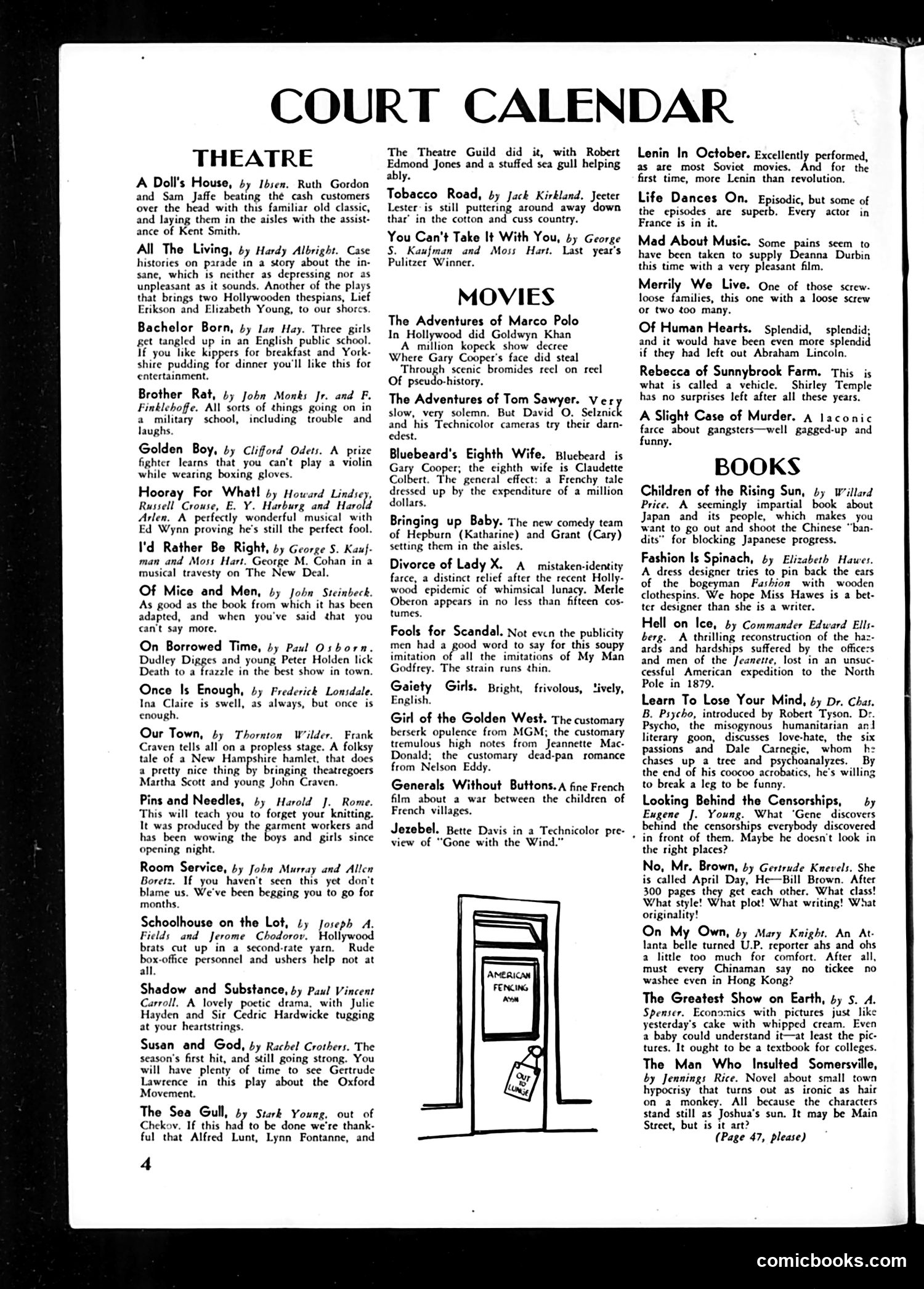
# Court Calendar Page Analysis This page from *Judge* magazine is primarily a **review section** rather than political satire. It contains capsule critiques of contemporary theatrical productions and films, plus book reviews. The single small cartoon visible shows a book or magazine titled "AMERICAN FOREIGN POLICY" being placed in what appears to be a mailbox or slot—likely a visual joke about the publication/distribution of political commentary itself. The reviews themselves constitute the satire: sharp, witty dismissals of plays and films. For instance, the critique of "You Can't Take It With You" notes it won "Pulitzer's Winner"—a sarcastic comment on its commercial success despite (implied) artistic mediocrity. Similar sardonic observations pepper reviews throughout. This represents *Judge*'s characteristic approach: sophisticated cultural criticism disguised as entertainment listings.
📄 Transcribed text from this page (OCR, searchable)
Machine-transcribed from the original scan — historical spelling and the odd misread are preserved.
COURT CALENDAR THEATRE A Doll's House, by Ibsen. Ruth Gordon and Sam Jaffe beating the cash customers over the head with this familiar old classic, and laying them in the aisles with the assist- ance of Kent Smith. All The Living, 6y Hardy Albright. Case histories on parade in a story about the in- sane, which is neither as depressing nor as unpleasant as it sounds. Another of the plays that brings two Hollywooden thespians, Lief Erikson and Elizabeth Young, to our shores. Bachelor Born, sy Ian Hay. Three girls get tangled up in an English public school. If you like kippers for breakfast and York- shire pudding (a dinner you'll like this for entertainment. Brother Rat, by John Monks Jr. and F. Finklehoffe. All sorts of things going on in a military school, including trouble and laughs. Golden Boy, by Clifford Odets. A prize fighter learns that you can't play a violin while wearing boxing gloves. Hooray For Whatl by Howard Lindsey, Russell Crouse, E. Y. Harburg and Harold Arlen, A perfectly wonderful musical with Ed Wynn proving he’s still the perfect fool. I'd Rather Be Right, by George S. Kauf- man and Moss Hart. George M. Cohan in a musical travesty on The New Deal. Of Mice and Men, by John Steinbeck. As good as the book from which it has been adapted, and when you've said that you can't say more, On Borrowed Time, sy Paul Osborn. Dudley Digges and young Peter Holden lick Death to a frazzle in the best show in town. Once Is Enough, by Frederick Lonsdale. Ina Claire is swell, as always, but once is enough. Our Town, by Thornton Wilder. Frank Craven tells all on a propless stage. A folksy tale of a New Hampshire hamlet, that does a pretty nice thing by bringing theatregoers Martha Scott and young John Craven. Pins and Needles, 4) Harold J. Rome. This will teach you to forget your knitting. It was produced by the garment workers and has been wowing the boys and girls since opening night. Room Service, by John Murray and Allen Boretz. If you haven't seen this yet don't blame us. We've been begging you to go for months. Schoolhouse on the Lot, 4y Joseph A. Fields and Jerome Chodorov. Hollywood brats cut up in a second-rate yarn. Rude box-office personnel and ushers help not at all. Shadow and Substance, sy Paul Vincent Carroll, A lovely poetic drama, with Julie Hayden and Sir Cedric Hardwicke tugging at your heartstrings. Susan and God, by Rachel Crothers. The season's first hit, and still going strong. You will have plenty of time to see Gertrude Lawrence in this play about the Oxford Movement. The Sea Gull, sy Stark Young, out of Chekov. If this had to be done we're thank- ful that Alfred Lunt, Lynn Fontanne, and 4 The Theatre Guild did it, with Robert Edmond Jones and a stuffed sea gull helping ably. Tobacco Road, by Jack Kirkland. Jecter Lester: is still puttering around away down thar’ in the cotton and cuss country. You Can't Take It With You, by George S. Kaufman and Moss Hart.’ Last year’s Pulitzer Winner. MOVIES The Adventures of Marco Polo In Hollywood did Goldwyn Khan ‘A million kopeck show decree Where Gary Cooper's face did steal Through scenic bromides reel on reel Of pseudo-history. The Adventures of Tom Sawyer. Ver slow, very solemn, But David O. Selznick and his Technicolor cameras try their darn- edest. Bluebeard’s Eighth Wife. Bluebeard is Gary Cooper; the eighth wife is Claudette Colbert. The’ general effect: a Frenchy tale dressed up by the expenditure of & millioa dollars. Bringing up Baby. The new comedy team of Hepburn (Katharine) and Grant (Cary) setting them in the aisles. Divorce of Lady X. A mistaken-identity farce, a distinct relief after the recent Holly- wood epidemic of whimsical lunacy. Merle Oberon appears in no less than fifteen cos- tumes. Fools for Scandal. Not even the publicity men had a good word to say for this soupy imitation of al the imitations of My Man Godfrey. The strain runs hin. Gaiety Girls. Bright, frivolous, ‘ively, English. Girl of the Golden West. The customary berserk opulence from MGM; the customary tremulous high notes from Jeannette Mac- Donald; the customary dead-pan romance from Nelson Eddy. Generals Without Buttons. A fine French film about a war between the children of French villages. Jezebel. Bette Davis in a Technicolor pre- view of “Gone with the Wind.” Lenin In October. Excellently performed, as are most Sovict movies. And for the first time, more Lenin than revolution. Life Dances On. Episodic, but some of the episodes are superb, Every actor in France is in it. Mad About Music. some pains seem to have been taken to supply Beanna Durbin this time with a very pleasant film. Merrily We Live. One of those screw- loose families, this one with a loose screw or two too many. Of Human Hearts. Splendid, splendid: and it would have been even more splendid if they had left out Abraham Lincoln. Rebecca of Sunnybrook Farm. This is what is called a vehicle. Shirley Temple has no surprises left after all these years. A Slight Case of Murder. A laconic farce about gangsters—well gagged-up and funny. BOOKS Children of the Rising Sun, by Willard Price. A seemingly impartial. book about Japan and its people, which makes you want to go out and shoot the Chinese “ban- dits" for blocking Japanese progress. Fashion Is Spinach, by Elizabeth Hawes. A dress designer tries to pin back the ears of the bogeyman Fashion with wooden clothespins. We hope Miss Hawes is a bet- ter designer than she is a writer. Hell on Ice, by Commander Edward Ells- berg. A thrilling reconstruction of the h: ards and hardships suffered by the office: and men of the Jeanette, lost in an unsuc- cessful American’ expedition to the North Pole in 1879. Learn To Lose Your Mind, by Dr. Chas. B. Psycho, introduced by Robert Tyson. Dr. Psycho, the misogynous humanitarian and literary goon, discusses love-hate, the six passions and Dale Carnegie, whom h: chases up a tree and psychoanalyzes. By the end of his coocoo acrobatics, he's willing to break a leg to be funny. Looking Behind the Censorships, sy Eugene J. Young. What ‘Gene discovers behind the censorships everybody discovered * in front of them. Maybe he doesn’t look in the right places? No, Mr. Brown, by Gertrude Knevels. She is called April Day, He—Bill Brown. After 300 pages they get each other, What class! What style! What plot! What writing! What originality! On My Own, by Mary Knight. An At- lanta belle turned U.P. reporter ahs and ohs a little too much for comfort. After all, must every Chinaman say no tickee no washee even in Hong Kong? The Greatest Show on Earth, by 5. A. Spenser. Economics with pictures just like yesterday's cake with whipped cream. Even a baby could understand it—at least the pic- tures, It ought to be a textbook for colleges. The Man Who Insulted Somersville, by Jennings Rice. Novel about small town hypocrisy that turns out as ironic as hair on a monkey. All because the characters stand still as Joshua's sun. It may be Main Street, but is it art? (Page 47, please) comicbooks.com