
Judge, 1938-05 · page 30 of 54
Judge — May 1938 — page 30: what you’re looking at
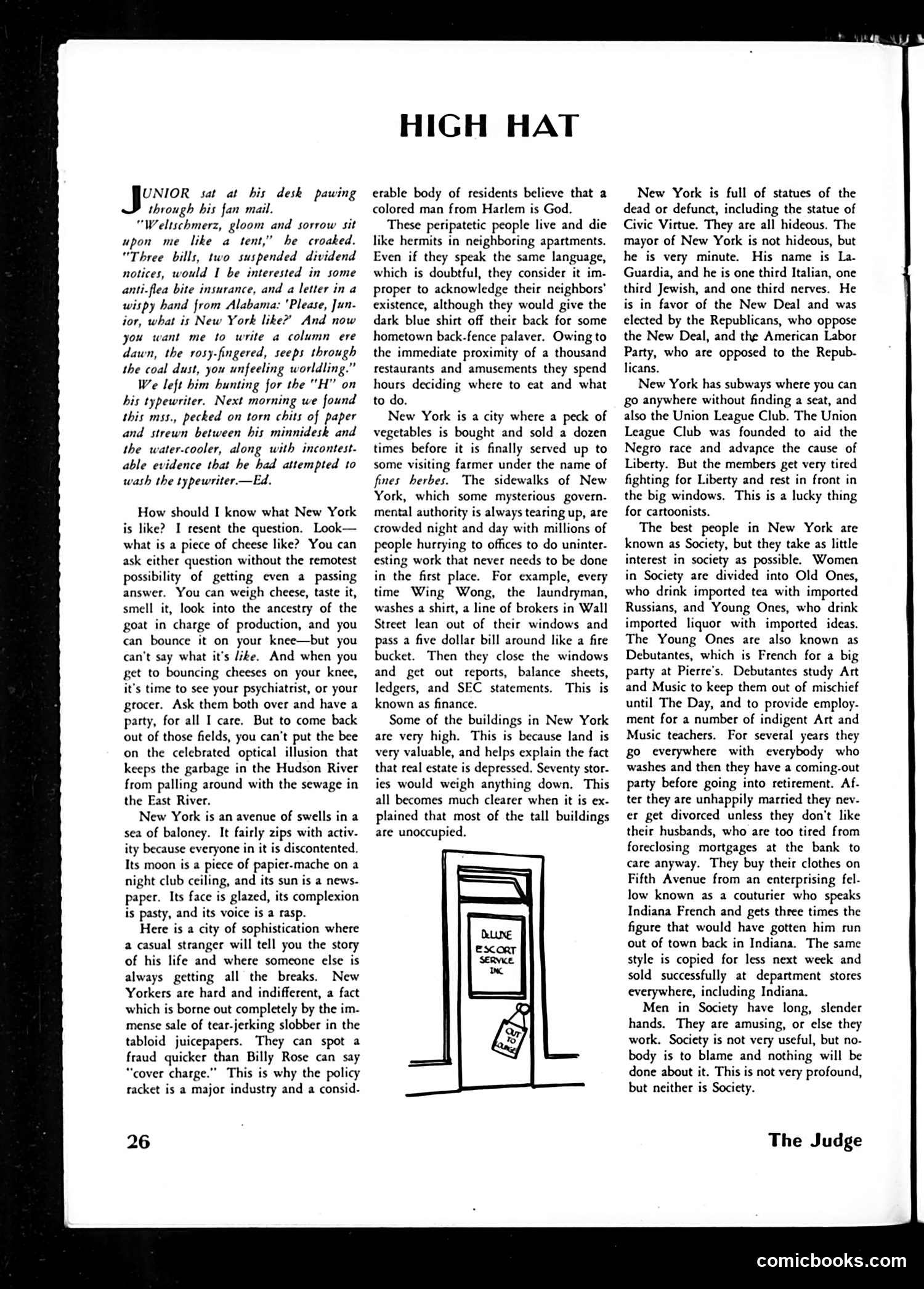
A restored page from Judge, 1938-05. Page through the whole issue in the reader above.
📄 Transcribed text from this page (OCR, searchable)
Machine-transcribed from the original scan — historical spelling and the odd misread are preserved.
UNIOR sat at bis desk pawing through bis fan mail. "Weltschmerz, gloom and sorrow sit upon me like a tent,” be croaked. "Three bills, two suspended dividend notices, would I be interested in some anti-flea bite insurance, and a letter ina wispy hand from Alabama: ‘Please, Jun- ior, what is New York like?’ And now you want me to write a column ere dawn, the rosy-fingered, seeps through the coal dust, you unfeeling worldling.” We left him bunting for the "H” on his typewriter. Next morning we found this mss., pecked on torn chits of paper and strewn between his minnidesk and the water-cooler, along with incontest- able evidence that he had attempted to wash the typewriter —Ed. How should I know what New York is like? I resent the question. Look— what is a piece of cheese like? You can ask either question without the remotest possibility of getting even a passing answer. You can weigh cheese, taste it, smell it, look into the ancestry of the goat in charge of production, and you can bounce it on your knee—but you can’t say what it’s like. And when you get to bouncing cheeses on your knee, it's time to see your psychiatrist, or your grocer. Ask them both over and have a party, for all I care. But to come back out of those fields, you can’t put the bee on the celebrated optical illusion that keeps the garbage in the Hudson River from palling around with the sewage in the East River. New York is an avenue of swells in a sea of baloney. It fairly zips with activ- ity because everyone in it is discontented. Its moon is a piece of papier-mache on a night club ceiling, and its sun is a news- paper. Its face is glazed, its complexion is pasty, and its voice is a rasp. Here is a city of sophistication where a casual stranger will tell you the story of his life and where someone else is always getting all the breaks. New Yorkers are hard and indifferent, a fact which is borne out completely by the im. mense sale of tear-jerking slobber in the tabloid juicepapers. They can spot a fraud quicker than Billy Rose can say “cover charge.” This is why the policy racket is a major industry and a consid- 26 HIGH HAT erable body of residents believe that a colored man from Harlem is God. These peripatetic people live and die like hermits in neighboring apartments. Even if they speak the same language, which is doubtful, they consider it im- proper to acknowledge their neighbors’ existence, although they would give the dark blue shirt off their back for some hometown back-fence palaver. Owing to the immediate proximity of a thousand restaurants and amusements they spend hours deciding where to eat and what to do. New York is a city where a peck of vegetables is bought and sold a dozen times before it is finally served up to some visiting farmer under the name of fines herbes. The sidewalks of New York, which some mysterious govern. mental authority is always tearing up, are crowded night and day with millions of people hurrying to offices to do uninter- esting work that never needs to be done in the first place. For example, every time Wing Wong, the laundryman, washes a shirt, a line of brokers in Wall Street lean out of their windows and pass a five dollar bill around like a fire bucket. Then they close the windows and get out reports, balance sheets, ledgers, and SEC statements. This is known as finance. Some of the buildings in New York are very high. This is because land is very valuable, and helps explain the fact that real estate is depressed. Seventy stor. ies would weigh anything down, This all becomes much clearer when it is ex- plained that most of the tall buildings are unoccupied. New York is full of statues of the dead or defunct, including the statue of Civic Virtue. They are all hideous. The mayor of New York is not hideous, but he is very minute. His name is La- Guardia, and he is one third Italian, one third Jewish, and one third nerves. He is in favor of the New Deal and was elected by the Republicans, who oppose the New Deal, and the American Labor Party, who are opposed to the Repub- licans. New York has subways where you can go anywhere without finding a seat, and also the Union League Club. The Union League Club was founded to aid the Negro race and advance the cause of Liberty. But the members get very tired fighting for Liberty and rest in front in the big windows. This is a lucky thing for cartoonists. The best people in New York are known as Society, but they take as little interest in society as possible. Women in Society are divided into Old Ones, who drink imported tea with imported Russians, and Young Ones, who drink imported liquor with imported ideas. The Young Ones are also known as Debutantes, which is French for a big party at Pierre's. Debutantes study Art and Music to keep them out of mischief until The Day, and to provide employ- ment for a number of indigent Art and Music teachers. For several years they go everywhere with everybody who washes and then they have a coming-out party before going into retirement. Af- ter they are unhappily married they nev- er get divorced unless they don't like their husbands, who are too tired from foreclosing mortgages at the bank to care anyway. They buy their clothes on Fifth Avenue from an enterprising fel- low known as a couturier who speaks Indiana French and gets three times the figure that would have gotten him run out of town back in Indiana. The same style is copied for less next week and sold successfully at department stores everywhere, including Indiana. Men in Society have long, slender hands. They are amusing, or else they work. Society is not very useful, but no- body is to blame and nothing will be done about it. This is not very profound, but neither is Society. The Judge comicbooks.com