
Judge, 1938-05 · page 39 of 54
Judge — May 1938 — page 39: what you’re looking at
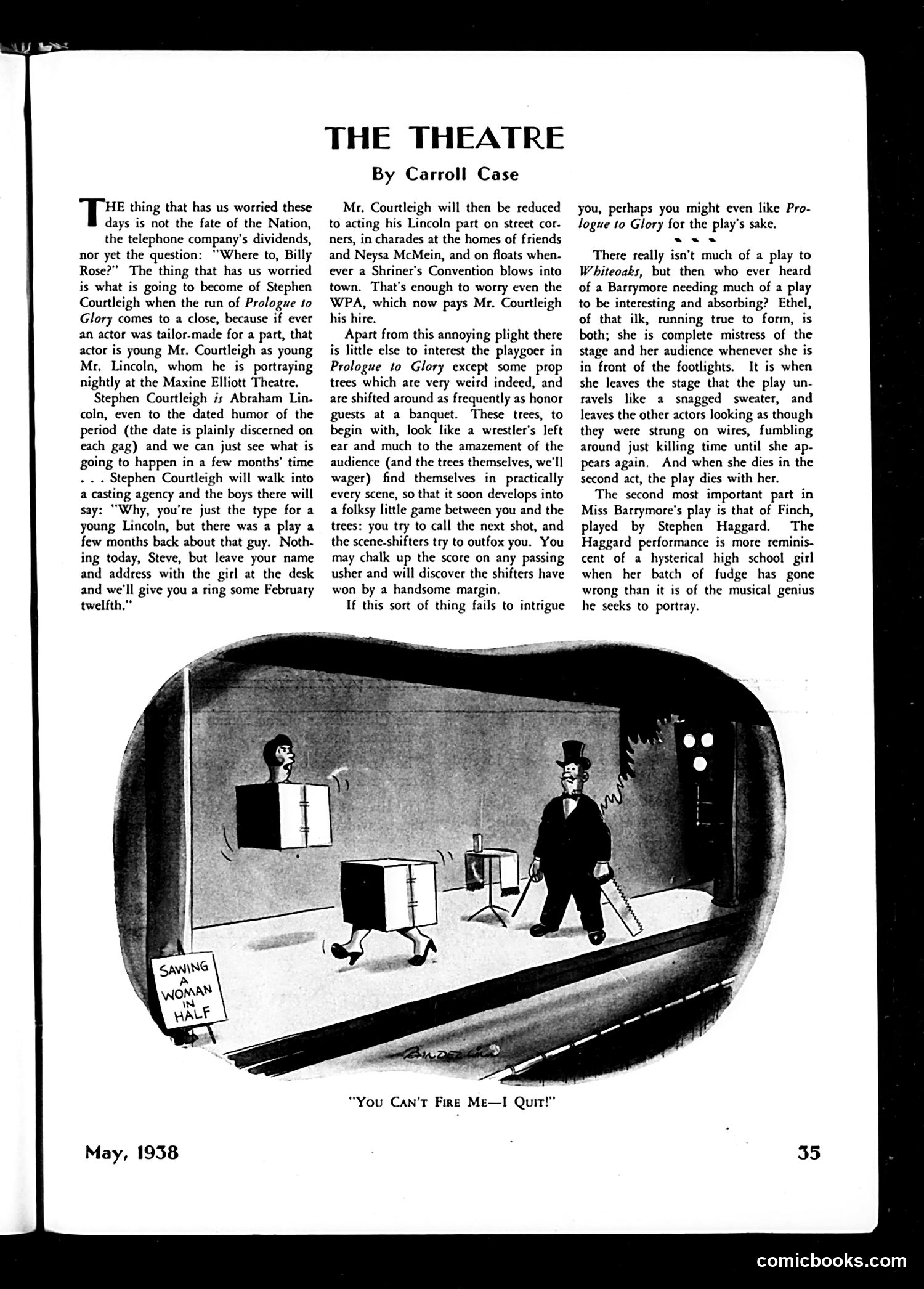
A restored page from Judge, 1938-05. Page through the whole issue in the reader above.
📄 Transcribed text from this page (OCR, searchable)
Machine-transcribed from the original scan — historical spelling and the odd misread are preserved.
HE thing that has us worried these days is not the fate of the Nation, the telephone company’s dividends, nor yet the question: “Where to, Billy Rose?” The thing that has us worried is what is going to become of Stephen Courtleigh when the run of Prologue to Glory comes to a close, because if ever an actor was tailor-made for a part, that actor is young Mr. Courtleigh as young Mr. Lincoln, whom he is portraying nightly at the Maxine Elliott Theatre. Stephen Courtleigh is Abraham Lin- coln, even to the dated humor of the period (the date is plainly discerned on each gag) and we can just see what is going to happen in a few months’ time . . + Stephen Courtleigh will walk into a casting agency and the boys there will say: “Why, you're just the type for a young Lincoln, but there was a play a few months back about that guy. Noth. ing today, Steve, but leave your name and address with the girl at the desk and we'll give you a ring some February twelfth.” May, 1938 THE THEATRE By Carroll Case Mr. Courtleigh will then be reduced to acting his Lincoln part on street cor- ners, in charades at the homes of friends and Neysa McMein, and on floats when- ever a Shriner's Convention blows into town. That's enough to worry even the WPA, which now pays Mr. Courtleigh his hire. Apart from this annoying plight there is little else to interest the playgoer in Prologue to Glory except some prop trees which are very weird indeed, and are shifted around as frequently as honor guests at a banquet. These trees, to begin with, look like a wrestler's left ear and much to the amazement of the audience (and the trees themselves, we'll wager) find themselves in practically every scene, so that it soon develops into a folksy little game between you and the trees: you try to call the next shot, and the scene-shifters try to outfox you. You may chalk up the score on any passing usher and will discover the shifters have won by a handsome margin. If this sort of thing fails to intrigue “You Can’T Fire Me—I Quit!” you, perhaps you might even like Pro- logue to Glory for the play's sake. There really isn’t much of a play to Whiteoaks, but then who ever heard of a Barrymore needing much of a play to be interesting and absorbing? Ethel, of that ilk, running true to form, is both; she is complete mistress of the stage and her audience whenever she is in front of the footlights. It is when she leaves the stage that the play un- ravels like a snagged sweater, and leaves the other actors looking as though they were strung on wires, fumbling around just killing time until she ap- pears again. And when she dies in the second act, the play dies with her. The second most important part in Miss Barrymore's play is that of Finch, played by Stephen Haggard. The Haggard performance is more reminis- cent of a hysterical high school girl when her batch of fudge has gone wrong than it is of the musical genius he seeks to portray. comicbooks.com