
Judge, 1938-05 · page 14 of 54
Judge — May 1938 — page 14: what you’re looking at
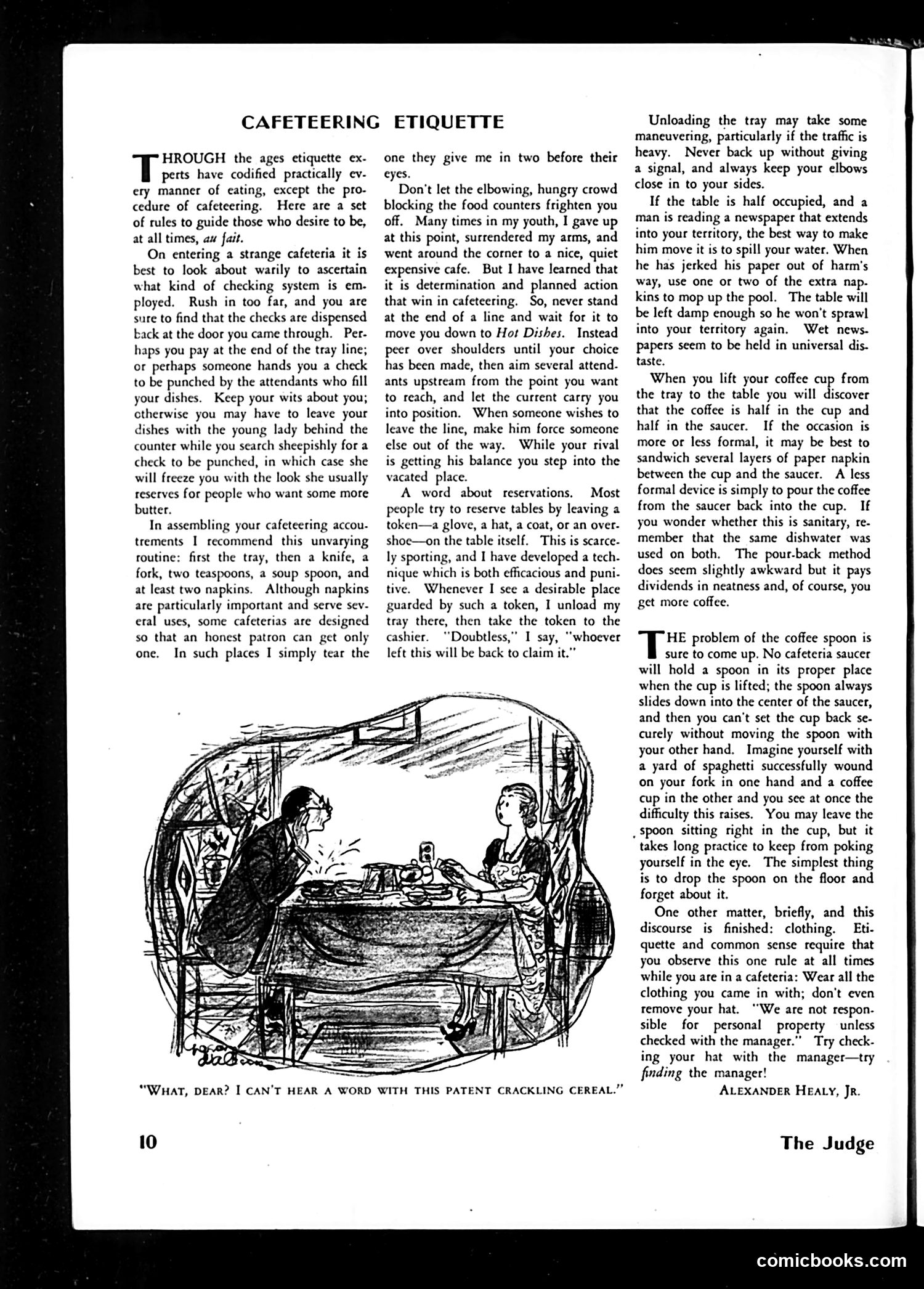
A restored page from Judge, 1938-05. Page through the whole issue in the reader above.
📄 Transcribed text from this page (OCR, searchable)
Machine-transcribed from the original scan — historical spelling and the odd misread are preserved.
CAFETEERING ETIQUETTE HROUGH the ages etiquette ex- Te have codified practically ev- ery manner of eating, except the pro- cedure of cafeteering. Here are a set of rules to guide those who desire to be, at all times, aw fait. On entering a strange cafeteria it is best to look about warily to ascertain what kind of checking system is em. ployed. Rush in too far, and you are sure to find that the checks are dispensed back at the door you came through. Per- haps you pay at the end of the tray line; or perhaps someone hands you a check to be punched by the attendants who fill your dishes. Keep your wits about you; ctherwise you may have to leave your dishes with the young lady behind the counter while you search sheepishly for a check to be punched, in which case she will freeze you with the look she usually reserves for people who want some more butter. In assembling your cafeteering accou- trements I recommend this unvarying routine: first the tray, then a knife, a fork, two teaspoons, a soup spoon, and at least two napkins. Although napkins are particularly important and serve sev- eral uses, some cafeterias are designed so that an honest patron can get only one. In such places I simply tear the one they give me in two before their eyes. Don't let the elbowing, hungry crowd blocking the food counters frighten you off. Many times in my youth, I gave up at this point, surrendered my arms, and went around the corner to a nice, quiet expensive cafe. But I have learned that it is determination and planned action that win in cafeteering. So, never stand at the end of a line and wait for it to move you down to Hot Dishes. Instead peer over shoulders until your choice has been made, then aim several attend- ants upstream from the point you want to reach, and let the current carry you into position. When someone wishes to leave the line, make him force someone else out of the way. While your rival is getting his balance you step into the vacated place. A word about reservations. Most people try to reserve tables by leaving a token—a glove, a hat, a coat, or an over- shoe—on the table itself. This is scarce- ly sporting, and I have developed a tech- nique which is both efficacious and puni- tive. Whenever I see a desirable place guarded by such a token, I unload my tray there, then take the token to the cashier. “Doubtless,” I say, “whoever left this will be back to claim it.” “WHAT, DEAR? I CAN'T HEAR A WORD WITH THIS PATENT CRACKLING CEREAL.” 10 Unloading the tray may take some maneuvering, particularly if the traffic is heavy. Never back up without giving a signal, and always keep your elbows close in to your sides. If the table is half occupied, and a man is reading a newspaper that extends into your territory, the best way to make him move it is to spill your water. When he has jerked his paper out of harm's way, use one or two of the extra nap. kins to mop up the pool. The table will be left damp enough so he won't sprawl into your territory again. Wet news. Papers seem to be held in universal dis. taste. When you lift your coffee cup from the tray to the table you will discover that the coffee is half in the cup and half in the saucer. If the occasion is more or less formal, it may be best to sandwich several layers of paper napkin between the cup and the saucer. A less formal device is simply to pour the coffee from the saucer back into the cup. If you wonder whether this is sanitary, re- member that the same dishwater was used on both. The pour-back method does seem slightly awkward but it pays dividends in neatness and, of course, you get more coffee. HE problem of the coffee spoon is sure to come up. No cafeteria saucer will hold a spoon in its proper place when the cup is lifted; the spoon always slides down into the center of the saucer, and then you can't set the cup back se- curely without moving the spoon with your other hand. Imagine yourself with a yard of spaghetti successfully wound on your fork in one hand and a coffee cup in the other and you see at once the difficulty this raises. You may leave the , Spoon sitting right in the cup, but it takes long practice to keep from poking yourself in the eye. The simplest thing is to drop the spoon on the floor and forget about it. One other matter, briefly, and this discourse is finished: clothing. Eti- quette and common sense require that you observe this one rule at all times while you are in a cafeteria: Wear all the clothing you came in with; don’t even remove your hat. “We are not respon- sible for personal property unless checked with the manager.” Try check- ing your hat with the manager—try finding the manager! ALEXANDER HEALY, JR. The Judge comicbooks.com