
Judge, 1938-05 · page 31 of 54
Judge — May 1938 — page 31: what you’re looking at
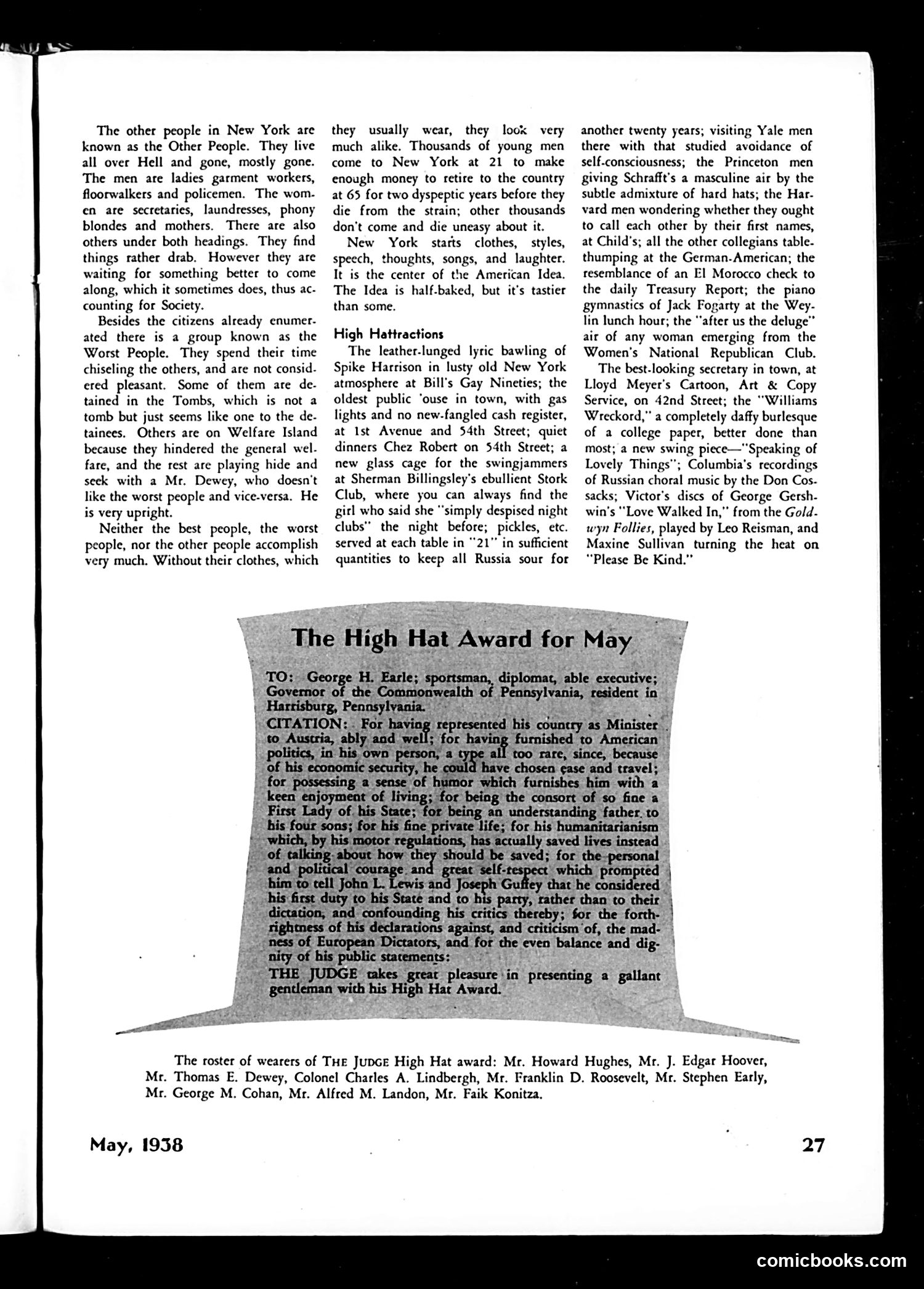
A restored page from Judge, 1938-05. Page through the whole issue in the reader above.
📄 Transcribed text from this page (OCR, searchable)
Machine-transcribed from the original scan — historical spelling and the odd misread are preserved.
The other people in New York are known as the Other People. They live all over Hell and gone, mostly gone. The men are ladies garment workers, floorwalkers and policemen. The wom. en are secretaries, laundresses, phony blondes and mothers. There are also others under both headings. They find things rather drab. However they are waiting for something better to come along, which it sometimes does, thus ac- counting for Society. Besides the citizens already enumer- ated there is a group known as the Worst People. They spend their time chiseling the others, and are not consid. ered pleasant. Some of them are de- tained in the Tombs, which is not a tomb but just seems like one to the de- tainees. Others are on Welfare Island because they hindered the general wel- fare, and the rest are playing hide and seck with a Mr. Dewey, who doesn’t like the worst people and vice-versa. He is very upright. Neither the best people, the worst people, nor the other people accomplish very much. Without their clothes, which they usually wear, they look very much alike. Thousands of young men come to New York at 21 to make enough money to retire to the country at 65 for two dyspeptic years before they die from the strain; other thousands don’t come and die uneasy about it. New York starts clothes, styles, speech, thoughts, songs, and laughter. It is the center of the American Idea. The Idea is half-baked, but it’s tastier than some. High Hattractions The leather-lunged lyric bawling of Spike Harrison in lusty old New York atmosphere at Bill's Gay Nineties; the oldest public ‘ouse in town, with gas lights and no new-fangled cash register, at 1st Avenue and 54th Street; quiet dinners Chez Robert on 54th Street; a new glass cage for the swingjammers at Sherman Billingsley’s ebullient Stork Club, where you can always find the girl who said she “simply despised night clubs” the night before; pickles, etc. served at each table in “21” in sufficient quantities to keep all Russia sour for another twenty years; visiting Yale men there with that studied avoidance of self-consciousness; the Princeton men giving Schrafft’s a masculine air by the subtle admixture of hard hats; the Har- vard men wondering whether they ought to call each other by their first names, at Child's; all the other collegians table. thumping at the German-American; the resemblance of an El Morocco check to the daily Treasury Report; the piano gymnastics of Jack Fogarty at the Wey- lin lunch hour; the “after us the deluge” air of any woman emerging from the Women's National Republican Club. The best-looking secretary in town, at Lloyd Meyer's Cartoon, Art & Copy Service, on 42nd Street; the “Williams Wreckord,” a completely daffy burlesque of a college paper, better done than most; a new swing piece—"Speaking of Lovely Things”; Columbia's recordings of Russian choral music by the Don Cos- sacks; Victor's discs of George Gersh- win's “Love Walked In,” from the Gold- wyn Follies, played by Leo Reisman, and Maxine Sullivan turning the heat on “Please Be Kind.” ‘The Fish Hat Award for May WiGueemorinet ‘diplomat, able Beatties Sareea rans peotent in” ees soiadermanilg: Siber to "ies to his h ly saved lives instead - ‘saved; for The roster of wearers of THE JuDGE High Hat award: Mr. Howard Hughes, Mr. J. Edgar Hoover, Mr. Thomas E. Dewey, Colonel Charles A. Lindbergh, Mr. Franklin D. Roosevelt, Mr. Stephen Early, Mr. George M. Cohan, Mr. Alfred M. Landon, Mr. Faik Konitza. May, 1938 comicbooks.com