
A complete issue · 36 pages · 1923
Judge — December 22, 1923
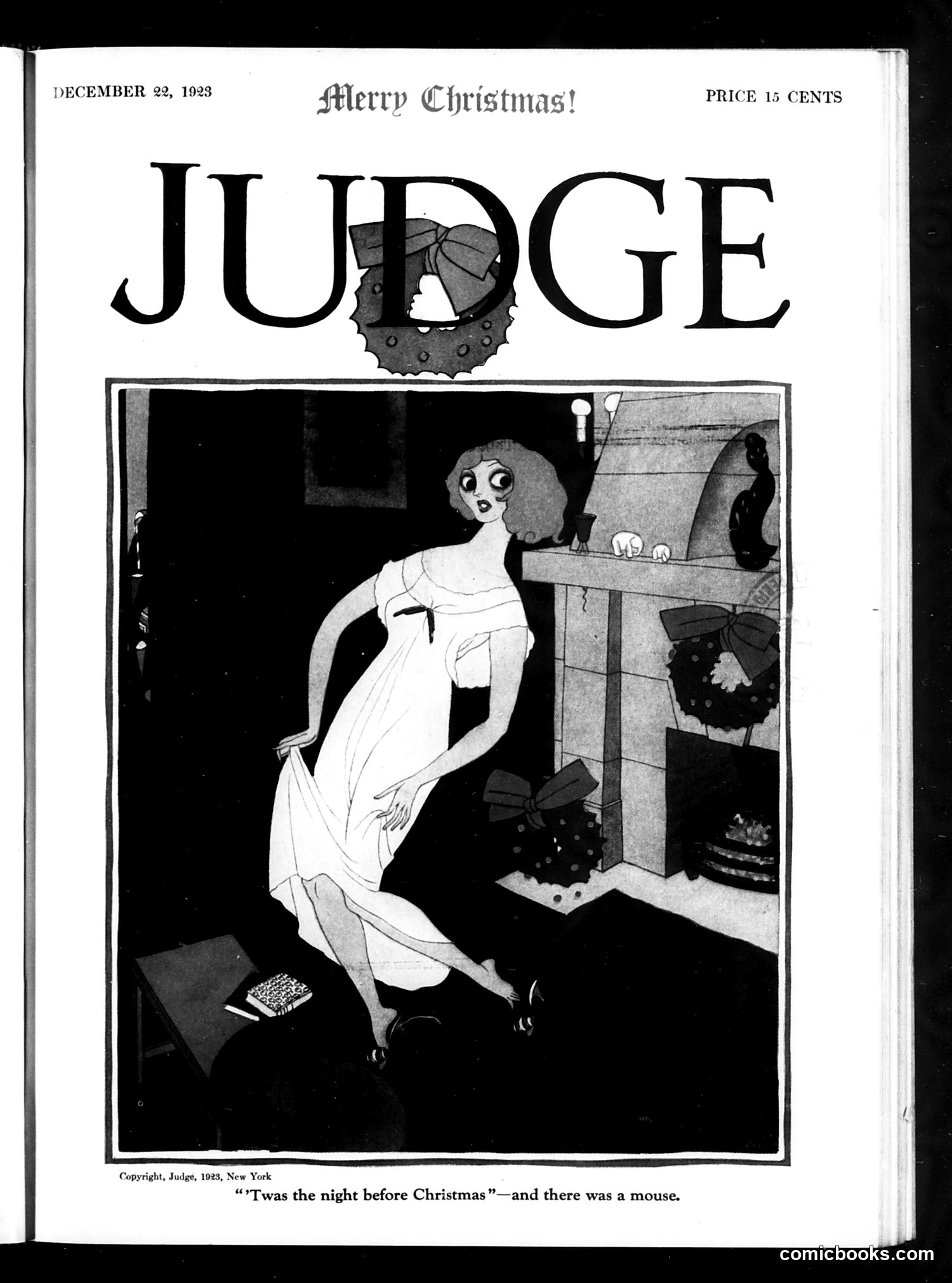
This is a humorous Christmas-themed illustration playing on the famous poem "Twas the Night Before Christmas." The caption reads: "'Twas the night before Christmas"—and there was a mouse." The illustration shows a woman in a nightgown discovering a mouse near the fireplace on Christmas Eve. The joke appears to be a dark comedic twist on the beloved holiday poem—instead of Santa Claus arriving with presents, the woman encounters a mouse, which would have been an unwelcome pest in 1920s homes. The humor relies on subverting reader expectations of the sentimental Christmas narrative with an absurd, slightly grotesque domestic moment. This represents typical Judge magazine satire: genteel, upper-class humor mocking domestic life through exaggeration and unexpected juxtapositions.
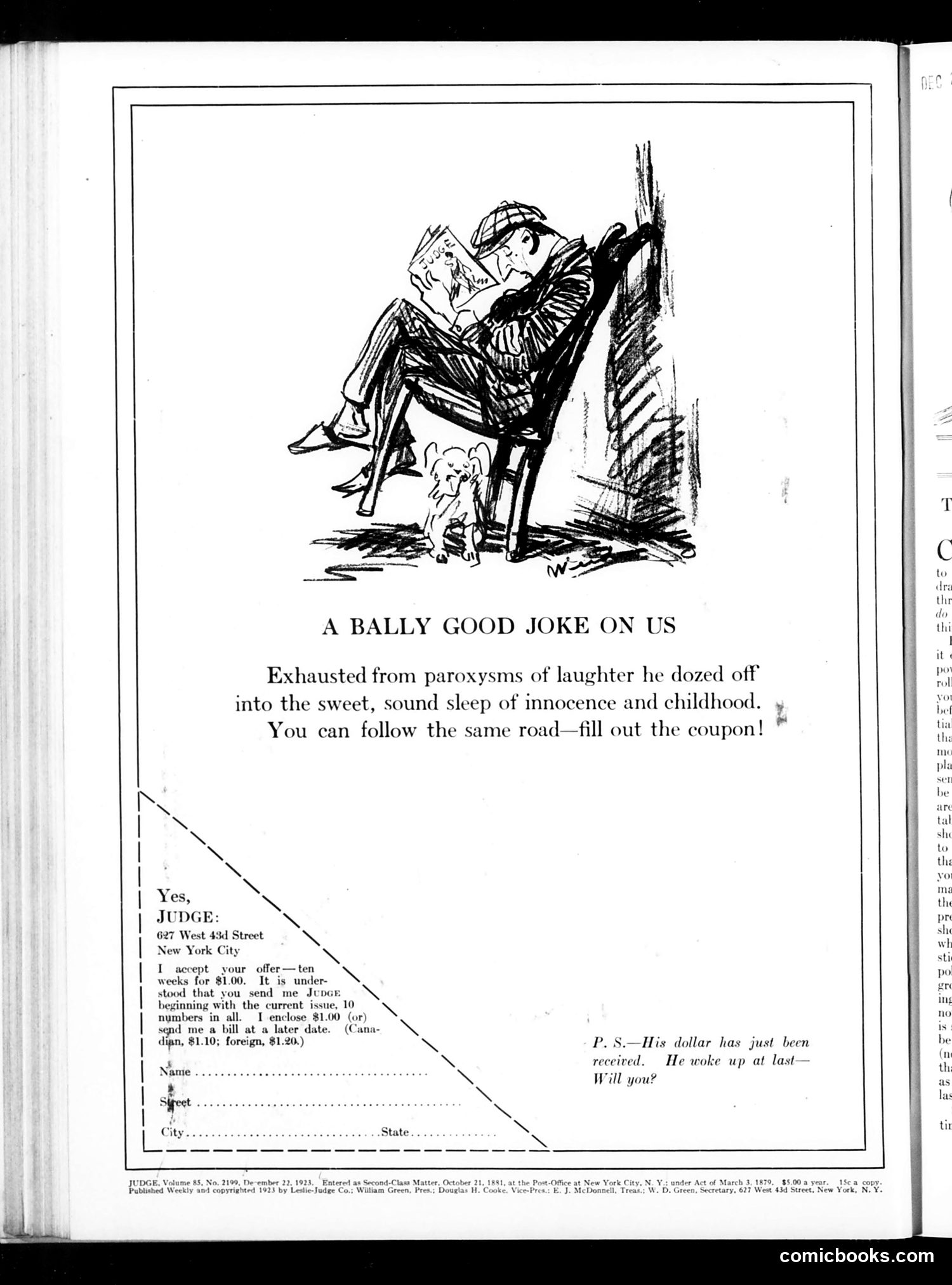
This page is primarily an **advertisement disguised as humor**. The cartoon shows a man reading in a chair, exhausted from laughter, while a small dog sits nearby. The accompanying text invites readers to "follow the same road" by filling out a coupon to Judge magazine. The "joke" is that subscribing to Judge will provide similar entertainment and laughter. The coupon offers a ten-week subscription for $1.00, addressed to "Judge" at a West 44th Street address in New York City. The satirical point appears self-referential: Judge is humorously suggesting its own magazine is so funny it will exhaust readers with laughter—a playful, tongue-in-cheek sales pitch typical of early 20th-century magazine advertising.
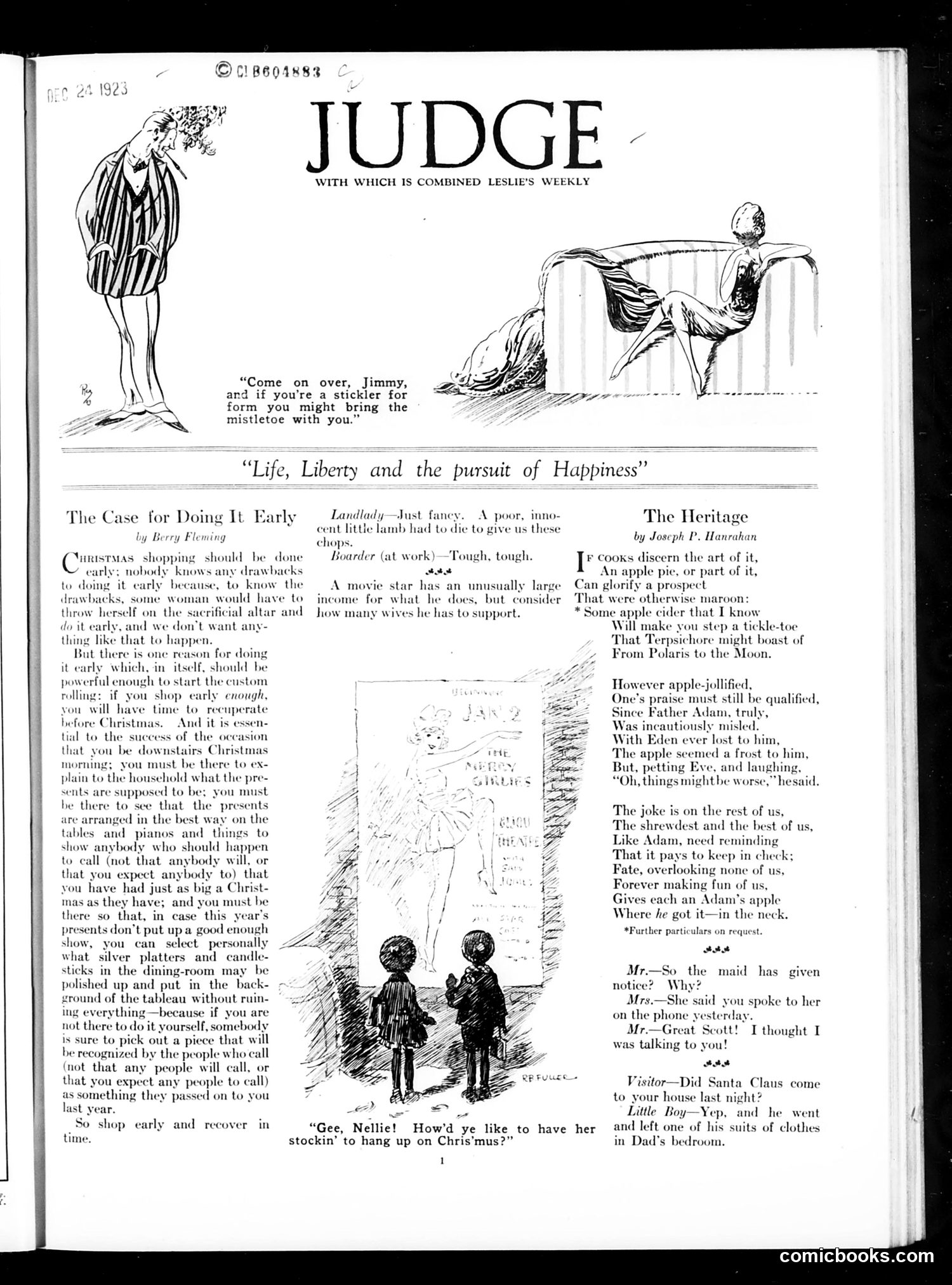
This December 24, 1923 issue contains three distinct pieces: **Top cartoon:** A flirtatious scene between a woman and man on a couch, with dialogue about bringing mistletoe—typical holiday romance humor of the era. **"The Case for Doing It Early"** (left): Barry Fleming argues for early Christmas shopping to avoid drawbacks like crowded stores and rushed preparation. The practical advice assumes most readers were doing last-minute shopping. **"The Heritage"** (right): A Joseph P. Harriman poem about apple pie as an American tradition, referencing Adam and Eve, with wordplay about apples and fate. **Bottom cartoon:** Children asking about hanging up stockings for Christmas, depicting Santa Claus visit anticipation. The page mixes holiday-themed humor, practical domestic advice, and nostalgic Americana—typical Judge magazine content blending entertainment with middle-class concerns.
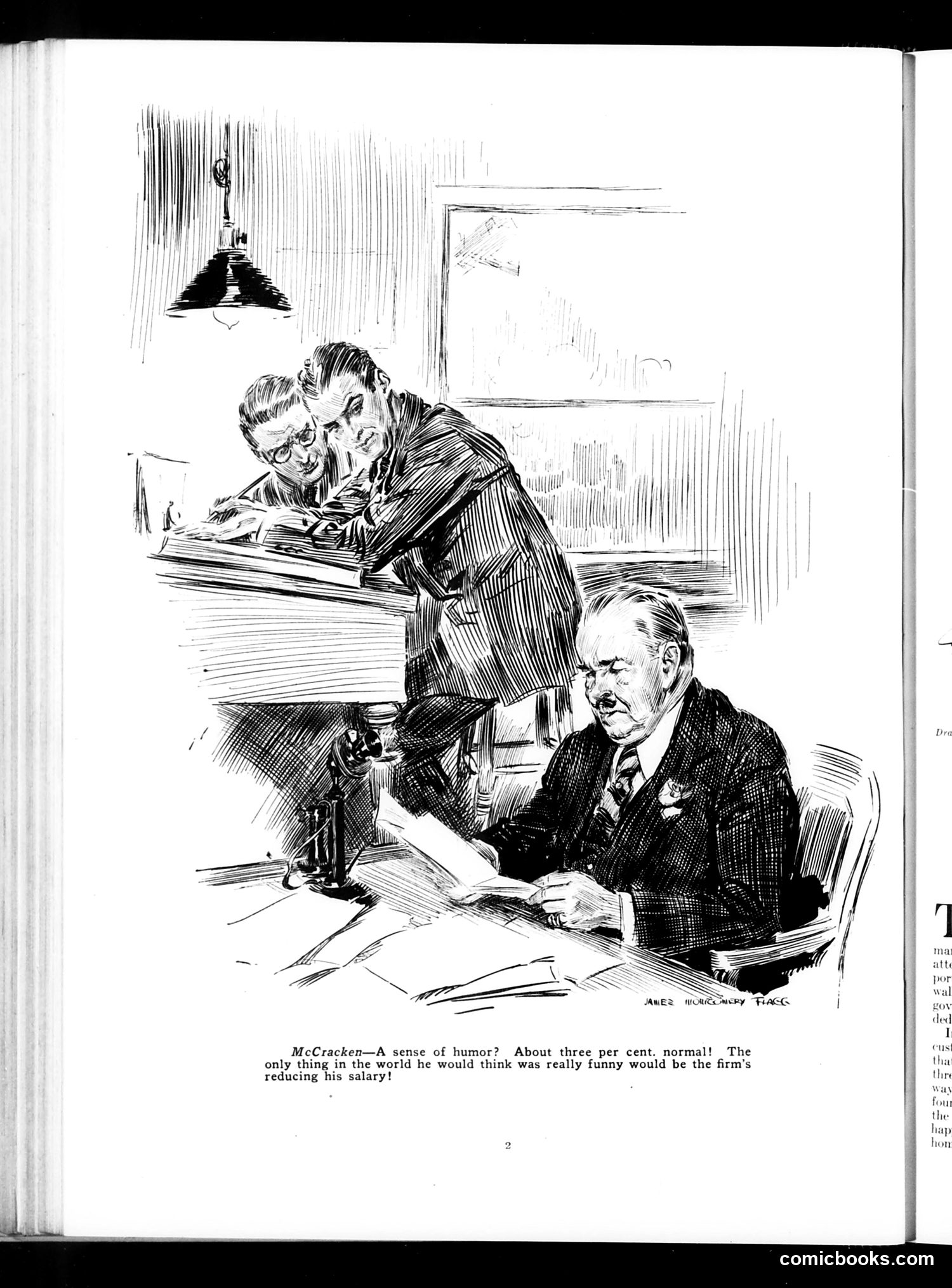
This cartoon satirizes a businessman named McCracken, depicted sitting at a desk reviewing documents while two other men (likely colleagues or subordinates) look over his shoulder in the background. The caption delivers the joke: McCracken claims to have "a sense of humor" at "about three per cent, normal," and the satirist's punchline is that the only thing McCracken would find genuinely funny would be the firm reducing his salary. The satire targets corporate miserliness and the disconnect between management claims of humor/humanity and their actual priorities. The cartoon suggests McCracken's true nature reveals itself through his indifference to anything except protecting his own compensation—a critique of greedy or callous businessmen of the era.
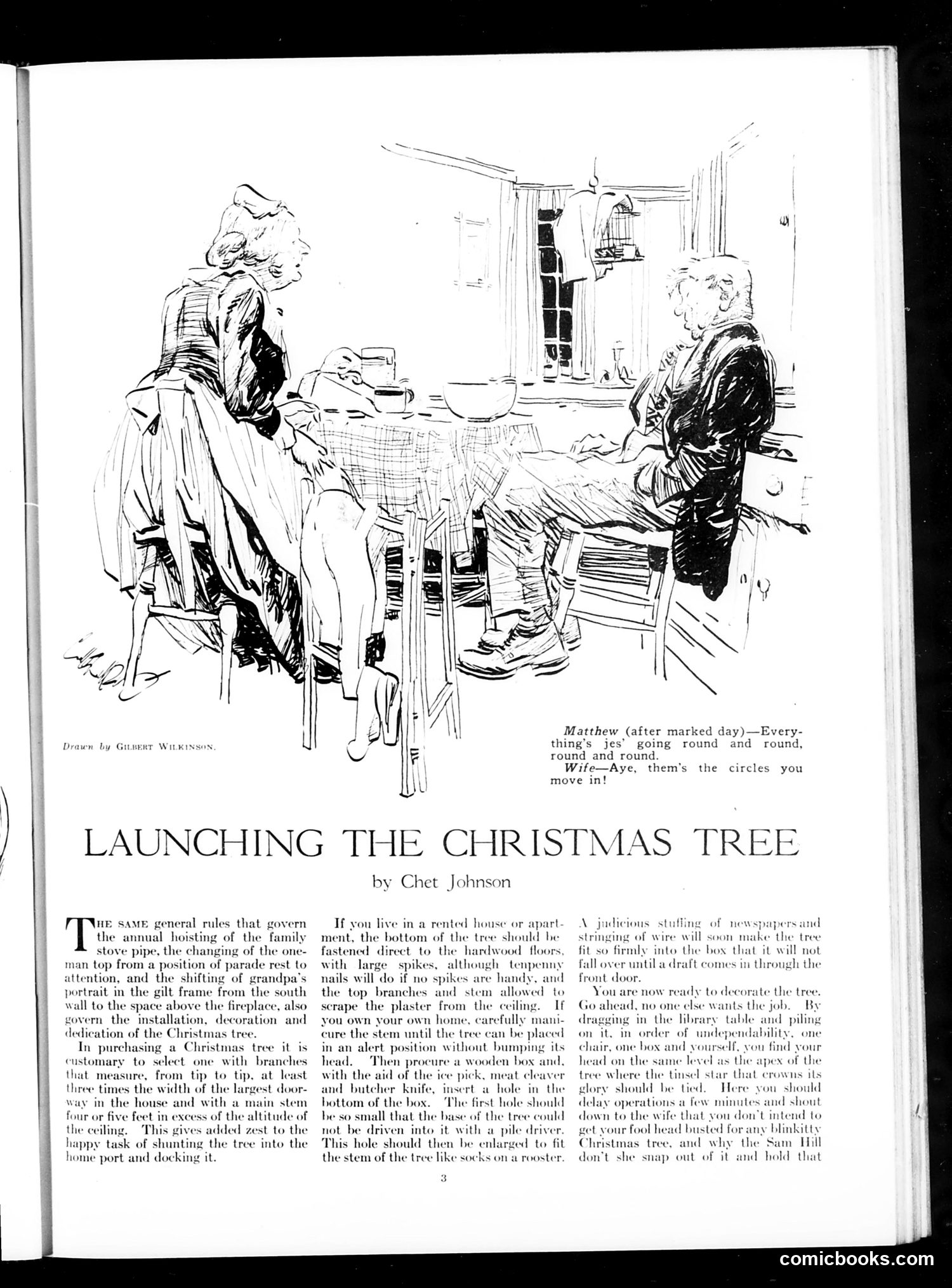
This page contains a humorous instructional article with an accompanying sketch by Gilbert Wilkinson. The illustration shows a couple discussing Christmas tree placement in their home, with the wife commenting on her husband's circular movements: "Aye, them's the circles you move in!" The joke appears to satirize domestic dynamics—specifically, the husband's ineffectual, repetitive behavior as he attempts to position the Christmas tree. The wife's remark suggests he moves in pointless circles rather than accomplishing the task efficiently. The article itself offers practical advice for securing a Christmas tree in period homes, addressing concerns about damaging walls, ceilings, and floors. This combines practical household guidance with gentle marital humor typical of Judge magazine's domestic comedy.
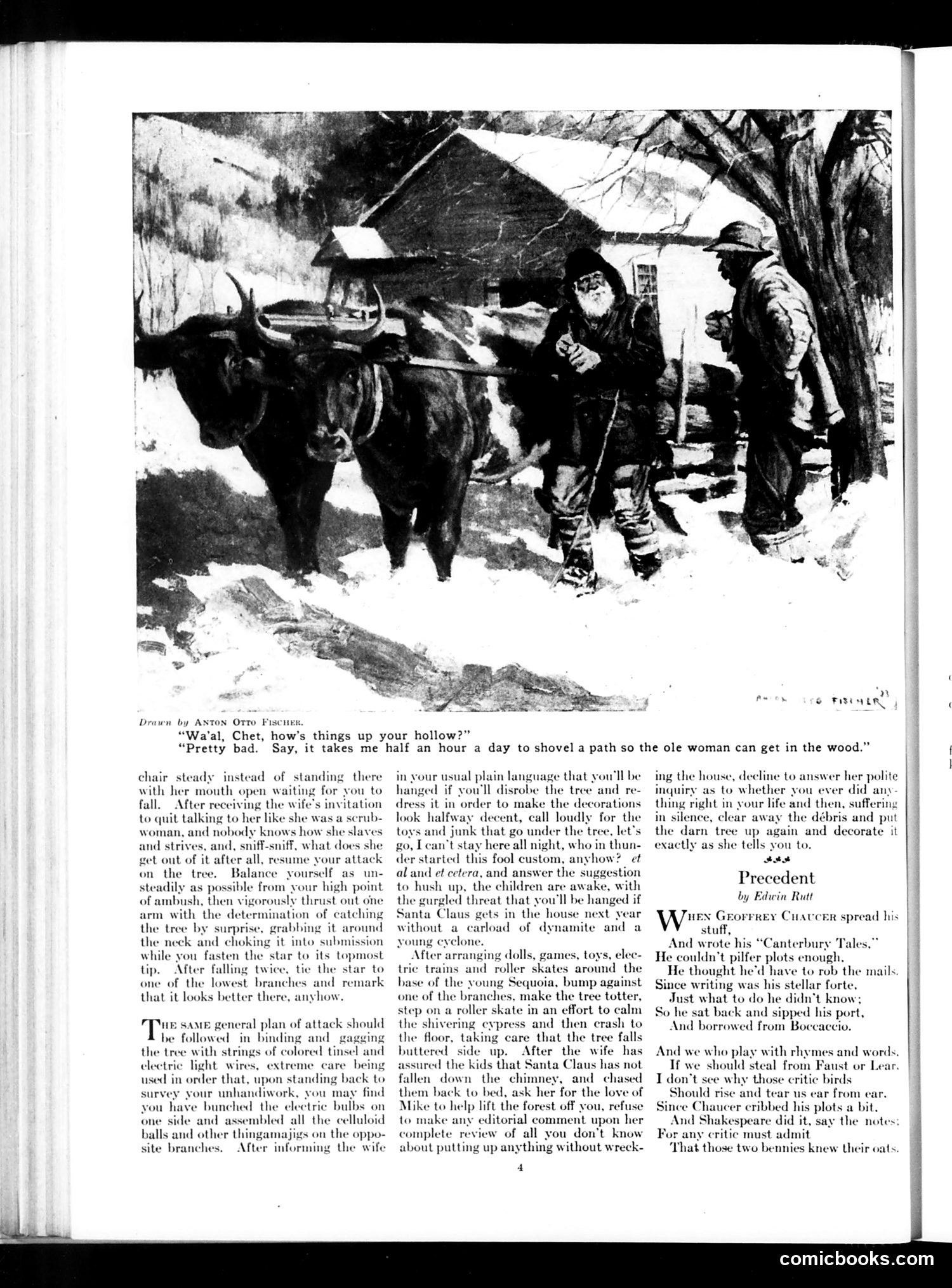
The main illustration, drawn by Anton Otto Fischer, depicts a winter scene with two men and oxen outside a cabin. The caption quotes dialogue about clearing snow so an elderly woman can reach the woods—a domestic scenario illustrating rural hardship. Below are two text sections: "Wa'al, Chet, how's things up your hollow?" and "Pretty bad," which continue this rural theme with vernacular dialect humor typical of Judge's era. The second piece, "Precedent" by Edwin Balti, is a literary commentary criticizing Geoffrey Chaucer's *Canterbury Tales* for insufficient plot variety and comparing his work unfavorably to Faust and Shakespeare. This represents Judge's frequent cultural criticism aimed at educated readers. The page lacks overt political satire—instead offering rural humor and literary critique representative of early 20th-century Judge content.
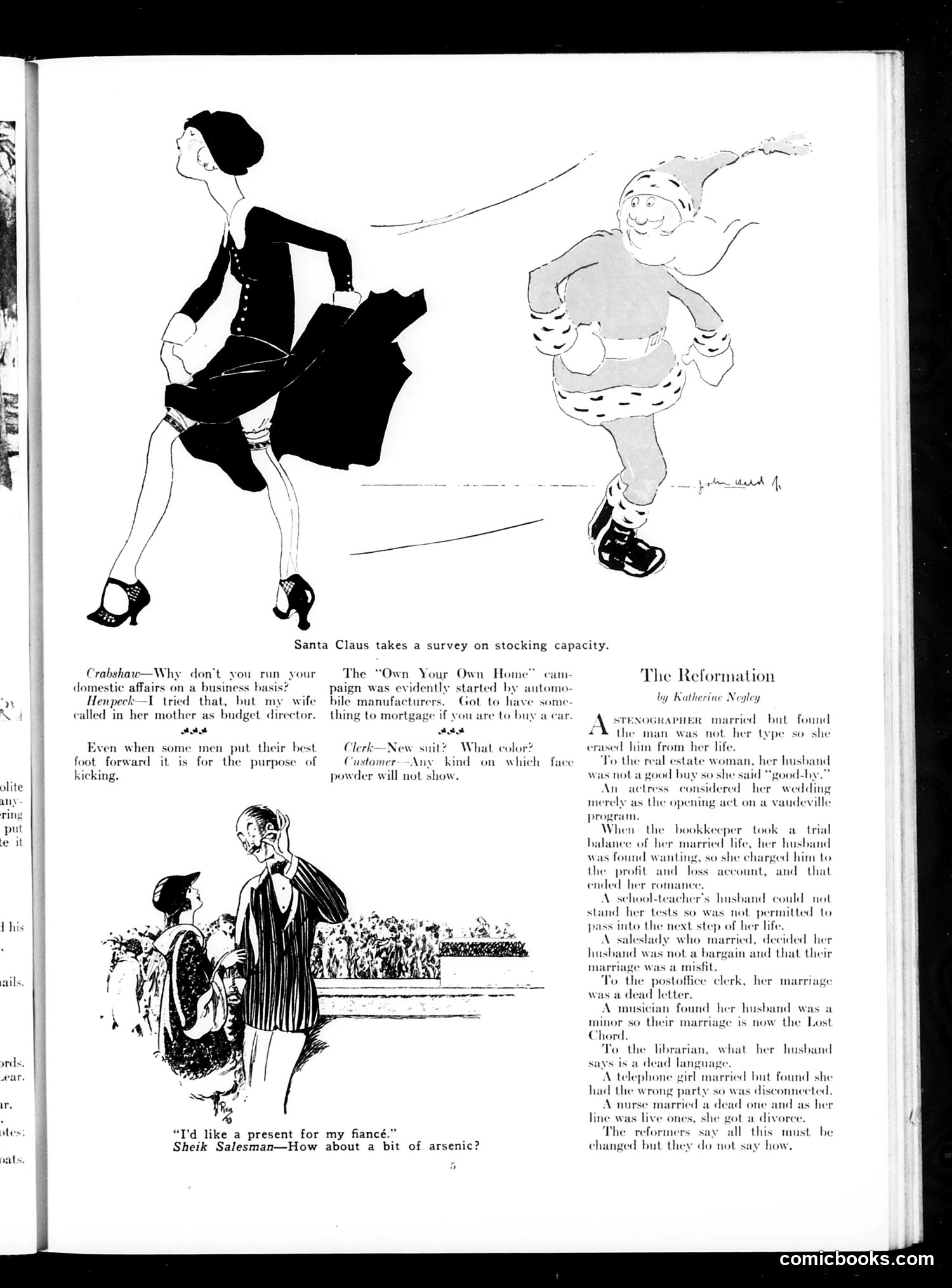
This Judge magazine page contains three separate satirical pieces: **Top cartoon**: "Santa Claus takes a survey on stocking capacity" mocks women's fashion, likely referencing 1920s hemlines and whether women's stockings could adequately cover their legs as skirts grew shorter—a major social controversy of the era. **Middle cartoon & dialogue**: Business humor about domestic finances and a salesman's dark joke about giving arsenic as an engagement gift—gallows humor about marriage tensions. **"The Reformation" article**: A satirical list of marriages that failed because wives judged husbands by their professions' standards (a bookkeeper judging by profit/loss, a telephone operator by "wrong party," etc.). The satire criticizes modern women for being too critical and career-minded, treating marriage as a business transaction rather than commitment. The final line dismisses reformers as hypocritical—they criticize but offer no solutions. The piece reflects 1920s anxiety about changing women's roles, independence, and evolving marriage expectations during the post-suffrage era.
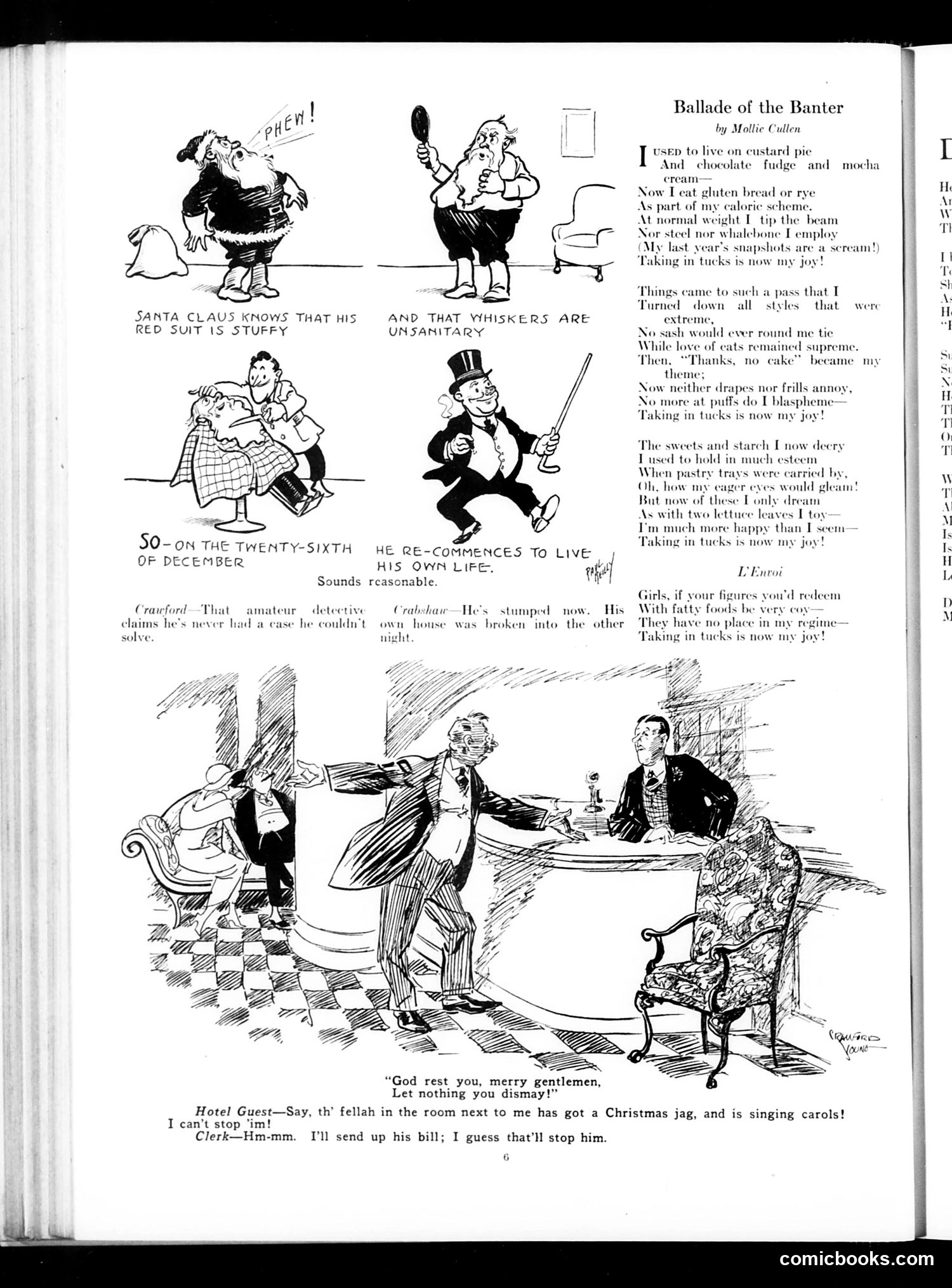
This page satirizes the emerging obsession with dieting and calorie-counting among American women in the 1920s. The poem mocks a woman who has abandoned her former love of rich foods (custard pie, chocolate, fudge) for an austere "caloric scheme" of gluten bread and lettuce. The humor lies in her claiming joy from "taking in tucks" (taking in dress seams) as her weight decreases. The upper cartoons show Santa Claus and other figures discussing cleanliness and fashion—likely satirizing health-conscious trends of the era. The lower cartoon depicts a drunken hotel guest singing Christmas carols loudly; the clerk suggests sending up his bill as a cure, playing on the assumption that financial shock will sober him. The overall tone ridicules modern fad dieting and suggests that such restrictive eating practices, however fashionable, represent a joyless deprivation masked by forced cheerfulness.
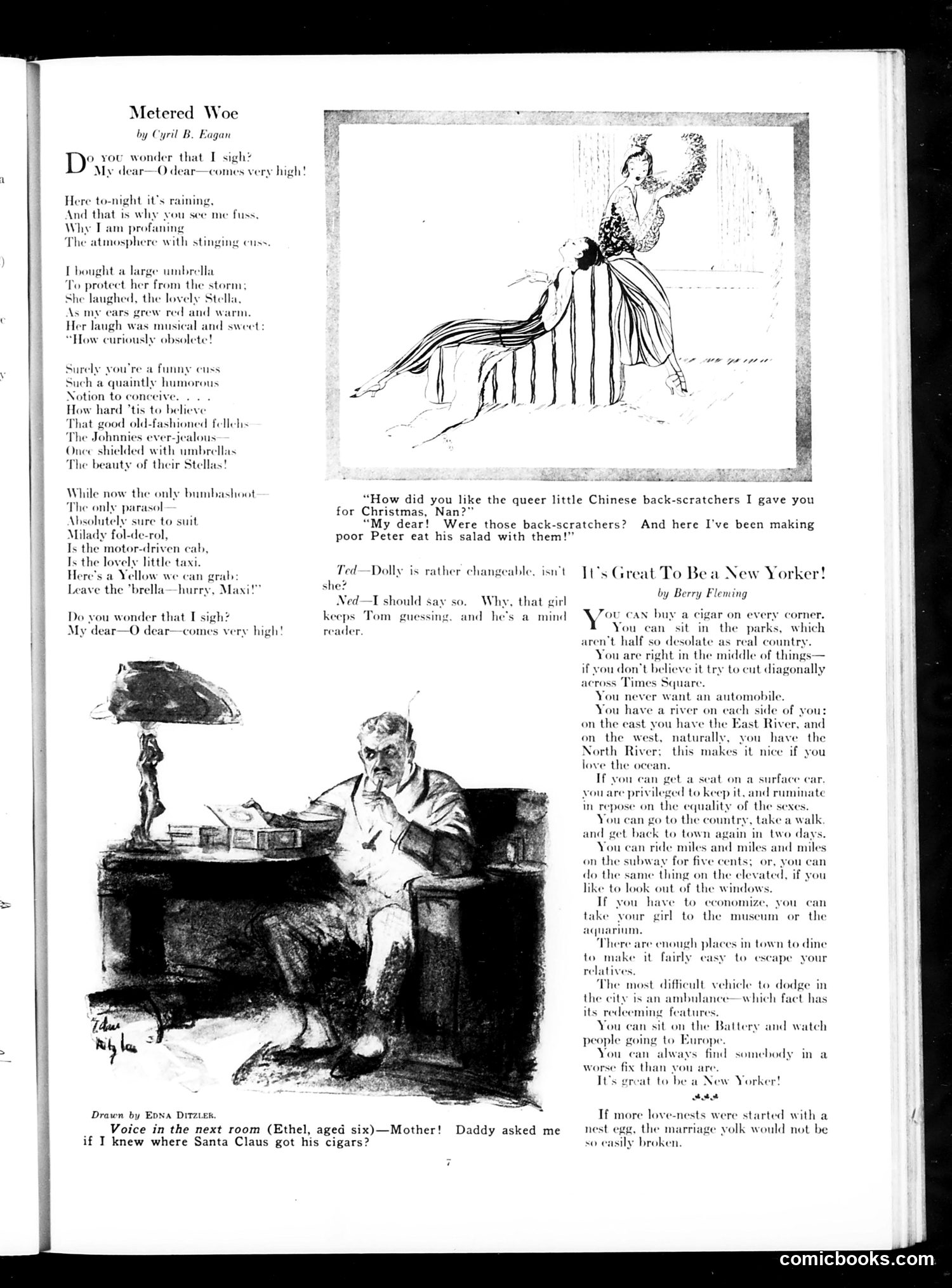
This page contains three distinct pieces of social satire: **"Metered Woe"** (left): A poem mocking the modern dating experience. The narrator complains that courtship "comes very high"—literally, as he must pay taxi fares ("motor-driven cab," "Yellow" cab) to see his girlfriend Stella. The satire targets how automobiles and urban transportation have made romance expensive. The joke at bottom shows a man holding an umbrella over his date, which she finds laughably "obsolete"—suggesting modern women no longer expect old-fashioned chivalry. **"It's Great To Be a New Yorker!"** (right): A humorous essay celebrating New York City amenities—parks, subways, museums, rivers—as affordable date activities. The final joke about ambulances being the hardest vehicles to dodge sardonically suggests urban life's dangers. **Bottom illustration**: A domestic scene where a child innocently asks where Santa gets cigars, implying the father smokes them illicitly or frequently—gentle family humor. The overall theme: Modern urban life, particularly courtship, has become costly and complicated by technology and changing social expectations.
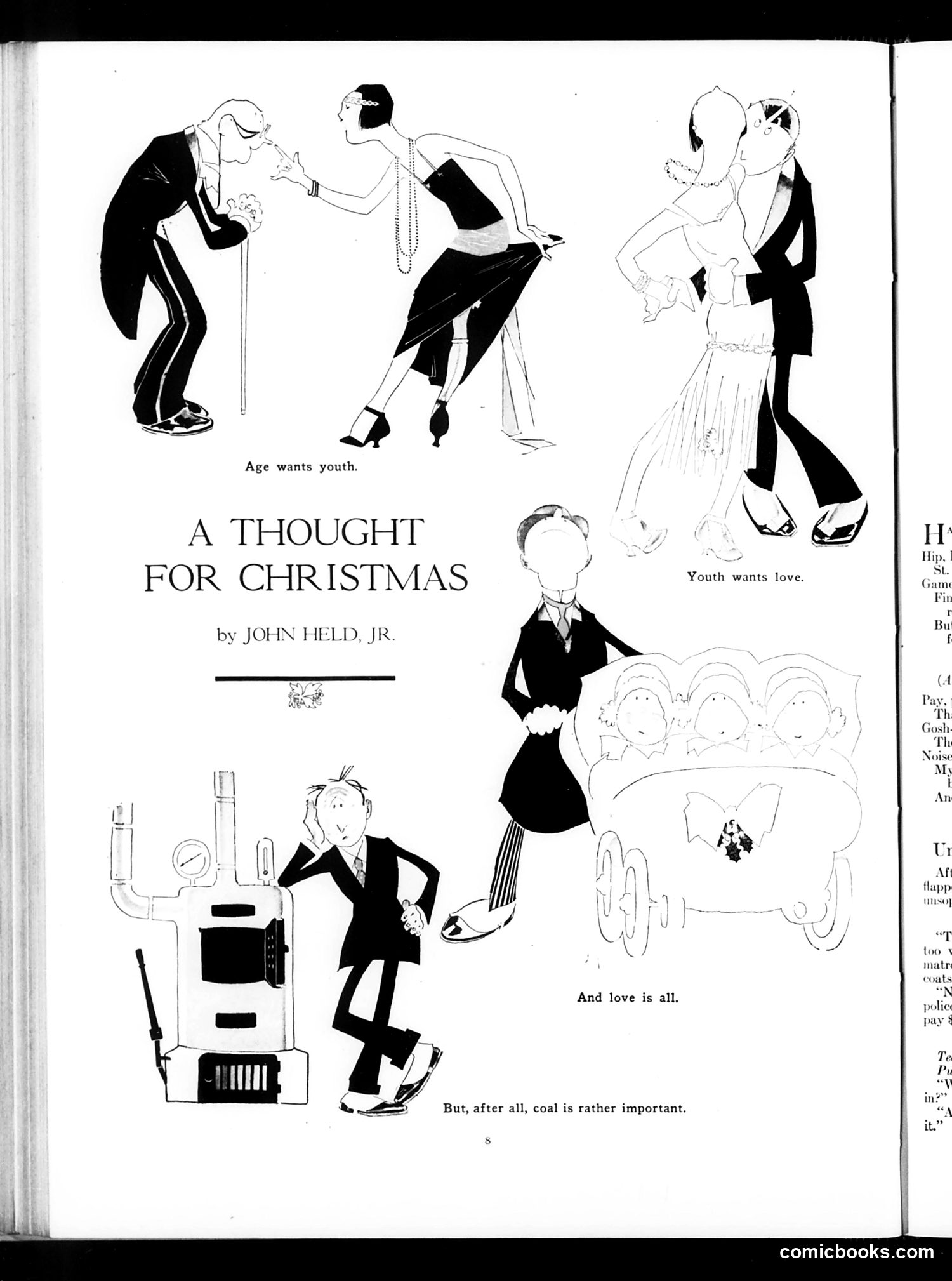
This satirical piece contrasts romantic ideals with practical realities. The top panels show youth pursuing love and romance—dancing couples and young people embracing—captioned "Age wants youth" and "Youth wants love." These represent sentimental Christmas expectations. However, the bottom panel deflates this sentiment: a man stands beside a coal stove with a woman holding a baby carriage, captioned "But, after all, coal is rather important." The joke critiques the gap between romantic holiday sentiment and working-class survival needs. During the early 20th century, coal was essential heating fuel for survival through winter. The cartoon suggests that despite Christmas ideals about youth and love, families' actual priorities centered on practical necessities—warmth and survival—over romance. It's a sardonic commentary on how economic realities supersede sentimental notions.
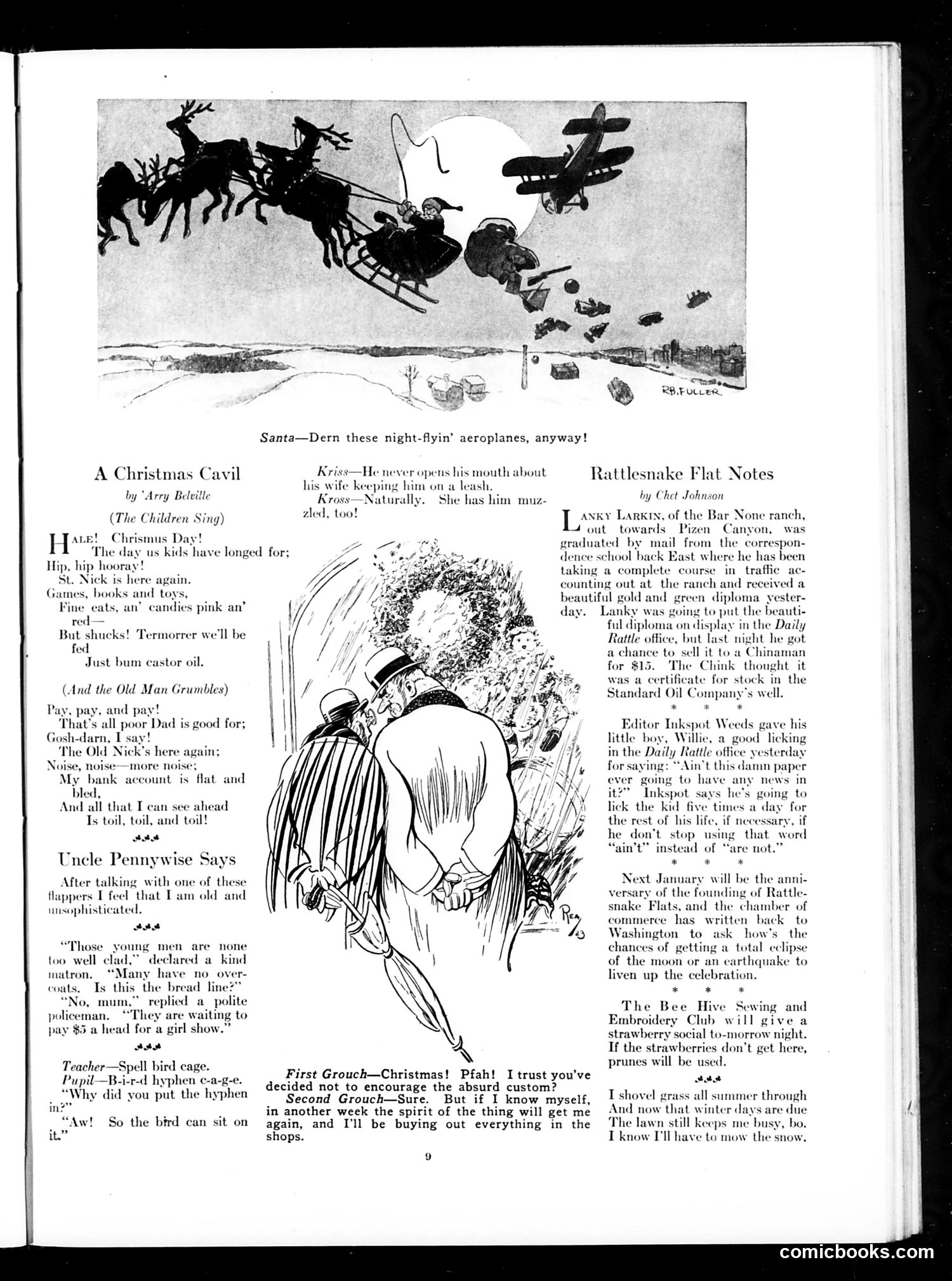
This page contains several satirical pieces typical of early 20th-century American humor: **Top Cartoon**: Santa and Mrs. Claus (labeled "Kriss" and "Kross") observe modern aeroplanes flying overhead—a reference to aviation's novelty and growing presence. Santa's complaint about "night-flyin' aeroplanes" satirizes how new technology was disrupting even traditional imagery. **Text Content**: The bulk consists of humorous verses and anecdotes poking fun at: - Children's Christmas disappointment (castor oil punishment) - Economic hardship (unemployed men waiting in a "bread line") - Social pretension (young men poorly dressed but paying for entertainment) - Rural life absurdities (a correspondence-school diploma confused with stock certificates) **Key Satire Targets**: Working-class struggles, generational conflict, and the gap between urban sophistication and rural naiveté. The "Rattlesnake Flat Notes" column particularly mocks small-town life through exaggerated anecdotes. The page reflects Depression-era or post-WWI concerns about employment and changing social values.
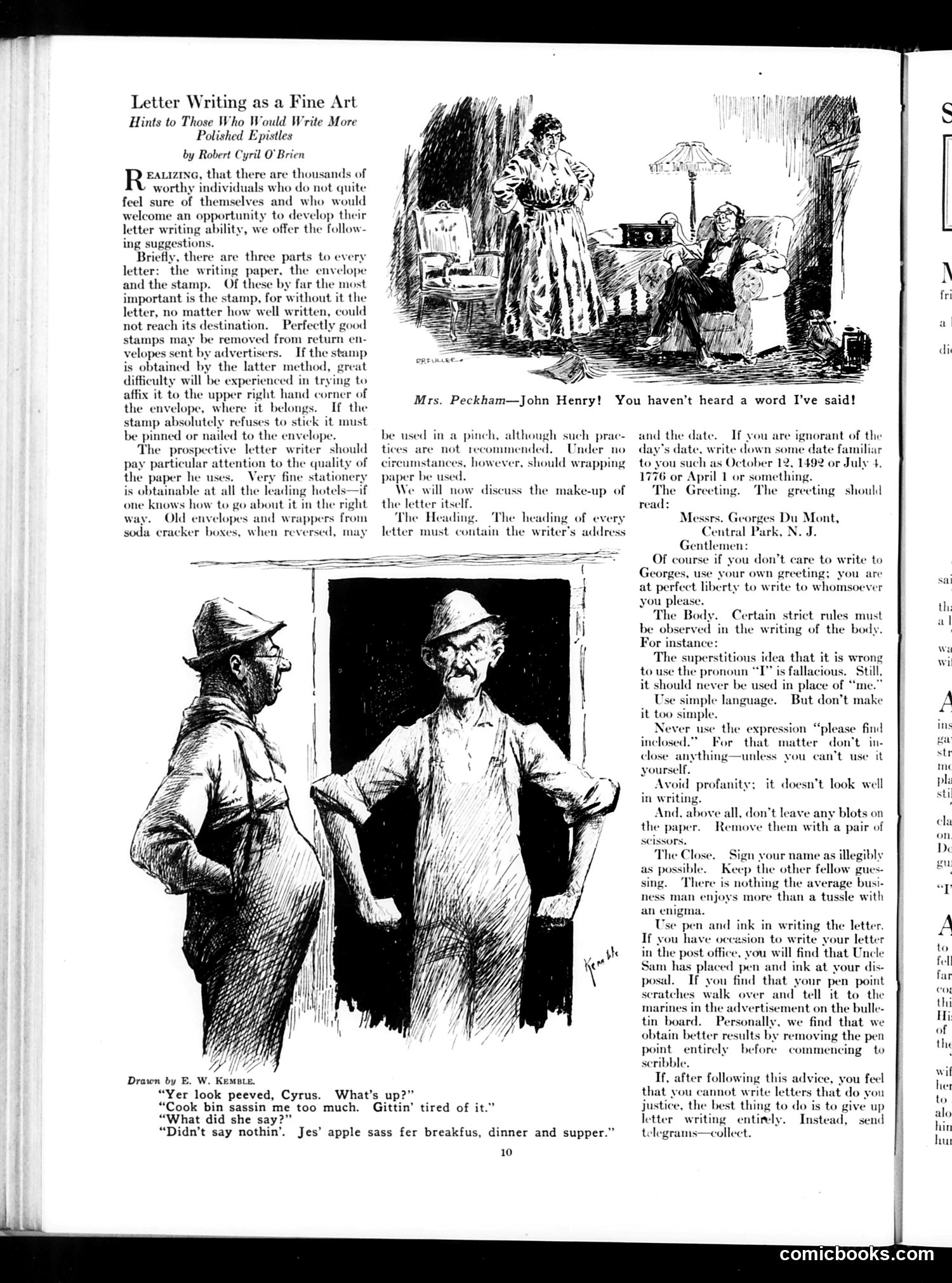
This is a humorous instructional article by Robert Cyril O'Brien offering deliberately absurd advice on letter writing. The satire works through intentional contradiction: O'Brien recommends using recycled soda cracker box envelopes, pinning stamps that won't stick, dating letters with historically inaccurate dates (1492, 1776), and signing illegibly so recipients must struggle to read the name. The accompanying cartoon by E.W. Kemble shows a domestic dispute—"Cyrus" complaining that his cook served "apple sass" (applesauce) for every meal. This illustrates marital frustration through food rather than letter-writing, providing comic relief. The entire piece mockingly critiques pretentious letter-writing guides popular at the time, suggesting that rigid etiquette rules were absurd. The final punchline—simply send telegrams instead—undercuts all preceding advice, exposing the article as pure satire on overwrought politeness manuals.
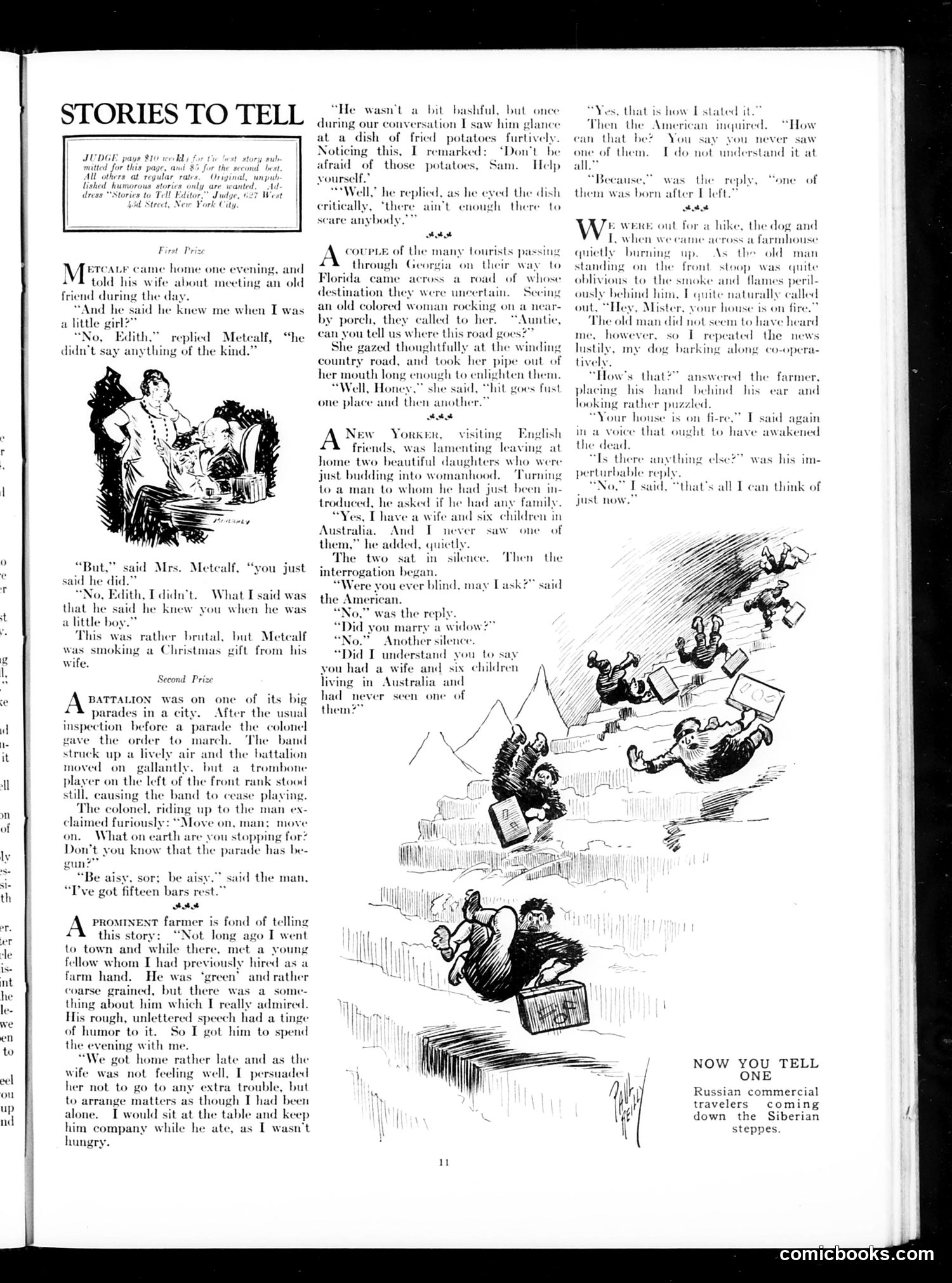
This page contains three humorous anecdotes typical of early 20th-century American magazine humor: 1. **Metcalf's Insult**: A husband embarrasses his wife by correcting her misremembering of a conversation—she thought he said a friend knew her as a girl, but he actually said the friend knew *him* as a boy. The joke relies on the husband's blunt correction while smoking a Christmas gift (implying he can afford to be rude to his wife). 2. **The Trombone Player**: A soldier stops marching during a military parade because he still has "fifteen bars" left to play from sheet music. The humor comes from the soldier's literal-minded, working-class Irish accent ("Be aisy, sor") prioritizing his musical part over military discipline. 3. **The Farm Hand and Potatoes**: A farmer invites his former hired hand to dinner. The hand hesitates before taking potatoes, thinking they might be reserved. The joke satirizes class anxiety and rural manners. The large illustration shows people sledding or sliding downhill chaotically—likely accompanying a separate story about tourists or travelers. The final brief anecdote involves Australian family separation, playing on immigration-era humor about distant relatives.
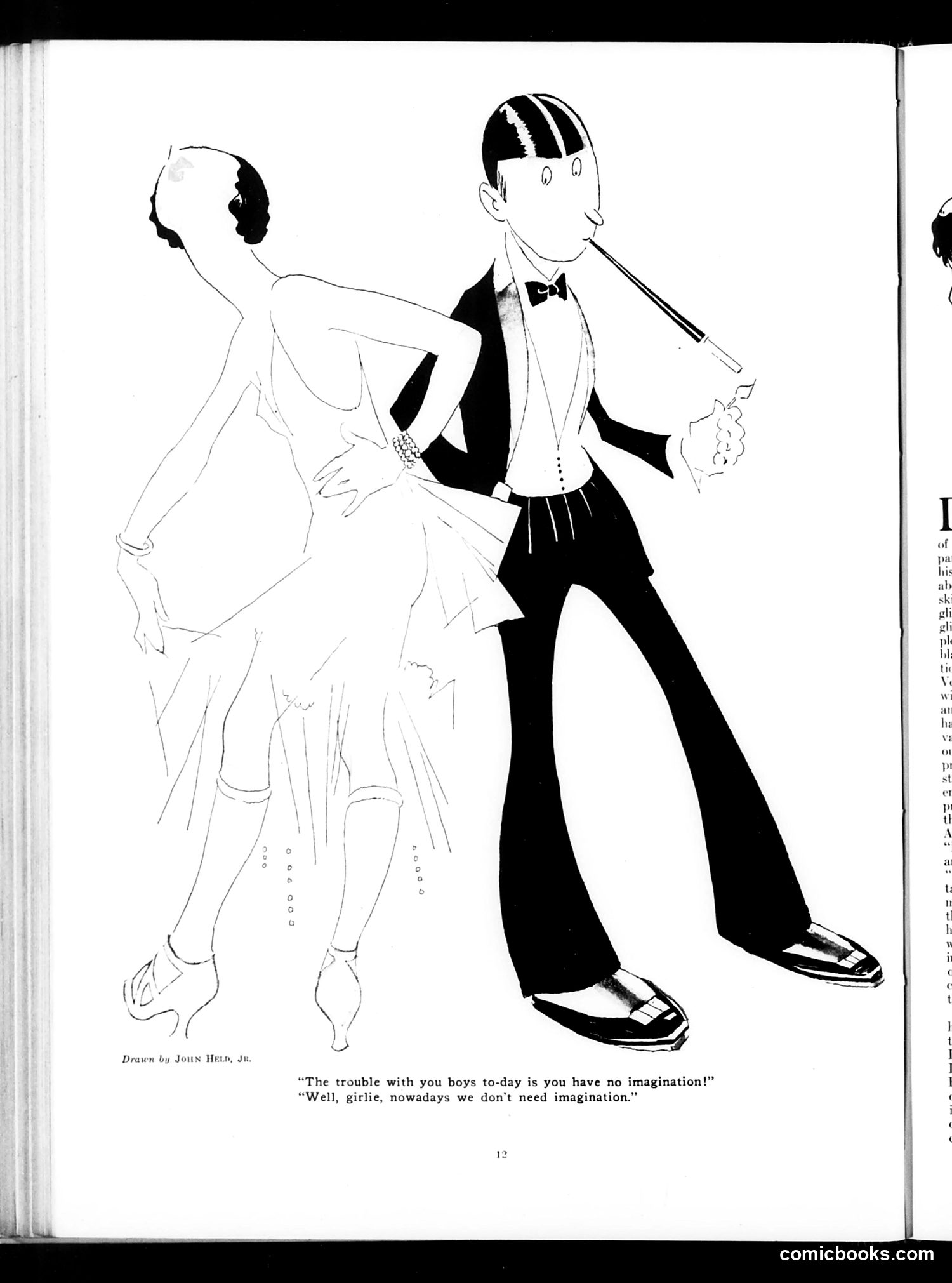
This is a satirical exchange between a woman in an elegant evening gown and a man in formal attire with a cigarette. The woman criticizes young men for lacking imagination; the man dismisses her concern, claiming modern times have eliminated that need. The satire likely targets early 20th-century modernity and changing gender dynamics. The woman represents traditional values emphasizing creativity and courtship; the man embodies a new, pragmatic masculinity unburdened by romantic idealism. His response suggests modern life—technology, mass culture, or changing social norms—has made imagination unnecessary, perhaps implying superficiality or reduced aspiration. The artwork by John Held Jr. (a prominent Judge cartoonist known for satirizing Jazz Age culture) uses sleek, fashionable styling to emphasize the contrast between old and new attitudes.
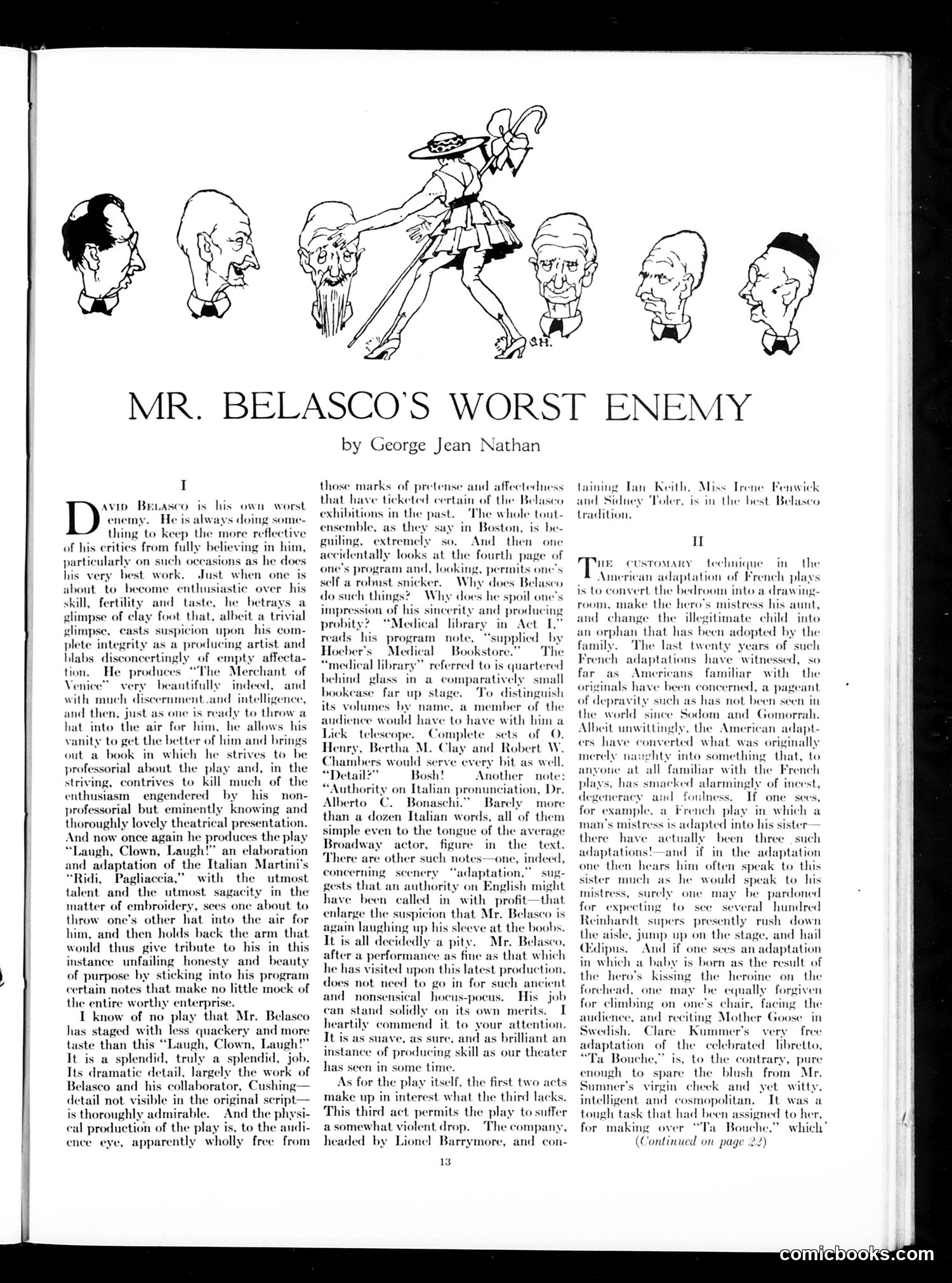
This is George Jean Nathan's theatrical critique of producer-director David Belasco's production of "Laugh, Clown, Laugh!" The cartoon's five caricatured male heads likely represent Belasco and collaborators or critics. Nathan praises Belasco's actual theatrical work as excellent and sincere, but savagely mocks his self-undermining pretentiousness. Belasco includes program notes crediting a medical library to a specific bookstore, attributing Italian pronunciation to an expert, and other unnecessary scholarly attributions. Nathan's point: these pedantic, show-offy notes betray vanity and affectation, contradicting the play's genuine artistry. The satire targets how successful artists sabotage themselves through ego—Belasco's need to appear erudite and authoritative paradoxically suggests the opposite, undermining the work's integrity. The title captures this paradox: Belasco is his own worst enemy through these petty vanities.
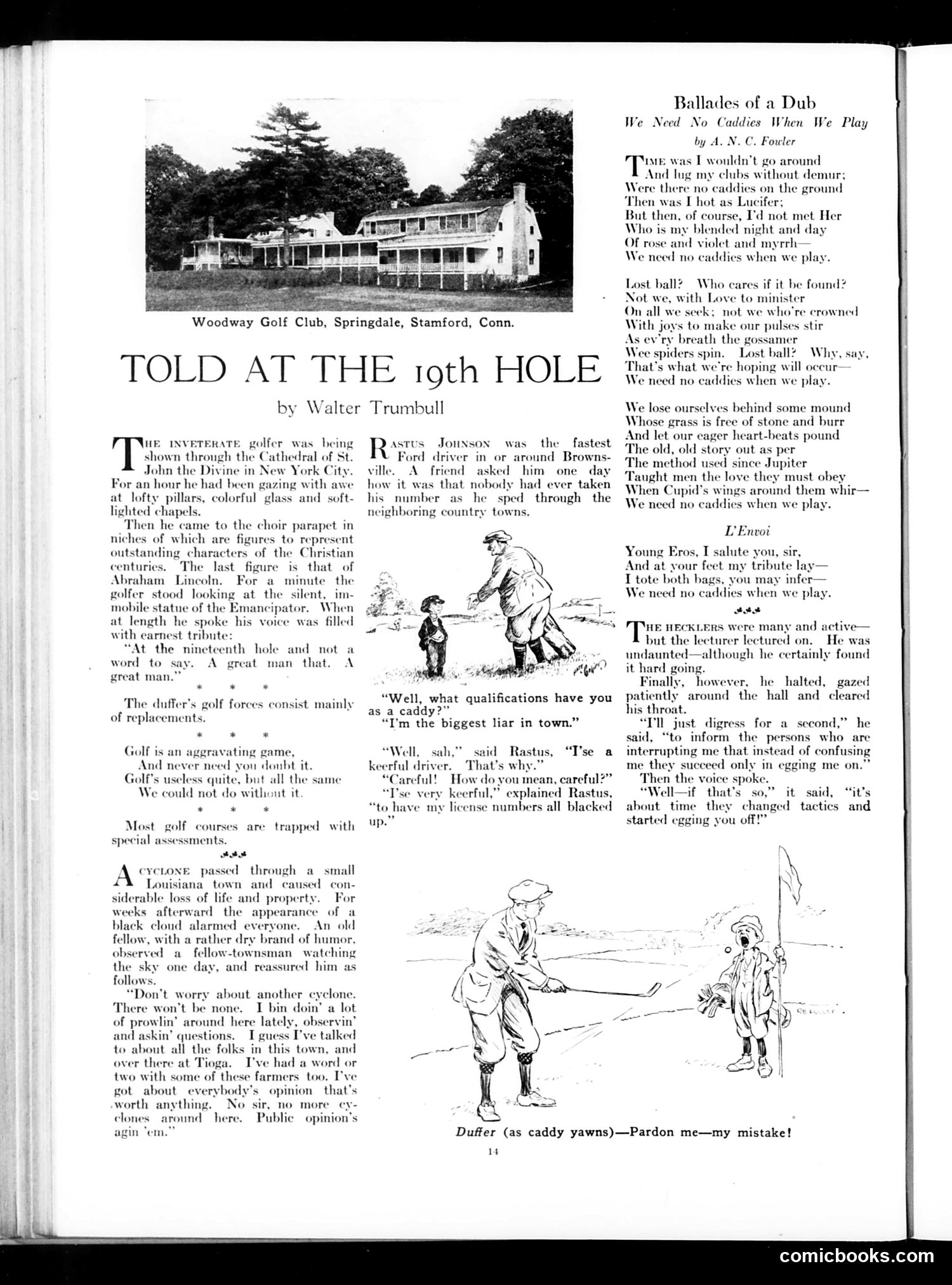
This page from *Judge* magazine contains three golf-themed humorous stories and a romantic poem, typical of early 20th-century American satire. **Main stories:** 1. **"Told at the 19th Hole"** (Trumbull): A reverent golfer tours St. John the Divine cathedral in NYC, viewing statues of Christian historical figures including Abraham Lincoln. His only comment: at the 19th hole (golf's final hole, metaphorically representing life's end), Lincoln is "a great man" for saying nothing—satirizing golfers' obsession with their sport above all else. 2. **Rastus Johnson anecdote**: A Black character brags about reckless driving while evading traffic enforcement by obscuring license plates—humor based on racial stereotypes and criminal behavior. 3. **Cyclone story**: An old man claims public opinion prevents future cyclones, satirizing faith in collective sentiment. **Secondary content** includes the poem "Ballades of a Dub" (romantic golf references) and a lecturer confronting hecklers. The satire targets golf culture's absurdity and human nature's quirks.
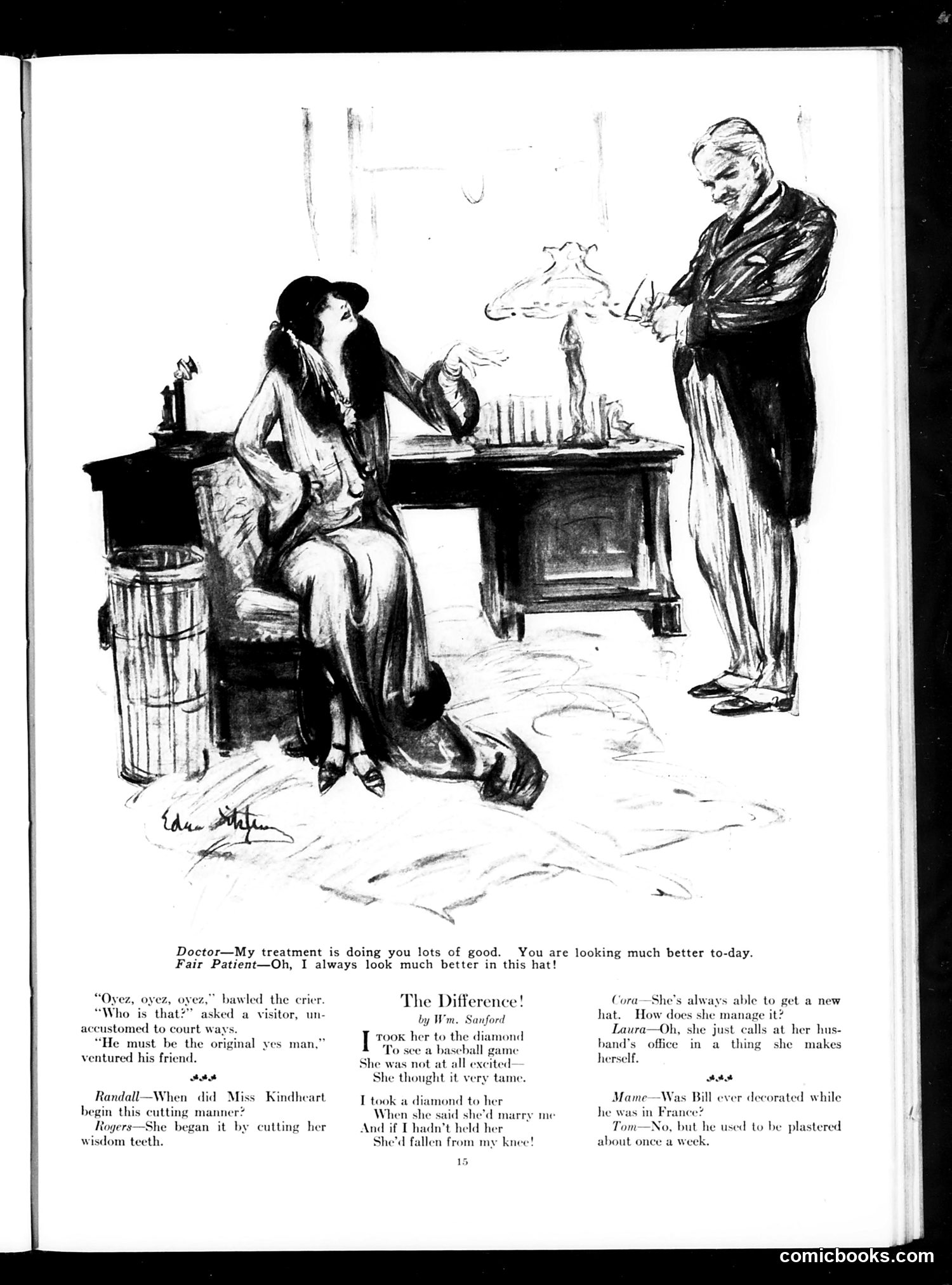
This page contains several brief humorous anecdotes typical of early 20th-century Judge magazine: The main cartoon depicts a doctor complimenting a female patient on her improved appearance, but she reveals her good looks are merely due to wearing an attractive hat—a joke about women's vanity and the power of millinery fashion. Below are several short jokes: one mocking an obsequious "yes man"; another playing on "cutting manner" as both social rudeness and teething; a poem contrasting a woman's indifference to baseball versus her excitement over diamond jewelry (engagement ring); and wordplay jokes about courtroom etiquette, Miss Kindheart's teeth-cutting, and a soldier who got "plastered" (drunk) rather than decorated (awarded medals) in France. The humor relies on puns, stereotypes about women's materialism, and casual references to WWI. These represent typical Judge content: light, domestically-focused satire aimed at middle-class readers.
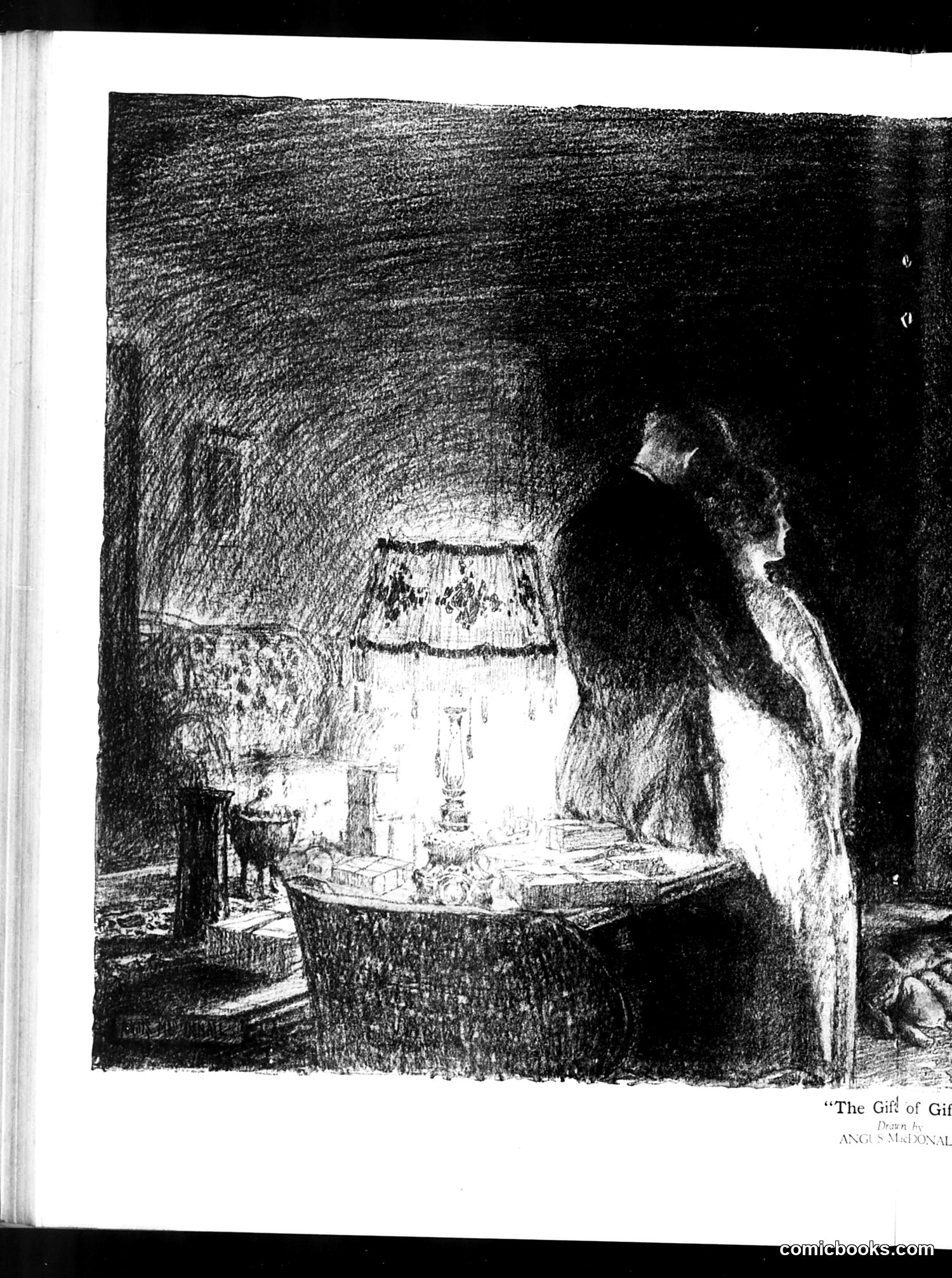
This appears to be an illustration titled "The Gift of Gif" drawn by Angus MacDonald for *Judge* magazine. The image shows a man in formal attire observing an ornate interior space with a domed ceiling and decorated lampshade. Without additional context or a clearer OCR of the full text, I cannot definitively identify the specific political or social reference being satirized. The title "Gift of Gif" is unclear—it may reference a person, concept, or event contemporary to the magazine's publication, but I cannot confirm the precise meaning or joke without more information. The drawing's style suggests early-to-mid 20th century satirical commentary, likely about wealth, architecture, or social pretension.
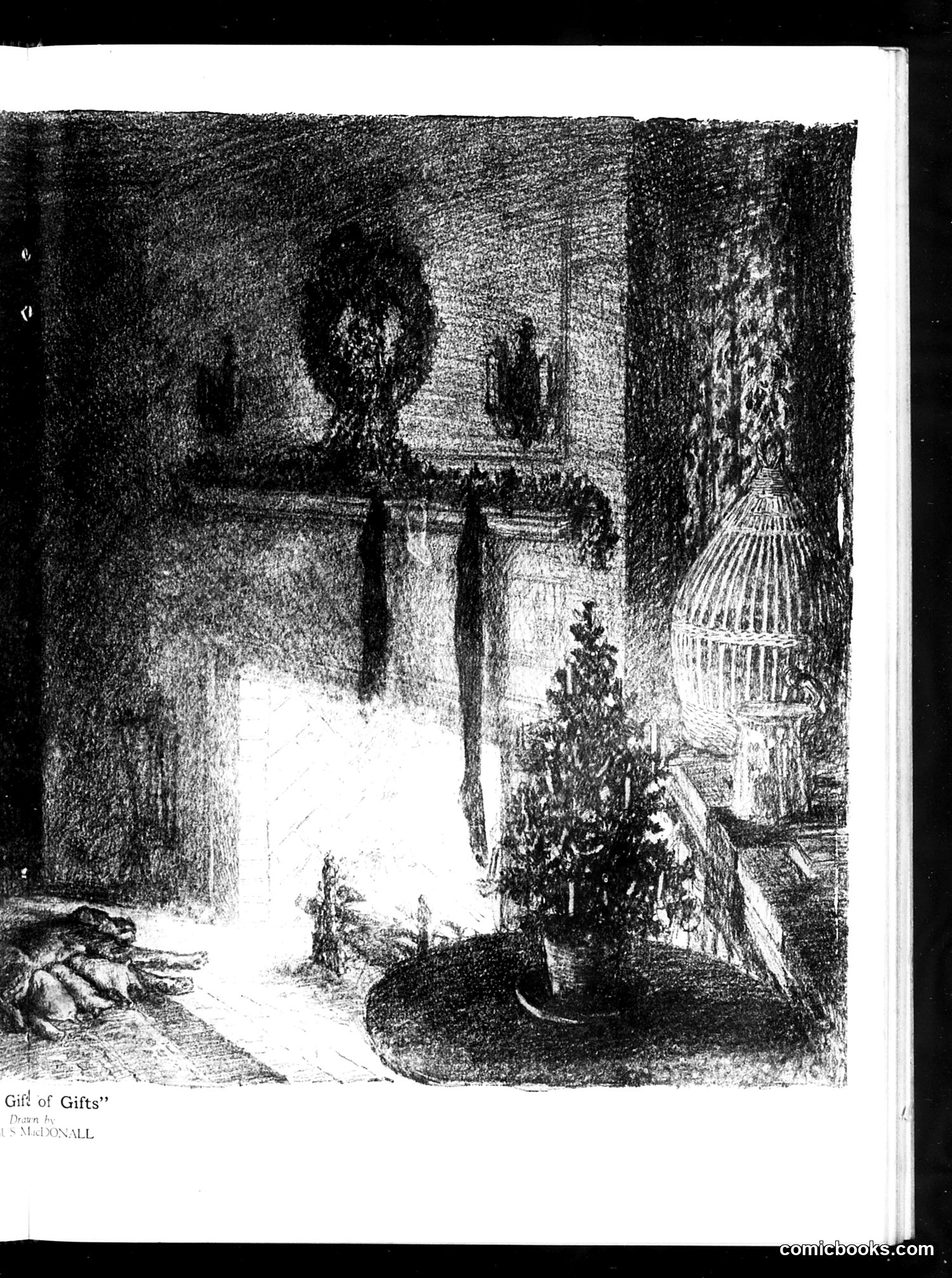
This artwork by C. M. Donnall depicts an interior architectural scene—a grand hallway or corridor with classical elements like columns and a domed ceiling. The composition shows dramatic lighting streaming through an opening, illuminating what appears to be decorative objects or furnishings in the foreground. Without additional context from surrounding text or other page elements, the specific satirical subject matter is unclear. The title "Gift of Gifts" suggests the work may reference gift-giving customs, possibly critiquing materialism or social pretension. However, the precise political or social commentary cannot be definitively determined from the image alone. The architectural grandeur and theatrical lighting may indicate satire aimed at wealthy institutions or ostentatious display.
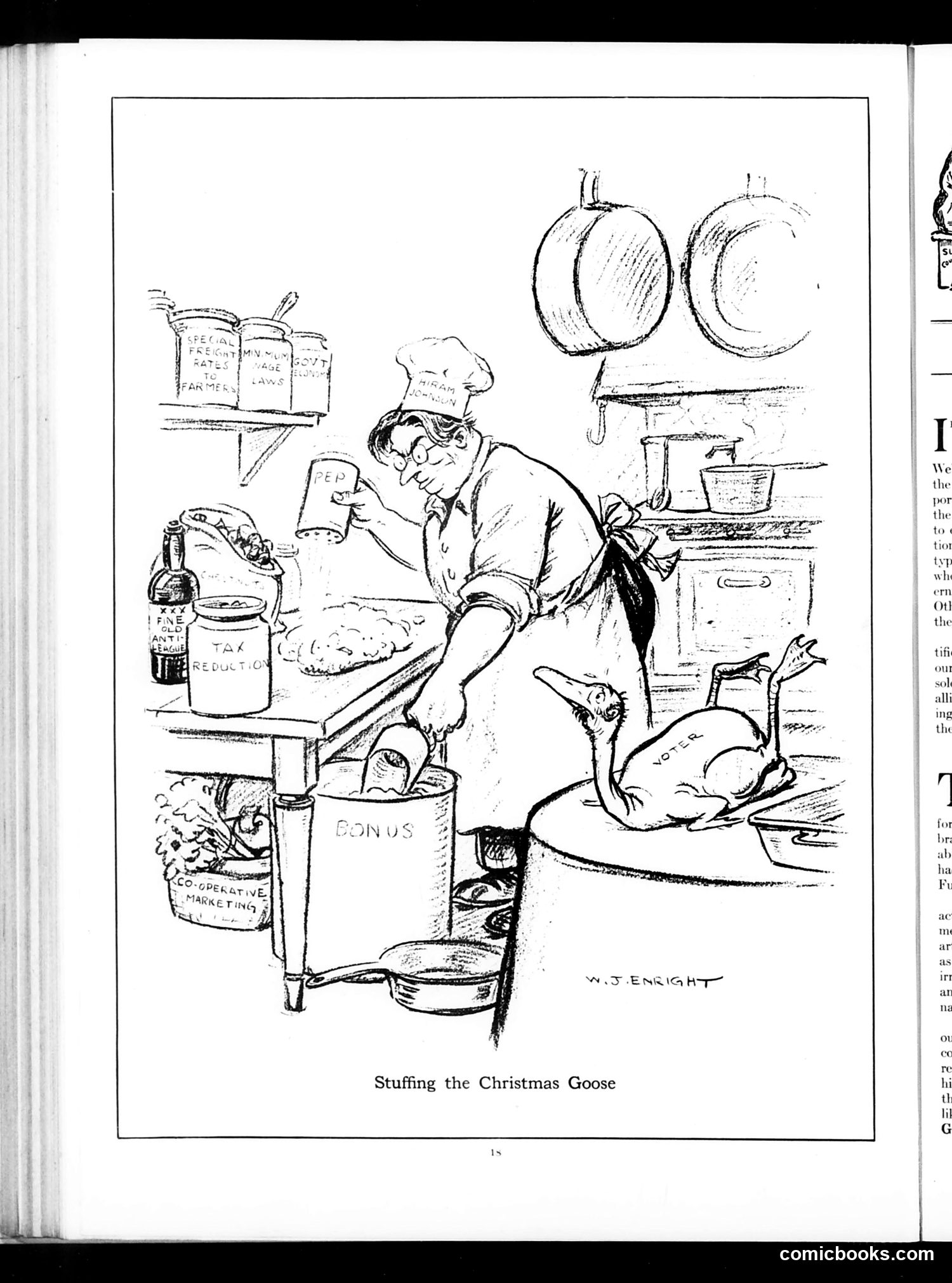
This cartoon satirizes wartime food production and marketing. A chef prepares a goose while surrounded by various packaged goods labeled with terms like "TAX REDUCTION," "FINE MARKETING," and what appears to be financial or political incentives. The visible ingredients and containers suggest the "stuffing" of the goose represents artificially inflating prices or profits through marketing tactics and tax policies rather than genuine value. The cartoon critiques how businesses use patriotic messaging (the Christmas goose as a holiday staple) and government policies to justify higher consumer costs. It's a commentary on wartime profiteering and how corporations "stuff" products with hidden costs disguised as necessary measures. The exaggerated chef character emphasizes the absurdity of the practice.
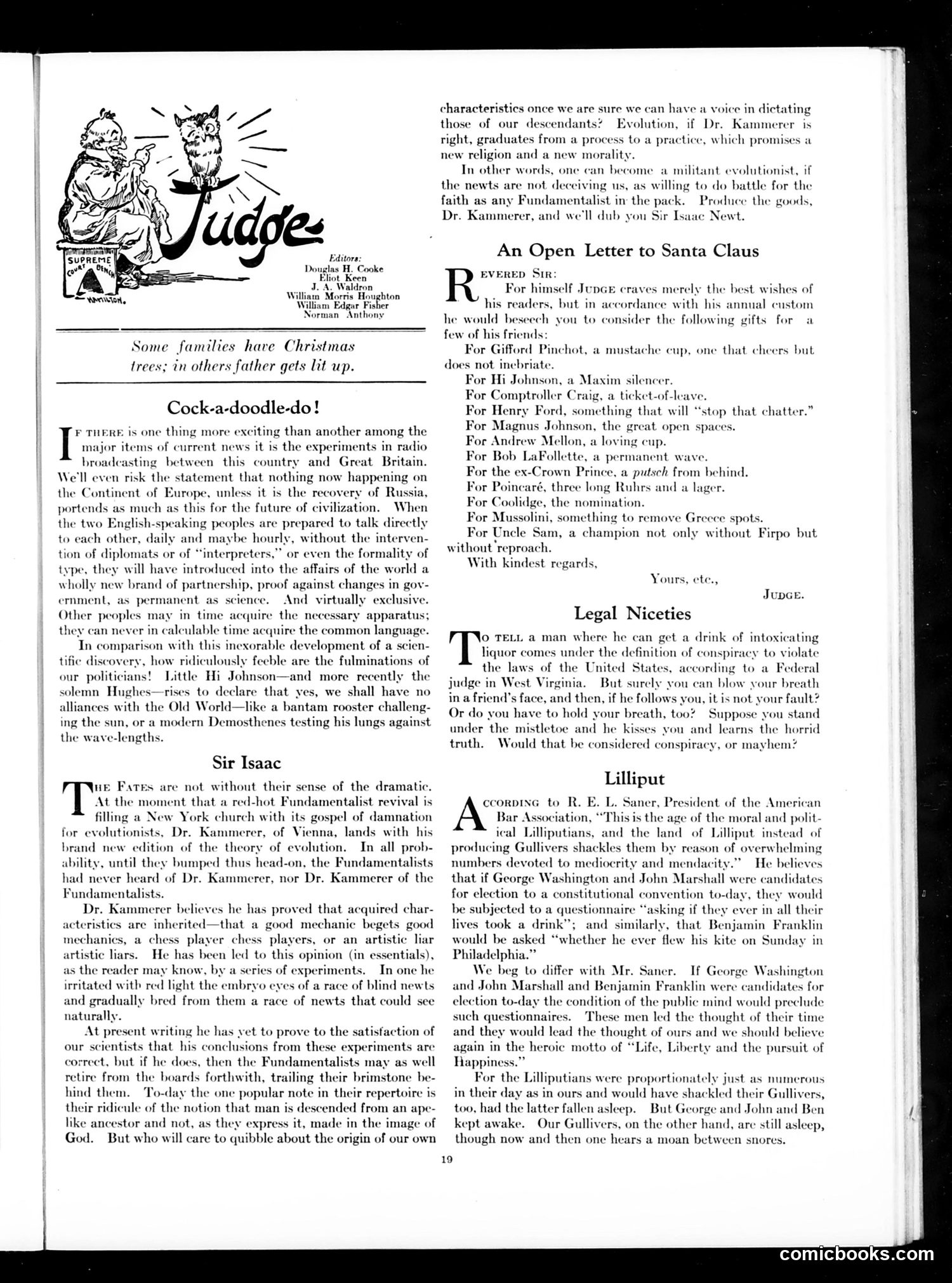
The page contains three distinct satirical pieces: **"Cock-a-doodle-do!"** celebrates radio broadcasting between America and Britain as revolutionary for international relations, then mocks American politicians—specifically "Little Hi Johnson" and "solemn Hughes"—who oppose alliances with Europe. The comparison to a rooster challenging the sun ridicules their futile isolationism against inevitable global connection. **"Sir Isaac"** satirizes the collision between religious Fundamentalism and evolutionary science. Dr. Kammerer's experiments on inherited acquired traits become a weapon against Fundamentalist ridicule of human-ape descent. The piece suggests if Kammerer succeeds, evolutionists could become as militantly faithful as religious fundamentalists—punning his name as "Sir Isaac Newt." **"An Open Letter to Santa Claus"** is mock-serious gift suggestions for public figures. Gifford Pinchot receives a "mustache cup" (a drinking vessel with a mustache guard—likely mocking his appearance), while "Hi Johnson" gets a "Maxim silencer" (a gun silencer), humorously wishing for his political silence. All three target progressive-era politicians and religious conservatives.
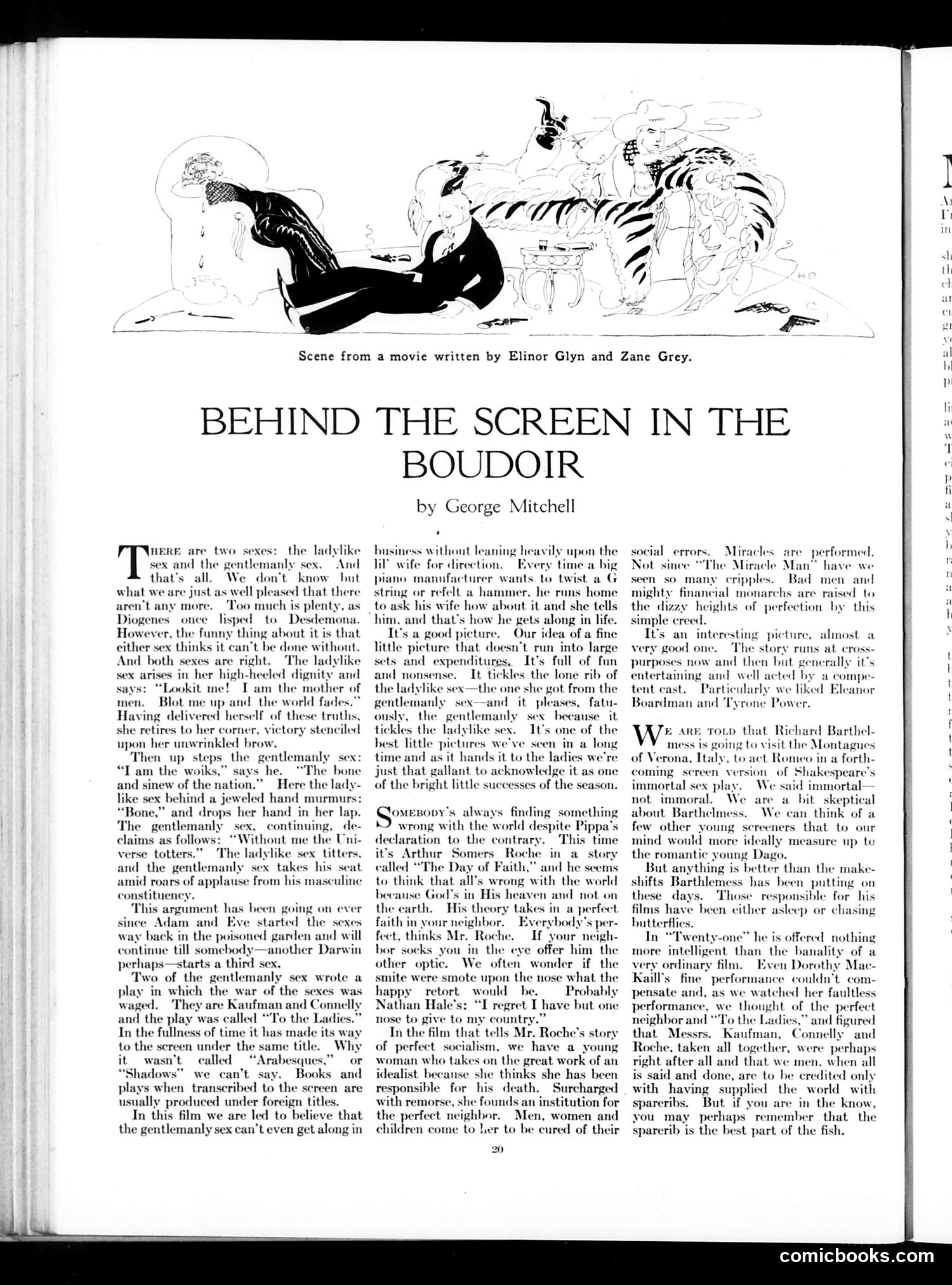
This page contains two film reviews by George Mitchell from Judge magazine, satirizing popular movies and contemporary attitudes about gender roles. **The cartoons** illustrate scenes from films written by Elinor Glyn and Zane Grey—prominent early Hollywood screenwriters known for romantic melodramas. **The satire targets**: 1. **"To the Ladies"** – Mitchell mocks a play-turned-film where successful businessmen supposedly depend entirely on their wives' guidance, despite the men's claims of importance. The joke: the film pleases both sexes by letting each believe they're essential, while actually depicting male incompetence. 2. **"The Day of Faith"** – Mitchell ridicules Arthur Somers Roche's story promoting extreme altruism and "perfect socialism" where victims forgive attackers. He sarcastically questions whether this philosophy would survive a punch to the nose, invoking Nathan Hale's patriotic quote absurdly. Both reviews mock early cinema's sentimental moralizing and gender politics—the contradiction between masculine bluster and actual dependence on women, and the unrealistic idealism of uplift narratives.
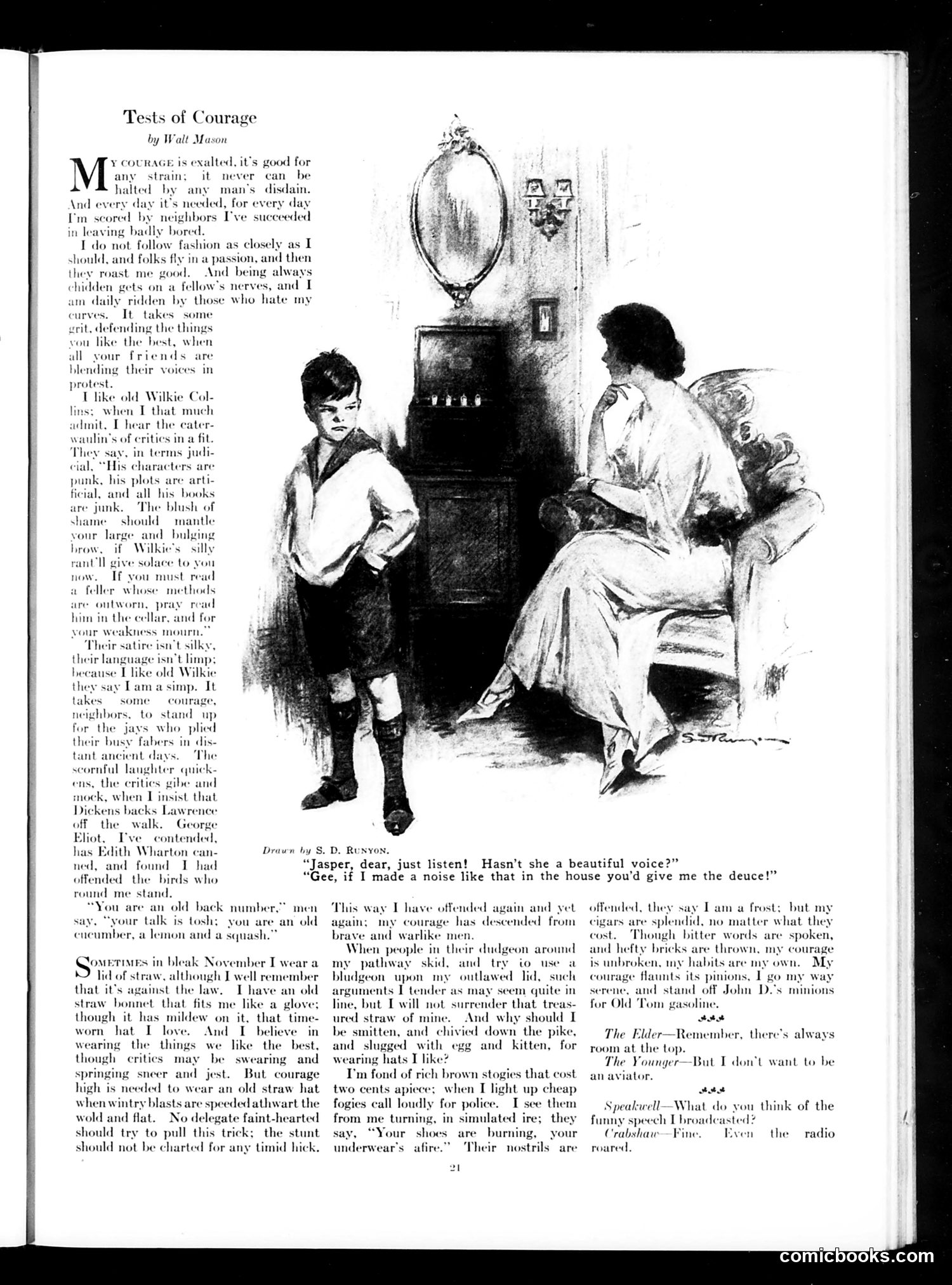
This page contains a humorous essay-poem by Walt Mason advocating for nonconformity and personal courage. Mason defends his tastes—liking Victorian authors like Wilkie Collins and Charles Dickens, wearing an old moldy straw hat despite fashion, and smoking cheap cigars—despite social ridicule. Critics mock these choices as outdated and vulgar, but Mason argues that defending unpopular preferences requires genuine courage. The illustration by S.D. Runyon shows a woman singing while a man winces—accompanying a joke about her "beautiful voice," with his retort that such noise at home would earn punishment. The page's broader theme reflects early 20th-century anxiety about conformity and social judgment, celebrating individualism while acknowledging the social costs of defying consensus taste.
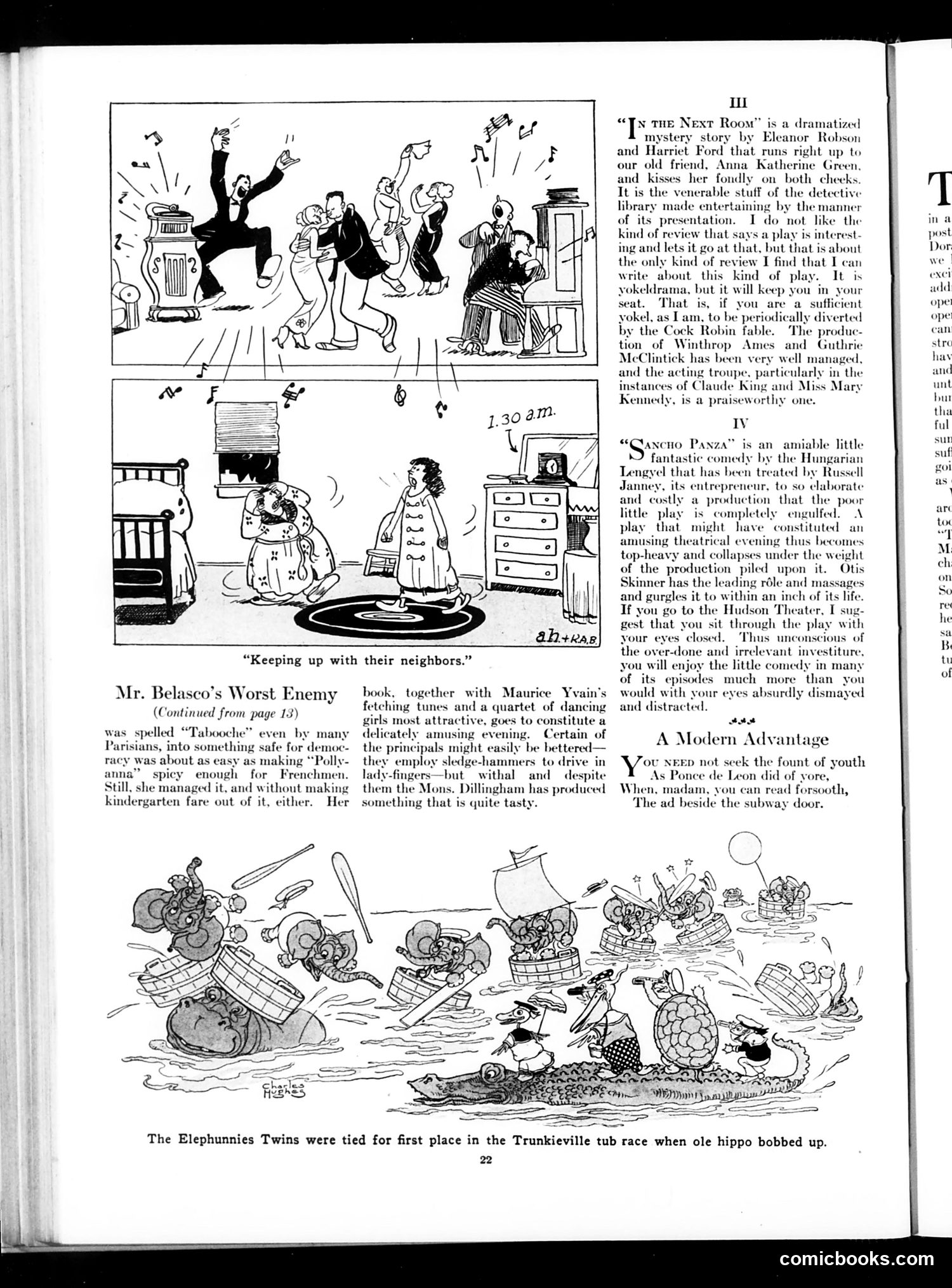
This page contains **theater reviews** rather than political cartoons. The critic discusses three Broadway productions: 1. **"In the Next Room"** — A detective play adapted from Eleanor Robson and Harriet Ford, praised as entertaining despite employing crude theatrical tactics ("sledge-hammers"). 2. **"Sancho Panza"** — A Hungarian comedy by Russell Janney that the critic finds amusing but overwhelmed by excessive production design and Otis Skinner's over-acting. 3. **Mr. Belasco's production** — Referenced from a previous page. The top illustration shows a lively party scene labeled "Keeping up with their neighbors," depicting 1920s social entertainment. The bottom illustration is a whimsical cartoon about a hippo disrupting a toy boat race ("The Elephunnies Twins"). The final section, "A Modern Advantage," is light verse mocking modern advertising—specifically subway ads promising youth to women—reflecting contemporary consumer culture satire typical of Judge's humor.
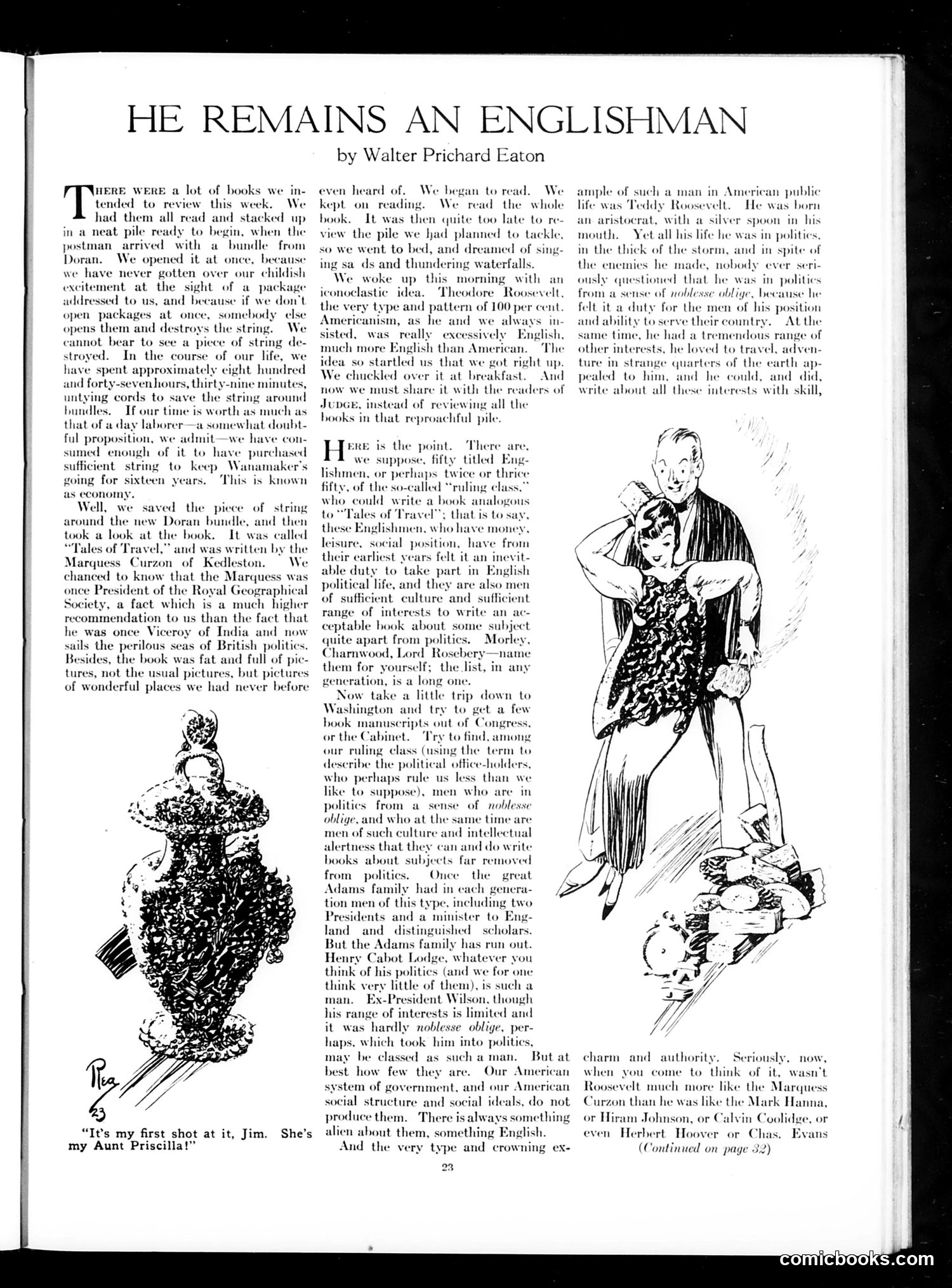
This is an essay by Walter Prichard Eaton, not primarily a political cartoon, though it includes illustrations. The piece argues that Theodore Roosevelt—despite being America's quintessential "100 per cent American"—actually embodies English cultural values more than American ones. Eaton's point: England's aristocratic "ruling class" produces cultured intellectuals who write books on diverse subjects while maintaining political involvement, viewing such work as *noblesse oblige* (noble duty). America's political leaders largely lack this breadth. Roosevelt is exceptional—a politician with genuine intellectual range and cultural sophistication. Eaton contrasts this with the decline of America's Adams family dynasty and suggests figures like Ex-President Wilson represent rare exceptions. The satire critiques American political culture for valuing narrow partisanship over the English model of cultivated gentlemen-statesmen. The accompanying illustrations appear to support this theme of cultural comparison.
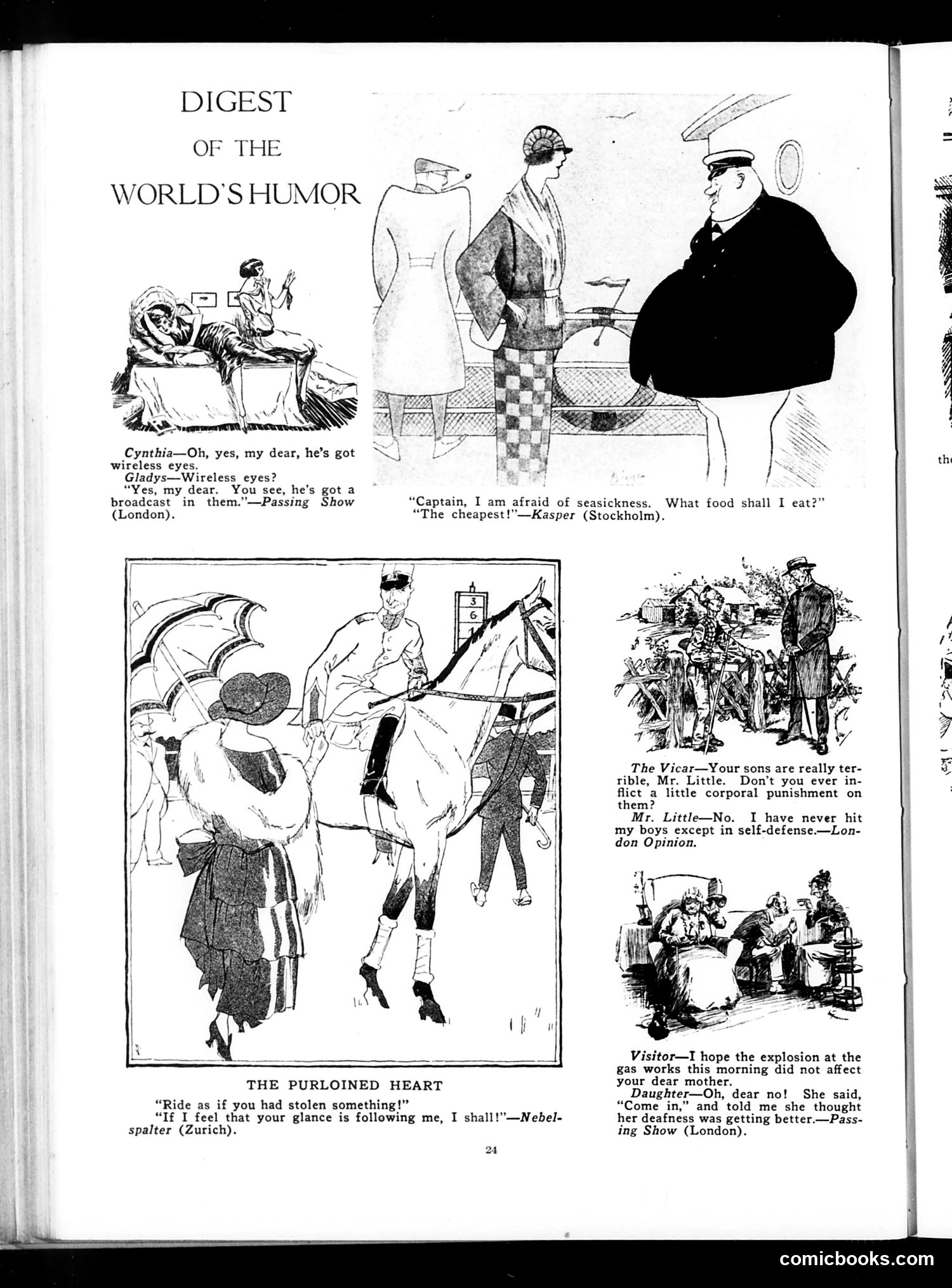
This page collects brief humorous anecdotes from various international publications, reflecting early 20th-century comedy sensibilities. **Key jokes:** 1. **"Wireless eyes"**: A pun on "wireless" (new radio technology) and a man's wandering gaze—he broadcasts his attraction openly. 2. **Seasickness remedy**: Dark humor about eating cheap food (presumably unappetizing) to cure nausea. 3. **"The Purloined Heart"**: A couple riding horseback; the woman jokes she must ride guiltily to match her lover's suspicious glance. 4. **Corporal punishment**: A father claims he only hits his sons "in self-defense"—implying they're so badly behaved they provoke it. 5. **Gas works explosion**: A visiting caller expresses concern; the daughter reveals her deaf mother didn't notice the explosion, suggesting her hearing loss is worsening (presented as comedic). These are lighthearted, often dark domestic and relationship humor typical of early 20th-century satirical magazines.
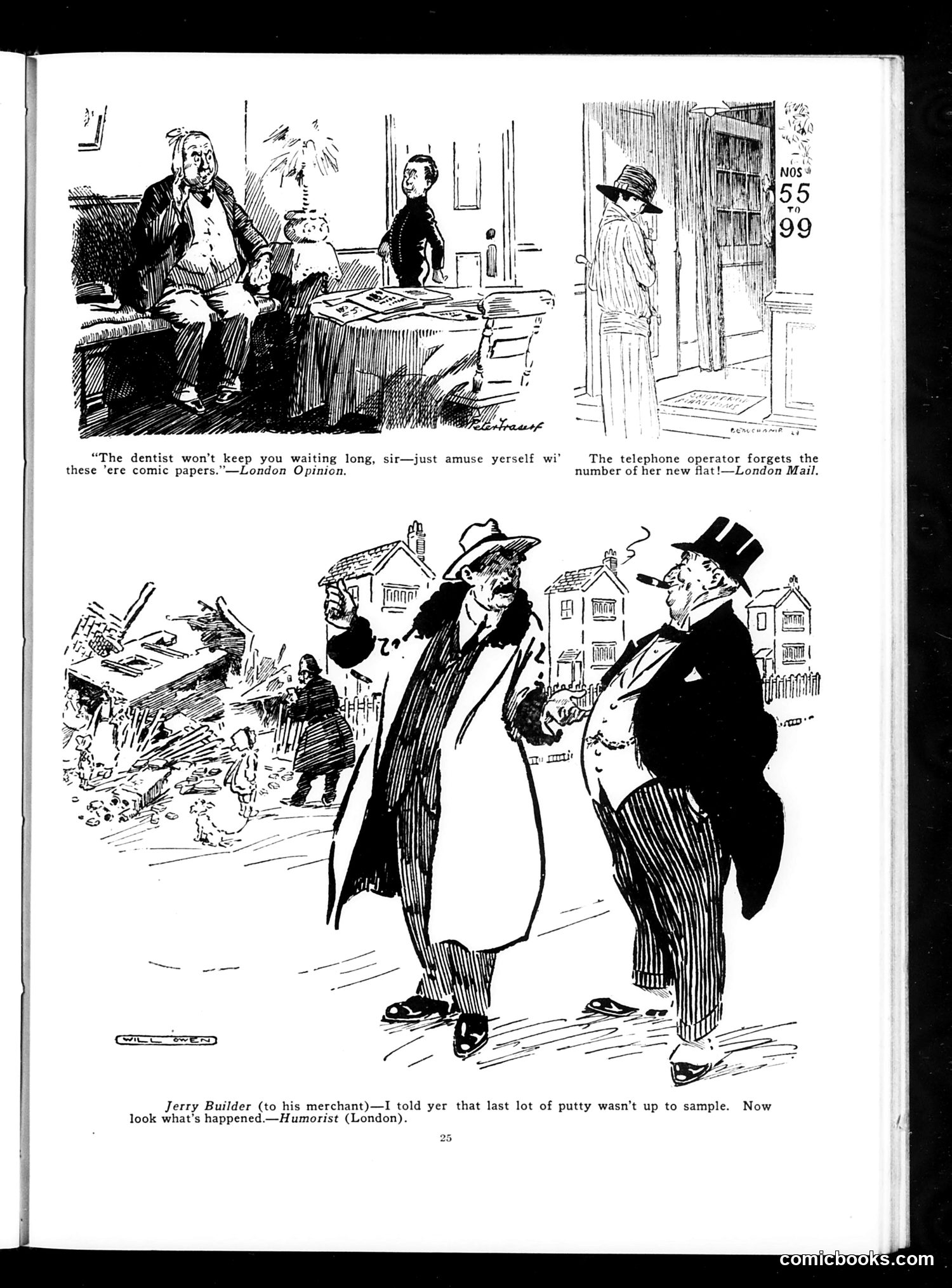
This page contains three separate jokes from British satirical publications, all poking fun at everyday incompetence and forgetfulness: 1. **Top left**: A dentist's waiting room where patients are given comic papers to pass time—satirizing the common practice of using cheap entertainment to distract anxious patients. 2. **Top right**: A telephone operator who is so distracted by her new flat that she forgets phone numbers—mocking absent-mindedness among service workers. 3. **Bottom**: A builder ("Jerry Builder") complains to his merchant that defective putty has caused structural damage—satirizing poor workmanship and shoddy building materials, common complaints in the construction industry. All three jokes target professional negligence and everyday frustrations, using caricatured figures to highlight social irritations familiar to the magazine's British readership.
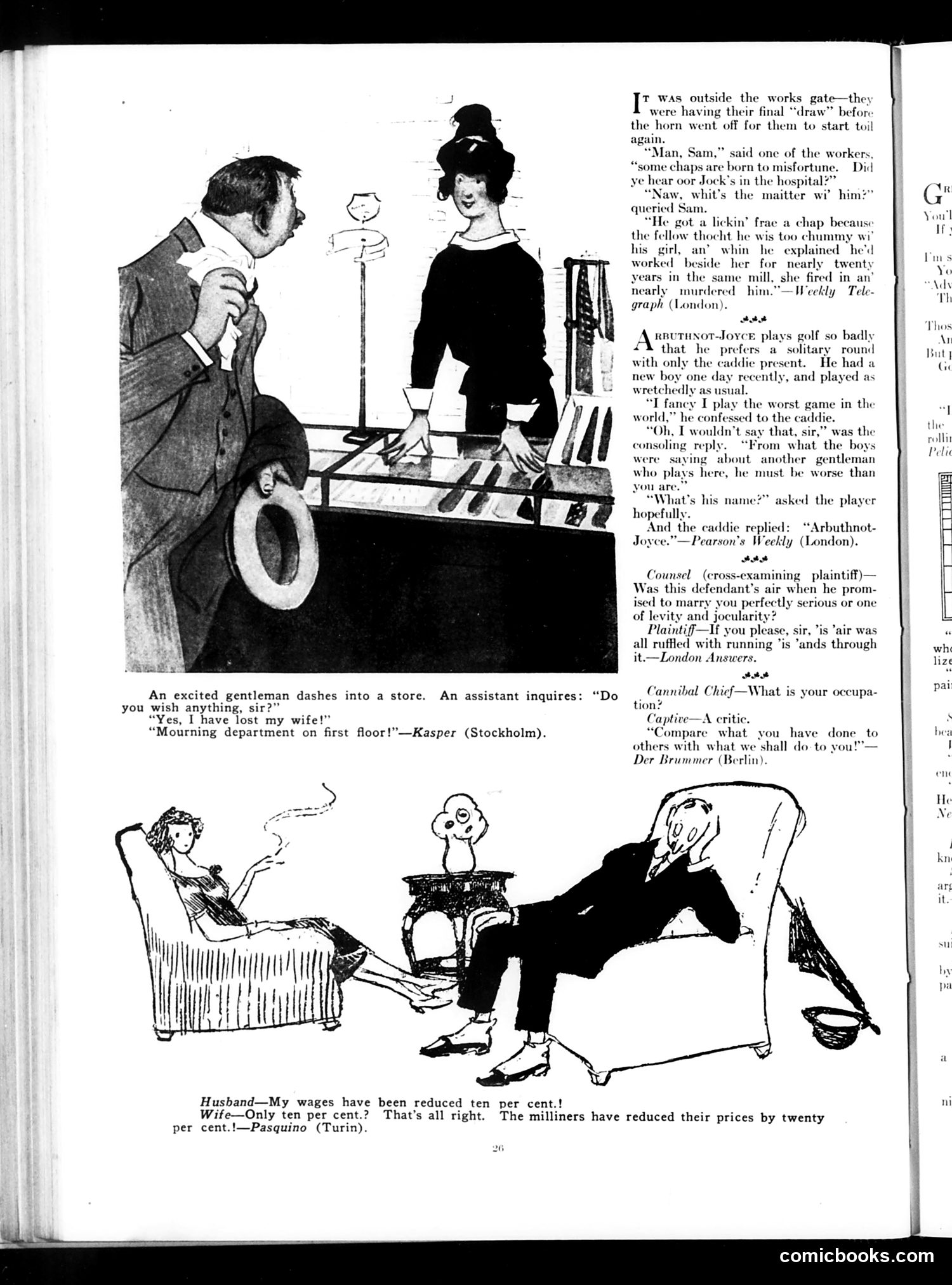
This page contains several brief satirical jokes from international sources, reflecting early 20th-century social commentary: **Top cartoon** (Stockholm): A man rushes into a store claiming he's lost his wife. The joke's dark humor lies in the assistant directing him to the "mourning department"—implying wives are so disposable that losing one is merely an occasion for purchasing mourning clothes. **Middle cartoon** (Turin): A husband announces his wages were cut 10%. His wife responds "only ten percent?" because the milliners have reduced prices by 20%—she's pleased the wage cut is smaller than the price reduction, showing her priorities and suggesting middle-class women's focus on shopping. **Other anecdotes** included cover workplace injuries, golf incompetence, courtroom testimony about marriage sincerity, and a cannibal-and-critic joke—all using ethnic/national stereotypes typical of the era's international humor exchanges. The page satirizes marriage dynamics, economic hardship, and social pretension across different cultures.
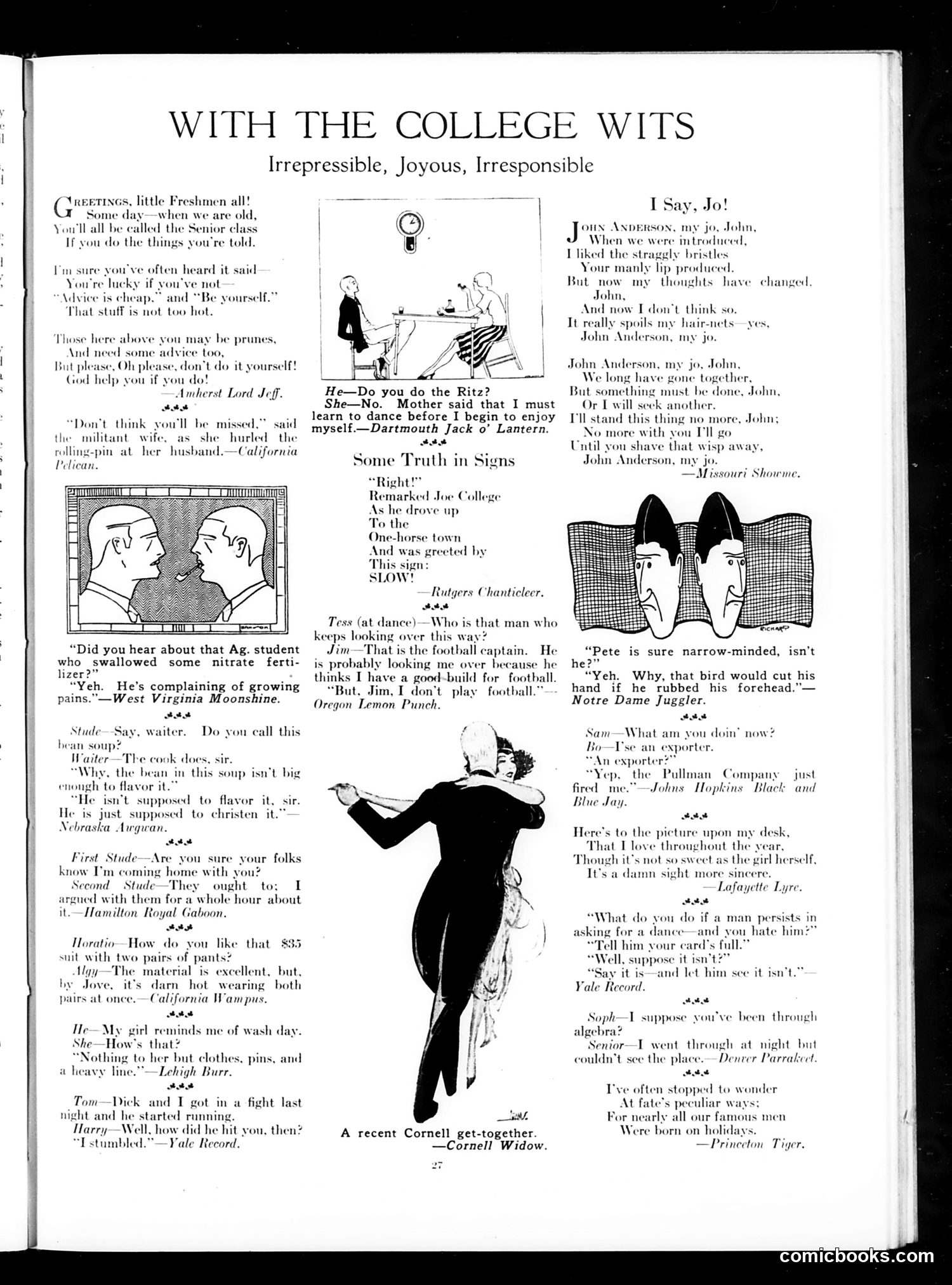
This page collects humorous anecdotes and light verse from various college magazines (Amherst, Cornell, Yale, etc.), satirizing undergraduate life in the early 20th century. The cartoons mock typical college stereotypes: freshmen receiving patronizing advice; students complaining about food quality and thin soup beans; a couple dancing (the "Cornell get-together" illustration showing two exaggerated faces). The humor targets familiar college experiences—dating mishaps, fashion complaints (wearing two pairs of pants), absurd conversations between students and waiters, and romantic disappointments. One piece mocks a girl rejecting a suitor because his facial hair is unfashionable ("John Anderson, my jo"). The "Some Truth in Signs" section jokes about a college student encountering a "SLOW" road sign in a small town—suggesting rural areas warn speeding college boys. Overall, this represents mainstream college humor: innocent pranks, courtship failures, and gentle mockery of student pretension. The content reflects 1920s-era campus culture with its emphasis on dating, appearance, and social hierarchy among underclassmen.
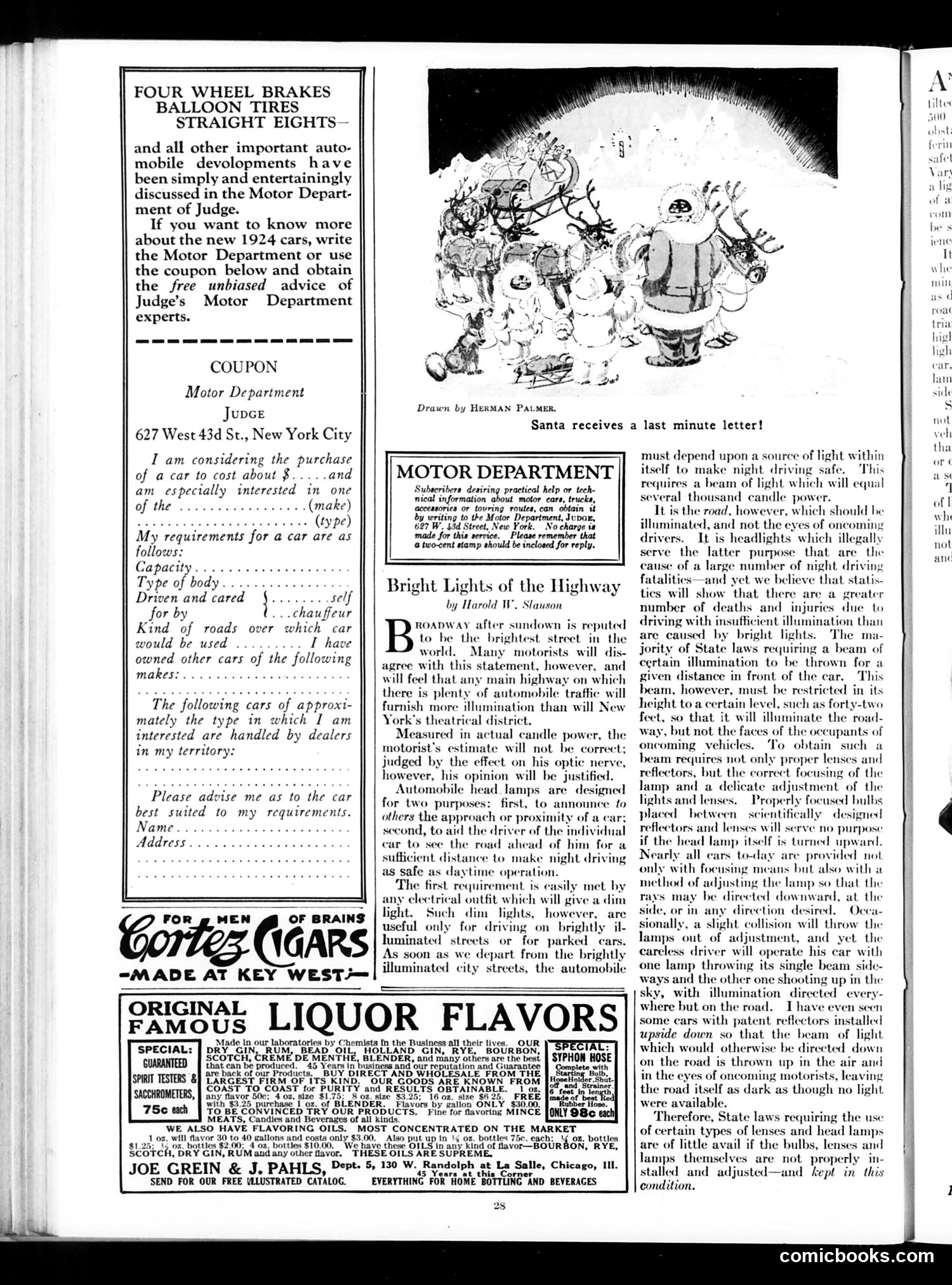
**The Main Cartoon:** Drawn by Herman Palmer, "Santa receives a last minute letter!" depicts Santa Claus surrounded by children and toys, humorously receiving correspondence at the last moment before Christmas delivery. The joke appears to be that even Santa needs to manage urgent communications—a relatable holiday theme for 1924 readers. **The Content:** The page is primarily **advertising and editorial material** rather than political satire. It includes: - A coupon for Judge's Motor Department offering free automobile advice (promoting 1924 car features like four-wheel brakes and straight-eight engines) - An article on automobile headlights titled "Bright Lights of the Highway" discussing safety concerns with insufficient road illumination - Advertisements for Cortez cigars and liquor flavoring products **Historical Context:** This reflects 1920s concerns about automobile safety and the emerging technology of electric headlights. The liquor advertising is notable given this is Prohibition-era America—these "flavoring oils" were marketed for "home bottling," a common legal workaround for home alcohol production.
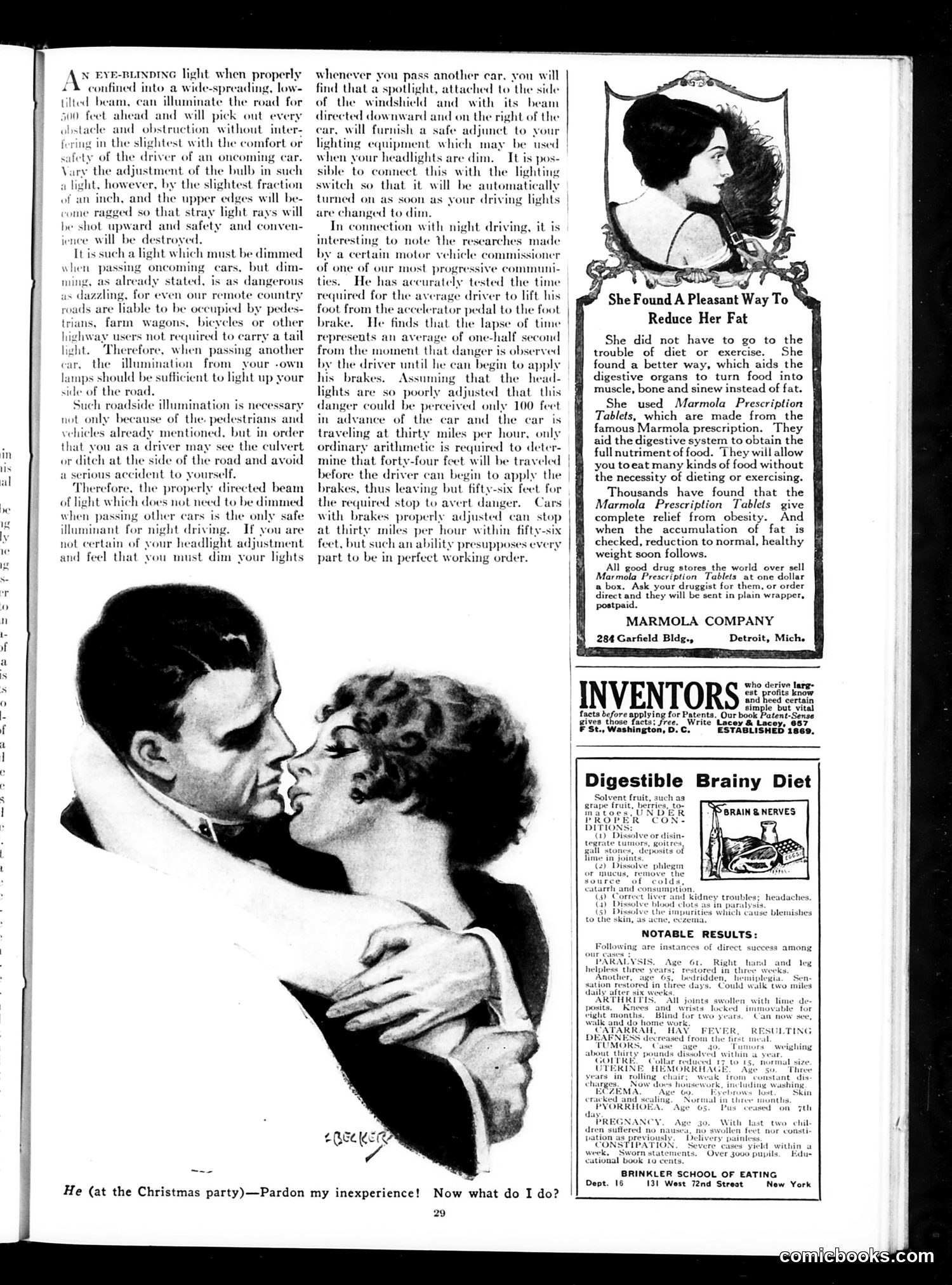
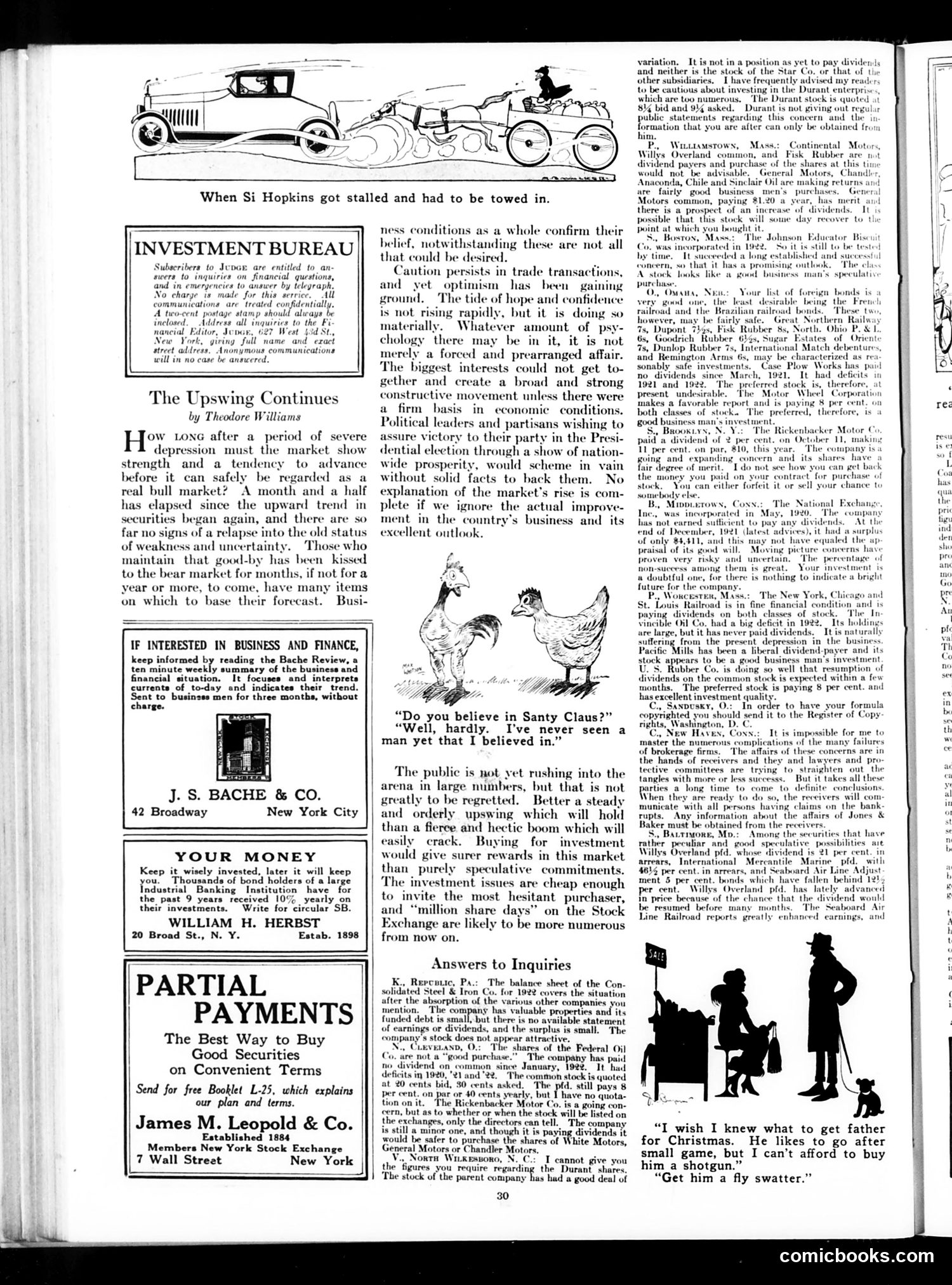
This page from Judge magazine features financial and investment content typical of the 1920s, when stock market enthusiasm was high. **The Cartoon**: "When Si Hopkins got stalled and had to be towed in" shows a car requiring towing—a humorous reference to a common occurrence with early automobiles, which frequently broke down. "Si Hopkins" appears to be a rural or working-class character type familiar to Judge's readers. **The Content**: The bulk of the page consists of investment advice and advertisements from financial firms (Bache & Co., Leopold & Co., Herbst). An article titled "The Upswing Continues" discusses the post-Depression market recovery, cautioning readers that while economic conditions are improving, the market's rise is based on genuine economic improvement, not mere speculation. **The Satirical Element**: A small cartoon shows someone claiming they don't believe in Santa Claus because "I've never seen a man yet that I believed in"—likely a cynical jab at financial promoters and market hype during this period of speculative excess. The page reflects 1920s optimism about business recovery and investment opportunities.
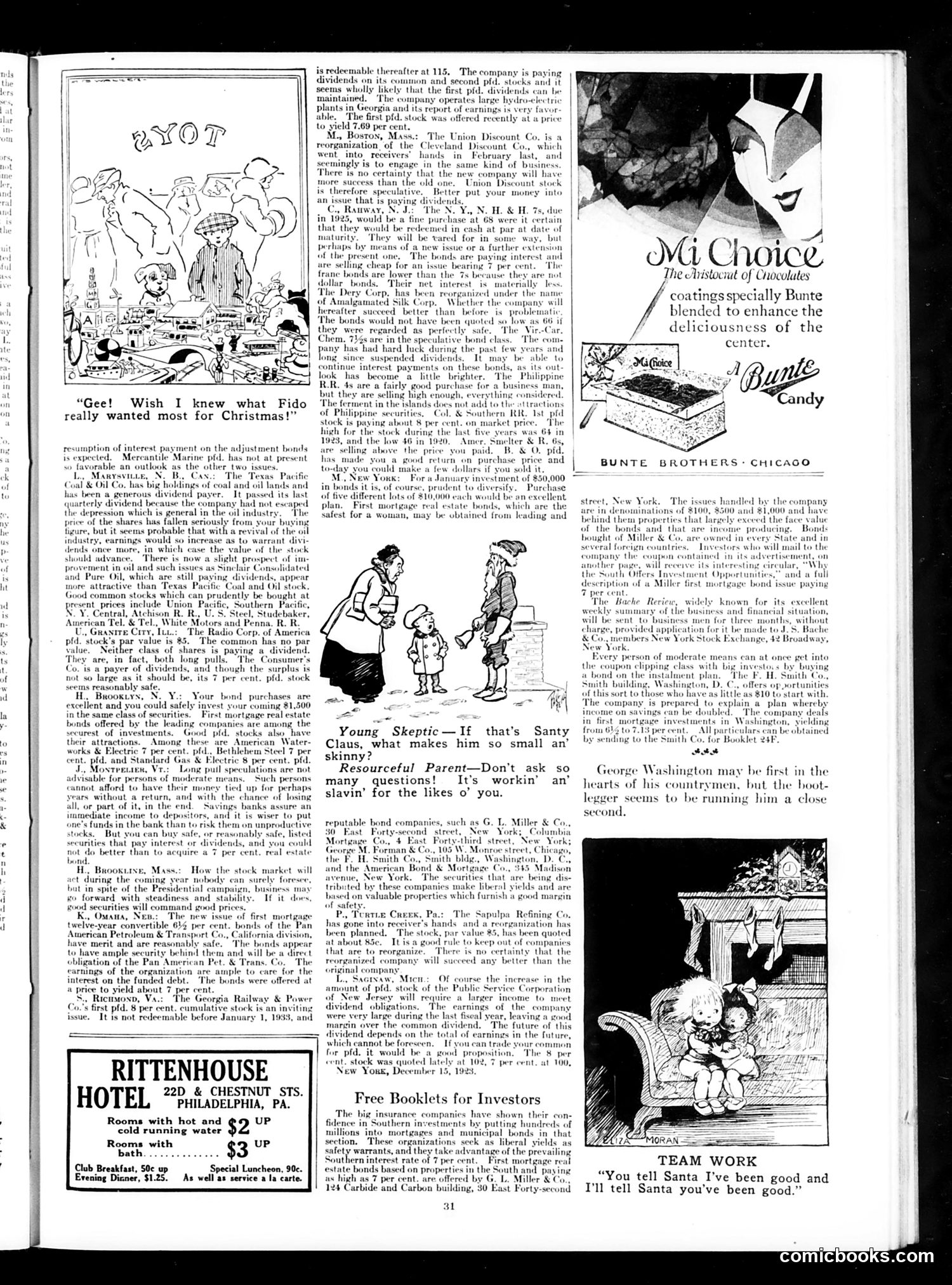
This page is primarily **financial and advertising content** rather than political satire. The main cartoon labeled "Gee! Wish I knew what Fido really wanted most for Christmas!" depicts a dog and family, illustrating a domestic Christmas scene—likely a lighthearted joke about pets' inscrutable wishes. The bulk of the page contains **investment advice columns** addressing readers' bond and stock inquiries, discussing rail securities, oil stocks, and mortgage bonds. There's also a **Bunte candy advertisement** and a "Team Work" cartoon about children being good for Santa. The only potentially satirical element is the "Young Skeptic" and "Resourceful Parent" exchange, which gently mocks parental excuses to children—but this is mild domestic humor rather than political commentary. **This is fundamentally a financial/advertising page with minimal satire.**
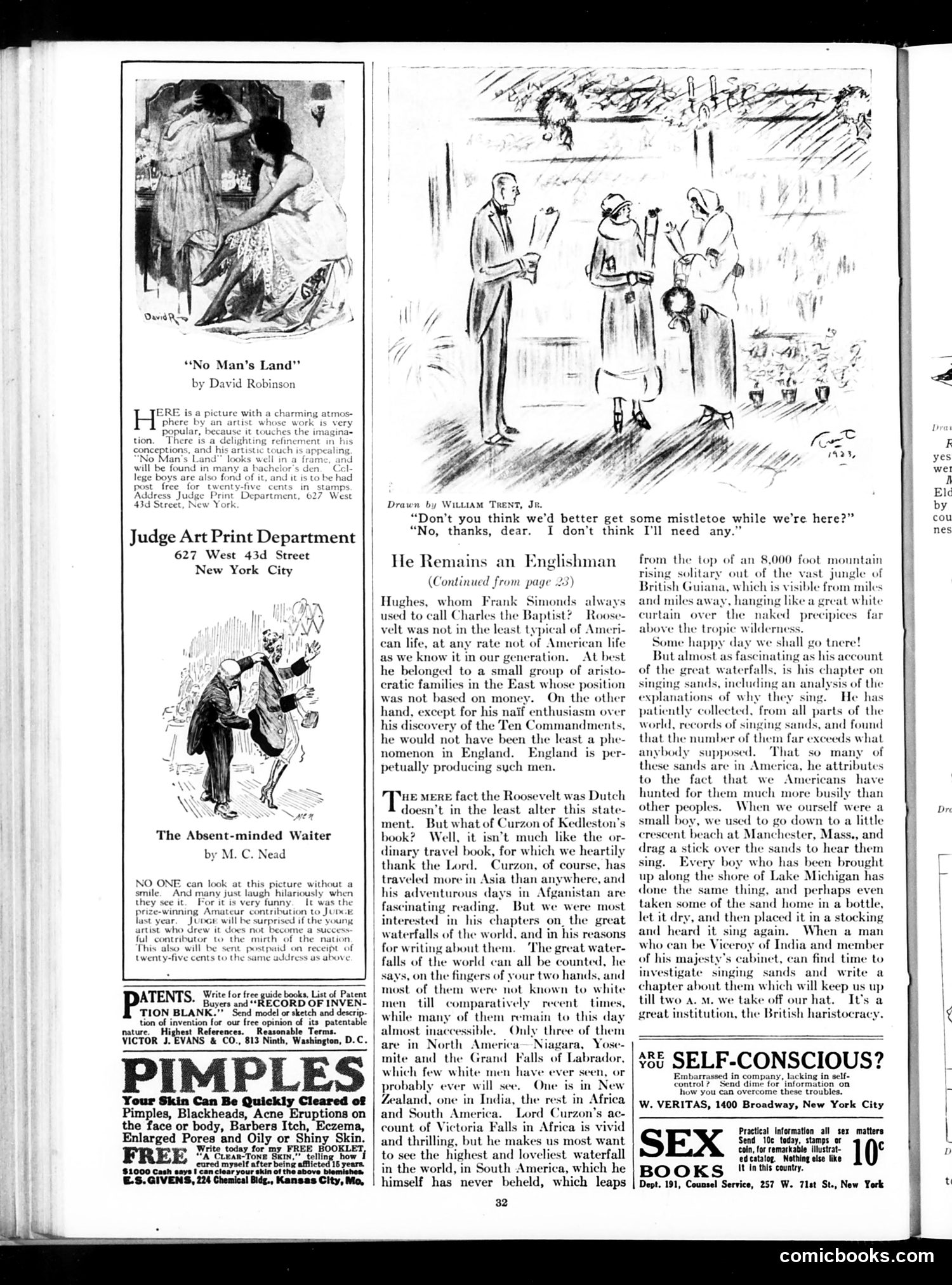
This page contains two cartoons and an article excerpt. **"The Absent-minded Waiter"** (left): A humorous domestic scene showing a waiter who has forgotten his duties—likely the joke being that a servant is neglecting his job, which would have been comedic to Judge's middle-class readership. **"Don't you think we'd better get some mistletoe while we're here?"** (right): A seasonal cartoon, likely from around Christmas, showing a couple on what appears to be a mountainside or outdoor setting. The woman suggests gathering mistletoe (traditionally used for Christmas decoration and kissing), but the man declines, suggesting he doesn't need the romantic pretext—a mild joke about their relationship. **"He Remains an Englishman"** (lower): An article excerpt comparing President Theodore Roosevelt to British aristocrat Lord Curzon, arguing that while Roosevelt seemed exotic to Americans, he would be unremarkable in England, which "perpetually produces such men." The piece discusses Curzon's travel writing about world waterfalls. The page mixes light domestic humor with more sophisticated cultural commentary typical of Judge's appeal to educated readers.
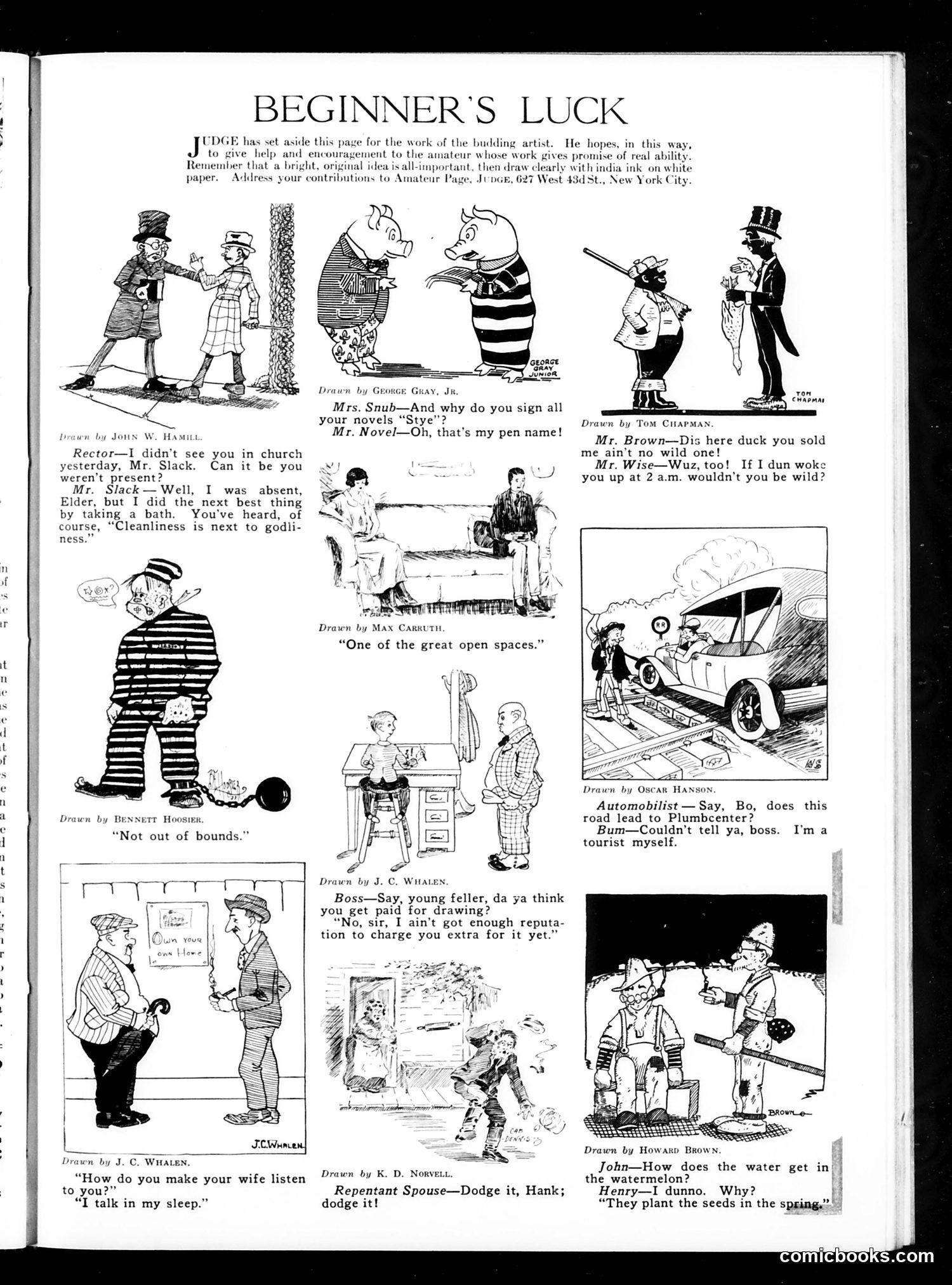
This page showcases amateur comic submissions to Judge magazine's "Amateur Page," a section encouraging new talent. The cartoons are brief, joke-driven gags typical of early 20th-century humor. The jokes rely on wordplay and everyday situations: a man claims bathing substitutes for church attendance; a novelist signs work "Stye" (a pen name/eye infection pun); an aspiring artist admits lacking reputation to charge extra; a man selling a "wild" duck claims it would be wild if awakened at 2 a.m.; someone mistakes an automobile road for one leading to "Plumbcenter"; and children discuss how water enters watermelons. The humor is gentle, domestic, and non-political—focused on social awkwardness, married life misunderstandings, and simple verbal jokes. This represents the lighthearted cartoon tradition of the era, distinct from Judge's typically sharper satirical work.
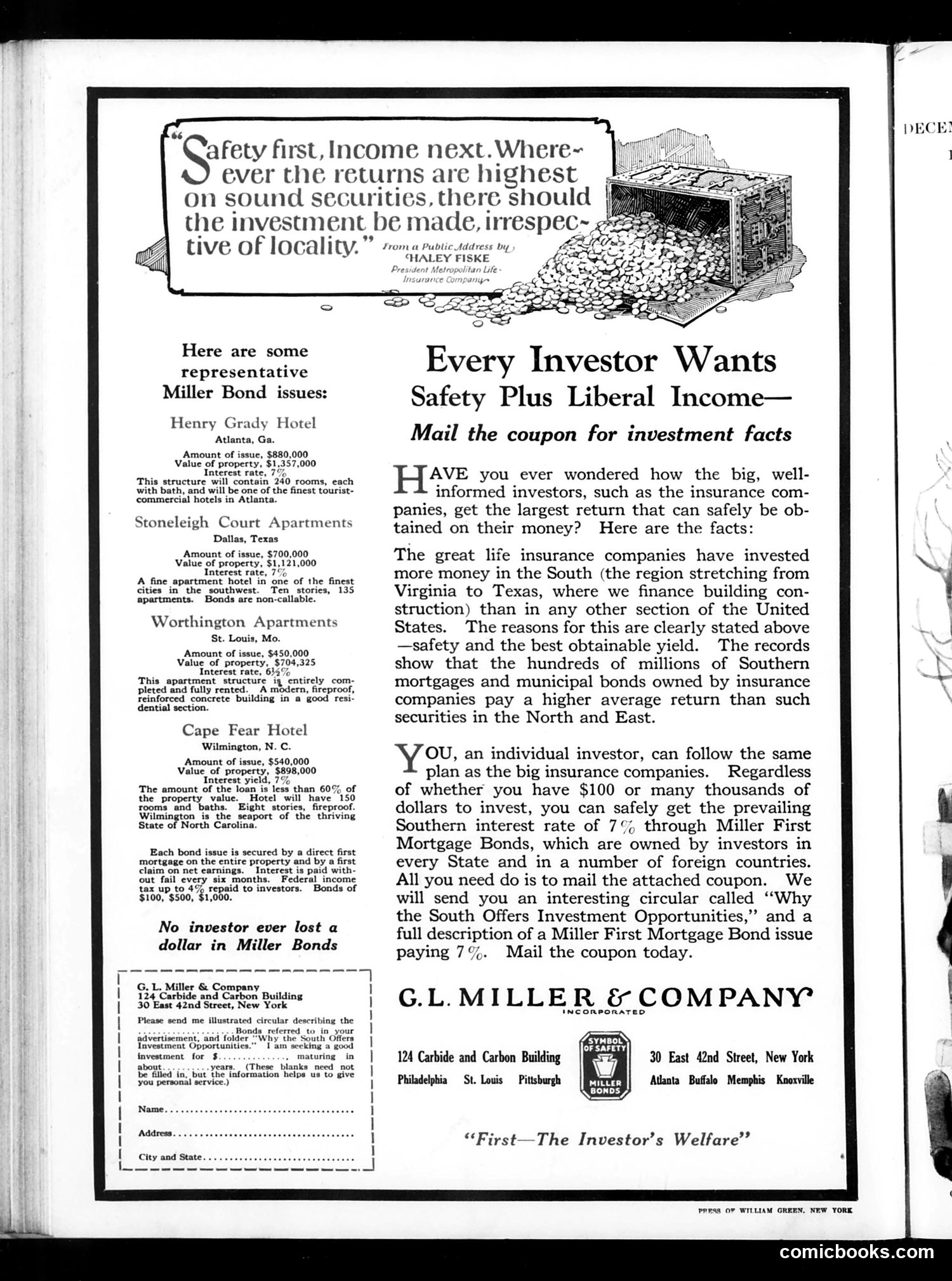
This page is **primarily advertising**, not satire. It's a 1920s investment pitch by G.L. Miller & Company promoting Southern real estate bonds to individual investors. The quote at top from Haley Fiske (Metropolitan Life president) establishes credibility by citing how major insurance companies invest heavily in the South for superior returns. Miller & Company then argues individual investors can access the same 7% Southern mortgage bonds these institutions use. The "representative issues" listed (hotels and apartments in Atlanta, Dallas, St. Louis, Wilmington) serve as proof of concept—real projects with detailed financial specifics to build trust. The page's logic: follow big institutional investors' strategy by purchasing Miller bonds secured by Southern property mortgages. The coupon invitation at bottom was standard direct-mail advertising technique of the era. There's no cartoon or satire here—it's straightforward financial marketing leveraging the era's economic optimism about Southern development and bond safety.