
Judge, 1923-12-22 · page 12 of 36
Judge — December 22, 1923 — page 12: what you’re looking at
What you’re looking at
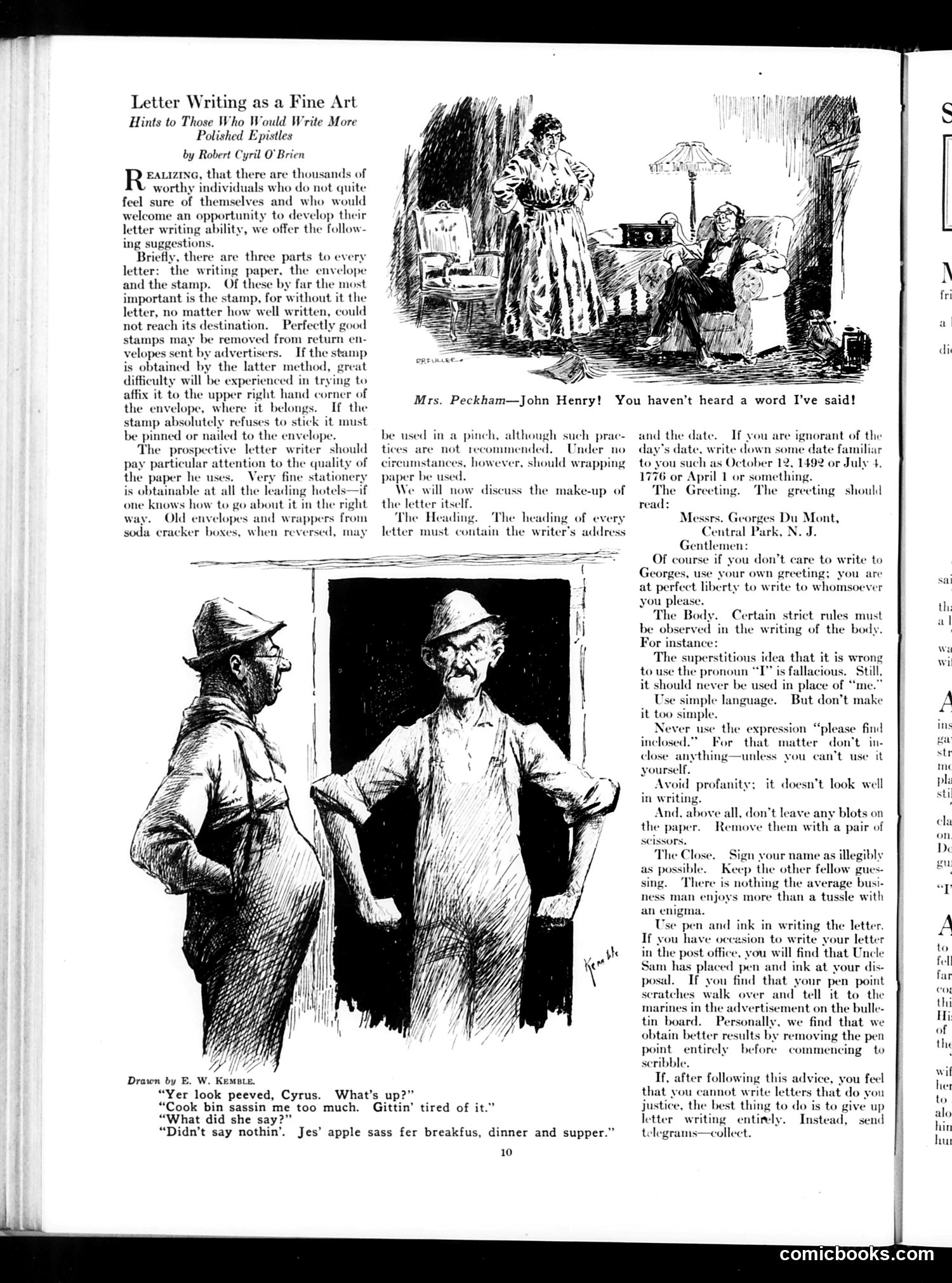
This is a humorous instructional article by Robert Cyril O'Brien offering deliberately absurd advice on letter writing. The satire works through intentional contradiction: O'Brien recommends using recycled soda cracker box envelopes, pinning stamps that won't stick, dating letters with historically inaccurate dates (1492, 1776), and signing illegibly so recipients must struggle to read the name. The accompanying cartoon by E.W. Kemble shows a domestic dispute—"Cyrus" complaining that his cook served "apple sass" (applesauce) for every meal. This illustrates marital frustration through food rather than letter-writing, providing comic relief. The entire piece mockingly critiques pretentious letter-writing guides popular at the time, suggesting that rigid etiquette rules were absurd. The final punchline—simply send telegrams instead—undercuts all preceding advice, exposing the article as pure satire on overwrought politeness manuals.
📄 Transcribed text from this page (OCR, searchable)
Machine-transcribed from the original scan — historical spelling and the odd misread are preserved.
Letter Writing as a Fine Art Hints to Those Who Would Write More Polished Epistles by Robert Cyril O'Brien EALIZING, that there are thousands of worthy individuals who do not quite feel sure of themselves and who would welcome an opportunity to develop their letter writing ability, we offer the follow- ing suggestions. Briefly, there are three parts to every letter: the writing paper, the envelope and the stamp. Of these by far the most important is the stamp, for without it the letter, no matter how well written, could not reach its destination. Perfectly good stamps may be removed from return en- velopes sent by advertisers. If the stamp is obtained by the latter method, at difficulty will be experienced in trying to affix it to the upper right hand corner of the envelope, where it belongs. If the stamp absolutely refuses to stick it must be pinned or nailed to the envelope. The prospective letter writer should pay particular attention to the quality of the paper he uses. Very fine stationery is obtainable at all the leading hotels—if knows how to go about it in the right ay. Old envelopes and wrappers from soda cracker boxes, when reversed, may Mrs. Peckham—John Henry! be used in a pinch, although such prac- tice: * not recommended. Under no circumstances, however, should wrapping paper be used. We will now discuss the make-up of the letter itself. The Heading. ‘The heading of every letter must contain the writer's address Drawn by E. W. Kemste. “Yer look peeved, Cyrus. What's up?” “Cook bin sassin me too much. Gittin’ tired of it.” “What did she say?” “Didn’t say nothin’. Jes’ apple sass fer breakfus, dinner and supper.” 10 You haven't heard a word I’ve said! and the date. If you are ignorant of the write down some date familiar to you such as October 12, 1492 or July 4. 1776 or April 1 or something. The Greeting. The greeting should read: Messrs. Georges Du Mont, Central Park, N. J. Gentlemen: Of course if you don’t care to write to Georges, use your own greetings ,you.aie at perfect liberty to write to whomsoever you please. The Body. Certain strict rules must be observed in the writing of the body. For instance: The superstitious idea that it is wrong to use the pronoun “I” is fallacious. Still, it should never be used in place of “me.” Use simple language. But don’t make it too simple. Never use the expression “please find inclosed.” For that matter don’t. in- close anything—unless you can’t use it yourself. Avoid profanity; it doesn’t look well in writing. And, above all, don’t leave any blots on the paper. Remove them with a pair of scissors. The Close. Sign your name as illegibly as possible. Keep the other fellow gues- sing. There is nothing the average busi- ness man enjoys more than a tussle with an enigma. Use pen and ink in writing the letter. Tf you have occesion to write your letter in the post off ou will find that Uncle Sam has placed pen and ink at your dis- posal. If you find that your pen point scratches walk over and tell it to. the marines in the advertisement on the bulle- tin board. Personally, we find that we obtain better results by removing the pen point entirely before commencing to scribble. If, after following this advice, you feel that you cannot write letters that do you justice, the best thing to do is to give up letter writing entimly. Instead, send telegrams—collect. comicbooks.com id a} fell far coi thi Hi of the wil het to. alo hin hut