
Judge, 1923-12-22 · page 15 of 36
Judge — December 22, 1923 — page 15: what you’re looking at
What you’re looking at
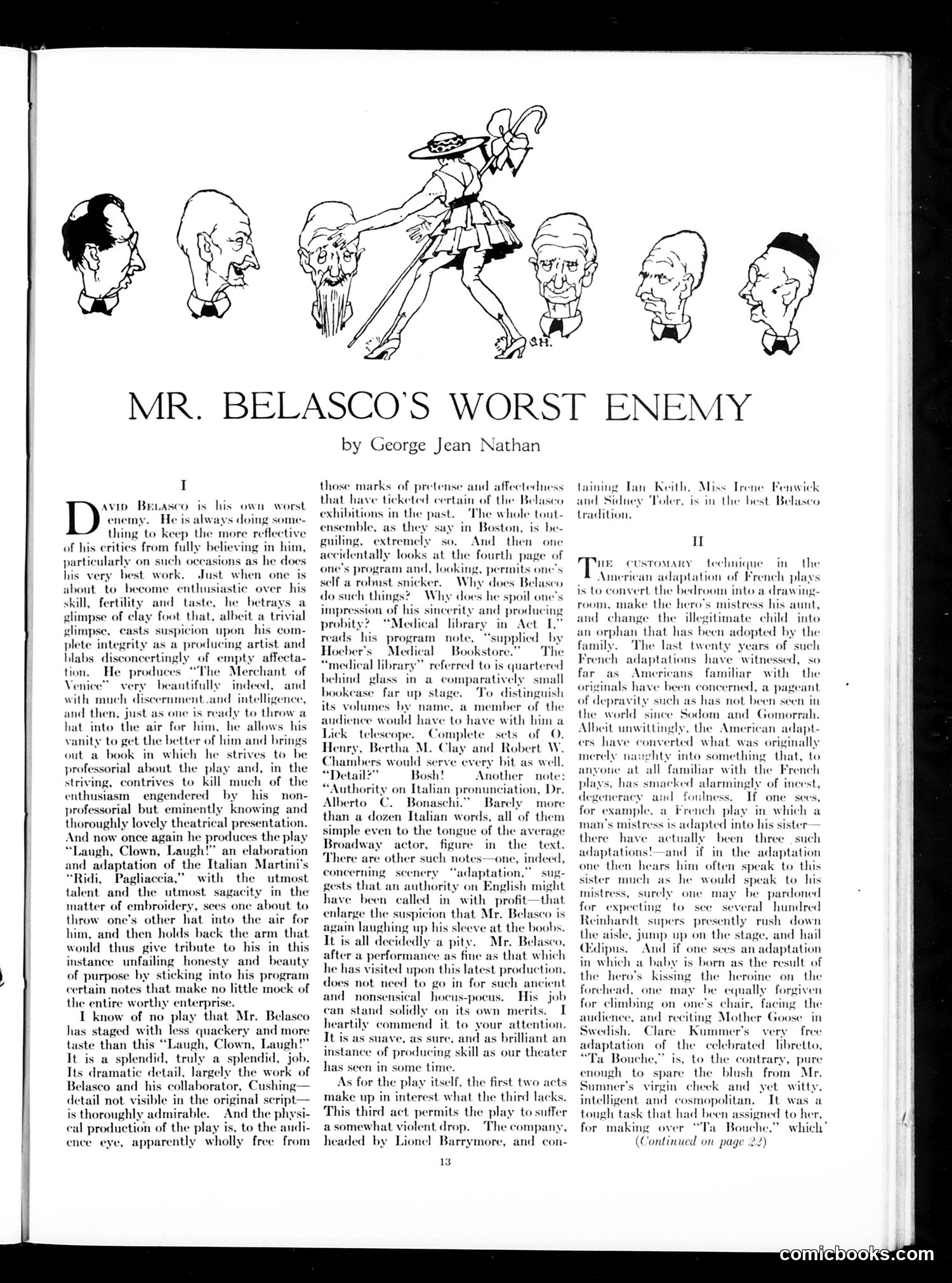
This is George Jean Nathan's theatrical critique of producer-director David Belasco's production of "Laugh, Clown, Laugh!" The cartoon's five caricatured male heads likely represent Belasco and collaborators or critics. Nathan praises Belasco's actual theatrical work as excellent and sincere, but savagely mocks his self-undermining pretentiousness. Belasco includes program notes crediting a medical library to a specific bookstore, attributing Italian pronunciation to an expert, and other unnecessary scholarly attributions. Nathan's point: these pedantic, show-offy notes betray vanity and affectation, contradicting the play's genuine artistry. The satire targets how successful artists sabotage themselves through ego—Belasco's need to appear erudite and authoritative paradoxically suggests the opposite, undermining the work's integrity. The title captures this paradox: Belasco is his own worst enemy through these petty vanities.
📄 Transcribed text from this page (OCR, searchable)
Machine-transcribed from the original scan — historical spelling and the odd misread are preserved.
6% MR. BELASCO’'S WORST ENEMY I avip Bevasco is his own worst D enemy. He is always doing som thing to keep the more reflective of his eritics from fully believing in him, particularly on such occasions as he does his very best work. Just when one is about to become enthusiastic over his skill, fertility and taste, he betrays a glimpse of clay foot that, albeit a trivial glimpse, casts suspicion upon his com- plete integrity as a producing artist and hlabs disconcertingly of empty affecta- tion. He produces “The Merchant of Venice” ve beautifully indeed, with much discernment and intellige and then, just as one is ready to throw a hat into the air for him, 1} lows his vanity to get the better of him and brings out a book in which he strives to be professorial about the play and, in the striving, contrives to kill much of the enthusiasm engendered by his non- professorial but eminently knowing and thoroughly lovely theatrical presentation. And now once again he produces the play “Laugh, Clown, Laugh!” an elaboration and adaptation of the Italian Martini’s “Ridi, Pagliaccia,” with the utmost talent and the utmost sagacity in the matter of embroidery, sees one about to throw one’s other hat into the air for him, and then holds back the arm that would thus give tribute to his in this instance unfailing honesty and beauty of purpose by sticking into his program -ertain notes that make no little mock of the entire worthy enterprise. I know of no play that Mr. Belasco has staged with less quackery and more taste than this “Laugh, Clown, Laugh!” It is a splendid, truly a splendid, job. Its dramatic detail, largely the work of Belasco and his collaborator, Cushing— detail not visible in the original script— is thoroughly admirable. And the phy cal production of the play is, to the audi ence ¢ apparently wholly free from by George Jean Nathan those marks of pretense and affectedness that have ticketed certain of the Belasco exhibitions in the past. The whole tout- ensemble, as they say in Boston, is be- guiling, extremely so. And = then one accidentally looks at the fourth page of one’s program and, looking, permits one's self a robust snick Why does Belasco do such things? Why does he spoil one’s impression of his sincerity and producing probity? “Medical library in Act. 1,” reads his program note, “supplied by Hoeber’s Medical Bookstore.” The “medical libra referred to is quartered behind glass ina comparatively small » far up stage. To distinguish its volumes by name, a member of the audience would to have with him a Lick telescope. Complete sets of O. Henry, Bertha M. C nd Robert W. Chambers would sery ‘y bit as well. “Detail?” Bosh! Another note: “Authority on Italian pronunciation, Dr. Alberto ©. Bonaschi.” Barely more than a dozen Italian words, all of them simple even to the tongue of the average Broadway actor, figure in the text. There are other such notes—one, indeed, concerning scenery “adaptation,” sug- gests that an authority on English might have been called in with profit—that enlarge the suspicion that Mr. Belasco is It is all decidedly a pity after a performance as that which ted upon this latest production, s not need to go in for such ancient and nonsensical hocus-pocus. His job can stand solidly on its own merits. I ly commend it to your attention. It is as suave, as sure, and as brilliant an instance of producing skill as our theater has seen in some time. As for the play itself, the first two acts make up in interest what the third lacks. This third act permits the play to suffer a somewhat violent drop. The company, headed by Lionel Barrymore, and con- 13 Keith, Miss Trene Fenwick ler is in the best: Belasco taining Tan and Sidney tradition. II HE customary technique in the American adaptation of French play is to convert the bedroom into a drawing- room, make the hero's mistress his aunt, and change the illegitimate child into an orphan that has been adopted by the family. The last twenty years of such French adaptations have witnessed, so far as Americans familiar with the originals have been concerned, a pageant of depravity such as has not been seen in the world since Sodom and Gomorrah. Albeit unwittingly, the American pt- ers have converted what was originally merely naughty into something that, to anyone at all familiar with the French plays, has smackec mingly of incest, and { If one for example, a French play in which a man’s mistress is adapted into his sister there have actually been three such adaptations!—and if in the adaptation one then hears him often speak to this sister much as he would speak to his mistress, surely one may be pardoned for expecting to see several hundred Reinhardt supers presently rush down the aisle, jump up on the stage, and hail (Edipus. And if one sees an adaptation in which a baby is born as the result of the hero's kissing the heroine on the forehead, one may be equally forgiven for climbing on one’s cl cing the audience, and reciting Mother Goose in Swedish. Clare Kummer’s very free adaptation of the celebrated libretto, “Ta Bouche,” is, to the contrary, pure enough to spare the blush from Mr. Sumner’s virgin cheek and yet witty, intelligent. and cosmopolitan. It was a tough task that had been assigned to her, for making over “Ta Bouche,” which’ (Continued on page 22) degeneracy sees,