
Judge, 1923-12-22 · page 25 of 36
Judge — December 22, 1923 — page 25: what you’re looking at
What you’re looking at
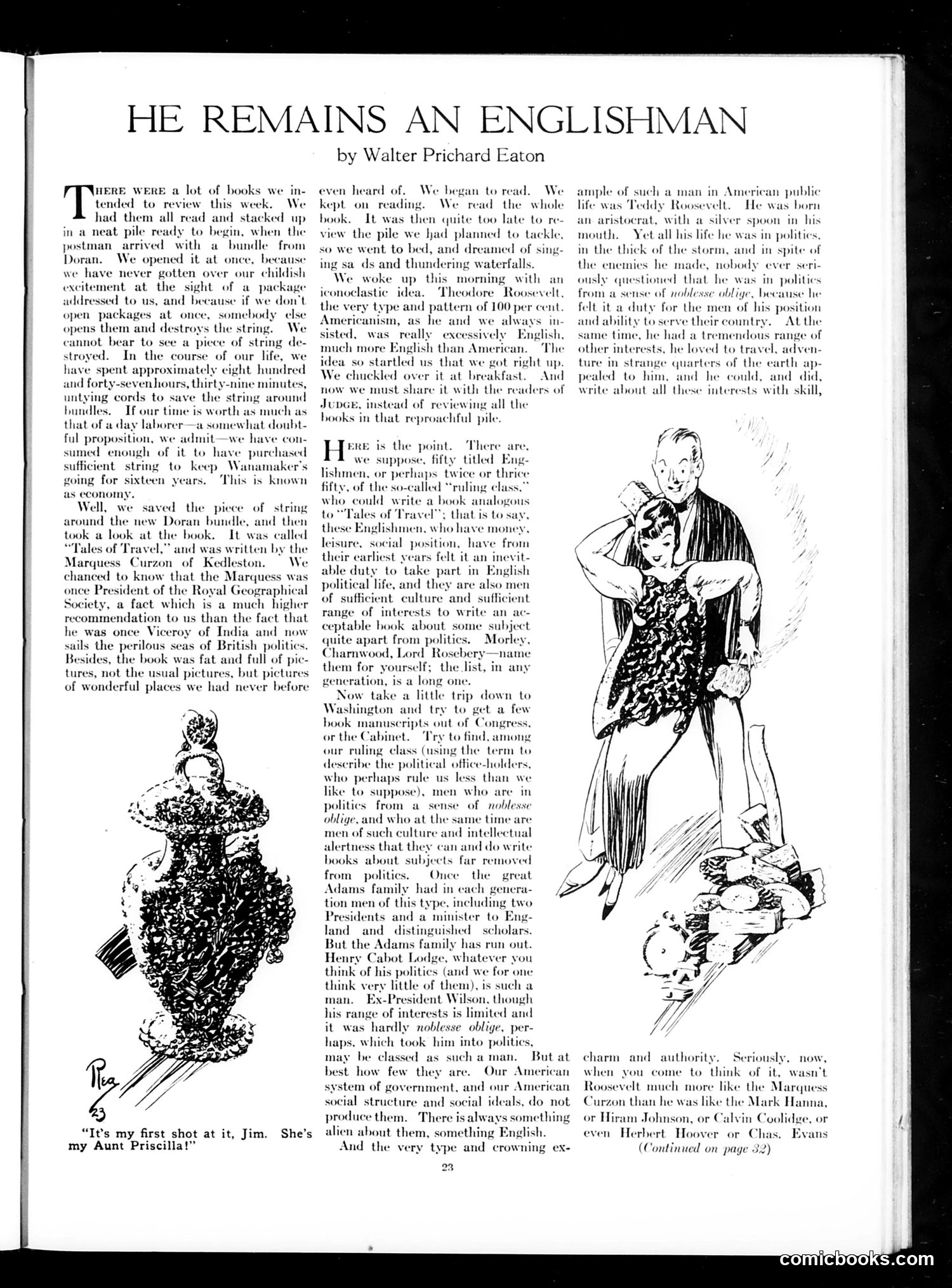
This is an essay by Walter Prichard Eaton, not primarily a political cartoon, though it includes illustrations. The piece argues that Theodore Roosevelt—despite being America's quintessential "100 per cent American"—actually embodies English cultural values more than American ones. Eaton's point: England's aristocratic "ruling class" produces cultured intellectuals who write books on diverse subjects while maintaining political involvement, viewing such work as *noblesse oblige* (noble duty). America's political leaders largely lack this breadth. Roosevelt is exceptional—a politician with genuine intellectual range and cultural sophistication. Eaton contrasts this with the decline of America's Adams family dynasty and suggests figures like Ex-President Wilson represent rare exceptions. The satire critiques American political culture for valuing narrow partisanship over the English model of cultivated gentlemen-statesmen. The accompanying illustrations appear to support this theme of cultural comparison.
📄 Transcribed text from this page (OCR, searchable)
Machine-transcribed from the original scan — historical spelling and the odd misread are preserved.
HE REMAINS AN ENGLISHMAN by Walter Prichard Eaton 4 NHERE WERE a lot of books we in- tended to review this week. We had them all read and stacked up in a neat pile ready to begin, when the postman arrived with a bundle from Doran. We opened it at once, because we have never gotten over our childish excitement at the sight of a package addressed to us, and because if we don’t open packages at once, somebody. else opens them and destroys the string. We cannot bear to see a piece of string de- stroyed. In the course of our life, we have spent approximately eight hundred and forty-seven hours, thirty-nine minutes, untying cords to save the string around bundles. If our time is worth as much as that of a day laborer —a somewhat doubt- ful proposition, we admit—we have con- sumed enough of it to have purchased sufficient’ string to keep Wanamaker’s going for sixteen years. This is known as economy. Well, we saved the piece of string around the new Doran bundle, and then took a look at the book. It was called “Tales of Travel,” and was written by the Marquess Curzon of Kedleston. We chanced to know that the Marquess was once President of the Royal Geographical Society, a fact which is a much higher recommendation to us than the fact that he was once Viceroy of India and now sails the perilous seas of British polities. s, the book was fat and full of pic- tures, not the usual pictures, but pictures of wonderful places we had never before “It’s my first shot at it, Jim. She’s my Aunt Priscilla!” sn heard of. We began to read. We ot on reading. We the whole book. It was then quite too late to re: view the pile we had planned to tackle, so we went to bed, and dreamed of sing- ing sa ds and thundering waterfalls. We woke up this morning with an iconoclastic idea. Theodore Roosevelt, the very type and pattern of 100 per cent Americanism, as he and we i sisted, was really excessivel much more English than American. idea so startled us that we got right up. We chuckled over it at breakfast. And now we must share it with the readers of JupGe, instead of reviewing all the hooks in that reproachful pile H™ is the point. There we suppose, fifty titled E lishmen, or perhaps twice or thrice fifty, of the so-called “ruling class.” who could write a book analogous to Tales of Travel”; that is to say. these Englishmen, who have money, leisure, social position, have from their carliest years felt it an inevit- able duty to take part in English politic and they are also men of sufficient. culture and _ sufficient range of interests to write an ceptable book about some subject quite apart from politics. Morley, Charnwood, Lord Rosebery—name them for yourself; the list, in any gencration, is a long one. Now take a little trip down to Washington and try to get a few book manuscripts out of Congress, or the Cabinet. ‘Try to find, among our ruling class (using the term to describe the political office-holders, who perhaps rule us less than we like to suppose), men who are in politics from a sense of noblesse oblige, and who at the same time are men of such culture and intellectual alertness that they can and do write books about subjects far removed from politics. Once the great Adams family had in each genera- tion men of this type. including two Presidents and a minister to Er land and distinguished scholars. jams family has run out. : whatever you think of his polities (and we for one think very little of them), is such a man. Ex-President Wilson, though his range of interests is limited and it was hardly noblesse oblige, per- haps. which took him into pol may be classed as such aman. But at best how few they are. Our Ameri system of government, and our Ameri structure and social ideals, do not produce them. There is always something alien about them, something English. And the very type and crowning ex- read cs, 23 ample of such a man in American public life was Teddy Roosevelt. He was born an aristocrat, with a silver spoon in his mouth. in the thick of the storm, and in spite of the enemies he made, nobody ever seri- Yet all his life he was in polities, ously questioned that he was in polities from a sense of noblesse oblige, because he felt it a duty for the men of his position and ability to serve their country. At the same time, he had a tremendous ran other interests, he loved to travel, adv ture in strange quarters of the earth ap- pealed to him, and he could, and did, write about all these interests with skill, charm and authority. Seriously, now, when you come to think of it, wasn't Roosevelt. much more like the Marquess Curzon than he was like the Mark Hanna, or Hiram Johnson, or Calvin Coolidge, or even Herbert’ Hoover or Chas. (Continued on page 32) Evans