
A complete issue · 36 pages · 1923
Judge — November 10, 1923
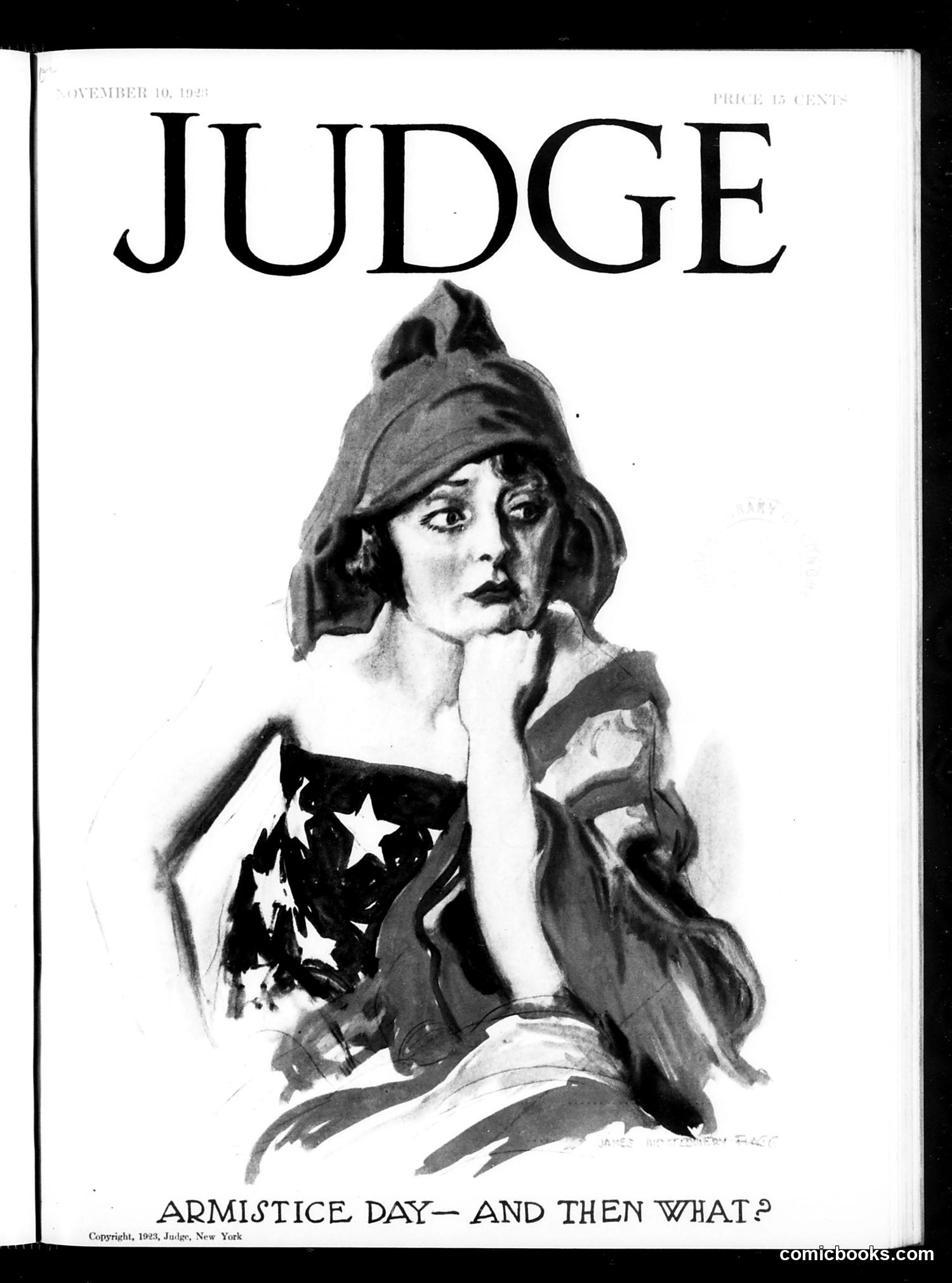
This cover depicts a woman in patriotic American dress (starred garment, draped flag) wearing a concerned expression and hand to face in a worried pose. The headline "ARMISTICE DAY—AND THEN WHAT?" references November 11, the anniversary of World War I's armistice (1918). The satire appears to address post-war anxiety: five years after the war ended, the nation faced economic uncertainty, labor unrest, and questions about America's future direction. The feminine personification of America suggests worry about the country's stability and prospects. The question "and then what?" captures contemporary uncertainty about whether post-war prosperity or problems would follow. This reflects Judge's satirical commentary on 1920s American concerns.
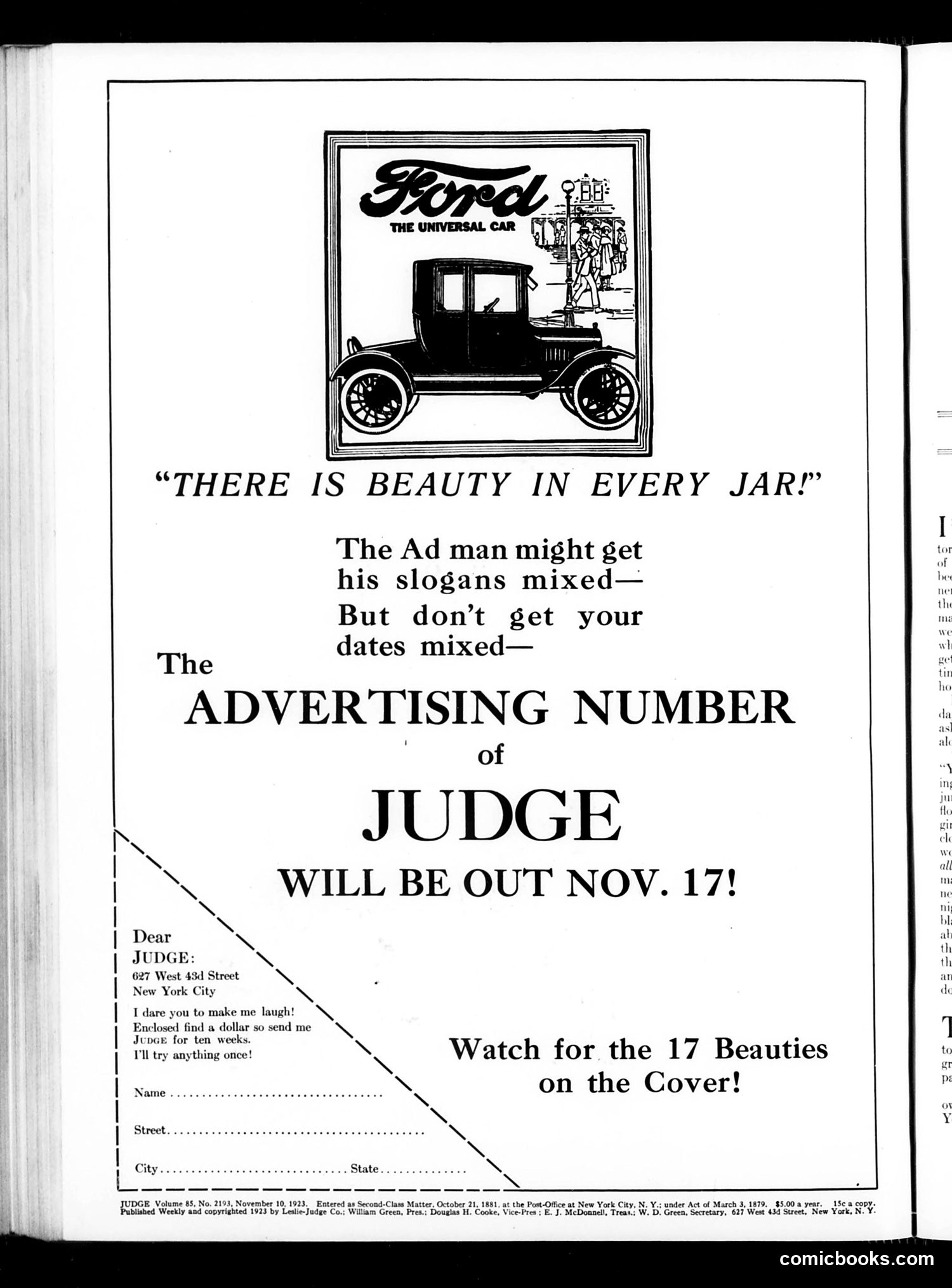
This page is primarily **advertising** rather than political satire. It promotes an upcoming issue of *Judge* magazine (dated November 17, scheduled release). The small Ford advertisement at the top uses the slogan "There is Beauty in Every Jar"—an apparent play on words, though the connection between automobile marketing and jars is unclear from this image alone. The main content is a subscription promotion encouraging readers to purchase a dollar subscription for ten weeks of *Judge*. It emphasizes anticipation for "the 17 Beauties on the Cover"—likely referring to illustrated cover girls or humorous character drawings featured in the upcoming issue. The format includes a tear-out coupon with address fields, typical of early-20th-century magazine marketing strategies.
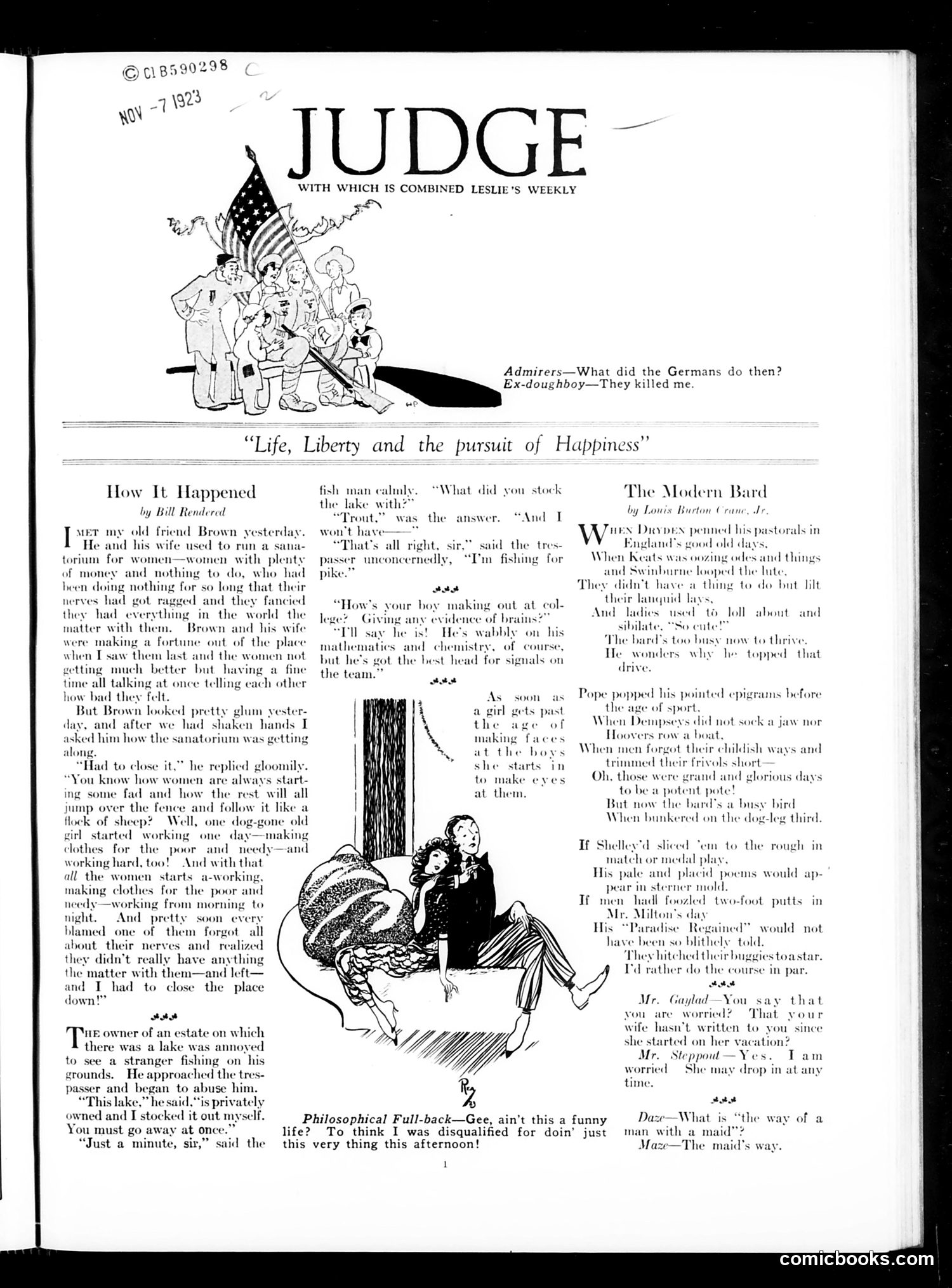
This page from Judge magazine (dated November 7, 1923) contains several satirical pieces rather than a single political cartoon. The masthead cartoon shows American figures with a flag, referencing patriotic themes ("Life, Liberty and the pursuit of Happiness"). The main content includes: - **"How It Happened"** by Bill Rendered: A humorous story about closing down a sanitarium for women - **"The Modern Bard"** by Louis Barton Came, Jr.: Poetry mocking Romantic-era poets - **Central illustration**: A couple in an apparent domestic dispute, captioned as satire about marital discord The page primarily offers light satirical humor about everyday American life—domesticity, leisure, and social pretension—rather than direct political commentary. It's representative of Judge's general approach: gentle social satire aimed at middle-class readers.
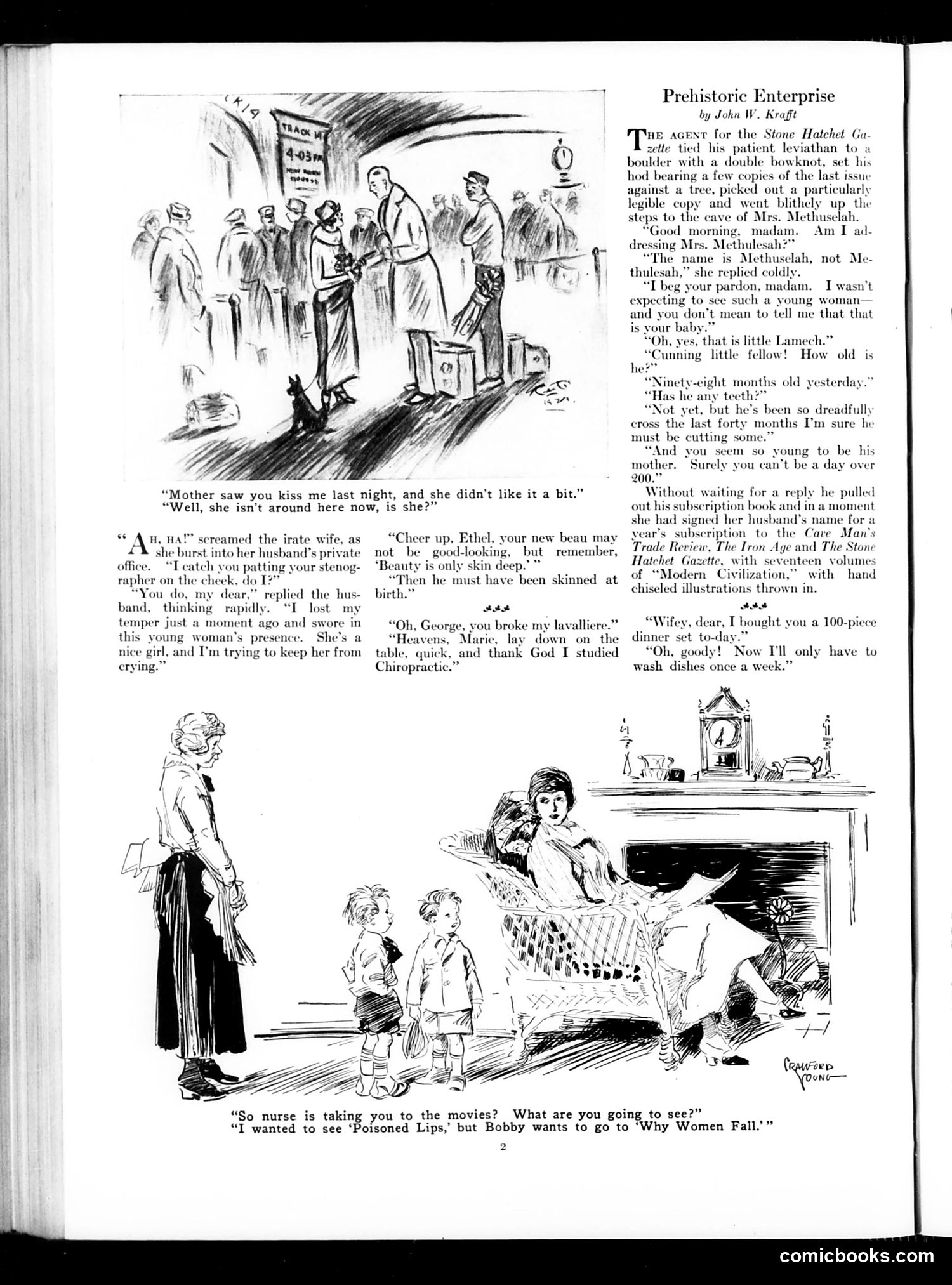
This page contains a short story titled "Prehistoric Enterprise" by John W. Kraft, illustrated with two scenes depicting domestic life humor typical of early-20th-century Judge magazine. The top illustration shows a crowded scene at what appears to be a train station or public venue, depicting a social encounter between characters. The dialogue and narrative concern a young mother with an infant named Lamech, who is nearly a year old. The bottom illustration shows a domestic scene where a nurse and children discuss going to the movies—one wants to see "Poisoned Lips" while another prefers "Why Women Fall." The humor relies on period-appropriate domestic situations and social commentary about modern entertainment and family life. The "prehistoric enterprise" title appears ironic, contrasting ancient themes with contemporary concerns about cinema and childcare.
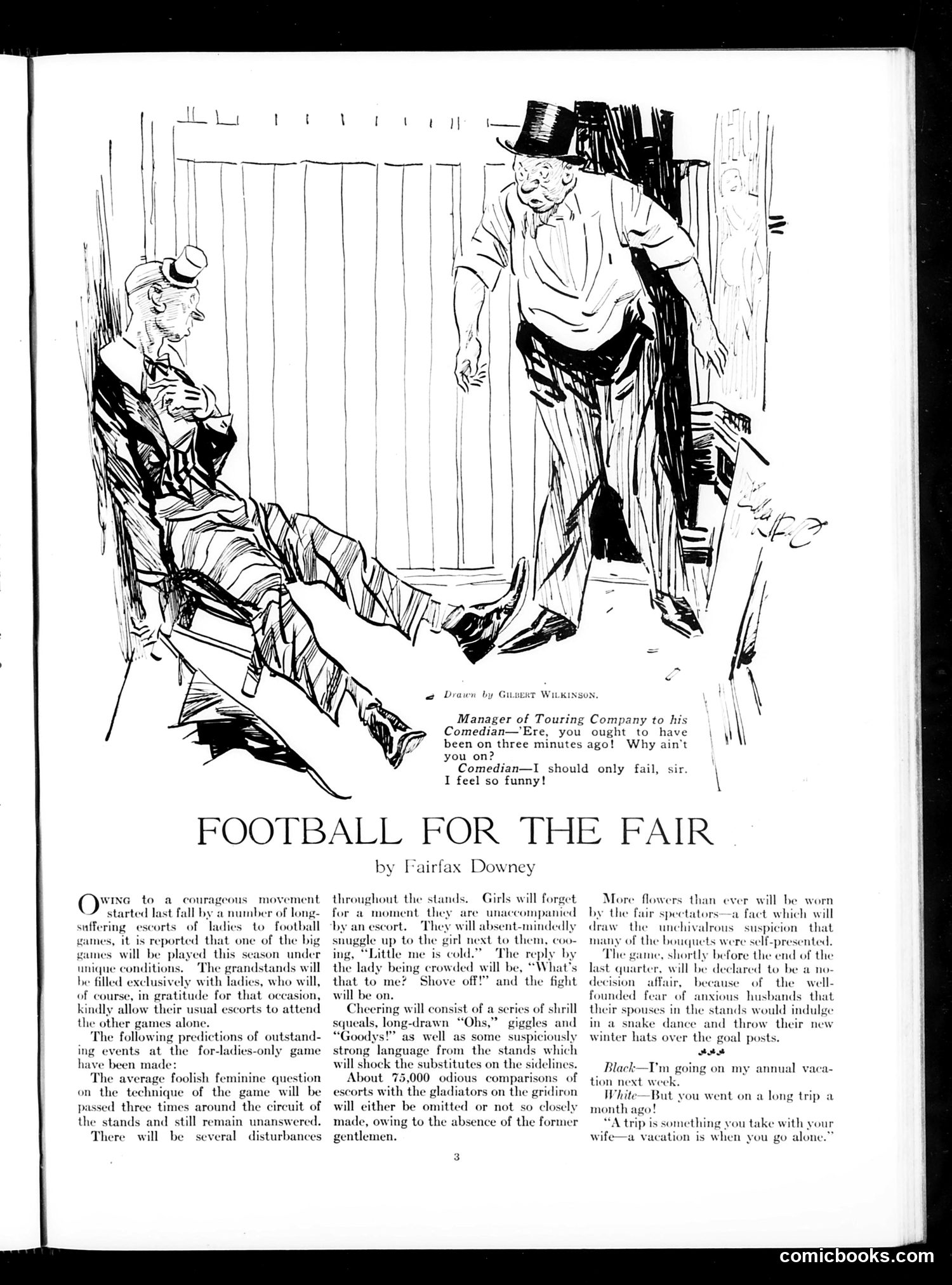
This satirical piece by Fairfax Downey mocks the idea of organizing football games exclusively for women spectators. The cartoon shows a theater manager scolding a comedian for arriving late, with the text below describing an upcoming "ladies-only" football event. The satire targets early 20th-century attitudes about women attending sports. The piece jokes that women would need male escorts to watch football, that they'd wear excessive flowers and jewelry, and that their presence would cause "disturbances." The comedian's excuse—"I feel so funny!"—plays on stereotypes of women as overly emotional. The accompanying dialogue ("A trip is something you take with your wife—a vacation is when you go alone") reinforces period attitudes about gender roles and marital dynamics, making this primarily a satire of contemporary sexism and social conventions.
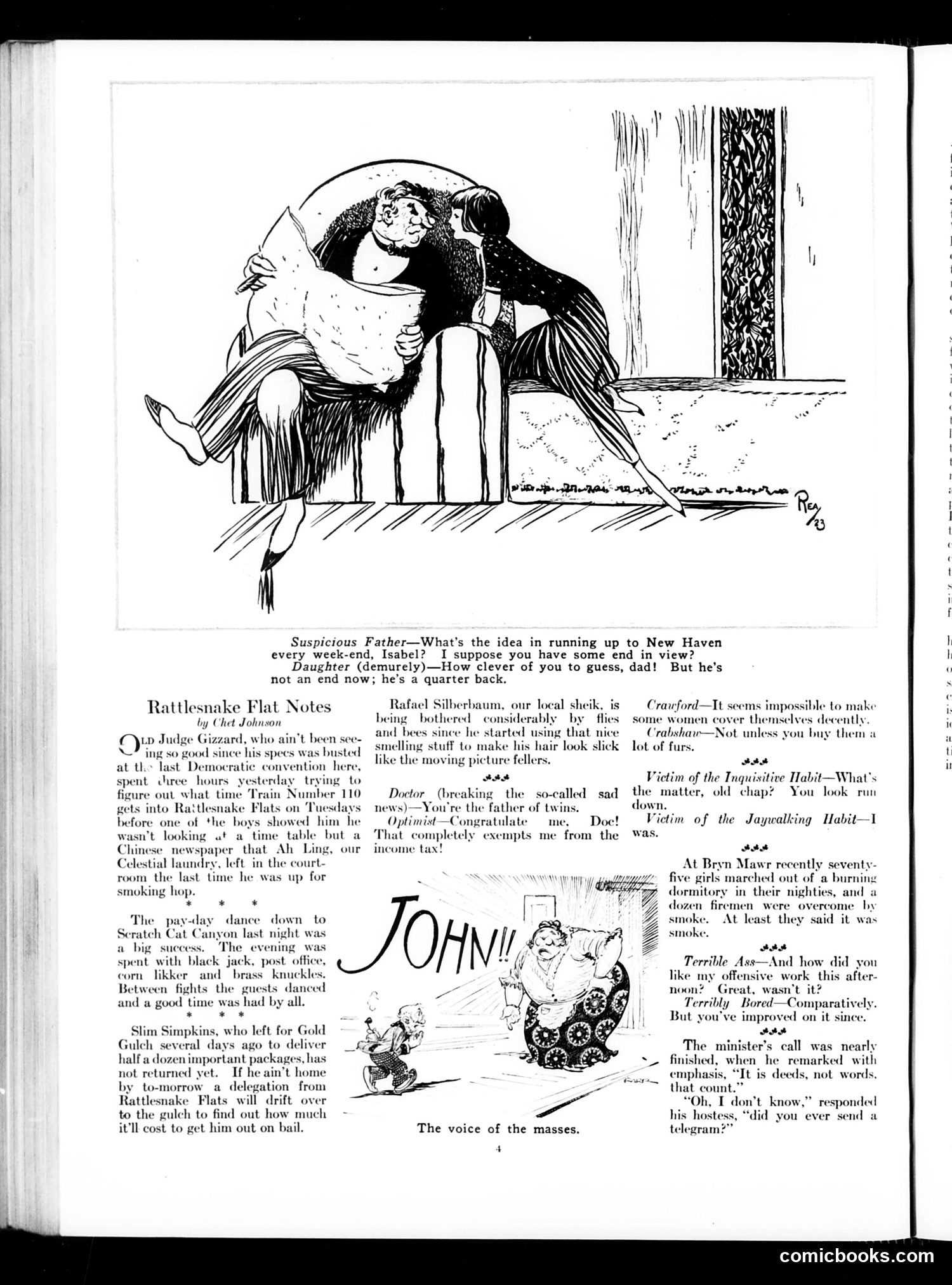
The top cartoon depicts a domestic scene where a woman reads a newspaper to a man sitting in a chair, likely commenting on "New Haven" weekend activities. The humor appears to play on marital dynamics and leisure activities. The larger middle cartoon titled "The voice of the masses" shows multiple figures in what appears to be a chaotic crowd scene, with one figure prominently shouting "JOHN!!" The caption suggests this represents public sentiment or collective outcry about someone named John. The "Rattlesnake Flat Notes" section contains local gossip and social commentary, including references to Chinese newspapers, bail situations, and various character observations typical of Judge's satirical small-town reportage. Without clearer historical context about which specific John or events are referenced, the exact political targets remain unclear, though the overall tone mocks urban social pretensions and small-town drama.
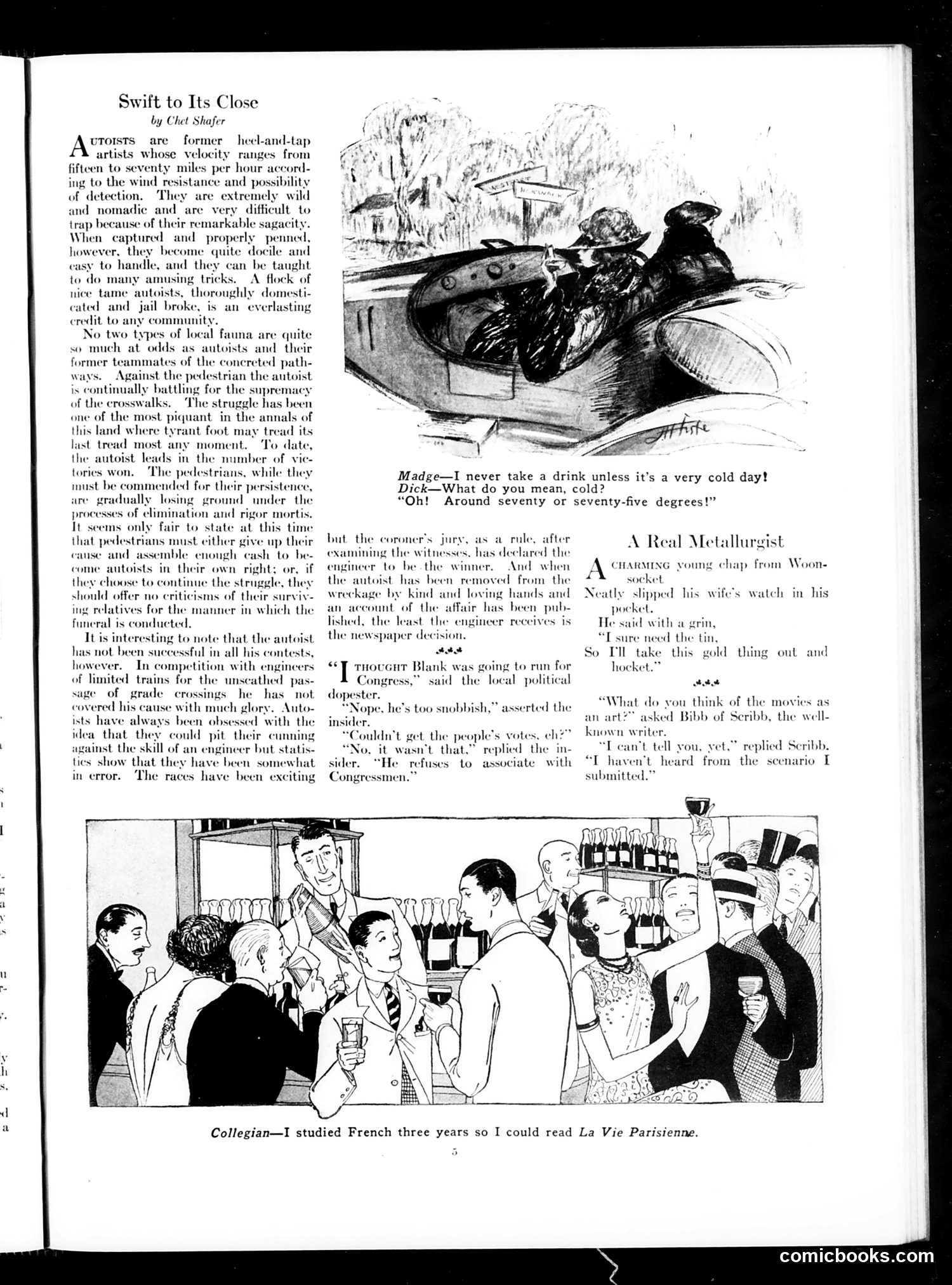
This page contains multiple satirical pieces mocking American society circa the 1920s-1930s. **"Swift to Its Close"** uses pseudo-scientific language to compare autoists (car drivers) to wild animals being "domesticated," sardonically suggesting pedestrians are losing a Darwinian struggle for survival. The piece critiques reckless drivers while noting that engineers (train operators) consistently "win" against automobiles at grade crossings—likely referencing fatal accidents where trains collide with cars. **"A Real Metallurgist"** jokes about a man from Woonsocket pawning his wife's gold watch, calling himself a "metallurgist" for extracting the gold. **Three brief jokes** mock: a woman's selective drinking habits, a snobbish political candidate who won't associate with congressmen, and a writer waiting to hear if his submitted screenplay was accepted. **The bottom cartoon** depicts a bar scene where a collegian boasts of studying French to read *La Vie Parisienne* (a Parisian entertainment magazine)—the joke being his pretentious cultural aspirations. The page satirizes materialism, vanity, and the new car culture disrupting traditional pedestrian society.
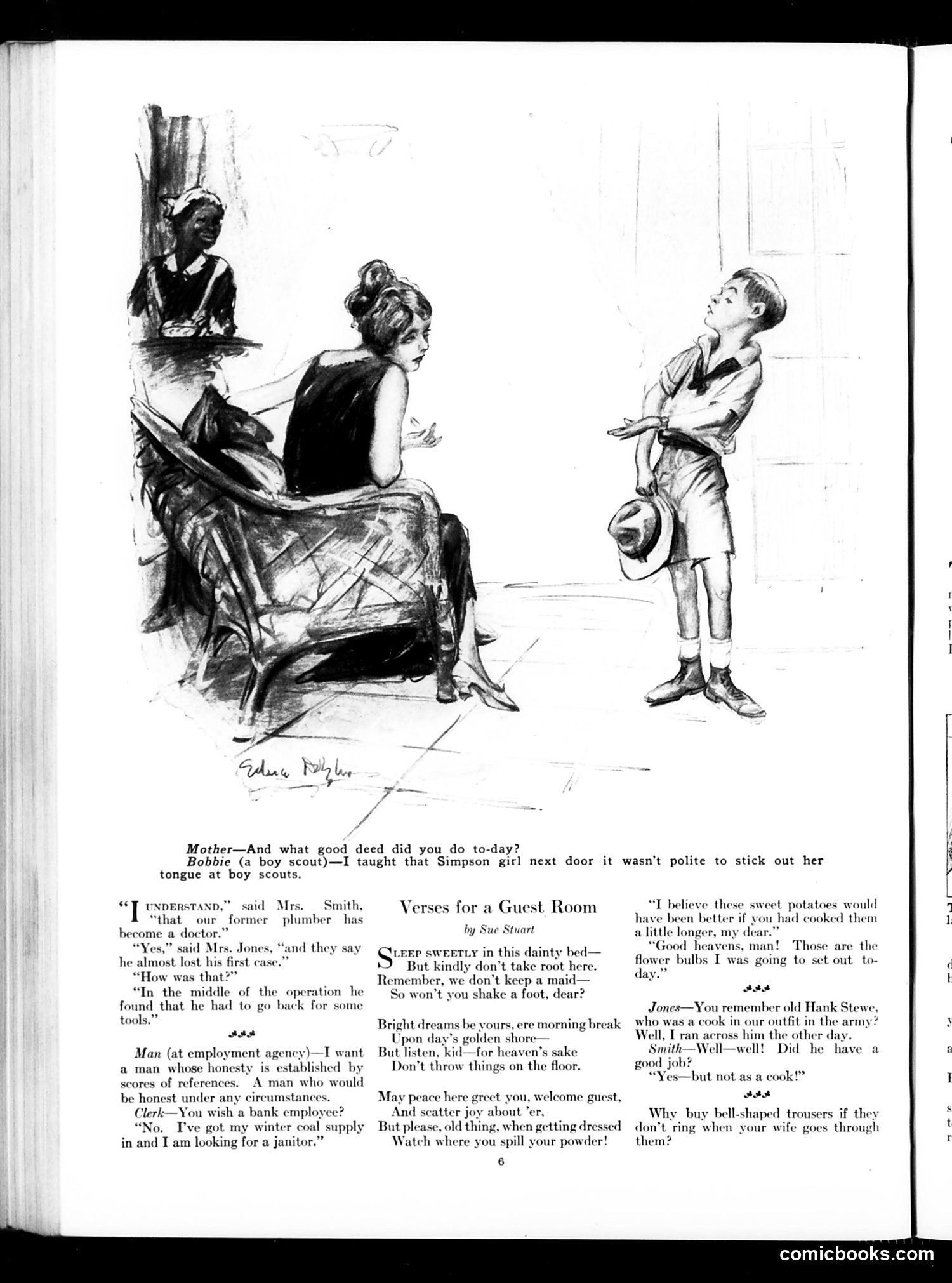
This page contains several brief satirical jokes typical of early 20th-century American humor, targeting social pretensions and domestic absurdities. The main cartoon depicts a mother questioning her Boy Scout son about his good deed. His answer—teaching a girl it's impolite to stick out her tongue—is juvenile and self-serving rather than genuinely charitable, satirizing the Boy Scout movement's moral claims. The written jokes mock various targets: a plumber-turned-doctor who lacks proper tools (satirizing professional incompetence); an employment agency clerk's joke that honest janitors are rarer than honest bank employees (cynical commentary on workplace dishonesty); a woman mistaking flower bulbs for sweet potatoes (domestic foolishness); and wordplay about bell-shaped trousers "ringing" when wives pass through them (crude marital humor). The "Verses for a Guest Room" poem humorously lists house rules disguised as welcoming poetry—don't overstay, don't be messy, don't break things—reflecting working-class anxieties about hosting guests. The humor relies on class commentary, domestic situations, and gentle mockery of contemporary institutions.
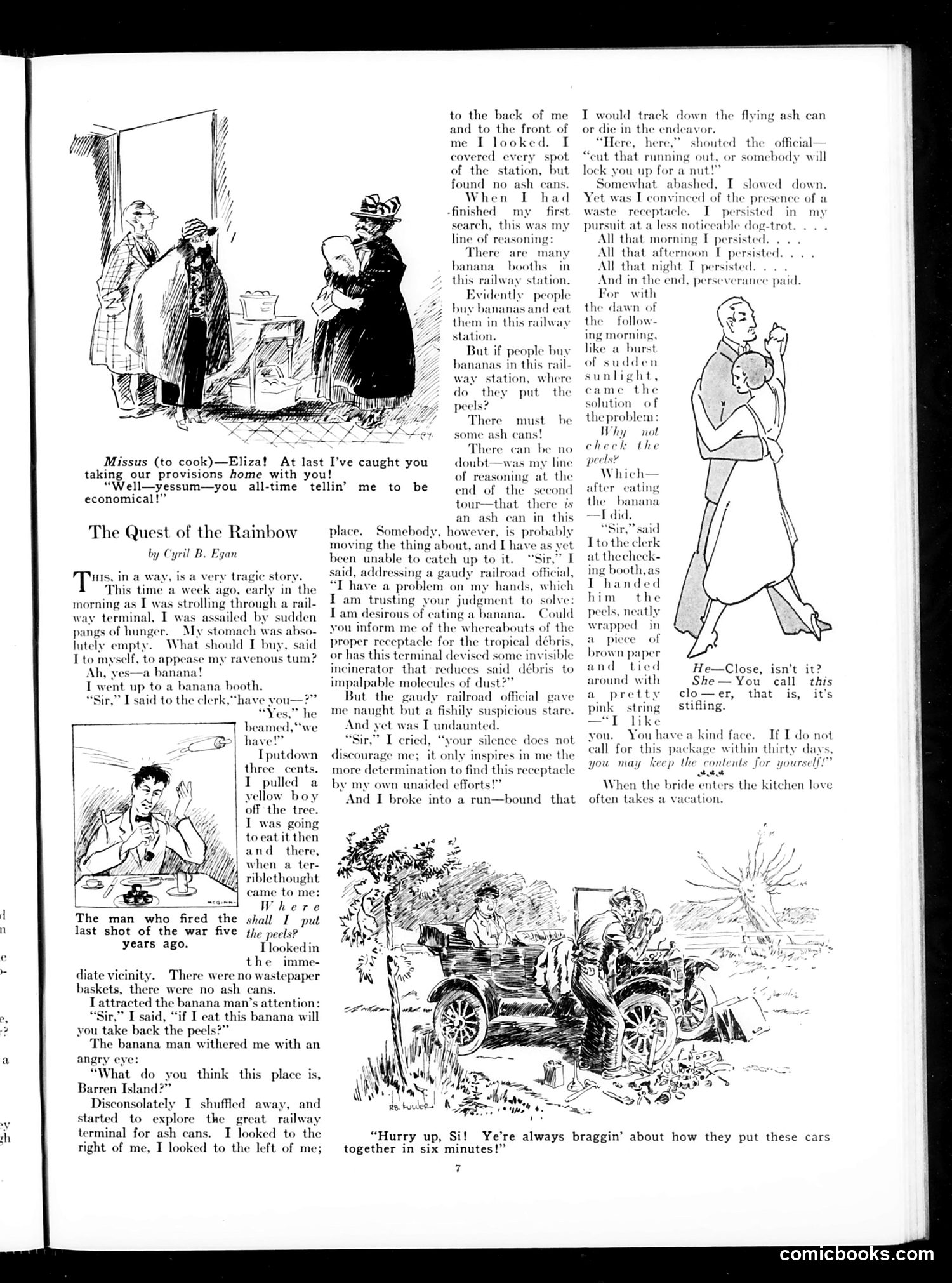
This page presents a humorous short story satirizing American bureaucratic indifference and urban cleanliness standards. The protagonist searches obsessively for a trash receptacle to dispose of banana peels at a railway terminal, only to discover none exist—a absurd commentary on poor municipal infrastructure and planning. The satire targets: 1. **Institutional incompetence**: Railway officials offer no solutions to obvious waste problems 2. **Excessive determination**: The narrator's comical persistence in pursuing a simple task reflects broader American anxiety about proper behavior and civic duty 3. **Class dynamics**: The interaction with the banana vendor and clerk suggests condescension toward service workers The accompanying illustrations—a cook caught taking provisions, a couple in an automobile—use visual gags to reinforce themes of domestic economy and modern life's small ironies. The overall tone mocks both bureaucratic negligence and the public's obsessive adherence to rules, likely resonating with 1910s-20s readers frustrated by urban municipal services.
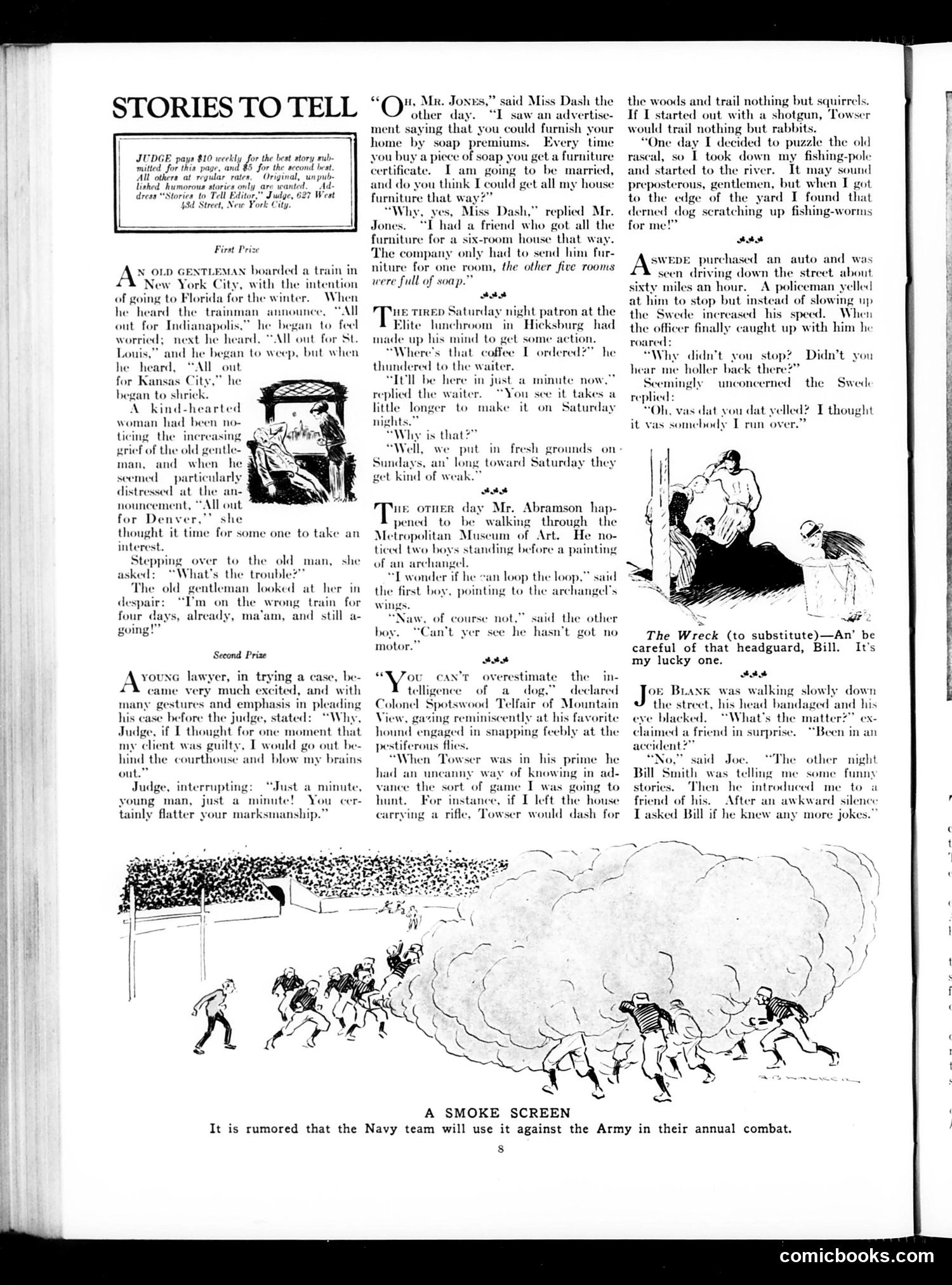
This page contains humorous short stories typical of early 20th-century American humor magazines. The main cartoons and stories reflect period attitudes: **The Stories:** Five brief anecdotes play on common scenarios—a confused traveler, a lawyer's boastfulness, a woman seeking furniture through soap premiums, slow diner service, and children viewing modern technology (an airplane in a museum painting, with one boy asking if the angel can "loop the loop" without a "motor"—a topical reference to early aviation stunts). **"A Smoke Screen" Cartoon:** The bottom illustration shows Navy and Army personnel in football formation creating a smoke cloud, labeled as a rumored tactic for their annual game. This is straightforward sports humor about college football's Army-Navy rivalry. **Overall Tone:** The humor is gentle, domesticated comedy focused on everyday misunderstandings and innocent observations rather than political satire. The page represents Judge's lighter content alongside its more pointed social commentary.
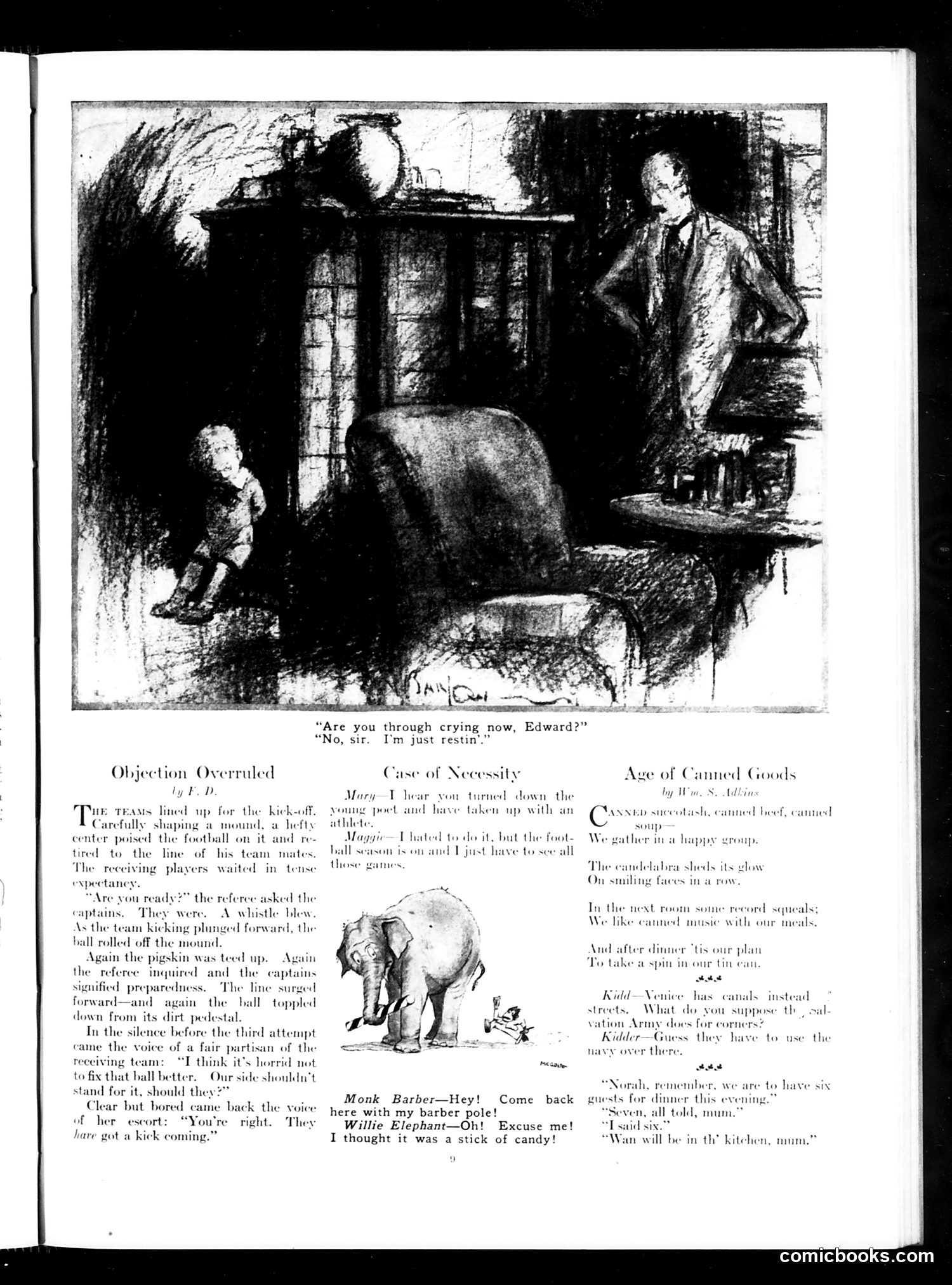
This page contains three brief humorous pieces typical of early 20th-century American satirical magazine fare: **"Objection Overruled"** satirizes American football's early days, when the ball was literally placed on a dirt mound before kicking. A referee repeatedly resets a wobbly ball while complaining spectators demand better preparation—poking fun at both the sport's crude equipment and fans' entitled attitudes. **"Case of Necessity"** is a brief romantic joke: a woman explains dumping a poet for a practical businessman because she "hated to do it, but the foot-vision [foot-vision/future vision] is on and I just have to see all those games"—trivializing love for entertainment. **"Age of Canned Goods"** satirizes modern consumer culture, celebrating canned food, recorded music ("canned music"), automobiles ("tin can"), and mass-produced leisure. The final exchange jokes that servants must eat canned goods in the kitchen while masters dine on them upstairs, mocking both industrial products and class hierarchy. The humor reflects 1910s-20s anxieties about industrialization and changing social values.
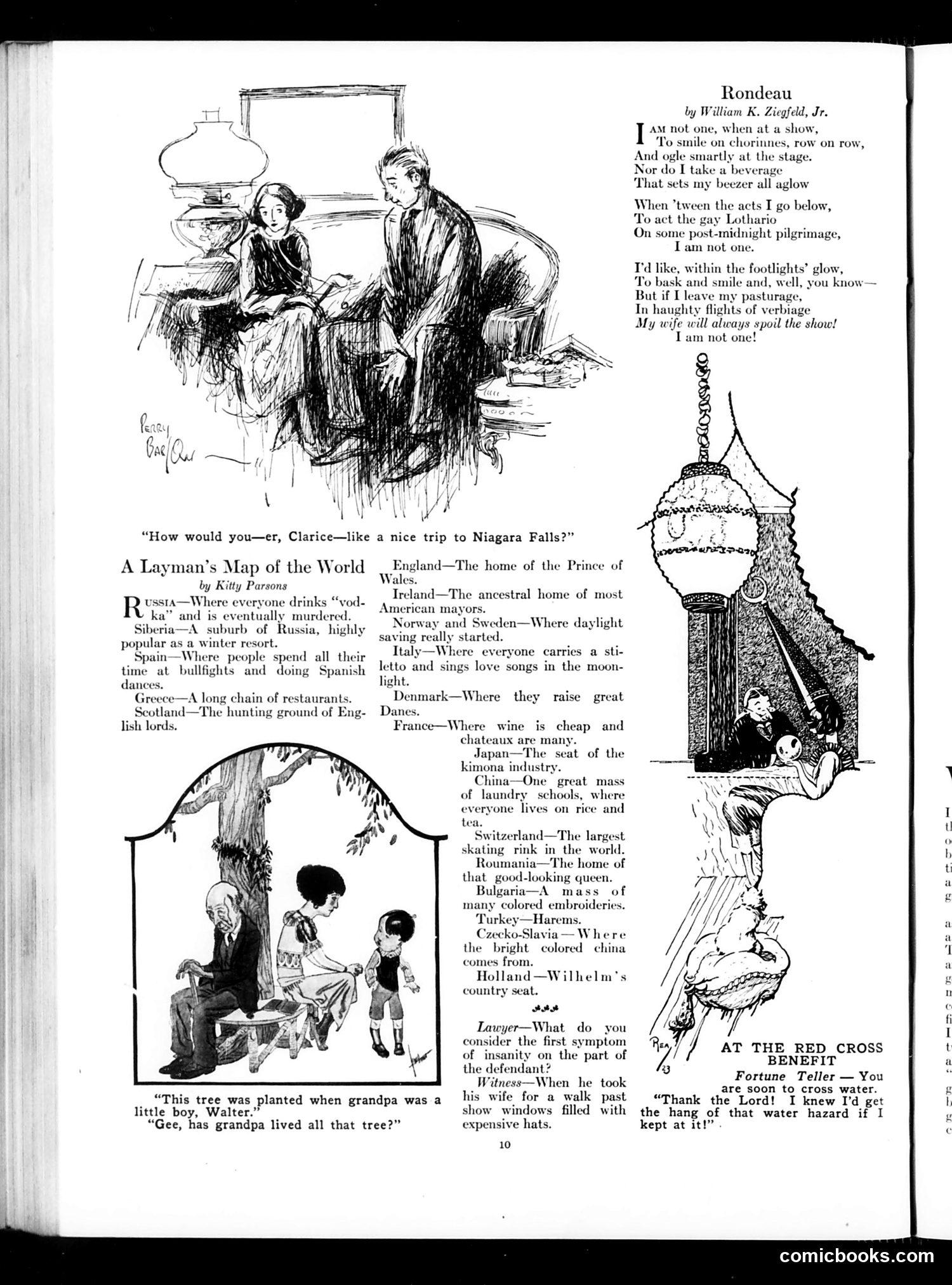
This page contains three satirical pieces typical of early 20th-century Judge magazine humor: **"A Layman's Map of the World"** stereotypes countries through exaggeration: Russia as murderous, Spain obsessed with bullfighting, Greece as restaurants, England hunting-obsessed. The humor relies on crude ethnic generalizations common to the era—Italy for serenades and knives, Denmark for large dogs, China for laundries. "Holland—Wilhelm's country seat" likely references Kaiser Wilhelm II and German imperial expansion, a topical reference suggesting pre-WWI tensions. **The tree illustration** is a gentle domestic joke about generational time passage—a grandfather's longevity compared to a planted tree. **The lawyer/witness exchange** satirizes male behavior around consumerism and marriage: a husband's "insanity" is taking his wife shopping for expensive hats, implying marital discord over spending. **"Rondeau" poem** humorously describes a man's hypocrisy—he claims not to flirt with chorus girls, yet his wife "spoils the show" by preventing him from doing exactly that. The overall tone is lighthearted social satire targeting male vanity, marital dynamics, and ethnic stereotyping as entertainment.
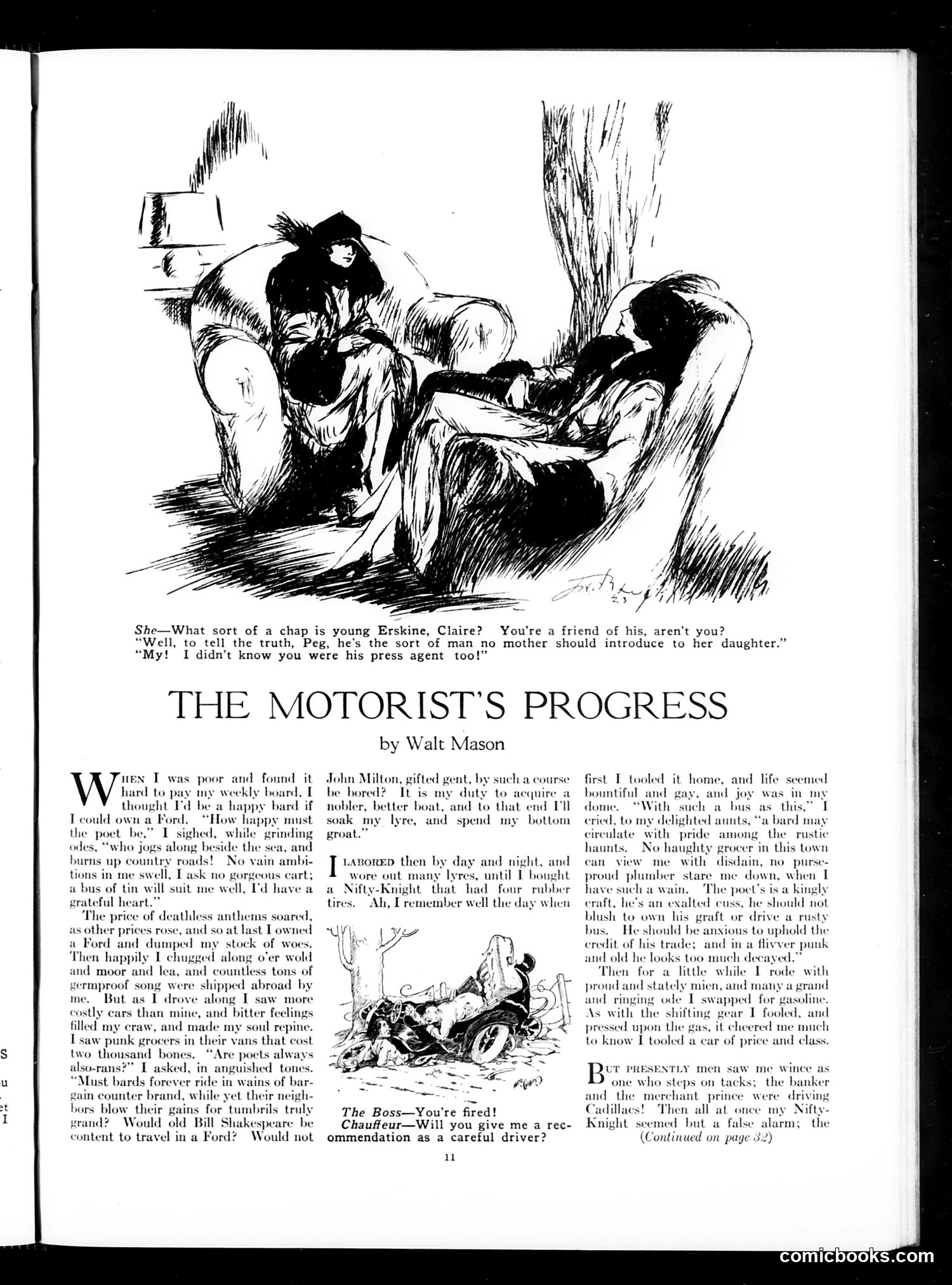
This is a satirical short story, not a political cartoon. The top cartoon is a separate joke about a man named Erskine being unsuitable company for women—a woman sarcastically suggests the critic should be his "press agent" since she's advertising his bad reputation. Mason's story satirizes social climbing and materialism in the early automobile era. A poor poet buys a modest Ford, initially content. But seeing wealthier neighbors drive expensive cars (Cadillacs, a Nifty-Knight), he becomes envious and ashamed. He labors to afford a better vehicle, believing a nice car will elevate his social status and poetic credibility—that even Shakespeare and Milton would demand luxury automobiles. The satire mocks how industrial consumer culture corrupts artistic values. The poet abandons his principles for possessions, chasing status symbols. The inserted dialogue shows a boss firing a chauffeur, perhaps hinting at the economic precarity underlying this materialistic competition. The story's irony: acquiring a "car of price and class" doesn't improve his life or art—it merely enslaves him to keeping up appearances.
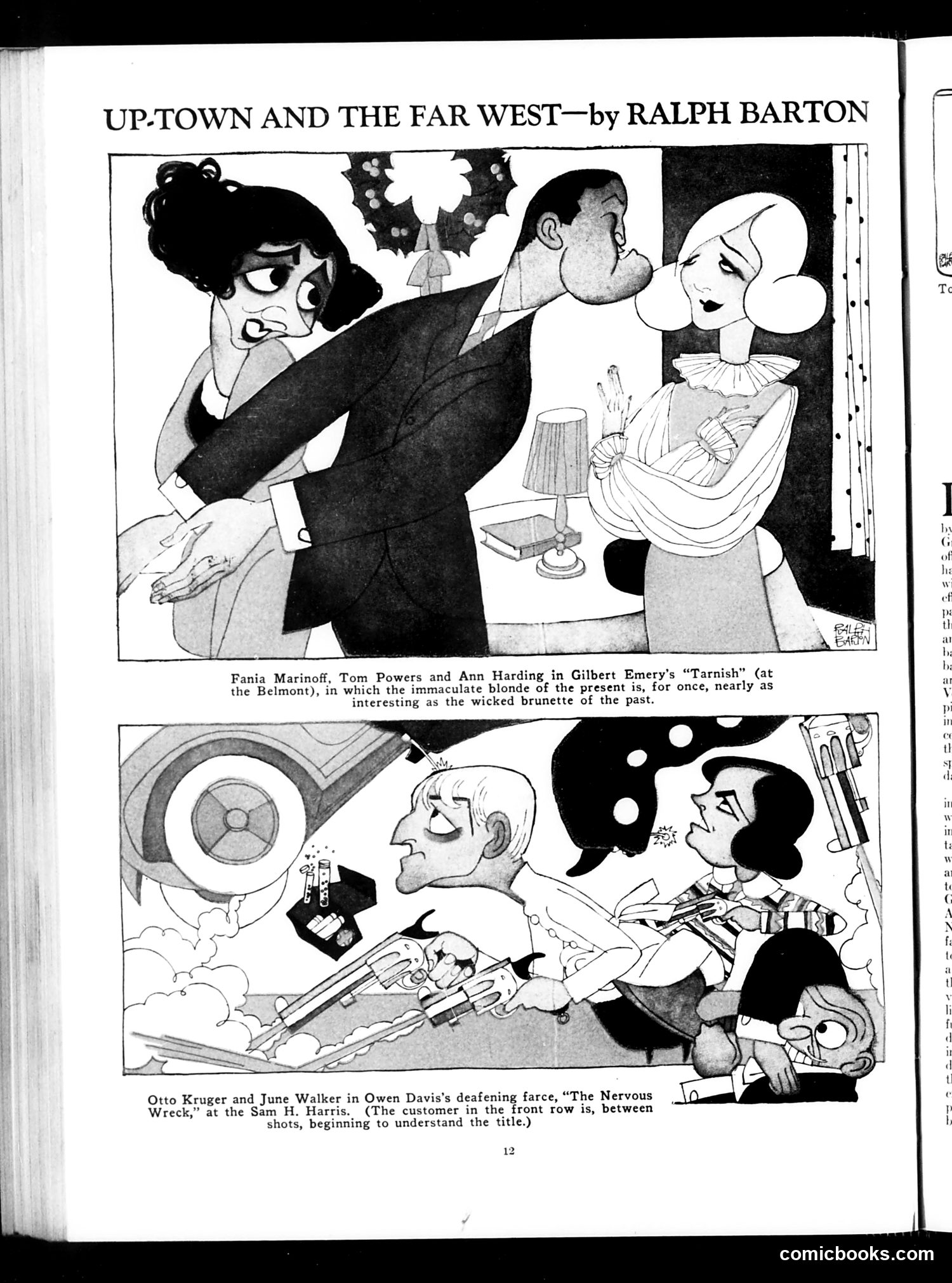
This is a theater review column by cartoonist Ralph Barton featuring two Broadway productions: **Top cartoon**: Depicts a scene from "Tarnish" at the Belmont Theatre, starring Fania Marinoff, Tom Powers, and Ann Harding. Barton's commentary suggests the play presents an interesting contrast—the "immaculate blonde of the present" (likely representing modern morality) proves nearly as compelling as the "wicked brunette of the past" (representing older, more scandalous female archetypes). **Bottom cartoon**: Shows "The Nervous Wreck" at the Sam H. Harris Theatre with Otto Kruger and June Walker. The joke is visual satire: the scene depicts chaotic action (explosions, weapons, mayhem), while Barton mockingly observes that a bewildered audience member is only "beginning to understand the title"—the farcical noise and confusion finally makes sense. Both cartoons use exaggerated caricature typical of 1920s satirical illustration to humorously critique contemporary theater productions.
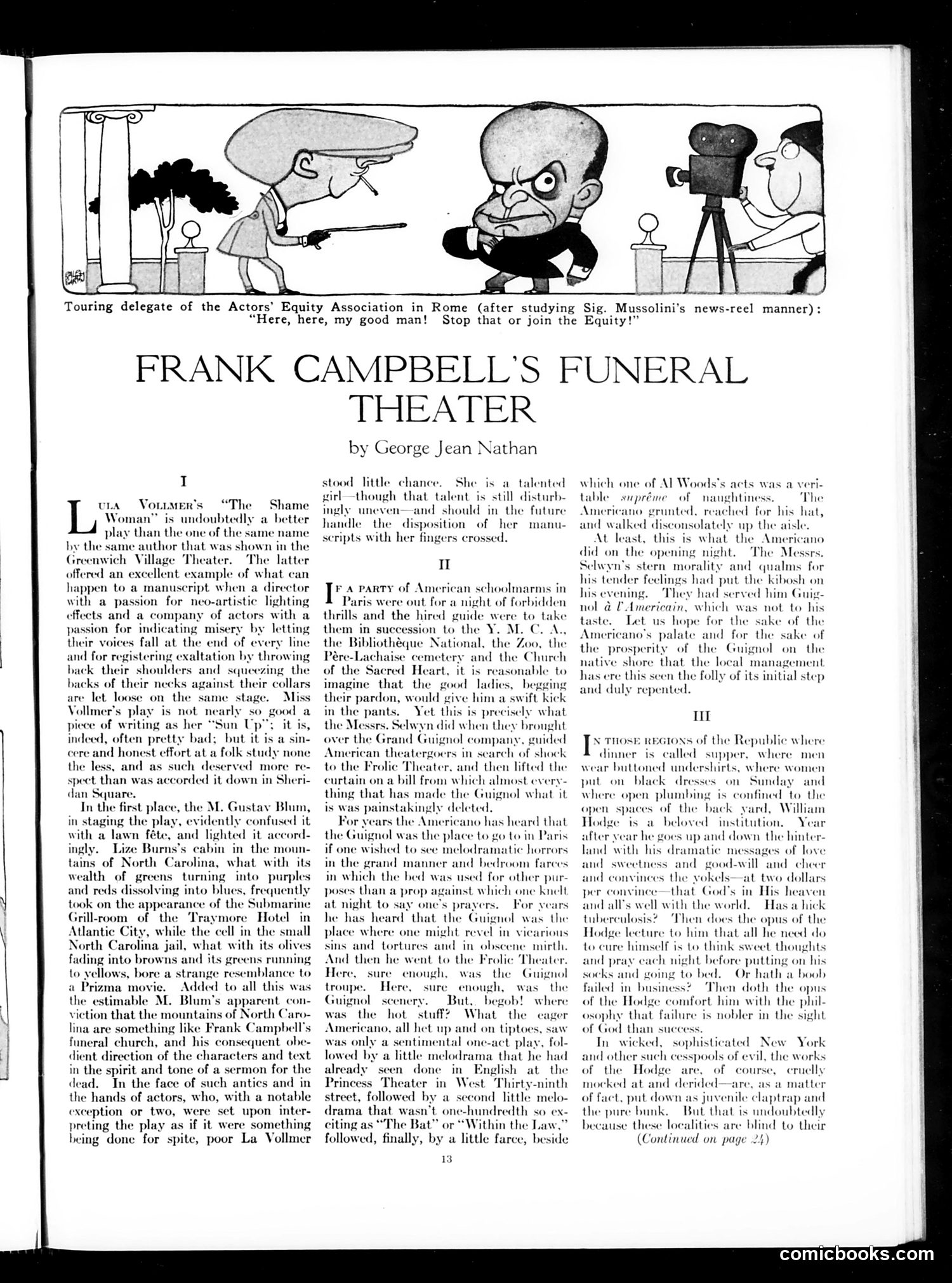
**The Cartoon (Top):** This satirizes the Actors' Equity Association sending a delegate to Rome to study Benito Mussolini's theatrical presentation style—specifically his dramatic gesturing and commanding presence in newsreels. The cartoon shows the delegate mimicking Mussolini's exaggerated poses and bullying manner, with the punchline being a threat to coerce compliance ("join the Equity!"). It's political satire about labor unions adopting authoritarian tactics, and mockery of how American actors might absurdly imitate fascist theatricality. **The Article:** George Jean Nathan's theater review critiques recent productions, particularly attacking M. Gustav Blum's overwrought staging of *The Shame Woman*—using excessive, inappropriate lighting effects and melodramatic acting direction. The second section mocks the Selwyn brothers' importation of Paris's famous Grand Guignol theater troupe, which promised shocking horror but delivered sanitized, sentimental plays instead—disappointing American audiences seeking authentic depravity.
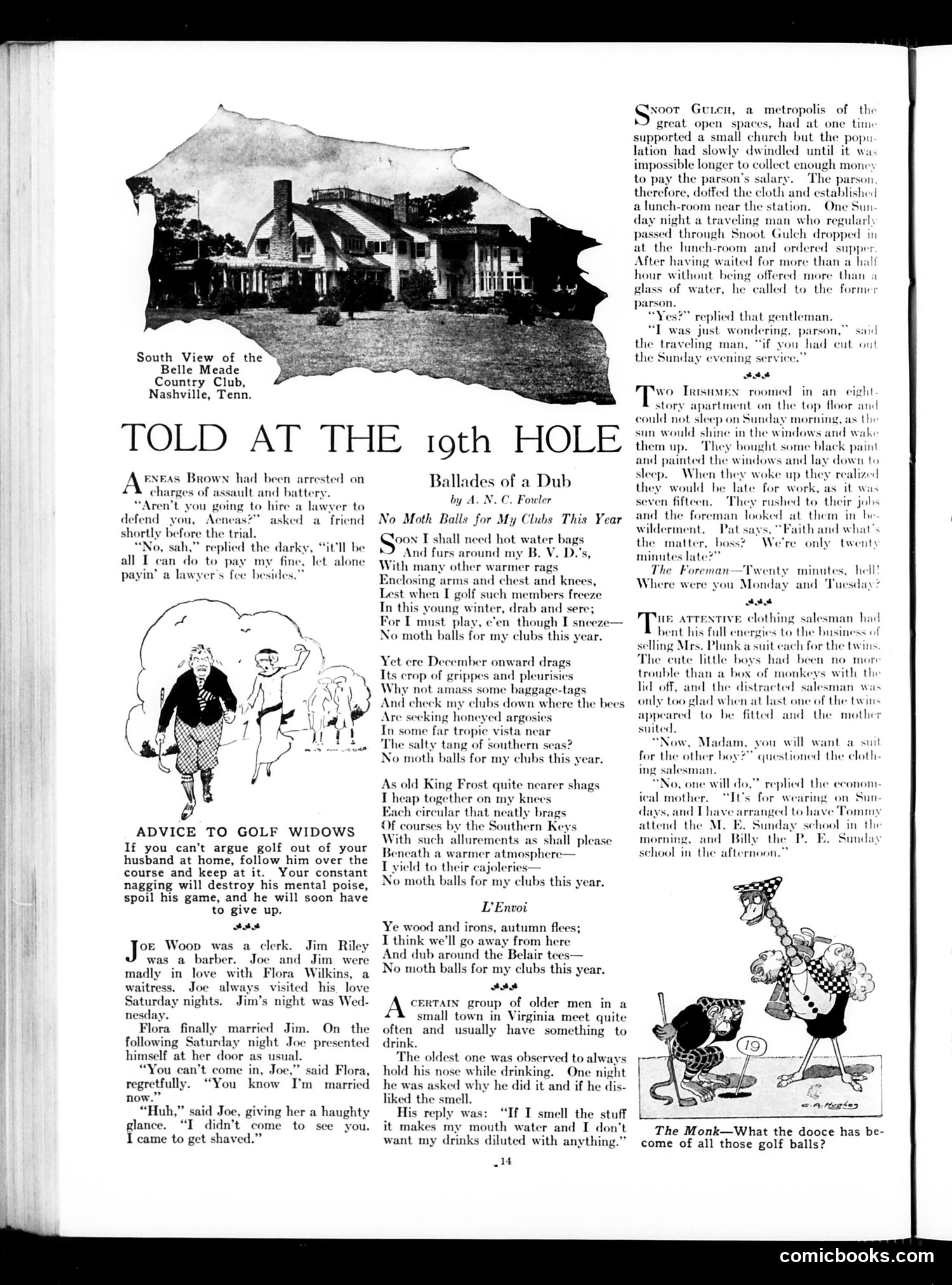
This page from *Judge* magazine contains several humorous stories and a poem about golf, reflecting early 20th-century American leisure culture and social attitudes. **"Told at the 19th Hole"** presents anecdotes told at a country club. One features racial stereotyping typical of the era: a Black man arrested for assault cannot afford a lawyer. Another mocks romantic betrayal—a barber loses his girlfriend to a rival, then shows up at her door claiming he came only for a shave, not to see her. **"Advice to Golf Widows"** sarcastically suggests wives sabotage their husbands' golf games by nagging them on the course—reflecting period anxiety about wives left behind while men pursued leisure. **"Ballades of a Dub"** is a poem about a golfer refusing to store his clubs for winter, preferring to play through illness rather than abandon the sport. The remaining jokes mock small-town life and working-class immigrants, using linguistic caricature (phonetic dialect) for humor. Overall, the page reflects period class attitudes, gender dynamics, and the growing obsession with golf among American upper-middle-class men.
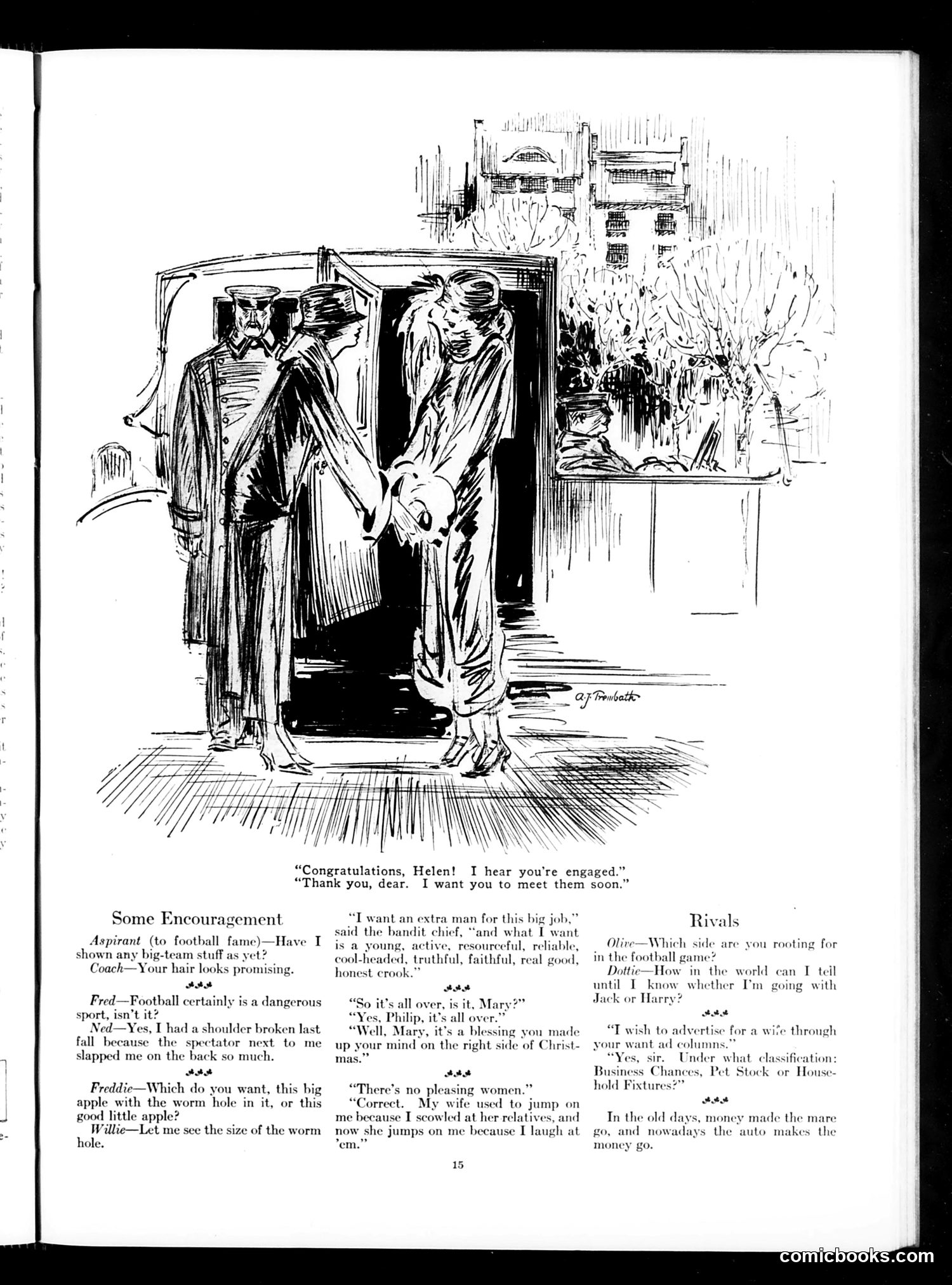
This page presents several short humorous vignettes satirizing early 20th-century American life: **The main cartoon** (top) depicts an engagement announcement, with the caption suggesting social obligation to meet the fiancé's family soon. **The jokes below** target contemporary absurdities: - A football coach compliments a player's *hair* rather than athletic ability—mocking vanity in sports - A spectator injures a player through enthusiastic back-slapping—satirizing overzealous fans - A child prefers an apple with a worm hole, valuing quantity over quality—gentle absurdist humor - A bandit requires a moral paragon as an accomplice—ironic commentary on criminal hypocrisy - Two women's football allegiance depends on which boyfriend they're dating—mocking women's supposed superficiality - An advertiser's ambiguous wording creates confusion about "fixtures"—wordplay on marriage/property - Final joke contrasts old wealth (horses) with new automotive expense—commentary on modern consumerism The sketches reflect Judge's satirical stance on sports enthusiasm, romantic conventions, gender stereotypes, and economic shifts of the era.
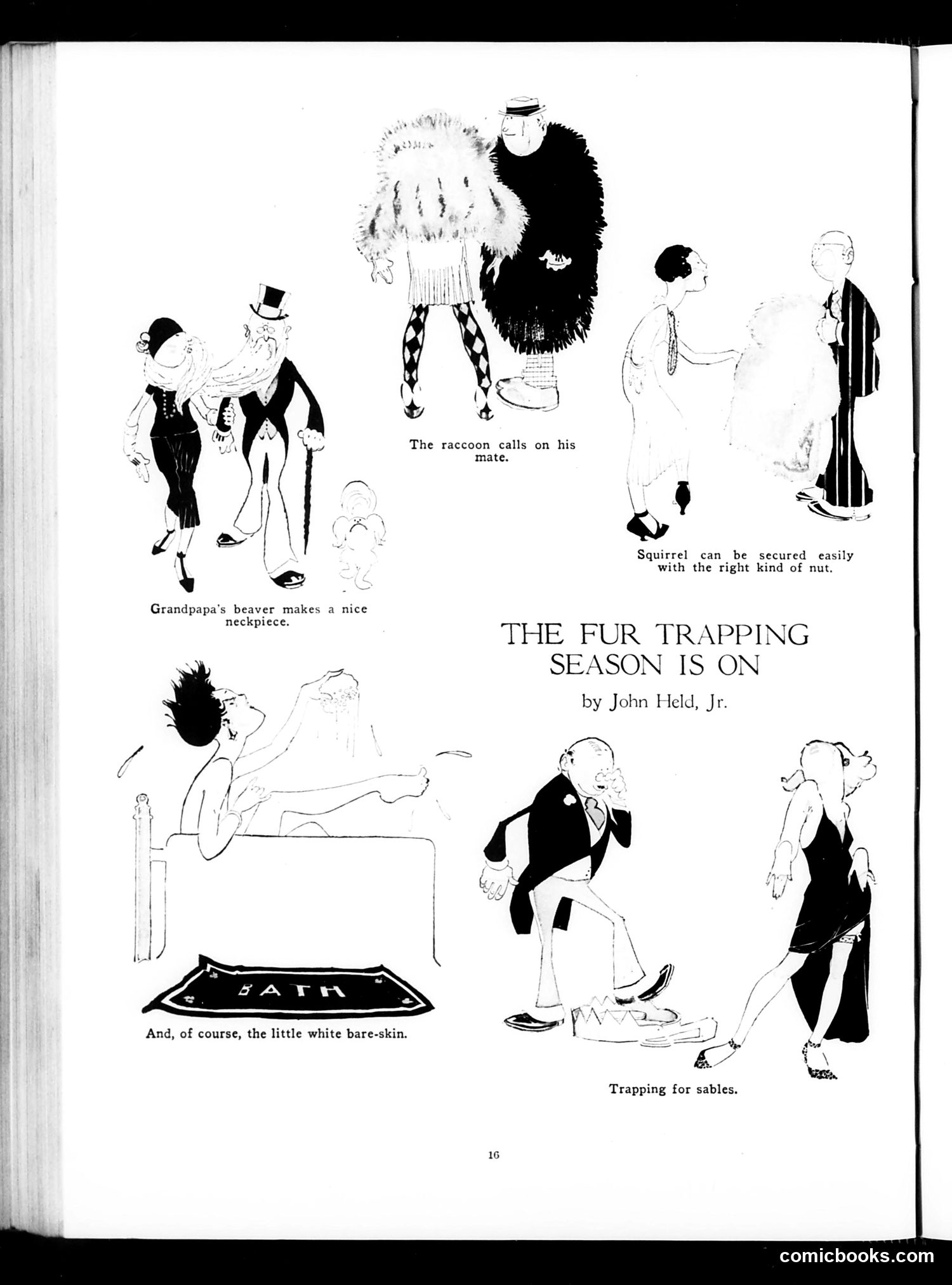
This satirical piece by John Held Jr. mocks wealthy society's enthusiasm for fur trapping by depicting fashionable people pursuing various furs as luxury goods. The cartoons show: - Upper-class figures acquiring beaver pelts as neckpieces and raccoon furs - References to trapping squirrels and sables (expensive furs) - A suggestive final panel labeled "the little white bare-skin," implying trappers pursue human targets The satire critiques consumerism and vanity among the wealthy elite who obsess over fur fashion. The progression from animals to the cryptic final image suggests commentary on moral degradation or exploitation tied to this materialistic pursuit. Held satirizes both the frivolousness of high society and the predatory nature of the fur industry itself.
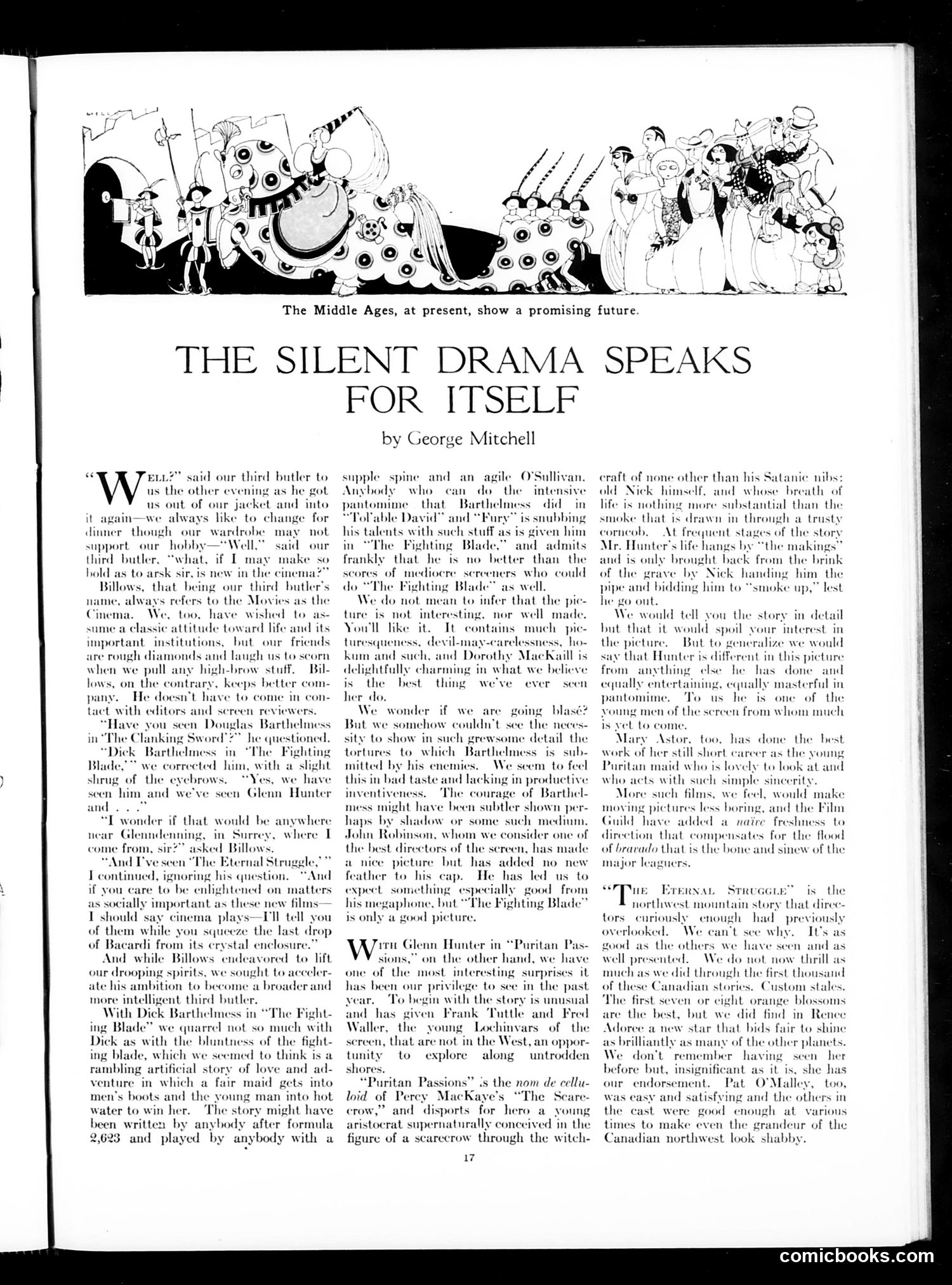
This page from *Judge* magazine reviews silent films, comparing three recent movies. The cartoon at top satirizes "The Middle Ages" (the medieval period) as a film subject gaining popularity in cinema. The article's narrator is a snobby socialite who discusses films with his butler, Billows. The satire targets pretentious film criticism: the narrator affects intellectual superiority while admitting he doesn't truly understand cinema's artistic merit. Key films reviewed: - **"The Fighting Blade"** (Dick Barthelmess): Criticized for gratuitous violence and formulaic plotting - **"The Clanking Sword"**: Dismissed as derivative - **"Puritan Passions"** (Glenn Hunter): Praised as genuinely innovative, exploring unexplored narrative territory The piece mocks both audience snobbery and mediocre filmmaking. The humor derives from the narrator's contradictions—he claims refinement while watching entertainment he considers shallow, and his butler Billows proves more culturally engaged than his employer. The satire suggests cinema's growing cultural importance in 1920s America, even as critics struggled to take it seriously.
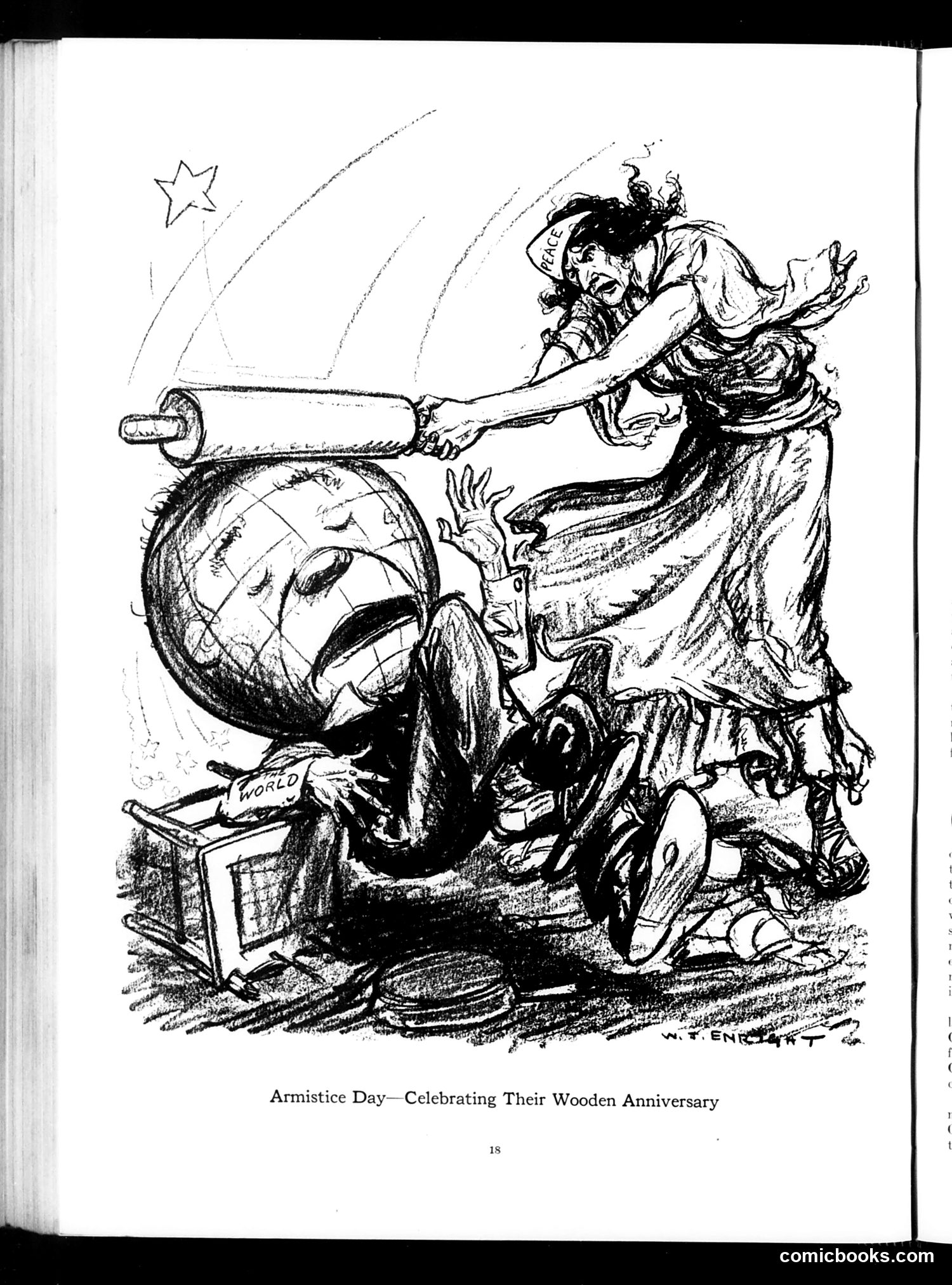
This is a satirical cartoon about Armistice Day (November 11, commemorating WWI's end) being celebrated as a "wooden anniversary." The figure on the left appears to be a distressed personification—possibly representing Europe or a war-torn nation—with a large round head marked with bandages and anguish. The figure on the right, dressed in elaborate clothing, wields a rolling pin or club, striking poses as if celebrating. The "wooden anniversary" reference is darkly ironic: typically marking five years of marriage, here it suggests the war's wooden, brittle aftermath. The contrast between the celebrant's exuberance and the wounded figure's suffering critiques how societies celebrated peace while populations remained traumatized and damaged by warfare. The satire appears to mock the disconnect between official Armistice Day celebrations and the actual human cost of the war.
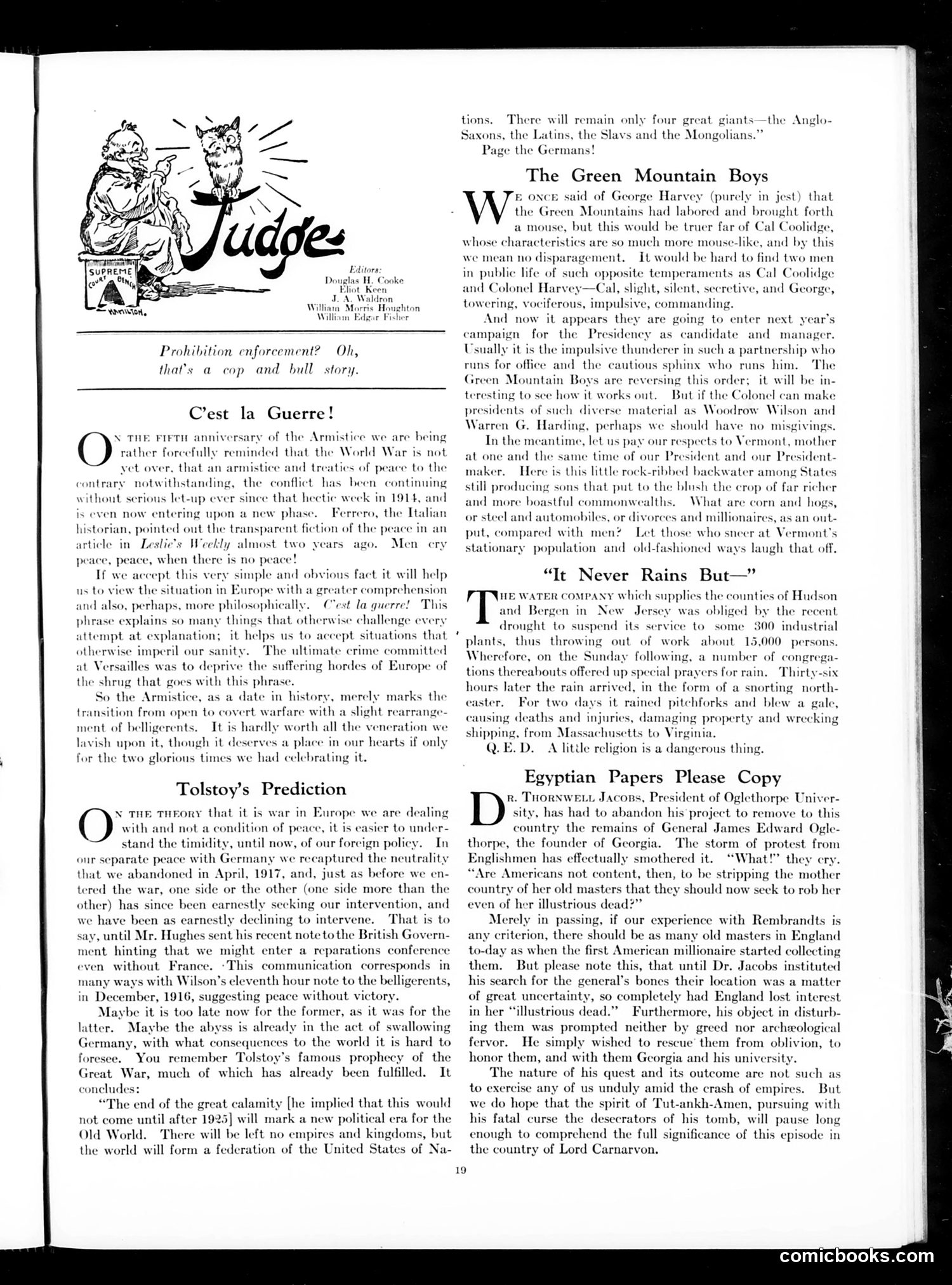
This page contains editorial commentary rather than political cartoons. The small illustration at top shows a judge figure—Judge magazine's mascot—commenting on "Prohibition enforcement." The main articles discuss post-WWI European politics and American domestic figures: **"C'est la Guerre!"** argues that despite the 1918 Armistice, warfare in Europe continues covertly. It references Tolstoy's prediction that empires will collapse, leaving only four great powers (Anglo-Saxons, Latins, Slavs, and Mongolians)—a concluding jab: "Page the Germans!" **"The Green Mountain Boys"** discusses Vermont politician Calvin Coolidge and journalist George Harvey entering the 1924 Presidential race as candidate and manager respectively. The piece notes their opposite temperaments—Coolidge being "slight, silent, secretive" versus Harvey's commanding presence. This likely satirizes their unlikely partnership, with the implication that the pairing will prove problematic. The page reflects post-war anxieties about European instability and American political maneuvering circa 1922-1923.
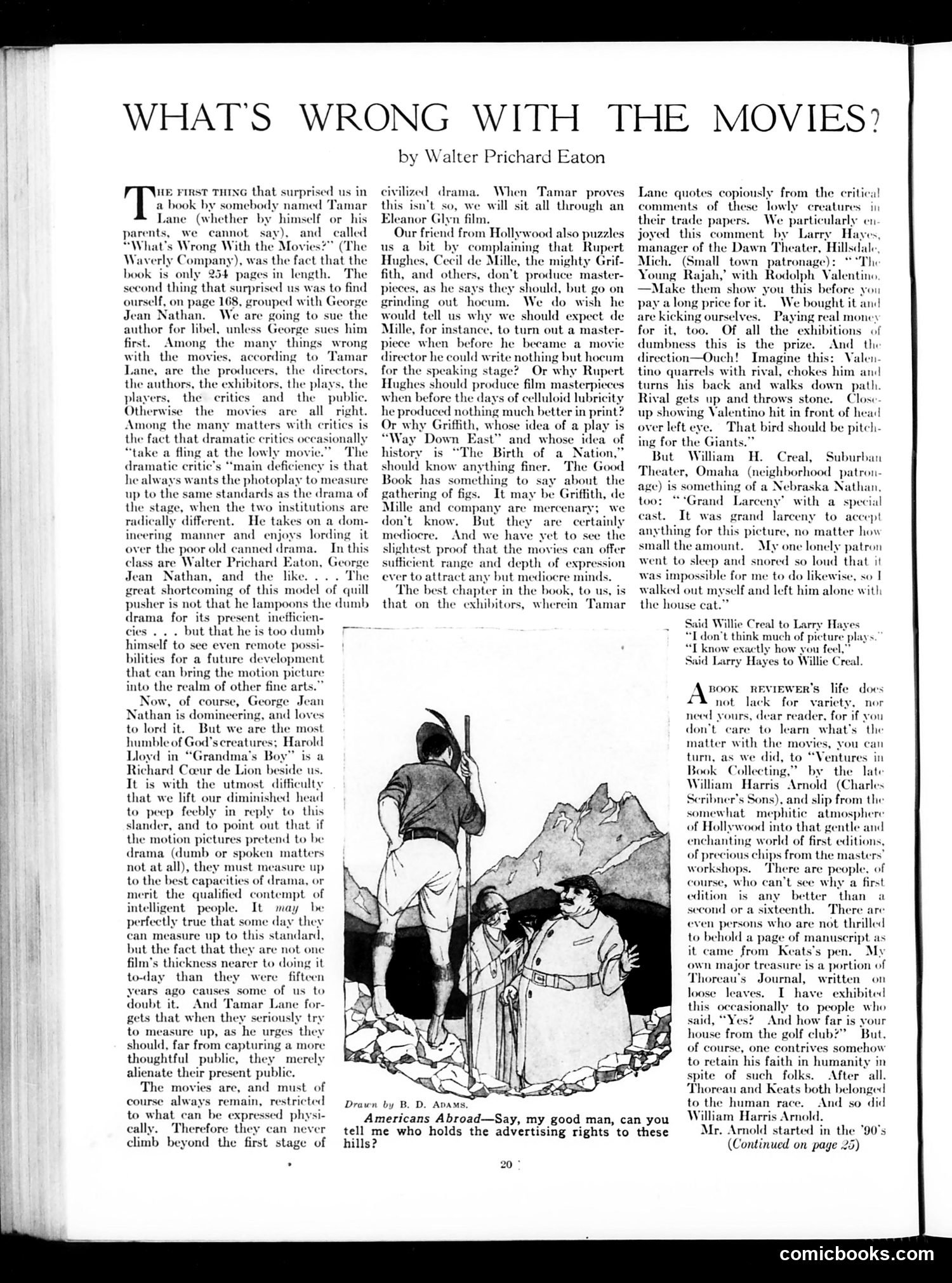
This is a book review by Walter Prichard Eaton critiquing *What's Wrong with the Movies?* by Tamar Lane. The cartoon (by R.D. Adams, titled "Americans Abroad") shows American tourists abroad, unrelated to the main text. Eaton defends film directors Cecil B. DeMille, D.W. Griffith, and Rupert Hughes against Lane's claim they should produce masterpieces. Eaton argues these men produced mediocre stage work before films, so expecting great cinema is unreasonable. He also dismisses the notion that movies can ever achieve the artistic depth of theater—they're fundamentally limited to entertaining the masses, not elevating them intellectually. The satire targets Lane's idealistic but impractical film criticism. Eaton sardonically groups himself with George Jean Nathan (a famous theater critic), implying he'll sue for defamation by association. The piece defends commercial filmmaking's current state while mocking critics who demand cinema match theatrical standards.
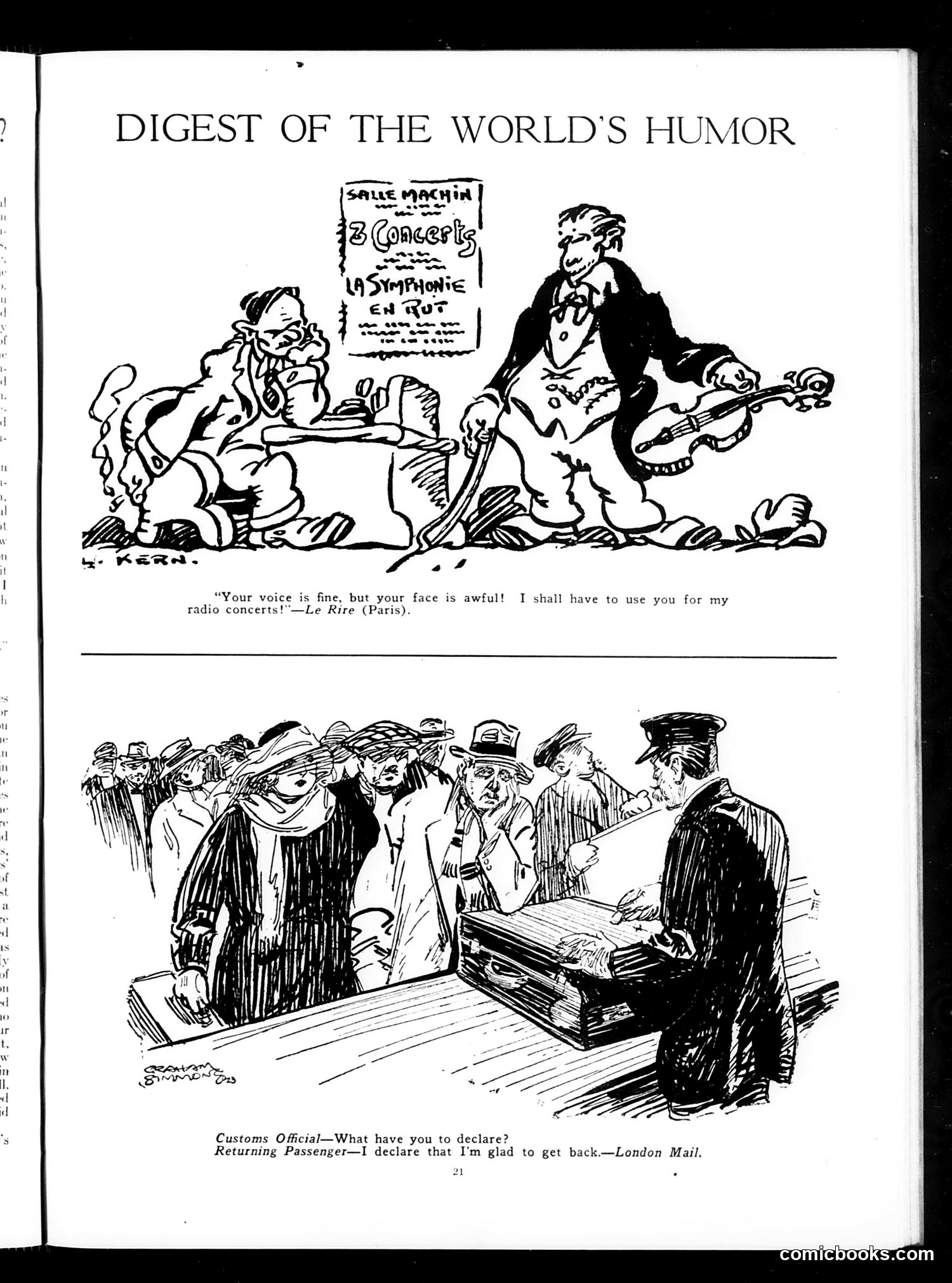
This page contains two unrelated jokes from international sources: **Top cartoon** (from French publication *Le Rire*): A radio concert promoter tells a musician his voice is excellent but his face is too ugly for public performance—so he'll only use him for radio broadcasts, where the audience won't see him. The humor plays on radio's invisibility and vanity about appearance. **Bottom cartoon** (from *London Mail*): A customs official asks a returning traveler what goods he must declare. The traveler's witty response is simply that he's happy to be home—a lighthearted comment on the relief of travel's end rather than any contraband declaration. The joke is the unexpected emotional answer instead of listing dutiable items. Both are gentle, observational humor typical of early-to-mid 20th century satirical magazines, relying on wordplay rather than sharp political critique.
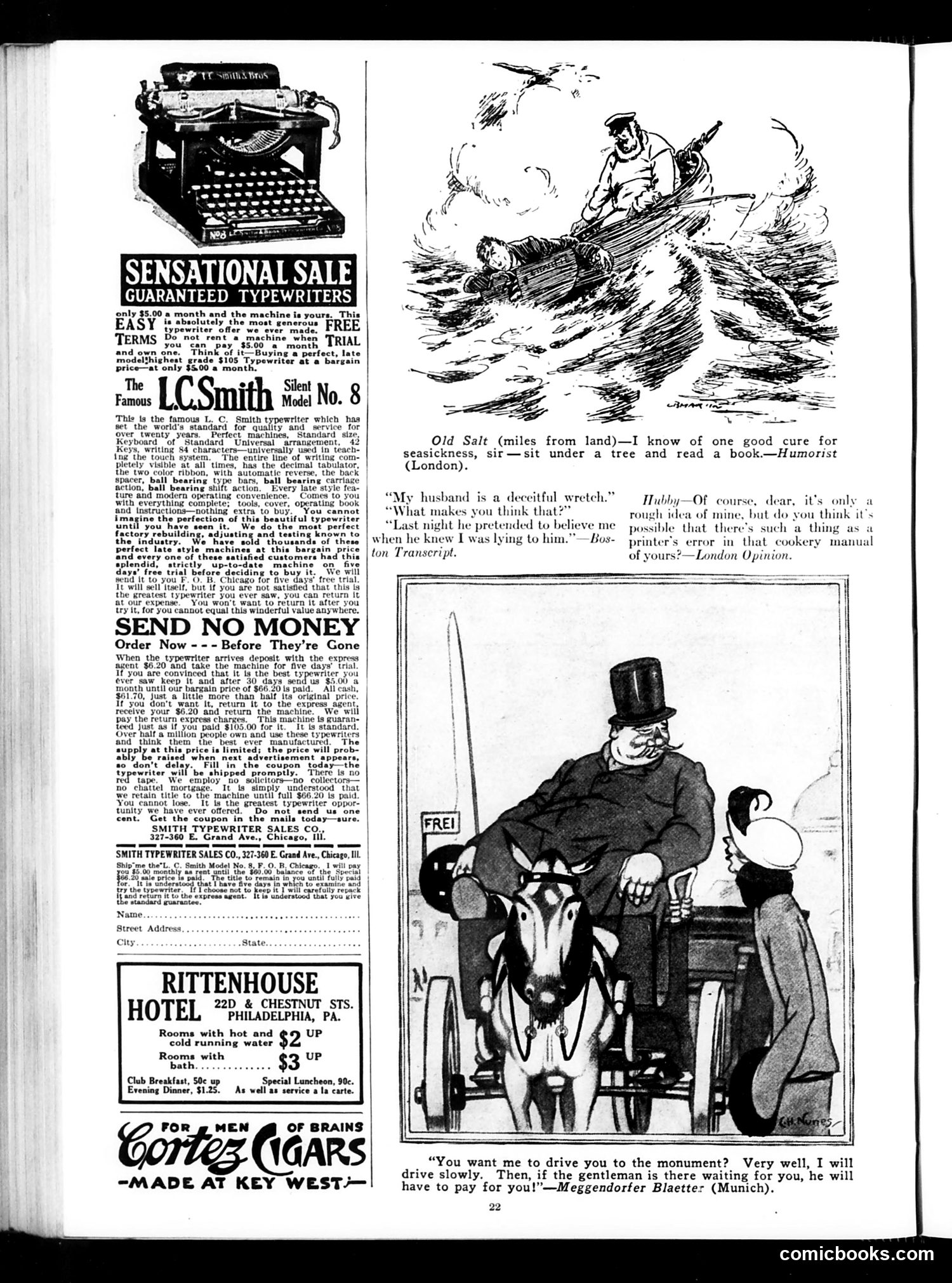
This page is primarily **advertising** rather than editorial content. The dominant feature is a full-page advertisement for the L.C. Smith typewriter, promoting an affordable payment plan ($5.00/month) and a five-day free trial. The page also contains small cartoon **jokes** rather than political satire: 1. **"Old Salt"**: A sailor recommends reading under a tree as a seasickness cure—absurdist humor about impractical folk remedies. 2. **The marriage joke**: A wife complains her husband is deceitful because he *pretended* to believe her lie—ironic commentary on marital dishonesty. 3. **The cartoon illustration** (bottom right): A well-dressed man in a top hat driving a goat-cart, with a caption about charging the passenger for waiting time—a joke about unconventional transportation and overcharging. These are light, domestic humor pieces typical of Judge's content, relying on wordplay and absurd situations rather than political commentary. The page reflects early 20th-century magazine advertising and social humor conventions.
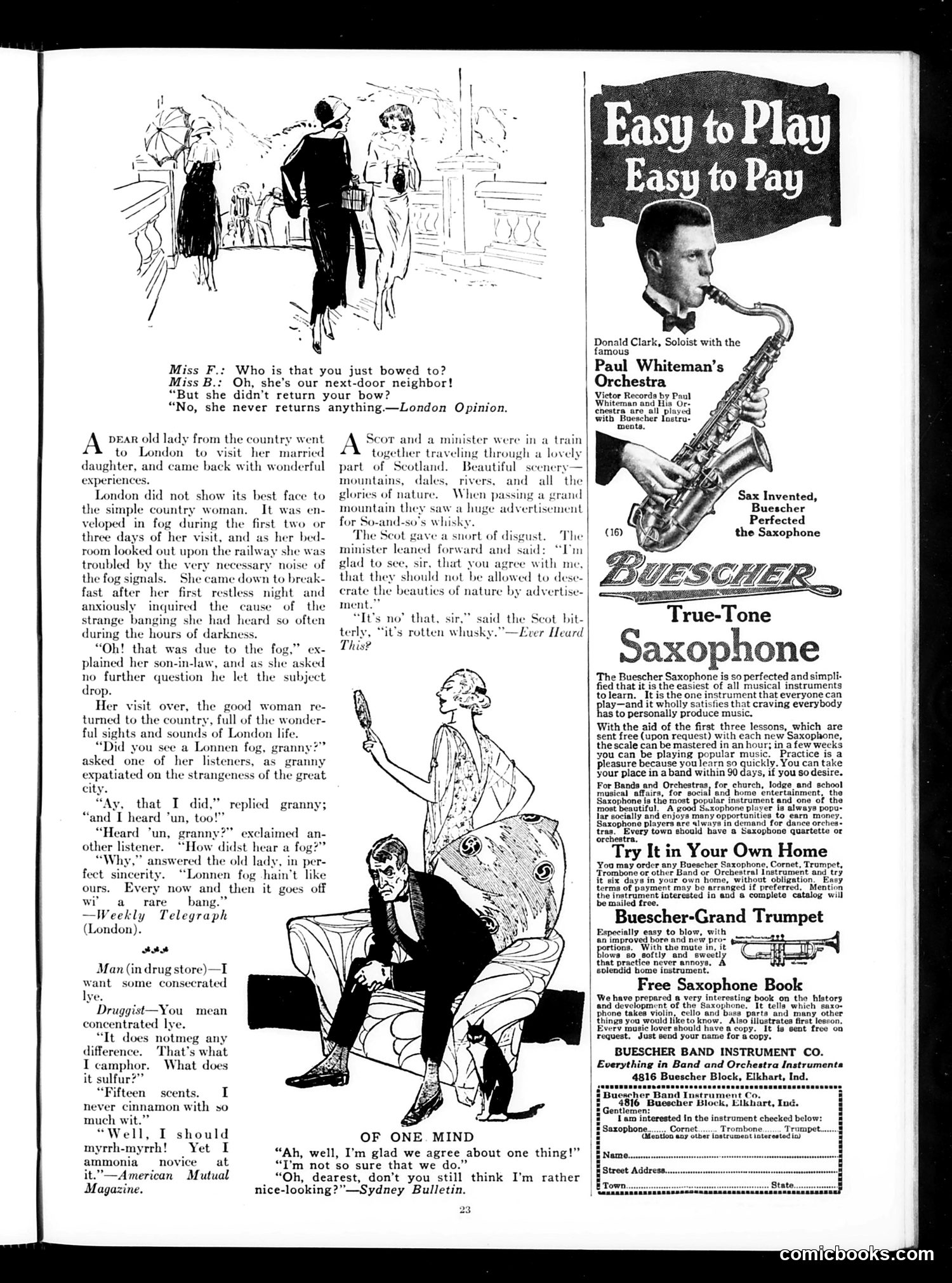
This page contains several short humorous anecdotes and a substantial advertisement for Buescher saxophones. **The Jokes:** - A brief society joke about a neighbor who never returns bows (implying rudeness/stinginess) - A country woman's confusion about London fog—she mistakes railway noise for the fog itself having a sound - A Scot and minister disagreeing about whisky advertising defacing Scottish landscape; the Scot's objection is merely that the whisky is poor quality - A couple's humorous misunderstanding about whether they agree on anything (she thinks he's conceding she's attractive) **The Advertisement:** The dominant right side promotes Buescher saxophones, featuring Donald Clark of Paul Whiteman's Orchestra. It emphasizes ease of learning ("master the scale in an hour"), quick results, and employment opportunities. This reflects 1920s jazz's popularity and the saxophone's emergence as an accessible, commercially viable instrument for aspiring musicians. The overall page reflects typical Judge content: light domestic and social satire aimed at middle-class readers, alongside period advertising reflecting consumer culture.
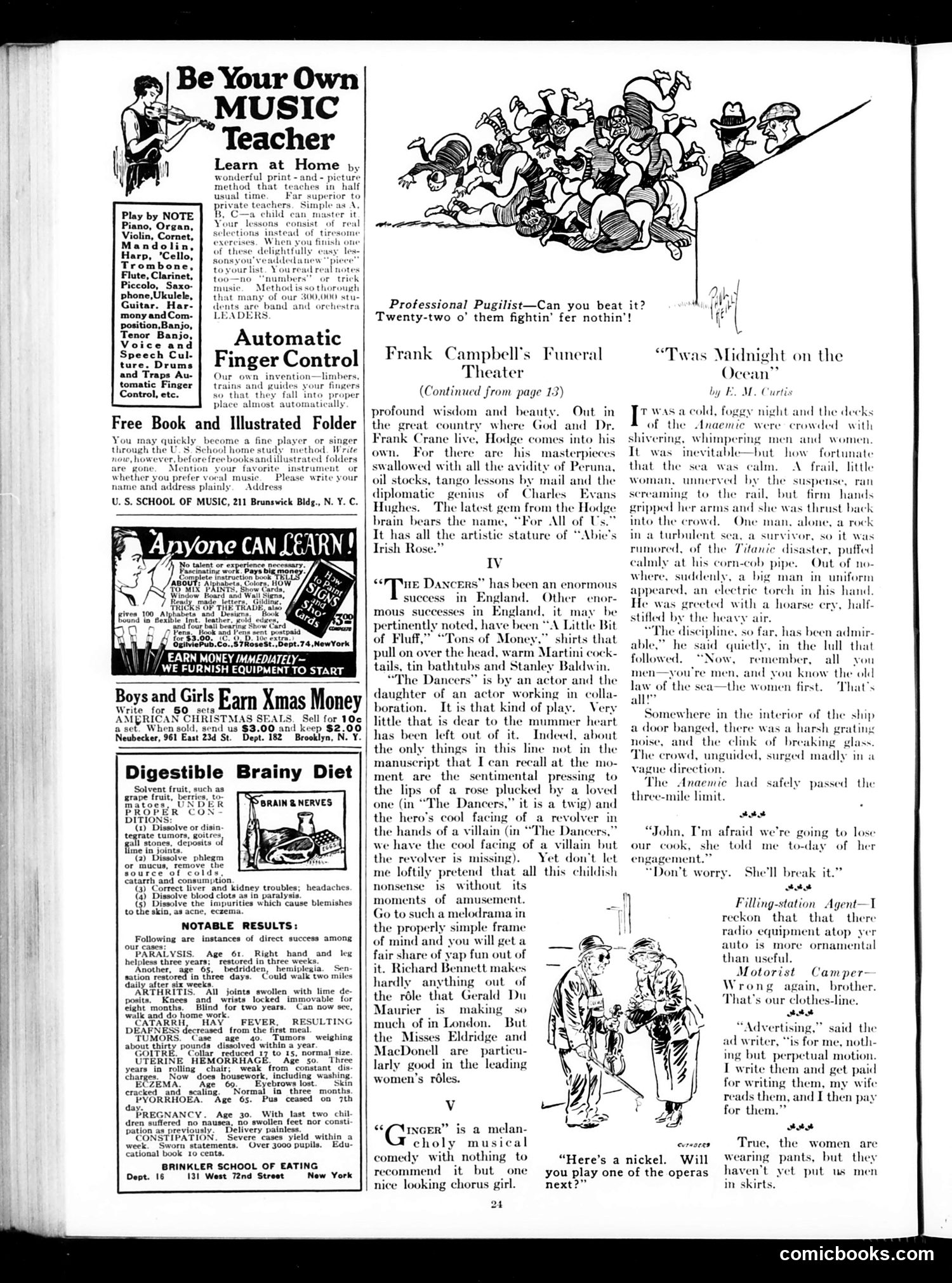
This page is primarily **advertisements and serialized fiction**, not political satire. The visible cartoons are generic illustrations accompanying ads rather than pointed social commentary. The main content includes: - **Music instruction ads** promoting home-study methods ("Be Your Own Music Teacher") - **"The Digestible Brainy Diet"** — a dubious health product claiming to cure paralysis, arthritis, goiter, and hemorrhage through dietary methods - **Christmas seal sales** for boys and girls - A **serialized theater review** of "Frank Campbell's Funeral Theater," discussing productions like "The Dancers" and "Ginger" The small cartoon showing children appears to illustrate the Christmas seal fundraising opportunity rather than convey political meaning. The health product ad is notable as an example of early 20th-century medical quackery — making sweeping therapeutic claims without scientific basis, which would be illegal today. This represents typical Judge magazine filler content rather than its signature satirical political cartoons.
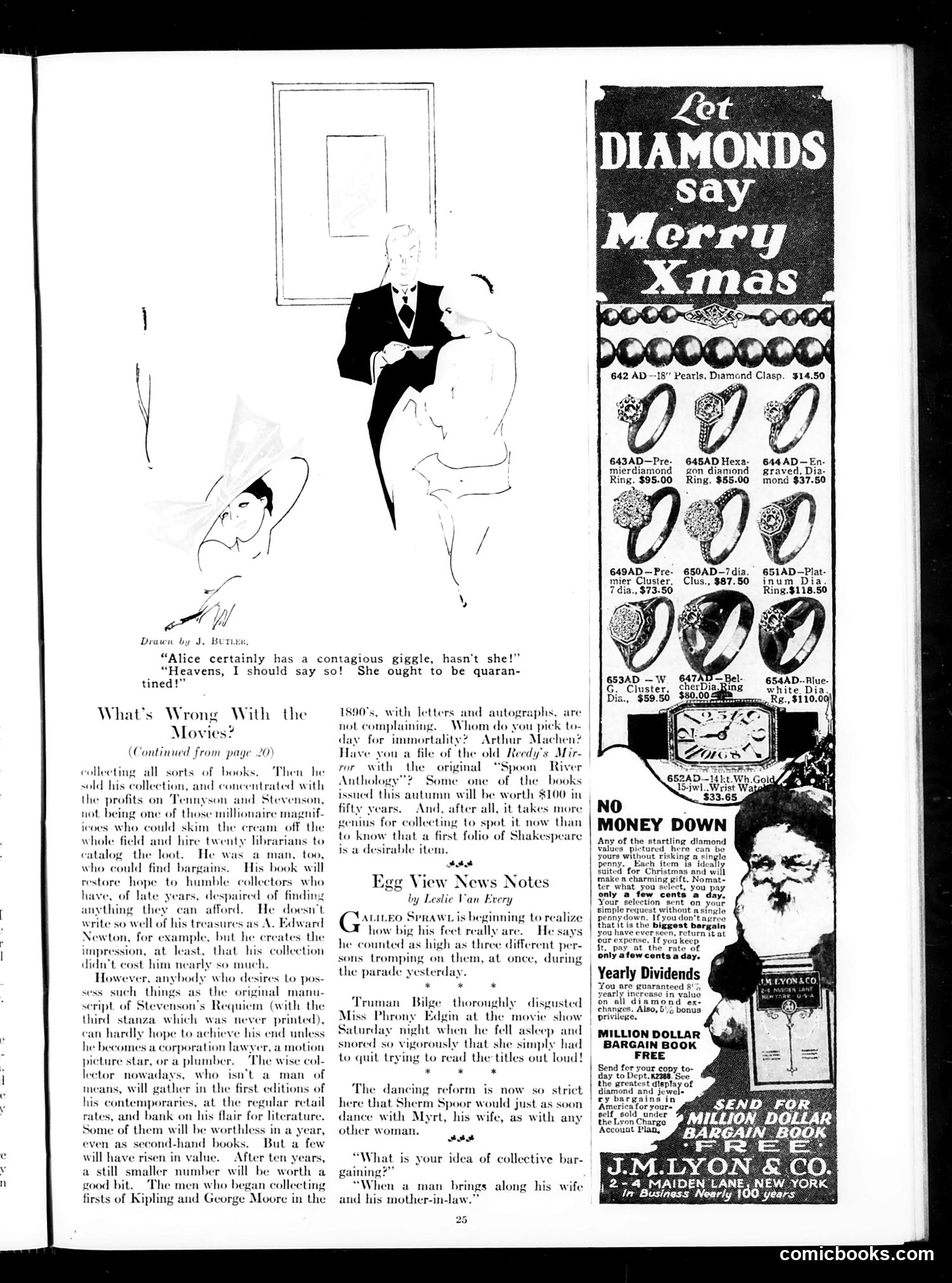
This page combines social commentary with advertising, typical of Judge's format. **The Cartoon:** The small illustrated cartoon at top depicts a man and woman in conversation about "Alice," who apparently has an infectious laugh. The woman suggests Alice "ought to be quarantined"—a dated social joke mocking women's giggles as an annoying, spreading affliction requiring isolation. It reflects early 20th-century attitudes dismissing women's expressions as frivolous. **Main Content:** The bulk of the page discusses book collecting, arguing that ordinary collectors needn't despair about affording rare manuscripts. The article suggests building collections of contemporary first editions instead, betting that some will appreciate in value—practical advice for middle-class readers. **Advertising:** The right side features "Egg View News Notes" (humorous rural vignettes) and diamond ring advertisements, including a "No Money Down" offer from J.M. Lyon & Co., capitalizing on Christmas shopping with financing options. The page reflects 1920s consumer culture and gendered humor now considered outdated.
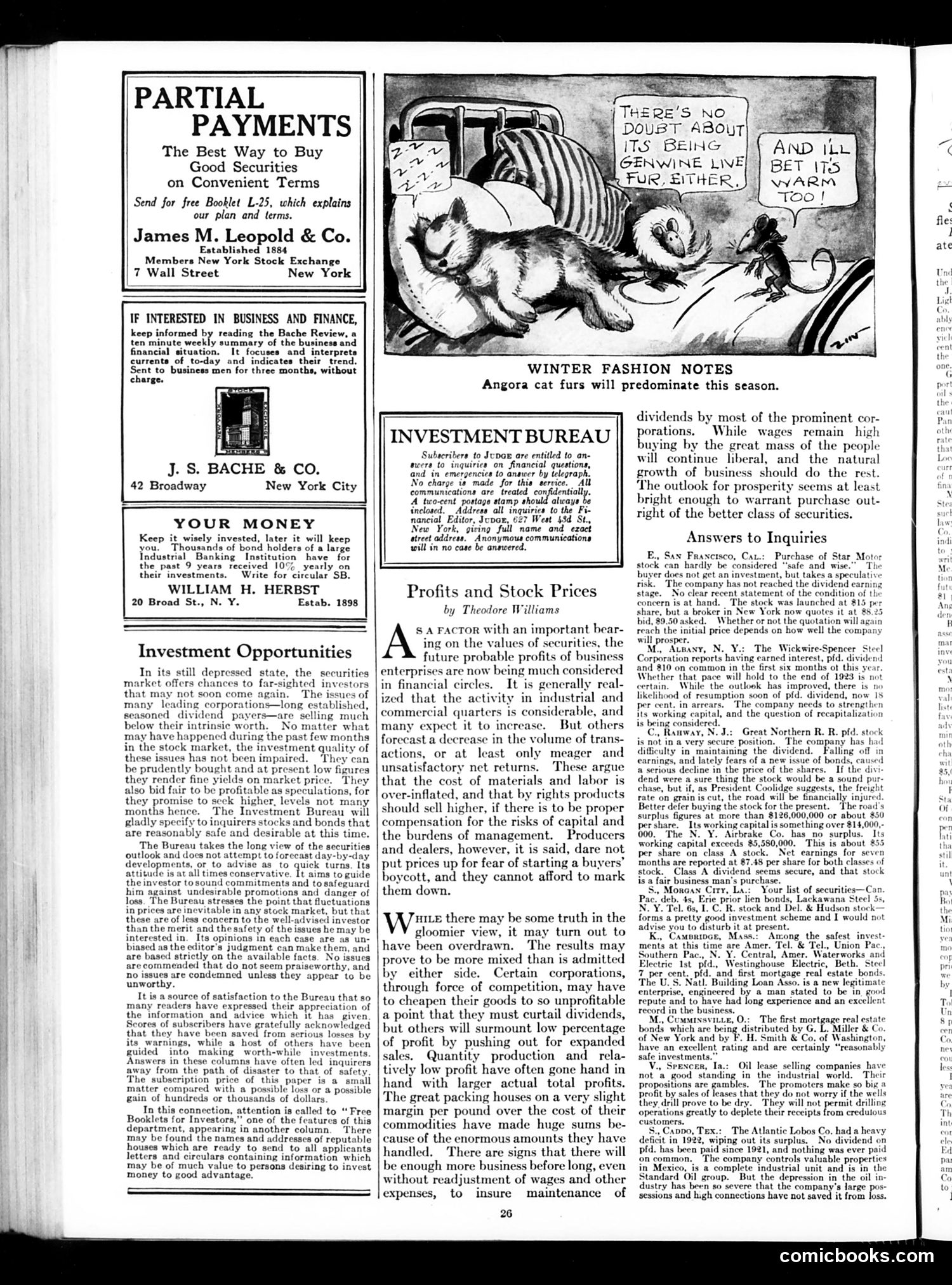
The cartoon shows a cat wearing an Angora fur coat, conversing with a mouse. The cat declares the fur is "genuine" and will keep it warm, while the mouse sarcastically agrees it's genuine—meaning genuine cat fur, not Angora. **The satire:** This is a visual pun on the "Winter Fashion Notes" headline announcing that "Angora cat furs will predominate this season." The joke plays on the ambiguity of "cat furs"—fashionable Angora (a rabbit breed), versus literal cat fur. By depicting an actual cat wearing actual cat fur, the cartoon mocks either the pretentiousness of fashion marketing or highlights the absurdity of the fashion industry's terminology. The mouse's fearful aside ("And I'll be its warm too!") adds dark humor, as the mouse realizes it could become part of the fashion trend next. This reflects Judge magazine's typical approach: using animal characters to satirize contemporary society and consumer culture.
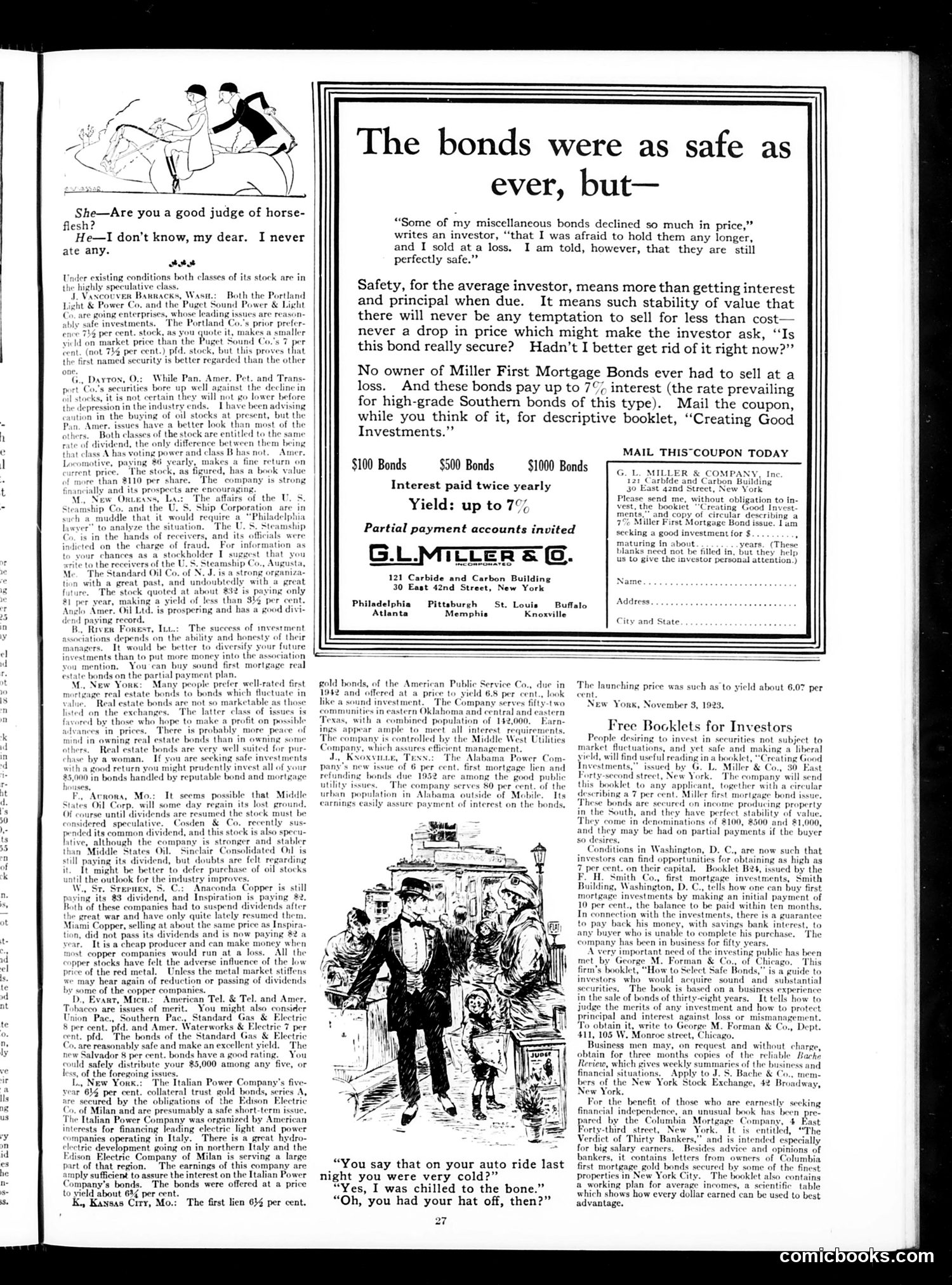
This page combines a satirical cartoon with investment advertising. **The Cartoon:** A couple discusses horseflesh (quality horses). The husband says he never eats any—a joke playing on "judge of horseflesh" (evaluating horse quality) being applied to bonds. It's light humor about investing expertise. **The Real Satire:** The accompanying editorial text is the actual point. It mocks investors who sold bonds at losses despite being told they were "perfectly safe." The satire highlights the gap between *theoretical* safety (stable interest payments) and *practical* safety (resale value). Investors panic-sold bonds when prices dropped, losing money on "safe" investments—exposing the disconnect between what financial institutions promise and market reality. **The Ad:** Miller First Mortgage Bonds are advertised as genuinely safe alternatives, offering up to 7% yield with partial-payment purchasing options. The joke: bonds labeled "safe" often aren't, because investors fear losing principal value regardless of maturity guarantees.
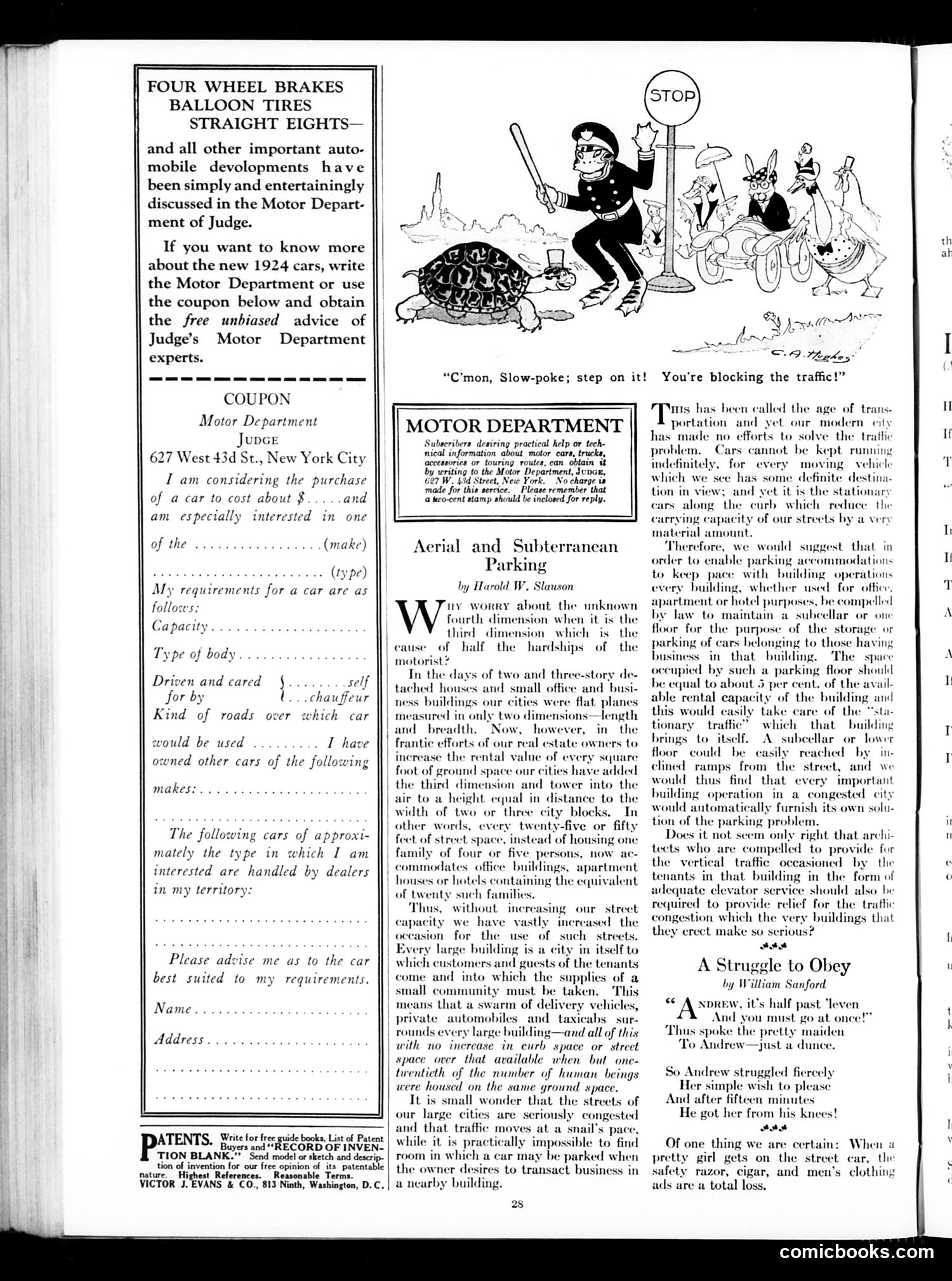
The main cartoon depicts a traffic cop frantically signaling a turtle-riding man to move, shouting "C'mon, Slow-poke; step on it! You're blocking the traffic!" The humor satirizes urban congestion and slow vehicle movement in 1920s cities. The accompanying article "Aerial and Subterranean Parking" by Harold W. Slauson addresses a genuine problem of the era: skyscrapers had dramatically increased urban density and population concentration without expanding street capacity. Modern readers should understand that in the 1920s, cities were experiencing their first major traffic crisis as automobiles proliferated. The cartoon mocks drivers who move slowly despite urban congestion—the implication being that even a *turtle* would be faster. The article proposes vertical solutions (underground and rooftop parking) to accommodate vehicles when traditional street-level parking proved inadequate. This represents early urban planning concerns now familiar to modern cities.
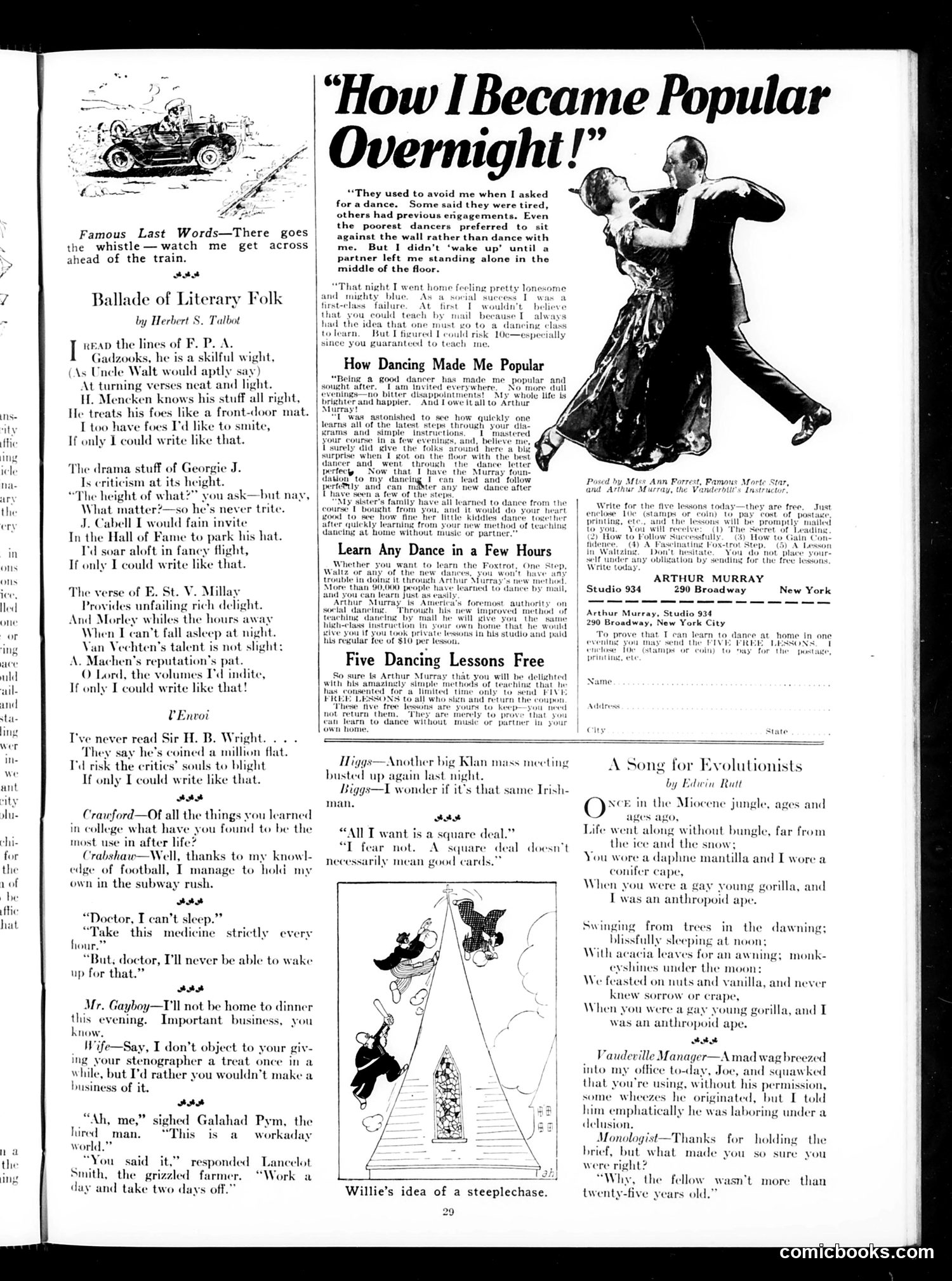
This page from *Judge* magazine contains several satirical pieces targeting American cultural figures and social foibles circa the 1920s. **"Ballade of Literary Folk"** mocks contemporary authors—P.F.A. Gadzooks, H. Mencken, George J., and others—through a literary form that repeatedly laments the speaker's inability to write like them, creating humorous deprecation. **The dancing lesson advertisement** featuring Arthur Murray represents the era's commercial promotion of modern social dancing (Foxtrot, One Step) as self-improvement, positioning dance instruction as transformative. **The brief jokes** satirize everyday situations: a man boasting about athletic prowess in subway crowds, marital tension over stenographers, and labor disputes—typical *Judge* humor targeting middle-class anxieties. **"Willie's Steeplechase"** cartoon shows children jumping over a fence, punning on the equestrian sport term. **"A Song for Evolutionists"** humorously traces romantic love backward through evolutionary history, from apes to modern humans—reflecting 1920s fascination with Darwinian theory applied to domestic life. The page reflects *Judge*'s satirical focus on contemporary literary, social, and commercial culture of the period.
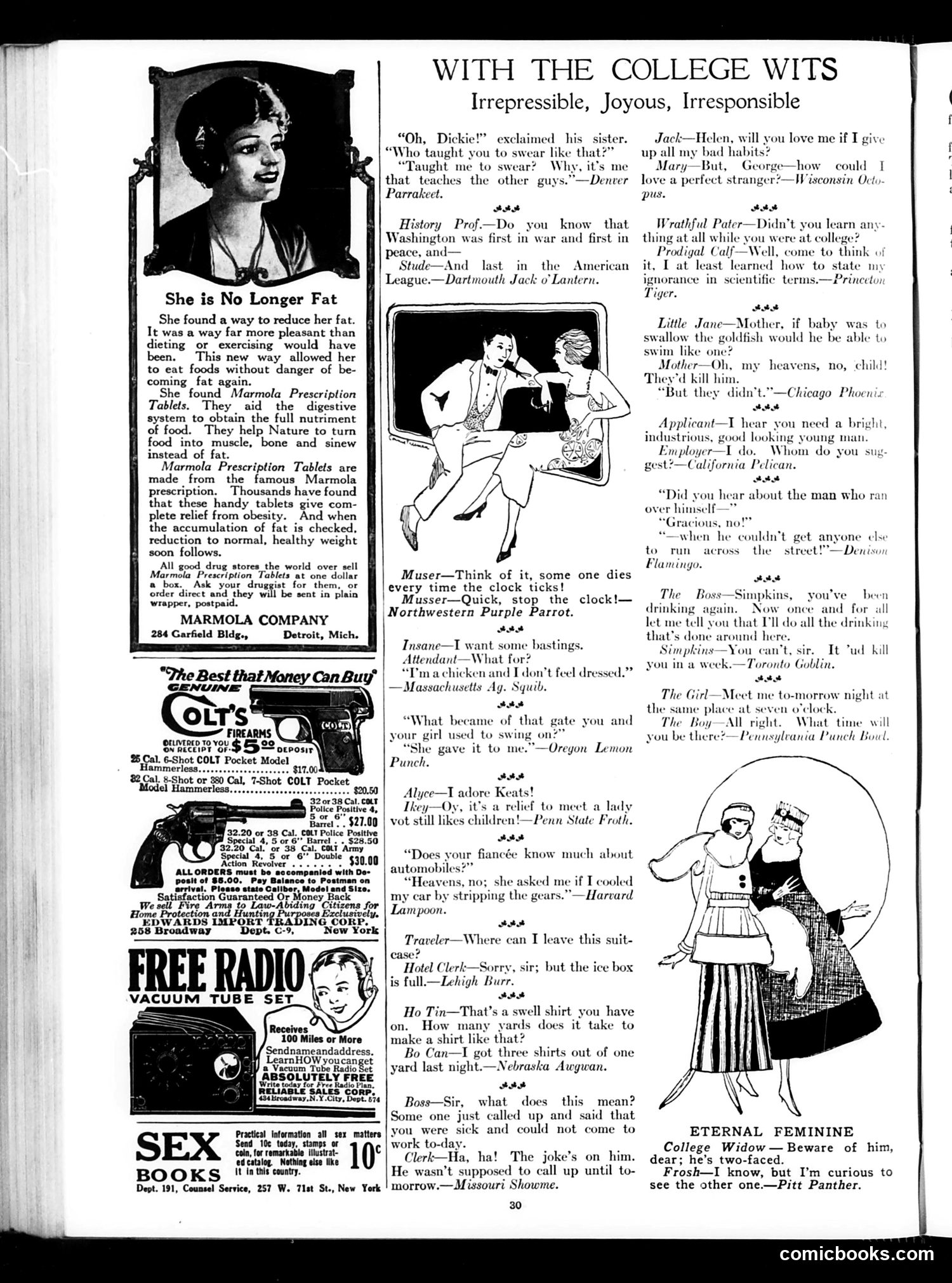
This page presents **college humor** — a series of short jokes attributed to various university publications (Dartmouth, Northwestern, Penn State, etc.). The humor reflects early 20th-century collegiate culture and sensibilities. **Key joke examples:** - A boy swears because he's taught the other students (subverting authority) - A student makes a baseball joke about George Washington (deflating reverence for historical figures) - Wordplay about clocks stopping when someone dies - A student admits college taught him only how to sound knowledgeable while remaining ignorant **The satire targets:** - Youth irreverence toward tradition and authority - College students as intellectually pretentious yet fundamentally unchanged - The gap between education's promise and actual character development The accompanying **advertisements** (Marmola weight-loss tablets, Colt firearms, sex education books, free radios) reflect commercial appeal to young readers, though they seem incongruous with the satirical content. The overall tone is lighthearted mockery of college culture itself rather than political satire.
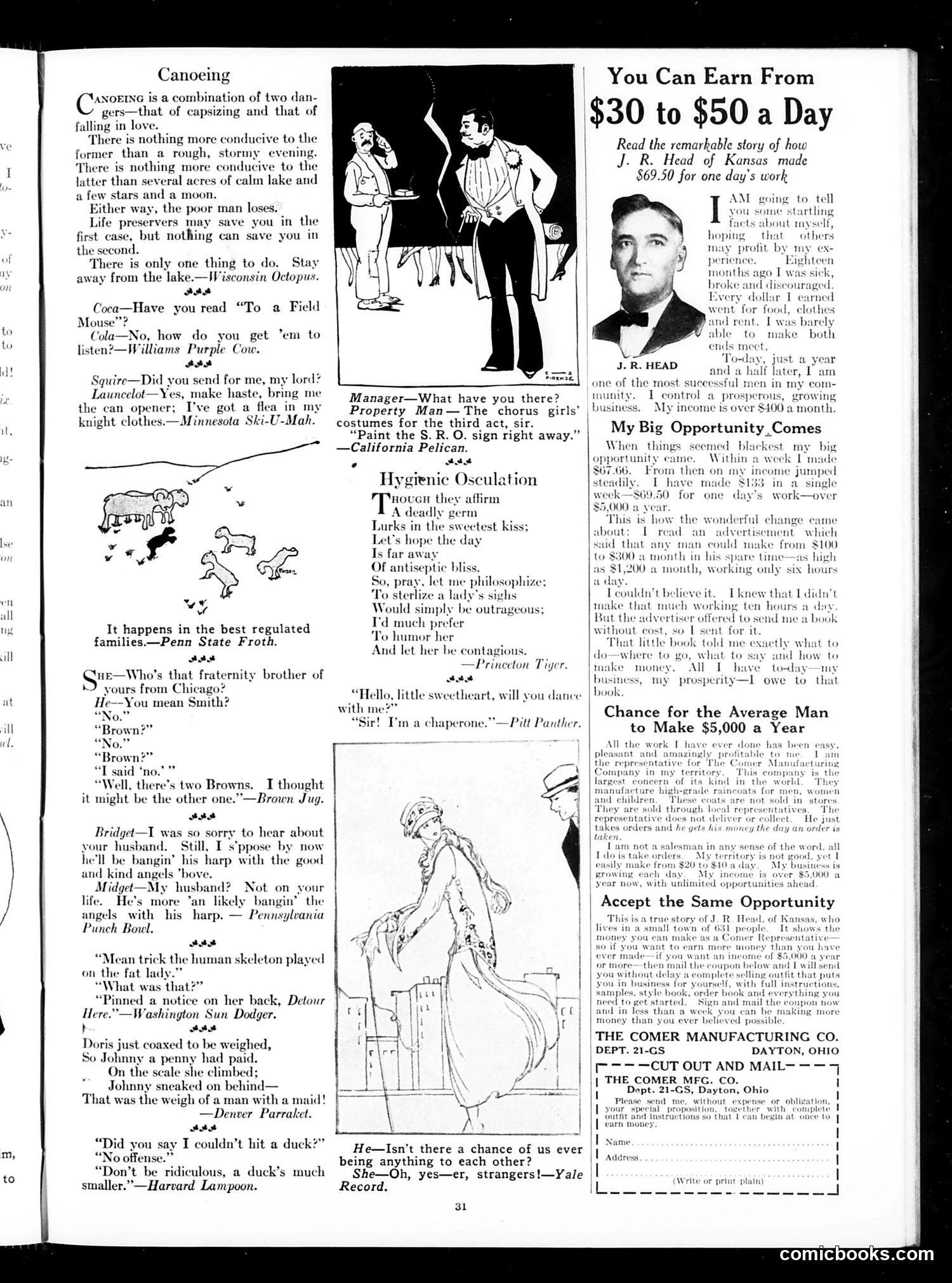
This is a **humor and advertising page** from an early 20th-century American satirical magazine. The **left side contains joke reprints** from college humor magazines (Wisconsin Octopus, Princeton Tiger, Yale Record, etc.)—typical filler material featuring lighthearted puns about romance, marriage, and social situations. References to canoeing, fraternity life, and courtship reflect period college culture. **Two cartoons appear**: one showing a man and woman in a canoe (illustrating the canoeing jokes about romance and danger), another depicting a woman on a weighing scale with a man sneaking onto it behind her—a visual gag about hidden weight. **The right side is entirely advertising** for "The Comer Manufacturing Company" (Dayton, Ohio), promoting work-from-home sales opportunities earning "$30 to $50 a day"—a substantial sum circa 1910s. This uses a testimonial from "J. R. Head of Kansas" claiming rapid financial transformation. This type of mail-order opportunity advertisement was extremely common in period magazines, often targeting desperate or ambitious readers.
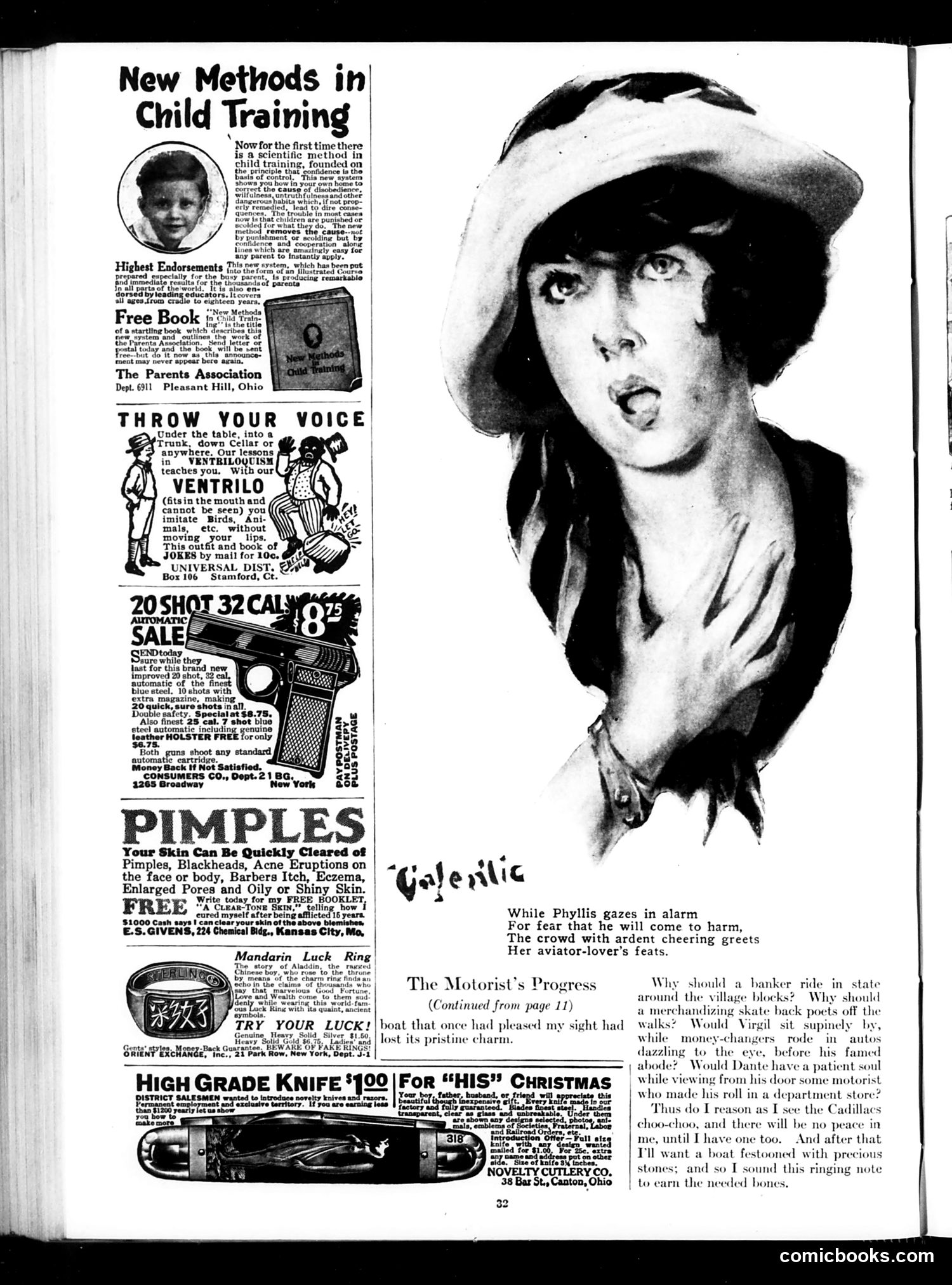
This page is primarily **advertising**, with one literary cartoon/poem excerpt. The main visual element is a portrait labeled "Galentis" showing a woman in 1920s attire (cloche hat, bobbed hair) gazing upward with an expression of alarm or concern. Below it runs a short poem titled "The Motorist's Progress" (continued from a previous page). The poem satirizes **modern materialism and status anxiety** in the Jazz Age. It contrasts Dante's supposed indifference to material display with the narrator's newfound envy—if Dante could watch a motorist showing off in a Cadillac without jealousy, why should *he* restrain himself? The speaker concludes he wants a boat "festooned with precious stones" to keep up with the competitive consumption he observes. The satire targets the **1920s culture of conspicuous consumption**, where owning automobiles and luxury goods became status symbols. The poem mocks how modern people abandon philosophical detachment in favor of acquisitive desire. The rest of the page consists of period advertisements for child-training books, ventriloquism lessons, firearms, skin treatments, and knives—typical of Judge's revenue model.
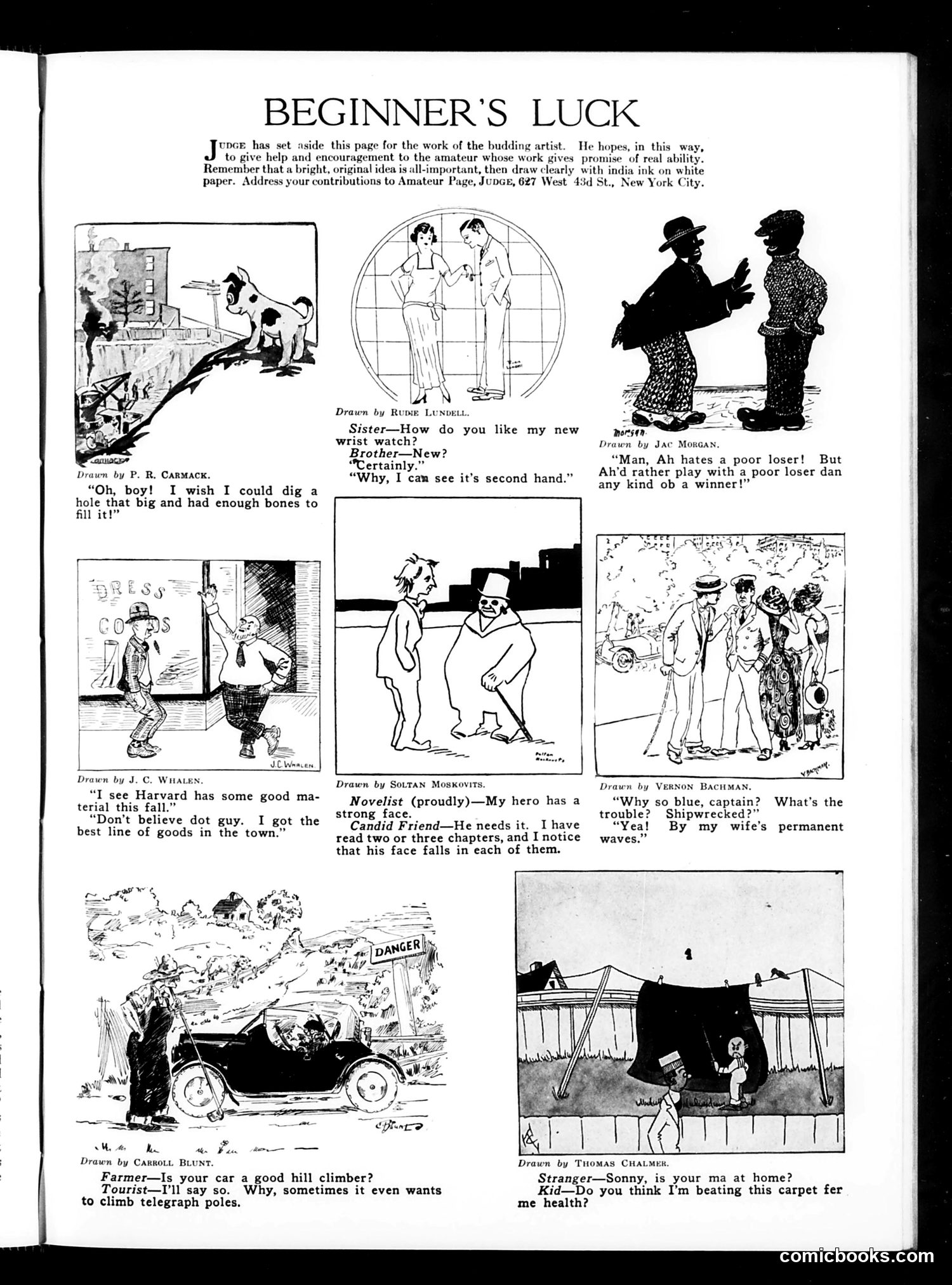
This page showcases amateur cartoons submitted to Judge's "Amateur Page." Each comic delivers quick, punchy jokes typical of 1920s humor: **Key jokes include:** - A dog wishing for a bone-filled hole (visual gag) - Harvard material/goods salesman wordplay - A secondhand watch joke (clever misdirection) - A novelist's hero's "face falls" — literary criticism pun - A poor loser preferring honest competition to dishonest winning (racial dialect humor, period-typical) - A captain's depression from his wife's "permanent waves" (double meaning: both hair treatment and marital discord) - A boy beating a carpet for exercise (child labor/poverty commentary) - A car climbing telegraph poles (exaggerated hill-climbing ability) The page's purpose, stated in the header, is encouraging amateur artists by publishing promising work. These are accessible, pun-based gags rather than sophisticated satire—designed to be relatable to average readers while showcasing diverse artistic styles.
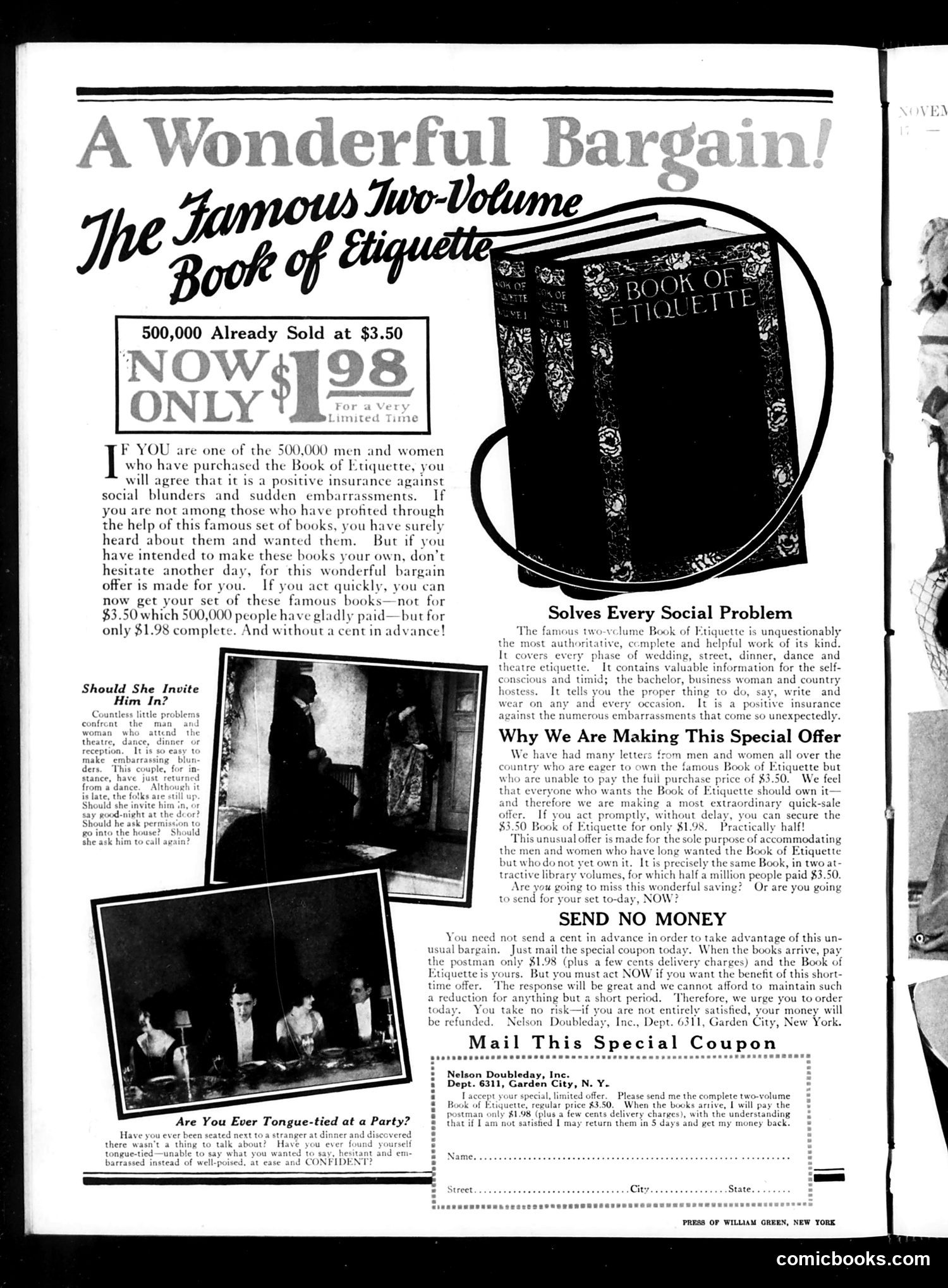
This page is **not a cartoon or satire**—it's a full-page advertisement disguised as editorial content in *Judge* magazine. The "Book of Etiquette" was a genuine two-volume reference work addressing social anxieties of the era. The ad exploits common early-20th-century concerns: social embarrassment, party anxiety ("tongue-tied"), proper behavior at formal occasions (weddings, dinners, dances). The marketing strategy uses psychological pressure—claiming 500,000 already own it, offering a "limited time" discount from $3.50 to $1.98, requiring immediate action, and using testimonial scenarios ("Should She Invite Him?") to create urgency and shame among non-owners. The "SEND NO MONEY" hook (cash-on-delivery) was a common sales tactic to remove purchase friction. This represents the era's etiquette-obsessed middle class, where social rules felt genuinely threatening and purchasable self-help was booming.