
Judge, 1923-11-10 · page 13 of 36
Judge — November 10, 1923 — page 13: what you’re looking at
What you’re looking at
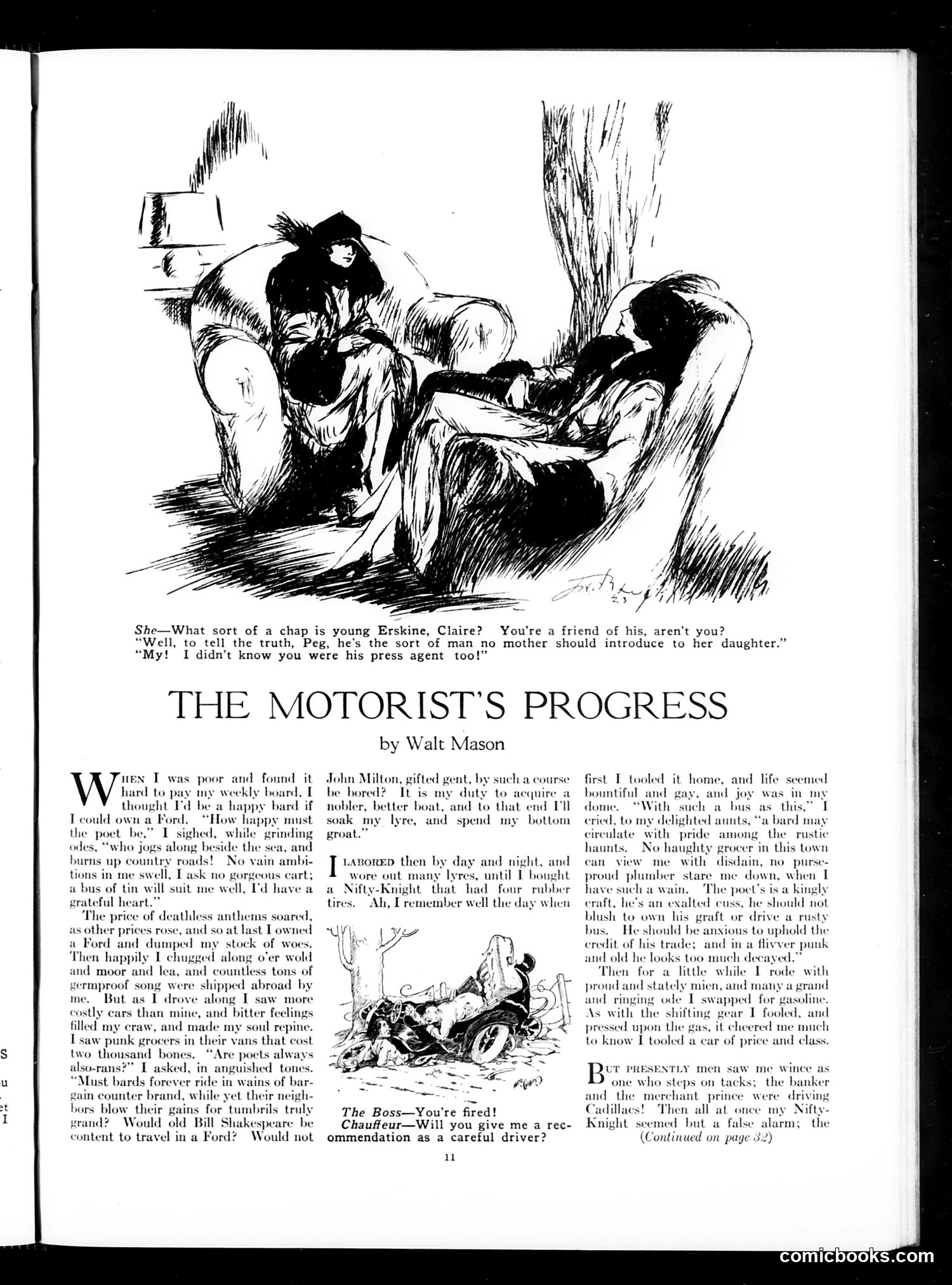
This is a satirical short story, not a political cartoon. The top cartoon is a separate joke about a man named Erskine being unsuitable company for women—a woman sarcastically suggests the critic should be his "press agent" since she's advertising his bad reputation. Mason's story satirizes social climbing and materialism in the early automobile era. A poor poet buys a modest Ford, initially content. But seeing wealthier neighbors drive expensive cars (Cadillacs, a Nifty-Knight), he becomes envious and ashamed. He labors to afford a better vehicle, believing a nice car will elevate his social status and poetic credibility—that even Shakespeare and Milton would demand luxury automobiles. The satire mocks how industrial consumer culture corrupts artistic values. The poet abandons his principles for possessions, chasing status symbols. The inserted dialogue shows a boss firing a chauffeur, perhaps hinting at the economic precarity underlying this materialistic competition. The story's irony: acquiring a "car of price and class" doesn't improve his life or art—it merely enslaves him to keeping up appearances.
📄 Transcribed text from this page (OCR, searchable)
Machine-transcribed from the original scan — historical spelling and the odd misread are preserved.
She—What sort of a chap is young Erskine, Claire? You're a friend of his, aren’t you? “Well, to tell the truth, Peg, he’s the sort of man no mother should introduce to her daughter.” “My! I didn’t know you were his press agent too!” THE MOTORIST’S PROGRESS x T was poor and found. it to pay my weekly board, I thought I'd be a happy bard if Tcould own a Ford. “How happy must the poet bi I sighed, while grinding odes, “who jogs along beside the sea, and burns up country roads! No vain ambi- tions in me swell, I ask no gorgeous cart; a bus of tin will suit me well, fd have a grateful heart.” ‘The price of deathless anthems soared, as other prices rose, and so at last owned a Ford and dumped my stock of woes. Then happily I chugged along o'er wold and moor and lea, and countless tons of yermproof song were shipped abroad by me. But as I drove along I saw more costly cars than mine, and bitter feelings filled my craw, and made my soul repine. I saw punk grocers in their vans that cost two thousand bones. “Are poets always also-rans?” I asked, ir guished tones. “Must bards forever ride in wains of bar- gain counter brand, while yet their neigh- bors blow their gains for tumbrils truly grand? Would old Bill Shakespeare be content to travel ina Ford? Would not by Walt Mason John Milton, gifted gent, by such a course be bored? It is my duty to acquire a nobler, better boat, and to that end Tll soak my lyre, and spend my bottom groat.” I LABoreED then by di wore out man, a Nifty-Knight the tires. y and night, and until T bought had four rubber Ah, [remember well the day when The Boss—You're fired! Chauffeur—Will you give me a _rec- ommendation as a careful driver? ql first T tooled it home, and life seemed bountiful and gay, and joy was in my “With such a bus as. this,” I ied, to my delighted aunt u bard may ulate with pride among the rustic aunts. No haughty grocer in this town can view me with disdain, no purse- proud plumber stare me down, when I have such a wain. The poet's is a kingly craft, he’s an exalted ¢ he should not blush to own his graft or drive a rusty bus. He should be anxious to uphold the credit of his trade; and in a flivver punk and old he looks too much decayed.” Then for a little while IT rode with proud and stately mien, and many i and ringing ode [ swapped for As with the shifti I fooled, and pressed upon the gas, it cheered me much to know I tooled a car of price and class. B PRESENTLY men saw me wince as one who steps on tacks; the banker and the merchant. prince were driving Cadillacs! Then all at once my Nifty: Knight seemed but a false alarm; the (Continued on page 32)