
Judge, 1923-11-10 · page 22 of 36
Judge — November 10, 1923 — page 22: what you’re looking at
What you’re looking at
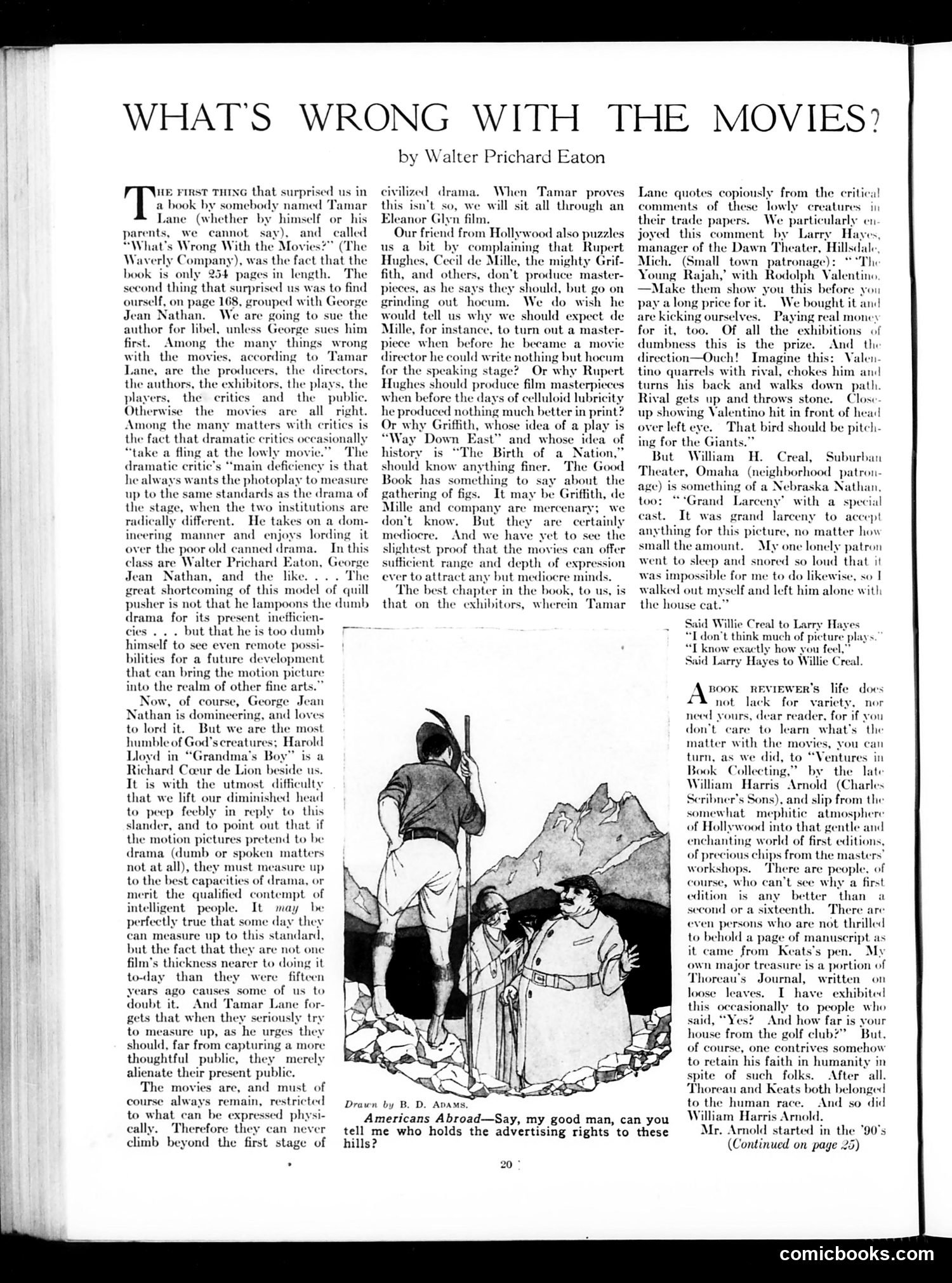
This is a book review by Walter Prichard Eaton critiquing *What's Wrong with the Movies?* by Tamar Lane. The cartoon (by R.D. Adams, titled "Americans Abroad") shows American tourists abroad, unrelated to the main text. Eaton defends film directors Cecil B. DeMille, D.W. Griffith, and Rupert Hughes against Lane's claim they should produce masterpieces. Eaton argues these men produced mediocre stage work before films, so expecting great cinema is unreasonable. He also dismisses the notion that movies can ever achieve the artistic depth of theater—they're fundamentally limited to entertaining the masses, not elevating them intellectually. The satire targets Lane's idealistic but impractical film criticism. Eaton sardonically groups himself with George Jean Nathan (a famous theater critic), implying he'll sue for defamation by association. The piece defends commercial filmmaking's current state while mocking critics who demand cinema match theatrical standards.
📄 Transcribed text from this page (OCR, searchable)
Machine-transcribed from the original scan — historical spelling and the odd misread are preserved.
HE FIRST THING that surprised us in book by somebody named ‘Tamar Lane (whether by himself or his parents, we cannot say), and called : (The “What's Wrong With the Movies? Waverly Company), was the fact that the book is only 254 pages in length. The second thing that surprised us was to find ourself, on page 168, grouped with George Jean Nathan. We are going to sue the author for libel, unless George sues him first. Among the many things wrong with the movies, according to Tamar Lane, are the producers, the directors, the authors, the exhibitors, the plays, the players, the crities and the public. Otherwise the movies are all right. Among the many matters with critics is atic critics occasionally fling at the lowly mov The tic critic’s “main deficiency is that he always wants the photoplay to measure up to the same standards as the drama of the stage, when the two institutions are radically different. He takes on a dom- incering manner and enjoys lording it over the poor old canned drama. In this ‘lass are Walter Prichard Eaton, George an Nathan, and the like... . The great shortcoming of this model of quill pusher is not that he lampoons the dumb dra na for its present. inefficien- . . . but that he is too dumb himself to see even remote possi- bilities for a future development that can bring the motion picture into the realm of other fine arts.” Now, of course, George Jean Nathan is domineering, and loves to lord But we are the most humble of God’s creatures; Harold Lloyd in “Grandma's Boy” i Richard Coeur de Lion beside us. It is with the utmost difficulty that we lift our diminished head to peep feebly in reply to. this slander, and to point out that if the motion pictures pretend to be drama (dumb or spoken matters not at all), they must measure up to the best capacities of drama, or merit the qualified contempt of intelligent. people. It may be perfectly true that some day they can measure up to this standar but the fact that they are not one film's thickness nearer to doing it to-day than they were fifteen years ago causes some of us to doubt it. And Tamar Lane for- gets that when they seriously try to measure up, as he urges they should, far from capturing a more thoughtful public, they merely alienate their present public. The movies are, and must of Ways remain, restricted can be expressed physi climb beyond the first stage of — hills? by Walter Prichard Eaton civilized drama. When Tamar proves this isn’t so, we will sit all through an Eleanor Glyn film. Our friend from Hollywood also puzzles us a bit by complaining that Rupert Hughes, Cecil de Mille, the mighty Grif- fith, and others, don’t produce master- pieces, as he says they should, but go on grinding out hocum. We do wish he would tell us why we should expect de Mille, for instance, to turn out a master- piece when before he became a movie director he could write nothing but hocum for the speaking stage? Or why Rupert Hughes should produce film masterpieces when before the days of celluloid lubricity he produced nothing much better in print? Or why Griffith, whose idea of a play i “Way Down East” and whose id history is “The Birth of a Nation,” should know anything finer. The Good Book has something to say about the gathering of figs. It may be Griffith, de Mille and company are mercer we don’t’ know. But they are. certainly mediocre. And we have yet to see the slightest proof that the movies can offer sufficient range and depth of expression ever to attract any but mediocre minds. The best chapter in the book, to us, is that on the exhibitors, wherein Tamar Drawn by B. D. ADaMs. 20: WHAT'S WRONG WITH THE MOVIES? Lane quotes copiously from the critica! comments of these lowly creatures ii their trade papers. We particularlh joyed this comment by Larry H. manager of the Dawn Theater, Hills Mich. (Small town patronage): **Thu Young Rajah,’ with Rodolph Valentino. —Make them show you this before you pay along price for it. We bought it and are kicking ourselves. Paying real money for it, too. Of all the exhibitions of dumbness this is the prize. And. thi direction—Ouch! Imagine this: Valen- tino quarrels with rival, chokes him ani turns his back and walks down path Rival gets up and throws stone. Clos: up showing Valentino hit in front of head over left That bird should be pitch- ing for the Giants.” But William H. Creal, Suburban Theater, Omaha (neighborhood patron- age) is something of a Nebraska Nathan, too: “*Grand Larceny’ with a special cast. It was grand larceny to accept anything for this picture, no matter how small the amount. My one lonely patron went to sleep and snored so loud that it was impossible for me to do likewise, so | walked out myself and left him alone with the house cat.” Said Willie Creal to Larry Haye: “I don’t think much of picture “T know ex: how Said Larry H. BOOK REVIEWER'S life does not lack for variety, nor need yours, dear reader, for if you don’t care to learn what's ‘the matter with the movies, you can turn, as we did, to “Ventures in Book Collecting,” by the late William Harris Arnold (Charles Scribner's Sons), and slip from the somewhat mephitie atmosphere of Hollywood into that gentle and enchanting world of first editions, of precious chips from the masters’ workshops. There are people, of course, who can’t see why a first edition is better than a second or a sixteenth. There a even persons who are not thri to behold a page of manuseript as it came from Keats's pen. My own major treasure portion of Thoreau’s Journal, written on loose le I have exhibited this occasionally to people who said, “Yes? And how far is your house from the golf club?” But. of course, one contrives somehow to retain his faith in humanity in spite of such folks. After all. Thoreau and Keats both belonged to the human race. And so did ts Americans Abroad—Say, my good man, can you William Harris Arnold. Therefore they can never tell me who holds the advertising rights to these Mr. Arnold started in the ‘90's (Continued on page 25) comicbooks.com