
Judge, 1923-11-10 · page 15 of 36
Judge — November 10, 1923 — page 15: what you’re looking at
What you’re looking at
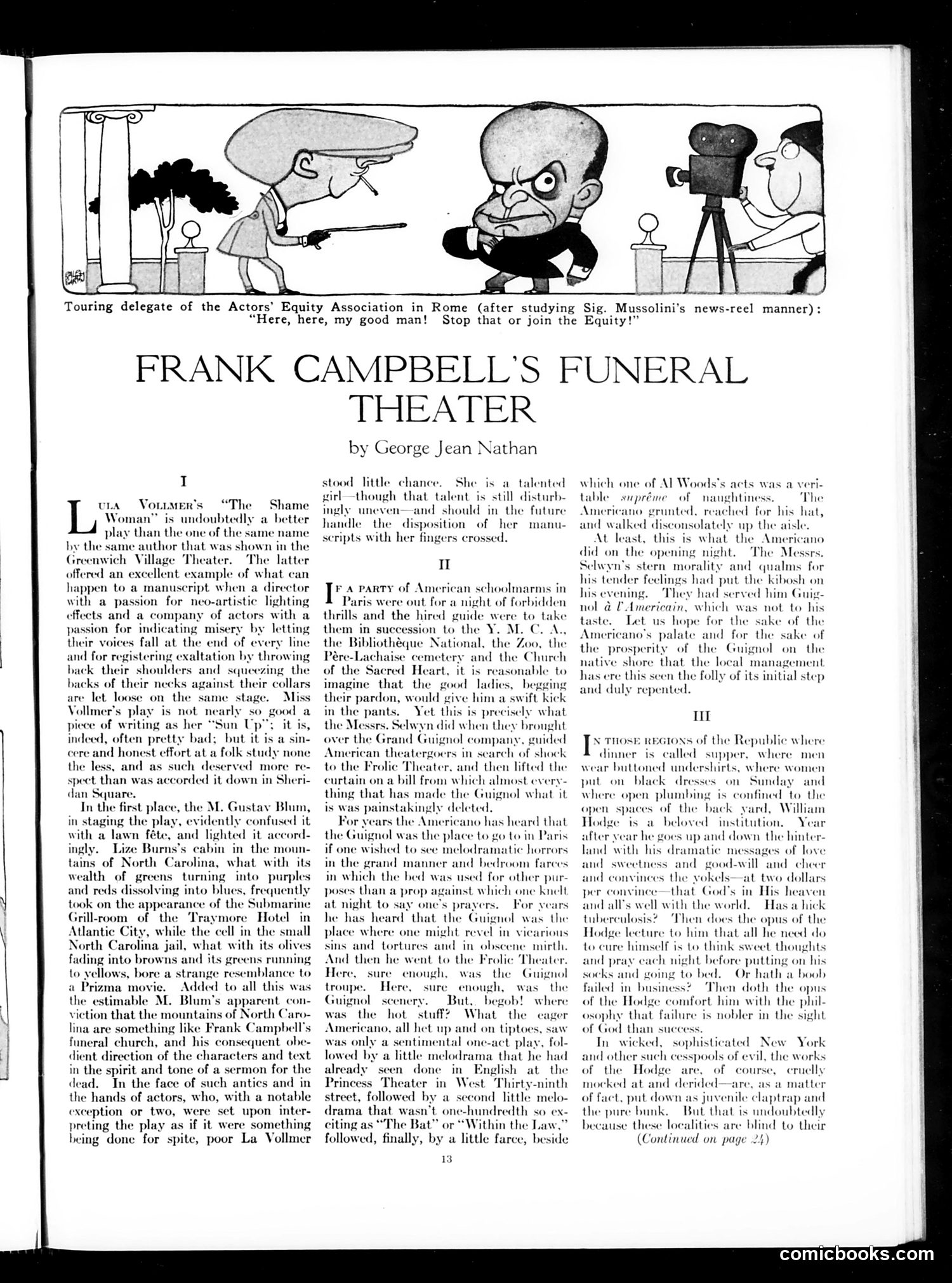
**The Cartoon (Top):** This satirizes the Actors' Equity Association sending a delegate to Rome to study Benito Mussolini's theatrical presentation style—specifically his dramatic gesturing and commanding presence in newsreels. The cartoon shows the delegate mimicking Mussolini's exaggerated poses and bullying manner, with the punchline being a threat to coerce compliance ("join the Equity!"). It's political satire about labor unions adopting authoritarian tactics, and mockery of how American actors might absurdly imitate fascist theatricality. **The Article:** George Jean Nathan's theater review critiques recent productions, particularly attacking M. Gustav Blum's overwrought staging of *The Shame Woman*—using excessive, inappropriate lighting effects and melodramatic acting direction. The second section mocks the Selwyn brothers' importation of Paris's famous Grand Guignol theater troupe, which promised shocking horror but delivered sanitized, sentimental plays instead—disappointing American audiences seeking authentic depravity.
📄 Transcribed text from this page (OCR, searchable)
Machine-transcribed from the original scan — historical spelling and the odd misread are preserved.
Touring delegate of the Actors’ Equity Association in Rome (after studying Sig. Mussolini's news- reel manner): “Here, here, my good man! Stop that or join the Equity!” FRANK CAMPBELL’S FUNERAL I uta Voter's “The Shame | Woman” is undoubtedly a better than the one of the same name ne author that was shown in the Greenwich Village Theater. The latter offered an excellent example of what can happen to a manuscript when a director with a passion for neo-artistic lighting effects and a company of actors with a indicating misery by letting their voices fall at the end of every line and for registering exaltation by throwing back their shoulders and. squeezing the backs of their necks against their collars are let loose on the same stage. Miss Vollmer’s play is not n piece of writing as her indeed, often pretty cere and honest effort ¢ the less, and spect than dan Square, In the first place, the M. Gustav Blum, in staging the play, evidently confused it with a lawn féte, and lighted it accord- i Lize Burns’s cabin in the moun- s of North Carolina, what with its th of greens turning into purples and reds dissolving into blues, frequently took on the appearance of the Submarine Grill-roc of the ‘Traymore Hotel in Atlantic City, while the cell in the small North Carolina jail, what with its olives fading into browns and its greens running to yellows, bore a strange resemblance to a Prizma movie. Added to all this was the estimable M. Blum’s apparent con- viction that the mountains of North Caro- lina are something like Frank Campbell's funeral church, and his consequent obe- dient direction of the characters and text in the spirit and tone of a sermon for the dead. In the face of such antics and in the hands of actors, who, with a notable exception or two, were set upon inter- preting the play if it were something being done for spite, poor La Vollmer ; but it is a sin- a folk study none as such deserved more corded it down in She THEATER by George Jean Nathan stood little chance. She is a talented girl though that talent is still disturb- ingly uneven—and should in the future handle the disposition of her manu- scripts with her fingers crossed. II I A party of American schoolmarms in ris were out for a night of forbidden thrills and the hired guide were them in succession to the Y. M. ¢ the Bibliothéque National, the Pere- rise cemetery and the Chu of the red Heart, it is reasonab! imagine that the od ladies, begging their pardon, would give him a swift kick in the pants. Yet this is precisely what the Messrs. Selwyn did when they brought over the Grand Guignol company, guided American theatergoers in search of shock to the Frolic Theater, and then lifted the curtain on a bill from which almost every- thing that has made the Guignol what it is was painstakingly deleted. For years the Americano has heard that the Guignol was the place to go to in Paris if one wished to see melodramatic horrors in the grand manner and bedroom farce: in which the bed was used for other pur- poses than a prop against which one knelt at night to say one’s prayers. For years he has heard that the Guignol was the place where one might revel in viearious sins and tortures and in obscene mirth. And then he went to the Frolic Theater. Here, sure enough, was the Guignol troupe. Here, sure enough, was the Guignol scenery. — But. begob! where was the hot stuff? What the cager Americano, all het up and on tiptoes, saw was only a sentimental one-act play, fol- lowed by a little melodrama that he had already’ seen done in English at the Princess Theater in West Thirty-ninth street, followed by a second little melo- drama that wasn’t one-hundredth so ex- citing as “The Bat” or “Within the Law,” followed, finally, by a little farce, beside 13 which one of Al Woods's acts was a veri- table supréme of naughtiness. ‘The Americano grunted, reached for his hat, and walked disconsolately up the aisle At least, this is what the Americano did on the opening night. The Messrs. Selwyn’s stern morality and qualms for his tender feelings had put the kibosh on his evening. They had served him Guig- nol @ LAmericain, which was not to his taste. Let us hope for the sake of the Americano’s palate and for the sake of the prosperity of the Guignol on the native shore that the local management has ere this seen the folly of its initial step and duly repented. Ii [8 t0s8 tates of the Republic where dinner is called) supper. where men wear buttoned undershirts, where women put black Sunday and where open plumbing is confined ‘to the open spaces of the yard, William Hodg 1 beloved institution. Year after year he goes up and down the hinter- land with his dramatic messages of love and sweetness and good-will and) cheer and convinces the yokels—at two dollars nvince—that God's in His heaven all's well with the world. Has a hick ulosis? Then does the opus of the s lecture to him that all he need do to cure himself is to think sweet thoughts and pray each night before putting on his socks and going to bed. Or hath a boob failed in business? Then doth the opus of the Hodge comfort him with the phil- osophy that failure is nobler in the sight of God than success. In wicked, sophisticated New York and other such cesspools of evil, the works of the Hodge are, of cruelly mocked at and derided. sas a matter of fact, put down as juvenile claptrap and the pure bunk. But that is undoubtedly because these localities are blind to their (Continued on page 24) on dresses on comicbooks.com