
Judge, 1923-11-10 · page 21 of 36
Judge — November 10, 1923 — page 21: what you’re looking at
What you’re looking at
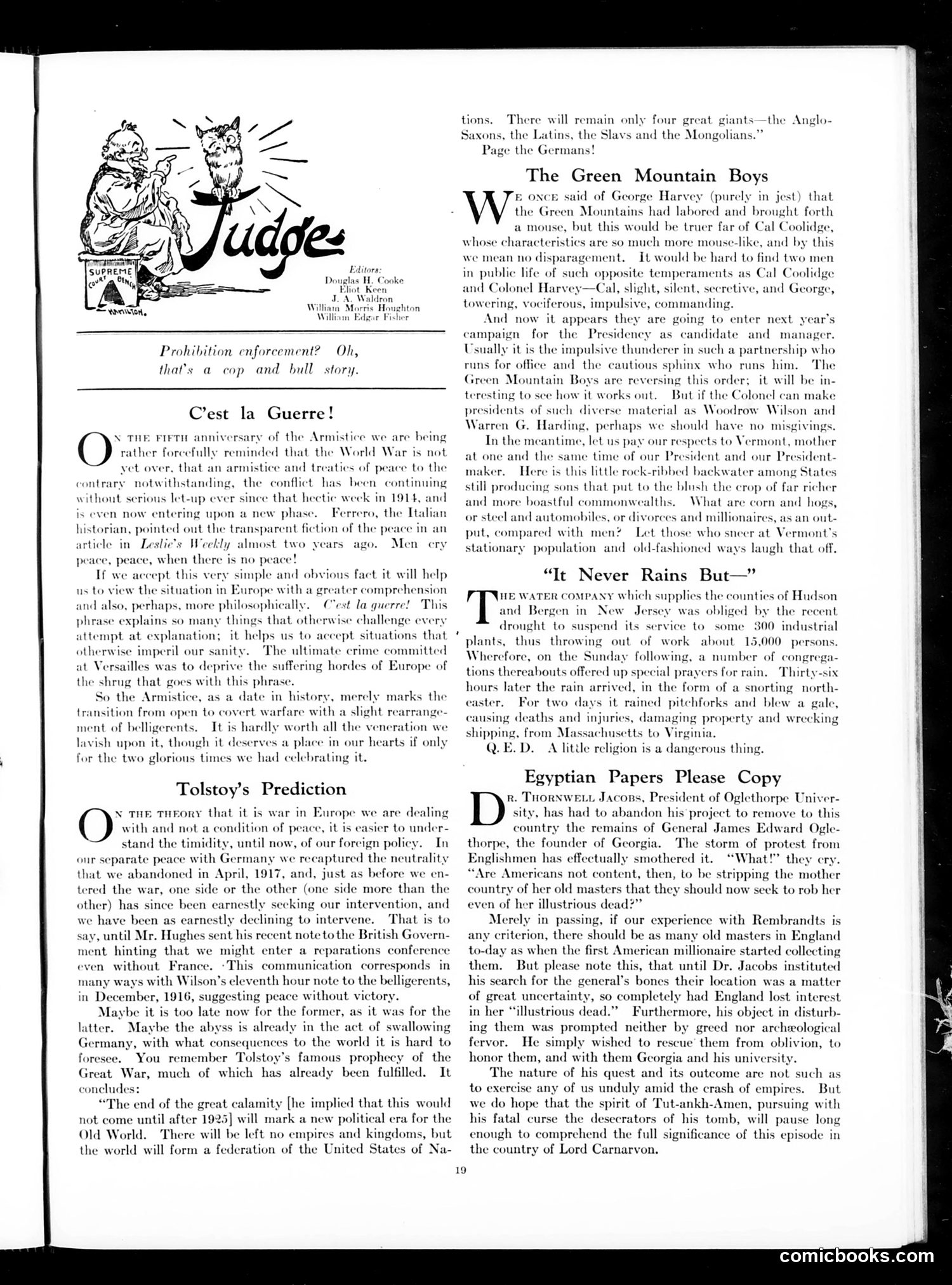
This page contains editorial commentary rather than political cartoons. The small illustration at top shows a judge figure—Judge magazine's mascot—commenting on "Prohibition enforcement." The main articles discuss post-WWI European politics and American domestic figures: **"C'est la Guerre!"** argues that despite the 1918 Armistice, warfare in Europe continues covertly. It references Tolstoy's prediction that empires will collapse, leaving only four great powers (Anglo-Saxons, Latins, Slavs, and Mongolians)—a concluding jab: "Page the Germans!" **"The Green Mountain Boys"** discusses Vermont politician Calvin Coolidge and journalist George Harvey entering the 1924 Presidential race as candidate and manager respectively. The piece notes their opposite temperaments—Coolidge being "slight, silent, secretive" versus Harvey's commanding presence. This likely satirizes their unlikely partnership, with the implication that the pairing will prove problematic. The page reflects post-war anxieties about European instability and American political maneuvering circa 1922-1923.
📄 Transcribed text from this page (OCR, searchable)
Machine-transcribed from the original scan — historical spelling and the odd misread are preserved.
J. A, Waldron Williaa Mo loughton = weiter, William Edger Fisher Prohibition enforcement? that's a and bull Oh, cop story. C’est la Guerre! \ THE FIFTH anniversary of the Armistice we are being O rather forcefully reminded that the World War is not yet over, that an armistice and treaties of peace to the conflict has been continuing -up ever since that hectic week in 1914, and is even now entering upon a new phase. Ferrero, the Italian historian, pointed out the transparent fiction of the peace in an Leslie's Weekly almost two Men cry when there is no pea If we accept this ve notwithstanding, the without serious | contrary: article in ars ago. peace, pea ! y simple and obvious fact it will help us to view the situation in Europe with a greater comprehension and also, perhaps, more philosophically. This phrase explains so many things that otherwise challenge every attempt at explanation; it helps us to accept situations that otherwise imperil our sanity. The ultimate crime committed at Versailles was to deprive the suffering hordes of Europe of the shrug that goes with this phrase. So the Armisticc merely marks the transition from open to covert warfare with a s ment of belligerents. It is hardly wort) Crest la guerre! as a date in history, it rearrang all the veneri lavish upon it, though it deserves a place in our hearts for the two glorious times we had celebrating it. Tolstoy’s Prediction N THE THEORY that it is war in Europe we are dealing with and not a condition of peace, it is easier to under- stand the timidity, until now, of our foreign policy. In arate peace with Ge ‘rmany we recaptured the ne: sutrality that we abandoned in April, 1917, and, just as before we en- tered the war, one side or the other (one side more than the other) has since been earnestly secking our intervention, and we have been as earnestly declining to intervene. That is to say, until Mr. Hughes sent his recent note tothe British Govern- ment hinting that we might enter a arations conference even without France. -This communication corresponds in many ways with Wilson’s eleventh hour note to the belligerents, in December, 1916, suggesting peace without victory. Maybe it is too late now for the former, as it was for the latter. Maybe the abyss is already in the act of swallowing Germany, with what consequences to the world it is hard to foresee. You remember Tolstoy’s famous prophecy of the Great War, much of which has already been fulfilled. It concludes: “The end of the great calamity [he implied that this would not come until after 1925] will mark a new political era for the Old World. There will be left no empires and kingdoms, but the world will form a federation of the United States of Na- our se plants, tions. There will remain only four great giants—the Saxons, the Latins, the Slavs and the Page the Germans! Anglo- Mongolians.” The Green Mountain Boys E ONCE said of George Harvey (purely in jest) that the Green Mountains had labored and brought forth but this would be truer far of Cal Coolidge, whose characteristics are so much more mouse-like, and by this we mean no disparagement. It would be hard to find two men in public life of such opposite temperaments as Cal Coolidge and Colonel Harvey—Cal, slight, silent, secretive, and George, towering, vociferous, impulsive, commanding. And now it appears they are going to enter next year’s campaign for the Presidency as candidate and manager. Usually it is the impulsive thunderer in such a partnership who runs for office and the cautious sphinx who runs him. The Green Mountain Boys are reversing this order; it will be in- teresting to see how it works ont. But if the Colonel can make presidents of such diverse material as Woodrow Wilson and Warren G. In the meantime, let us pay our respects to Vermont, mother at one and the same maker. a mouse, Harding, perhaps we should have no misgivings. time of our President and our President- Here is this little rock-ribbed backwater among States still producing sons that put to the blush the crop of far richer and more boastful commonwealths. What are corn and hogs, or steel and automobiles, or divorces and millionaires, : put, compared with men? an out- Let those who sneer at Vermont's stationary population and old-fashioned ways laugh that off. “It Never Rains But—” HE WATER COMPANY Which supplies the counties of Hudson nd Bergen in New d by the recent drought to suspend its service to some 300 industrial thus throwing out of work 15,000 Wherefore, on the Sunday following, a number of congrega- tions thereabouts offered up special prayers for rain. Thirty-six hours later the rain arrived, in the form of a snorting north- easter. For two days it rained pitchforks and blew a gale, hs and injuries, damaging property and wrecking shipping, from Massachusetts to Virginia. QED. Jersey was oblig about persons. using « A litile religion is a dangerous thing. Egyptian Papers Please Copy rR. THORNWELL Jacons, President of Oglethorpe Univer- sity, has had to abandon his project to remove to this country the remains of G the founder of Georgia. sral James Edward Ogle- The storm of protest from has effectually smothered it. ‘What!’ they cry. “Are Americans not content, then, to be stripping the mother country of her old masters that they should now seck to rob her even of her illustrious dead?” Merely in passing, if our experien any criterion, there should be to-day as when the first Ameri them, But please note th his search for the thorpe, Englishme > with Rembrandts is many old masters in England n millionaire started collecting » that until Dr. Jacobs instituted general's bones their location was a matter of great uncertain > completely had England lost interest in her * Furthermore, his object in disturb- ing them was prompted neither by greed nor archeological fervor. He simply wished to rescue’ them from oblivion, to honor them, and with them Georgia and his university. The ure of his quest and its outcome are not such as to exercise any of us unduly amid the crash of empires. But we do hope that the spirit of Tut-ankh-Amen, pursuing with his fatal curse the desecrators of his tomb, will pause long enough to comprehend the full significance of this episode in the country of Lord Carnarvon, ‘illustrious dead.” comicbooks.com