
Judge, 1923-11-10 · page 30 of 36
Judge — November 10, 1923 — page 30: what you’re looking at
What you’re looking at
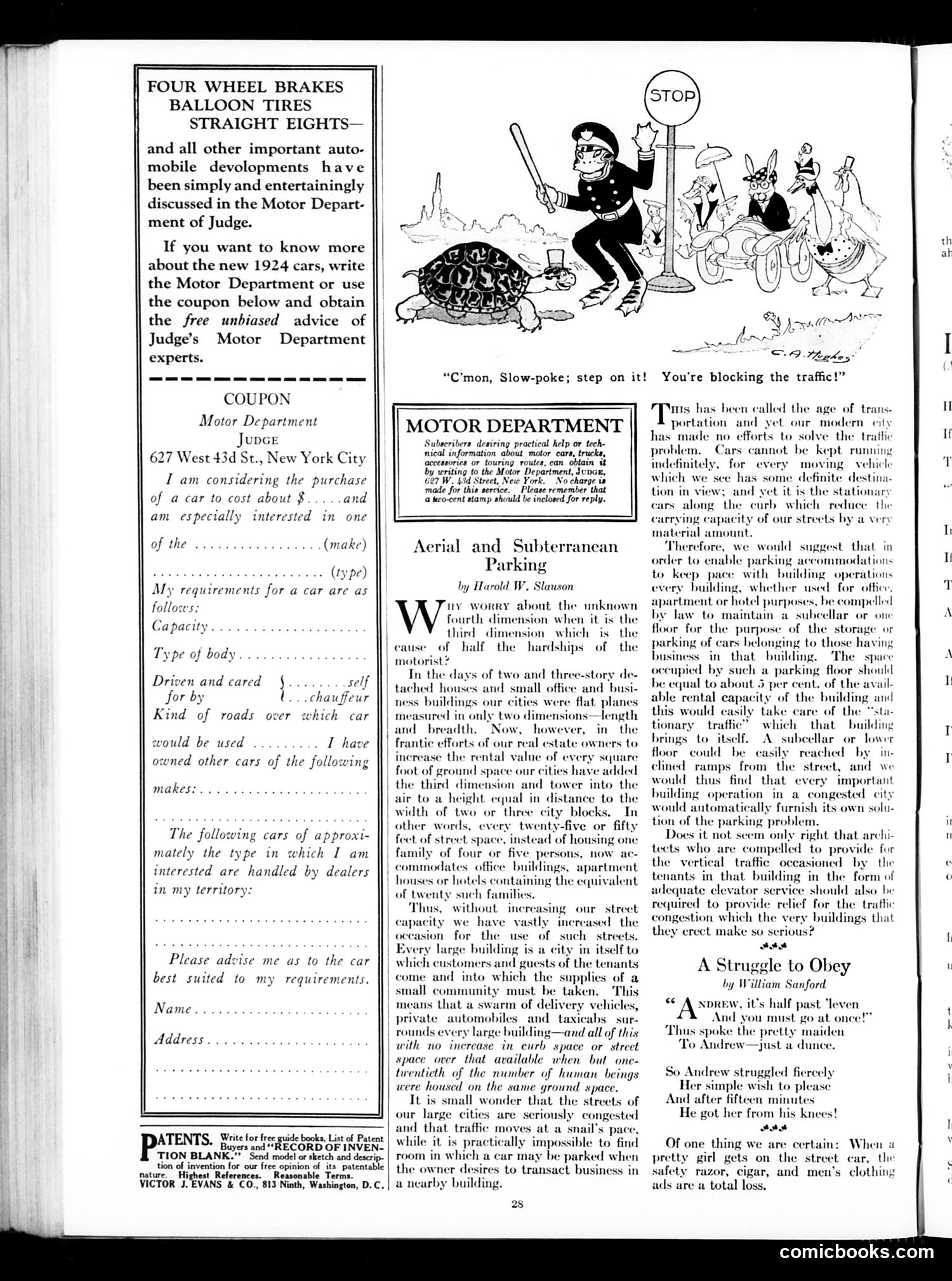
The main cartoon depicts a traffic cop frantically signaling a turtle-riding man to move, shouting "C'mon, Slow-poke; step on it! You're blocking the traffic!" The humor satirizes urban congestion and slow vehicle movement in 1920s cities. The accompanying article "Aerial and Subterranean Parking" by Harold W. Slauson addresses a genuine problem of the era: skyscrapers had dramatically increased urban density and population concentration without expanding street capacity. Modern readers should understand that in the 1920s, cities were experiencing their first major traffic crisis as automobiles proliferated. The cartoon mocks drivers who move slowly despite urban congestion—the implication being that even a *turtle* would be faster. The article proposes vertical solutions (underground and rooftop parking) to accommodate vehicles when traditional street-level parking proved inadequate. This represents early urban planning concerns now familiar to modern cities.
📄 Transcribed text from this page (OCR, searchable)
Machine-transcribed from the original scan — historical spelling and the odd misread are preserved.
FOUR WHEEL BRAKES BALLOON TIRES STRAIGHT EIGHTS— and all other important auto- mobile devolopments have been simply and entertainingly discussed in the Motor Depart- ment of Judge. If you want to know more about the new 1924 cars, write the Motor Department or use the coupon below and obtain the free unbiased advice of Judge’s Motor Department experts. COUPON Motor Department JupGe 627 West 43d St., New York City I am considering the purchase of acar to cost about $ and am especially interested in one of the (make) My requirements for a car are as follozes: Capacity . Type of body. . Driven and cared §.... self for by U.. chauffeur Kind of roads over which car would be used . T have owned other cars of the following makes:...... The following cars of approxi- mately the type in which I am interested are handled by dealers in my territory: as to the car requirements. Please advise me best suited to my Name. Address. ...... pteler free guide books, List of Patent ATENTS. ind "RECORD OF INVEN- TION BLANK?" Bal model or sketch and descrip- tea of i invention for our free opinion of its patentable Highest References. Reasonable Terms. VICTOR J EVANS & CO., 813 Ninth, Washington, D.C. “C’mon, Slow-poke; step on it! MOTOR DEPARTMENT Subacribera desiring practical help or tech- nical information about motor cara, trucks, accessories or touring routes, can obtain tt by writing to the Motor Department, SuDGE, 627 W, 43d Street, New York. No charge ia made for this sercice. Please remember that @ teo-cent stamp should be incloeed for reply. Aerial and Subterranean Parking by Harold W. \ X Tuy worry about the unknown fourth dimension when it is the third dimension which is the cause of half the hardships of the motorist? In the days of two and three-story de- tached houses and small office and busi- ness buildings our cities were flat planes measured in only two dimensions—length and breadth. Now, however, in’ the frantic efforts of our real estate owners to increase the rental value of every square foot of ground space our cities have added the third dimension and tower into the air to a height equal in distance to the width of two or three city blocks. In other words, ¢ y twenty-five or fifty feet of strect space, instead of housing one family of four or five persons, now ac- Slauson | commodates office buildings, apartment houses or hotels con of twenty such families. Thus, without incre capacity we have vastly occasion for the use of such streets. Every large building is a city in itself to which customers and guests of the tenants come and into which the supplic small community must be t means that a sv private; automobiles , anid’ ‘ti abe. sine rounds ey ‘ge building—and all of this with no increase in curb space or street space over that available when but one- twentieth of the number of human beings were housed on the same ground space. It is small wonder that the streets of our large c¢ seriously congested and that traffic moves at a snail’s pace, while it is practically impossible to find room in which a car may be parked when the owner desires to transact business in a nearby building. ning the equivalent ing our street increased the 28 <9 Meakes You're blocking the traffic!” nis has been called the age of trans- portation and yet our modern. city has made no efforts to solve the traffic problem. Cars cannot be kept running indefinitely, for every moving vehick which we see has some definite destina tion in view; and yet it is the stationar cars along the curb which reduce the carrying capacity of our streets by a very material amount. Therefore, we would suggest. that in order to enable parking accommodations to keep pace with building operations every building, whether used for office, apartment or hotel purposes, be compelled w law to maintain a subcellar or one floor for the purpose of the storage or parking of cars belonging to those having business in that building. ‘The space occupied by such a parking floor should be equal to about 5 per cent. of th able rental capacity of the buil this would easily take care of the “sta- tionary — traffi which that — building brings to itself. A subcellar or lower floor could be easily reached) by in- clined ramps from the street, and we would thus find that every important building operation in a congested city would automatically furnish its own solu- tion of the parking problem. Does it not seem only right that archi- tects who are compelled to provide for the vertical occasioned by the tenants in that building in the form of adequate clevator service should also be required to provide relief for the traffic congestion which the very buildings that they erect make so serious? rey A Struggle to Obey by William Sanford t's half past ‘leven vaAnd you eaust a Thus spoke the pretty m: To Andrew—just a dunce. So Andrew struggled fierce Her simple wish to please And after fifteen minutes He got her from his knees! tae Of one thing we are certain: When a pre tty girl gets on the street. car, thie z zor, Cigar, and men’s clothing 1 total loss. Ais are comicbooks.com