
A complete issue · 36 pages · 1923
Judge — September 29, 1923
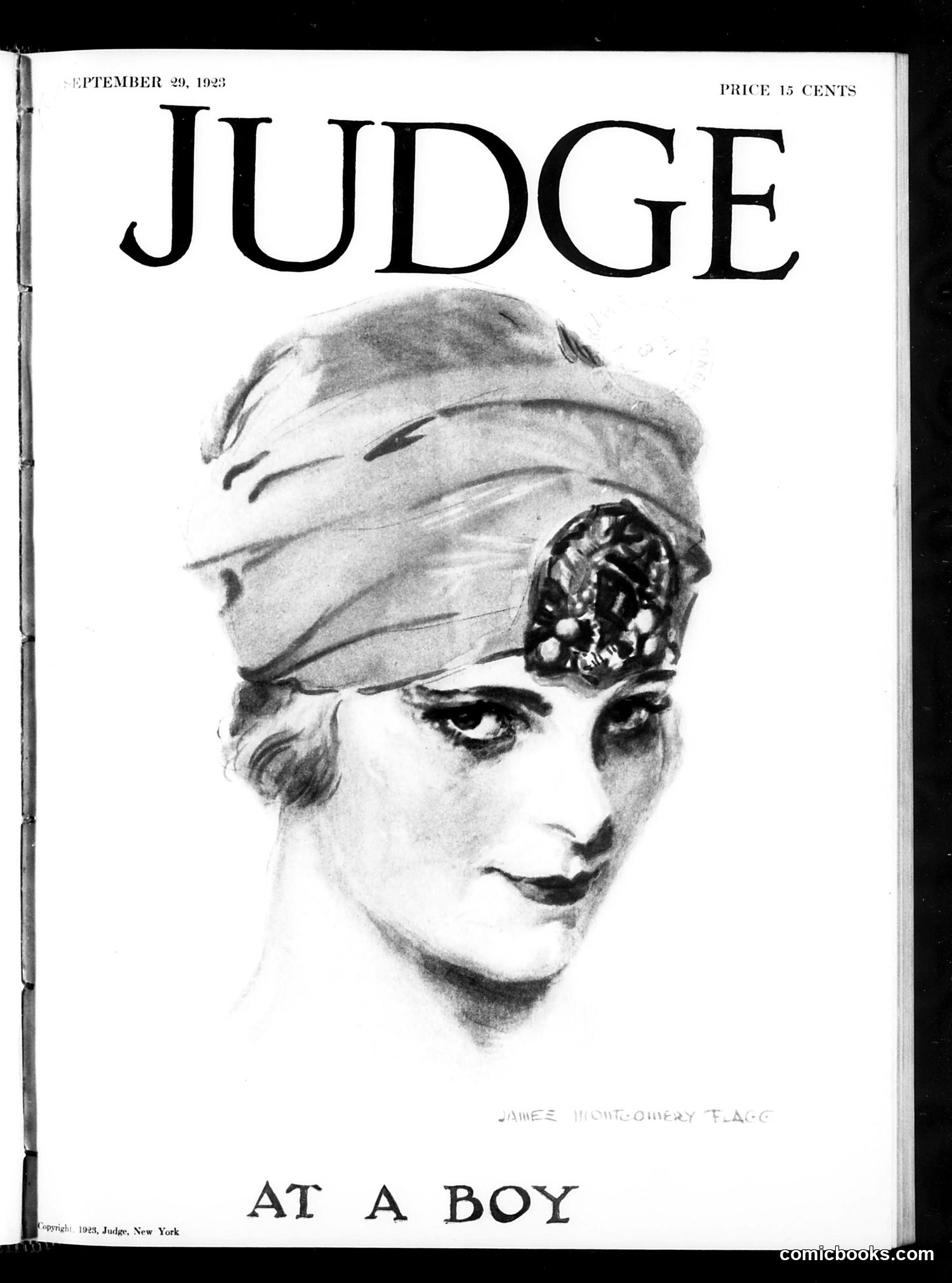
This September 29, 1923 *Judge* cover features a stylized illustration titled "At a Boy" by James Montgomery Flagg, a renowned illustrator of the era. The artwork depicts a woman's face in profile wearing an elaborate wrapped head covering or turban adorned with a decorative brooch. The styling reflects 1920s flapper fashion—specifically the fashionable, often androgynous aesthetic of the Jazz Age. The phrase "At a Boy" suggests approval or encouragement, likely satirizing contemporary fashion trends and the modernized appearance of 1920s women. The caption may be mocking either the fashion itself or society's reactions to women's changing styles and gender presentations during this period of increasing female independence and social transformation.
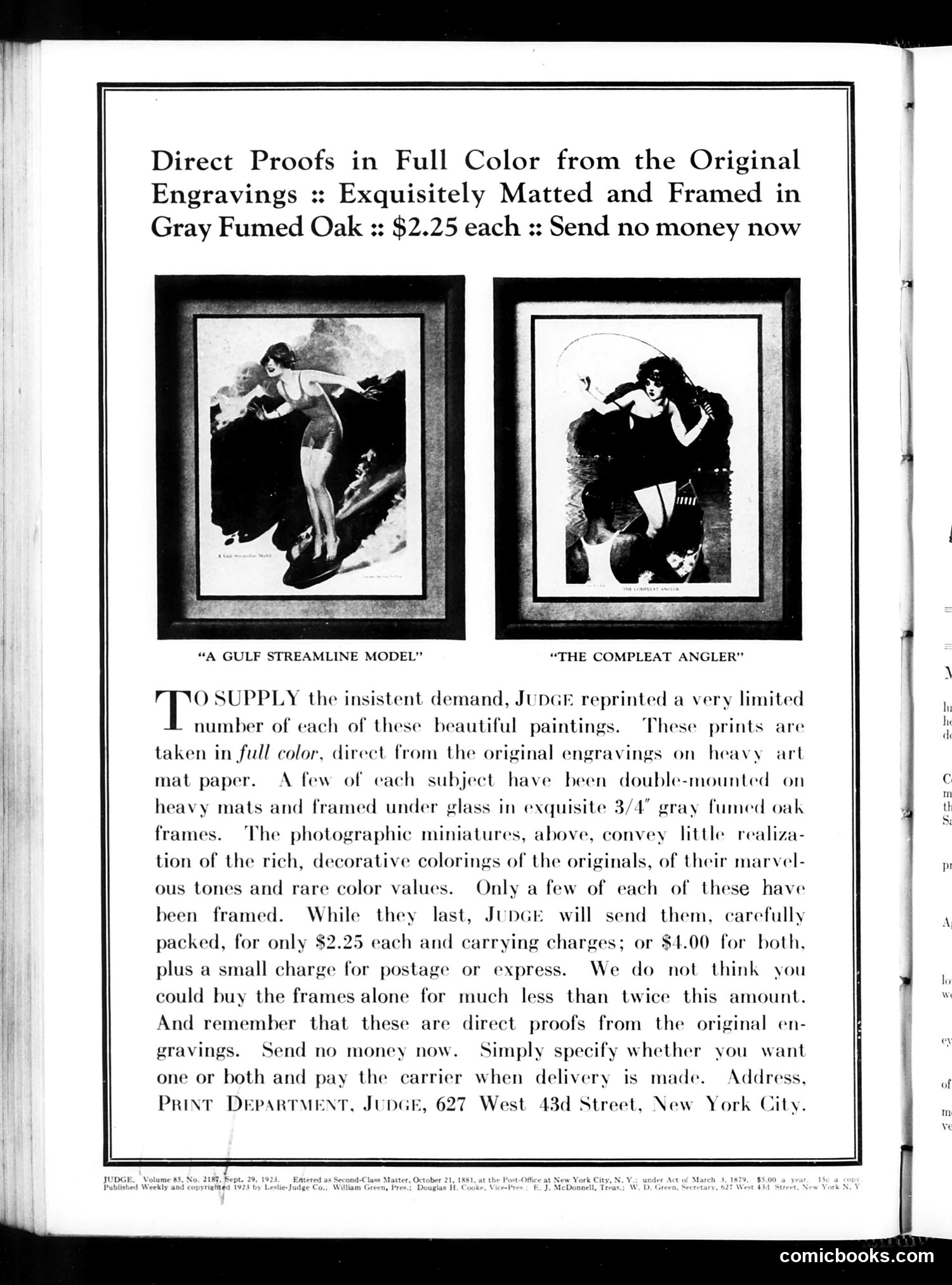
This page is primarily an advertisement, not a political cartoon. It promotes framed art prints titled "A Gulf Streamline Model" and "The Compleat Angler," offered by Judge magazine's Print Department for $2.25 each (or $4.00 for both). The advertisement emphasizes that these are "direct proofs in full color from the original engravings" on heavy art paper, with some options available pre-framed in gray fumed oak. The text stresses the limited availability and quality of the reproductions, noting their "rich decorative colorings" and "rare color values." This appears to be a straightforward mail-order sales pitch rather than satirical content—typical of how magazines monetized their artistic content in the early 1920s.
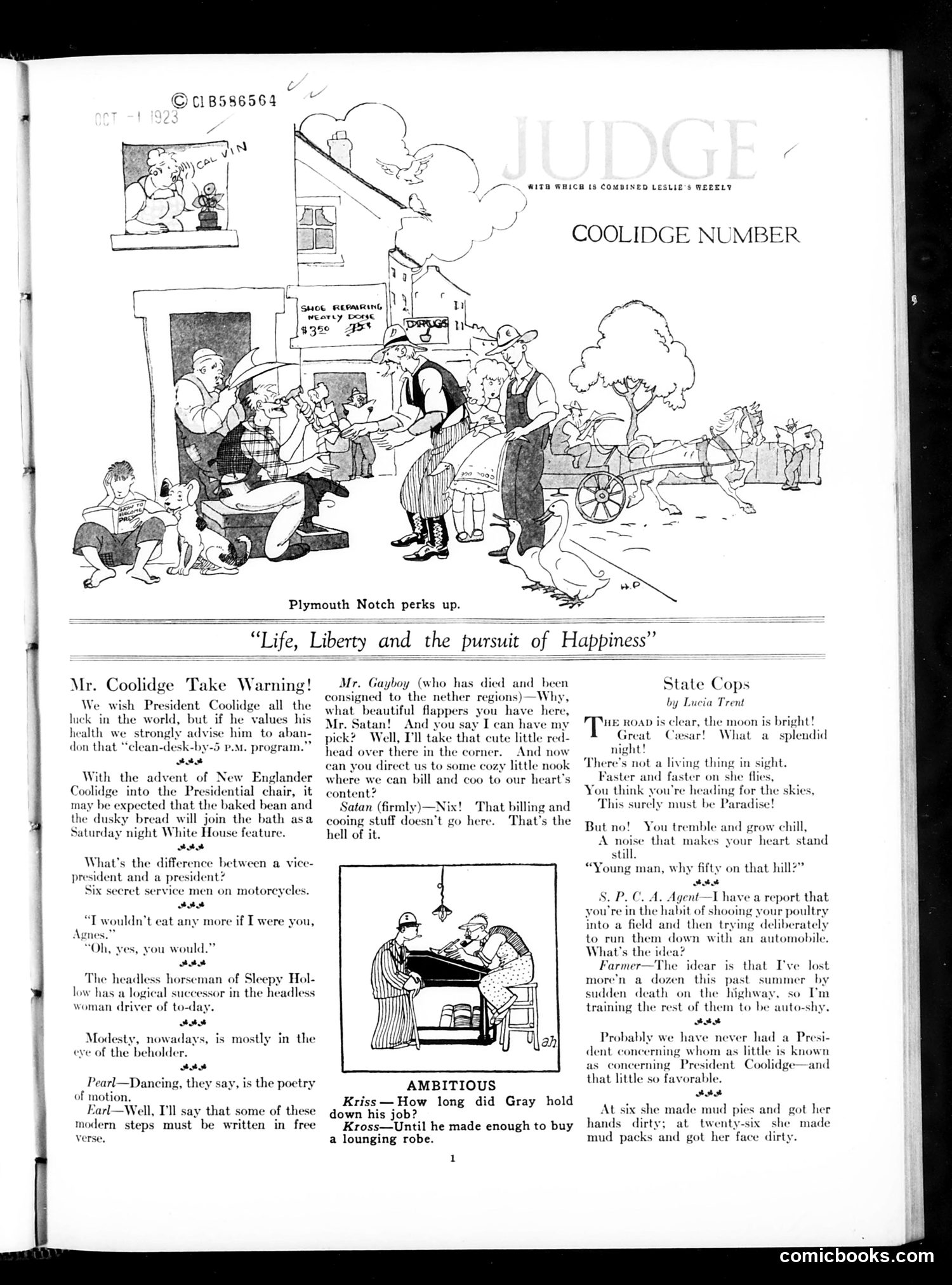
This 1923 page satirizes President Calvin Coolidge's policies and personality. The headline "Mr. Coolidge Take Warning!" criticizes his economic approach, suggesting his "bread and butter" policies will fail. The jokes mock his reserved demeanor—comparing vice presidents unfavorably to presidents, referencing his taciturn nature ("Modesty, nowadays, is mostly in the eye of the beholder"). The cartoon "Plymouth Notch perks up" shows rural New England celebrating Coolidge's rise, with references to his Vermont origins. The "State Cops" poem satirizes his conservative governance and law-and-order policies. The page reflects 1920s skepticism toward Coolidge's laissez-faire approach during an economically uncertain period. The satire targets both his limited public personality and his hands-off presidential style.
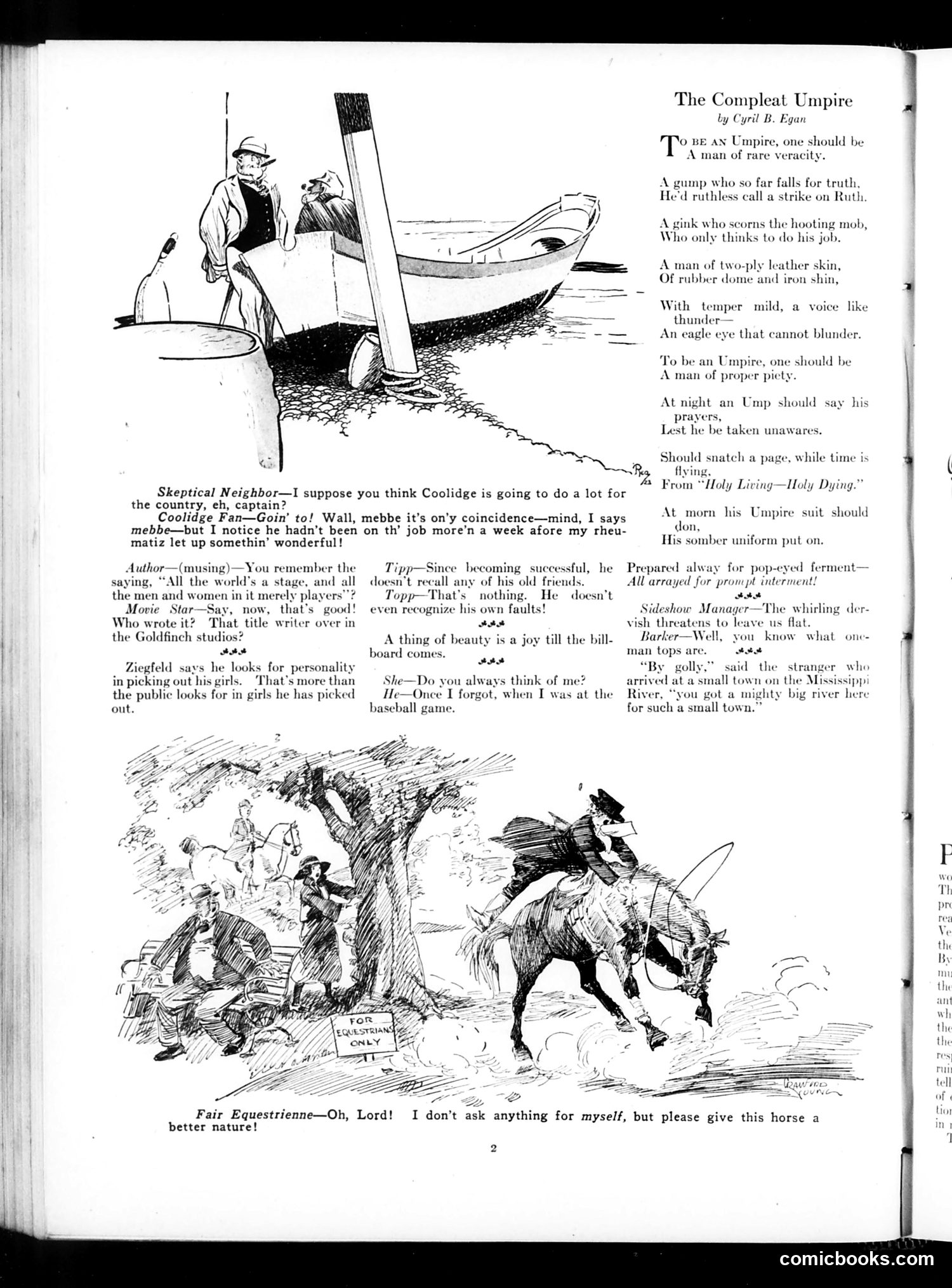
This page from *Judge* magazine contains two distinct satirical pieces: **"The Compleat Umpire"** (top right) is a humorous poem by Cyril B. Egan describing the ideal baseball umpire—someone with unwavering judgment, emotional control, and integrity. The poem satirizes umpires by listing contradictory or impossible virtues ("a man of two-ply leather skin, / Of rubber dome and iron shin"), mocking their authority and the demands placed on them. **The two cartoons** illustrate baseball and horseback-riding scenarios with accompanying dialogue. The bottom cartoon "Fair Equestrienne" shows a rider thrown from a horse, humorously requesting better treatment for the animal rather than for herself—satirizing excessive concern for animal welfare or perhaps feminine delicacy. The middle section contains brief conversational snippets between unnamed characters discussing writers, personalities, and entertainment—typical *Judge* filler humor of its era.
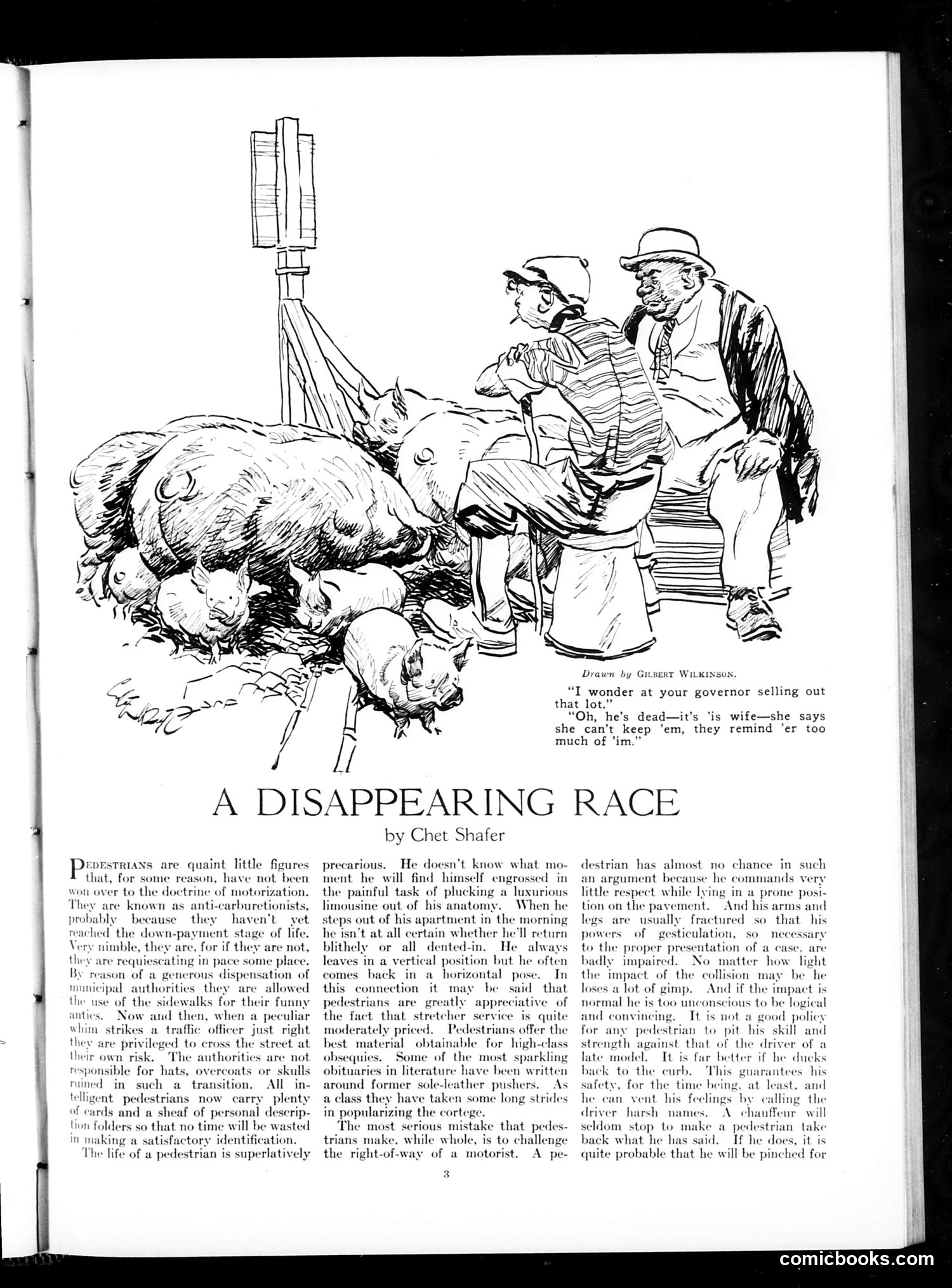
This article satirizes pedestrians' apparent extinction in early automobile culture. The illustration shows two men examining a dead pedestrian beneath a street lamp—a dark joke about traffic fatalities. The text argues that pedestrians, once dominant urban figures, are vanishing as motorists gain power and legal privilege. Shafer critiques how authorities favor drivers over pedestrians, allowing cars to dominate streets while pedestrians lose their traditional right-of-way. The piece notes pedestrians now carry identification cards and must follow strict rules, while drivers face minimal consequences. The satire highlights the dramatic social shift in early 20th-century cities: the automobile's arrival reversed street hierarchy, endangering and subordinating pedestrians who previously commanded public space. The "disappearing race" is humanity itself—literally killed by progress.
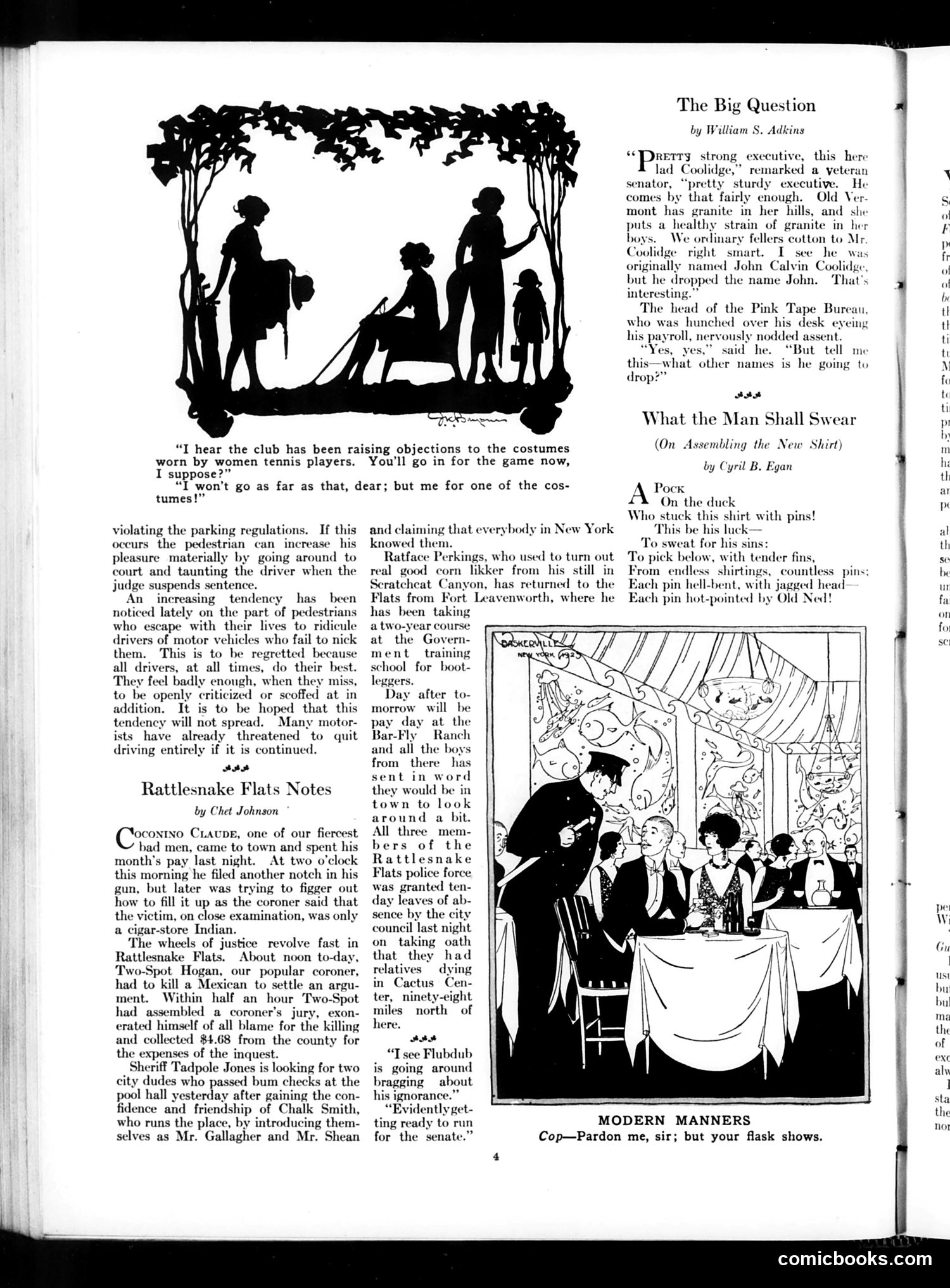
This page contains three distinct pieces of social satire typical of Judge magazine's humor: 1. **"The Big Question"** discusses naming conventions among Vermont families, satirizing rural naming practices where ordinary names like "John" are dropped in favor of distinctive appellations. 2. **"Rattlesnake Flats Notes"** appears to be a humorous local-interest column describing frontier justice and small-town drama, including a coroner's inquest and sheriff activities—satirizing Wild West lawlessness and frontier incompetence. 3. **"What the Man Shall Swear"** and the accompanying cartoon mock masculine vanity through a poem about shirt pins and personal grooming, with the "Modern Manners" caption satirizing a man's exaggerated concern with fashionable dress—a critique of male pretension and superficiality. The overall tone targets rural simplicity, frontier violence, and urban male vanity.
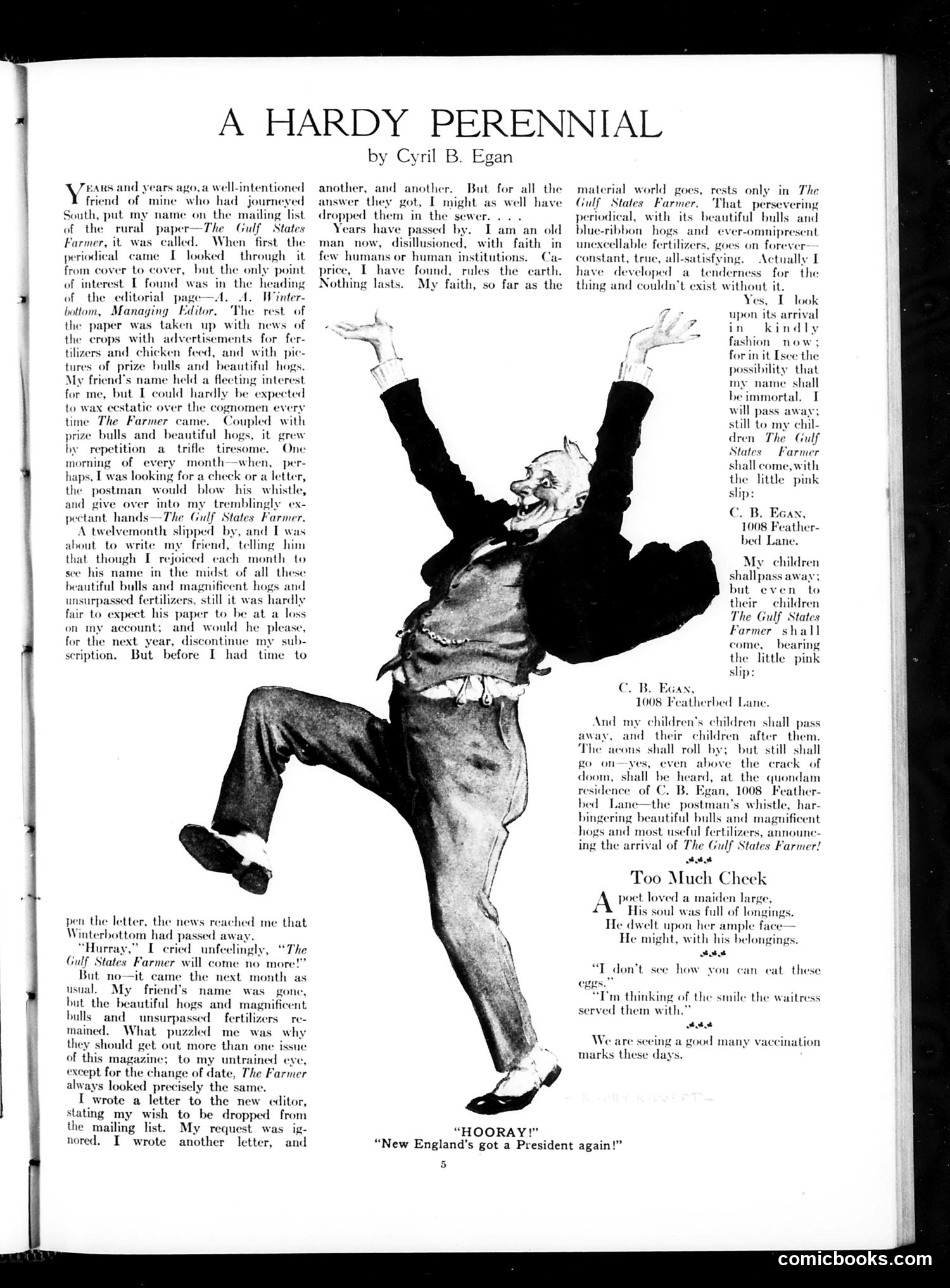
This page contains two satirical pieces from *Judge* magazine: **"A Hardy Perennial"** is a humorous essay about unwanted magazine subscriptions. The author describes subscribing to *The Gulf States Farmer* through a friend and becoming unable to cancel it despite repeated requests to the editor. Years pass; the friend dies, yet the magazine keeps arriving with the same content (prize bulls, fertilizers, hogs). The author jokes that this publication is so permanent it will outlast him and his descendants forever—an eternal, inescapable "hardy perennial." The accompanying illustration shows a joyful man (appearing to be a farmer or rustic figure) leaping enthusiastically, likely representing the magazine's irrepressible persistence. **"Too Much Cheek"** is a brief comic poem about a poet admiring a large woman, making a somewhat crude joke about her "ample face" and his belongings—unclear satirical intent without additional context. The satire mocks both unwanted direct mail and the era's agricultural magazine marketing—still recognizable frustrations today, though the specific product placement is dated.
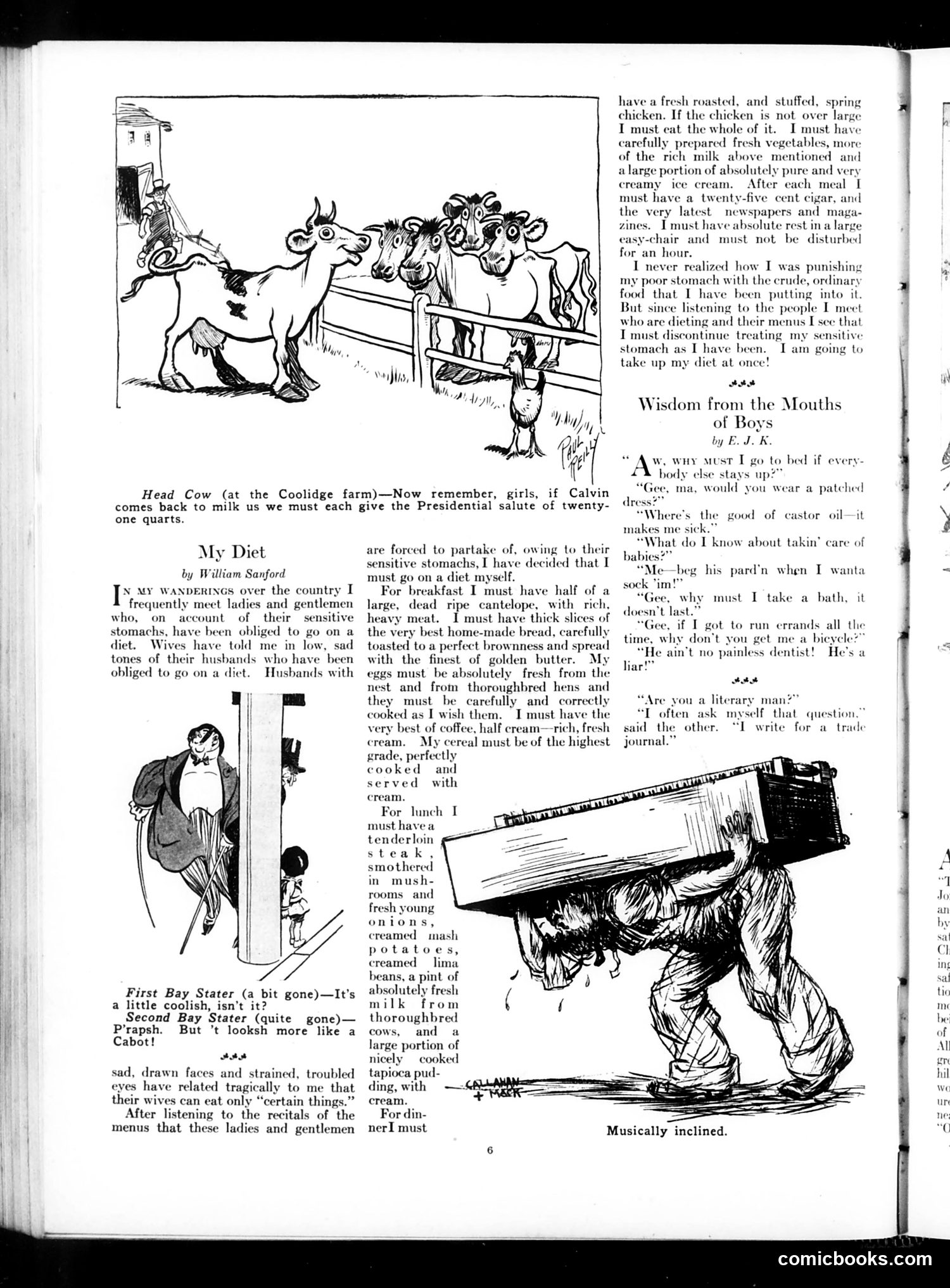
This page contains several satirical pieces mocking 1920s American anxieties: **"Head Cow" cartoon**: References President Calvin Coolidge's Vermont farm background, satirizing his rural image by joking that dairy cows must salute him with "twenty-one quarts" (a play on the presidential gun salute). The humor relies on Coolidge's known taciturn, understated persona. **"My Diet" article**: Parodies the era's obsession with "sensitive stomachs" and dietary restrictions among the wealthy. The author ironically catalogs an absurdly luxurious "diet" (fresh cantaloupe, prime beef, creamed vegetables, ice cream), mocking how privileged people claimed fragile health while consuming excessive amounts of expensive foods—a commentary on class pretension and hypochondria. **"Bay Stater" dialogue**: A regional joke about Massachusetts accents, where intoxicated speakers confuse "coolish" weather with a "Cabot" (a prominent Massachusetts family name), suggesting drunken slurring. **"Wisdom from Mouths of Boys"**: Collects children's naive questions and complaints, poking fun at parental authority and childhood logic.
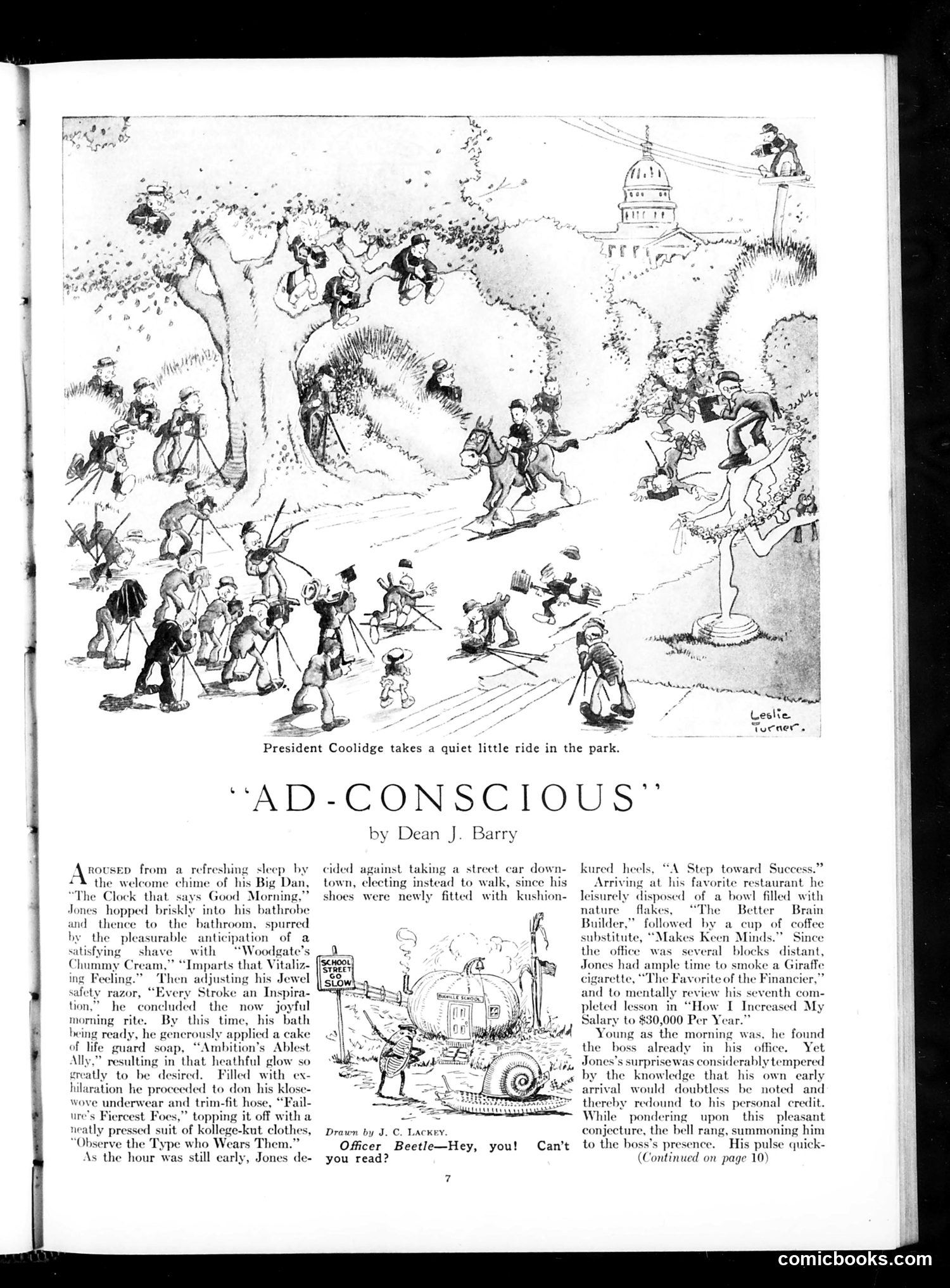
This satirical story mocks Americans' obsession with branded consumer products and advertising. The narrative follows a man named Jones through his morning routine, where nearly every action is tied to a specific advertised product—from "Woodgate's Chummy Cream" shaving soap to "Ambition's Ablest" life guard soap to a "Giraffe" cigarette. The joke is that Jones's entire identity and sense of accomplishment is constructed through consumption and brand loyalty. His satisfaction comes not from genuine personal merit but from using the "right" products. The top cartoon of "President Coolidge takes a quiet little ride in the park" likely parallels this theme—even the president cannot escape the public spectacle and media attention (advertisements) of modern life. The story satirizes 1920s consumer culture and the emerging power of advertising to shape behavior and self-perception.
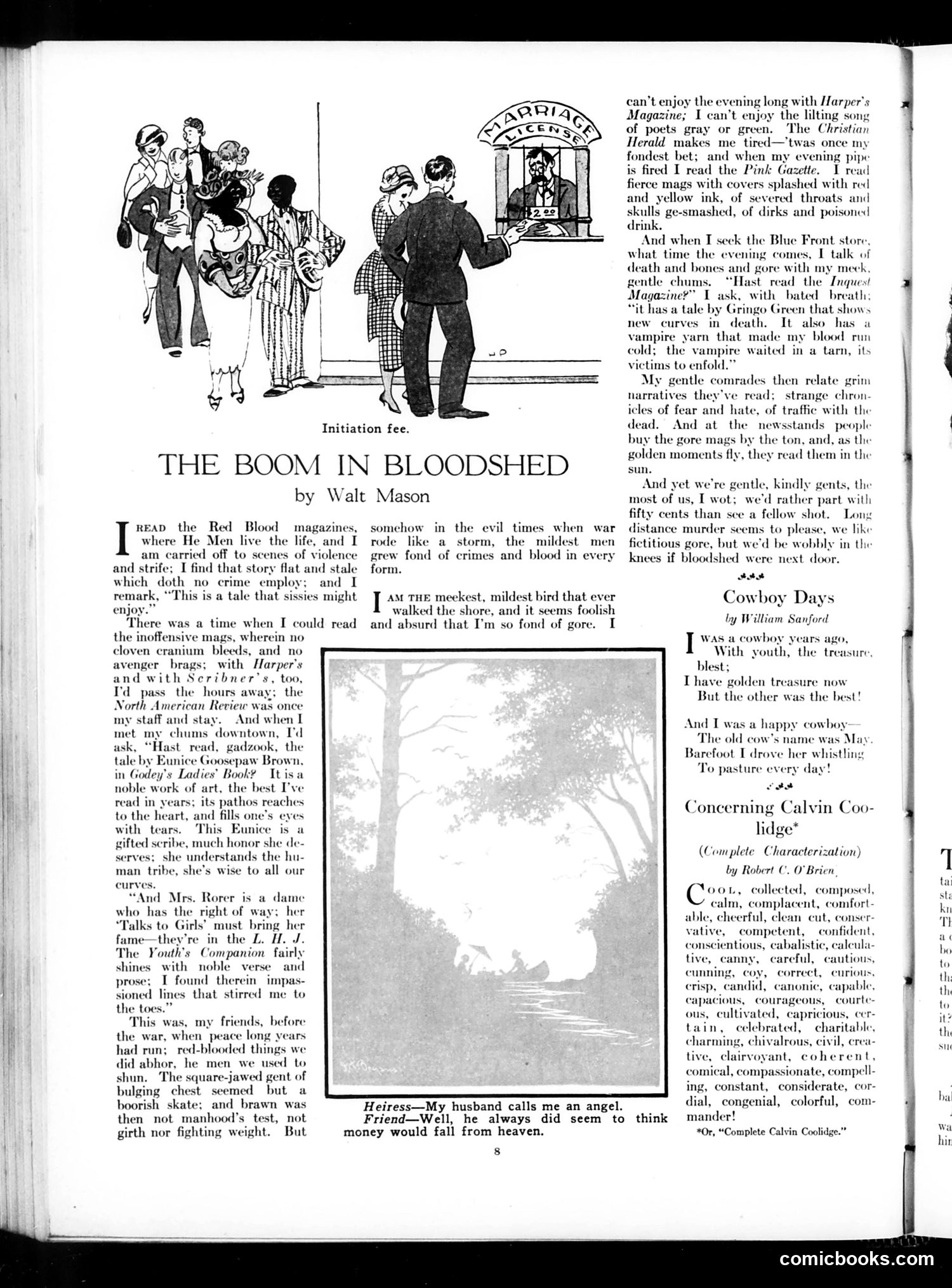
Walt Mason's poem satirizes how American magazine reading habits shifted dramatically due to World War I. Pre-war, readers enjoyed genteel publications like *Harper's*, *Scribner's*, and *The Youth's Companion*—magazines featuring moral tales and refined literature. The author presents himself as formerly content with such "inoffensive" fare. However, wartime transformed public taste. The poem's speaker now craves lurid "Red Blood magazines" featuring sensational crime, gore, and violence—"severed throats," "skulls ge-smashed," poisoned drink. Mason's irony cuts deep: these now-genteel readers who once scorned "square-jawed gents" now obsess over brutality. The joke's twist: despite their bloodlust for fictional gore, these same "gentle, kindly gents" remain squeamish about *actual* violence—they'd "rather part with fifty cents than see a fellow shot." Mason critiques the disconnect between wartime's desensitization to violence and lingering Victorian propriety.
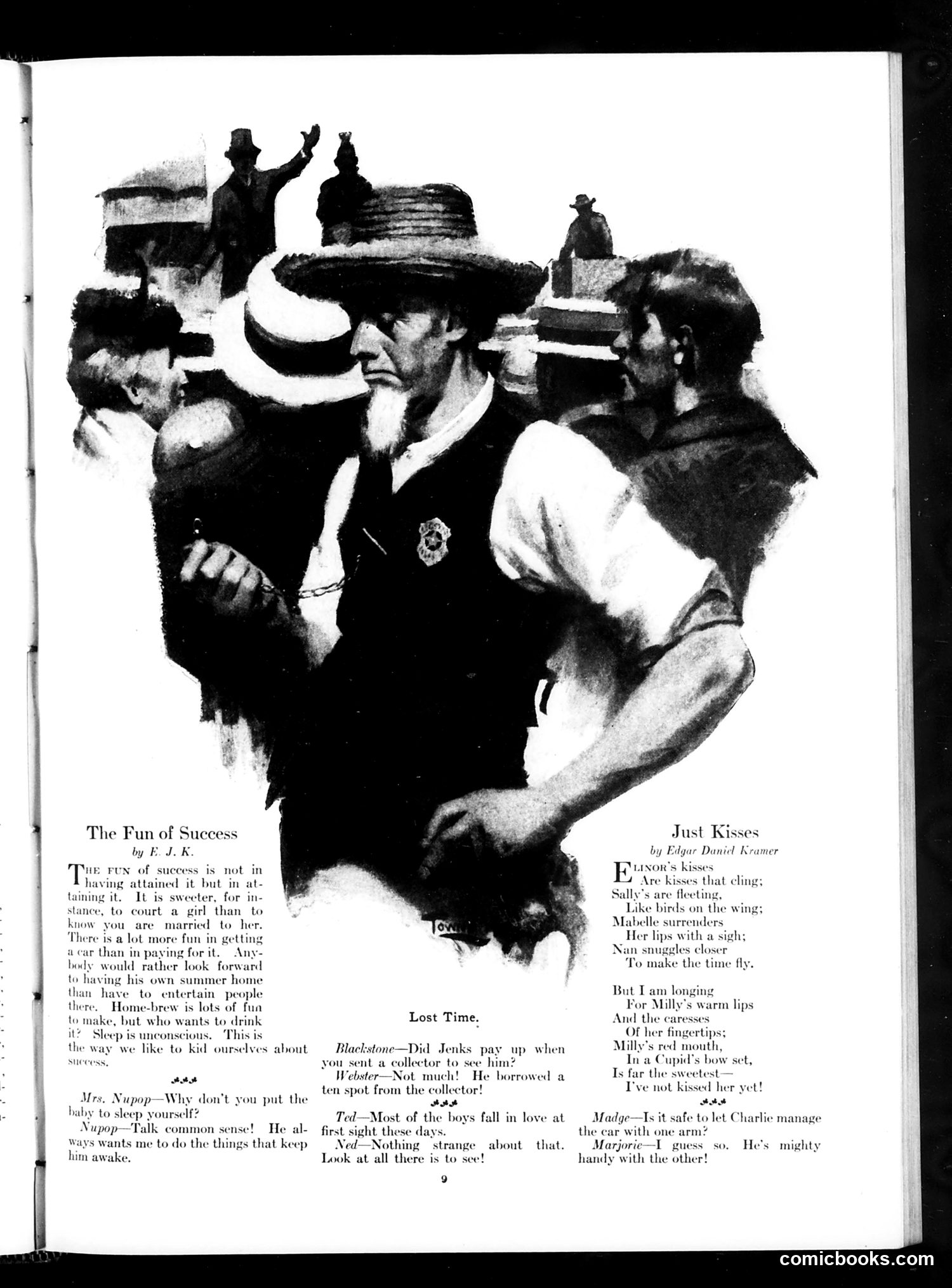
This page contains three humorous pieces reflecting early 20th-century American domestic life: **"The Fun of Success"** satirizes the human tendency to enjoy *anticipation* more than *achievement*—courtship beats marriage, acquiring beats owning, building beats living in a home. The accompanying cartoon shows a man unable to quiet his baby because the child won't sleep unless the father performs the activities that keep him awake: a witty paradox on parental exhaustion. **"Lost Time"** presents brief jokes about financial irresponsibility: a man borrows money from the debt collector sent to collect from him—absurdist humor about avoiding payment. **"Just Kisses"** is sentimental verse cataloging different women's kissing styles, ending with the speaker's unrequited longing for Milly, whom he hasn't kissed yet. The accompanying cartoon makes a crude double entendre about a woman trusting her boyfriend to drive one-handed because "he's handy with the other." The content reflects period attitudes toward romance, marriage, money, and gender relations—lighthearted but with hints of marital tedium and sexual innuendo typical of Judge's humor.
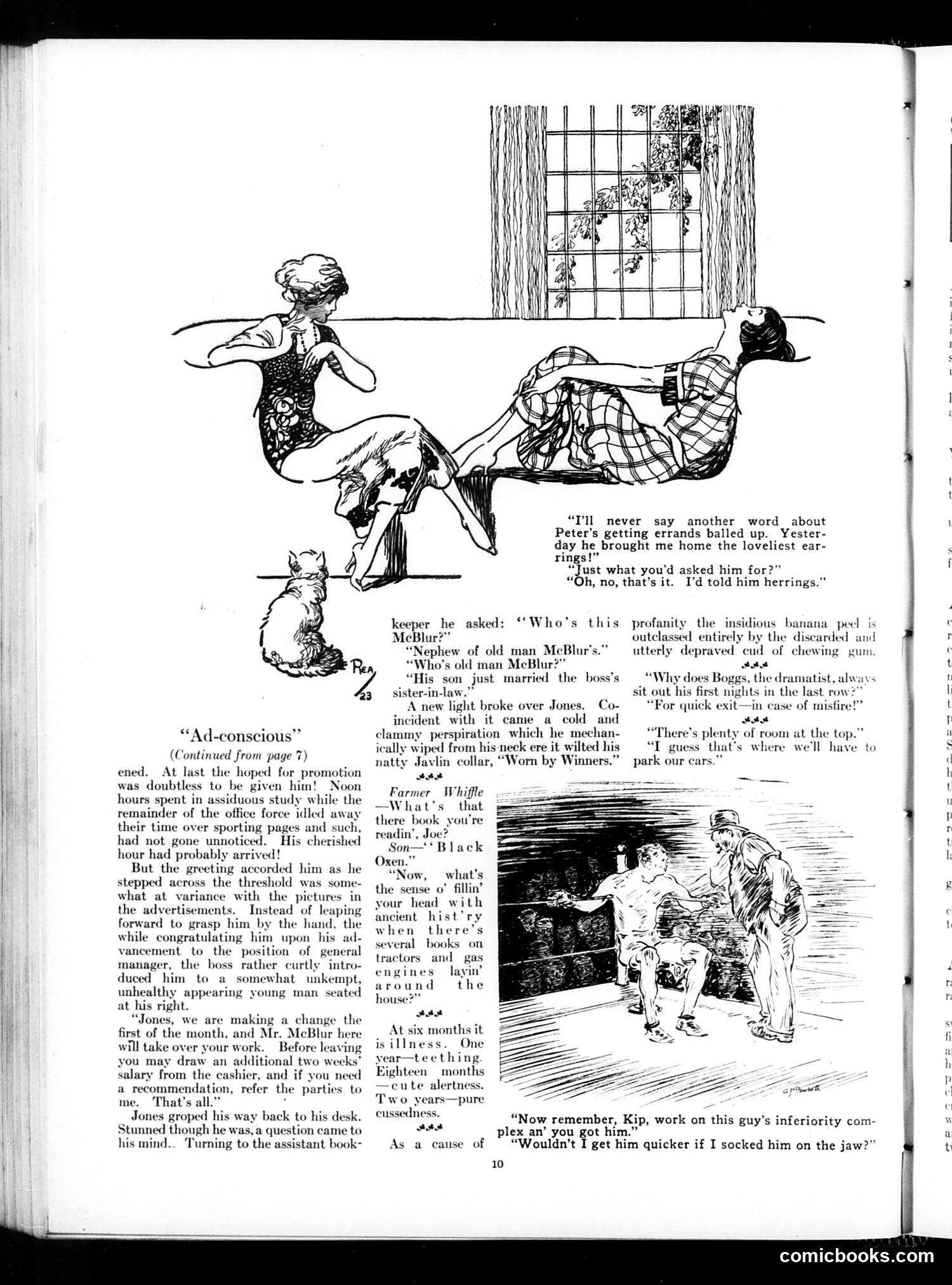
This page contains two distinct satirical pieces: **"Ad-conscious"** (main story): Satirizes men whose lives are shaped by advertising promises. Jones, a diligent office worker, believes advertisements depicting boss-employee relations showing warm congratulations upon promotion. Instead, his boss curtly fires him, replacing him with the nepotistically-hired son-in-law of old man McBlur. The satire mocks how advertising creates false expectations about American business meritocracy, contrasting glossy ads with grim workplace reality. **"Farmer Whiffle"** (rural humor strip): A farmer questions why his son reads "Black Oxen" (likely a 1920s novel) when practical farming books exist. This satirizes rural skepticism toward modern literature and urban culture. **Smaller jokes** mock advertising absurdities (chewing gum profanity, car parking), dramatists' superstitions, and psychology/salesmanship tactics. The overall theme: advertising misleads Americans about how the world actually works.
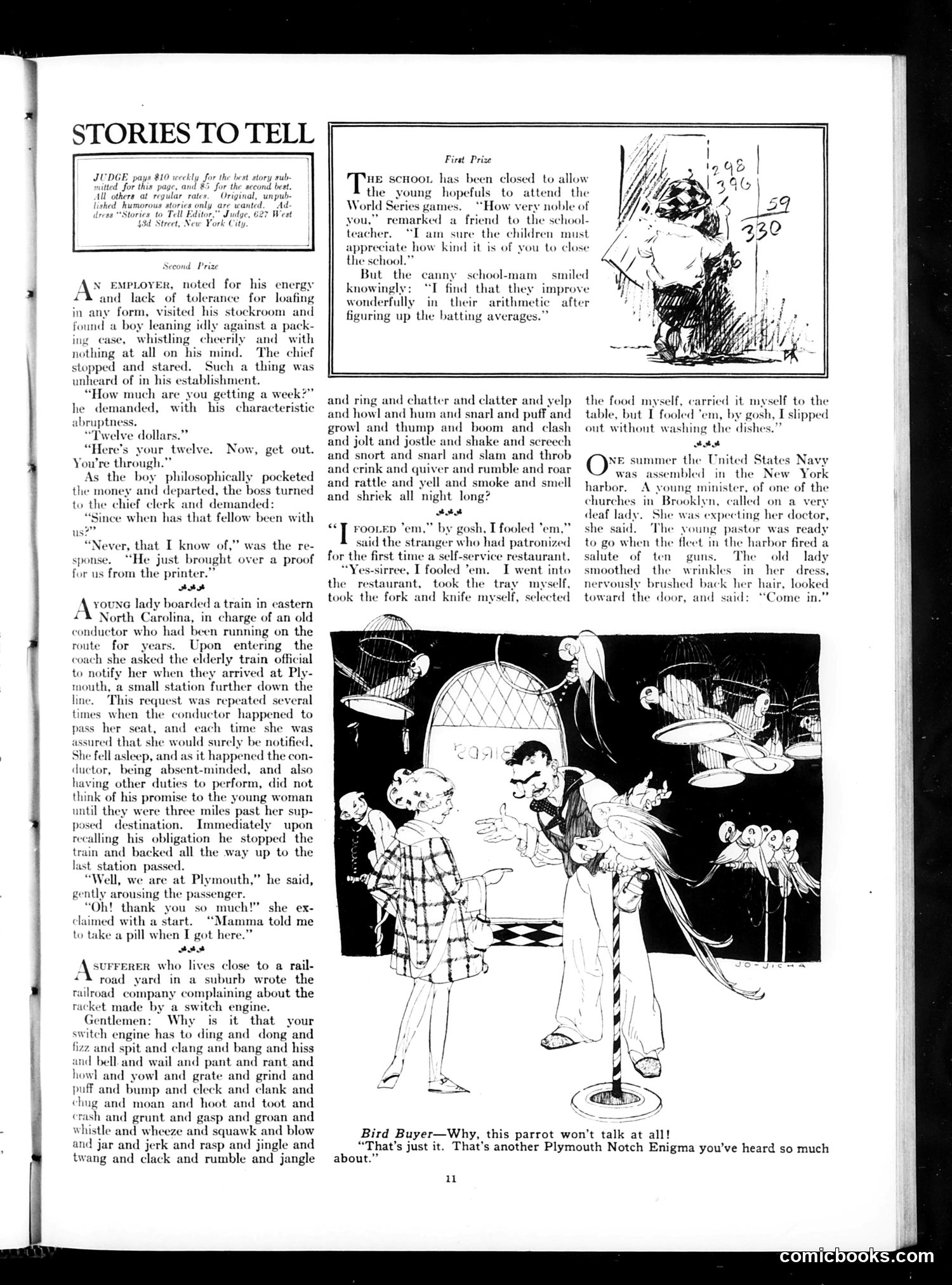
This is a "Stories to Tell" humor page from Judge magazine, featuring four brief satirical anecdotes: **First Prize Story**: A schoolteacher closes school for the World Series games, claiming it benefits children's education. The joke: she cynically admits students only improve at "arithmetic after figuring up the batting averages"—implying she uses sports to teach math while enjoying the games herself. **Second Prize Story**: A boss fires a boy loafing in the stockroom, only to learn the employee was merely a visiting printer's delivery person, not actually his worker. The satire targets inefficient management and hasty judgment. **The Conductor Story**: An elderly train conductor forgets to wake a sleeping passenger at Plymouth, then awkwardly backs the train up miles to correct his mistake. **The Railroad Complaint**: A lengthy comedic list of onomatopoeia describing a switch engine's noise—satirizing tedious complaint letters and mechanical annoyance. **Bottom Cartoon**: Shows a man with a parrot labeled a "Plymouth Notch Enigma" for refusing to speak—a reference to Calvin Coolidge's famous taciturnity. The page exemplifies Judge's early-20th-century humor style: workplace absurdity, social observation, and gentle mockery of American life.
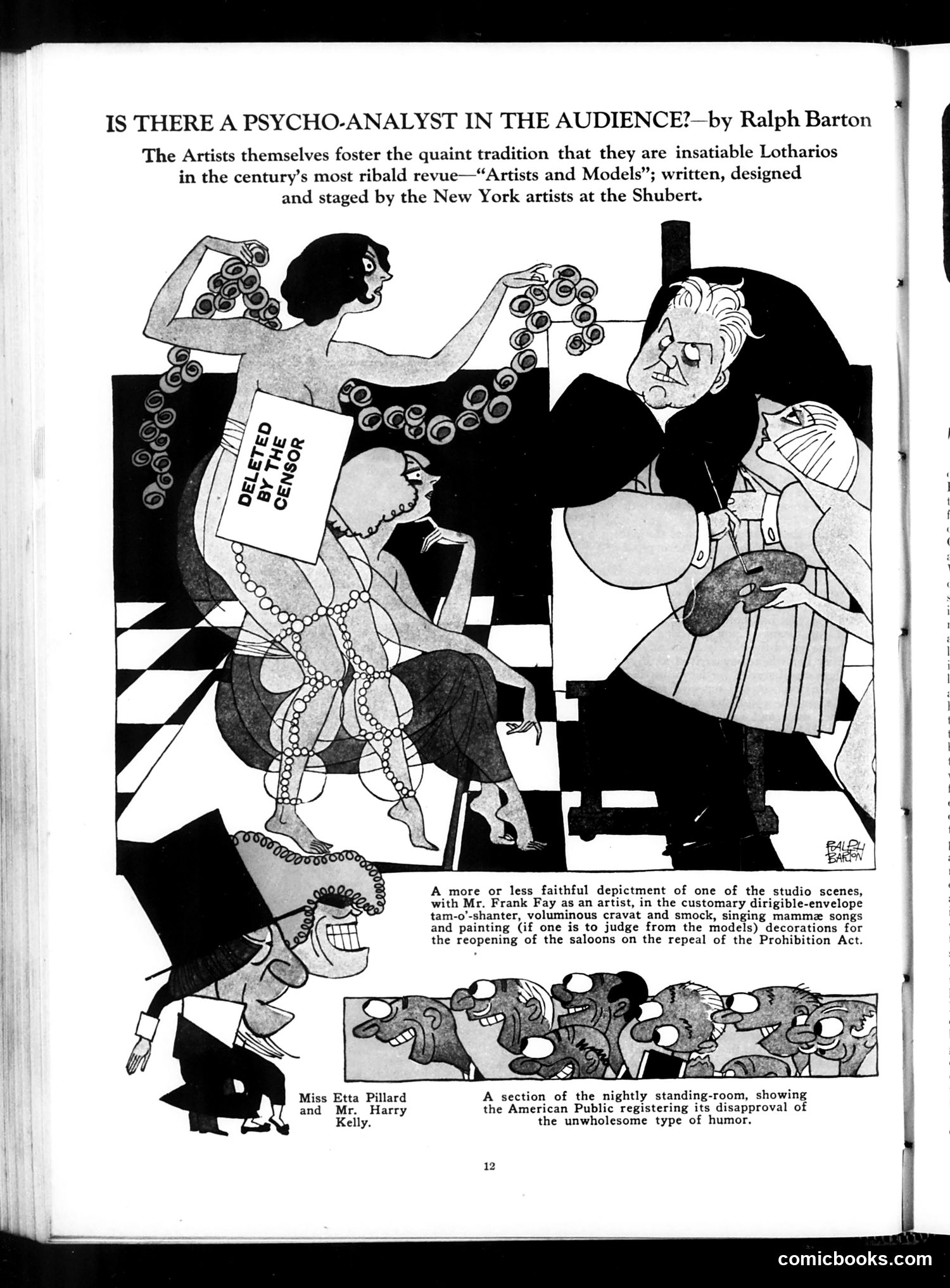
This is Ralph Barton's satirical commentary on the Broadway revue "Artists and Models" at the Shubert Theatre. The cartoon mocks the show's reputation for risqué humor and the stereotype of bohemian artists as womanizers ("insatiable Lotharios"). The main illustration depicts a studio scene with Frank Fay as an affected artist (wearing the stereotypical beret and cravat), surrounded by scantily-clad models. The reference to "reopening of the saloons on the repeal of the Prohibition Act" dates this to the early 1930s, when Prohibition ended. The lower panel shows audience members registering disapproval, suggesting that despite the show's scandalous reputation, mainstream society—represented by "the American Public"—finds it morally objectionable rather than entertaining. The satire targets both the pretensions of the artistic community and the prudish hypocrisy of audiences who attend such shows while publicly condemning them.
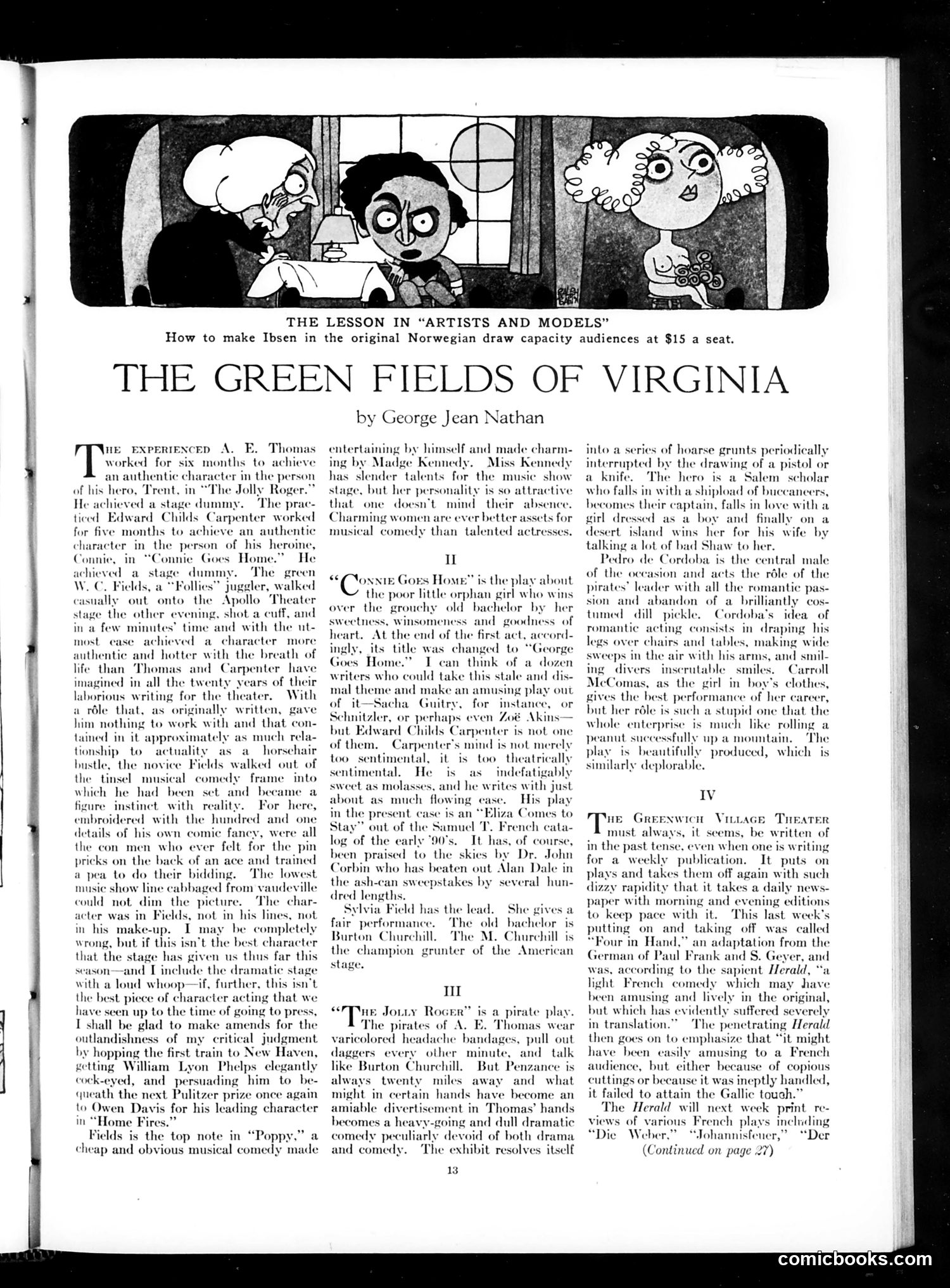
The top cartoon is a satirical jab at Henrik Ibsen adaptations. It shows exaggerated caricatures apparently mocking how producers were marketing serious Norwegian drama ("Ibsen in the original Norwegian") to American audiences willing to pay premium prices ($15 a seat) — suggesting the appeal relied on pretense or novelty rather than genuine artistic merit. The main article by George Jean Nathan is a theater review praising W.C. Fields's performance in the musical comedy "Poppy," contrasting his genuine character work against professional dramatists who produced wooden stage "dummies." Nathan argues Fields, despite playing a con man in a "cheap and obvious" show, demonstrated superior acting craft through authentic detail and personality — a critique suggesting theatrical seriousness doesn't guarantee quality performance.
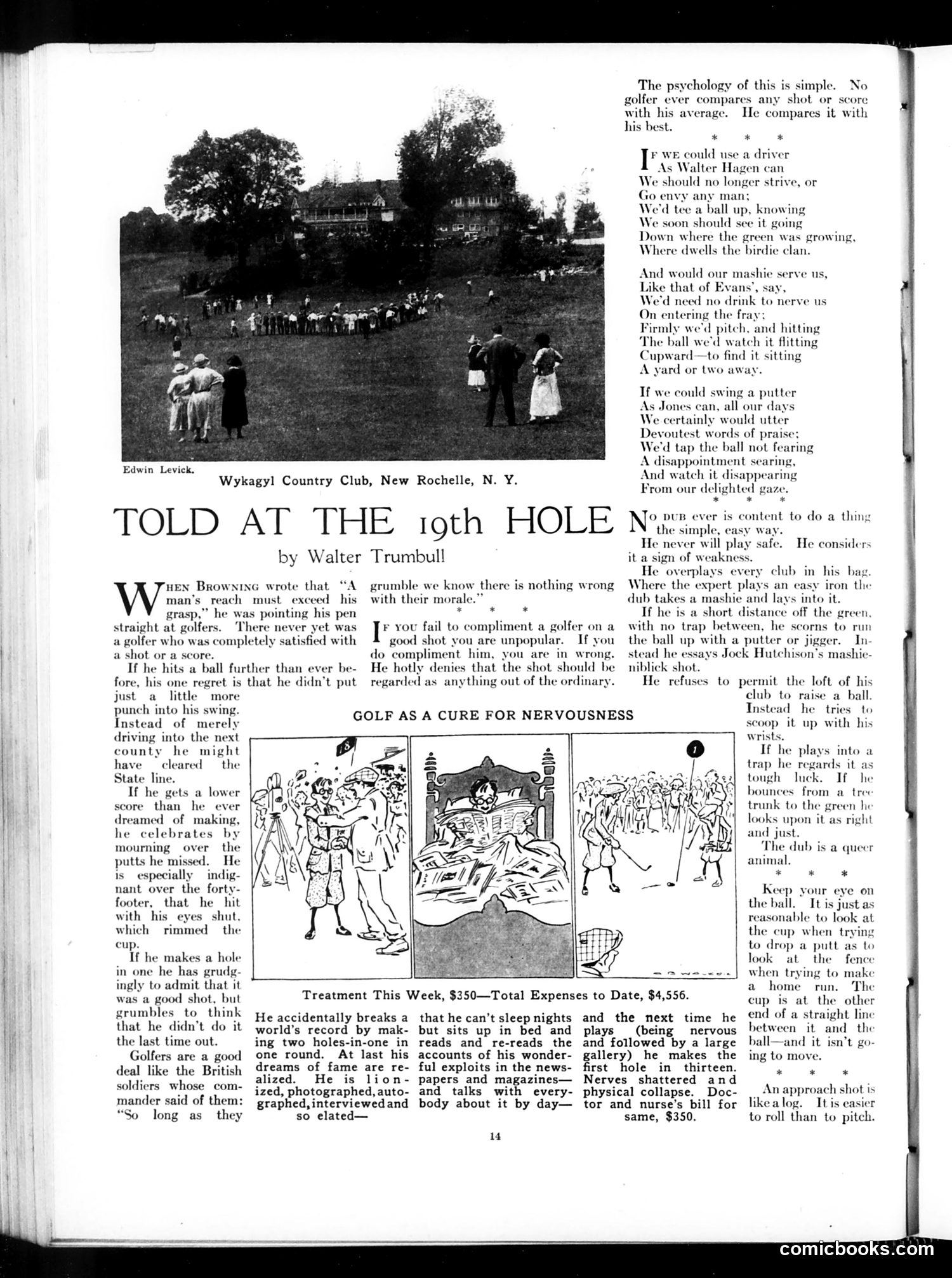
This page satirizes golfer psychology through Walter Trumbull's essay and accompanying cartoon panels titled "Golf as a Cure for Nervousness." The central joke: golfers are neurotic perfectionists who never feel satisfied. A golfer measures every shot against his *best* performance, not his average, creating constant disappointment. The text humorously catalogs this obsession—hitting farther than ever but regretting not hitting harder; making a hole-in-one but mourning missed putts. The cartoon narrative illustrates the absurdity: a golfer breaks a world record (two holes-in-one), becomes lionized in newspapers, can't sleep from excitement, then—paralyzed by nerves and gallery pressure—shoots 13 on the next first hole. The treatment? A $350 doctor and nurse bill for his nervous collapse. The satire mocks both golfers' psychological fragility and the era's emerging "nervousness" as a medical condition requiring treatment. References to champion golfers like Walter Hagen and Bobby Jones add period authenticity to the aspirational fantasy.
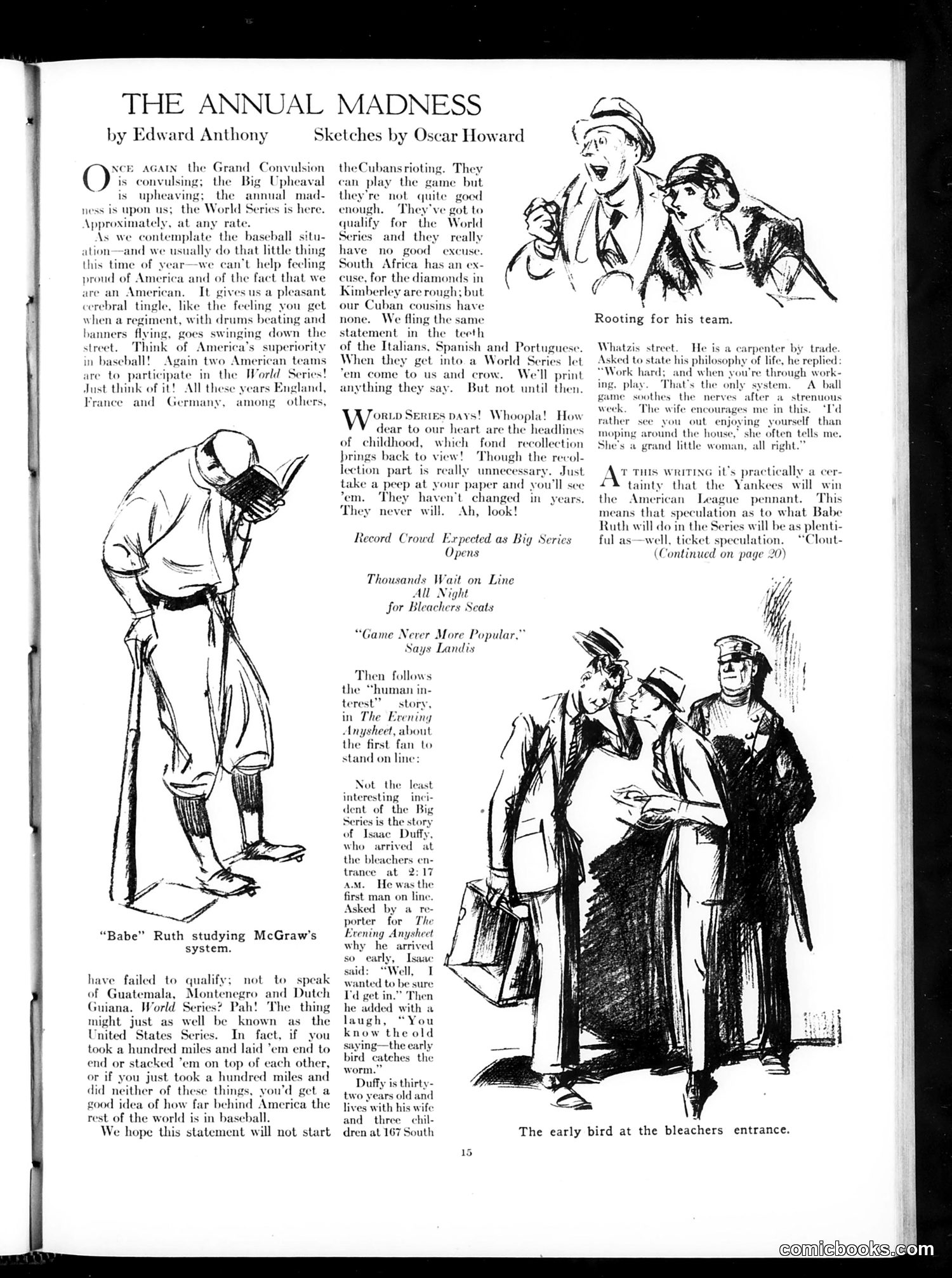
This 1920s article by Edward Anthony satirizes American obsession with baseball's World Series. The piece celebrates American baseball superiority with mock-patriotic boasting—claiming other nations (Guatemala, Montenegro, even South Africa) are so far behind that America's sport dominance is unmeasurable. The satire targets predictable World Series coverage: the stock headlines about "record crowds," the mandatory human-interest story about the "first fan" (Isaac Duffy, arriving at 2:17 AM), and his inevitable clichéd explanation ("the early bird catches the worm"). Oscar Howard's sketches show Babe Ruth studying strategy and fans queuing for bleachers seats. The piece gently mocks American exceptionalism regarding baseball while skewering sportswriting's formulaic clichés. The repeated observation that these stories "never will" change highlights how stale and repetitive World Series journalism had become—a joke modern readers would recognize about sports media today.
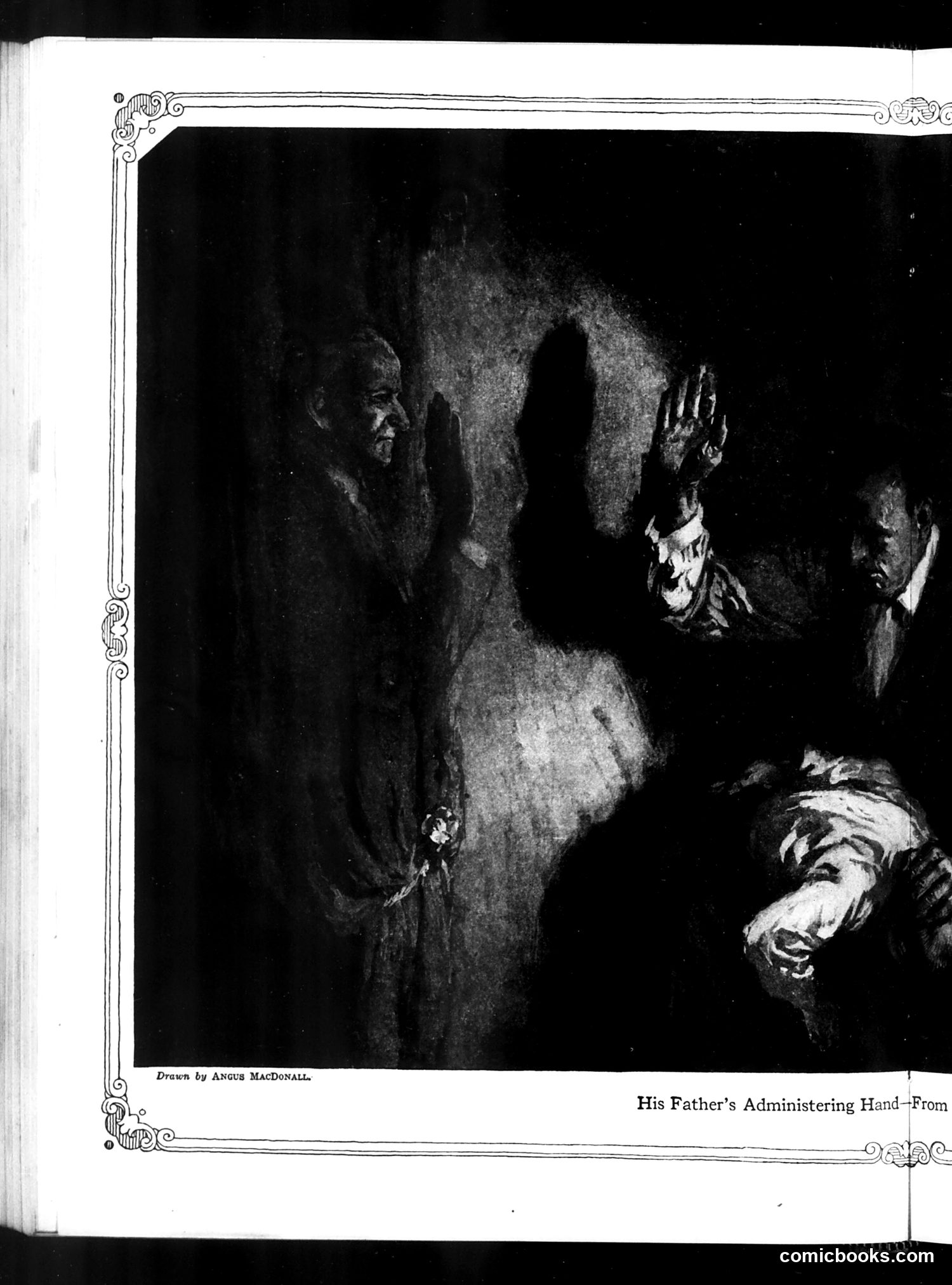
This drawing by Angus MacDonald depicts a dramatic nighttime scene of apparent corporal punishment. The composition shows several figures in shadow: a man on the left (likely a father figure) administering what appears to be a beating to a central figure, while onlookers—possibly children or family members—witness the scene on the right, their hands raised in distress or alarm. The title "His Father's Administering Hand" suggests social commentary on paternal discipline and child-rearing practices. Given Judge magazine's satirical nature, this likely critiques either excessive parental punishment or broader anxieties about discipline and authority in American households during the early 20th century. The dramatic chiaroscuro and emotional expressions emphasize the violence of the moment for satirical effect.
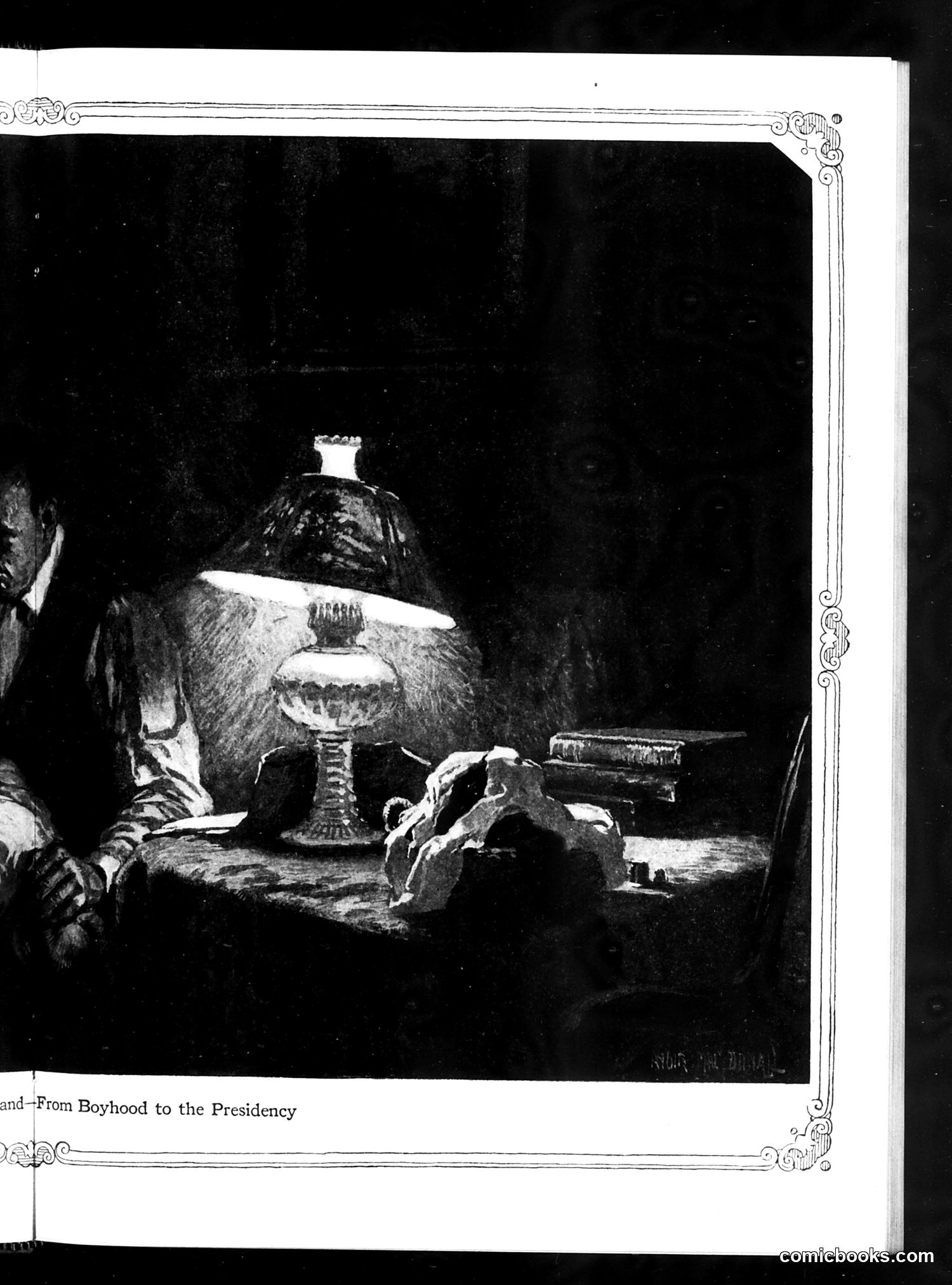
The OCR text is corrupted/illegible, so I'm working from the image and caption alone. The caption reads: "—and From Boyhood to the Presidency" This appears to be a political cartoon showing a figure examining objects on a table by lamplight—likely depicting someone's rise to power. The composition suggests a retrospective look at a political career's origins. However, without legible text identifying the specific figure or the magazine's date, I cannot definitively name which president or political candidate is being satirized or what specific events/controversies are being referenced. The image's dark, dramatic lighting and the arrangement of objects suggest scrutiny of someone's past, but the specific satirical point remains unclear without additional context or readable caption text.
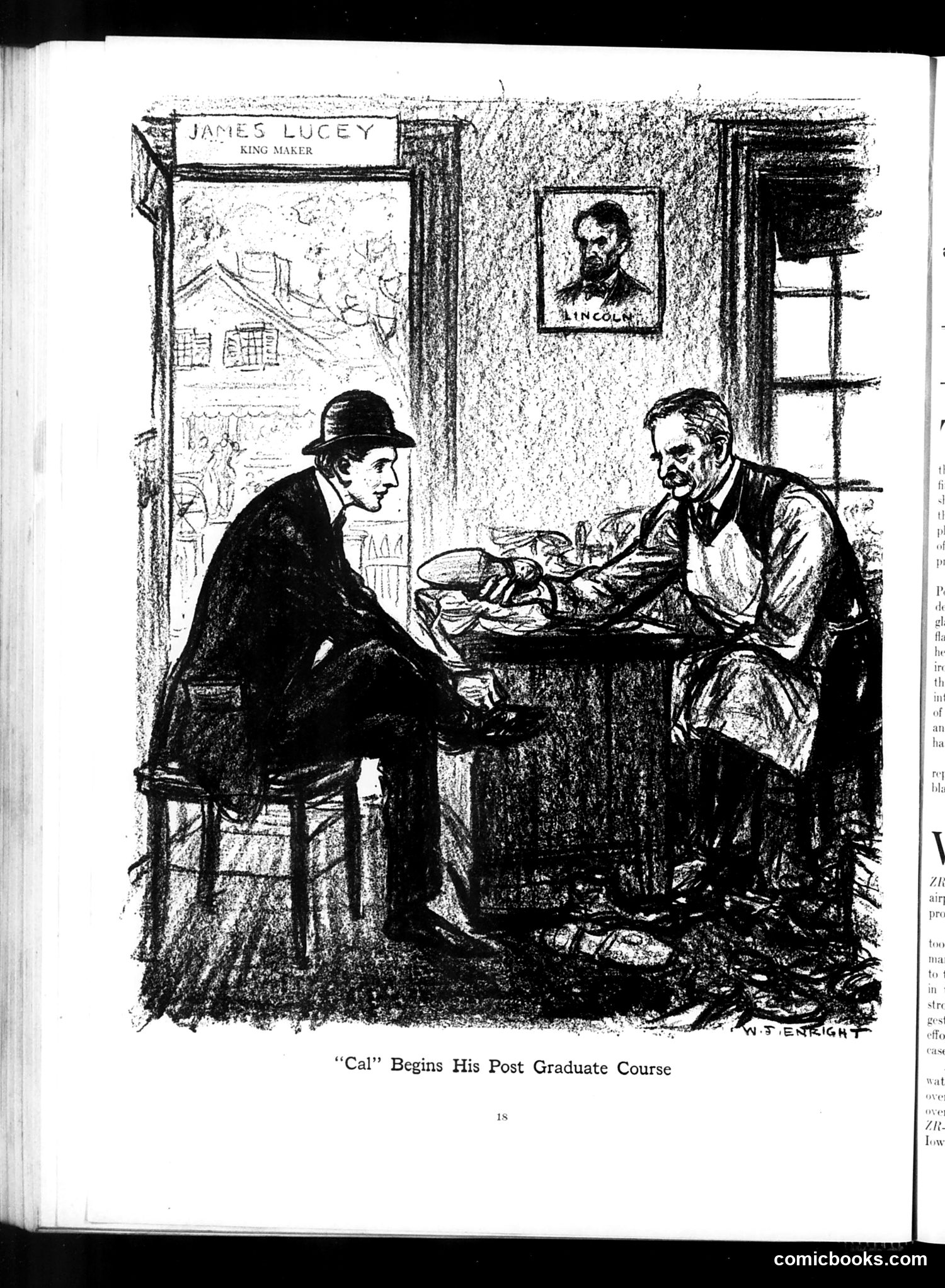
This satirical cartoon depicts two men at a modest table in what appears to be a humble dwelling. The caption references someone nicknamed "Cal" beginning a "post graduate course," suggesting a comedown or ironic reversal. The shop sign identifies "James Lucey, King Maker," indicating Lucey as a political power broker. A Lincoln portrait hangs on the wall, invoking American political authority. The humor appears to target a political figure (likely "Cal" Coolidge, though this isn't explicitly confirmed) whose fortunes have changed dramatically—moving from prestigious political status to an ordinary domestic situation. The "king maker" reference suggests mockery of those who manipulate politics, now reduced to humble circumstances. The satire critiques either a fallen political operative or uses domestic degradation as metaphor for political humiliation.
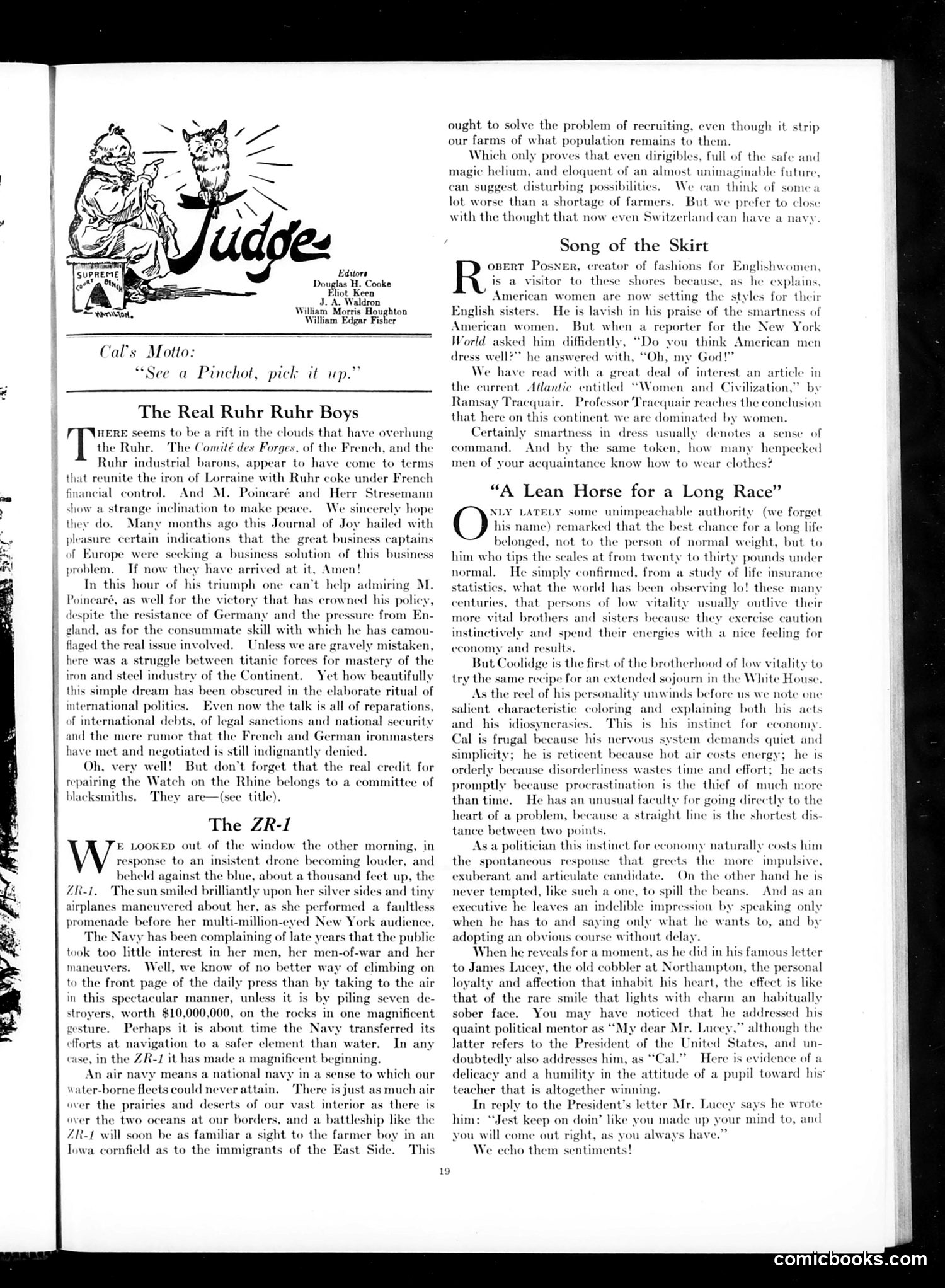
This page contains three distinct pieces of satirical commentary: **"The Real Ruhr Ruhr Boys"** mocks post-WWI industrial diplomacy. The "Ruhr Ruhr Boys" refers to French and German industrial leaders (the "Comité des Forges" and German iron/steel barons) negotiating control of the Ruhr region's resources. Judge sarcastically praises this "business solution" while cynically noting the real negotiations are obscured by diplomatic language about "reparations" and "national security." The title's pun ("Ruhr Ruhr") and reference to "blacksmiths" emphasize that industrial capitalists, not governments, are truly controlling post-war European politics. **"The ZR-1"** discusses the Navy's new rigid airship (likely the USS ZR-1, later the USS Shenandoah), which performed public demonstrations over New York. Judge sarcastically suggests the Navy is using spectacular aerial stunts to generate public interest and recruitment, while ironically noting this airship technology could eventually replace naval forces entirely—a somewhat dystopian technological commentary wrapped in humor. **"Song of the Skirt"** briefly notes Robert Posner, a British fashion designer, observing that American women now set fashion trends for English women.
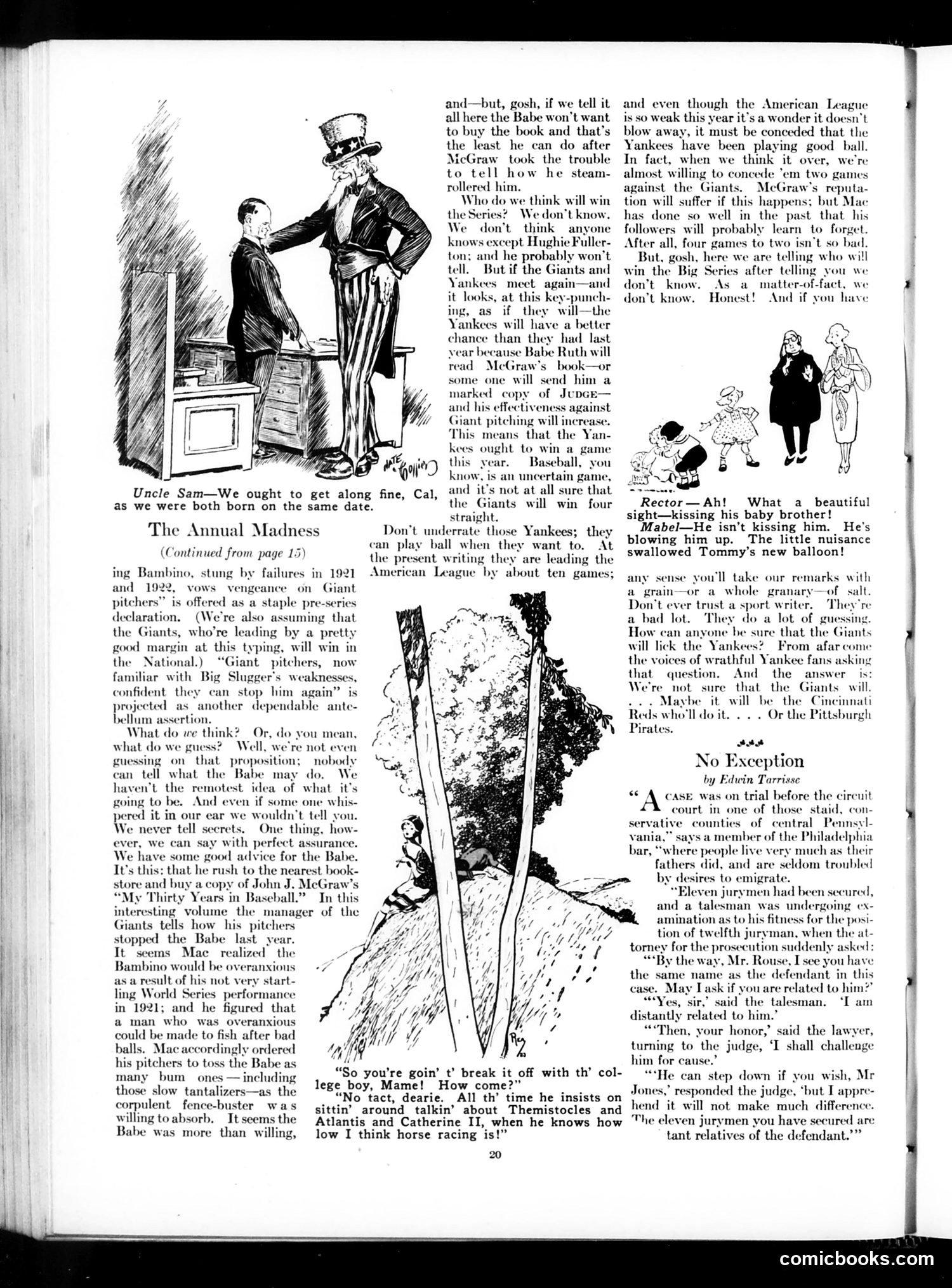
The top cartoon depicts **Uncle Sam and "Cal"** (President Calvin Coolidge), suggesting they should "get along fine" since both were "born on the same date"—a patriotic joke about American unity. The main article discusses the **1922 World Series** between the **New York Giants and Yankees**. It lampoons sports writers' predictive claims about baseball outcomes, particularly regarding **Babe Ruth** ("the Bambino") and manager **John McGraw**'s Giants. The author humorously notes that nobody—except perhaps sportswriter **Hughie Fullerton**—truly knows who will win, yet writers confidently make predictions anyway. The satire mocks the pretension and guesswork inherent in sports journalism: "How can anyone be sure that the Giants will lick the Yankees?" The piece advises Ruth to buy McGraw's book to understand how he was previously stopped, while simultaneously admitting the writer has no actual certainty about the series outcome. This exemplifies Judge magazine's satirical approach to contemporary American culture and popular obsessions.
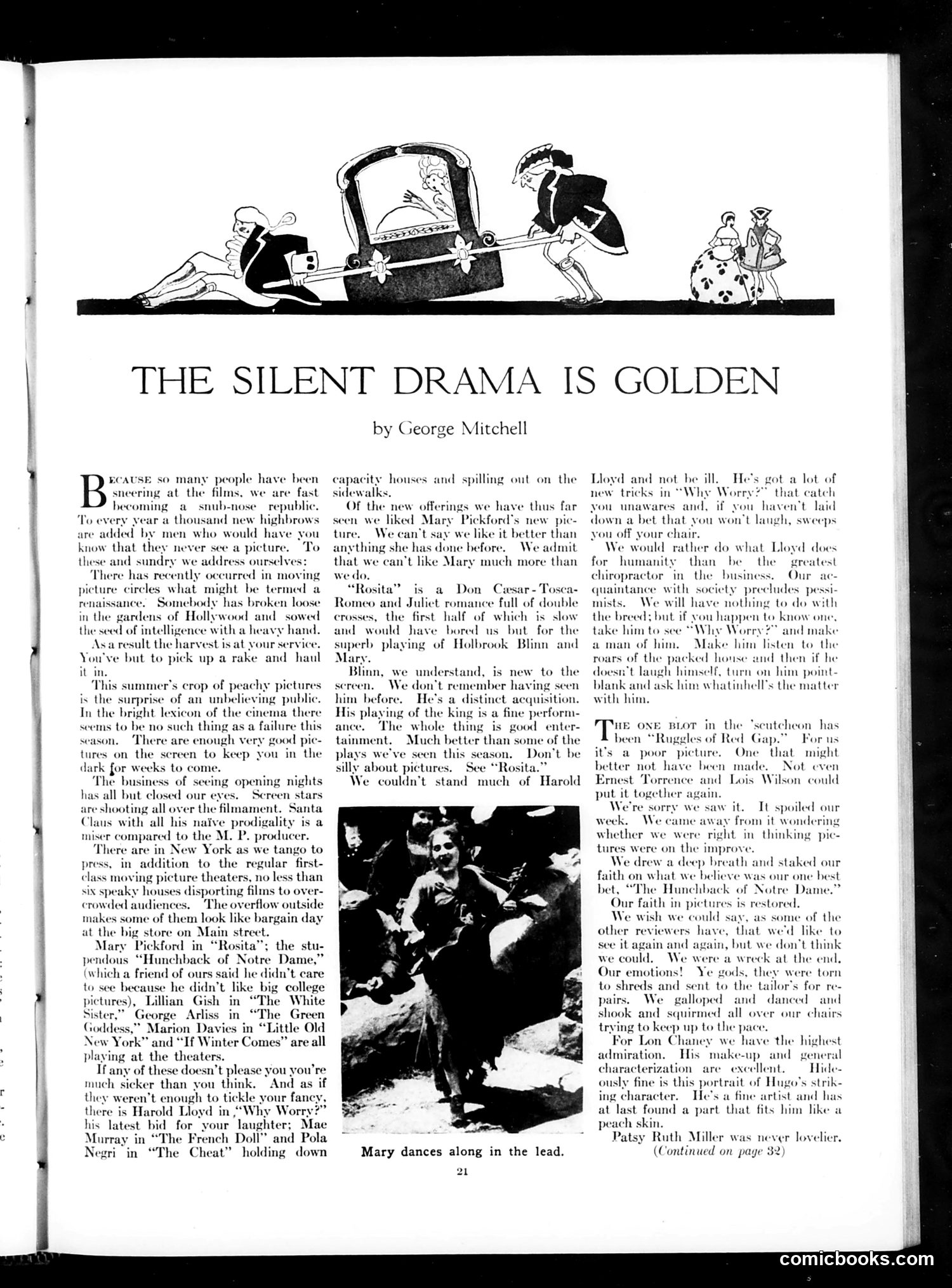
This is a film criticism article by George Mitchell praising the current crop of 1920s silent movies. The cartoon header depicts Mary Pickford being pulled in a carriage by admiring figures—a visual metaphor for her star power and popularity. Mitchell argues against intellectual "snobs" who dismiss cinema as lowbrow entertainment. He celebrates recent releases like Mary Pickford's "Rosita," "The Hunchback of Notre Dame," and Harold Lloyd's "Why Worry?" as evidence that film has achieved artistic legitimacy. The piece praises specific performances: Holbrook Blinn's acting in "Rosita" and Lloyd's comedic genius. Mitchell dismisses "Ruggles of Red Gap" as an exception to the season's quality. The article's main point: silent film has matured into genuine art worthy of intellectual respect—even snobs should attend these pictures. The tone is celebratory but also somewhat defensive about cinema's cultural status, reflecting 1920s debates about whether movies were legitimate entertainment or mere frivolous spectacle.
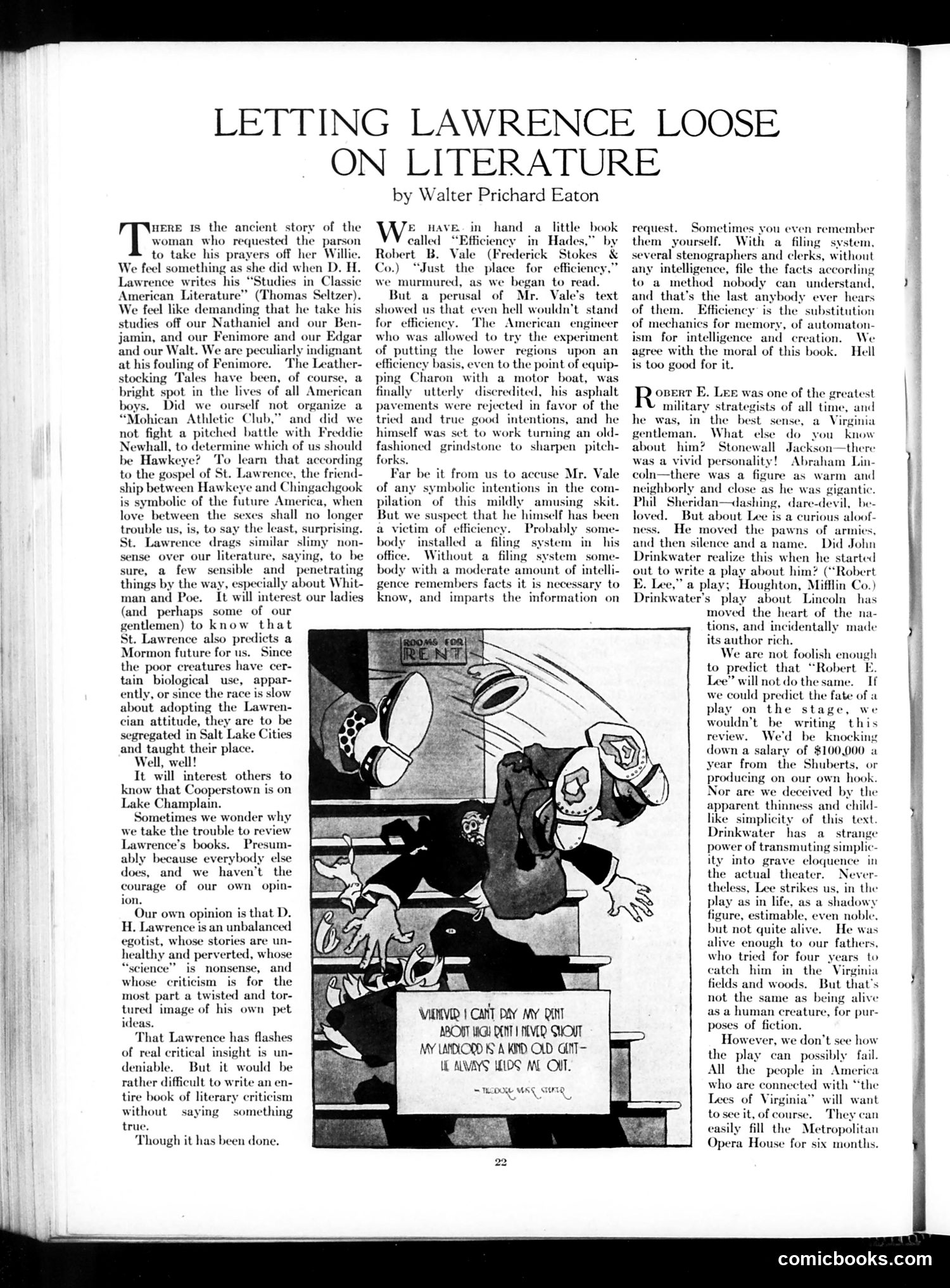
This 1920s satirical piece critiques British author D.H. Lawrence's literary analysis in *Studies in Classic American Literature*. The author Walter Prichard Eaton accuses Lawrence of perverting interpretations of American classics—particularly James Fenimore Cooper's *Leatherstocking Tales*—by imposing his own ideological obsessions onto the texts. The cartoon illustrates this complaint through a caricatured figure (representing Lawrence) forcibly "fouling" American literature. Eaton objects specifically to Lawrence's claim that Hawkeye and Chingachgook's friendship symbolizes a future America without sexual division—reading homosexual subtext into innocent adventure fiction. The piece also mocks Lawrence's prediction of Mormon futures for America. The secondary item about "Efficiency in Hades" uses similar logic: efficiency systems paradoxically destroy understanding by replacing human memory and judgment with mechanical filing systems that no one can navigate. The satire targets intellectual pretension and over-interpretation masquerading as literary criticism.
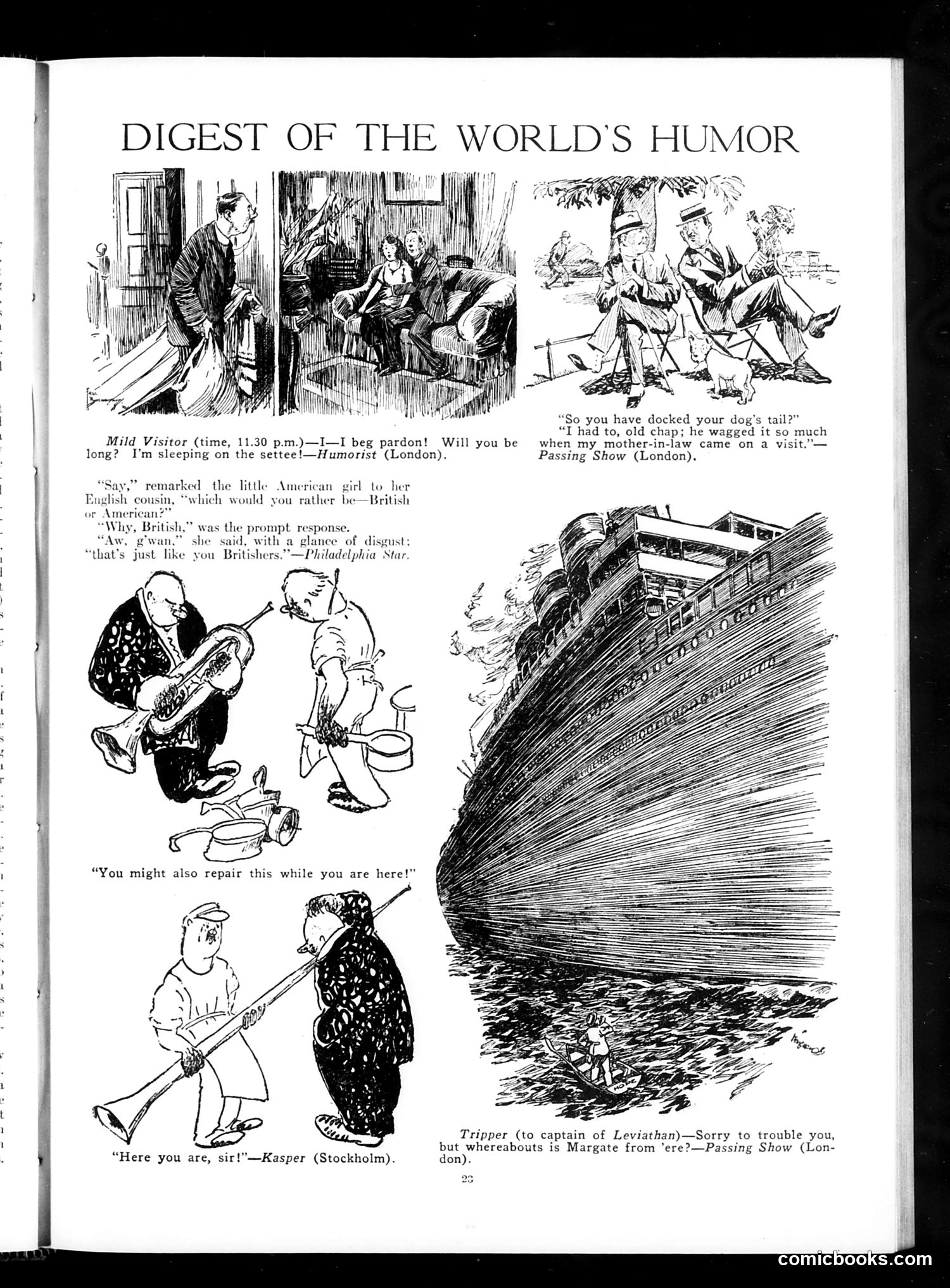
This page collects brief humorous anecdotes from international sources, showcasing early 20th-century cultural humor. The jokes reflect period attitudes and concerns: **The American Girl joke** pokes fun at American directness and anti-British sentiment, with the girl dismissing British reserve as pretentious. **The Dog's Tail cartoon** is domestic humor about in-laws—a universal source of comedy. The implication is the dog's excessive tail-wagging at the mother-in-law's arrival was embarrassing, so docking it solved the problem. **The Ship Passenger cartoon** satirizes tourist ignorance. A visitor to the *Leviathan* (a famous ocean liner) doesn't know where Margate (a British seaside resort) is located relative to the ship, suggesting comical geographical confusion among travelers. **The Musician cartoon** appears incomplete but suggests mishaps during musical repair work. The page exemplifies Judge magazine's format: reprinting jokes from international publications to entertain American readers with cross-cultural humor.
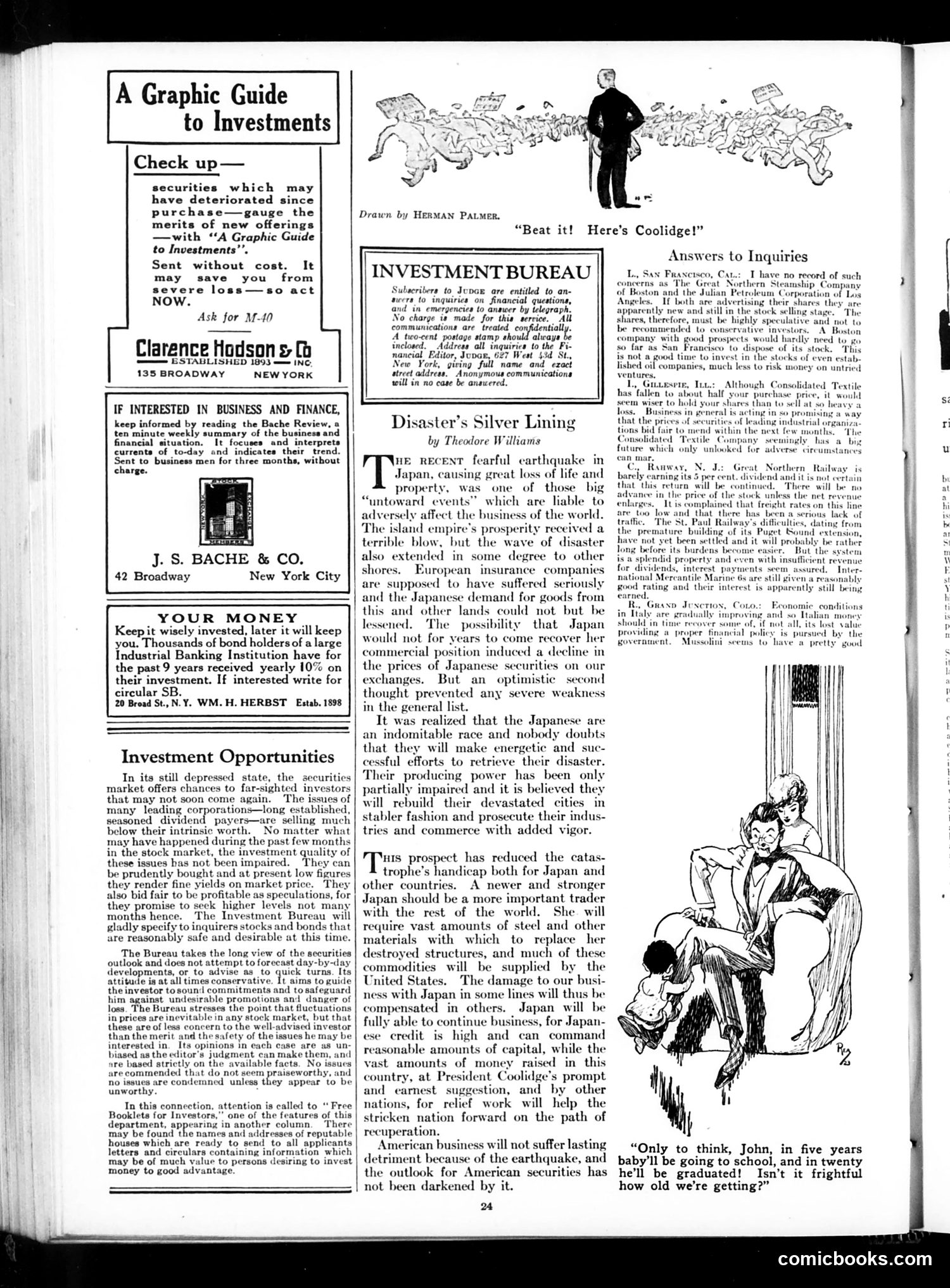
This page from Judge combines investment advertisements with satirical commentary on the 1923 Japan earthquake disaster and President Calvin Coolidge. **The main cartoon** ("Beat it! Here's Coolidge!") depicts a figure representing Japan—drawn as a distressed person being literally swept away by chaos—encountering Coolidge, who dismissively tells him to "beat it." This satirizes Coolidge's perceived indifference to international crises. The caption suggests America's president offers no sympathy or aid to the earthquake-stricken nation. **The accompanying article**, "Disaster's Silver Lining" by Theodore Williams, takes a more optimistic tone about Japan's recovery prospects, arguing that Japanese resilience and creditworthiness will help rebuild their economy and strengthen international trade. **The irony**: While advertisements promise financial security through careful investing, the cartoon and article discuss genuine catastrophic loss. Together, they reflect 1920s American attitudes—both callous dismissal of foreign suffering and opportunistic optimism about future profit from reconstruction.
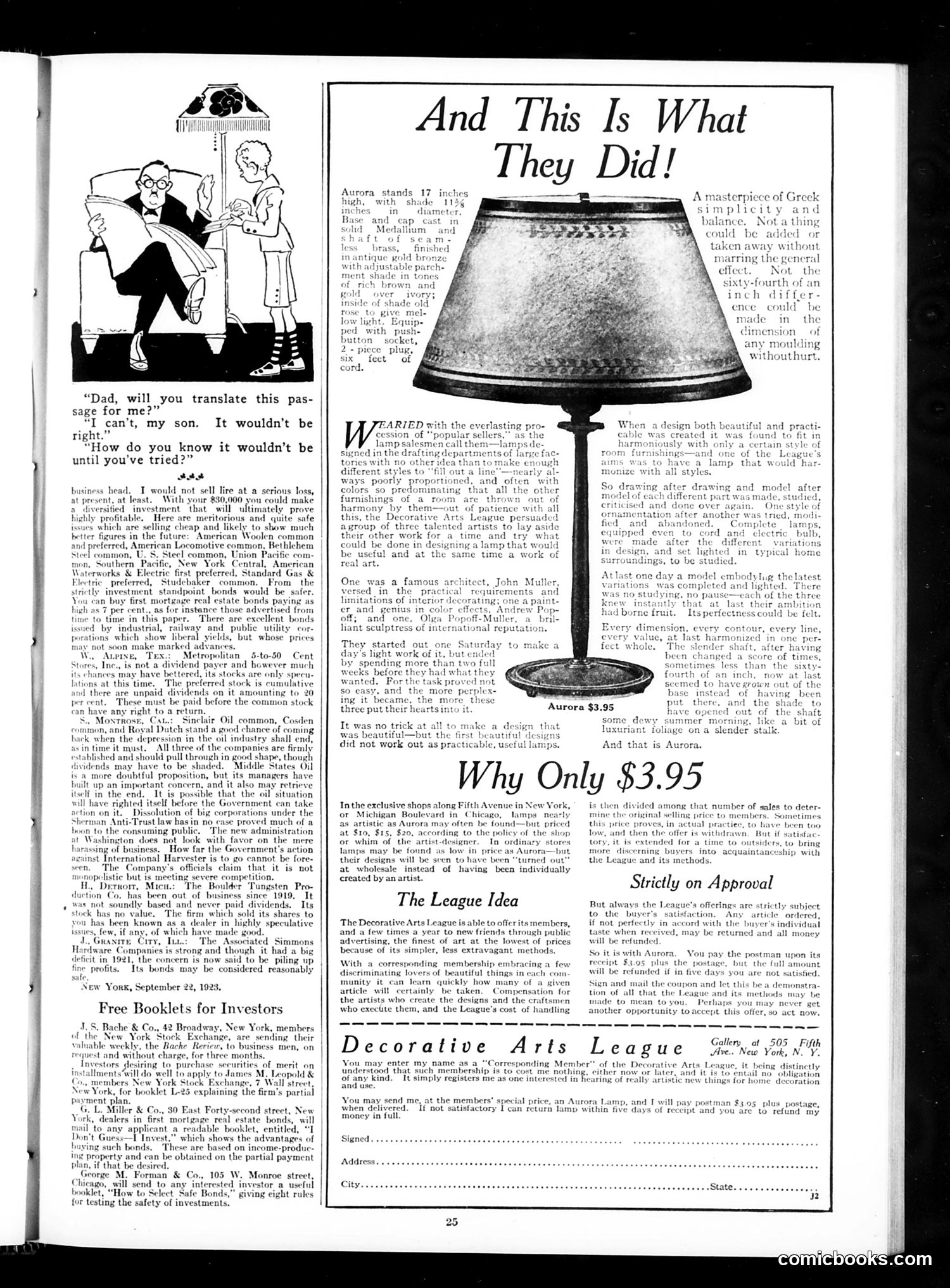
This page combines satire with financial advice, typical of Judge's 1920s content. **The Cartoon (top left):** Shows a father unable to translate a passage for his son, admitting ignorance rather than attempting it. The joke satirizes parental authority—the father can't claim expertise he lacks, undercutting the traditional paternal role. **The Main Content:** Dominates the page with an advertisement for an "Aurora" lamp priced at $3.95, pitched as a masterpiece of Greek simplicity. The accompanying text emphasizes its elegant design and the exclusivity of the Decorative Arts League, which sells such items to members at special prices. **The Financial Advice Column:** Addresses reader letters about stock investments during the 1923 economic period, offering practical guidance on bonds, industrial stocks, and speculative securities—reflecting post-WWI financial uncertainty. **The Satire:** Implicit—while promoting aesthetic goods and investment opportunities, Judge subtly critiques American consumer culture and the aspirational marketing targeting middle-class readers seeking both beauty and financial security during uncertain economic times.
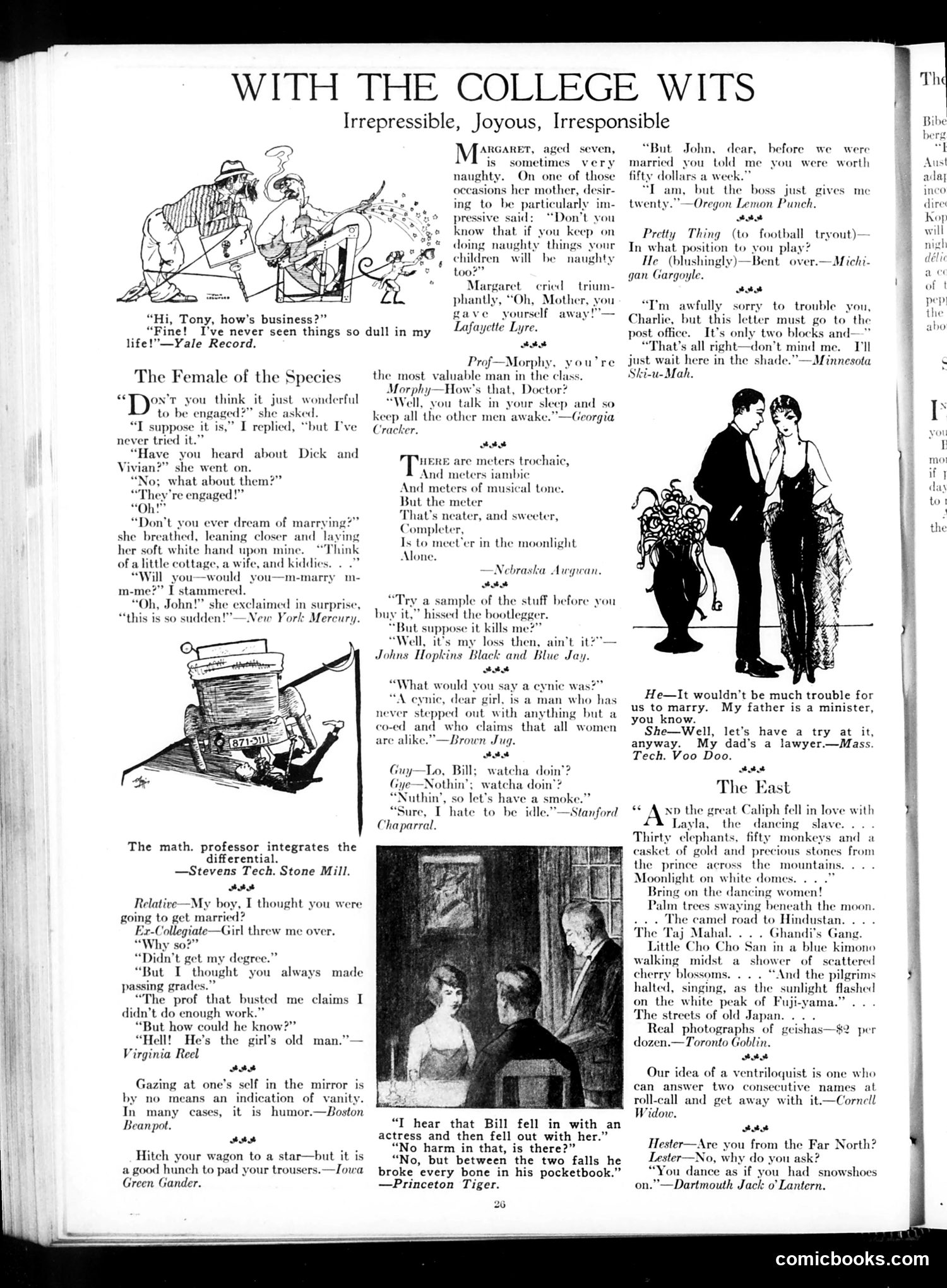
This page collects humorous anecdotes and verse from college humor magazines (Yale Record, Georgia Cracker, Nebraska Awgwan, etc.), targeting early-20th-century college life and dating customs. **Main satirical targets:** - **Young women's marriage schemes**: Multiple jokes mock females pursuing engagement and marriage, portraying them as calculating ("this is so sudden!"). - **Academic pretense**: Professors and students are depicted as incompetent or lazy; a math professor "integrates the differential" while sleeping students struggle. - **Bootlegging**: References to illegal alcohol sales ("bootlegger," "sample of stuff") reflect Prohibition-era concerns. - **Social climbing and courtship**: The cartoon and anecdotes ridicule awkward romantic interactions and class anxieties (a minister's son versus a lawyer's daughter). The humor is gentle mockery of collegiate life—emphasizing youth's irresponsibility, dating confusion, and academic failures. The tone is nostalgic rather than sharply critical, celebrating college as a space of youthful folly.
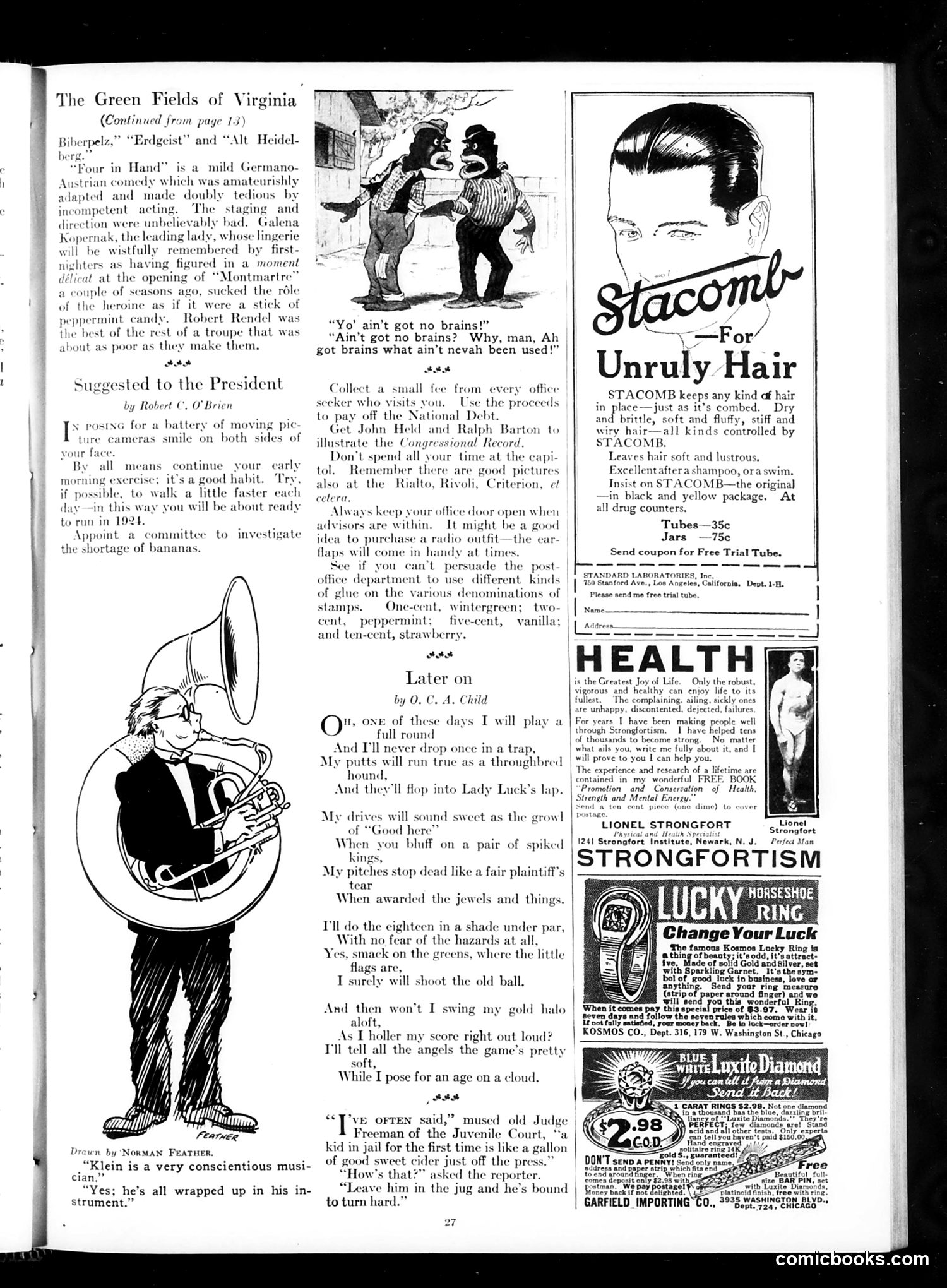
This page contains several distinct elements: **The main cartoon** (top left) depicts two African American men in dialect-heavy conversation—one accusing the other of having "no brains," to which the other responds he has brains "what ain't nevah been used." This reflects the racist caricature and minstrel-show humor common in 1920s American satire. **"Suggested to the President"** is a humorous advice column mocking President Coolidge's administration (the 1924 reference dates this). It includes absurdist suggestions like collecting fees from office visitors to pay the national debt and using different-flavored glues on postage stamps. **"Later on"** is a golf poem about eventual mastery of the sport. **The remaining content** is primarily **advertising** for hair product Stacomb, a health/strength institute (Strongfortism), and jewelry/lucky rings—typical 1920s product pitches. The page exemplifies Judge's mix of political satire, ethnic humor (offensive by modern standards), and commercial advertising typical of the era.
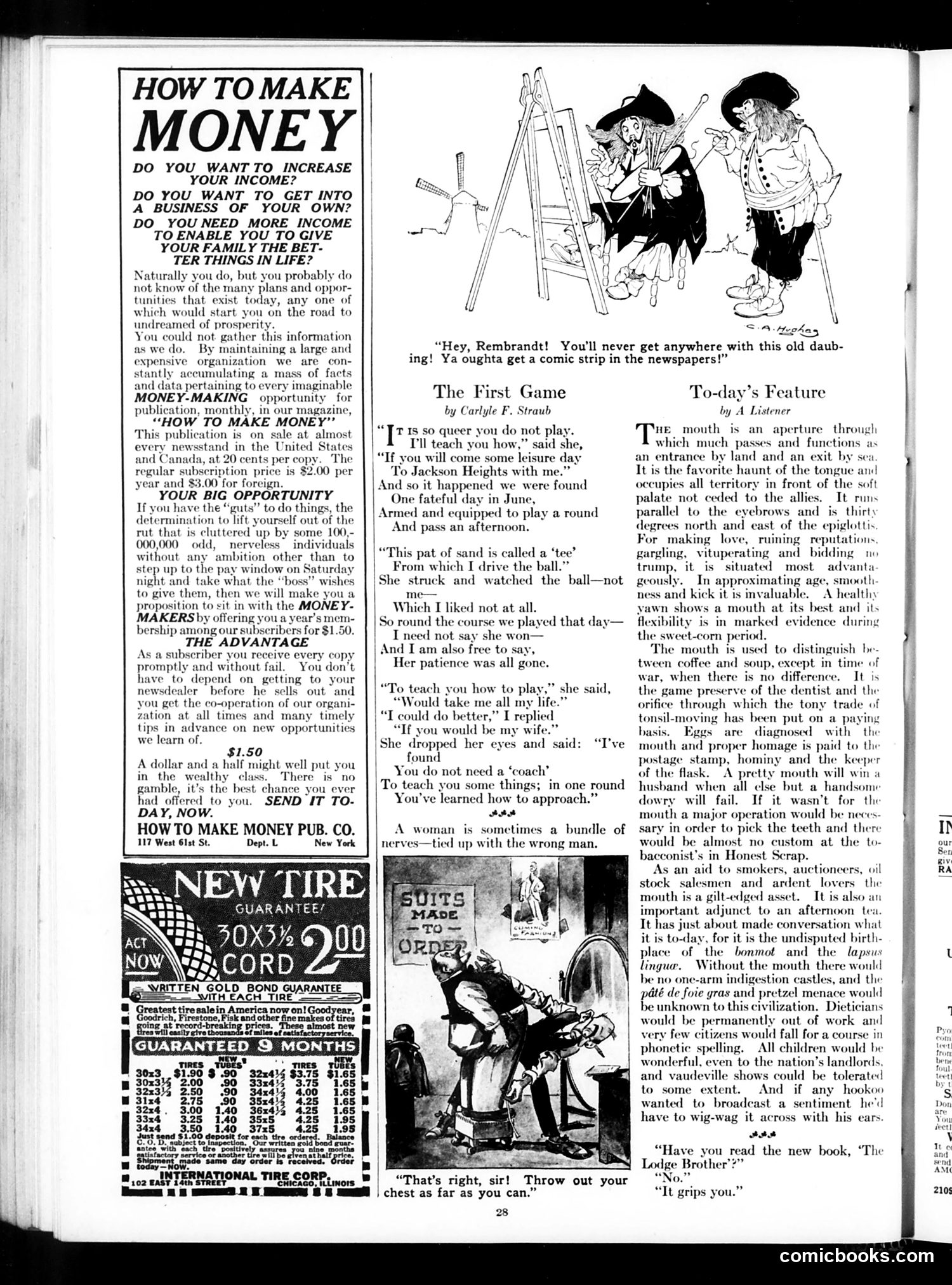
This page from Judge magazine contains several satirical elements: **"How to Make Money" Advertisement**: A self-promotional piece selling subscriptions to a magazine promising readers financial opportunities. The satirical point is transparent: Judge itself is profiting by selling the dream of wealth to working-class readers ("100,000,000 odd, nerveless individuals") stuck in dead-end jobs, charging $1.50 for supposedly exclusive money-making secrets. **Top Cartoon**: Two figures (appearing to be artists or bohemians) mock a third for pursuing traditional art ("old daubing"), urging him toward commercial success in newspaper comics—itself satirizing the tension between "high art" and profitable commercial work. **"The First Game" and "To-day's Feature"**: Humorous sketches about courtship/romance and anatomical description of the mouth, representative of Judge's typical light satirical humor. **Tire Advertisement**: Standard commercial advertising. The overarching satire targets get-rich-quick schemes and the exploitation of working-class desperation.
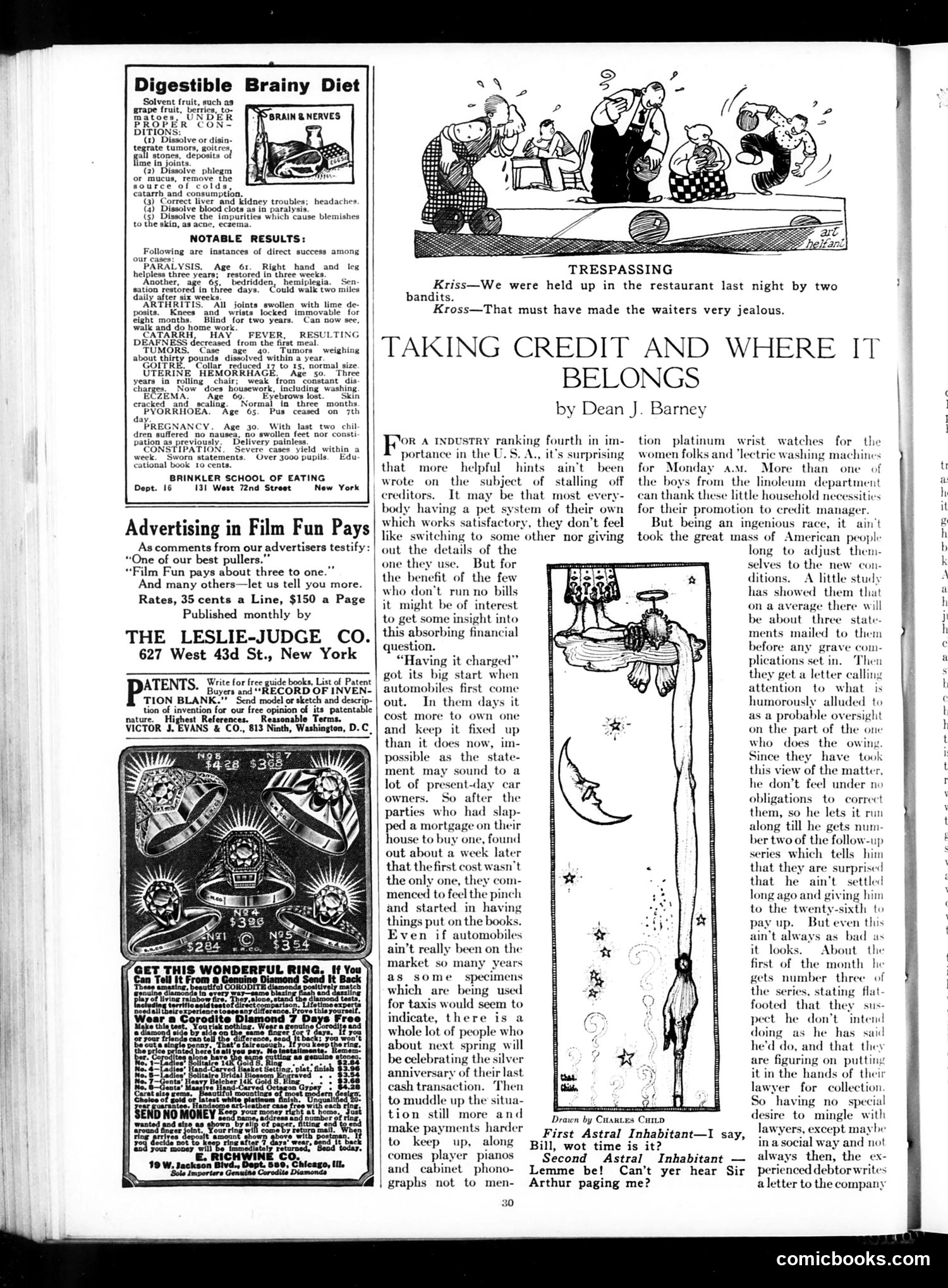
This page contains mixed content from *Judge* magazine. The dominant feature is a small cartoon titled "TRESPASSING" (top right)—a brief joke where one character tells another they were held up by bandits at a restaurant, and the response is that the waiters must be jealous. The humor is darkly satirical: waiters, who depend on tips and customer goodwill, would theoretically "prefer" robbery to losing customers. The main article, "Taking Credit and Where It Belongs" by Dean J. Barney, discusses the cultural practice of "charging" purchases rather than paying cash—a system that apparently emerged with the automobile industry. The piece satirizes how Americans rationalized debt and installment buying as normal financial practice. The page also contains period advertisements, including one for the Brinkler School of Eating (promoting dietary healing) and patent-related services—typical of early 20th-century magazine content. The satirical thrust targets American consumerism and credit dependency as an emerging social problem.
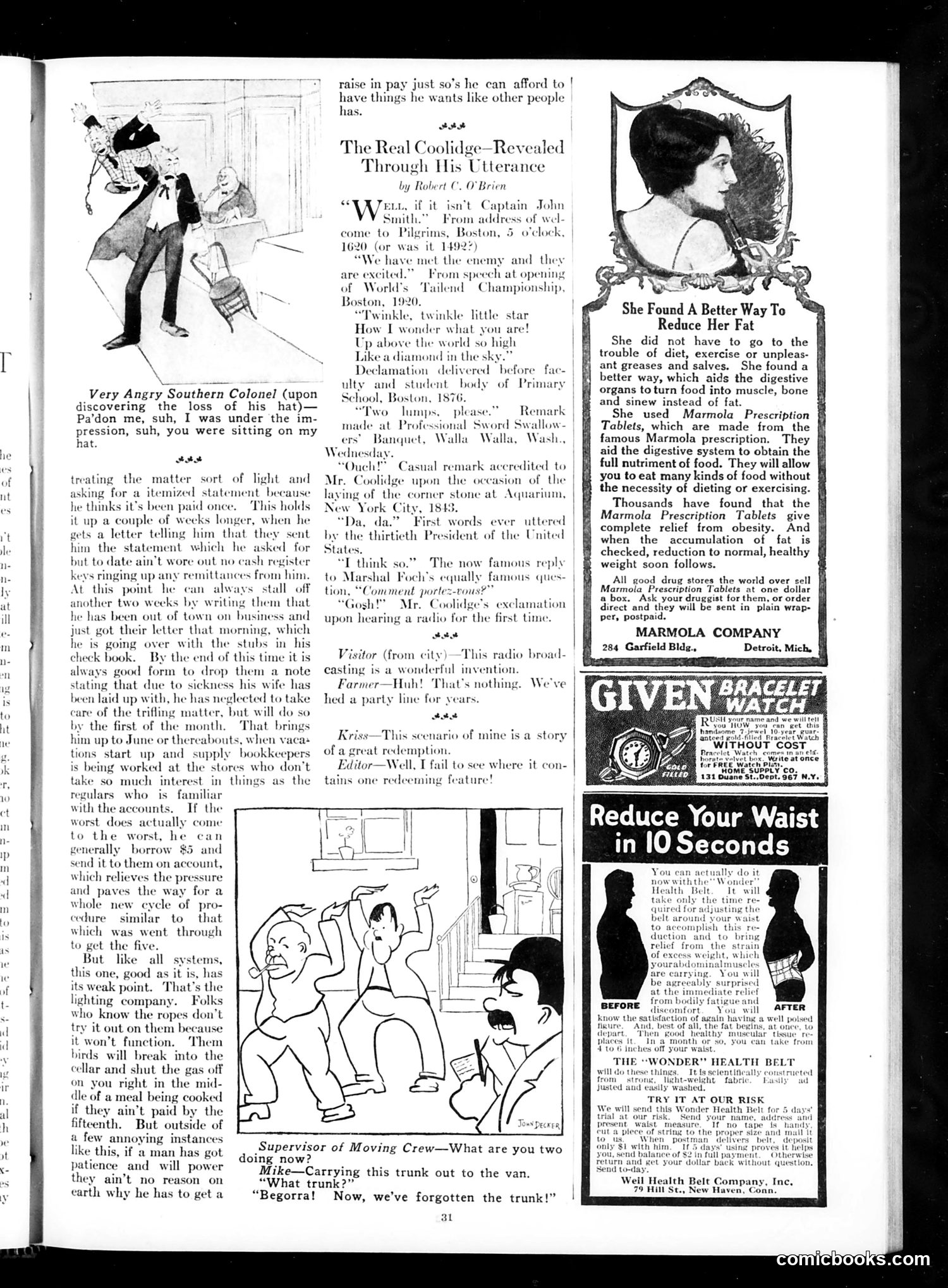
This page from Judge (circa 1920s) contains several satirical pieces: **"Very Angry Southern Colonel"**: A brief joke depicting a stereotypical Southern gentleman discovering someone sat on his hat. The humor relies on exaggerated dialect and the absurdity of the formal complaint. **"The Real Coolidge—Revealed Through His Utterance"**: Political satire mocking President Calvin Coolidge's famous taciturnity (quiet demeanor). The piece attributes banal, obvious, or nonsensical quotes to him—"I think so," "Gosh!"—satirizing his reputation for brief, unmemorable public statements. This was a common joke about Coolidge's laconic personality. **"Supervisor of Moving Crew"**: A brief visual gag about absent-mindedness, where workers forget what they're carrying mid-task. The page is largely advertising space (Marmola weight-loss tablets, waist-reduction devices, bracelet watches), typical of Judge's revenue model. The cartoons mock contemporary figures and social foibles rather than addressing specific political issues.
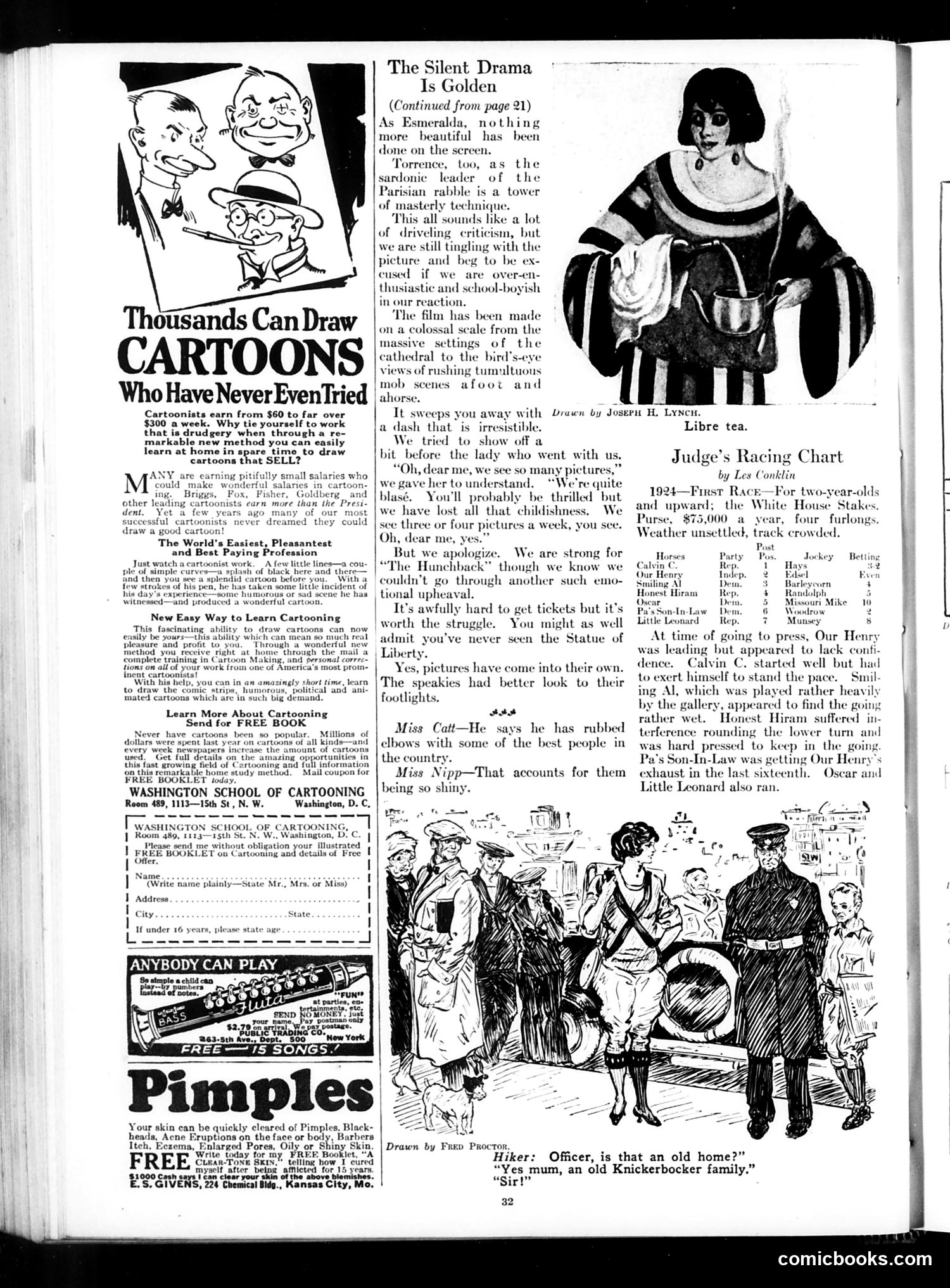
This page mixes editorial content about silent film with advertisements and a political cartoon disguised as a "racing chart." **Main Content:** A film review praising "The Hunchback of Notre Dame" (likely the 1923 Lon Chaney version), calling it a masterpiece of silent cinema. The reviewer, trying to appear sophisticated before his date, admits being moved despite his affected blasé attitude. **Political Satire:** The "Judge's Racing Chart" is a mock horse-racing prediction treating political figures as racehorses: Calvin Coolidge (Republican), "Our Henry" (likely Henry Ford), and Woodrow Wilson among others. The satirical intent is unclear from image alone, but appears to mock contemporary political figures by reducing them to sporting competition—a common Judge magazine tactic. **Advertisements:** The page also advertises cartooning correspondence courses and skin-care products, typical of 1920s magazine content. The humor relies on readers recognizing contemporary political figures and understanding the magazine's satirical voice.
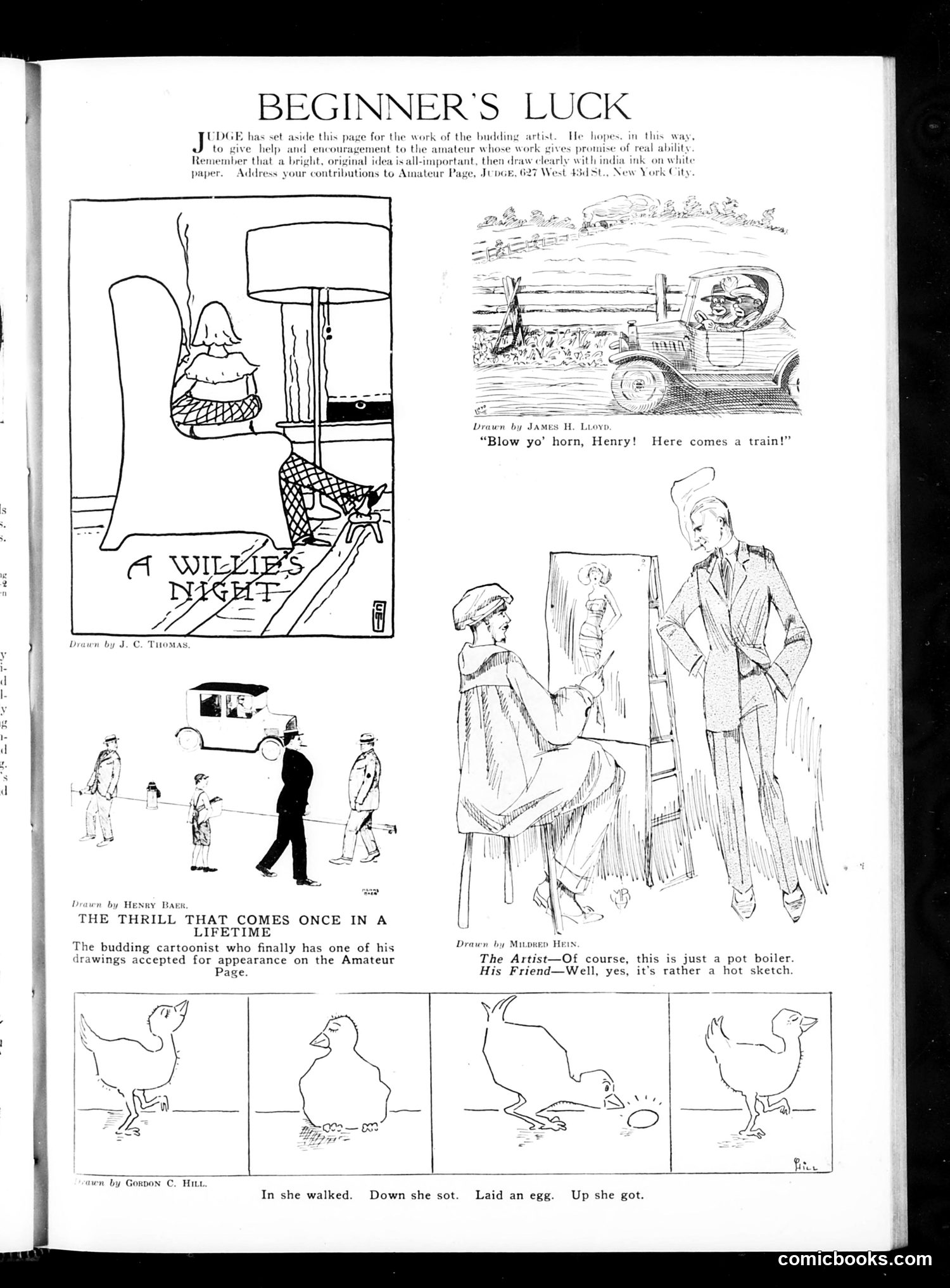
This is a **submissions page** showcasing amateur cartoonist contributions to Judge's "Amateur Page" feature. The page celebrates work from aspiring artists, presenting several cartoon strips and gags: 1. **"A Willie's Night"** (J.C. Thomas): A domestic scene with a couple and lamp—likely a simple domestic humor gag. 2. **"Blow yo' horn, Henry!"** (James H. Lloyd): Rural/folk humor with dialect, showing a car approaching a train crossing—the joke appears to be about comic timing or a near-miss. 3. **"The Thrill That Comes Once in a Lifetime"** (Henry Barr): Shows a man's excitement at finally having a cartoon accepted—self-referential humor about the amateur cartoonist's dream. 4. **"The Artist—Of course, this is just a pot boiler"** (Mildred Hein): A conversation between artist and friend about commercial versus serious work. 5. **Duck sequence** (Gordon C. Hill): A wordless four-panel strip showing a duck's simple actions ("walked," "sat," "laid an egg," "got up")—gentle absurdist humor. The page encourages amateur submissions, celebrating aspiring talent.
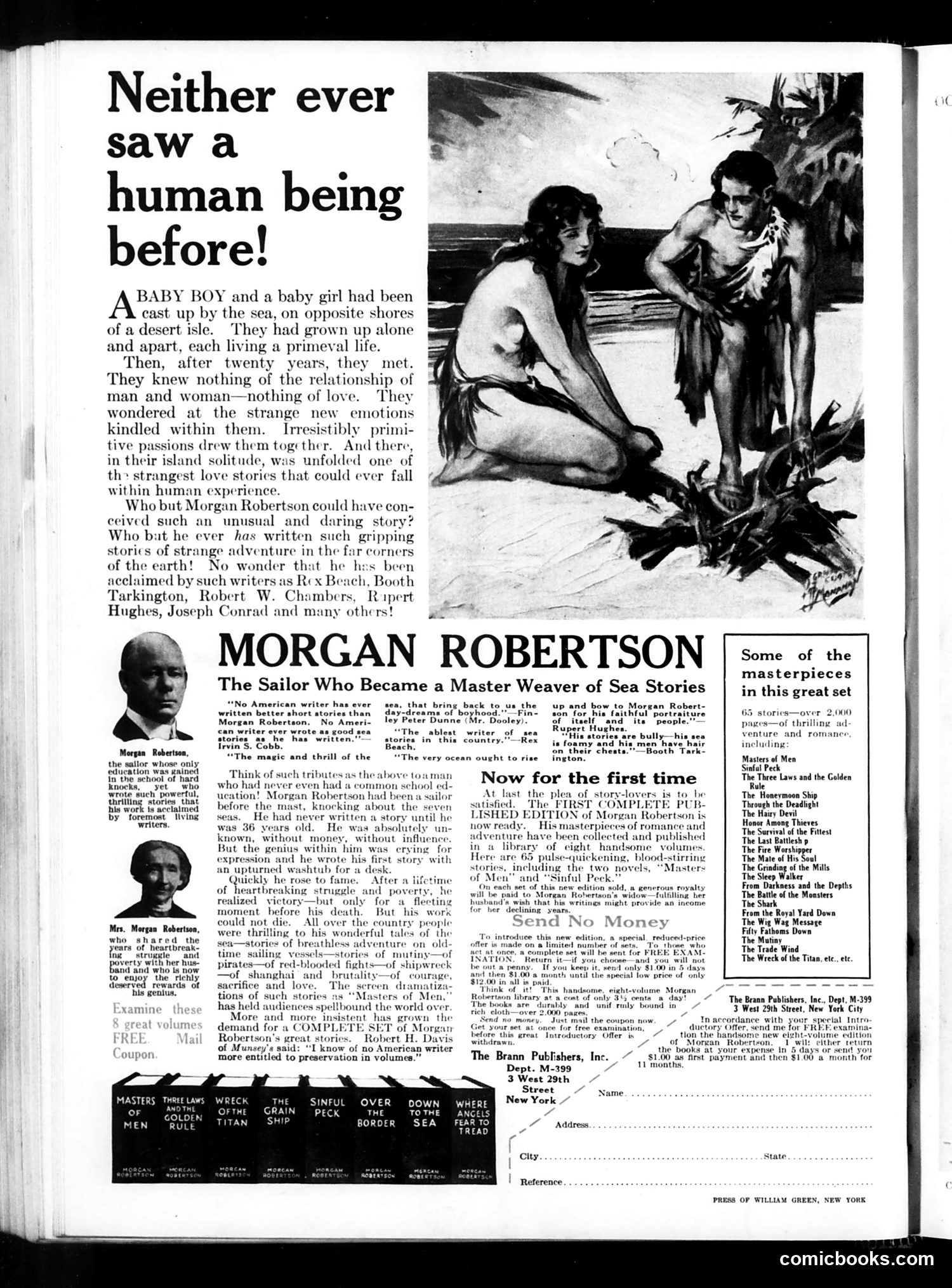
This page is primarily **advertising**, not satire or political commentary. It promotes a newly published complete edition of short stories by Morgan Robertson, a maritime adventure writer. The narrative frame at top—two island-raised youths meeting for the first time—is Robertson's actual story premise, presented to showcase his imaginative talents. The accompanying photographs show Robertson himself and his wife. The text includes genuine testimonials from celebrated contemporaries (Rex Beach, Booth Tarkington, Joseph Conrad), emphasizing Robertson's literary stature despite his humble beginnings as a sailor without formal education. The appeal is commercial: Judge's readers are invited to purchase the eight-volume set through a mail-order coupon, with flexible payment terms ("only 34 cents a day"). This represents typical early 20th-century periodical advertising strategy—leveraging the magazine's educated readership to sell premium book collections.