
Judge, 1923-09-29 · page 10 of 36
Judge — September 29, 1923 — page 10: what you’re looking at
What you’re looking at
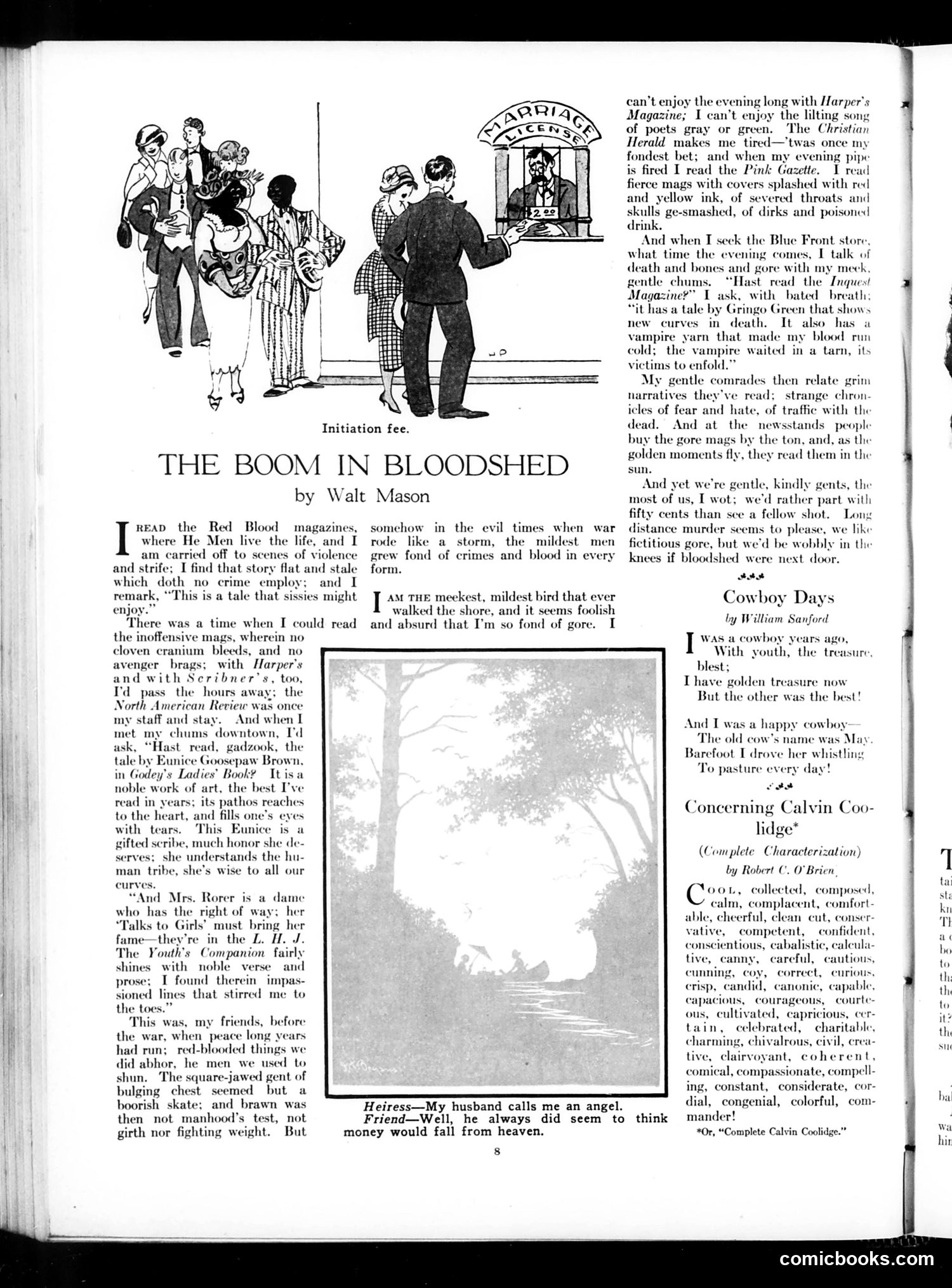
Walt Mason's poem satirizes how American magazine reading habits shifted dramatically due to World War I. Pre-war, readers enjoyed genteel publications like *Harper's*, *Scribner's*, and *The Youth's Companion*—magazines featuring moral tales and refined literature. The author presents himself as formerly content with such "inoffensive" fare. However, wartime transformed public taste. The poem's speaker now craves lurid "Red Blood magazines" featuring sensational crime, gore, and violence—"severed throats," "skulls ge-smashed," poisoned drink. Mason's irony cuts deep: these now-genteel readers who once scorned "square-jawed gents" now obsess over brutality. The joke's twist: despite their bloodlust for fictional gore, these same "gentle, kindly gents" remain squeamish about *actual* violence—they'd "rather part with fifty cents than see a fellow shot." Mason critiques the disconnect between wartime's desensitization to violence and lingering Victorian propriety.
📄 Transcribed text from this page (OCR, searchable)
Machine-transcribed from the original scan — historical spelling and the odd misread are preserved.
Initiation fee. THE BOOM IN BLOODSHED by Walt Mason where He Men live the life, and I am carried off to scenes of violence and strife; I find that story flat and stale which doth no crime employ; and I remark, “This is a tale that sissies might enjoy.” There was a time when I could read the inoffensive mags, wherein no cloven cranium bleeds, and no snger brags; with Harper's and with Scribner's, too, I'd pass the hours away: the North American Review was once my staff and stay. And when I met my chums downtown, I'd Hast . gadzook, the the Red Blood magazines, Eunice Goosepaw Brown. i * Book? Itisa t, the best I've ches 's Ladi read in y ts pathos to the heart, and fills one with tears. This Eunice gifted scribe, much honor she de- serves; she understands the hu- man tribe, she’s wise to all our curves. “And Mrs. Rorer is a dame who has the right of way; her alks to Girls’ must bring her fame—they’re in the L. H. J. The Youth's Companion fairly shines with noble verse and prose; I found therein impas- sioned lines that stirred me to the toes.” This was, my friends, before the war, when peace long years had run; red-blooded things we did abhor, he men we used to shun. The square-jawed gent of bulging chest seemed but a boorish skate; and brawn was then not manhood’s test, not girth nor fighting weight. But somehow in the evil times when war rode like a storm, the mildest men grew fond of crimes and blood in every form. I AM THE meekest, mildest bird that ever walked the shore, and it seems foolish and absurd that I’m so fond of gore. I Heiress—My husband calls me an angel. Friend—Well, he always did seem to think money would fall from heaven. 8 can’t enjoy the evening long with Harper's Magazine; I can’t enjoy the lilting song of poets gray or green. The Christian Herald makes me tired—twas once my fondest bet; and when my evening pipe is fired I read the Pink Gazette. I read fierce mags with covers splashed with red and yellow ink, of severed throats and skulls ge-smashed, of dirks and poisoned drink. And when T seck the Blue Front store, what time the evening comes, I talk of th and bones and gore with my meek gentle chu “Hast read the Inquest Magazine?” 1 ask, with bated breath: “it has a tale by Gringo Green that shows new curves in death. It also has a ampire n that made my blood run ; the vampire waited in a tarn, its victims to enfold.” My gentle comrades then relate grim ives they've read; strange chron s of fear and hate, of traffic with the And at the newsstands peopl the gore mags by the ton, and, as the golden moments fly, they read them in the sun. And yet we're gentle, kindly gents, the most of us, I wot; we'd rather part with fifty cents than see a fellow shot. Long distance murder scems to please, we lik« is gore, but we'd be wobbly in the if bloodshed were next door. ree Cowboy Days by William Sanford I WAS a cowboy years a With youth, the blest; Thave golden treasure now But the other was the best! And Twas a happy cowboy The old cow’s name was May Barefoot I drove her whistling To pasture every day! an Concerning Calvin Coo- lidge* (Complete Characterization) by Robert (. O° Brien Cees collected, compose alm, complacent, comfort- able, cheerful, clean cut, conser: vative, competent, confident, conscientious, cabalisti cul yy Ct + curious, crisp, candid, canonic, capab capacious, Courageous, court ous, cultivated, capricious, cer- tain, celebrated, charitable, ming, chivalrous, civil, crea- clairvoyant, coherent, , compassionate, compell- ing, constant, considerate, cor- dial, congenial, colorful, com- mander! *Or, “Complete Calvin Coolidge.” tiv com comicbooks.com ta a bo to th; th to it? th wa hin