
Judge, 1923-09-29 · page 24 of 36
Judge — September 29, 1923 — page 24: what you’re looking at
What you’re looking at
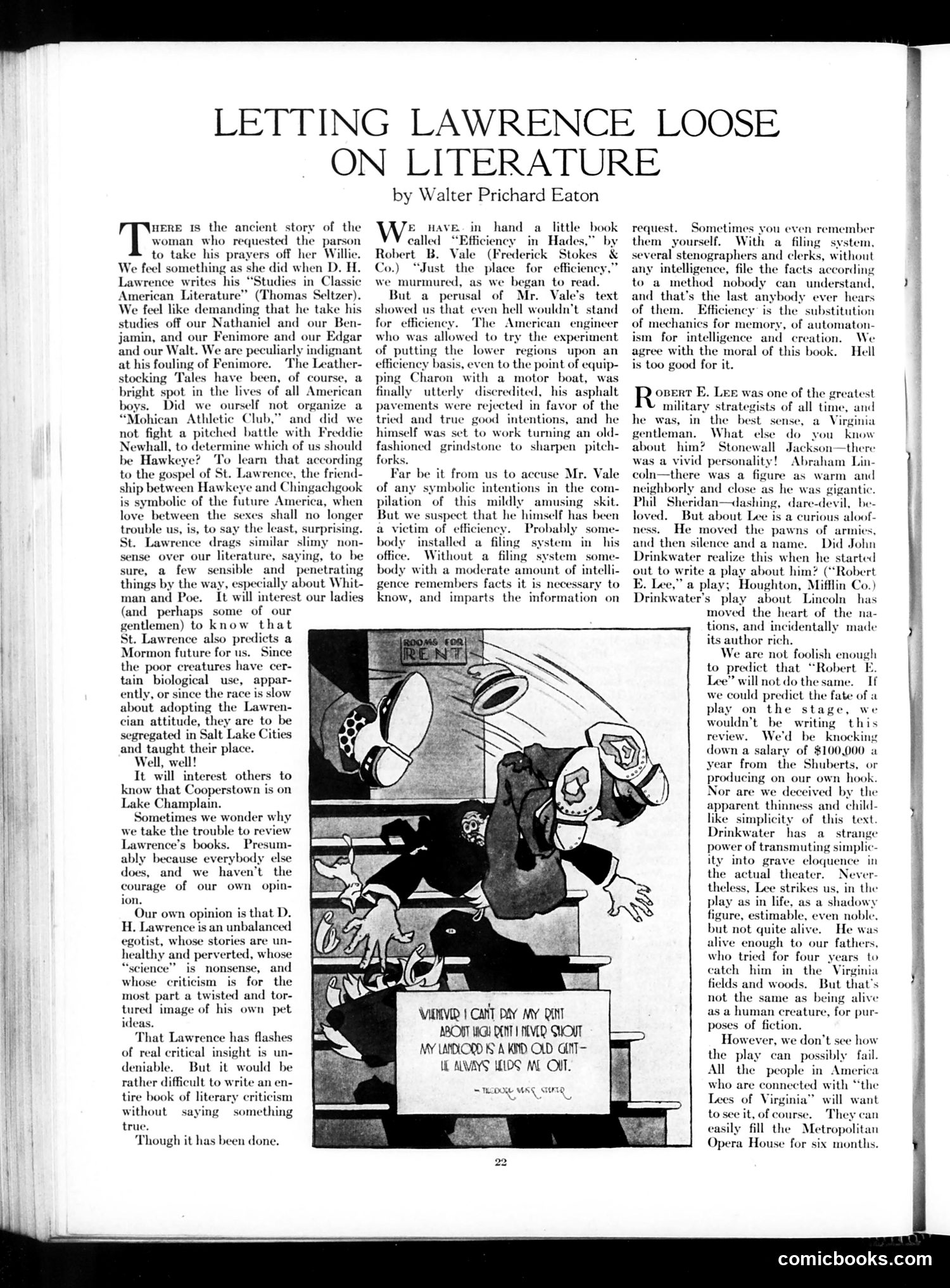
This 1920s satirical piece critiques British author D.H. Lawrence's literary analysis in *Studies in Classic American Literature*. The author Walter Prichard Eaton accuses Lawrence of perverting interpretations of American classics—particularly James Fenimore Cooper's *Leatherstocking Tales*—by imposing his own ideological obsessions onto the texts. The cartoon illustrates this complaint through a caricatured figure (representing Lawrence) forcibly "fouling" American literature. Eaton objects specifically to Lawrence's claim that Hawkeye and Chingachgook's friendship symbolizes a future America without sexual division—reading homosexual subtext into innocent adventure fiction. The piece also mocks Lawrence's prediction of Mormon futures for America. The secondary item about "Efficiency in Hades" uses similar logic: efficiency systems paradoxically destroy understanding by replacing human memory and judgment with mechanical filing systems that no one can navigate. The satire targets intellectual pretension and over-interpretation masquerading as literary criticism.
📄 Transcribed text from this page (OCR, searchable)
Machine-transcribed from the original scan — historical spelling and the odd misread are preserved.
LETTING LAWRENCE LOOSE ON LITERATURE HERE 18 the ancient story of the woman who requested the parson to take his prayers off her Willie. We feel something as she did when D. H. Lawrence writes his “Studies in Classic American Literature” (Thomas Seltzer). We feel like demanding that he take his studies off our Nathaniel and our Ben- jamin, and our Fenimore and our Edgar and our Walt. We are peculiarly indignant at his fouling of Fenimore. The Leather- stocking Tales have been, of course, a bright spot in the lives of all American boys. Did we ourself not organize a Tohican Athletic Club,” and did we not fight a pitched battle with Freddie Newhall, to dete ermine which of us should be Hawkeye? To learn that according to the gospel “Stl wrence, the friend- ship between Hawkeye and Chingachgook mbolic of the future America, when > between the sexes shall no longer trouble us, is, to say the least, surprising. St. Lawrence drags similar slimy non- sense over our literature, saying, to be sure, a few sensible and penetrating things by the especially about Whit- man and Poe. It will interest our ladies (and perhaps some of our gentlemen) to know that St. Lawrence also predicts a Mormon future for us. Since the poor creatures have cer- tain biological use, appar- ently, or since the is slow about adopting the Lawren- cian attitude, they are to be segregated in Salt Lake Cities and taught their place. Well, well! It will interest others to know that Cooperstown is on Lake Champlair Sometimes we wonder why we take the trouble to review Lawrence’s books. Presum- ably because everybody else does, and we haven't the courage of our own opin- ion. Our own opinion is that D. H. Lawrence is an unbalanced egotist, whose stories are un- lo Ithy and perverted, whose “scienc is nonsense, and whose criticism is for the most part a twisted and tor- tured image of his own pet ideas. That Lawrence has flashes of real critical insight is un- deniable. But it would be rather difficult to write an en- tire book of literary criticism without saying something true. ‘Though it has been done. by Walter Prichard Eaton Ws HAVE. in hand a_ little book called “Efficiency in Hades,” by Robert B. Vale (Frederick Stoke a Co.) “Just the place for efficienc we murmured, as we began to read But a perusal of Mr. Val showed us that even hell wouldn't: stand for efficiency. The American engineer who was allowed to try the experiment of putting the lower Tegions upon an efficiency basis, even to the point of equip- ping Charon with a motor boat, was finally utterly discredited, his asphalt pavements were rejected in favor of the tried and true good intentions, and he himself was set to work turning an old- fashioned grindstone to sharpen pitch- forks. Far be it from us to accuse Mr. Vale of any symbolic intentions in the cor pilation of this mildly amusing But we suspect that he himself has text a victim of efficienc Prol body installed a_fili system offi Without a filing system som body with a modcrate amount of intelli- gence remembers facts it is necessary to know, and imparts the information on MY LANDLORD S A KD OLD GIIT- WL ALWAYS LOS ML ONT. TODO MING SUR request. Sometimes you even remember them yourself. With a filing system, several stenographers and clerks, without any intelligence, file the facts according toa method nobody can understand, and that’s th vody ever hears of them. Effi s the substitution of mechanics for memory, of automaton- ism for intelligence and creation. We agree with the moral of this book. Hell is too good for it. Reve E. 1 military str: was one of the greatest gists of all tin nd he was, in the best sense, a Virginia gentleman. What else do you know about him? Stonewall Jackson—there was a vivid personality! Abraham Lin- coln—there was a figure as warm and neighborly and close as he was gigantic. Phil Sheridan—dashing, dare-devil, be- loved. But about Lee is a curious aloof- ness. He moved the pawns of armies, and then silence and a name. Did John Drinkwater realize this when he started out to write a play about him? (“Robert E. Lee,” a play; Houghton, Mifflin Co.) Drinkwater's ‘play about Lincoln has moved the heart of the na- tions, and incidentally made its author rich. We are not foolish enough to predict that “Robert E. Lee” will not do the same. If we could predict the fate of a play on the stage, we wouldn’t be writing this review. We'd be knocking down a salary of $100,000 a year from the Shuberts, or producing on our own hook. Nor are we deceived by the apparent thinness and child- like simplicity of this text Drinkwater has a_ strar power of transmuting simplic ity into grave eloquence in the actual theater. Never- theless, Lee strikes us, in the play as in life, as a shadowy figure, estimable, even noble, but not quite al He was alive enough to our fathers, who tried for four years to catch him in the Virginia fields and woods. But that’s not the same as being alive as a human creature, for pur- poses of fiction. However, we don’t see how the play All the people in Ameri who are connected with “the Lees of Virginia” will want to see it, of course. They can easily fill the Metropolitan Opera House for six months. can possibly. fai } comicbooks.com