
Judge, 1923-09-29 · page 5 of 36
Judge — September 29, 1923 — page 5: what you’re looking at
What you’re looking at
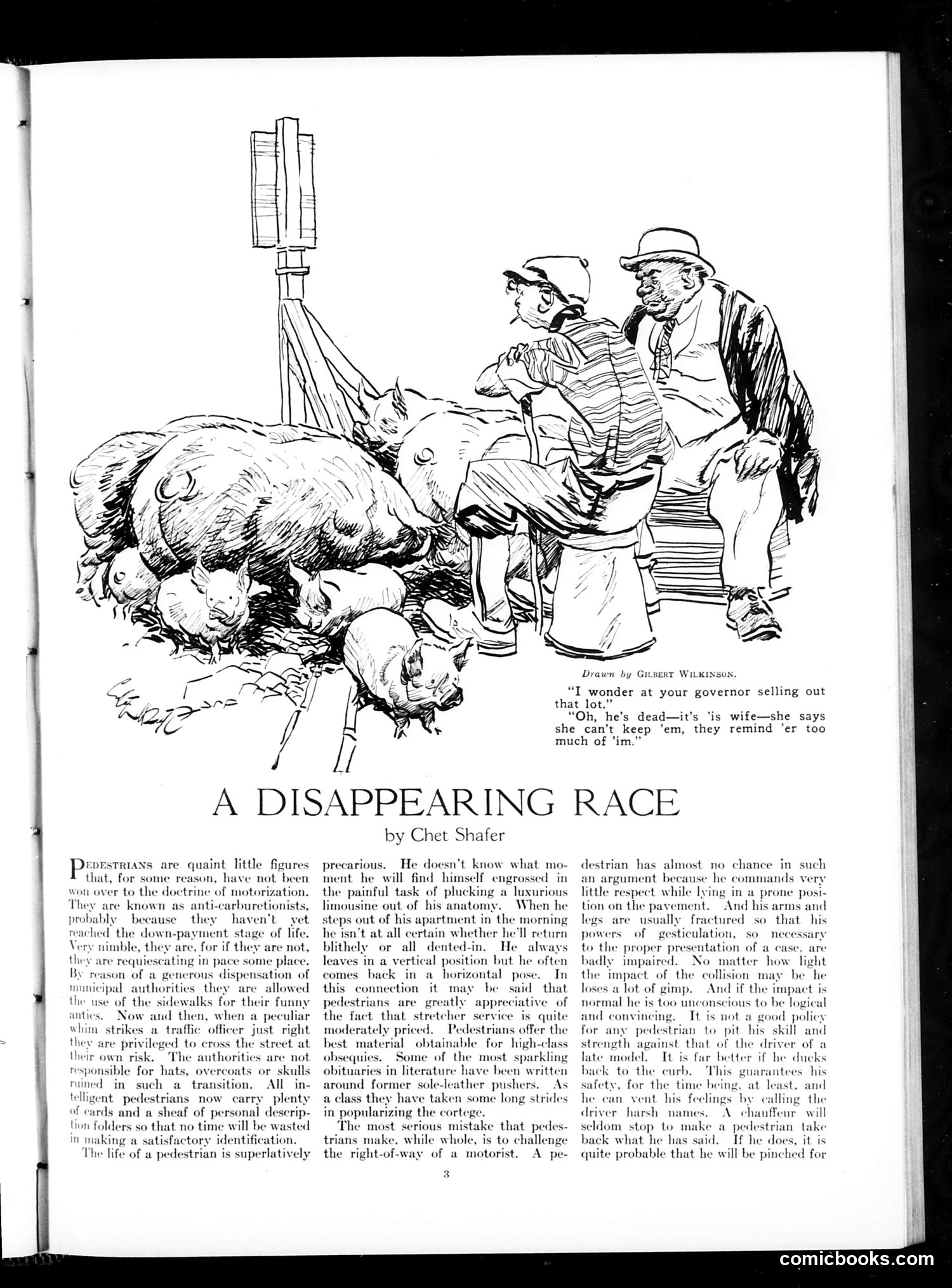
This article satirizes pedestrians' apparent extinction in early automobile culture. The illustration shows two men examining a dead pedestrian beneath a street lamp—a dark joke about traffic fatalities. The text argues that pedestrians, once dominant urban figures, are vanishing as motorists gain power and legal privilege. Shafer critiques how authorities favor drivers over pedestrians, allowing cars to dominate streets while pedestrians lose their traditional right-of-way. The piece notes pedestrians now carry identification cards and must follow strict rules, while drivers face minimal consequences. The satire highlights the dramatic social shift in early 20th-century cities: the automobile's arrival reversed street hierarchy, endangering and subordinating pedestrians who previously commanded public space. The "disappearing race" is humanity itself—literally killed by progress.
📄 Transcribed text from this page (OCR, searchable)
Machine-transcribed from the original scan — historical spelling and the odd misread are preserved.
Drawn by GILBERT WILKINSON. “IT wonder at your governor selling out that_lot.” “Oh, he’s dead—it’s ‘is wife—she says she can’t keep ‘em, they remind ’er too much of ’im.” by Chet Shafer DEDESTRIANS are quaint little figures precarious. He doesn’t know what mo- destrian has almost no chance in such that, for some reason, have not been ment he will find himself engrossed in an argument because he commands very won over to the doctrine of motorization. the painful task of plucking a luxurious little respect while lying in a prone posi- They are known as anti-carburetionists, limousine out of his anatomy. When he tion on the pavement. And his arms and probably because they haven't yet — steps out of his artment in the morning legs are usually fractured so that his reached the down-payment stage of life. he isn’t at all certain whether he'll return powers of — gesticulation, so necessary Very nimble, the . for if they are not, blithely or all dented-in. He always to the proper pr r they are requiescating in pace some place. leaves in a vertical position but he often badly impai By reason of a generous dispensation of comes back in a horizontal pose. In the impact o municipal authorities they are allowed this connection it may be said that loses a lot of gimp. And if the impact is the use of the sidewalks for their funny ns are greatly appreciative of normal he is too unconscious to be logical antics. Now and then, when a peculiar t that stretcher service is quite and convincing. It is not a good policy whim strikes a traffic officer just right moderately priced. 1 rians offer the for any pedestrian to pit his skill and they are privileged to cross the street at best materi obtainable for high-class strength against that of the driver of a their own risk. The authorities are not obsequies. Some of the most sparkling late modc Tt is far better if he ducks responsible for hats, overcoats or skulls obituaries in literature have been written back to the curb. ‘This guarantees his ruined in such a transition. All in- around former sole-leather pushers. As safety, for the time being, at least, and telligent. pedestrians now carry plenty a class they have taken some long strides he can vent his feelings by calling the of cards and a sheaf of personal descrip- in popularizing the cort driver harsh names. A ch itation of a case. are . No matter how light the collision may be he ir will lion folders so that no time will be wasted The most serious mistake that pedes- seldom stop to ma a pedestrian take n making a satisfactory identification. trians make, while whole, is to challenge back what he has said. If he does, it is The life of a pedestrian is superlatively the right-of-way of a motorist. A pe- quite probable that he will be pinched for 3 comicbooks.com