
Judge, 1923-09-29 · page 15 of 36
Judge — September 29, 1923 — page 15: what you’re looking at
What you’re looking at
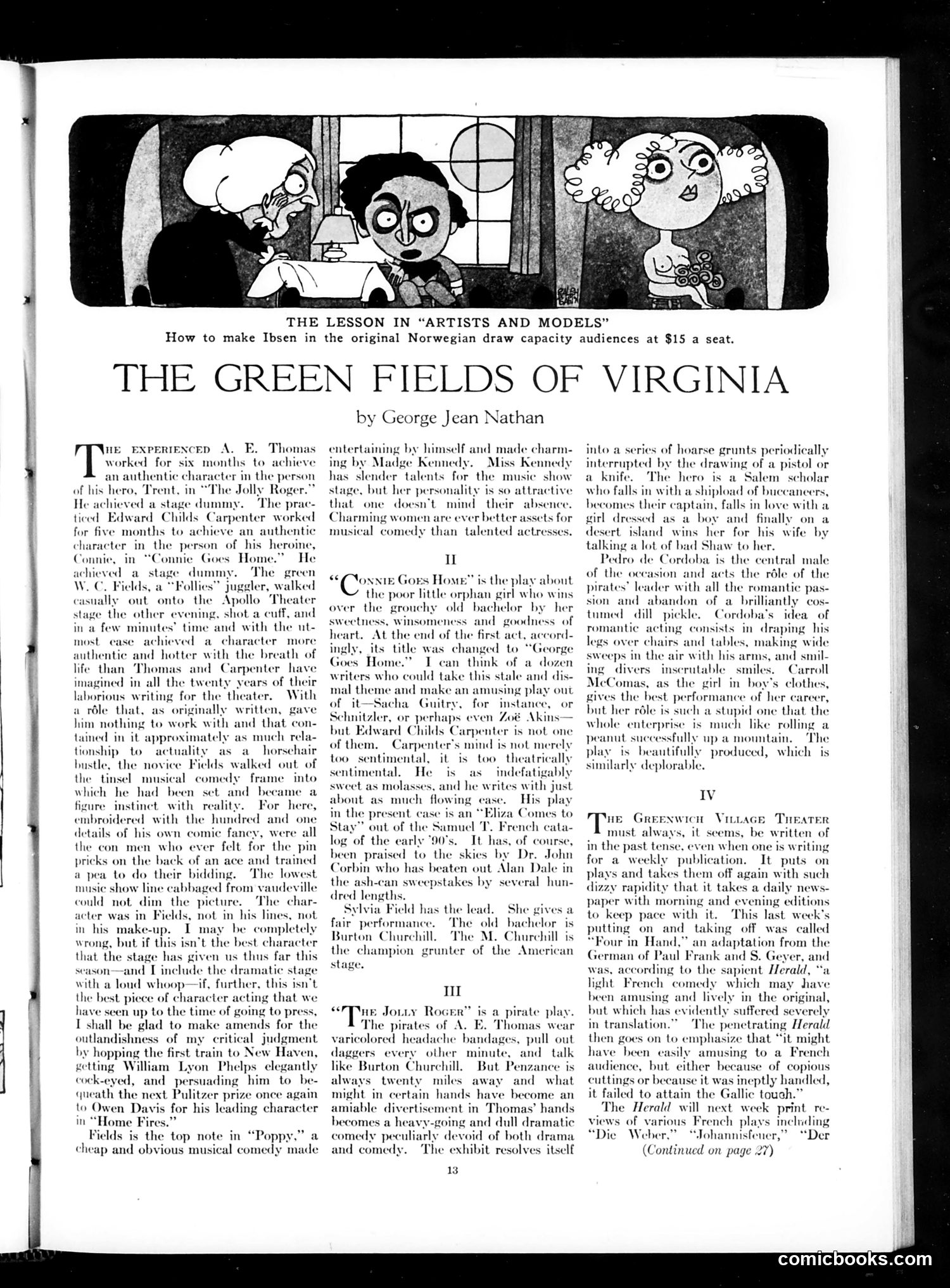
The top cartoon is a satirical jab at Henrik Ibsen adaptations. It shows exaggerated caricatures apparently mocking how producers were marketing serious Norwegian drama ("Ibsen in the original Norwegian") to American audiences willing to pay premium prices ($15 a seat) — suggesting the appeal relied on pretense or novelty rather than genuine artistic merit. The main article by George Jean Nathan is a theater review praising W.C. Fields's performance in the musical comedy "Poppy," contrasting his genuine character work against professional dramatists who produced wooden stage "dummies." Nathan argues Fields, despite playing a con man in a "cheap and obvious" show, demonstrated superior acting craft through authentic detail and personality — a critique suggesting theatrical seriousness doesn't guarantee quality performance.
📄 Transcribed text from this page (OCR, searchable)
Machine-transcribed from the original scan — historical spelling and the odd misread are preserved.
ee SL NT THE LESSON IN “ARTISTS AND MODELS” How to make Ibsen in the original Norwegian draw capacity audiences at $15 a seat. THE GREEN FIELDS OF VIRGINIA HE EXPERIENCED A. E. Thomas | worked for six months to achieve an authentic character in the person of his hero, Trent, in “The Jolly Roger.” He achieved a stage dummy. The prac- ticed Edward Childs Carpenter worked for five months to achieve an authentic character in the person of his heroine, Connie, in “Connie Goes Home.” He achieved a stage dummy. The green W. C. Fields, a “Follies” juggler, walked ally out onto the Apollo Theater the other evening, shot a cuff, and in a few minutes’ time and with the ut- most achieved a character) more authentic and hotter with the breath of life than ‘Thomas and Carpenter have imagined in all the twenty years of their laborious writing for the theater. With a réle that, as originally written, gave him nothing to work with and that ¢ tained in it approximately as much rela- tionship to. actuality as a_ horsehair bustle, the novice Fields walked out of the tinsel musical comedy frame into which he had t nd became a figure instinet with reality. For here, embroidered with the hundred and one details of his own comic fancy, were all the con men who ever felt for the pin pricks on the back of an ace and trained a pea to do their bidding. The lowest music show line cabbaged from vaudeville could not dim the picture. The char- acter was in Fields, not in his lines, not in his make-up. I may be completely wrong, but if this isn’t the best character that the stage has given us thus far this and [ include the dramatic stage with a loud whoop—if, further, this isn’t the best piece of character acting that we lave seen up to the time of going to press, I shall be glad to make amends for the outlandishness of my critical judgment by hopping the first train to New Haven, getting William Lyon Phelps elegantly ved, and persuading him to. be- r prize once again to Owen Davis for his leading character in “Home Fires.” Fields is the top note in “Poppy.” a cheap and obvious musical comedy made cast ease set season by George Jean Nathan entertaining by: himself and made charm- ing by Madge Kennedy. Miss Kennedy has slender talents for the musie show stage, but her personality is so attractive that doesn’t mind their absence. Charming women are ever better assets for musical comedy than talented actresses, one Il * Cossie Gors Howe” is the play about the poor little orphan girl who wins over the grouchy old bachelor by her sweetness, winsomeness and goodness of heart. At the end of the first ac ingly, its title was changed to “George Goes Home.” IT can think of a dozen writers who could take this stale and dis- mal theme and make an amusing play out of it—Sacha Guitry, for instance, or Schnitzler, or perhaps even Akins— but Edward Childs Carpenter is not one of them, Carpenter's mind is not merely too sentimental, it is too theatrically sentimental, He is as — indefatigably sweet as molasses, and he writes with just about as much flowing ease. His play in the present case is an “Eliza Comes to Stay” out of the Samuel T. French cata- log of the early “90's. It has, of course, been praised to the skies by Dr. John Corbin who has beaten out Alan Dale in the ash-can sweepstakes by several hun- dred lengths. Sylvia Field has the lead. She gives a fair performance. ‘The old bachelor. is Burton Churchill. The M. Churchill is the champion grunter of the American stage. accord. II “Pune Jouny Roct a pirate play. Tie pirates of : Thomas wear varicolored headache bandages, pull out daggers every other minute, and talk like Burton Churchill. But Penzance is always twenty miles away and) what might in certain hands have become an amiable divertisement in ‘Thomas’ hands becomes a heavy-going and dull dramatic comedy peculiarly devoid of both drama and comedy. The exhibit resolves itself 13 into a series of hoarse grunts periodically interrupted by the drawing of a pistol or a knife. The hero is a Salem. scholar who falls in with a shipload of buccaneers, becomes their captain, falls in love with a girl dressed as a boy and finally on a desert island wins her for his wife by talking a lot of bad Shaw to her. Pedro de Cordoba is the central male of the oceasion and acts the réle of the pirates’ leader with all the romantic pas- sion and abandon of a brilliantly cos- tumed dill pickle. idea of romantic acting consists in draping his legs over chairs and tables, making wide sweeps in the air with his arms, and smil- ing divers inscrutable smiles. Carroll McComas, as the girl in boy's clothes, gives the hest performance of her carcer, but her réle is such a stupid one that the whole enterprise is much like rolling a peanut successfully up a mountain. The play is beautifully produced, which is similarly deplorable. Cordoba’s Iv T Greexwich Vittace Treater must always, it seems, be written of in the past tense. even when one is writing for a weekly publication. It puts on nd takes them off again with such y rapidity that it takes a daily news- paper with morning and evening editions to keep pace with it. This last week's putting on and taking off was called “Four in Hand,” an adaptation from the German of Paul Frank and S. Geyer, and was, according to the sapient Herald, “: light’ French comedy which may ha been amusing and lively in the original, but which has evidently suffered severely in translation.” The penetrating Herald then goes on to emphasize that “it might have been easily amusing to a French audience, but either because of copious cuttings or because it was ineptly handled, it failed to attain the Gallic touch.” The Herald will next week print re- ws of various French plays inelnding “Die Weber.” “Johannisfener,” “Der (Continued on page 27) comicbooks.com