
Judge, 1923-09-29 · page 21 of 36
Judge — September 29, 1923 — page 21: what you’re looking at
What you’re looking at
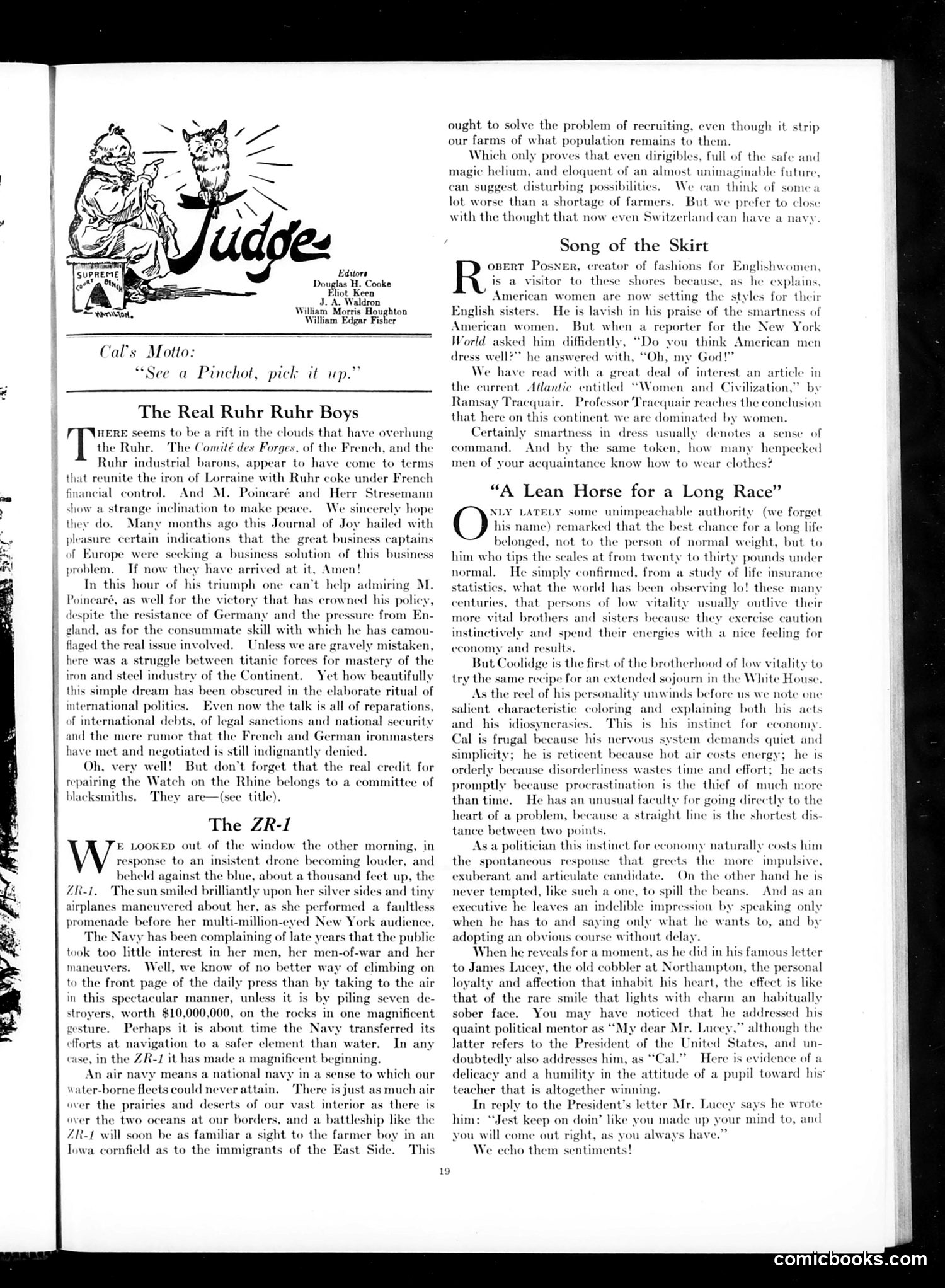
This page contains three distinct pieces of satirical commentary: **"The Real Ruhr Ruhr Boys"** mocks post-WWI industrial diplomacy. The "Ruhr Ruhr Boys" refers to French and German industrial leaders (the "Comité des Forges" and German iron/steel barons) negotiating control of the Ruhr region's resources. Judge sarcastically praises this "business solution" while cynically noting the real negotiations are obscured by diplomatic language about "reparations" and "national security." The title's pun ("Ruhr Ruhr") and reference to "blacksmiths" emphasize that industrial capitalists, not governments, are truly controlling post-war European politics. **"The ZR-1"** discusses the Navy's new rigid airship (likely the USS ZR-1, later the USS Shenandoah), which performed public demonstrations over New York. Judge sarcastically suggests the Navy is using spectacular aerial stunts to generate public interest and recruitment, while ironically noting this airship technology could eventually replace naval forces entirely—a somewhat dystopian technological commentary wrapped in humor. **"Song of the Skirt"** briefly notes Robert Posner, a British fashion designer, observing that American women now set fashion trends for English women.
📄 Transcribed text from this page (OCR, searchable)
Machine-transcribed from the original scan — historical spelling and the odd misread are preserved.
Douglas H. Cooke Eliot Keen J. A. Waldron William Morris Houghton William Edgar Fisher Cal's Motto: “See a Pinchot, pick it up.” The Real Ruhr Ruhr Boys HERE seems to be a rift in the clouds that have overhung the Ruhr. The Comité des Forges, of the French, and the Ruhr industrial barons, appear to have come to terms that reunite the iron of Lorraine with Ruhr coke under French financial control. And M. Poincaré and show a strange inclination to make peace. they do. Herr Stresemann We sincerely hope Many months ago this Journal of Joy hailed with pleasure certain indic vations that the great business captains of Europe were secking a business solution of this business problem. If now they have arrived at it, Amen! In this hour of his triumph one can’t help admiring M. J Poincaré, as well for the victory that has crowned his policy, despite the resistance of Germany and the pressure from En- gland, as for th flaged the real i » consummate skill with which he has camou- Unless we are gravely mistaken, here was a struggle between titanic forces for mastery of the iron and steel industry of the Continent. Yet how beautifully this simple dream has been obscured in the elaborate ritual of international politics. Even now the talk is all of reparations, of international debts, of legal sanctions and national security and the mere rumor that the French and German ironmasters have met and negotiated is still indignantly denied. Oh, very well! But don’t forget that the real credit for repairing the Watch on the Rhine belongs to a committee of blacksmiths. They are—(see title). The ZR-1 E LOOKED out of the window the other morning, in \ \ response to an insistent drone becoming louder, and beheld against the blue, about a thousand feet up, the ZR-1, The sun smiled brilliantly upon her silver sides and tiny airplanes maneuvered about her, as she performed a faultless promenade before her multi-million-eyed New York audience. The Navy has been complaining of late years that the public took too little interest in her men, her men-of-war and her Well, we know of no better way of climbing on to the front page of the daily press than by ng to the air in this spectacular manner, unless it is by piling seven de- stroyers, worth $10,000,000, on the rocks in one magnificent Perhaps it is about time the N efforts at na sue involved. maneuvers. gesture. vy transferred its er element than water. In any case, in the ZR-1 it has made a magnificent beginning. An air navy means a national navy water-borne fleets could never attain. in a sense to which our There is just as much air over the prairies and deserts of our vast interior as there is over the two oceans at our borders, and a battleship like the ZR-1 will soon be as familiar a sight to the farmer boy in an lowa cornfield as to the immigrants of the East Side. This ought to solve the problem of recruiting, even though it strip our farms of what population remains to them. Which only proves that even dirigibles, full of the safe and magic helium, and eloquent of an almost unimaginable future, can suggest disturbing possibilities. We can think of some a lot worse than a shortage of farmers. But we prefer to clos. with the thought that now even Switzerland can have a navy Song of the Skirt oBerT Posner, creator of fashions for Englishwomen, R is a visitor to these shores because, as he explains, American women are now setting the styles for their English sisters. He is lavish in his praise of the smartness of 1 women. But when a reporter for the New York World asked him diffidently, “Do you think American men dress well?” he answered with, “Oh, my God!” We have read with a great deal of interest an article in the current Atlantic entitled “Women and Civilization,” by Ramsay Tracquair. Professor Tracquair reaches the conclusion that here on this continent we are dominated by women. Certainly smartness in dress usually denotes a sense of command. And by the same token, how many henpecked men of your acquaintance know how to wear clothes? “A Lean Horse for a Long Race” NLY LATELY some unimpeachable authority (we forget his name) remarked that the best chance for a long life belonged, not to the person of normal weight, but to him who tips the scales at from twenty to thirty pounds under normal. He simply confirmed, from a study of life insurance statistics, what the world has been observing lo! these many centuries, more v! that persons of low: vitality usually outlive their brothers and sisters because tl y exercise caution instinctively and spend their energies with a nice feeling for economy and results. But Coolidge is the first of the brotherhood of low vitality to try the same recipe for an extended sojourn in the White House. As the reel of his personality unwinds before us we note one salient. characteristic coloring and explaining both his acts and his idiosync This is his instinct for economy Cal is frugal because his nervous system demands quiet and simplicity; he is reticent because hot air costs en : orderly because disorderliness wastes time and effort promptly because procrastination is the thief of much more than time. He has an unusual faculty for going directly to the heart of a problem, because a straight line is the shortest dis- tance between two points. asics. As a politician this instinet for economy naturally costs him that more. impulsive, exuberant and articulate candidate. On the other hand he is never tempted, like such a one, to spill the beans. And as an executive he leaves an indelible impression by speaking only when he has to and saying only what he wants to, and by adopting an obvious course without delay. When he reveals for a moment, as he did in his famous letter to James Lucey, the old cobbler at Northampton, the personal loyalty and affection that inhabit his heart, the effect is like that of the » smile that lights with charm an habitually sober face. You may noticed that he quaint political mentor as “My dear Mr. Luce: latter refers to the President of the United States, and un- doubtedly also addresses him, as “Cal.” Here is evidence of a delicacy and a humility in the attitude of a pupil toward his* teacher that is altogether winning. In reply to the President’s letter Mr. Lucey says he wrote him: “Jest keep on doin’ like you made up 3 you will come out right, as you always have. We echo them sentiments! the spontaneous response greets the have addressed his although the yur mind to, and comicbooks.com