
A complete issue · 36 pages · 1923
Judge — January 20, 1923
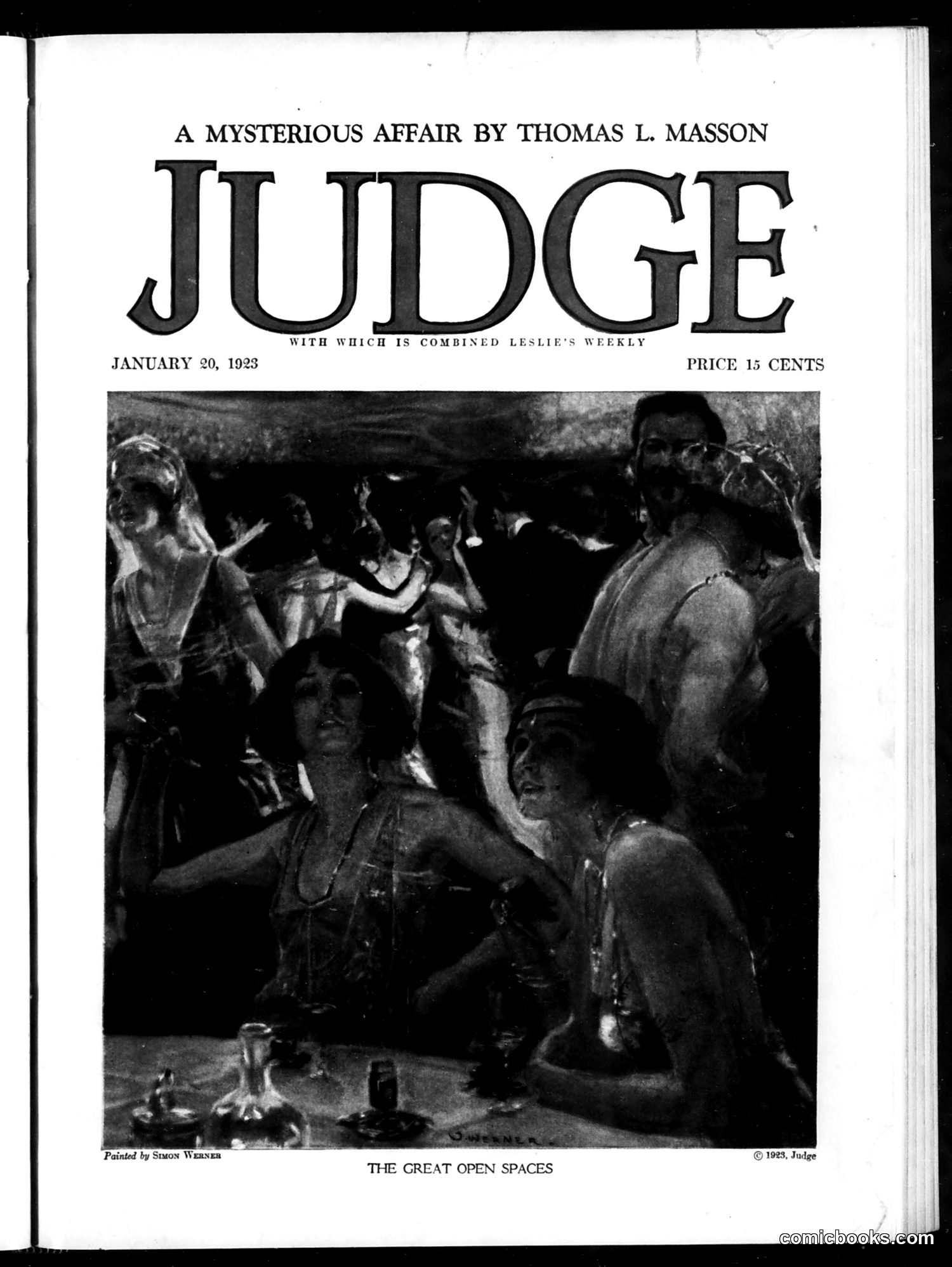
This appears to be an illustration (not a political cartoon) accompanying Thomas L. Masson's story "A Mysterious Affair." The painting by Simon Webber depicts what seems to be a dramatic scene with multiple figures gathered indoors—possibly a confrontation or tense social moment. The image is dark and expressionistic in style. Without additional context about Masson's story, the specific satire or social commentary remains unclear from the image alone. The title "The Great Open Spaces" suggests irony about confinement or crowding, possibly contrasting the cramped indoor scene with wilderness themes. The illustrated story format was typical Judge content alongside its satirical commentary on contemporary issues.
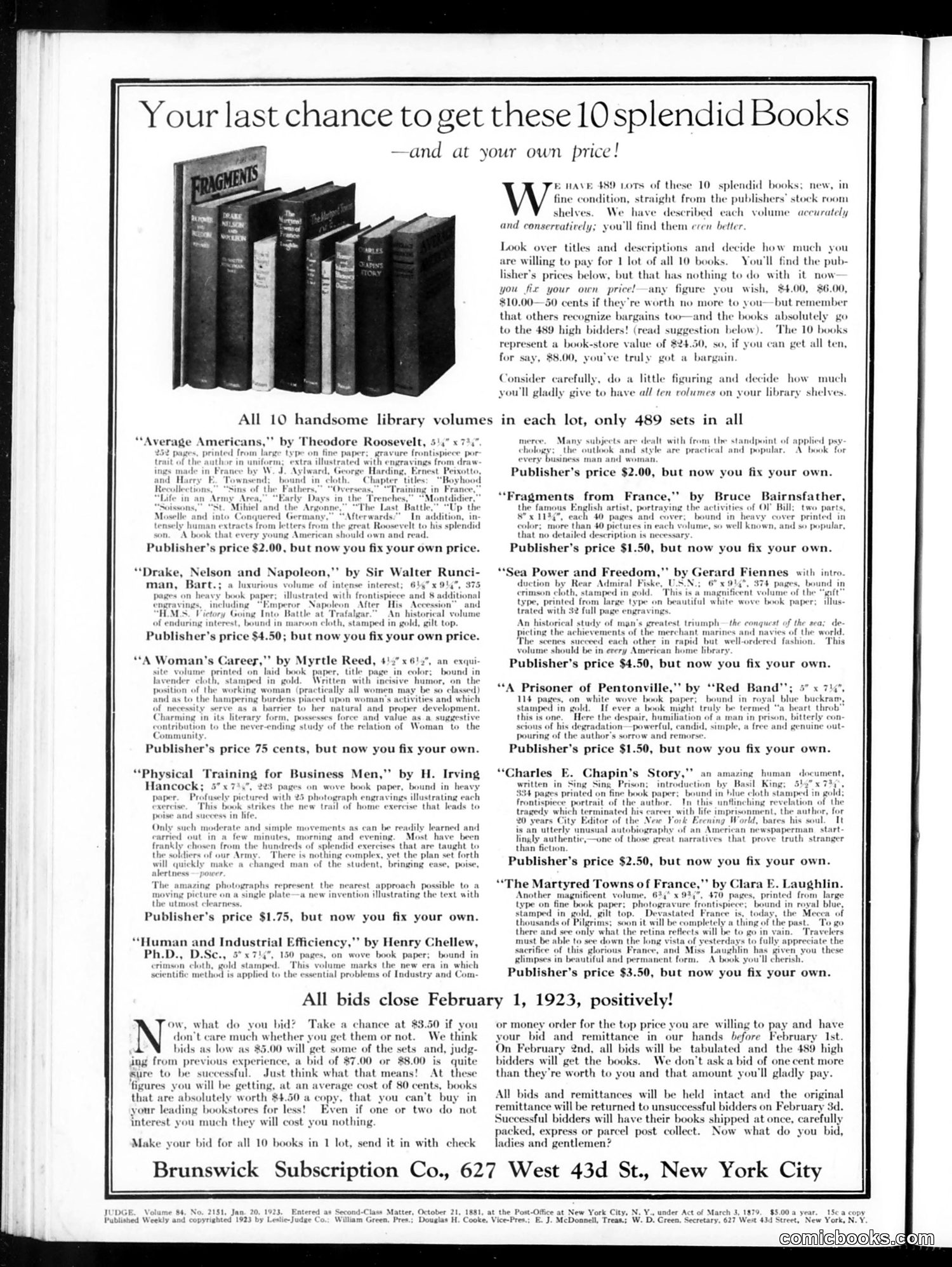
This page is **primarily a book auction advertisement**, not political satire. It announces a closing auction on February 1, 1923, for 10 "splendid" books being sold by Brunswick Subscription Co. at reader-determined prices ($4–$10 per complete set). The books listed include titles like "Fragments from France" by Bruce Bairnsfather, "Drake, Nelson and Napoleon," and "A Woman's Career." These appear to be popular contemporary literature and non-fiction, some related to World War I themes (given the 1923 date and Bairnsfather's war cartoons). The advertisement uses sales psychology ("your last chance," "truly got a bargain") typical of the era, appealing to readers' desire for quality books at bargain prices during the post-war period. There is **no political cartoon or satire present** on this page—it is straightforward commercial advertising.
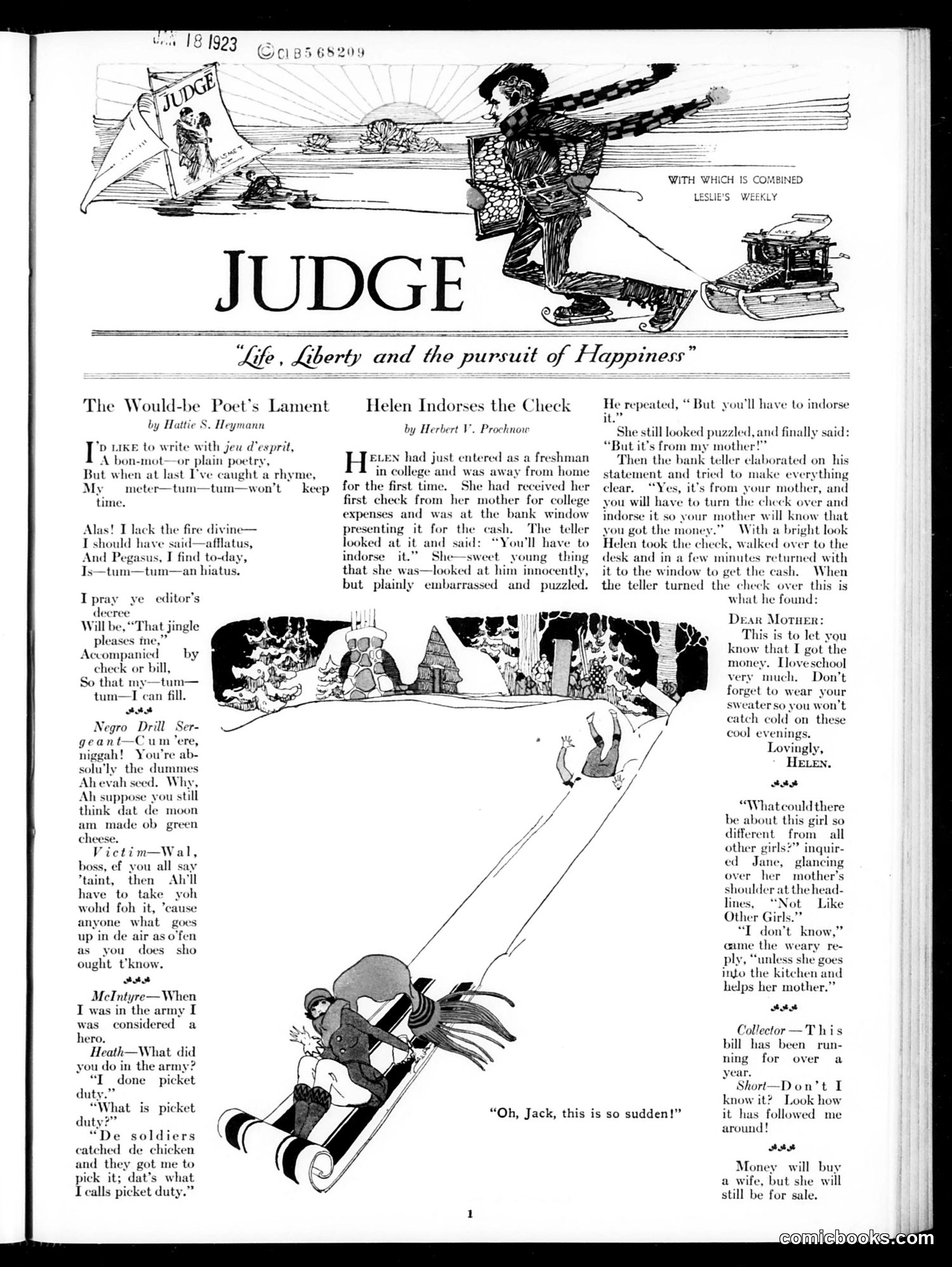
This page contains three separate humorous pieces rather than unified political commentary: 1. **"The Would-be Poet's Lament"** satirizes an aspiring poet's struggle with rhyming, using exaggerated dialect ("Ah'll," "taint") for comedic effect. 2. **"Helen Endorses the Check"** depicts a young woman (Helen) embarrassed when a bank teller questions a check from her mother—the joke hinges on her confusion about endorsement procedures and maternal financial dependence. 3. **"Negro Drill Sergeant"** and **"McIntyre" dialogues** use period ethnic comedy stereotypes, now offensive, featuring exaggerated dialect humor typical of 1920s entertainment. The illustrations show sledding and domestic scenes. The page reflects era-specific humor styles—linguistic comedy, banking confusion, and ethnic caricature—that modern readers would find dated or problematic.
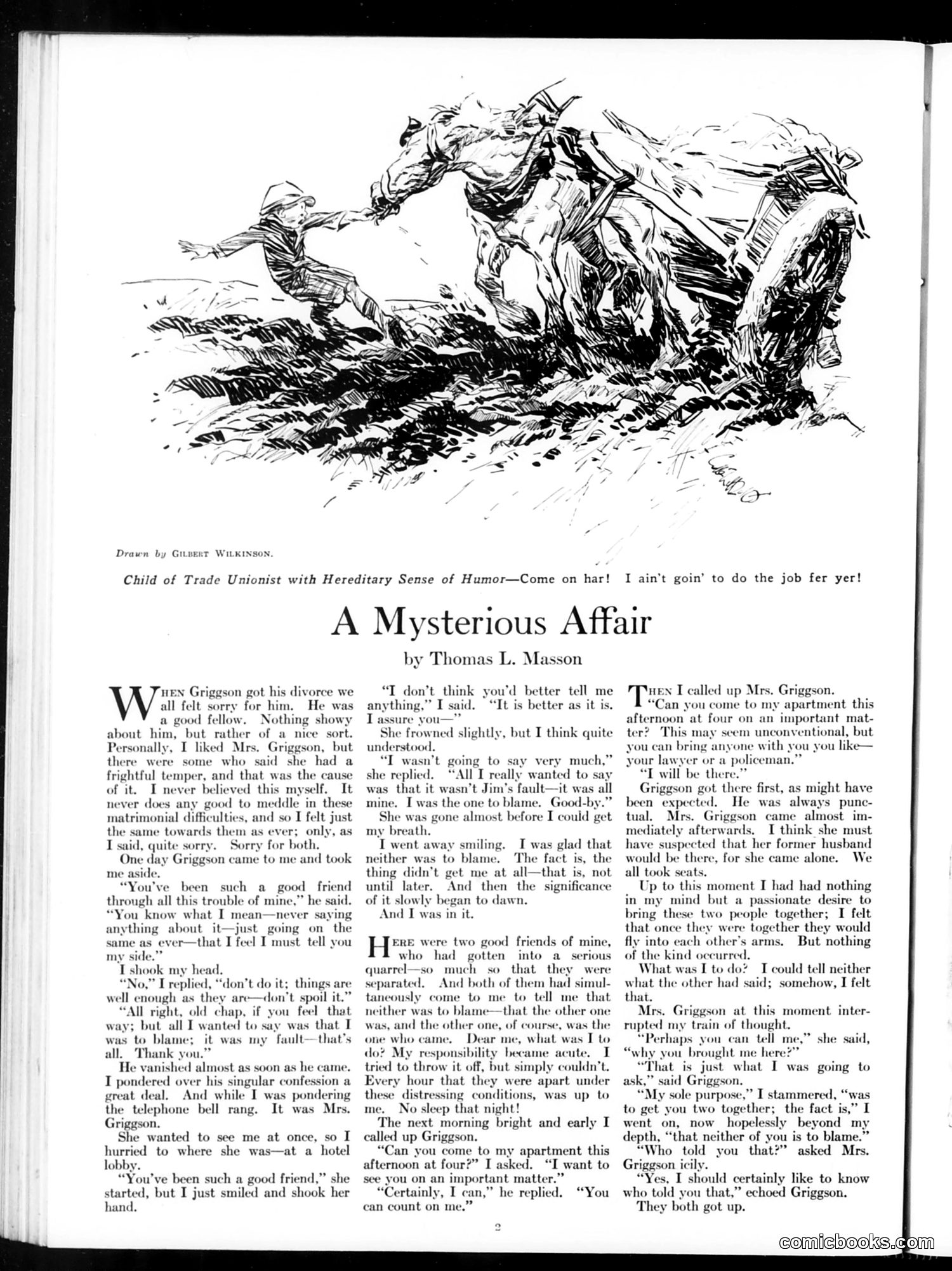
The top illustration by Gilbert Wilkinson depicts a labor scene: a man in work clothes struggles with a stubborn mule or horse while a figure representing union leadership (wearing a hat) pulls in the opposite direction. The caption "Chief of Trade Unionist with Hereditary Sense of Humor—Come on har! I ain't goin' to do the job for yer!" satirizes union leadership as obstructive and comedically incompetent, suggesting they actively prevent workers from completing their tasks rather than advancing labor interests. The cartoon critiques early 20th-century American labor unions, portraying them as obstacles to productivity—a common anti-labor argument of the era. The "hereditary sense of humor" implies union leaders inherit their positions through nepotism rather than merit, compounding the satire about institutional dysfunction and self-serving leadership.
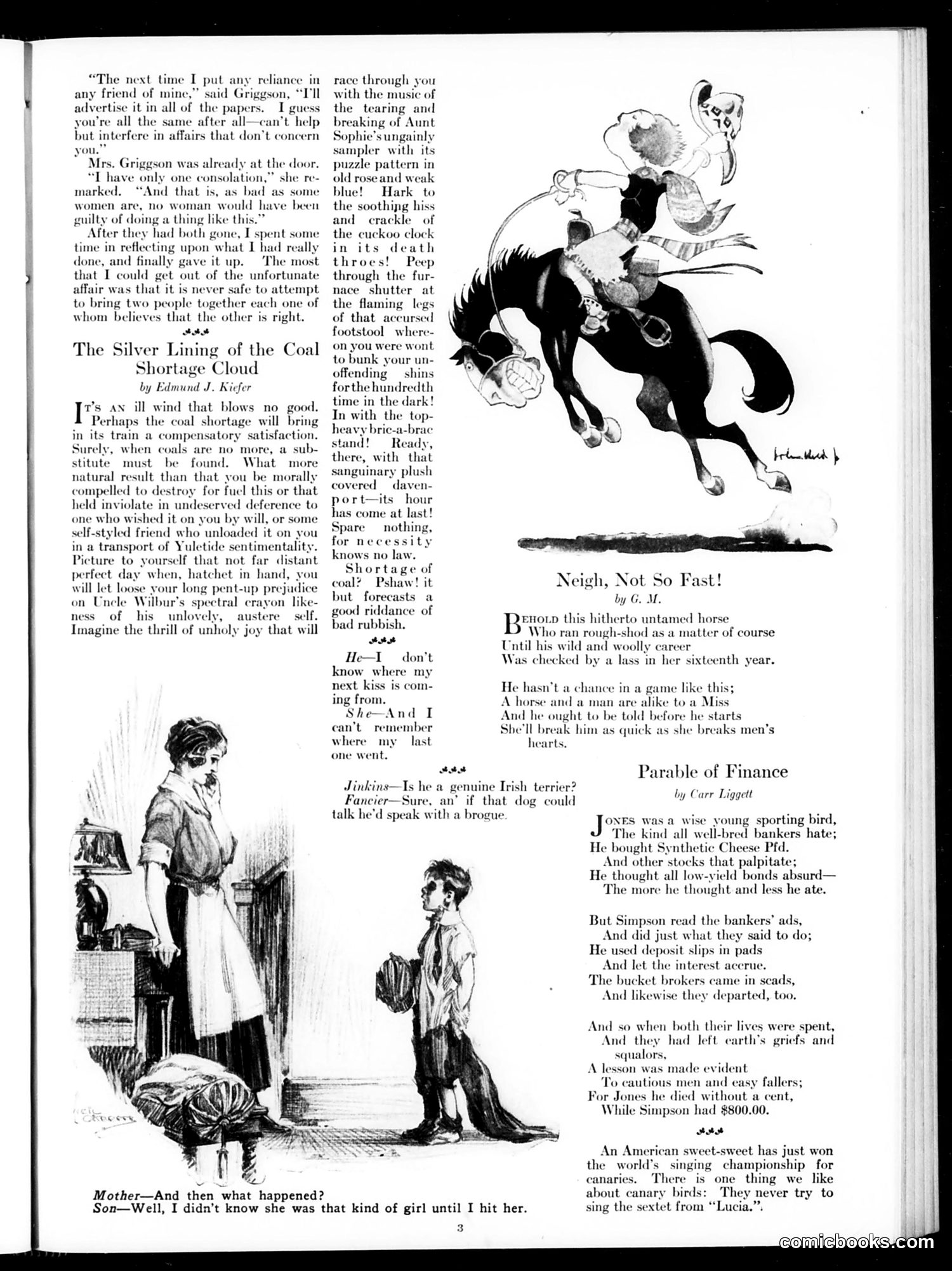
This page contains three literary pieces with accompanying illustrations rather than political cartoons. The main content includes: 1. **"The Silver Lining of the Coal Shortage Cloud"** by Edmund J. Kiefer — a humorous essay suggesting that coal shortages might force people to destroy furniture for fuel, with satirical commentary on undeserved deference to those who claim hardship. 2. **"Neigh, Not So Fast!"** by G.J. — a poem about an untamed horse that subverts romantic expectations by breaking a man's heart before he can break a woman's. 3. **"Parable of Finance"** by Carr Liggett — verse contrasting Jones (who made poor investment choices) with Simpson (who followed bankers' advice), ending with Simpson's financial success versus Jones's ruin. The illustrations are domestic/social humor rather than political satire. The page reflects early 20th-century concerns about coal shortages and financial speculation.
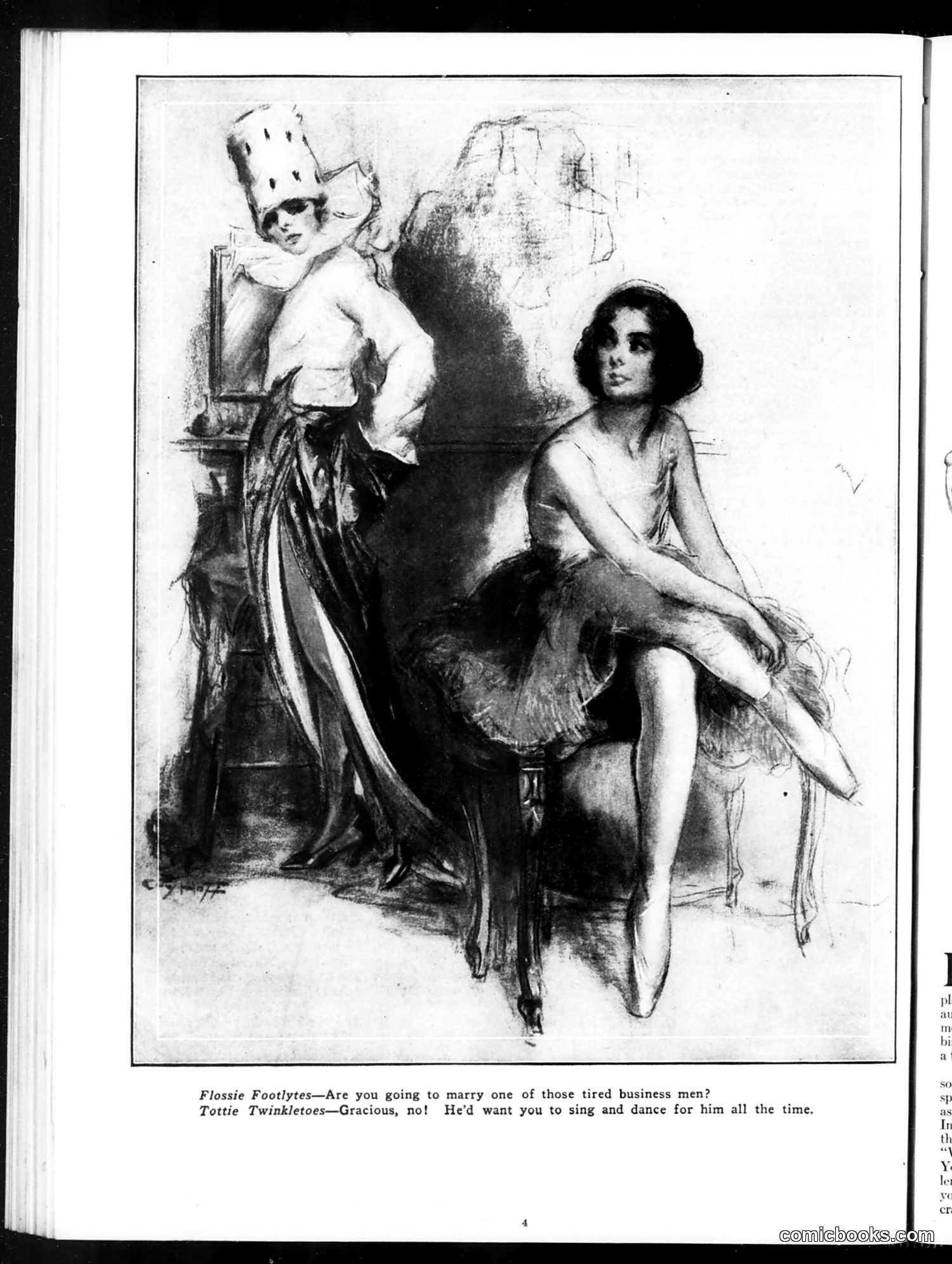
This appears to be a satirical cartoon from Judge magazine depicting two women in conversation. The dialogue suggests social commentary about marriage choices: **Flossie Footlytes** asks whether her friend is marrying "one of those tired business men." **Tottie Twinkletoes** responds negatively, stating she'd prefer a husband who wants her to "sing and dance for him all the time." The cartoon satirizes early 20th-century attitudes about marriage and women's roles. It mocks both the stereotype of exhausted businessmen as husbands and the frivolous ideal of women as entertainers rather than partners. The elaborate costumes and theatrical styling reinforce this commentary on superficial expectations in courtship and matrimony. The satire targets shallow attitudes about what constitutes a suitable marriage match.
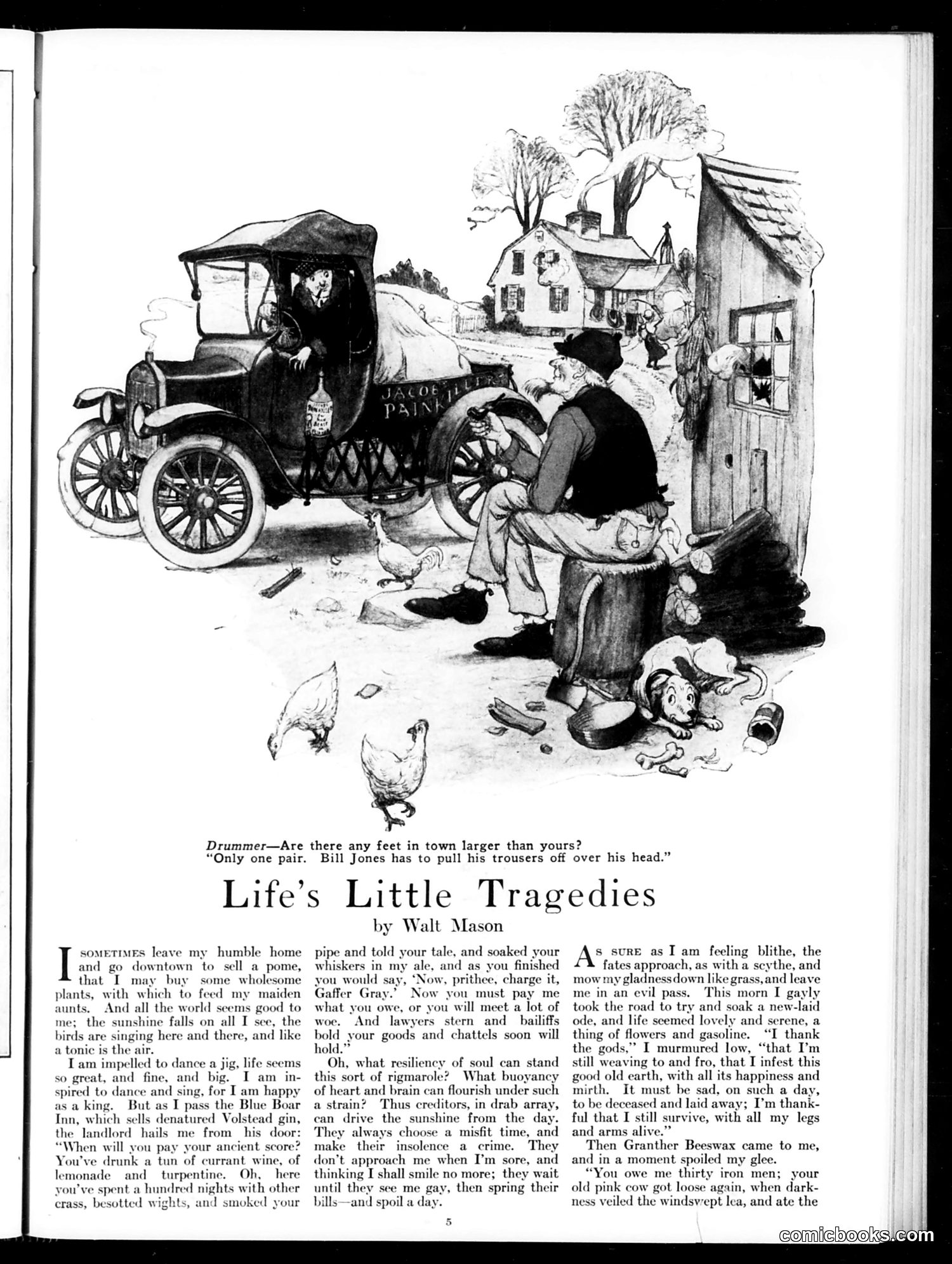
This is a humorous illustrated essay, not a political cartoon. The small cartoon at top shows a "Drummer" (traveling salesman) making a joke about oversized feet—Bill Jones supposedly has to remove his trousers over his head because his feet are so large. Mason's main text is autobiographical comedy about life's frustrations. He describes his attempts to improve his finances by selling poetry, only to be repeatedly accosted by creditors—his landlord demanding payment for drinks, then a neighbor (Granther Beeswax) claiming his cow ate crops. The satire targets ordinary working-class struggles during Prohibition ("denatured Volstead gin"—illegal alcohol named after the Prohibition law). The joke is how optimism and good mood are constantly punctured by mundane financial obligations and the petty complaints of creditors and neighbors. It's gentle social humor about the universal experience of debt and small-town life's relentless demands.
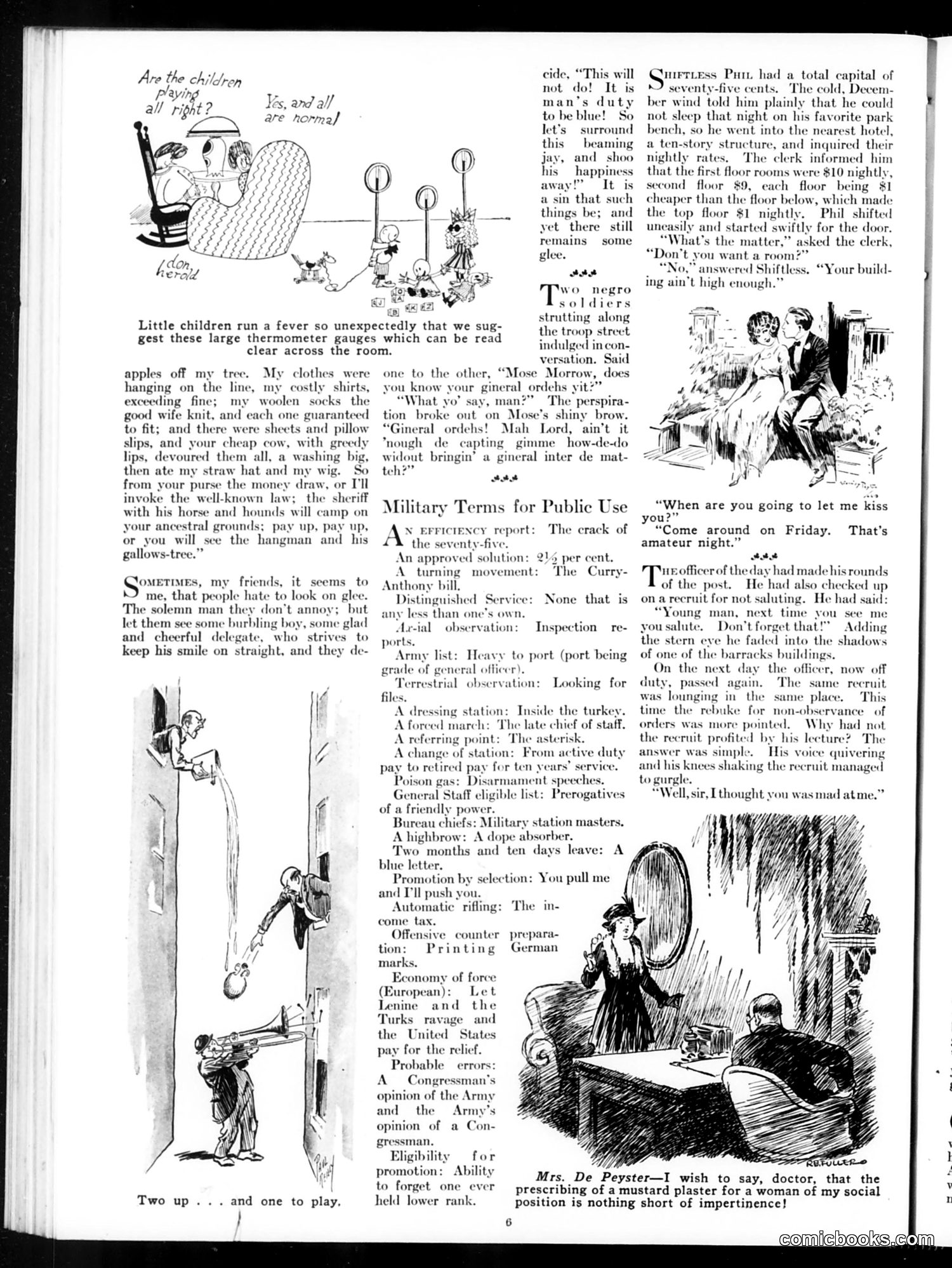
This Judge magazine page contains multiple satirical pieces: **Top cartoon**: A child's complaint about a neighbor's cow eating laundry and belongings, threatening legal action. This satirizes common rural disputes and exaggerated legal threats. **"Military Terms" section**: A political satire using fake military terminology to mock current events—likely WWI-era references. "Curry-Anthony bill" as a "turning movement," "printing German marks" as "offensive counter preparation," and "disarmament speeches" as "poison gas" mock Congressional debates and military strategy with absurdist humor. **Middle cartoon**: Two Black soldiers discussing military orders in dialect ("Gineral ordehs"). This reflects period racial stereotyping common in era's humor. **Bottom cartoon**: Mrs. De Peyster complains to a doctor about receiving a mustard plaster—a working-class remedy she considers beneath her social status. This satirizes class pretension and medical practice. **"Shiftless Phil" story**: A poor man with 75 cents seeks cheap hotel lodging but leaves when finding even the cheapest floor ($1) exceeds his budget—satirizing poverty and hotel pricing schemes.
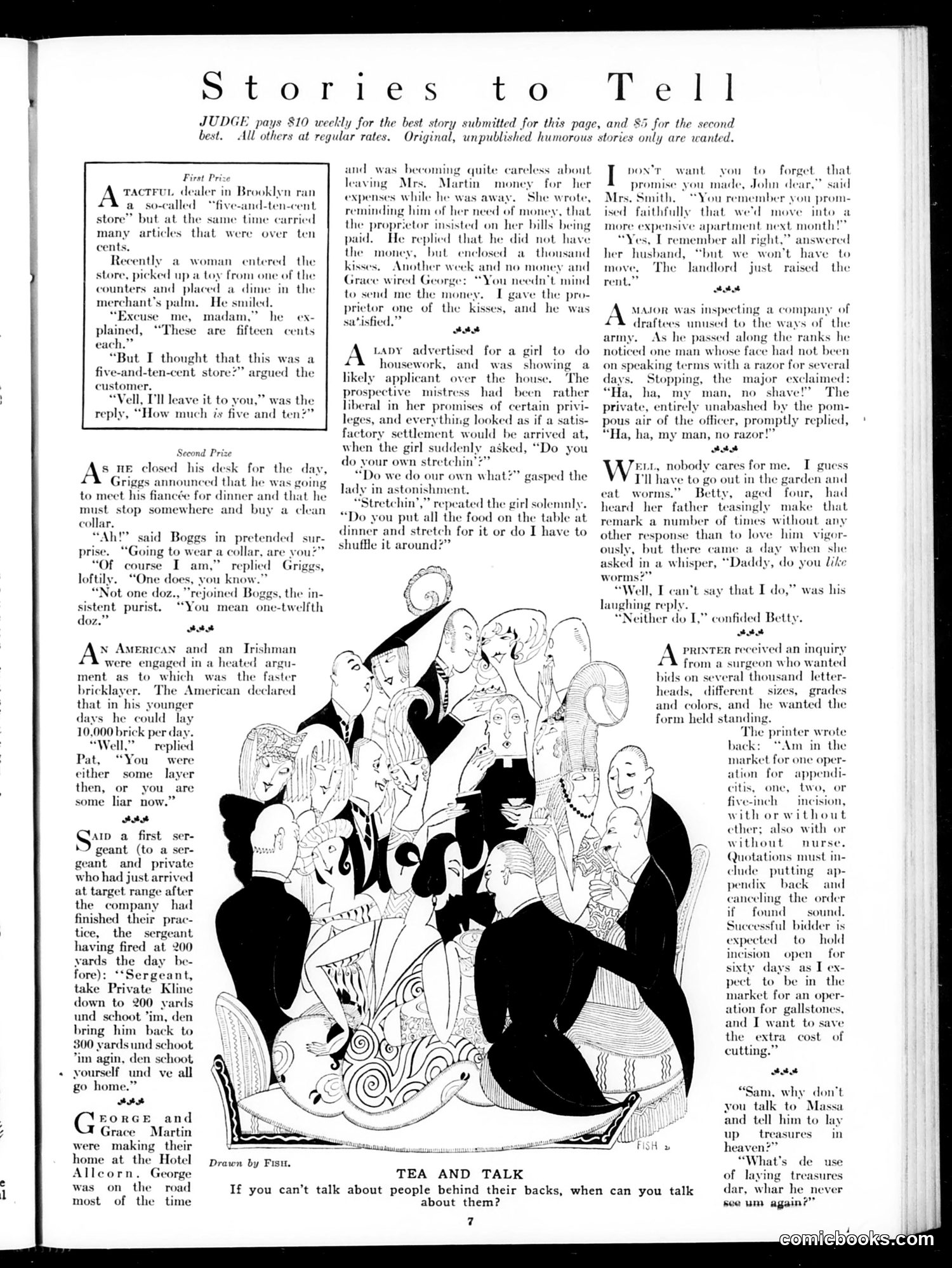
This page from Judge magazine contains humorous short stories competing for editorial prizes ($10 for first place, $5 for second). The cartoons and anecdotes satirize everyday American life and human nature. The central illustration by Fist depicts a crowded tea party or social gathering, likely emphasizing the caption's commentary: gossip is unavoidable in social settings. The joke questions social hypocrisy—people claim not to speak badly of others behind their backs, yet do so constantly. The surrounding stories mock various figures: a dishonest five-and-dime store owner who inflates prices, a bricklayer's exaggerated boasts, Army officers and enlisted men's pretensions, and domestic complaints about money and household help. The satire targets working-class and middle-class American behavior—deception in commerce, male braggadocio, military inefficiency, marital discord, and servant-hiring difficulties. These are gentle, observational comedies rather than political commentary, reflecting Judge's focus on social humor for educated readers.
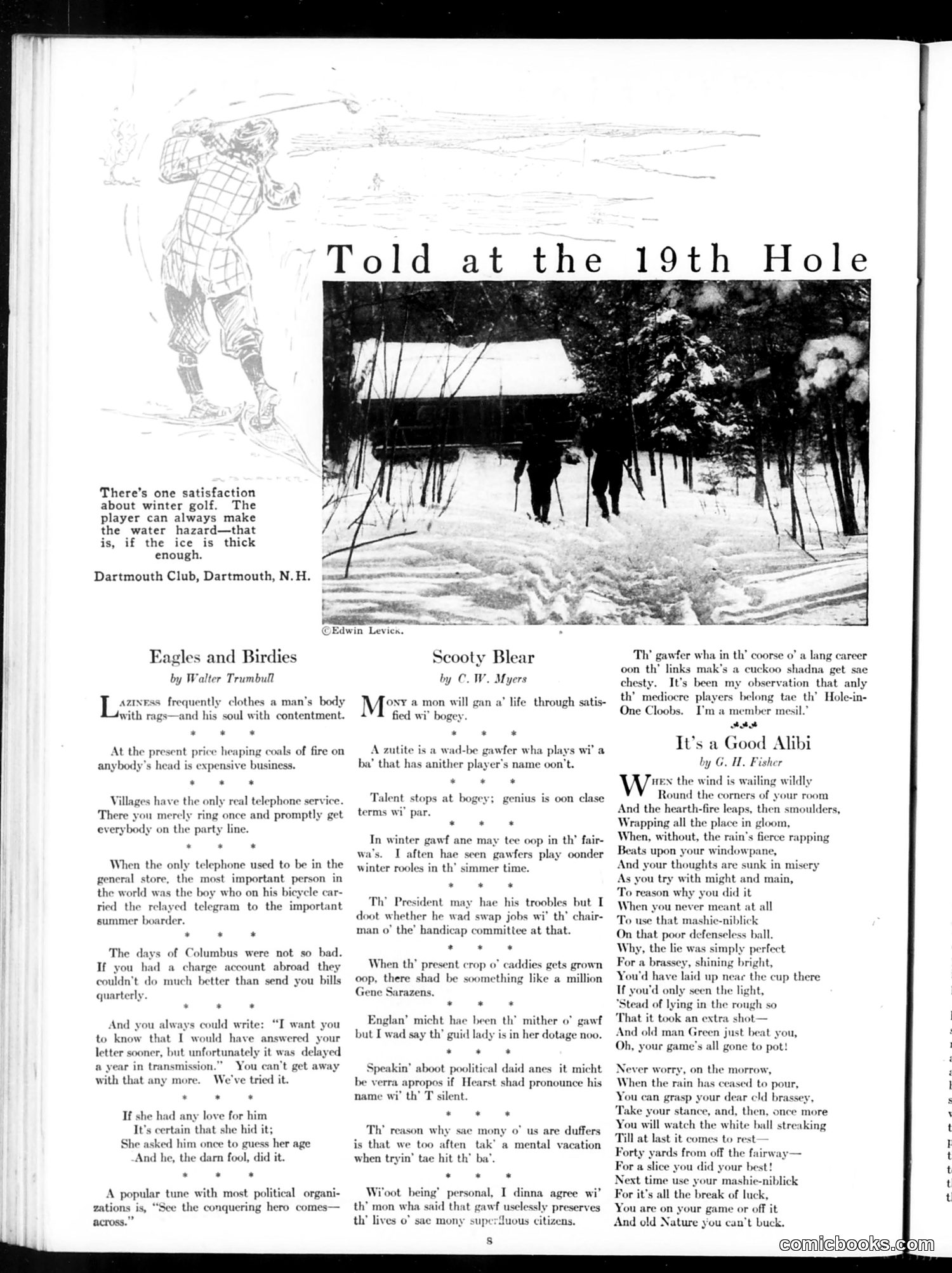
This page from *Judge* magazine features humorous golf commentary written in Scottish dialect. The main content includes: **"Eagles and Birdies"** and **"Scooty Blear"**: Golf-themed humor columns using Scottish vernacular ("gawf," "ba'," "caddie"). These joke about golf etiquette, handicaps, and player behavior. **"It's a Good Alibi"** by G.H. Fisher: A poem about a golfer making excuses for a poor shot. The humor lies in the universal experience of blaming external conditions (wind, rain, poor light) rather than admitting lack of skill—then promising to do better tomorrow. **The cartoon** (upper left) shows a golfer mid-swing in winter, illustrating the text's joke about winter golf: a player can reliably "make the water hazard" because frozen ice provides a solid surface. The satirical point: golf brings out human weakness—excuses, self-deception, and optimism despite repeated failure. This resonates today as timeless commentary on sports frustration and human nature.
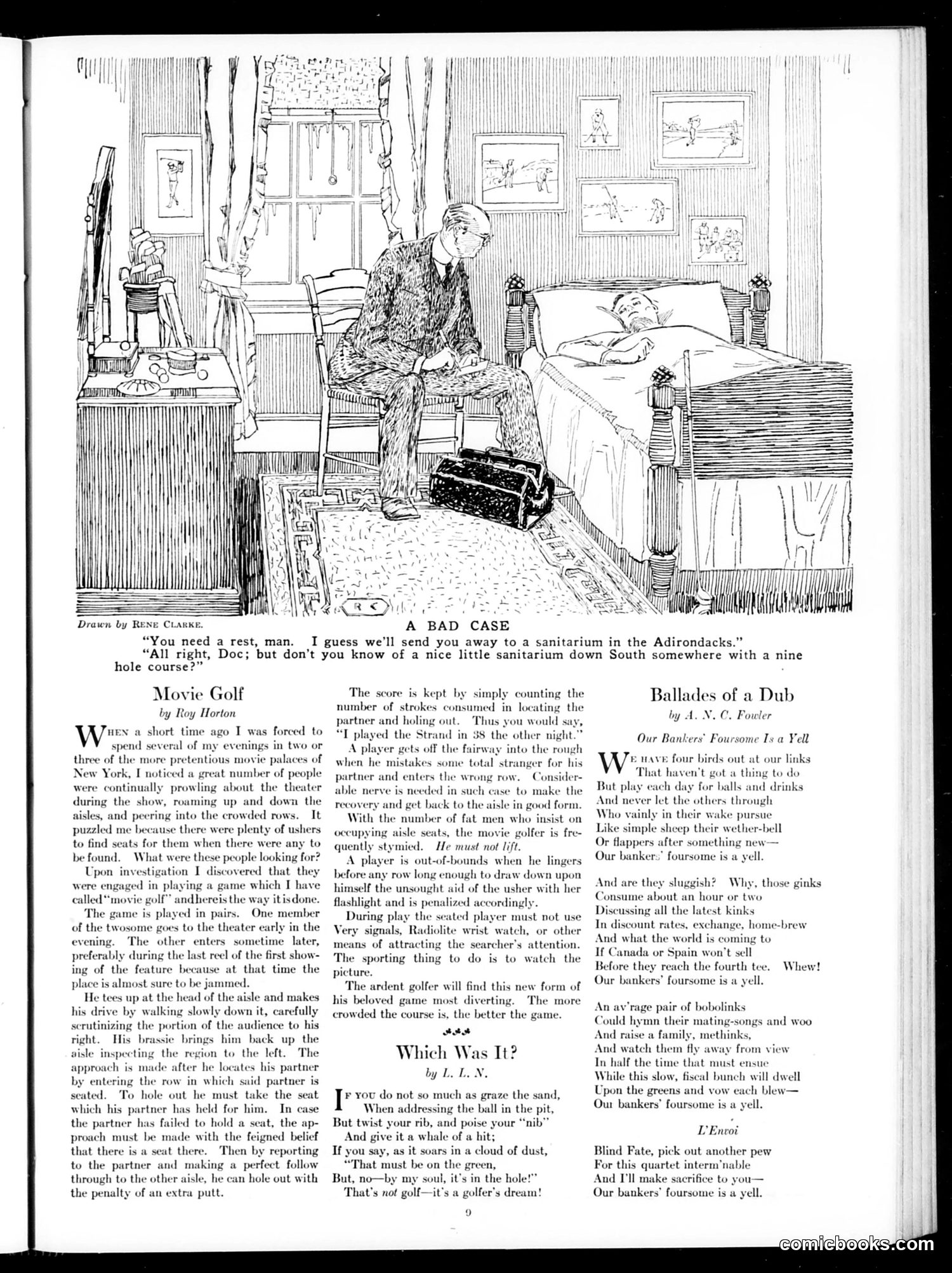
This single-panel cartoon satirizes the leisure priorities of wealthy Americans during what appears to be the 1920s. A doctor prescribes rest at an upstate sanitarium to an apparently affluent male patient. The patient's response reveals the joke: he'll accept the medical advice *only if* the facility has a nine-hole golf course. The satire targets the obsession with golf among the upper class—so consuming that even medical intervention cannot interrupt it. The patient won't sacrifice his hobby even for health reasons; rest and golf must coexist. This reflects broader 1920s social commentary mocking the era's nouveau riche and their status-conscious recreation. Golf was an expensive, exclusive sport associated with wealth and leisure class identity, making it an ideal target for Judge magazine's satirical humor about American materialism and misplaced priorities.
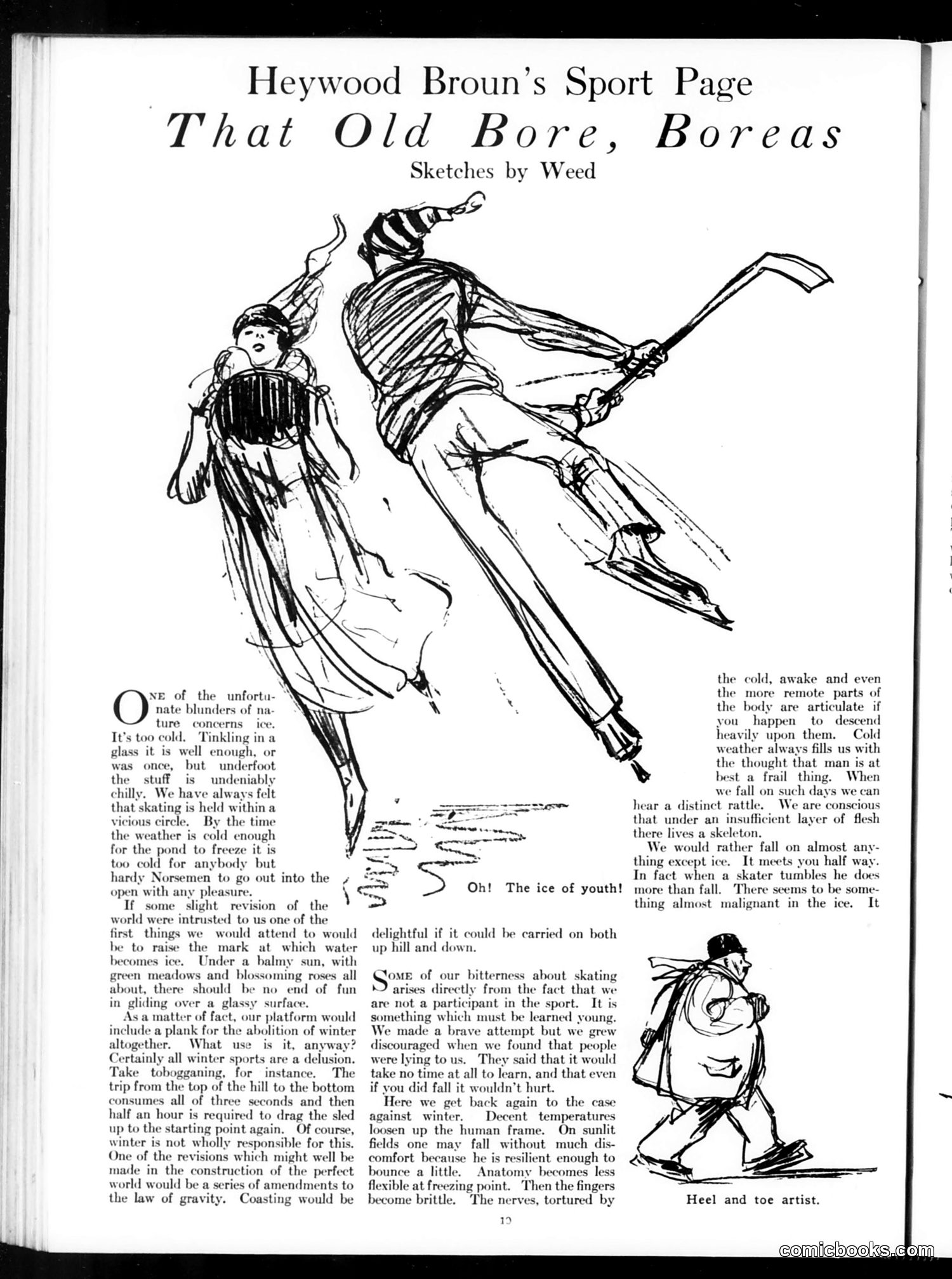
This is a humorous sports column by Heywood Broun (a prominent sportswriter of the early 20th century) complaining about winter sports, particularly ice skating and sledding. **The satire:** Broun adopts a tongue-in-cheek, curmudgeonly tone to mock winter activities. He presents absurd "solutions"—like wishing water froze at warmer temperatures, or amending the laws of gravity to make coasting work uphill. **The actual complaint:** The piece genuinely critiques how winter sports are physically unpleasant and potentially dangerous. Ice is hard; falls hurt; the cold makes bodies brittle and vulnerable. Sledding wastes time dragging equipment back uphill. People lied to him about learning to skate painlessly. **For modern readers:** This reflects early 20th-century attitudes toward winter recreation—not as romanticized fun, but as tedious, uncomfortable necessities that privileged people endured. The sketches by "Weed" show exaggerated skating poses, likely illustrating Broun's complaints about awkwardness and mishaps. The humor relies on Broun's cranky, reasonable-sounding exaggeration of genuine inconveniences.
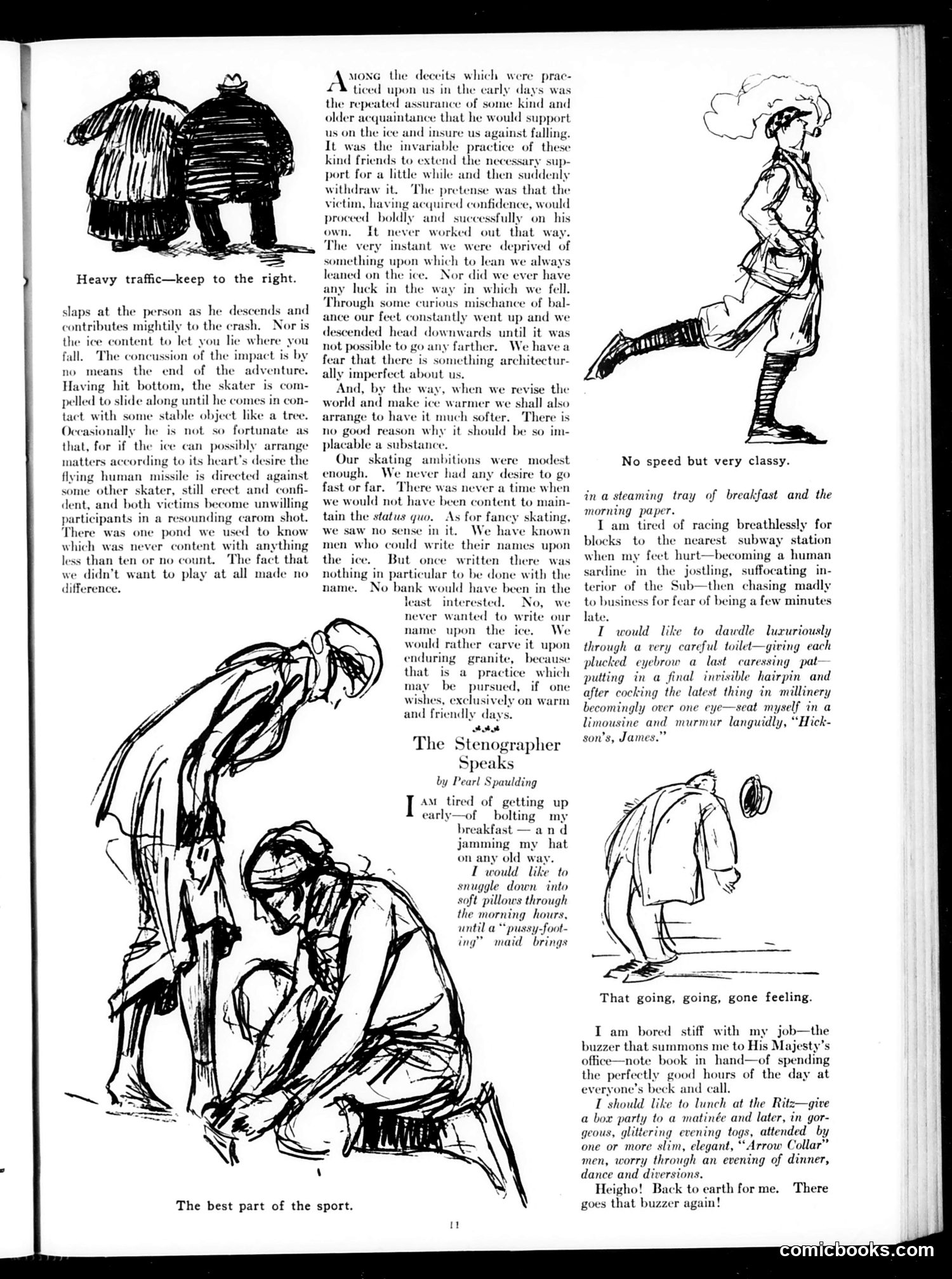
This page contains two satirical pieces mocking early 20th-century leisure and work: **"Heavy Traffic" section** (top/left): A humorous essay about ice skating mishaps. The accompanying sketches show people falling repeatedly. The satire targets the false confidence people gain from friends' support on ice—the moment support is withdrawn, they inevitably fall. It's gentle social commentary on human behavior and self-deception, with exaggerated illustrations of comic pratfalls. **"The Stenographer Speaks"** (right/bottom): A monologue by Pearl Spaulding presenting a working woman's fantasies of luxury. The stenographer expresses exhaustion with early mornings, rushed breakfasts, chaotic subway commutes, and menial office work. She dreams of leisurely mornings, limousines, and lunch at the Ritz instead of serving others. **Historical context**: This reflects early 1900s class consciousness and working women's frustrations—office work was expanding but remained underpaid and drudgerous. The satire points to the gap between working-class reality and wealthy leisure, likely resonating with Judge's middle-class readers who recognized such aspirations.
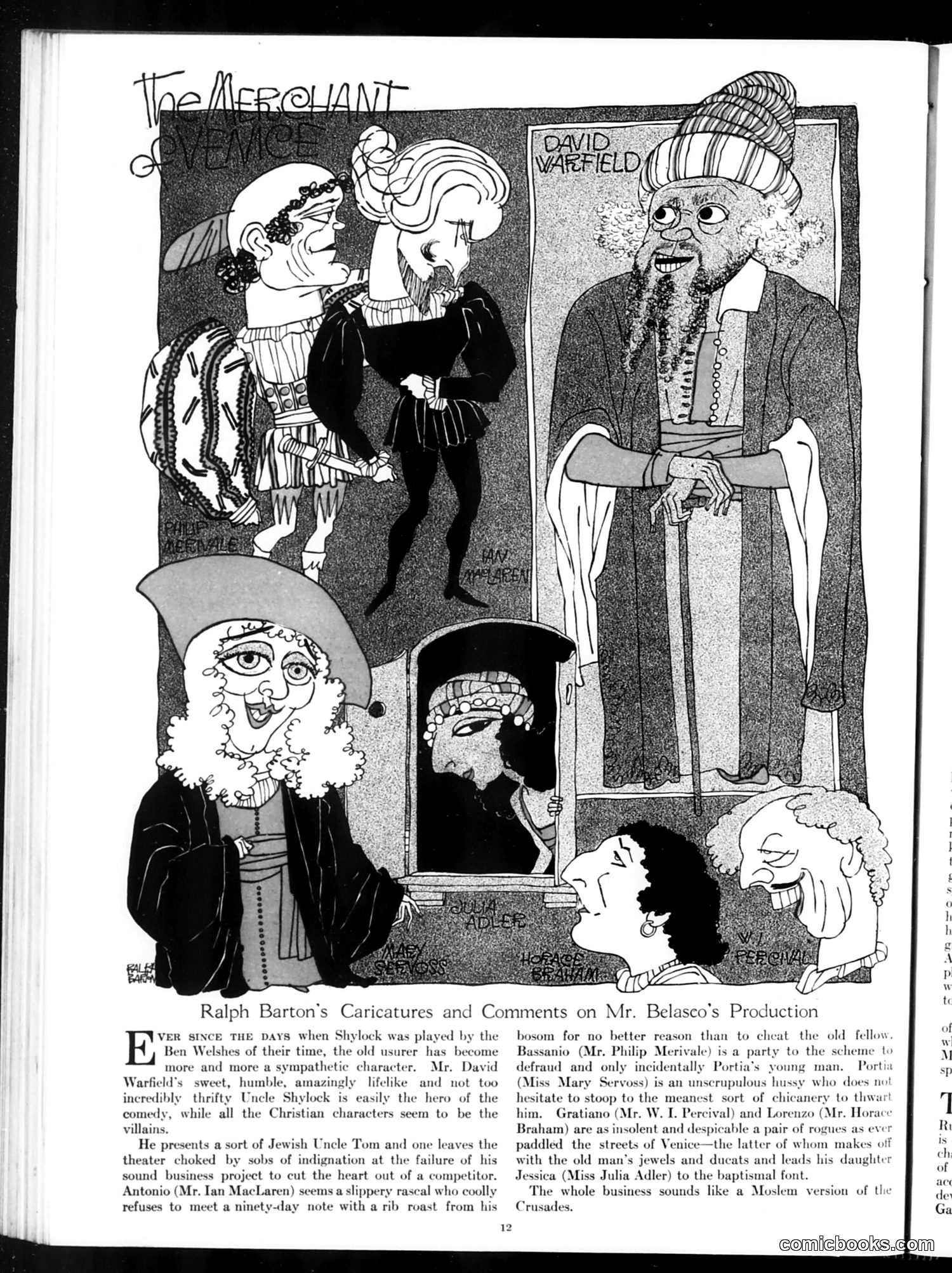
This page reviews David Belasco's theatrical production of Shakespeare's *The Merchant of Venice*. Ralph Barton's caricatures satirize how the production has reframed the play's moral landscape. The critic argues that David Warfield's portrayal of Shylock has become so sympathetic—playing him as a humble, innocent "Uncle Shylock"—that the Christian characters (Antonio, Portia, Gratiano, Lorenzo) now appear as villains. Antonio refuses to repay a debt; Portia uses legal trickery; Lorenzo steals Shylock's jewels and converts his daughter Jessica to Christianity. The satire's point: by making Shylock pathetic rather than villainous, Belasco's production accidentally reveals the Christian characters as genuinely dishonorable. The final crack—calling it "a Moslem version of the Crusades"—suggests the production inadvertently exposes Christian characters as religiously motivated cheaters and thieves.
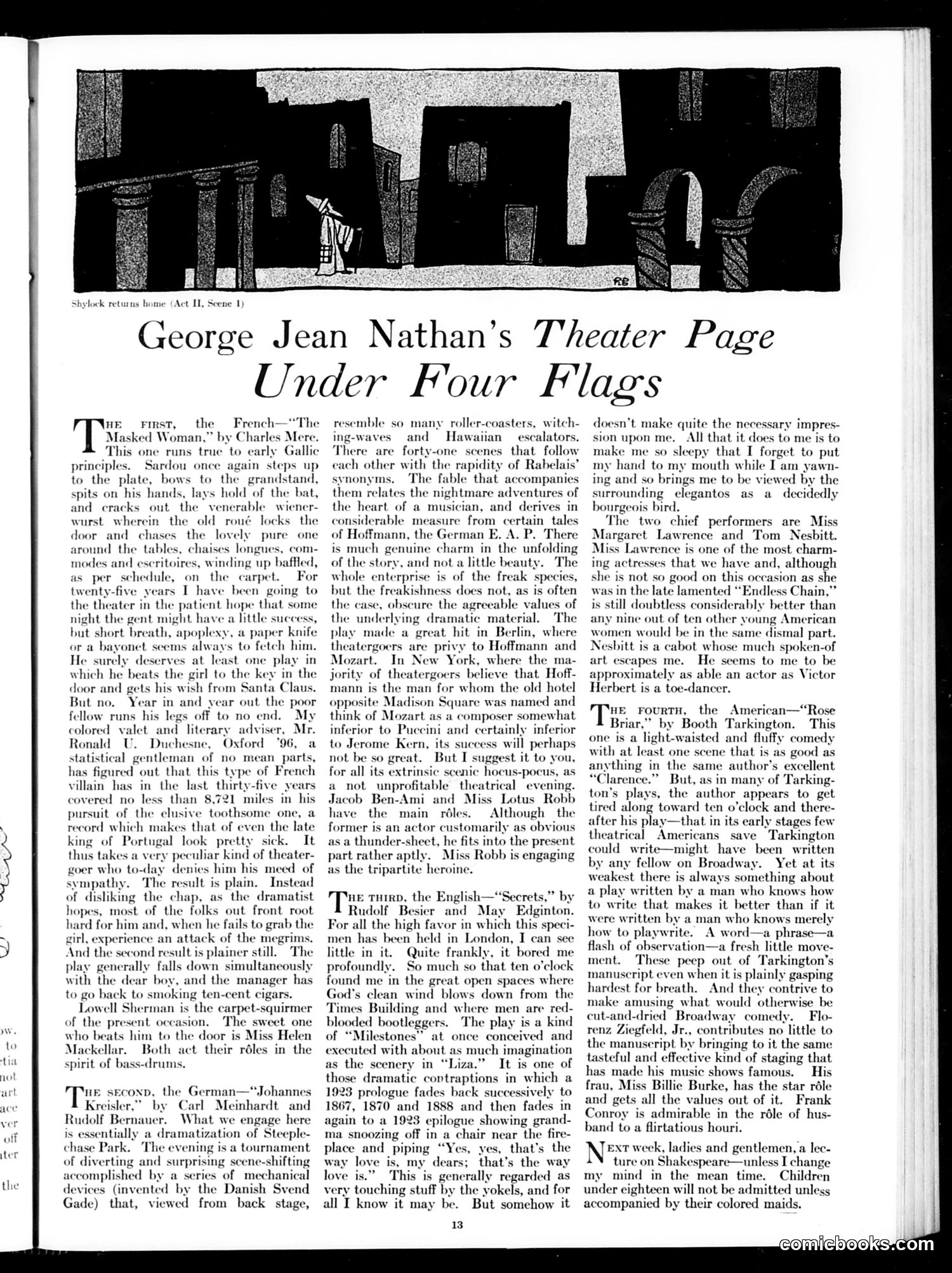
This is theater critic George Jean Nathan's review column covering four theatrical productions. The illustration at top shows a scene from Shakespeare's *The Merchant of Venice* (Shylock returning home). Nathan reviews four plays from different national traditions: 1. **French** ("The Asked Woman"): Nathan satirizes the predictable formula of French farce—an aging libertine chases a young woman around furniture, fails to catch her, and exhausts himself. He's cynical that audiences root *for* the villain rather than against him, making the play collapse. 2. **German** ("Johannes Kreisler"): A fantastical production featuring elaborate mechanical scenery (invented by "Danish Svend Gade"). Nathan notes it succeeded in Berlin among audiences familiar with Hoffmann and Mozart, but doubts American theatergoers—who he dismissively suggests confuse Hoffmann with a hotel name and Mozart with an inferior composer—will appreciate it. 3. **English** ("Secrets"): Apparently boring Nathan profoundly. 4. **American** ("Rose Briar"): Described as light-hearted but weak. The satire targets both predictable theatrical conventions and American cultural provincialism.
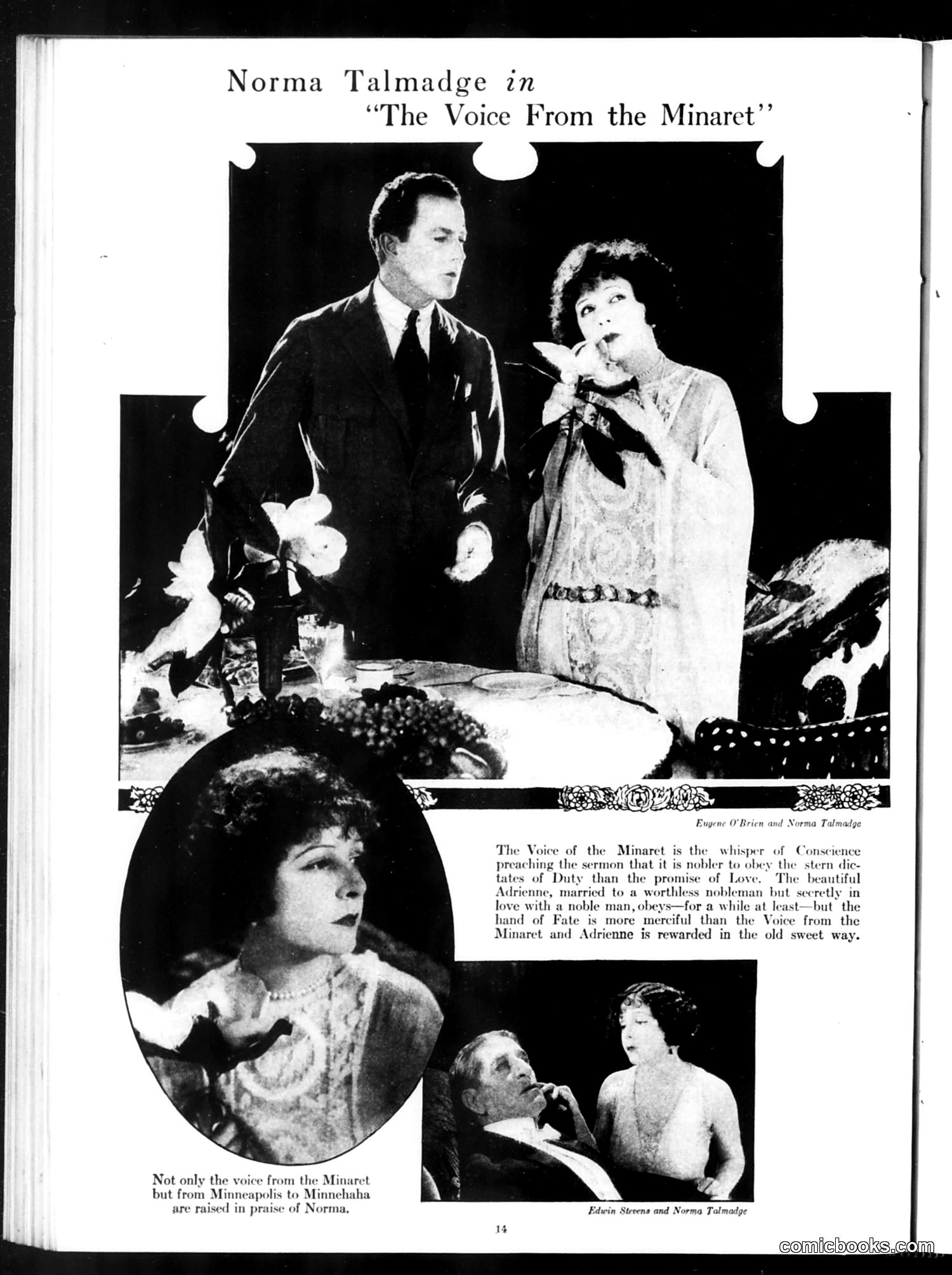
This page reviews a silent film starring actress Norma Talmadge. The plot concerns a woman (Adrienne) torn between duty to her husband and love for another man. A "voice from the minaret" (Islamic call to prayer tower) represents conscience urging her toward moral obligation over romance. Ultimately, fate resolves the conflict favorably for the lovers. The review praises Talmadge's performance, noting she's beloved "from Minneapolis to Minnehaha" (Minnesota reference, likely a joke about widespread popularity). The film appears to explore the tension between social/moral duty and romantic desire—a common silent-era theme. Judge presents this as entertainment reviewing an established actress in a popular dramatic picture, with the text treating the film's melodramatic conflict as worthy of serious discussion.
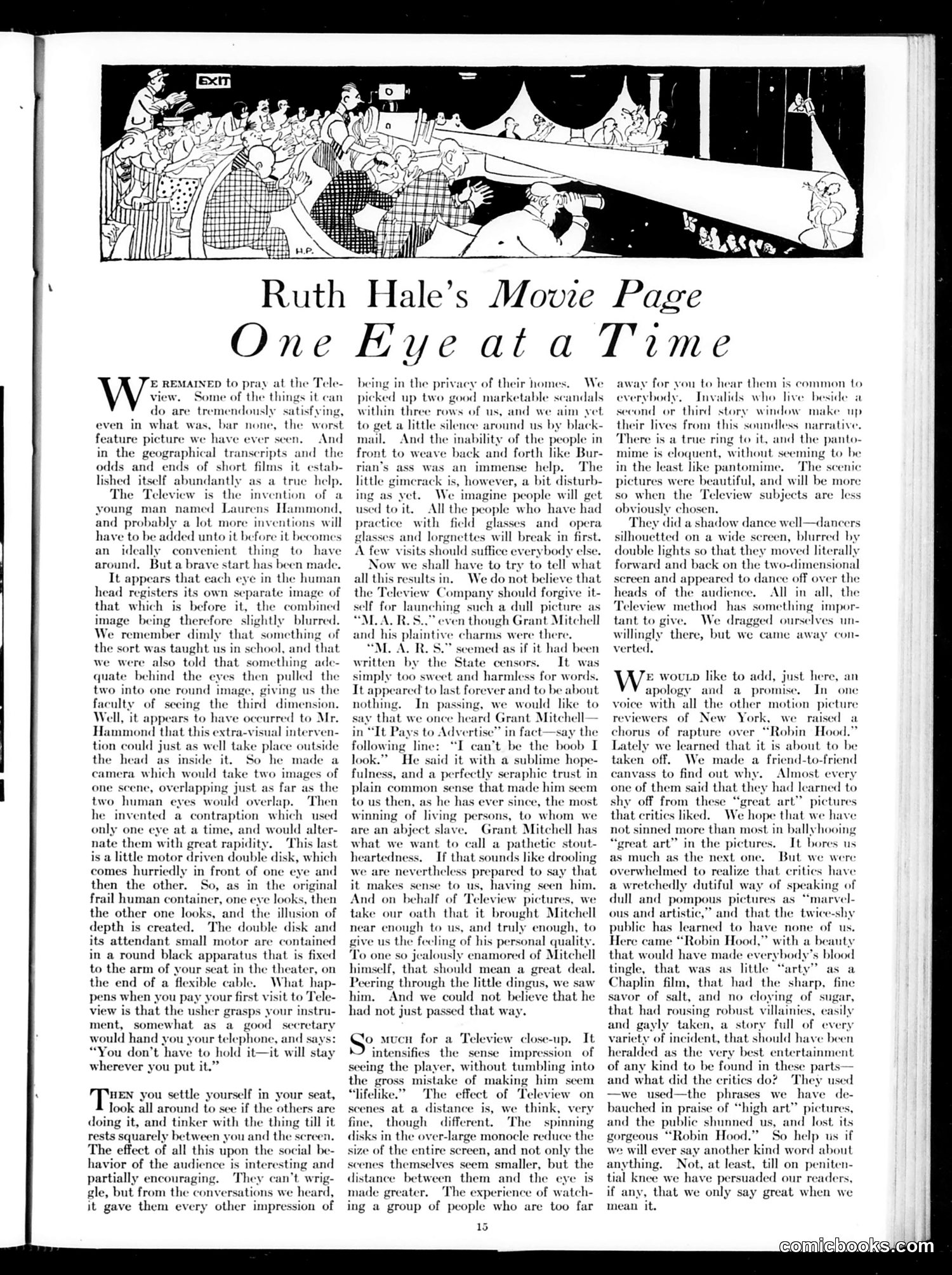
This is a film review column by Ruth Hale discussing the **Teleview**, an early 3D cinema technology invented by Laurens Hammond. The device uses a motorized disk that alternates between each viewer's eyes, presenting slightly offset images to create a three-dimensional effect—mimicking how human binocular vision works. Hale describes the theater experience: viewers wear a apparatus attached to their seat that eliminates typical audience distractions (people shifting, blocking views). However, she criticizes the film being shown—"M.A.R.S."—as dull and censorship-approved pablum, despite Grant Mitchell's performance. She praises Mitchell's earlier work in "It Pays to Advertise." The review is optimistic about Teleview's potential while disappointed in the accompanying entertainment. The cartoon illustration above shows theater audiences experiencing this novelty technology.
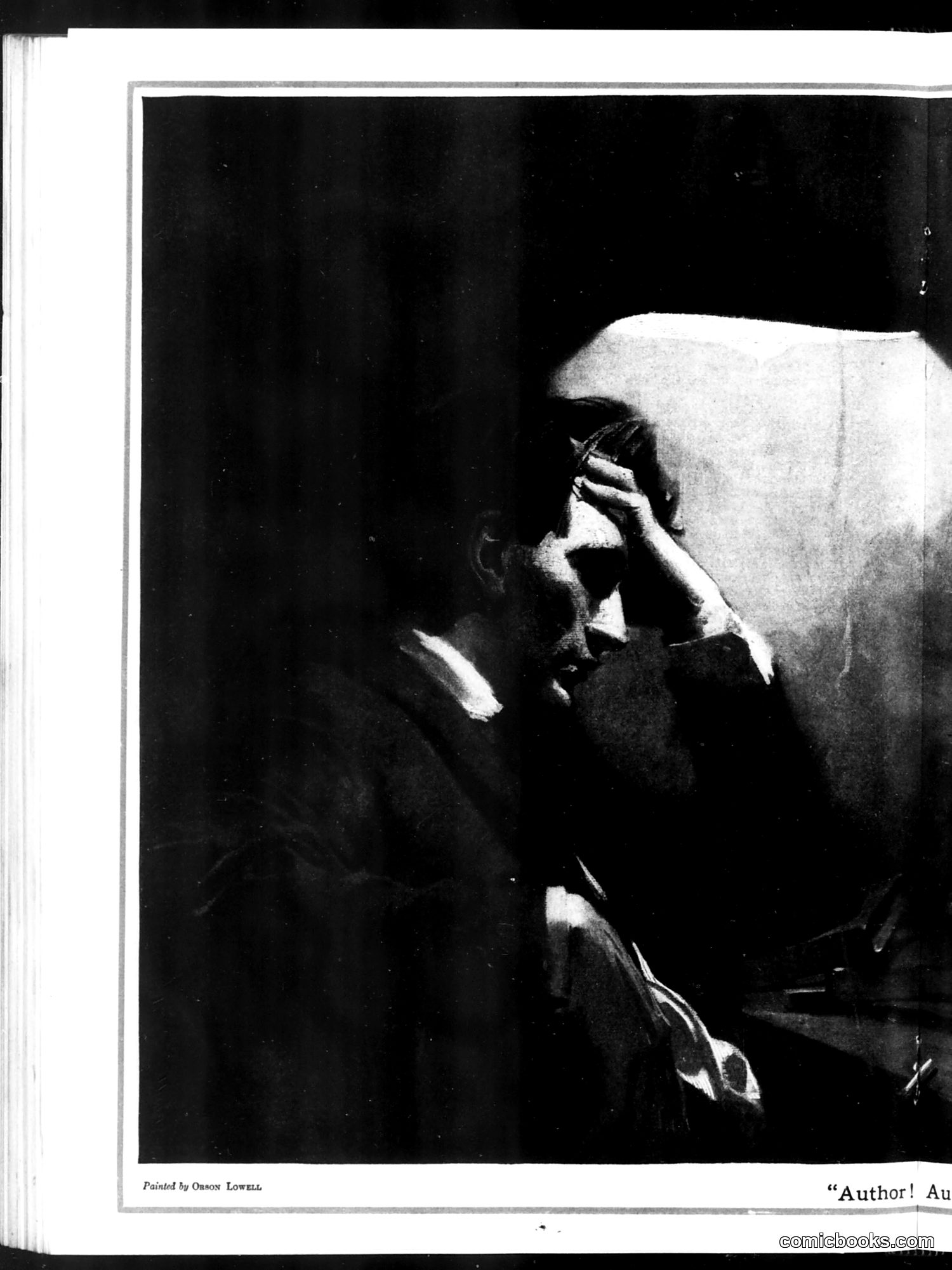
This is a dramatic black-and-white portrait painting credited to artist Orson Lowell. The image shows a figure in profile, seated and illuminated against a dark background, appearing contemplative or troubled. The figure wears formal attire with a white collar visible. The partial caption "Author! Au..." suggests this depicts a writer or literary figure, though the specific identity is unclear from the visible text. The artistic style—theatrical lighting and introspective pose—suggests this may be satirizing literary pretension or authorial self-importance, common targets in *Judge* magazine's humor. However, without complete caption text or additional context, the specific satirical target and political/social reference remain uncertain.
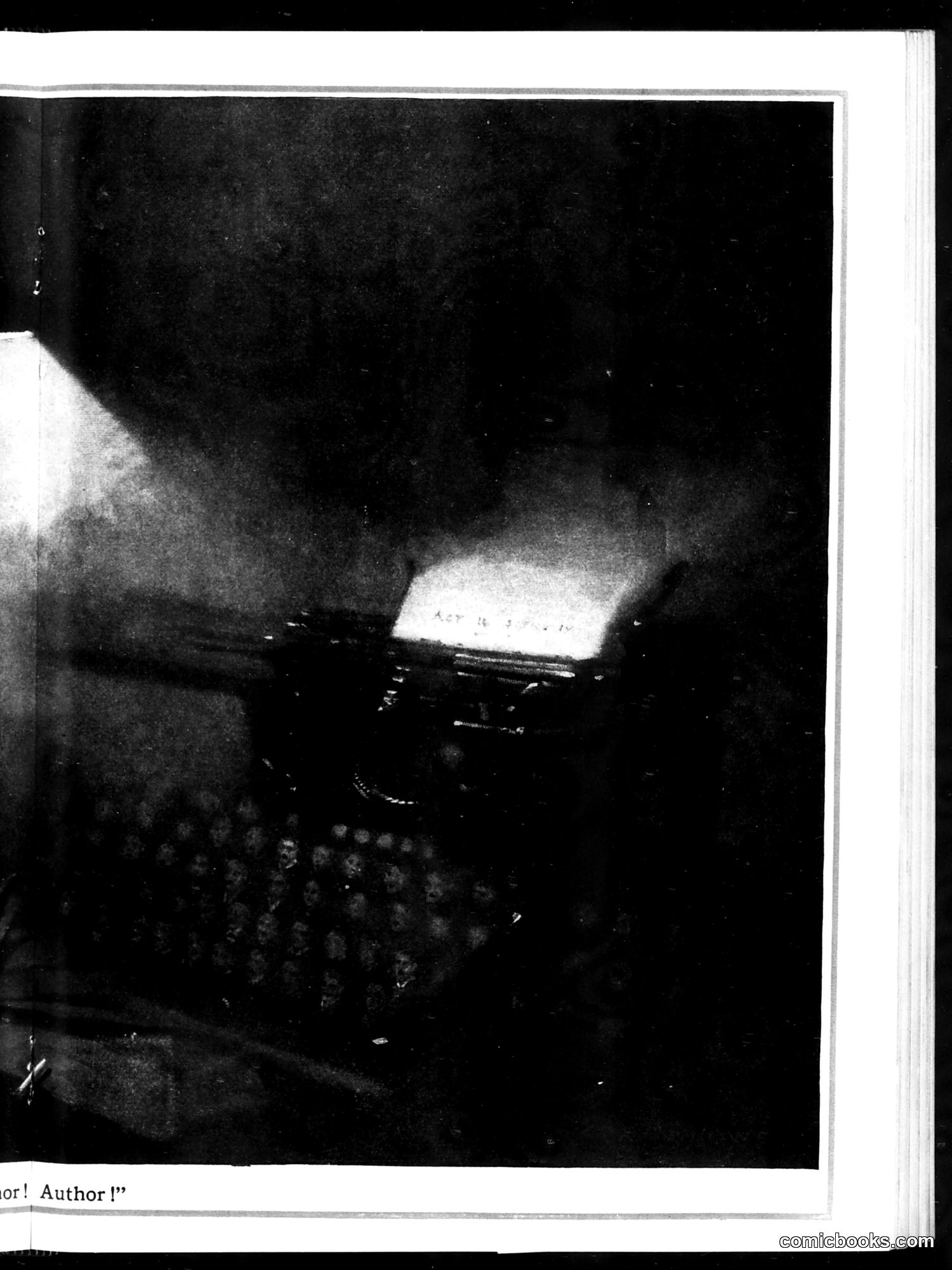
This appears to be a black and white photograph or illustration showing a typewriter with a sheet of paper inserted. The visible text on the paper reads "Author!" and the caption below states "or! Author!" The image likely satirizes the writing profession or the act of authorship itself, though the specific satirical point is unclear from this fragment alone. The dramatic lighting and composition suggest this may be commentary on the solitary, intense nature of the writing process, or possibly mockery of aspiring authors. Without additional context from Judge magazine's era or surrounding content, the precise political or social critique remains ambiguous. The photograph's grainy quality and stark contrast are typical of early-to-mid 20th century magazine reproduction.
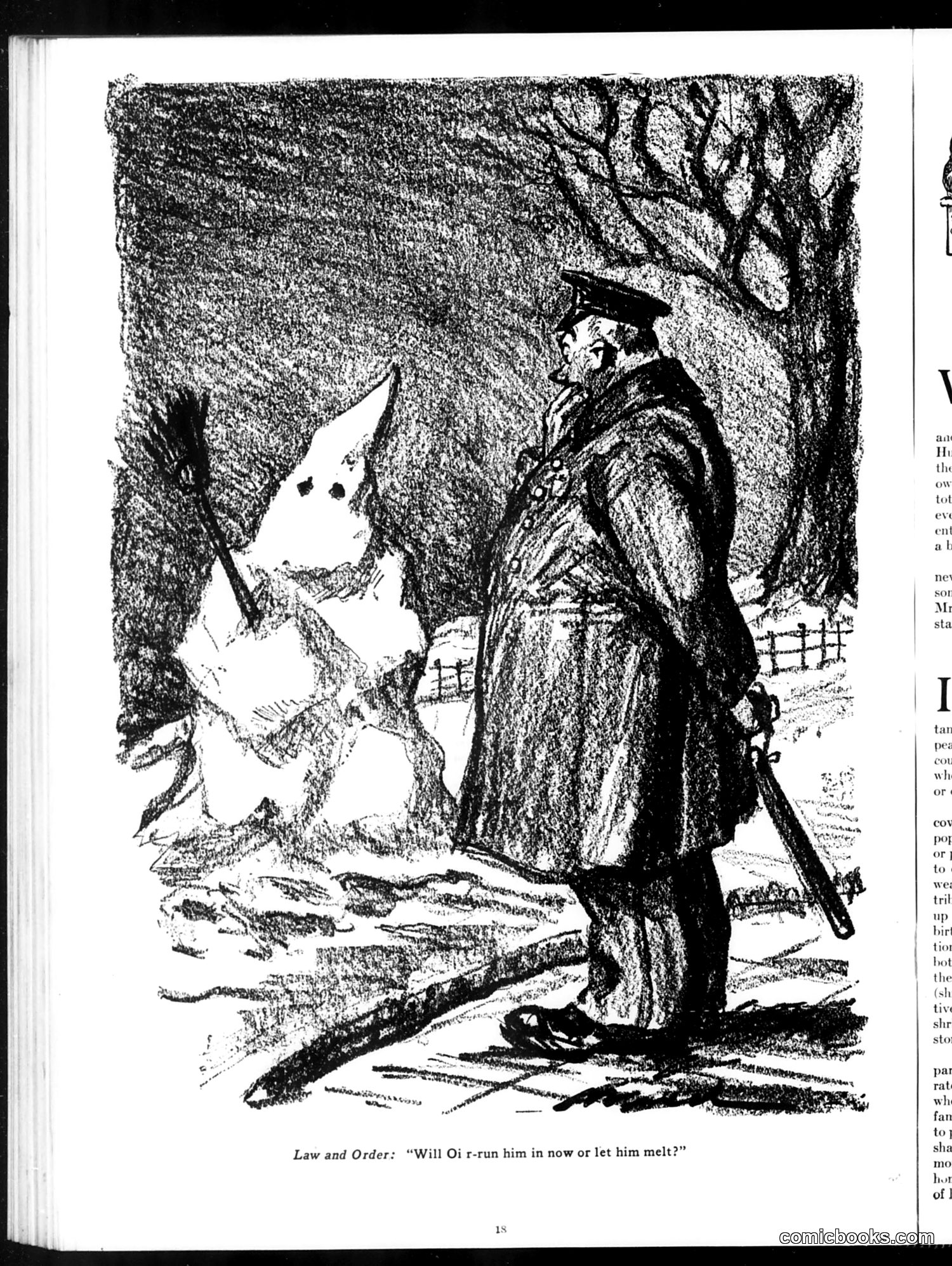
This political cartoon from *Judge* magazine depicts a figure in winter clothing confronting what appears to be a snowman. The caption reads: "Will Oi r-run him in now or let him melt?" The cartoon satirizes law enforcement and justice ("Law and Order"). The snowman likely represents a criminal or suspect, while the uniformed figure appears to be a police officer or authority figure. The joke plays on the transience of snow—the officer must decide whether to arrest the suspect immediately or wait until the evidence literally disappears through melting. This is social satire about how criminals might escape justice through inaction or delay, or possibly commentary on the effectiveness of law enforcement. The specific historical context or individual referenced remains unclear without additional publication date information.
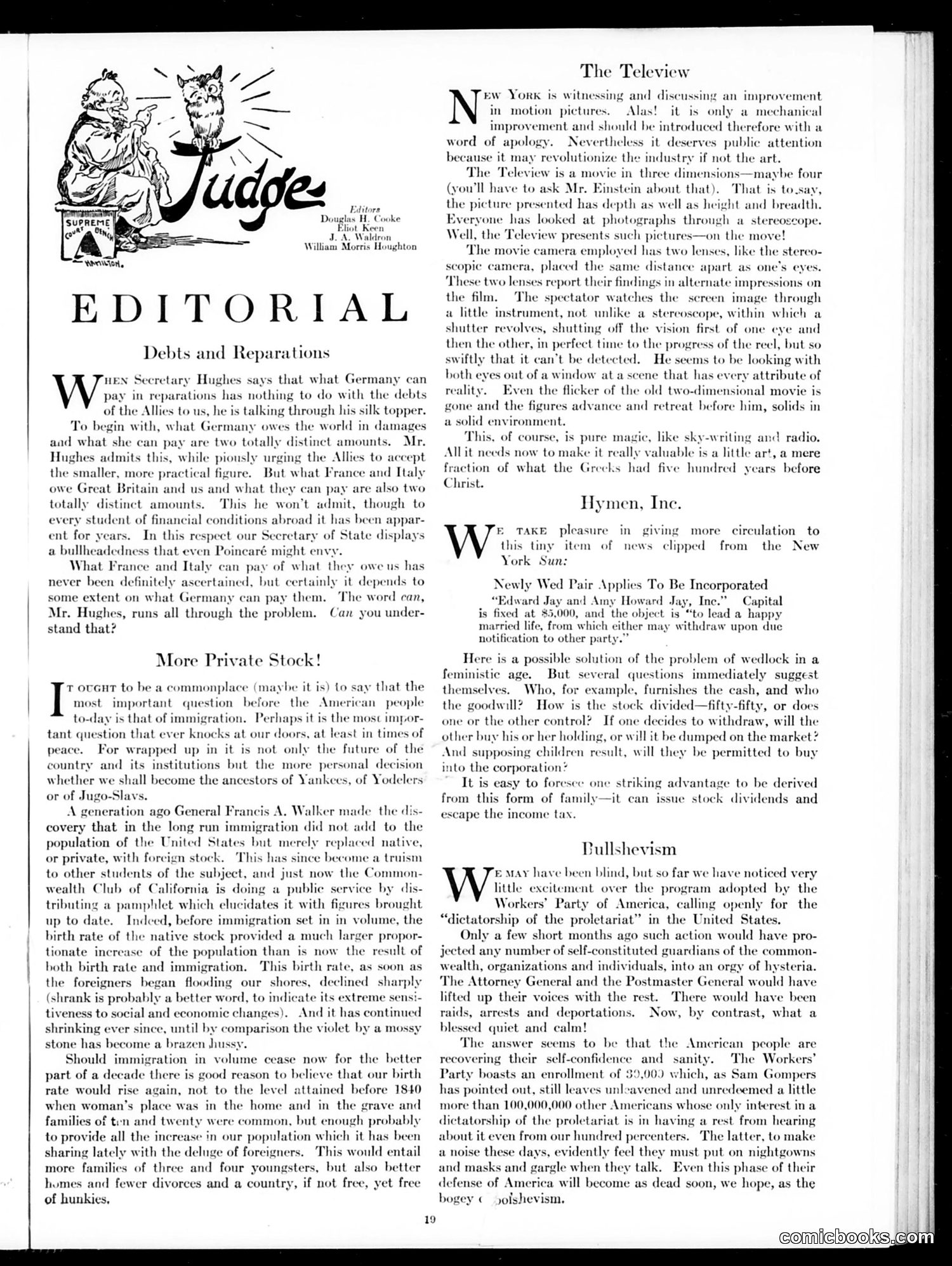
This editorial page from Judge magazine addresses three distinct topics: **"Debts and Reparations"** critiques Secretary of State Charles Evans Hughes's post-WWI reparations policy, arguing he falsely separates German reparations from Allied debts to America. The editor contends all amounts are interconnected financially—Hughes's position is logically inconsistent. **"More Private Stock!"** attacks immigration policy using period-typical eugenic language ("hunkies," concern about "Yodelers" and "Jugo-Slavs"). The piece argues immigration suppresses native American birth rates and advocates restricting immigration to restore population growth among native-born citizens. **"The Teleview"** reviews an early 3D cinema technology, praising its mechanical innovation while dismissing it as mere technical advancement lacking artistic value—it needs "a little art" to truly matter. The cartoonish "Judge" masthead at top shows the magazine's satirical voice. These pieces reflect 1920s-era concerns: war debt, immigration restriction (pre-1924 quotas), and emerging cinema technology.
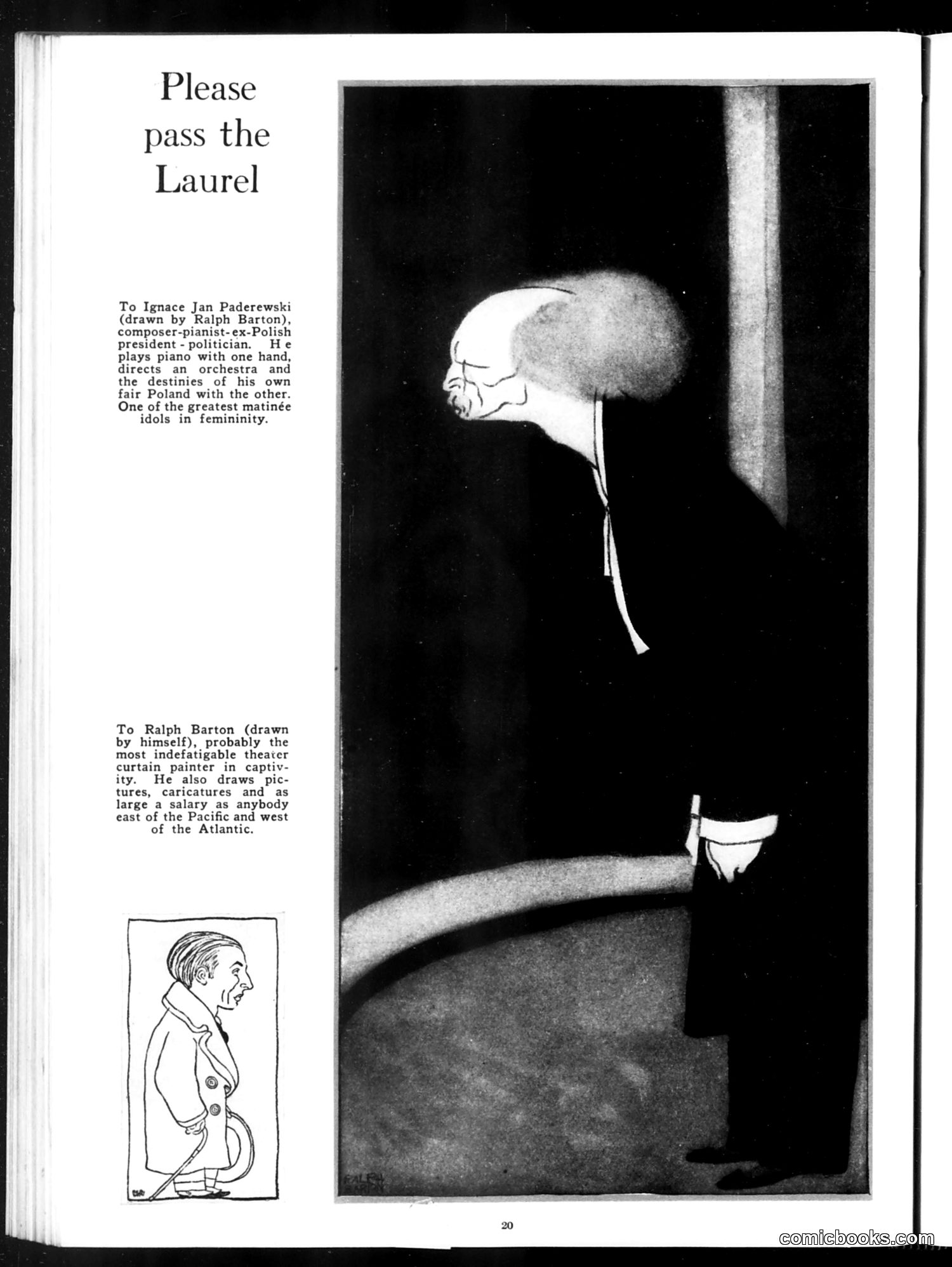
This page presents mutual artistic tributes between two prominent figures. The large photograph shows **Ignace Jan Paderewski**, the famous Polish pianist-composer and former president, depicted in profile during a performance. The text humorously credits him with simultaneously playing piano one-handed while conducting orchestras and directing Poland's political destiny—a satirical exaggeration of his dual roles as artist and statesman. It also notes his popularity with women ("matinee idols in femininity"). The small caricature represents **Ralph Barton**, the cartoonist who drew Paderewski above. The text sarcastically praises Barton's prolific output across theater curtain painting, drawing, and caricature work, while noting his substantial income. The "pass the laurel" concept suggests mutual professional respect between the two creative figures.
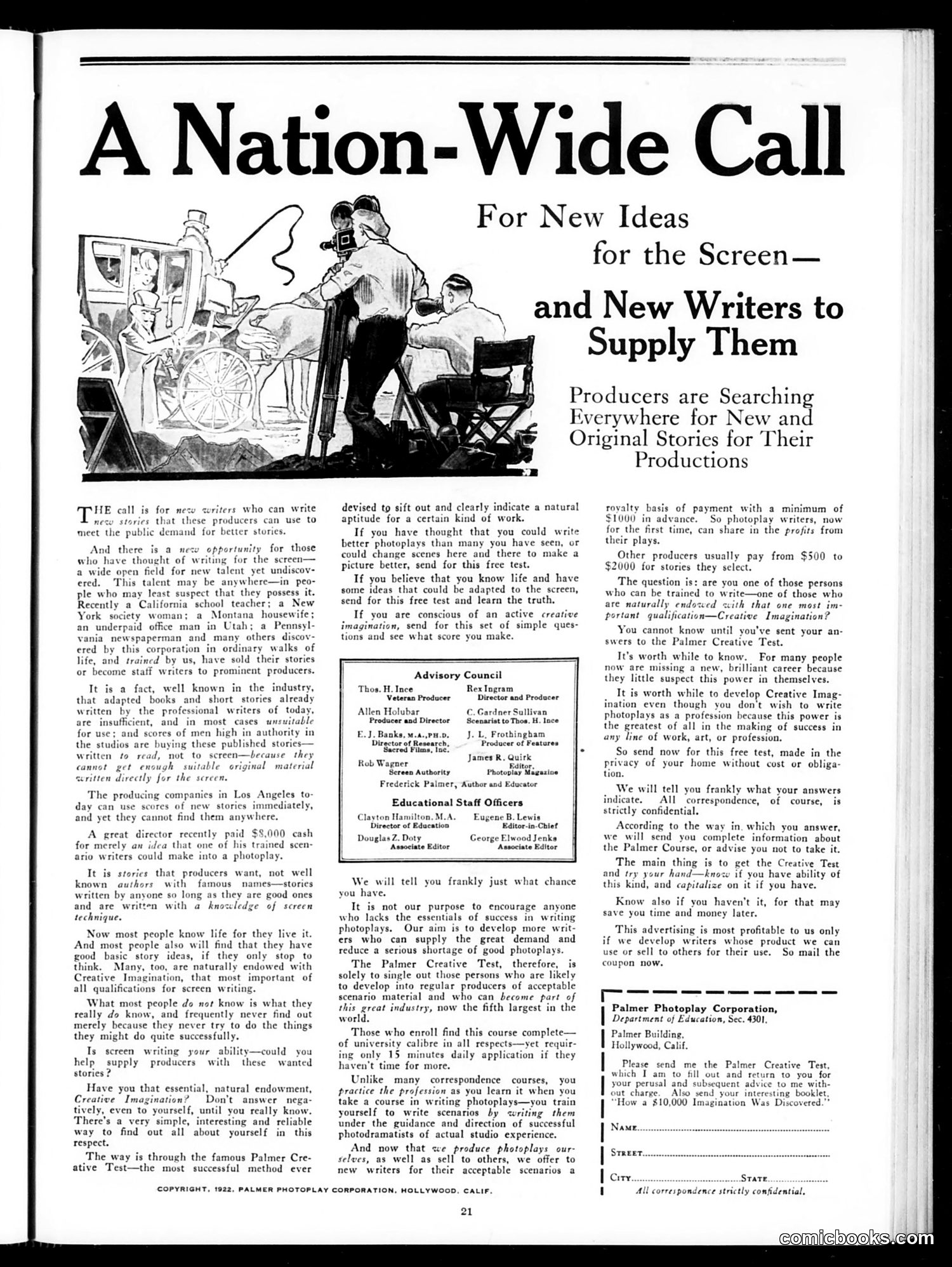
This page is primarily a **recruitment advertisement** rather than satire or commentary. It represents Hollywood's search for new screen story material during the silent film era (copyright 1922). The text announces that film producers actively need original stories but cannot find them in sufficient quantity. The cartoon illustration shows filmmaking activity (camera, crew, action) to visualize the industry's hunger for content. The actual "call" is to ordinary people—schoolteachers, housewives, office workers, newspapers men—who possess "Creative Imagination." The Palmer Corporation offers a free "Creative Test" to identify latent screenwriting talent nationwide. There's no political satire here; this is a genuine (if somewhat ambitious) business solicitation promising that untrained people might possess valuable storytelling abilities suitable for film adaptation.
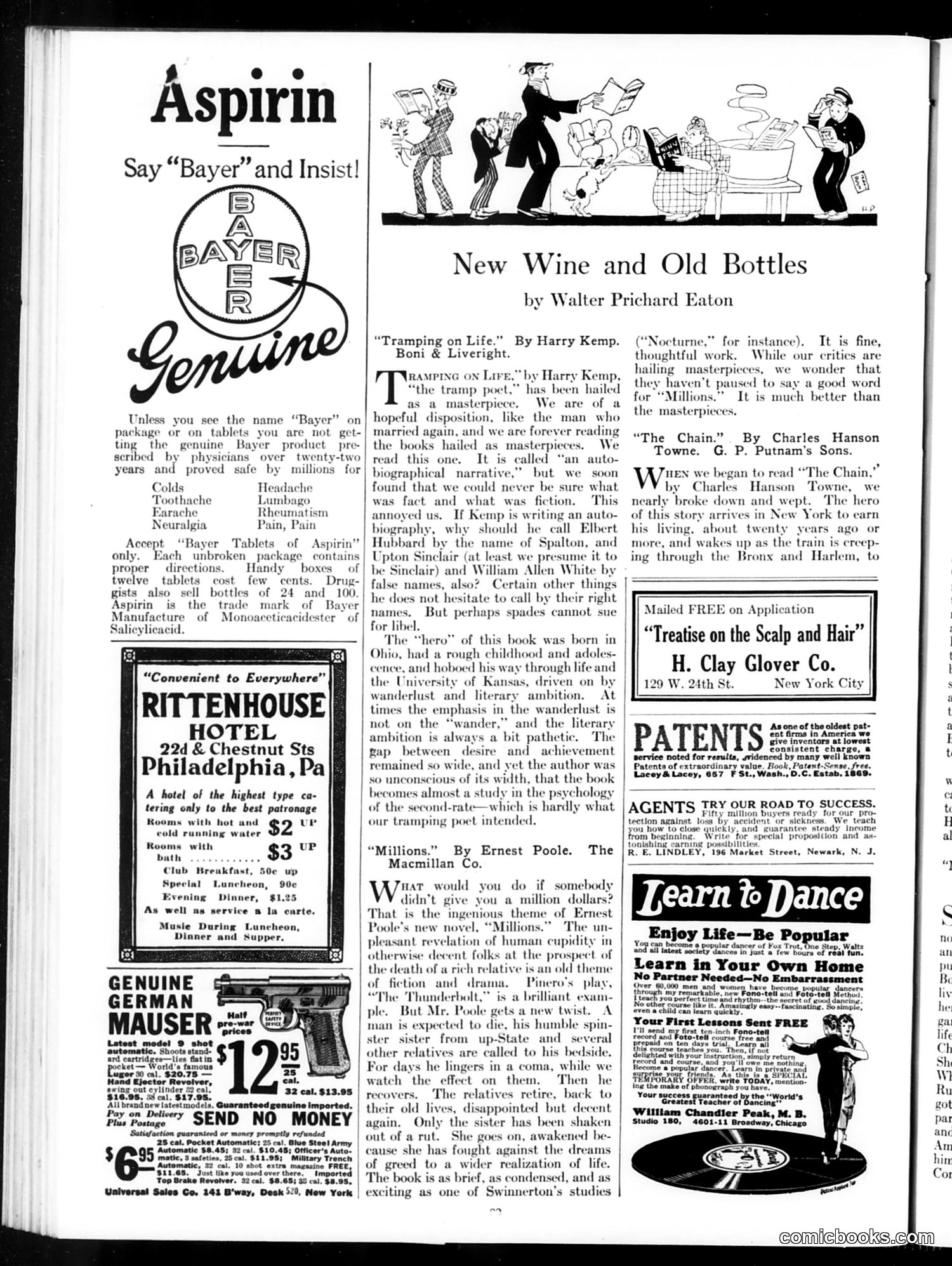
This page is primarily **advertising and book reviews**, not political satire. The top illustration shows a chaotic domestic scene—likely representing general household disorder—but serves mainly as decorative header for Walter Prichard Eaton's book review column. The reviews themselves critique three contemporary books: Harry Kemp's autobiography "Tramping on Life" (criticized for using false names for real people like Elbert Hubbard), Ernest Poole's novel "Millions" (about relatives' greed when expecting an inheritance), and Charles Hanson Towne's "The Chain." The surrounding advertisements reflect early 1920s commerce: Bayer Aspirin emphasizing brand-name authenticity, a Philadelphia hotel, a German automatic pistol, a dance instruction course, and a hair treatise. The pistol ad is notably casual by modern standards—marketed without safety concerns as a pocket weapon. No specific political figures or events are referenced. This is a standard magazine page mixing consumer goods promotion with literary criticism.
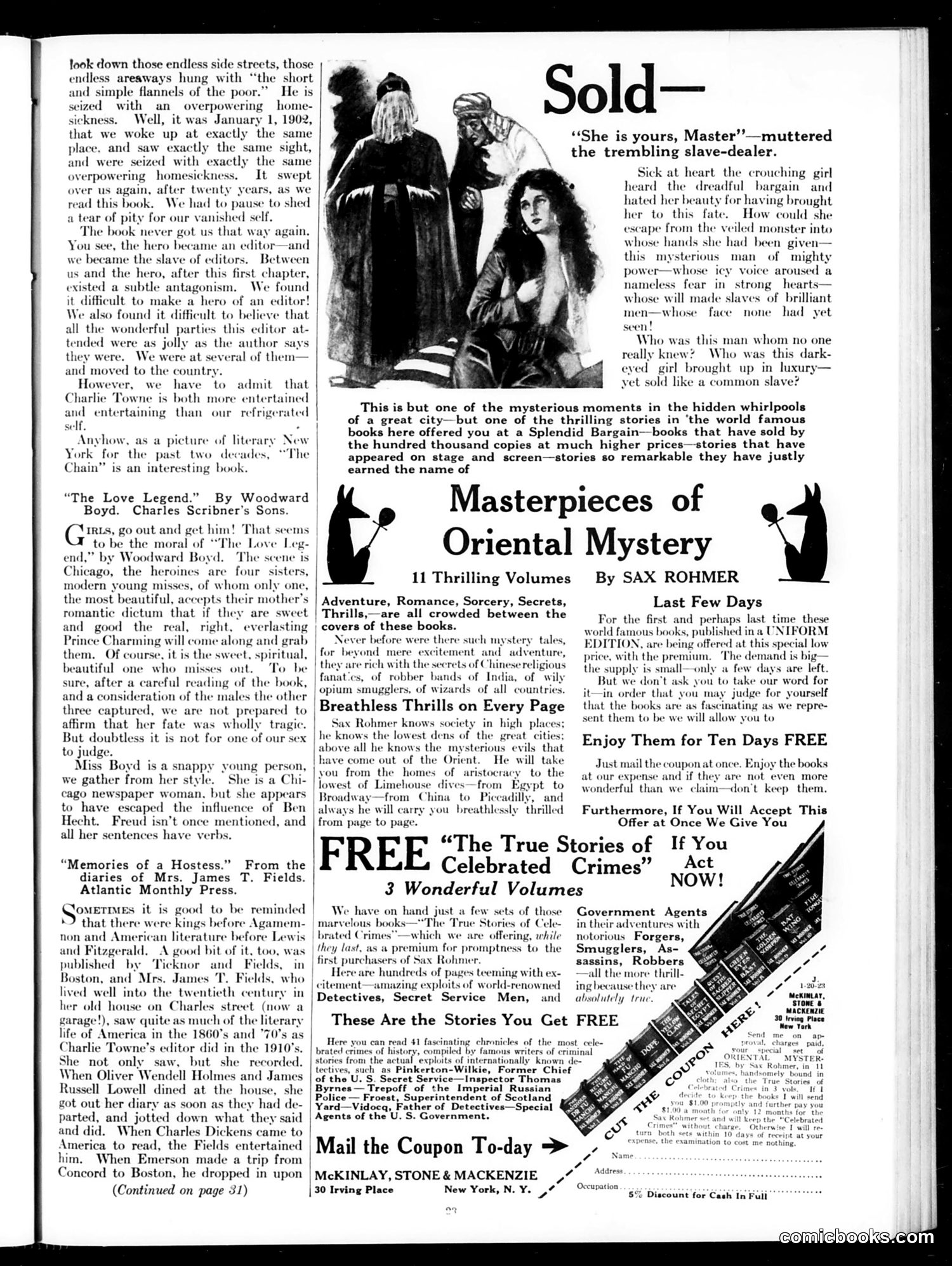
This page is primarily **advertising and book reviews**, not political satire. The main content consists of: **Book Reviews:** Literary criticism of three books—"The Love Legend" by Woodward Boyd (about Chicago sisters seeking romance), and memoirs of Mrs. James T. Fields (a 19th-century Boston hostess). **The Illustration:** Shows a dramatic slave-trade scene—part of an advertisement for "Masterpieces of Oriental Mystery," an 11-volume series by Sax Rohmer. The image depicts a transaction between dealers and a frightened woman, highlighting the sensational content these adventure novels offered. **The Advertisement:** Promotes Sax Rohmer's exotic mystery stories featuring "Adventure, Romance, Sorcery, Secrets, Thrills"—with a free offer of "The True Stories of Celebrated Crimes." There is **no political cartoon or satire** on this page. It's a standard magazine layout mixing literary commentary with period pulp-fiction marketing designed to appeal to early 20th-century readers seeking thrilling, exotic entertainment.
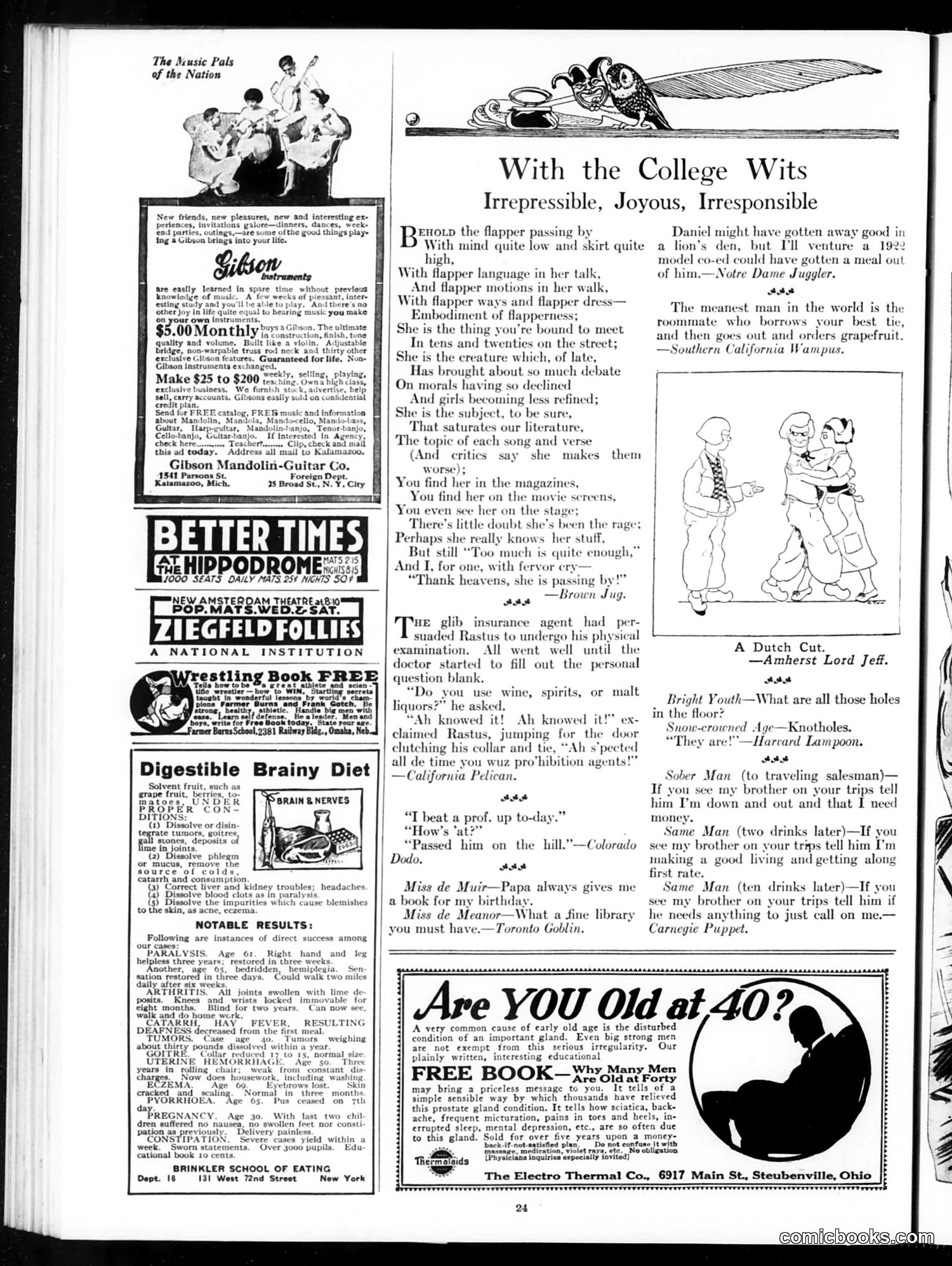
This page primarily features a poem mocking the "flapper"—the modern young woman of the 1920s who scandalized traditionalists with her short skirts, bobbed hair, loose morals, and independent behavior. The poem catalogs her ubiquity in popular culture (magazines, movies, stage) while expressing exasperation at her dominance of contemporary literature and social debate. The accompanying cartoon depicts three young people in flapper-era clothing, illustrating the "irrepressible, joyous, irresponsible" youth the text describes. Below are various college humor jokes lampooning different social types: insurance agents questioning Black men about alcohol during Prohibition, students boasting, and a drunk man's changing fortunes—typical collegiate satire of the period. The page reflects 1920s anxieties about rapidly changing gender roles and youth culture following World War I.
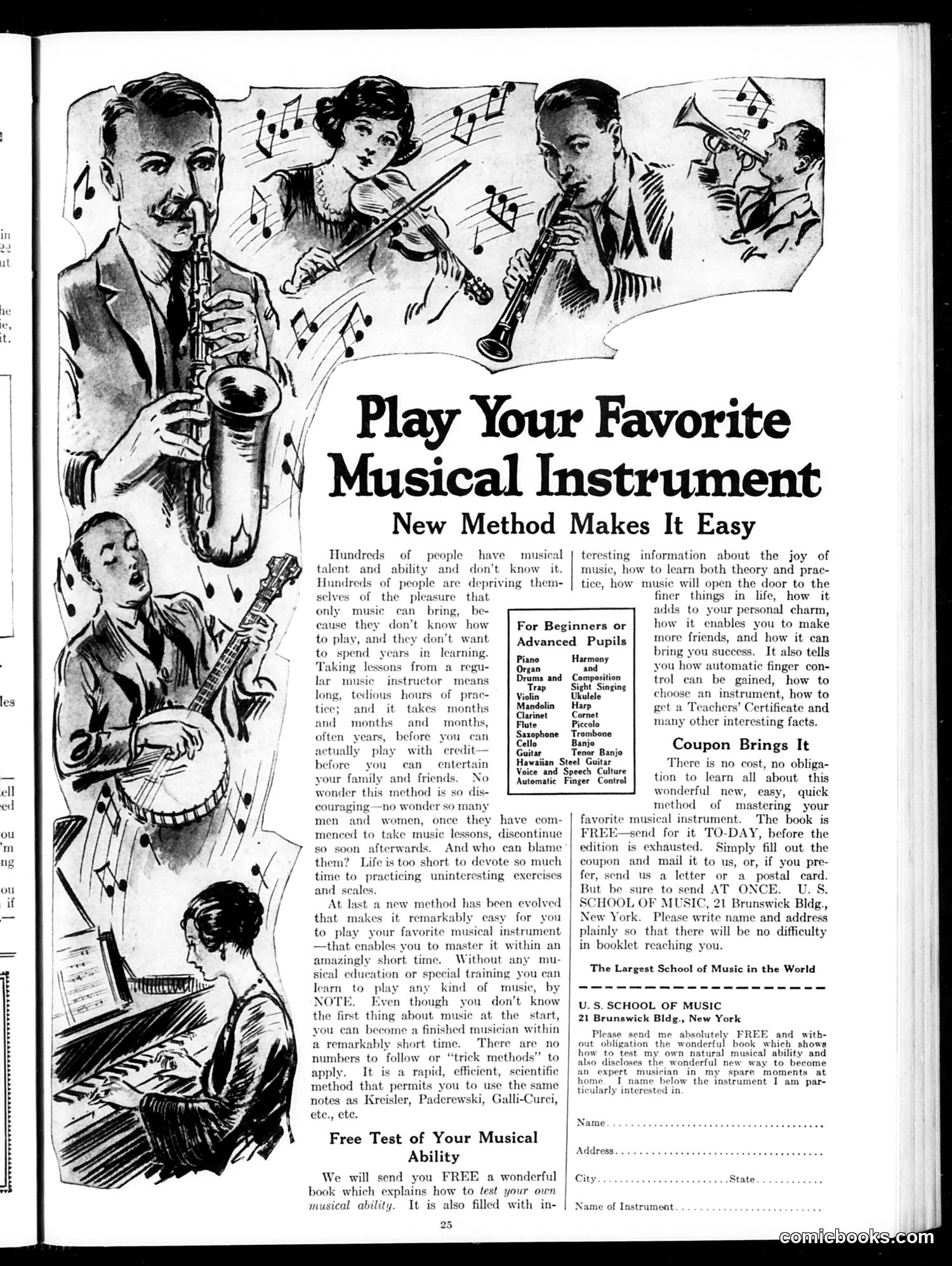
This is **not a political cartoon**, but rather a **full-page advertisement** for the U.S. School of Music, appearing in Judge magazine. The illustrations show musicians of various eras playing different instruments (saxophone, violin, trumpet, banjo, piano). The ad makes an appeal to ordinary people who believe they lack musical talent: it promises that anyone can learn to play professionally in a "remarkably short time" without years of tedious lessons from traditional instructors. The pitch emphasizes personal enrichment ("adds to your personal charm," "brings you success") and convenience ("spare moments at home"). A coupon offers a free aptitude test and instructional book. **The satirical context**: Judge likely ran this as an example of dubious mail-order promises common in early 20th-century magazines—the kind of "learn X in weeks!" advertisements that were often exaggerated. The earnest copy promising rapid mastery would have been recognizable to readers as typical advertising hyperbole of the era.
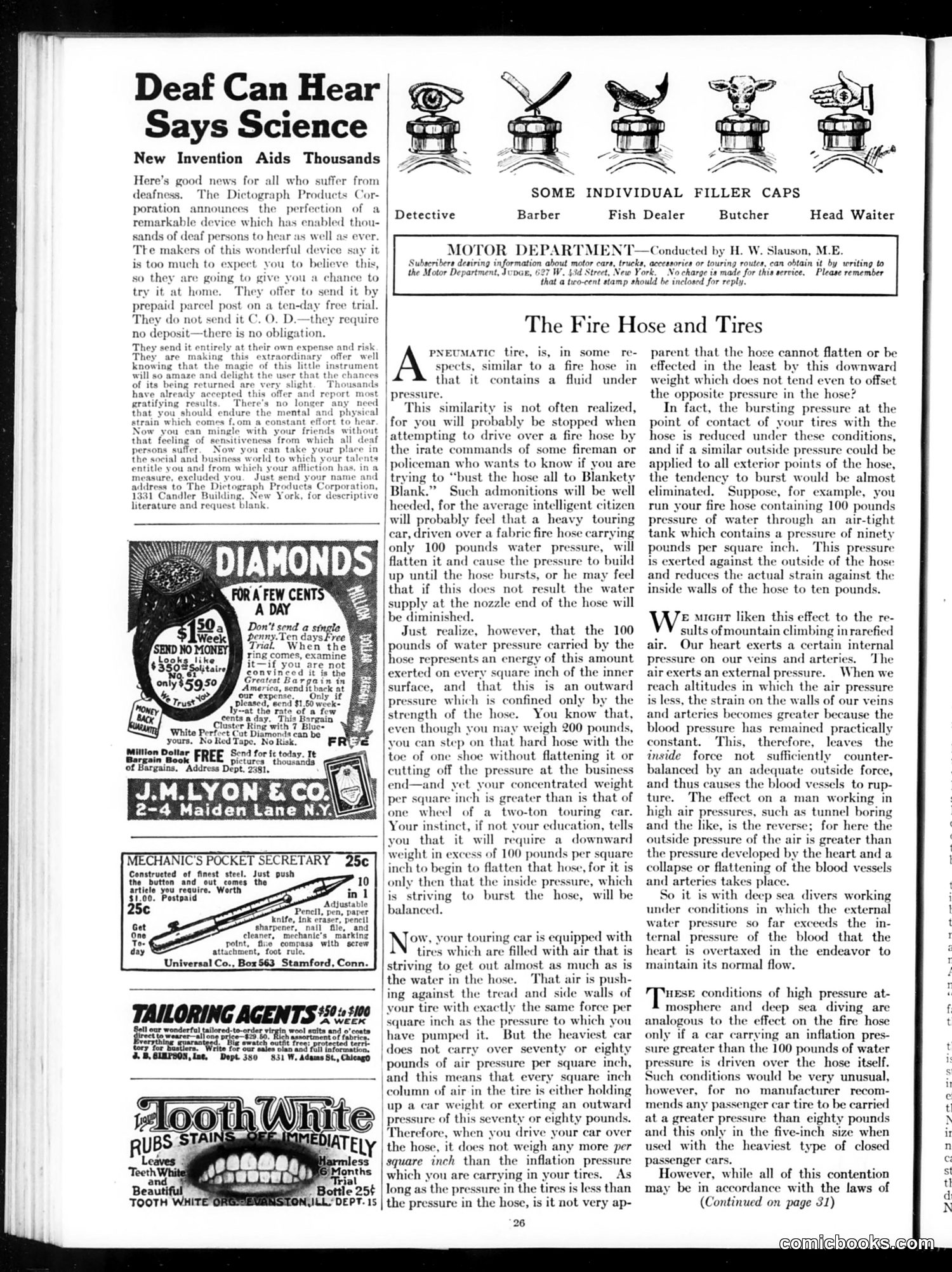
This is primarily **not satire or political cartoon** — it's a **technical educational article** explaining a counterintuitive physics principle to general readers. The piece uses the analogy of a car tire (filled with air pressure) compared to a fire hose (filled with water pressure) to demonstrate that pressure, not total weight, determines whether something flattens. The author argues that despite a heavy touring car's weight, its tires won't flatten a fire hose because the air pressure inside the tire is only 70-80 pounds per square inch — less than the hose's 100-pound water pressure. The article addresses a common misconception: that a heavy vehicle would burst or flatten a fire hose. Instead, it shows that pressure distribution matters more than gross weight. The page contains **period advertisements** (diamonds, dental products, pocket secretaries) typical of Judge magazine, but these lack satirical intent — they're standard commercial ads.
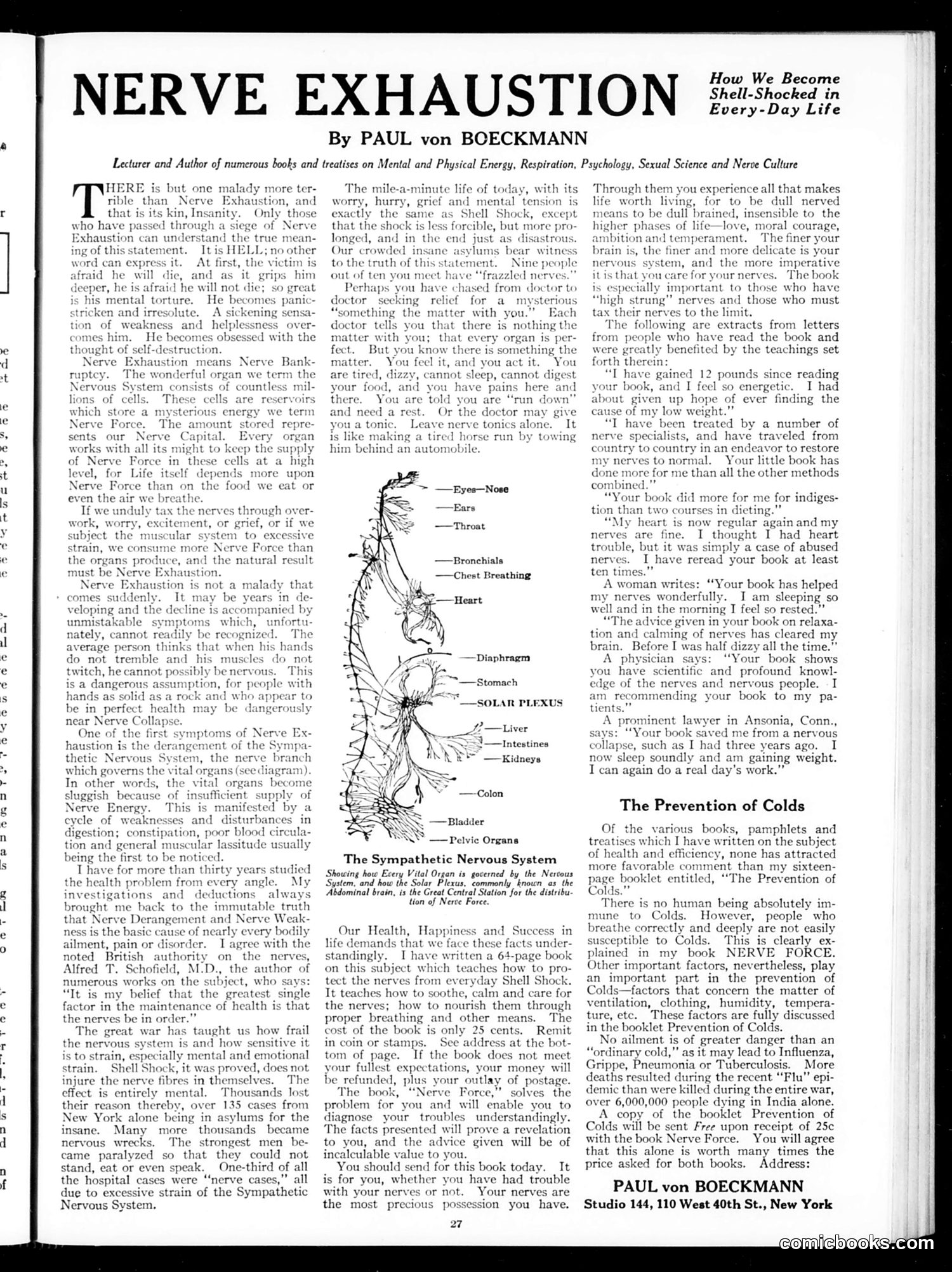
This is not a political cartoon but rather **advertorial content**—a lengthy article promoting von Boeckmann's health book on nerve exhaustion and vitality. The piece uses "Shell Shock" (psychological trauma from WWI combat) as its primary analogy for modern nervous breakdown. Von Boeckmann argues that everyday life—"the mile-a-minute life of today, with its worry, hurry, grief and mental tension"—produces the same debilitating effects as wartime trauma. The accompanying **anatomical diagram** shows the sympathetic nervous system governing vital organs (heart, lungs, stomach, etc.), illustrating his theory that nerve exhaustion disrupts organ function through depleted "Nerve Force." The article includes testimonial letters from satisfied readers claiming the book cured fatigue, weight gain, and nervousness. **Historical context**: This reflects early-20th-century pseudoscientific "nerve tonic" marketing, where vague health concerns were attributed to nervous system depletion—a common sales pitch before modern medicine.
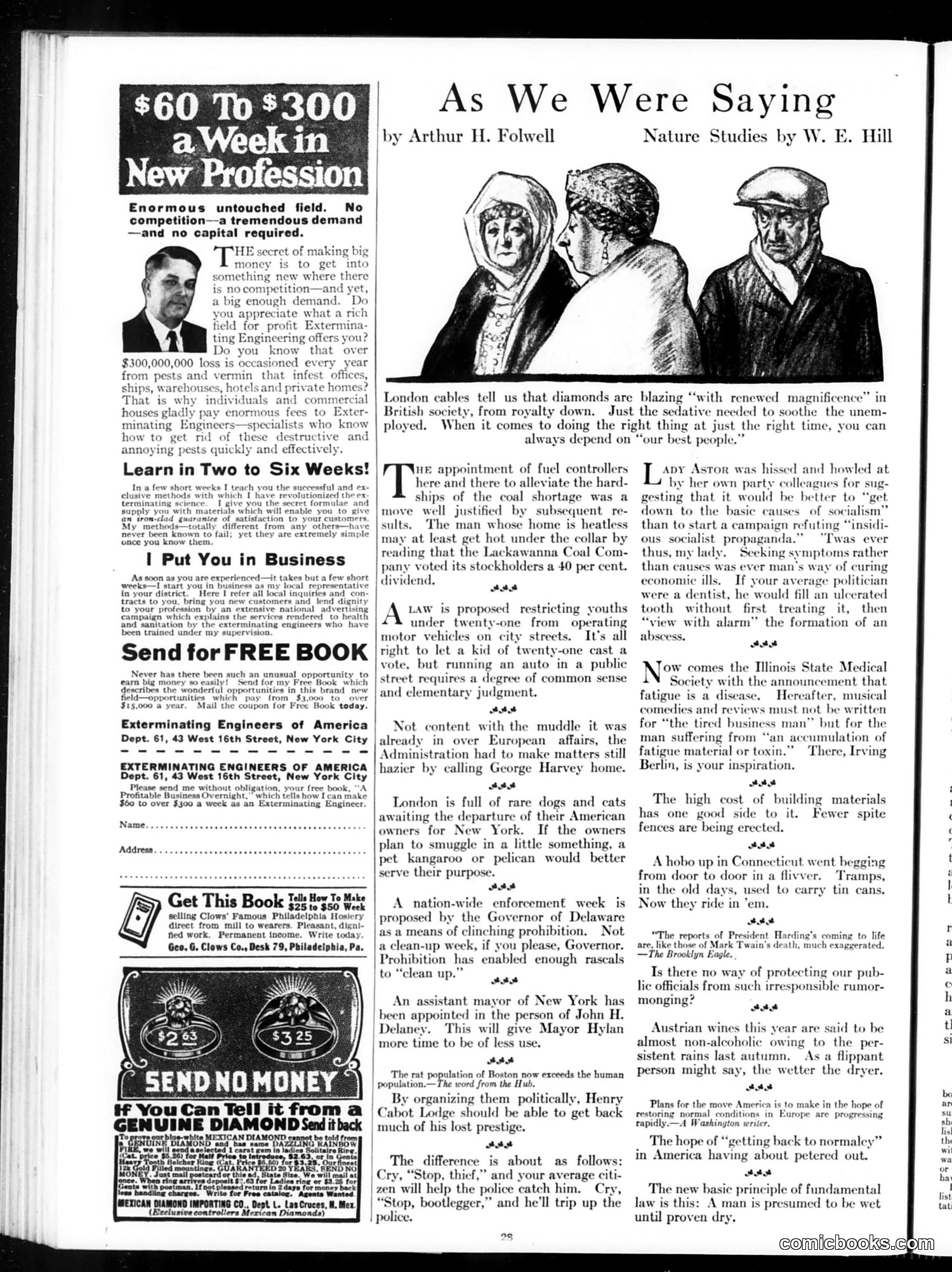
This page mixes advertisements and short satirical commentaries typical of Judge magazine's format. The main cartoon (upper right) by W.E. Hill depicts three people in conversation but lacks clear context clues about who they represent. The text beneath consists of brief, humorous social observations on contemporary issues: - **Fuel controllers**: Mocking the hypocrisy of coal shortage appointments while the Lackawanna Coal Company paid shareholders 40% dividends - **Young drivers**: Criticizing proposed age restrictions—questioning whether teens fit to vote can't handle cars - **George Harvey**: Suggesting Wilson administration mishandled international affairs by recalling Harvey - **Prohibition enforcement**: Sarcastically noting the Governor's "clean-up week" proposal when prohibition already enabled criminals to "clean up" - **Boston rats**: Making political jokes about organizing rats to restore Henry Cabot Lodge's prestige The left side contains business advertisements (exterminating services, diamond importing) unrelated to editorial content. The satire focuses on post-WWI American political incompetence and the emerging prohibition era's contradictions.
This page from Judge magazine is primarily an **Investment Bureau advice column** rather than a satirical cartoon piece. The main content consists of financial guidance and railroad industry commentary by Theodore Williams. The notable element is the **editorial titled "Still Baiting the Railroads,"** which argues that Congress is unfairly harassing American railroads through excessive legislation (134 bills mentioned). The author characterizes railroad critics as economically ignorant politicians and their followers engaging in "anti-railroad bolshevism"—equating railroad regulation with radical socialism. The accompanying **small cartoons** (two figures shown) appear to illustrate financial discussions, though details are unclear from the OCR. The editorial's perspective reflects **pro-business sentiment** typical of the 1920s financial press, defending railroads as vital national infrastructure from what the author frames as populist or radical political attacks. The page includes standard advice columns about real estate investments and stock recommendations.
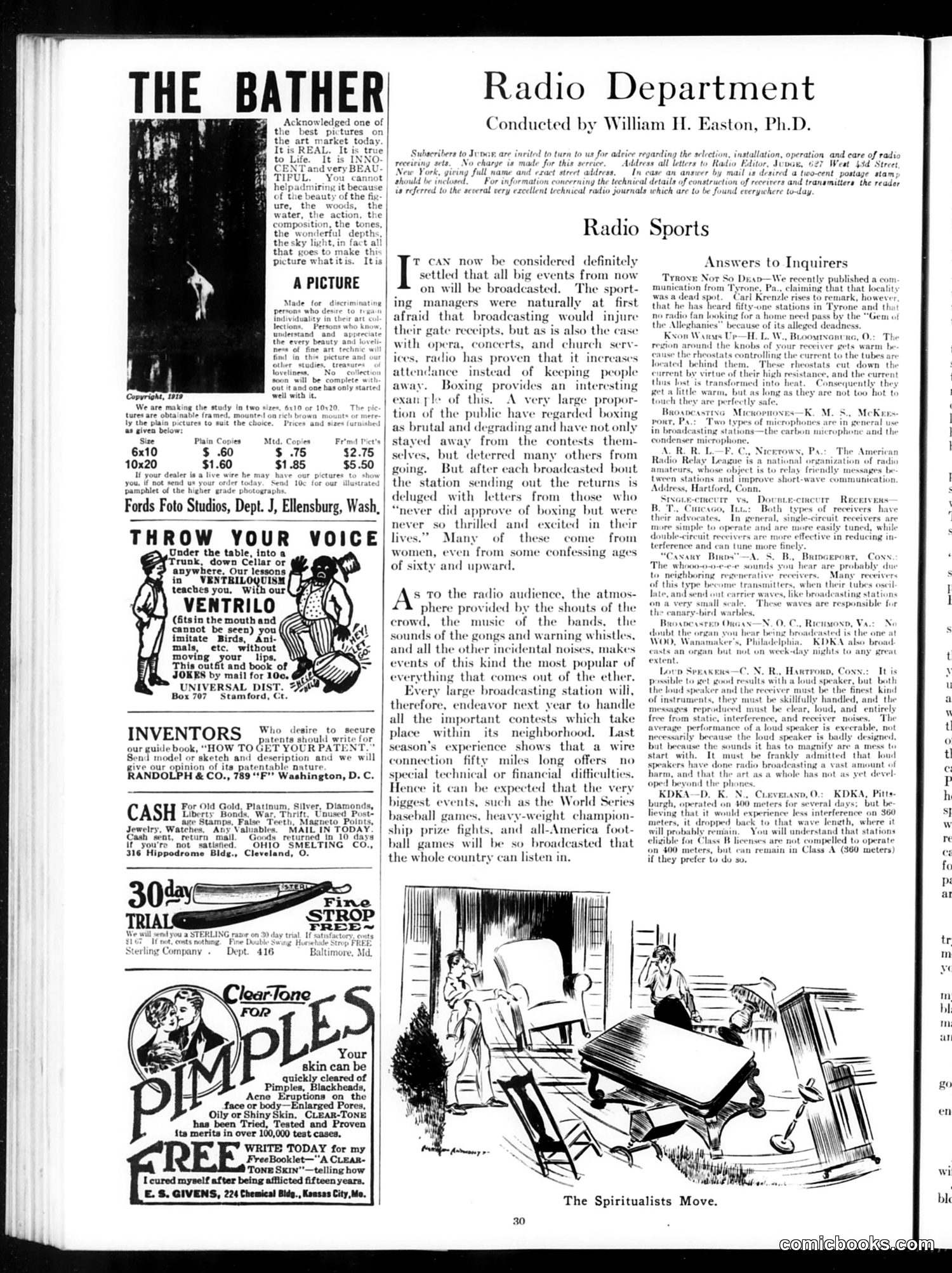
This page is primarily a **Radio Department editorial** by William H. Easton, Ph.D., discussing how radio broadcasting is expanding sports coverage—particularly boxing matches. The key argument is that broadcasting large sporting events (boxing, baseball, football) *increases* rather than decreases attendance, contrary to managers' initial fears. The piece notes that radio's atmospheric appeal—crowd noise, band music, warning whistles—makes sports events "the most popular of everything that comes out of the ether." The cartoon at bottom ("The Spiritualists Move") appears unrelated to the radio content—it depicts what seems to be a domestic or séance scene with figures moving furniture, likely satirizing spiritualism as a fad. The remainder consists of **period advertisements** for ventriloquism lessons, skin treatments, smelting services, and photo studios—typical early 1920s magazine filler unrelated to the main article's substance.
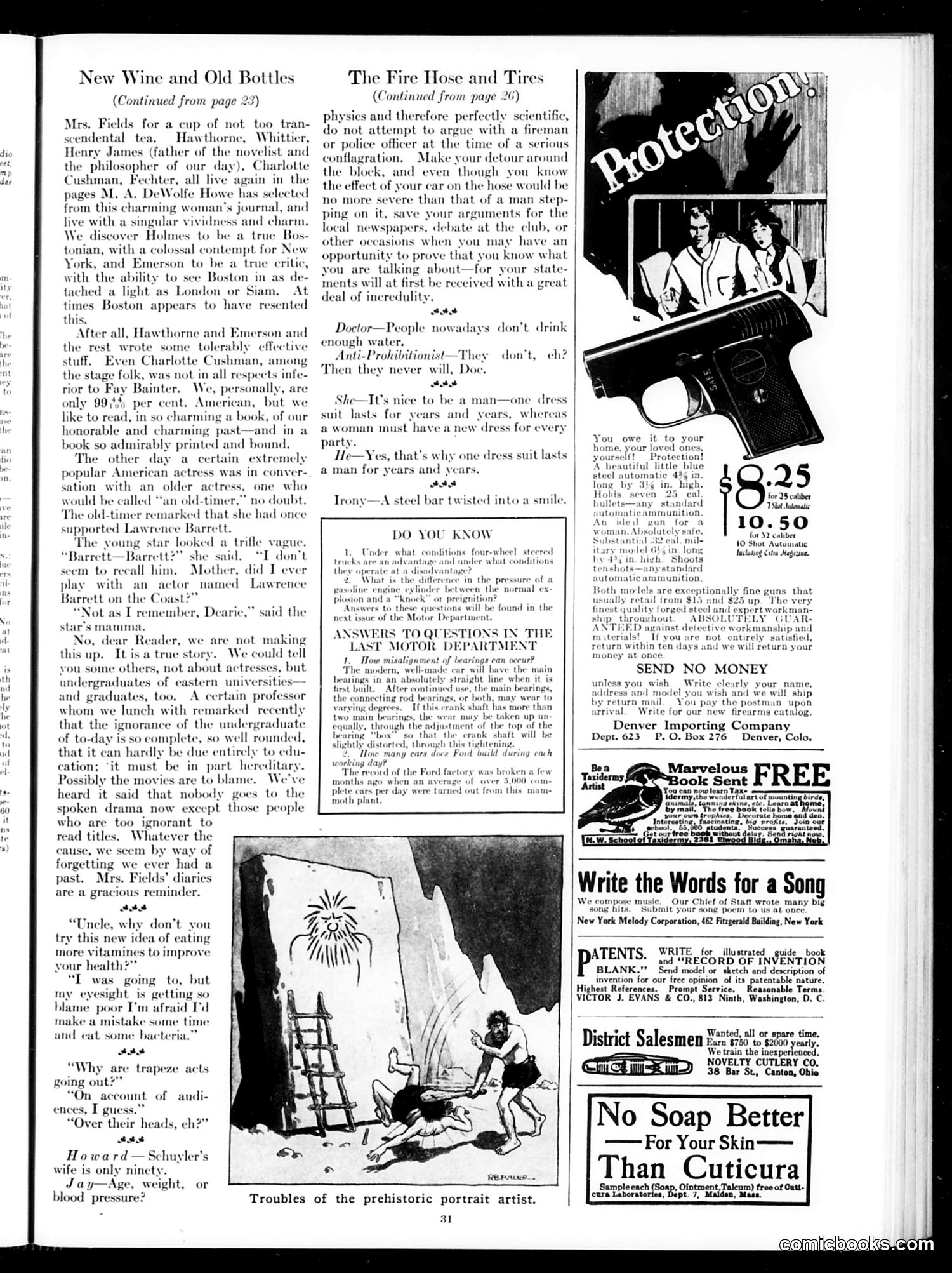
This page combines literary commentary with humor pieces. The main essay discusses a new book by M.A. DeWolfe Howe featuring diary excerpts from someone (likely Annie Fields) who knew famous 19th-century American writers—Hawthorne, Emerson, Holmes, James, and others. The author celebrates these figures while noting their regional Boston pride and America's tendency to forget its cultural past. The humor pieces mock modern ignorance: an actress doesn't recognize the name "Lawrence Barrett" (a famous 19th-century actor); undergraduates are shockingly uneducated; people avoid theater for movies. Brief jokes about Prohibition-era water-drinking and gender differences in clothing round out the page. The cartoons illustrate these themes of lost knowledge and social change. Overall, the page laments America's disconnection from its literary and theatrical heritage.
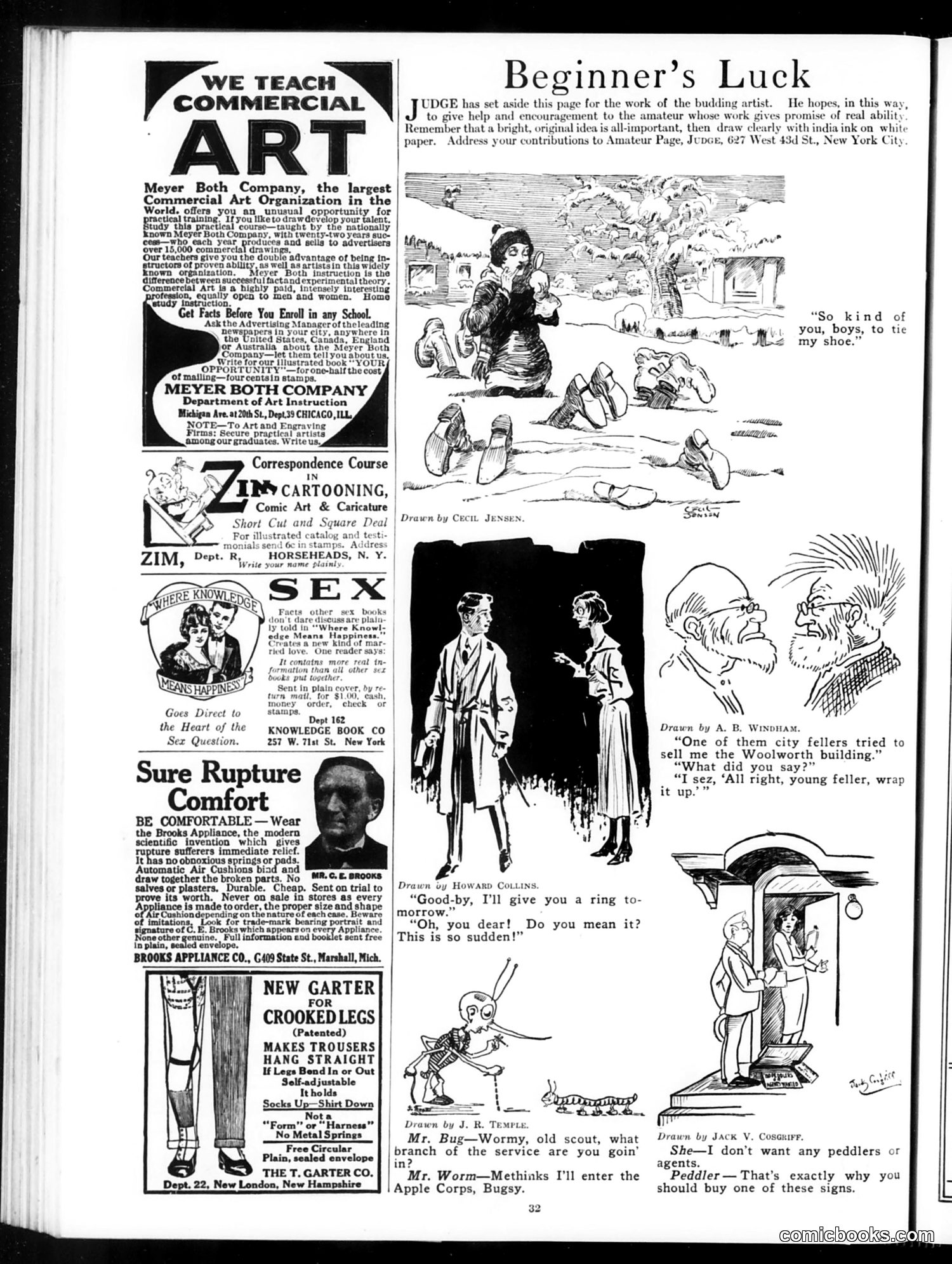
This is primarily an **advertising page** with several unrelated comic cartoons scattered throughout. The page's main purpose is to promote commercial art schools and various products (rupture appliances, garters, knowledge books). The cartoons themselves are brief, simple gags with no political content: - **Jensen's drawing**: Children help tie an adult's shoe, misunderstanding the phrase "so kind of you" - **Collins' drawing**: A man proposes with a ring; the woman misinterprets his casual remark as a marriage proposal - **Temple's cartoon**: A bug and worm discuss military service; the worm jokes about joining the "Apple Corps" (pun on Army Corps) - **Windsham's drawing**: A rural person claims a city con artist sold him the Woolworth Building - **Cosgriff's drawing**: A peddler sells "No Peddlers" signs to someone trying to avoid salesmen These are lighthearted domestic and situational humor with no deeper satirical meaning—typical filler material for early 20th-century magazines. The page's real value lay in its advertisements targeting aspiring artists and medical/fashion product consumers.
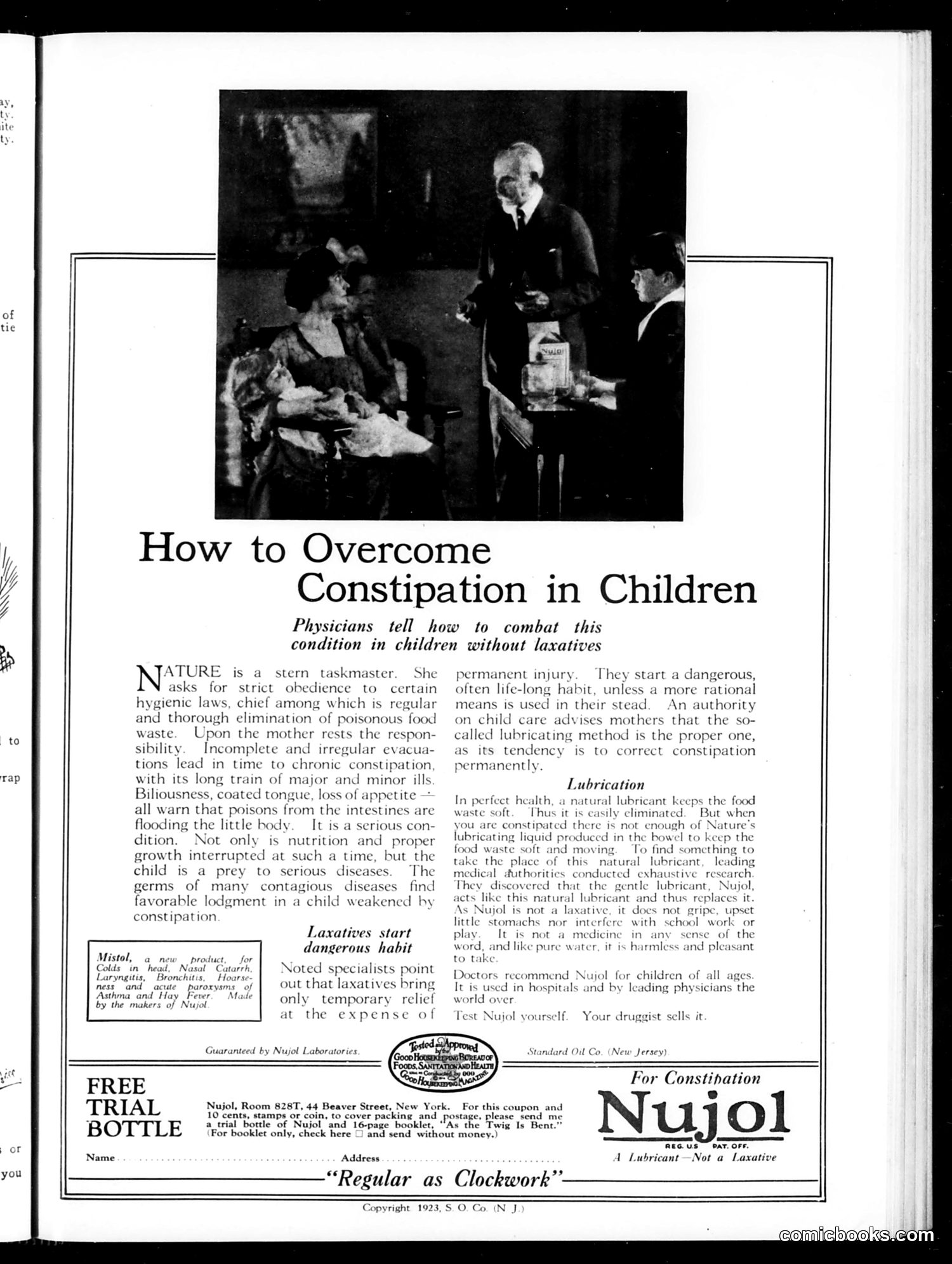
This page is **primarily a product advertisement**, not a political cartoon. It promotes Nujol, a mineral oil laxative made by Standard Oil Company, marketed to parents concerned about childhood constipation. The image shows what appears to be a doctor or medical authority (standing, center) consulting with a mother and child, lending medical credibility to the product. The advertisement argues that traditional laxatives are dangerous and habit-forming, positioning Nujol as a safer "lubricant" alternative that mimics natural bodily functions rather than forcing evacuation. The tagline "Regular as Clockwork" plays on the period's obsession with regularity as a moral and health virtue. The copy emphasizes endorsements from physicians and hospitals, a common marketing strategy of the 1920s for pharmaceutical products sold without modern FDA regulation. There is **no satirical content or political cartoon** on this page—it's straightforward advertising using health anxiety and medical authority to sell a product.
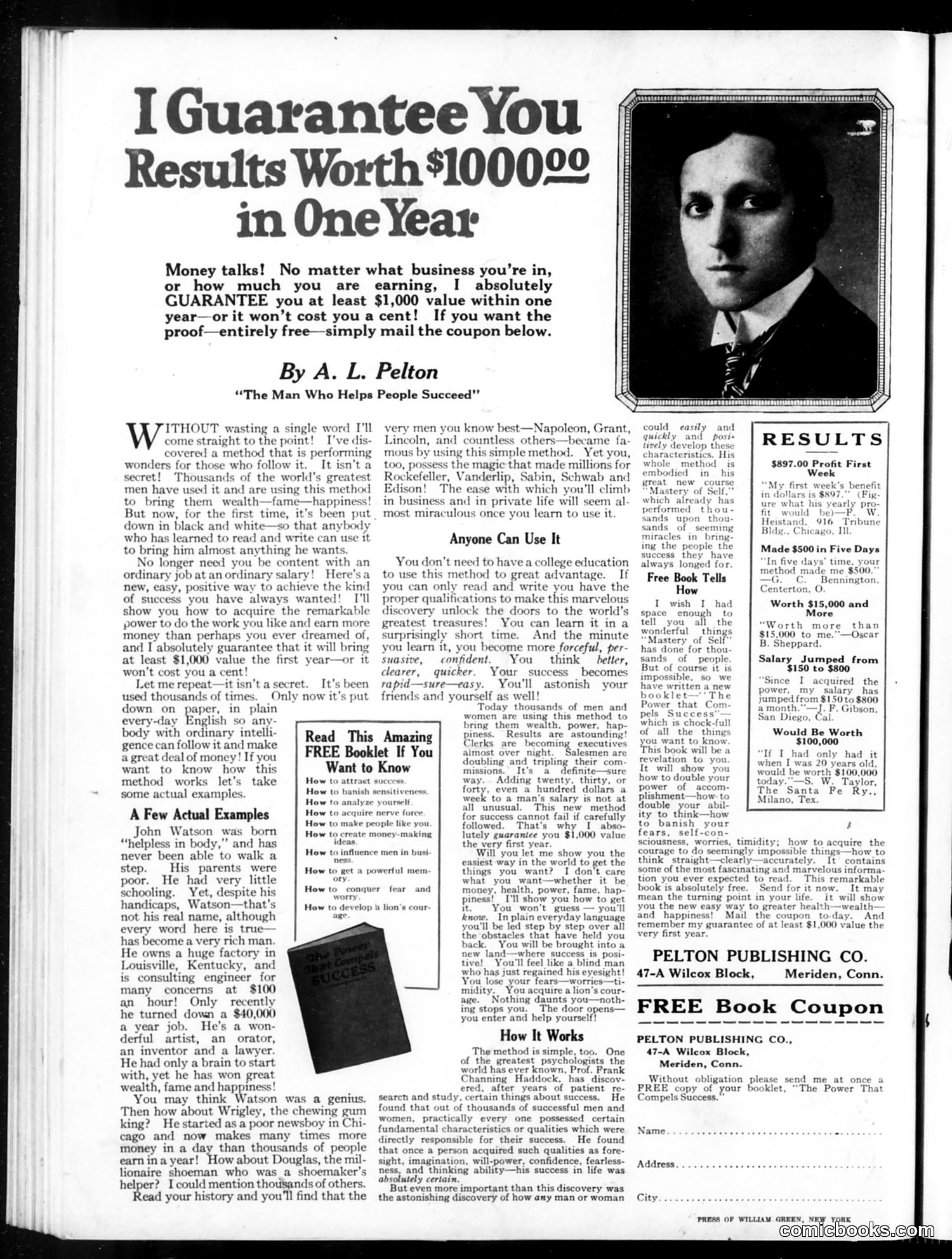
This is primarily a **full-page advertisement**, not satirical content. It promotes A. L. Pelton's self-help book promising "$1,000 value in one year" through an unspecified success method. The ad employs common early-20th-century direct-mail tactics: breathless promises, testimonials (John Watson, Wrigley, Douglas), and appeals to ordinary people's desire for wealth without education. The phrase "Anyone Can Use It" and repeated guarantees target working-class readers. While Judge was a satirical magazine, this page appears to be paid advertising rather than editorial satire. However, the page itself could be *ironic*—Judge may have been satirizing such get-rich-quick schemes by running this earnest, overblown advertisement. The gap between grandiose promises and vague methodology ("I won't waste a word") is characteristically absurd. The portrait of Pelton and the earnest testimonials about disabled Watson becoming a millionaire engineer reflect period optimism about self-improvement, which Judge likely mocked.