
Judge, 1923-01-20 · page 3 of 36
Judge — January 20, 1923 — page 3: what you’re looking at
What you’re looking at
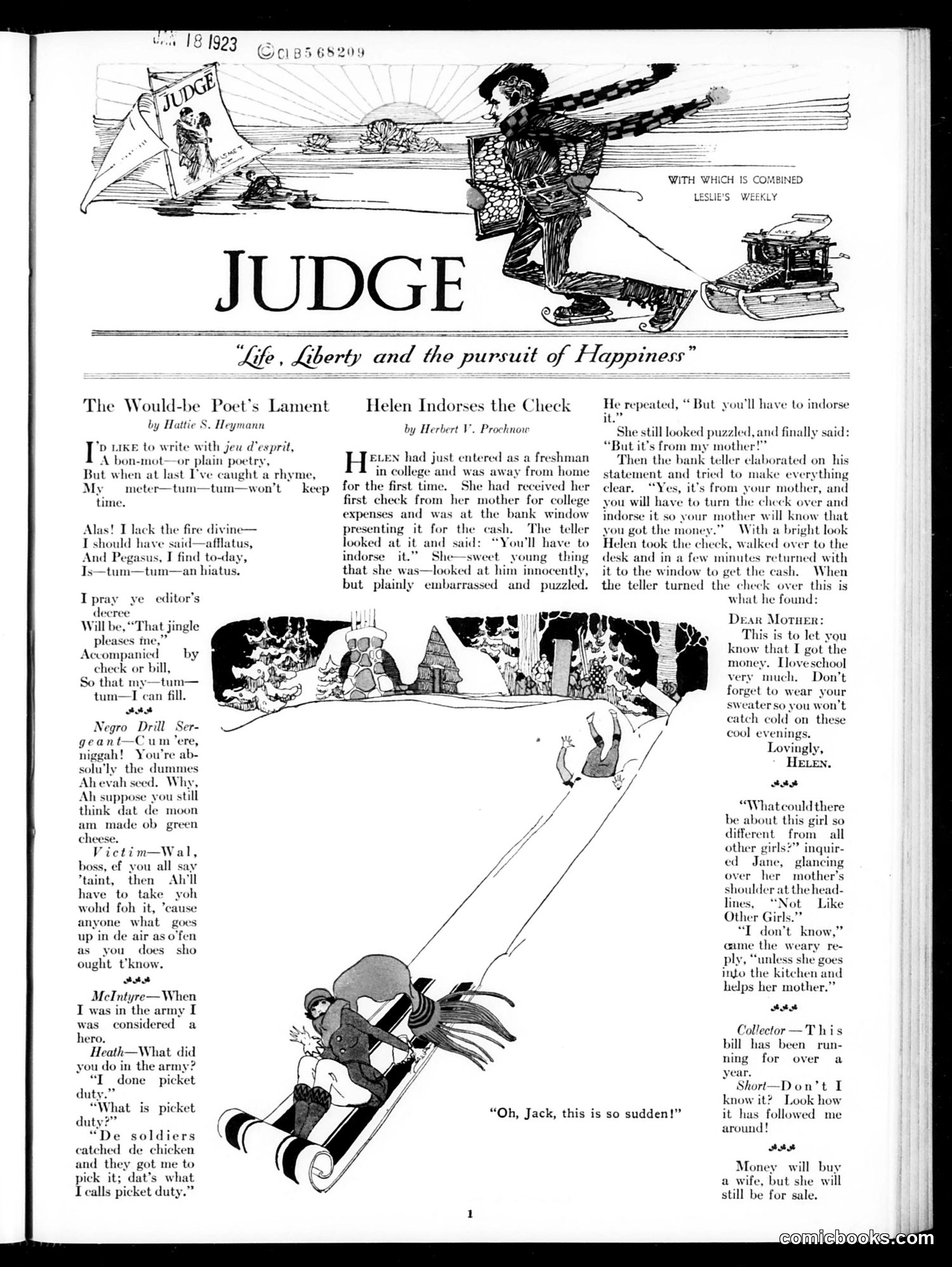
This page contains three separate humorous pieces rather than unified political commentary: 1. **"The Would-be Poet's Lament"** satirizes an aspiring poet's struggle with rhyming, using exaggerated dialect ("Ah'll," "taint") for comedic effect. 2. **"Helen Endorses the Check"** depicts a young woman (Helen) embarrassed when a bank teller questions a check from her mother—the joke hinges on her confusion about endorsement procedures and maternal financial dependence. 3. **"Negro Drill Sergeant"** and **"McIntyre" dialogues** use period ethnic comedy stereotypes, now offensive, featuring exaggerated dialect humor typical of 1920s entertainment. The illustrations show sledding and domestic scenes. The page reflects era-specific humor styles—linguistic comedy, banking confusion, and ethnic caricature—that modern readers would find dated or problematic.
📄 Transcribed text from this page (OCR, searchable)
Machine-transcribed from the original scan — historical spelling and the odd misread are preserved.
ven 18 1923 ©cig5 68209 1e Would-be Poet’s Lamen The Would-be Poet's I t by Hattie S. Heymann ‘D LIKE to write with jeu d'esprit, A bon-mot—or plain poetry, But when at last I've caught a rhyme, My — meter—tum—tum—won’t keep time. Alas! T lac I should And Pegasus, I find to-day, Is—tum—tum—an hiatus, editor's That jingle pleases ie,” Accompanied check or bill, So that my—tum— tum—I can fill. by ‘Life, Liberty and the pursuit Helen Indorses the Check by Herbert V. Procknow ELEN had just entered as a freshman in college and w y from home for the first time. She had received her first check from her mother for college s and was at the bank window ng it for the cash, The teller looked at it and said: oll have to indorse _ it She—sweet young thing that she was—looked at him innocently, but plainly embarrassed and puzzled. rer Negro Drill Ser- geant—Cum’ere, niggah! You're ab- y the dummes Ahevah secd. Why, Ah suppose you still think dat de moon am made ob green cheese. Victim—Wal, boss, ef you all say *taint, then Ah'll have to take yoh wohd foh it, ‘cause anyone wh up in de as you does ought t’know. sho MeIntyre—When I was in the army I was considered a hero. Heath—What did you do in the army? “T done picket duty. hat is picket Ye soldiers ched de chicken 1 they got me to i ’s_ what “Oh, Jack, this is so sudden!” . ” Gppiness ; He repeated, “ But you'll have to indorse it.” She still looked puzzled, a “But it’s from my moth Then the bank teller elaborated on his statement and tried to make everything clear. “Yes, it’s from your mother, and you will have to turn the check over and indorse it so your mother will know that you got the money.” With a bright look Helen took the check, walked over to the desk and in a few minutes returned with it to the window to get the cash. When the teller turned the check over this is what he found: nd finally said: Dear Mortuer: This is to let you know that I got the money. Ioveschool very much. Don’t forget to wear your sweater so you won't catch cold on these cool evenings. Lovingly, HELEN. tas “Whatcould there be about this girl so different from all other girls?” inquir- ed Jane, glancing over her mother’s shoulder at the head- lines, “Not Like Other Girls.” “IT don’t know,’ came the weary r ply, “unless she goes into the kitche: helps her mother.” tot Collector —This bill has been run- ning for over a year, Short—D on’t I know it? Look how it has followed me around! PAH Money will buy a wife, but she will still be for sale.