
Judge, 1923-01-20 · page 21 of 36
Judge — January 20, 1923 — page 21: what you’re looking at
What you’re looking at
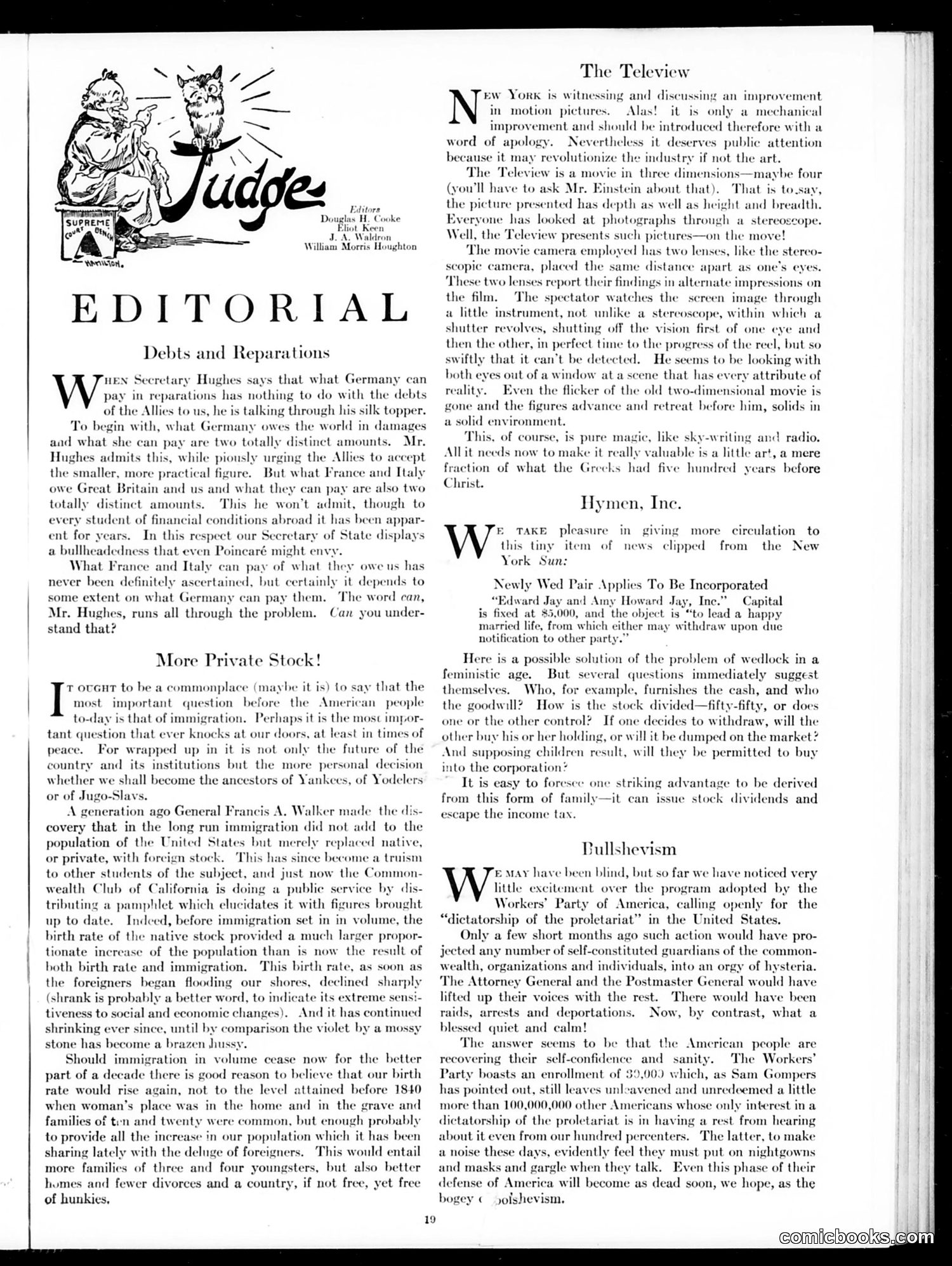
This editorial page from Judge magazine addresses three distinct topics: **"Debts and Reparations"** critiques Secretary of State Charles Evans Hughes's post-WWI reparations policy, arguing he falsely separates German reparations from Allied debts to America. The editor contends all amounts are interconnected financially—Hughes's position is logically inconsistent. **"More Private Stock!"** attacks immigration policy using period-typical eugenic language ("hunkies," concern about "Yodelers" and "Jugo-Slavs"). The piece argues immigration suppresses native American birth rates and advocates restricting immigration to restore population growth among native-born citizens. **"The Teleview"** reviews an early 3D cinema technology, praising its mechanical innovation while dismissing it as mere technical advancement lacking artistic value—it needs "a little art" to truly matter. The cartoonish "Judge" masthead at top shows the magazine's satirical voice. These pieces reflect 1920s-era concerns: war debt, immigration restriction (pre-1924 quotas), and emerging cinema technology.
📄 Transcribed text from this page (OCR, searchable)
Machine-transcribed from the original scan — historical spelling and the odd misread are preserved.
Editors Douglas H. Cooke lint Keen J. A, Waldron William Morris Houghton EDITORIAL Debts and Reparations HEN Secretary Hughes says that what Germany can V V pay in reparations has nothing to do with the debts of the Allies to us, he is talking through his silk topper. Germany owes the world in damages To begin with, wh aad what she can pay are two totally distinct amounts. Mr. Hughes admits this, while piously urging the Allies to accept But what France and aly are also two the smaller, more practical figure. Britain and us and what they can pa This he won't admit, though to conditions abroad it has been appar- c displays owe Gr totally distinct. amounts. every student of financiz ent for years. In this respect our Seere a bullheadedness that even Poincaré might envy What France and Italy can pay of what they owe us has never been definitely some extent on what Germany can pay them, The word can, Mr. Hughes, runs all through the problem. Can you under- stand that? T ovGnt to t most import ary of S ined, but certainly it depends to More Private Stock! commonplace (maybe it is) to say that the an people it question before the Ame to-day is that of immigration, Perhaps it is the most impor- tant question that ever knocks at our doors, at least in times of peace. For wrapped up in it is not only the future of the country and its institutions but the more personal decision whether we shall become the ancestors of Yankees, of Yodelers or of Jugo- A generation ago General Francis A. Walker made the dis- covery that in the long run immigration did not add to the population of the United States but merely replaced native, or private, with foreign stock. This has since become a truism to other students of the subject, and just now the Common- wealth Club of California is doing a public service b; tributing a pamphlet which elucidates it with figures brought up to date. Indeed, before immigration set in in volume, the birth rate of the native stock provided a much larger propor- ionate increase of the population than is now the result of both birth rate and immigration. This birth rate, as soon as the foreigners began flooding our shores, declined sharply < is probably a better word, to indicate its extreme sen to social and economic cl s). And it has continu shrinking ever since, until by comparison the violet by a mossy stone has become a brazen jiussy. Should immigration in volume cease now for the better part of a decade there is good reason to believe that our birth rate would rise again, not to the level ruined before 1840 when woman's place was in the home and in the g nd families of ten and twenty were common, but enough probably to provide all the increase in our population which it has been sharing lately with the deluge of foreigners. This would entail and four youngsters, but also better more families of three homes and fewer divorces and a country, if not free, yet free of hunkies, 19 The Teleview ew York is witnessing and discussing an improvement in motion pictures. Alas! it is only a mechanical improvement and should be introduced therefore with a Nevertheless it deserves public attention because it may revolutionize the industry if not the art. The Teleview is a movie in three dimensions—maybe four (you'll have to ask Mr. Einstein about that). That is to.say, the picture presented has depth as well as height and breadth. word of apology. Everyone has looked at photographs through a. stereoscope. Well, the Teleview presents such pictures—on the move! The movie camera employed has two lenses, like the stereo- scopic camera, placed the same distance apart as one’s eyes. These two lenses report their findings in alternate impressions on the film. The spectator watches the screen image through a little instrument, not unlike shutter revolves, shutting off the then the other, in perfect time to the progress of the reel, but so swiftly that it can’t be detected. He seems to be looking with ves out of a window at a scene that has every attribute of Even the flicker of the old two-dimensional movie is stereoscope, within which a vision first of one eye and reality. gone and the figures advance and retreat before him, solids in a solid environment. This, of course, is pure magic, like sky-writing and radio. Allit needs now to make it really valuable is a little art, a mere fraction of what the Grecks had five hundred years before Christ. Hymen, Ine. TAKE pleasure in giving more circulation to E i \ V this tiny item of news clipped from the New York Sun: Newly Wed Pair Applies To Be Incorporated “Edward J id Ainy Howard Ine.” Capital is fixed at 85,000, and the object is “to lead a happy married life, from which either may withdraw upon due notification to other party. Here is a possible solution of the problem of wedlock in a feministie age. But several questions immediately suggest Who, for example, furnishes the cash, and who the goodwill? How is the stock divided—fifty-fifty, or does one or the other control? If one decides to withdraw, will the other buy his or her holding, or will it be dumped on the market? And supposing children result, will they be permitted to buy themselves. into the corporation? It is easy to foresee one striking advantage to be derived from this form of family—it can issue stock dividends and escape the income tay. Bullshevism E MAY have been blind, but so far we have noticed very \ V little excitement over the program adopted by the Workers’ Party of America, calling openly for the “dictatorship of the proletariat” in the United States. Only a few short months ago such action would have pro- jected any number of self-constituted guardians of the common- tions and individuals, into an orgy of hysteria. al and the Postmaster General would have es with the rest. There would have been Now, by contrast, what a wealth, organi The Attorney Gene lifted up their voi arrests and deportations. 1 quiet and calm! Th ms to be that the Ameri recovering their self-confidence and_ sanity. 900 which, as Sam Gompers ned and unredeemed a little raids, answer s¢ The Workers’ Party boasts an enrollment of 3 has pointed out, still leaves unle: more than 100,000,000 other Americans whose only interest in a is in having a rest from hearing dictatorship of the proleta about it even from our hundred percenters. The latter, to make a noise these days, evidently feel they must put on nightgowns and masks and gargle when they talk. Even this phase of their defense of America will become as dead soon, we hope, as the bogey © jolshevism. comichooks,