
Judge, 1923-01-20 · page 15 of 36
Judge — January 20, 1923 — page 15: what you’re looking at
What you’re looking at
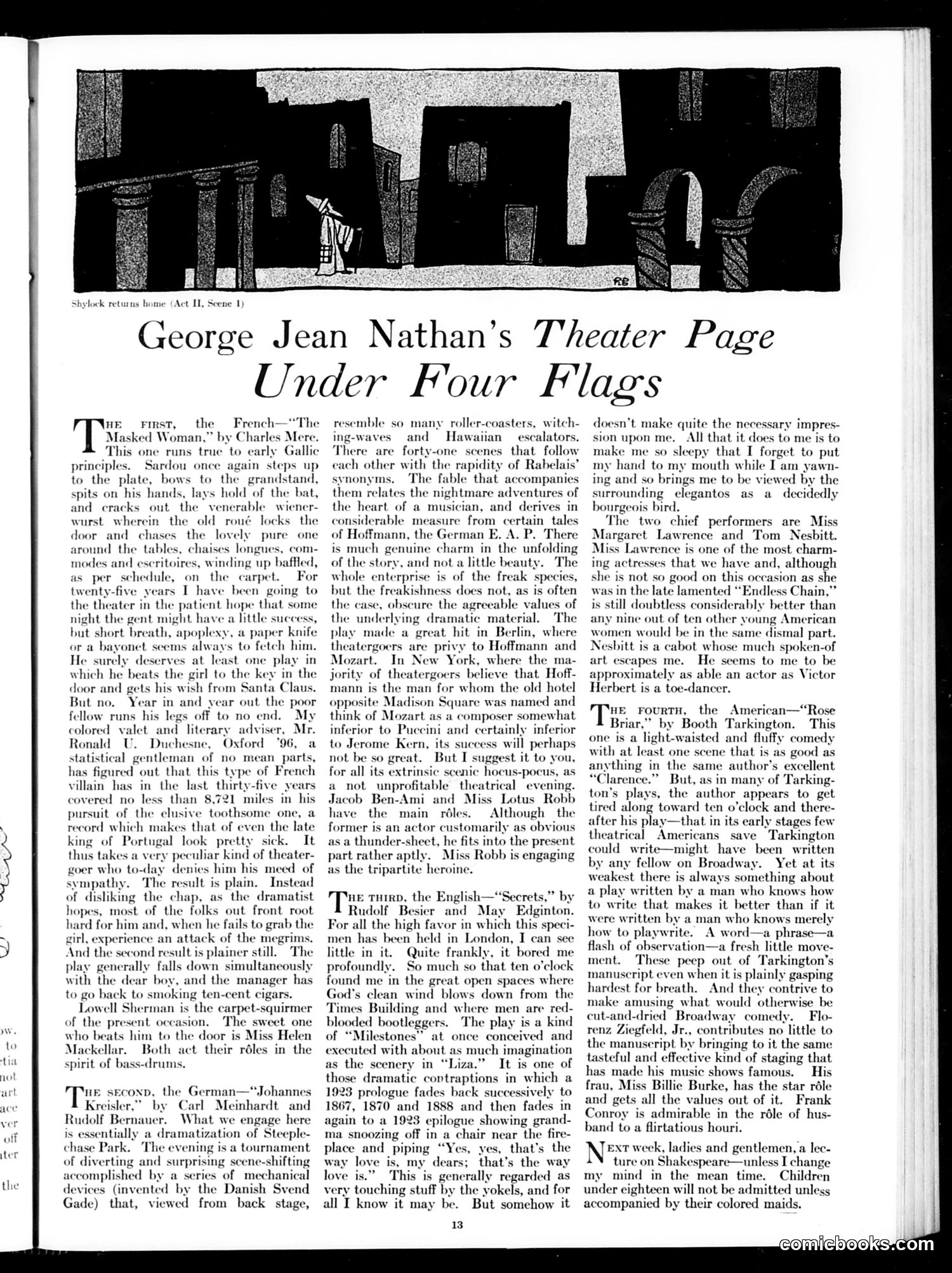
This is theater critic George Jean Nathan's review column covering four theatrical productions. The illustration at top shows a scene from Shakespeare's *The Merchant of Venice* (Shylock returning home). Nathan reviews four plays from different national traditions: 1. **French** ("The Asked Woman"): Nathan satirizes the predictable formula of French farce—an aging libertine chases a young woman around furniture, fails to catch her, and exhausts himself. He's cynical that audiences root *for* the villain rather than against him, making the play collapse. 2. **German** ("Johannes Kreisler"): A fantastical production featuring elaborate mechanical scenery (invented by "Danish Svend Gade"). Nathan notes it succeeded in Berlin among audiences familiar with Hoffmann and Mozart, but doubts American theatergoers—who he dismissively suggests confuse Hoffmann with a hotel name and Mozart with an inferior composer—will appreciate it. 3. **English** ("Secrets"): Apparently boring Nathan profoundly. 4. **American** ("Rose Briar"): Described as light-hearted but weak. The satire targets both predictable theatrical conventions and American cultural provincialism.
📄 Transcribed text from this page (OCR, searchable)
Machine-transcribed from the original scan — historical spelling and the odd misread are preserved.
Shylock returns home (Act II, Scene 1) George Jean Nathan’s Theater Page Under Four Flags French—“The asked Woman,” by Charles Mere. his one runs true to early Gallic Sardou once again steps up Fist, the T principles. to the plate, bows to the grandstand, spits on his hands, lays hold of the bat, the venerable wiener- the old roué locks the door and chases the lovely pure one around the tables, chaises longues, com- modes and escritoires, winding up baffled, as per schedule, on the carpet. For twenty-five years I have been going to the theater in the patient hope that some night the gent might have a little success, but short breath, apoplexy, a paper knife or a bayonet scems always to fetch him. He surely deserves at least one play in which he beats the girl to the key in the door and gets his wish from Santa Claus. But no. Year in and year out the poor fellow runs his legs off to no end. My colored valet and literary adviser, Mr. Ronald U. Duchesne, Oxford "96, a statistical gentleman of no mean parts, has figured out that this type of French villain has in the last. thirty-five years covered no less than 8,721 miles in his pursuit of the elusive toothsome one, a record which makes that of even the late king of Portugal look pretty sick. It thus takes a very peculiar kind of theater- goer who to-day denies him his meed of sympathy. The result is plain. Instead of disliking the chap, as the dramatist hopes, most of the folks out front root hard for him and, when he fails to grab the girl, experience an attack of the megrims. And the second result is plainer still. The play generally falls down simultaneously with the dear boy, and the manager has to go back to smoking ten-cent Lowell Sherman is the carpet-squirmer of the present occasion. The sweet one who beats him to the door is ¥ Helen Mackellar. Both act their réles in the spirit of bass-drums. and cracks out wurst’ wherein HE SECOND, the German—Johannes Kreisler,” by Carl Meinhardt and Rudolf Bernauer. What we engage here is essentially a dramatization of Steeple- chase Park. The evening is a tournament of diverting and surprising scene-shifting accomplished by a series of mechanical devices (invented by the Danish Svend Gade) that, viewed from back stage, resemble so many’ roller-coasters, witch- ing-waves and H ators. There are forty-one s that fol cach other with the rapidity of Rabel synonyms. The fable that accompanies them relates the nightmare adventures of the heart of a musician, and der considerable measure from certain tales of Hoffmann, the German E. A. P. There is much genuine charm in the unfolding of the story, and not a little beauty. The whole enterprise is of the freak ‘species, but the freakishness does not, as is often the case, obscure the agreeable values of the underlying dramatic mate: The play ma a great hit in Berlin, where theatergoers are privy to Hoffmann and Mozart. In New York, where the ma- jority of theatergoers believe that Hoff- mann is the man for whom the old hotel opposite Madison Square was named and think of Mozart as a composer somewhat inferior to Puccini and certainly inferior to Jerome Kern, its success will perhaps not be so great. But I suggest it to you, for all its extrinsic scenic hocus-pocus, as a not unprofitable theatrical evening. ‘ob Ben-Ami and Miss Lotus Robb the in réles. Although the former is tor customarily as obvious thunder-sheet, he fits into the present rtrather aptly. Miss Robb is engaging as the tripartite heroine. HE THIRD, the English—‘‘Secrets,” by Rudolf Besier and May Edginton. For all the high favor in which this speci- men has been held in London, I can see little in it. Quite frankly, it bored me profoundly. So much so that ten o'clock found me in the great open spaces where God's clean wind blows down from the Times Building and where men are red- blooded bootleggers. The play is a kind of “Milestones” at once conceived and xecuted with ab as much imagination i It is one of 1867, 1870 and 1888 and then fades in again to a 1923 epilogue showing grand- ma snoozing off in a chair near the fire- place and piping “Yes, yes, that’s the y love is, my dears; that’s the way This is generally regarded as very touching stuff by the yokels, and for all I know it may be. But somehow it 13 doesn’t make quite the necessary impres- sion upon me. All that it does to me is to make me so sleepy that I my hand to my mouth while ing and so brings me to be vic . surrounding elegantos as a decidedly bourgeois bird. The two chief performers are Miss Margaret Lawrence and Tom Nesbitt. Miss Lawrence is one of the most charm- ing actresses that we have and, although she is not so good on this occasion as she was in the late lamented ‘*Endless Chain,” is still doubtless considerably better than any nine out of ten other young American women would be in the same dismal part. Nesbitt is a cabot whose much spoken-of art escapes m He seems to me to be approximately as able an actor as Victor Herbert is a toe-dani HE FourTH, the American—‘Rose Briar,” by Booth Tarkington. This one is a light-waisted and fluffy comedy with at least one scene that is as good as anything in the same author's “Clarenc But, as in many of Tarking- ton’s plays, the author appears to get tired along toward ten o'clock after his play—that in its earl theatrical Americans save "Tarkington could write—might have been written by any fellow on Broadway. Yet at its weakest there is always something about a play written by a man who knows how to write that makes it better than if it were written by a man who knows mere! how to playwrite. A word—a phrase—a flash of observation—a fresh little move- ment. These peep out of Tarkington's manuscript even when it is plainly gasping hardest for breath. And they contrive to make amusing what would otherwise be cut-and-dried Broadway comedy. Flo- renz Ziegfeld, Jr., contributes no little to the manuscript by bringing to it the same tasteful and effective kind of staging that has made his music shows famous. His frau, Miss Billie Burke, has the star réle and gets all the values out of it. Frank Conroy is admirable in the réle of hus- band to a flirtatious houri. N® ‘tT week, ladies and gentlemen, a lec- 1N ture on Shakespeare—unless I change my mind in the mean time. Children under eighteen will not be admitted unless accompanied by their colored maids.