
Judge, 1923-01-20 · page 4 of 36
Judge — January 20, 1923 — page 4: what you’re looking at
What you’re looking at
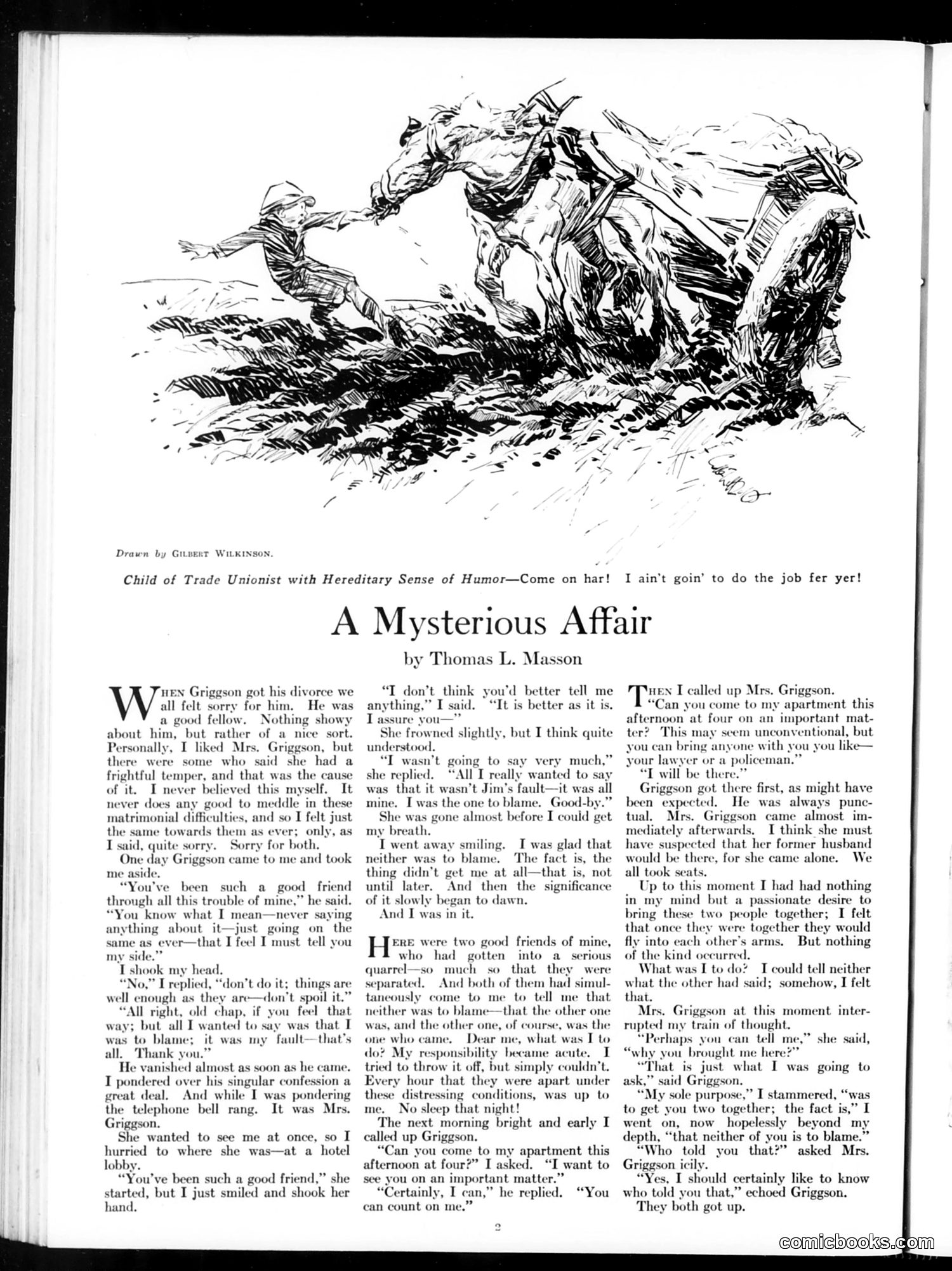
The top illustration by Gilbert Wilkinson depicts a labor scene: a man in work clothes struggles with a stubborn mule or horse while a figure representing union leadership (wearing a hat) pulls in the opposite direction. The caption "Chief of Trade Unionist with Hereditary Sense of Humor—Come on har! I ain't goin' to do the job for yer!" satirizes union leadership as obstructive and comedically incompetent, suggesting they actively prevent workers from completing their tasks rather than advancing labor interests. The cartoon critiques early 20th-century American labor unions, portraying them as obstacles to productivity—a common anti-labor argument of the era. The "hereditary sense of humor" implies union leaders inherit their positions through nepotism rather than merit, compounding the satire about institutional dysfunction and self-serving leadership.
📄 Transcribed text from this page (OCR, searchable)
Machine-transcribed from the original scan — historical spelling and the odd misread are preserved.
SQN STAN wos Drawn by GiLuenT WILKINSON. Nene WORN Child of Trade Unionist with Hereditary Sense of Humor—Come on har! A Mysterious Affair HEN Griggson got his divorce we 1 felt sorry for him. He was a good fellow. Nothing showy about him, but rather of a nice sort. Personally, I liked Mrs. Griggson, but there were some who said she had a frightful temper, and that was the cause of it. IT ne believed this myself. It never does any good to meddle in these matrimonial difficulties, and so I felt just the same towards them as ever; only, as I said, quite sorry. Sorry for both. One day Griggson came to me and took me asid: You've been such a good friend through all this trouble of mine,”” he said. “You know what I mean—never saying anything about it—just going on the same as ever—that I feel I must tell you my side.” I shook my head. “No,” I replied, “don’t do it; things are well enough as they are—don’t spoil it.” “All right, old chap, if you feel that way; but all I wanted to say was that I was to blame; it was my fault—that’s all. Thank you.” He vanished almost as soon as he came. I pondered over his singular confession a great deal. And while I was pondering the telephone bell rang. It was Mrs. Griggson. She wanted to see me a hurried to where she was: lobby. You've been such a good friend,” started, but I just smiled and shook her hand. once, so I at a hotel by Thomas L. Masson “I don’t think you'd better tell me anything,” I said. “It is better as it is. T assure you— She frowned slightly, but I think quite understood. “I wasn’t going to say very much,” she replied. “All I really wanted to say was that it wasn’t Jim's fault—it mine. I was the one to blame. Good-b) She was gone almost before I could get my breath. I went away smiling. I was glad that neither was to blame. The i thing didn’t get me at all—that is, not until later. And then the significance of it slowly began to dawn. And I was in it. ERE were two good friends of mine, who had gotten into a quarrel—so much so that the separated. And both of them had simul- taneously come to me to tell me that neither was to blame—that the other one was, and the other one, of course, was the one who came. Dear me, what was I to do? My responsibility became acute. I tried to throw it off, but simply couldn't. Every hour that they were apart under these distressing conditions, was up to me. No sleep that night! The next morning bright and early I called up Griggson, “Can you come to my apartment this afternoon at four?” I asked. “I want to you on an important matte! rtainly, I can,” he replied. “You can count on me,” I ain't goin’ to do the job fer yer! "aes T called up Mrs. Griggson. an you come to my apartment this afternoon at four on an important mat- This may scem unconventional, but you can bring anyone with you you like— your lawyer or a policeman.” “T will be there.” Griggson got there first, as might have been expected. He was always punc- tual. Mrs. Griggson came almost im- mediate terwards. I think she must have suspected that her former husband would be there, for she came alone. We all took seats. Up to this moment I had had nothing in my mind but a passionate desire to bring these two people together; I felt that once they were together they would fly into each other's arms. But nothing of the kind occurred. What was I to do? TI could tell neither what the other had said; somehow, I felt that. Mrs. Griggson at this moment inter- rupted my train of thought. “Perhaps you can tell me “why you brought me here “That is just what I was going to ask,” said Griggson. “My sole purpose,” I stammered, “was to get you two together; the fact is, went on, now hopelessly beyond my depth, “that neither of you is to blam “Who told you that?” asked Mrs. Griggson icily. “Yes, I should certainly like to know who told you that,” echoed Griggson. ‘They both got up. she said, comichooks.gom