
Judge, 1923-01-20 · page 17 of 36
Judge — January 20, 1923 — page 17: what you’re looking at
What you’re looking at
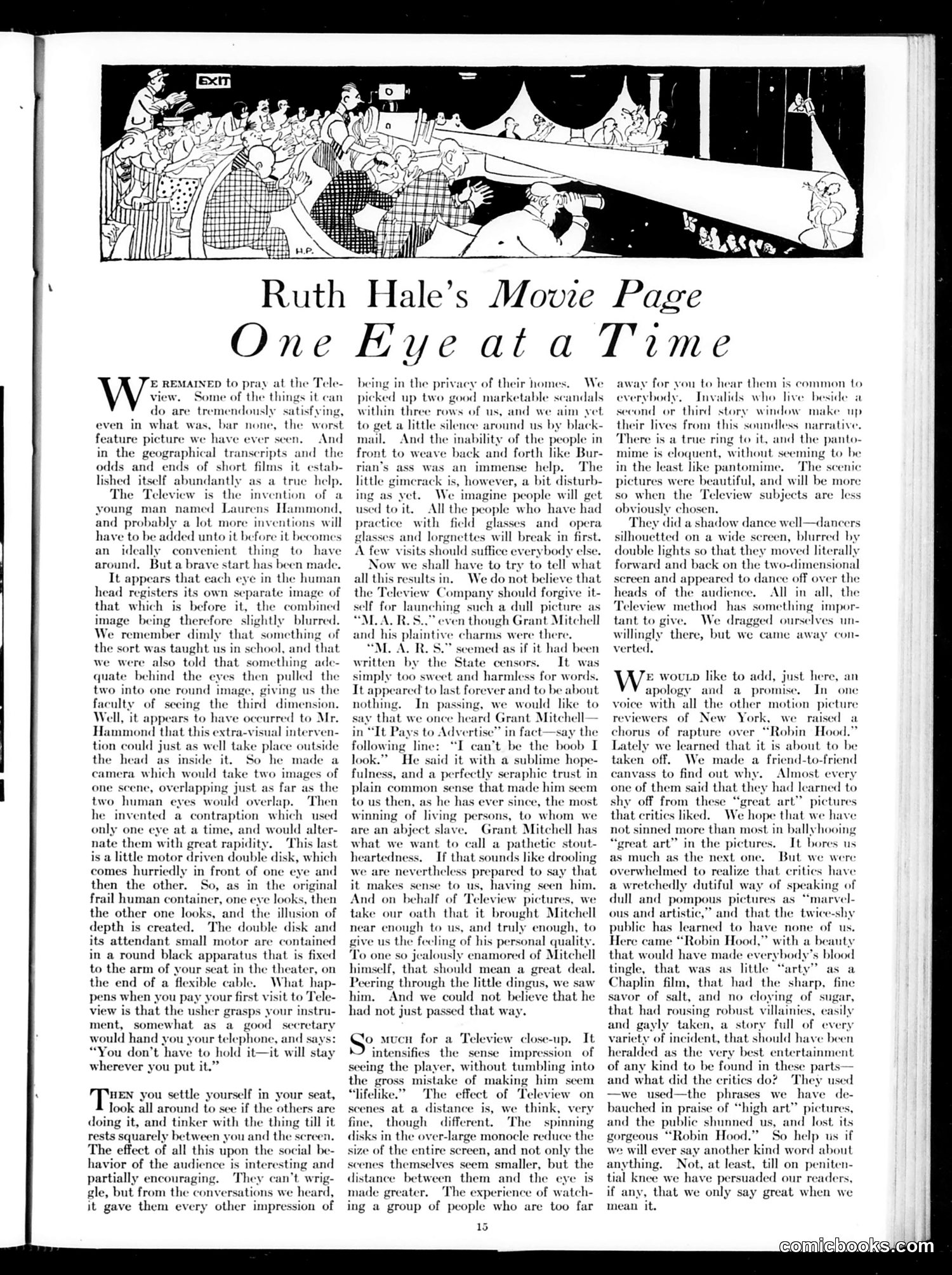
This is a film review column by Ruth Hale discussing the **Teleview**, an early 3D cinema technology invented by Laurens Hammond. The device uses a motorized disk that alternates between each viewer's eyes, presenting slightly offset images to create a three-dimensional effect—mimicking how human binocular vision works. Hale describes the theater experience: viewers wear a apparatus attached to their seat that eliminates typical audience distractions (people shifting, blocking views). However, she criticizes the film being shown—"M.A.R.S."—as dull and censorship-approved pablum, despite Grant Mitchell's performance. She praises Mitchell's earlier work in "It Pays to Advertise." The review is optimistic about Teleview's potential while disappointed in the accompanying entertainment. The cartoon illustration above shows theater audiences experiencing this novelty technology.
📄 Transcribed text from this page (OCR, searchable)
Machine-transcribed from the original scan — historical spelling and the odd misread are preserved.
Ruth Hale’s Movie Page One Hye ata Time REMAINED to pray at the Tele- ew. Some of the things it can do are tremendously satisfying, even in what was, bar none, the worst feature picture we have ever seen, And in the geographical transcripts and. the odds and ends of short films it estab- lished itself abundantly as a true help. The Teleview is the invention of a young man named Laurens Hammond, and probably a lot more inventions will have to be added unto it before it becomes an ideally convenient thing to have around, Buta brave start has been made. It appears that each eye in the human head registers its own separate image of that which is before it, the combined image being therefore slightly blurred. We remember dimly that something of the sort was taught us in school, and that we were also told that something ade- quate behind the eyes then pulled the two into one round image, giving us the faculty of seeing the third dimension. Well, it appears to have occurred to Mr. Hammond that this extra-visual interven- tion could just as well take place outside the head as inside it. So he made a camera which would take two images of one scene, overlapping just as far as the two human eyes would overlap. Then he invented a contraption which used only one eye at a time, and would alter- nate them with great rapidity. ‘This last is a little motor driven double disk, which comes hurriedly in front of one eye and then the other. So, as in the original frail human container, one eye looks, ‘then the other one look nd the illusion of depth is create The double disk and its attendant small motor are contained in a round black apparatus that is fi to the arm of your seat in the theater, on the end of a flexible cable. What hap- pens when you pay your first visit to Tele- view is that the usher grasps your instru- ment, somewhat as a secreta! would hand you your telephone, and say “You don’t hi to hold it—it will stay wherever you put it.” good HEN you settle yourself in your seat, look all around to see if the others are doing it, and tinker with the thing till it rests squarely between you and the screen. The effect of all this upon the social be- havior of the audience is interesting and partially encouraging. They can’t wrig- gle, but from the conversations we heard, it gave them every other impression of being in the privacy of their homes. picked up two good marketable s within three rows of us, and we aim yet to get a little silence around us by black- mail. And the inability of the people in front to weave ba id forth like Bur- rian’s ass was an immense help. The little gimerack is, however, a bit disturb- We imagine people will get used to it. All the people who have had practice with ficld glasses and opera glasses and lorgnettes will break in first. A few visits should suffice everybody else. Now we | have to try to tell what all this results in. We do not believe that the Teleview Company should forgive self for launching such a dull picture as “M.A. RLS...” even though Grant Mitchell and his plaintive charms were there. = A. R.S.” seemed as if it had been written by the State censors. It was simply t« t and harmless for words. It appeared to last forever and to be about nothing. In passing, we would like to y that we once heard Grant Mitchell in “It Pays to Advertise” in fact—say the following line: “I can’t be the boob I * He said it with a sublime hope- and a perfectly seraphic trust in plain common sense that made him seem to us then, as he has ever since, the most winning of living persons, to whom we n abject slave. Grant Mitchell has t we want to call a pathetic stout- heartedness. If that sounds like drooling we are nevertheless prepared to say that it makes sense to us, having seen him. And on behalf of Teleview pictures, we take our oath that it brought Mitchell r enough to us, and truly enough, to give us the feeling of his personal quality. ‘To one so jealously enamored of Mitchell himself, that should mean a great deal. Peering through the little dingus, we saw him. And we could not believe that he had not just passed that way. ing as yet. swe S° mucu for a Teleview close-up. It K intensifies the sense impression of secing the player, without tumbling into the gross mistake of making him seem “lifelike.” The effect of Teleview on scenes at a distance is, we think, very fine, though different. The spinning disks in the over-large monocle reduce the size of the entire screen, and not only the scenes themselves seem smaller, but the distance between them nd the eye is made greater. The experience of watch- ing a group of people who are too far 15 away for you to hear them is common to Invalids who live beside a second or third story window make up their lives from this soundless narrative. There is a true ring to it, and the panto- mime is cloquent, without seeming to | in the least like pantomime. The si pictures were beautiful, and will be mor so when the Teleview subjects are less obviously chosen, They did a shadow dance well—dancers silhouetted on a wide screen, blurred by double lights so that they moved literally forward and back on the two-dimensional screen and appeared to dance off over the heads of the audience. All in all, the Teleview method has something impor- tant to give. We dragged ourselves un- willingly there, but we came away con- verted, an We woutp like to add, just here, apology and a promise. In one voice with all the other motion picture reviewers of New York, we raised chorus of rapture over “Robin Hooc Lately we learned that it is about to be taken off. We made a friend-to-friend canvass to find out why. Almost every one of them said that they had learned to shy off from these “great art’ pictures that critics liked. We hope that we have not sinned more than most in ballyhooing “great art” in the pictures. It bores us as much as the next one. But we were overwhelmed to realize that critics have a wretchedly dutiful y of speaking of dull and pompous pictures as “marvel- ous and artistic,” and that the twice-shy public has ned to have none of us. Here came “Robin Hood,” with a beauty that would have made everybody's blood tingle, that was as little “arty as a Chaplin film, that had the sharp, fine savor of salt, and no cloying of sugar, that had rousing robust villainies, easily and gayly taken, a story full of every variety of incident, that should have been heralded as the very best entertainment of any kind to be found in these parts— and what did the crities do? They used —we used—the phra bauched in praise of “high art and the public shunned us, and lost. its gorgeous “Robin Hood.” So help us if we will ever another kind word about thing. Not, at least, till on peniten- tial knee we have persuaded our readers, if any, that we only say great when we mean it. everybody,