
Judge, 1923-01-20 · page 28 of 36
Judge — January 20, 1923 — page 28: what you’re looking at
What you’re looking at
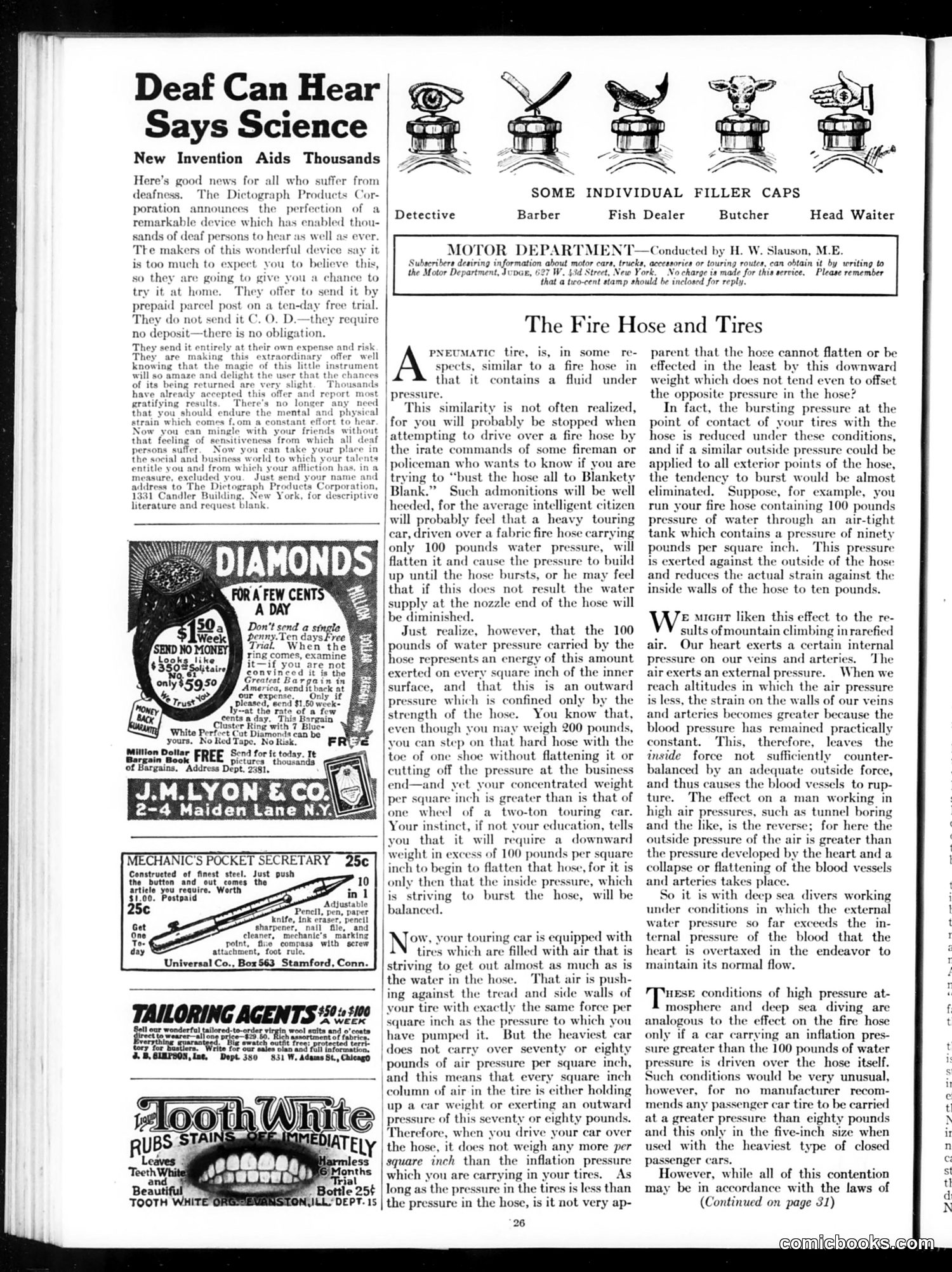
This is primarily **not satire or political cartoon** — it's a **technical educational article** explaining a counterintuitive physics principle to general readers. The piece uses the analogy of a car tire (filled with air pressure) compared to a fire hose (filled with water pressure) to demonstrate that pressure, not total weight, determines whether something flattens. The author argues that despite a heavy touring car's weight, its tires won't flatten a fire hose because the air pressure inside the tire is only 70-80 pounds per square inch — less than the hose's 100-pound water pressure. The article addresses a common misconception: that a heavy vehicle would burst or flatten a fire hose. Instead, it shows that pressure distribution matters more than gross weight. The page contains **period advertisements** (diamonds, dental products, pocket secretaries) typical of Judge magazine, but these lack satirical intent — they're standard commercial ads.
📄 Transcribed text from this page (OCR, searchable)
Machine-transcribed from the original scan — historical spelling and the odd misread are preserved.
Deaf Can Hear Says Science New Invention Aids Thousands Here’s good news for all who suffer from deafness. The Dictograph Products Cor- poration announces the perfection of a remarkable device which has enabled thou- sands of deaf persons to h , ver. Tte makers of this wonderful ay it is too much to expect you to | » this, so they © going to give you : try it at home. They offer to prepaid parcel post on a ten-day free trial. They do not send it C. O. D.—they require no deposit—there is no obligation. They send it entirely at their own expense They are xtraordinary offer well knowing t is little instrument will so amaze the user that the chances of its being returned are very slight pusands eady accepted this offer t most ing results. There's no ‘any need that you should endure the m strain which comes f.om a constant ¢ pur frien and risk irld to whic the social and business fiction hi entitle y and from which your measure, excluded you your name address to The Dictogray ucts Corporation, 1331 Candler Building, New York, for descriptive literature and request blank. and WN like Solitaire) Look, $3503 dit is the Greatest Bargain in America, send fthack at a id Dottar | Send for fe toda times tay FREE fr of Bargains. Address Dept. 381. n, DADET knife, ink eraser, fect to wearer alfor Saget og bce BS. ‘hig owatch outht free: tory for bastlers. ftnd full information, 3°5, GIMPOON, Ine, Dept S808 331 W, Adams St, “Trial MF Bottle 25¢ Hwee DEPT. 15 Detective Barber MOTOR DEPARTME Subseribere desiring information about motor car the Motor Department, Jvvar, 627 W. in some re- fire hose in fluid under PNEUMATIC tire, is, spects, similar to a that it contains a pressure This similarity not often realized, for you will probably be stopped when attempting to drive over a fire hose by the e commands of some fireman or | policeman who wants to know if you are trying to “bust the hose all to Blankety Blank.” Such admonitions will be well heeded, for the average intelligent citizen will probably feel that a heavy touring | car, driven over a fabric fire hose carrying only 100 pounds water pressure, ‘will flatten it and cause the pressure to build up until the hose bursts, or he may feel |that if this does not result the water at the nozzle end of the hose will be diminished. Just realize, however, that the 100 pounds of water pressure carried by the hose represents an energy of this amount exerted on every square inch of the inner surface, and that this is an outward | pressure which is confined only by the strength of the hose. You know that, even though you may weigh 200 pounds, you can step on that hard hose with the toe of one shoe without flattening it or cutting off the pressure at the business end—and yet your concentrated weight | per square inch is greater than is that of }one wheel of a two-ton touring Your instinct, if not your education, you that it will require a downward weight in excess of 100 pounds per square inch to begin to flatten that hose, for it is only then that the inside pressure, which is striving to burst the hose, will be balanced. No your touring car is equipped with 4N tires which are filled with air that is striving to get out almost as much as is | the water in the hose. That air is push- }ing against the tread and side walls of your tire with exactly the same force per Square inch as the pressure to which you pumped it. But the heaviest ‘car does not carry over seventy or eighty pounds of air pressure per square inch, i y square inch column of air in the tire is either holding up a car weight or exerting an outward pressure of this seventy or eighty pounds. Therefore, when you drive your car over the hose, it does not weigh ‘any more per which you are carrying in long as the pressure in the tires is le s than the pressure in the hose, is it not very ap- 26 ‘T—Conducted by H. V trucks, accessories or touring routes, can obtain it by writing to b3d Street, New York. that a tweo-cent stamp should be inclosed for reply. SOME INDIVIDUAL FILLER CAPS Fish Dealer Butcher Head Waiter auson, M.E. No charge is made for this service. Please remember The Fire Hose and Tires parent that the hose cannot flatten or be effected in the least by this downward weight which does not tend even to offset the opposite pressure in the hos In fact, the bursting pressure at the point of contact of your tires with the hose is reduced under these conditions, and if a similar outside pressure could be applied to all exterior points of the hose, the tendency to burst would be almost eliminated. Suppose, for mple, you run your fire hose containing 100 pounds pressure of water through an i tank which contains a pressure of ninety pounds per square inch. This pressure is exerted against the outside of the hose and reduces the actual strain against the inside walls of the hose to ten pounds. E miGut liken this effect to the re- sults of mountain climbing in rarefied Our heart exerts a certain internal pressure on our veins and arteries. The air exerts an external pressure. When we ch altitudes in which the air pressure . the strain on the air. ire has remained prac This, therefore, leaves inside force not sufficiently counter balanced by an adequate outside force, and thus causes the blood vessels to rup- The effect on a man working in r pressures, such as tunnel boring and the like, is the reverse; for here the outside pressure of the air is greater than the pressure developed by the heart and a collapse or flattening of the blood vessels and arteries takes place. So it is with deep sea divers working under conditions in which the external water pressure so far exceeds the in- ternal pressure of the blood that the heart is overtaxed in the endeavor to maintain its normal flow. HESE conditions of high pressure at- mosphere and deep sea diving are analogous to the effect on the fire hose only if a car carrying an inflation pres- sure greater than the 100 pounds of water pressure is driven over the hose itself. Such conditions would be very unusual, however, for no manufacturer recom- mends any passenger car tire to be carried at a greater pressure than eighty pounds and this only in the five-inch size when used with the heav type of closed passenger cars. However, while all of this contention may be in accordance with the laws of (Continued on page 31)