
Judge, 1923-01-20 · page 12 of 36
Judge — January 20, 1923 — page 12: what you’re looking at
What you’re looking at
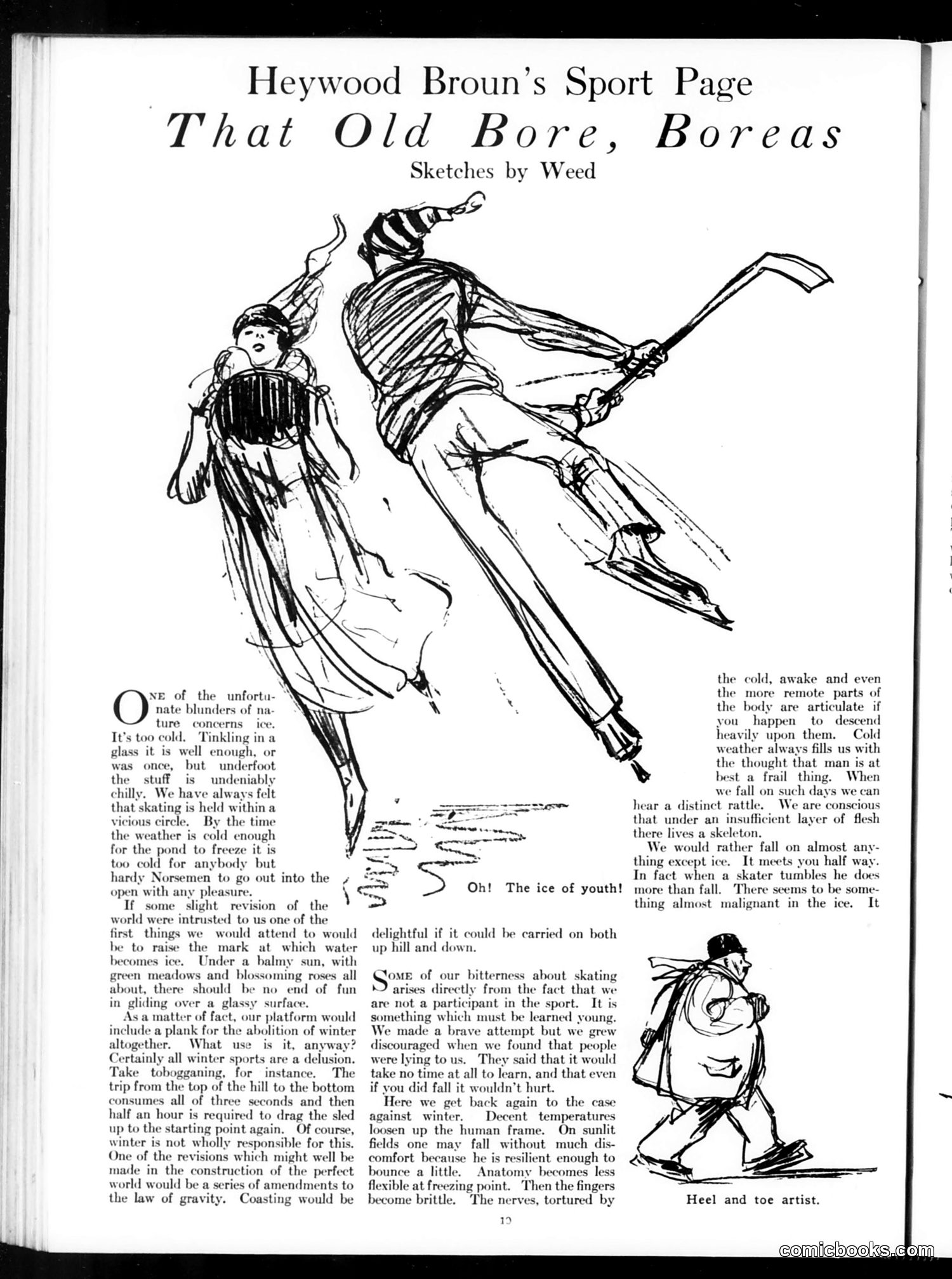
This is a humorous sports column by Heywood Broun (a prominent sportswriter of the early 20th century) complaining about winter sports, particularly ice skating and sledding. **The satire:** Broun adopts a tongue-in-cheek, curmudgeonly tone to mock winter activities. He presents absurd "solutions"—like wishing water froze at warmer temperatures, or amending the laws of gravity to make coasting work uphill. **The actual complaint:** The piece genuinely critiques how winter sports are physically unpleasant and potentially dangerous. Ice is hard; falls hurt; the cold makes bodies brittle and vulnerable. Sledding wastes time dragging equipment back uphill. People lied to him about learning to skate painlessly. **For modern readers:** This reflects early 20th-century attitudes toward winter recreation—not as romanticized fun, but as tedious, uncomfortable necessities that privileged people endured. The sketches by "Weed" show exaggerated skating poses, likely illustrating Broun's complaints about awkwardness and mishaps. The humor relies on Broun's cranky, reasonable-sounding exaggeration of genuine inconveniences.
📄 Transcribed text from this page (OCR, searchable)
Machine-transcribed from the original scan — historical spelling and the odd misread are preserved.
Heywood Broun’s Sport Page That Old Bore, Boreas Sketches by Weed NE of the unfortu- nate blunders of na- ture concerns — ice. It’s too cold. ‘inkling in a glass it is well enough, or was once, but underfoot the stuff is undeniably chilly. We have always felt t skating is held within a vicious circle. By the time the weather is cold enough for the pond to freeze it is too cold for anybody but hardy Norsemen to go out into the open with any pleasure. \ If some slight revision of the world were intrusted to us one of the first. things we would attend to would he to raise the mark at which water becomes ic Under a balmy sun, with green meadows and blossoming roses all about, there should be no end of fun in gliding over a glassy surface. As a matter of fact, our platform would include a plank for the abolition of winter altogether. What use is i aly all winter sports are si ‘ake tobogganing, for instance. The trip from the top of the hill to the bottom consumes all of three seconds and then half an hour is required to drag the sled up to the starting point again. Of course, winter is not wholly responsible for this. One of the revisions which might well be made in the construction of the perfect world would be a series of amendments to the law of gravity. Coasting would be ~~, —— pa} on Oh! The ice of youth! delightful if it could be carried on both up hill and down. Some of our bitterness about skating WD arises directly from the fact that we are not a participant in the sport. It is something which must be learned young. We made a brave attempt but we grew discouraged when we found that people were lying to us. They said that it would t i t all to learn, and that even if you did fall it wouldn't hurt. Here we get back again to the case Decent temperatures loosen up the human frame. On sunlit fields one may fall without much dis- comfort because he is resilient enough to bounce a little. Anatomy becomes less flexible at freezing point. Then the fingers become brittle. The nerves, tortured by 19 the cold, awake and even the more remote parts of the body are articulate happen to de y upon them. you ne Cold her always fills us with the thought that man is at best a frail thing. we: on such ¢ hear a distinct rattle. We are that under an insufficient layer of flesh there lives a skeleton. We would rather fall on almost any- thing except ice. It meets you half way. In fact when a skater tumbles he does more than fall. There seems to be some- thing almost malignant in the ice. It