
A complete issue · 36 pages · 1923
Judge — January 13, 1923
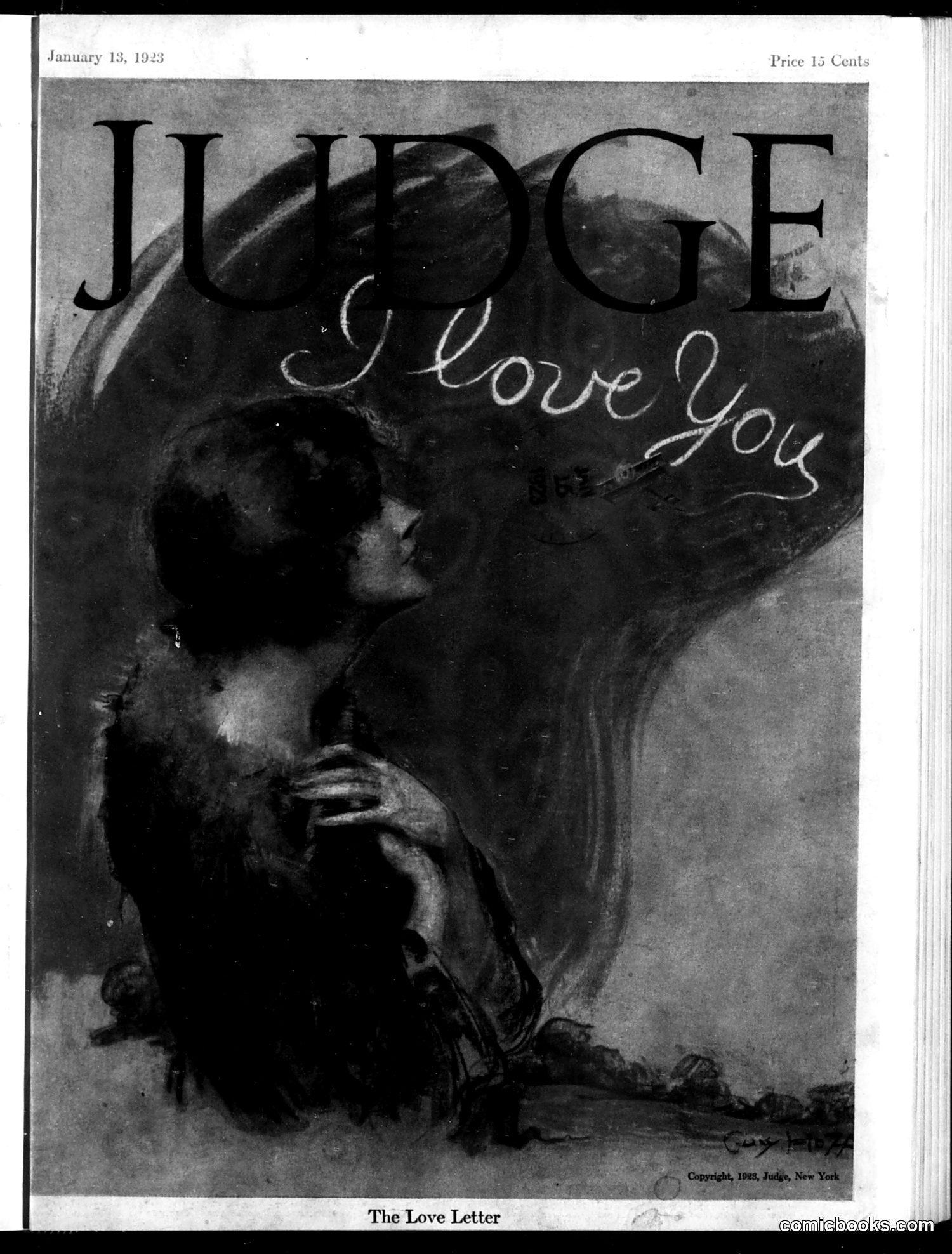
This cover illustrates a romantic scene titled "The Love Letter," showing a woman in profile gazing upward with a dreamy expression while holding what appears to be a letter. The phrase "I love you" is written in script across the image. The illustration appears to be a straightforward romantic artwork rather than political satire. It depicts the sentimental emotional state of receiving or reading a love letter—a popular theme in early 1920s popular culture and magazines. The image captures the idealized romanticism of the era, with soft lighting and the woman's ethereal pose conveying tender emotion. This cover reflects Judge's inclusion of romantic or sentimental content alongside its typical satirical political cartoons, appealing to broad readership interests of the period.
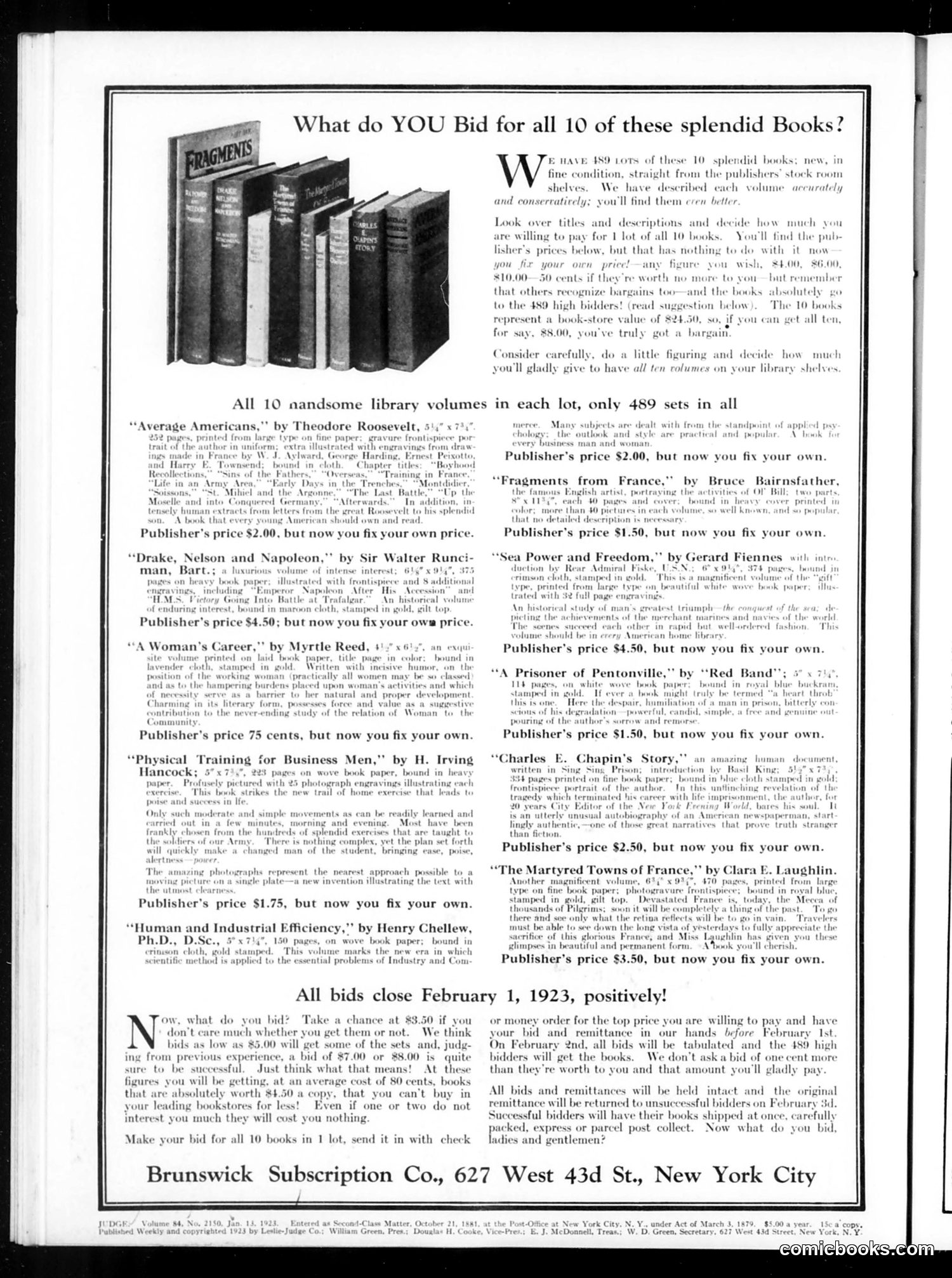
This page is primarily **advertising content**, not political satire. It promotes a book subscription offer from Brunswick Subscription Co. (New York City), featuring ten volumes described as "splendid books" in fine condition from publishers' stock. The advertisement lists individual titles with publishers' prices, then invites readers to bid on all ten volumes together, emphasizing the bargain value. The closing date for bids is February 1, 1923. The only visual element is a photograph of the ten books stacked together at the top left. **There is no political cartoon or satirical content on this page.** It's a straightforward mail-order book sale advertisement typical of Judge magazine's revenue model, mixing editorial content with commercial offers to subscribers.
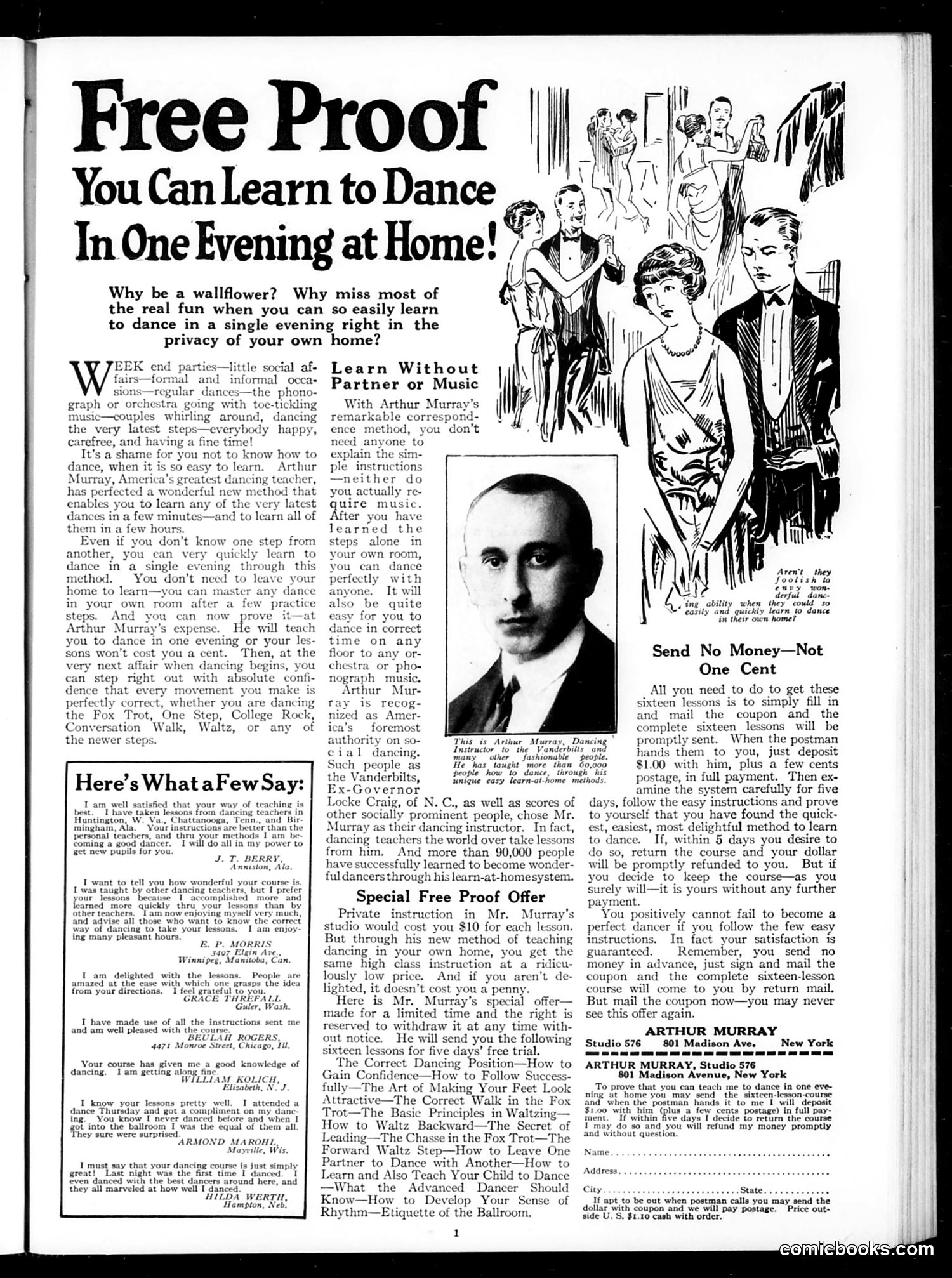
This page is primarily **advertising, not satire or political commentary**. It's a full-page advertisement for Arthur Murray's dance instruction course, promoting his "learn-to-dance-at-home" method. The illustrations show **well-dressed couples in 1920s formal attire** at social events—typical aspirational imagery for the era. The text emphasizes that anyone can learn popular dances (Fox Trot, Waltz, etc.) in one evening without a partner or music, using Murray's correspondence course. The testimonials from named individuals (a governor, judges, and society figures) serve as endorsements of credibility and social legitimacy. The "Send No Money" offer was a common direct-mail marketing tactic of the period. This reflects early 20th-century anxieties about social dancing skills and self-improvement through mail-order instruction.
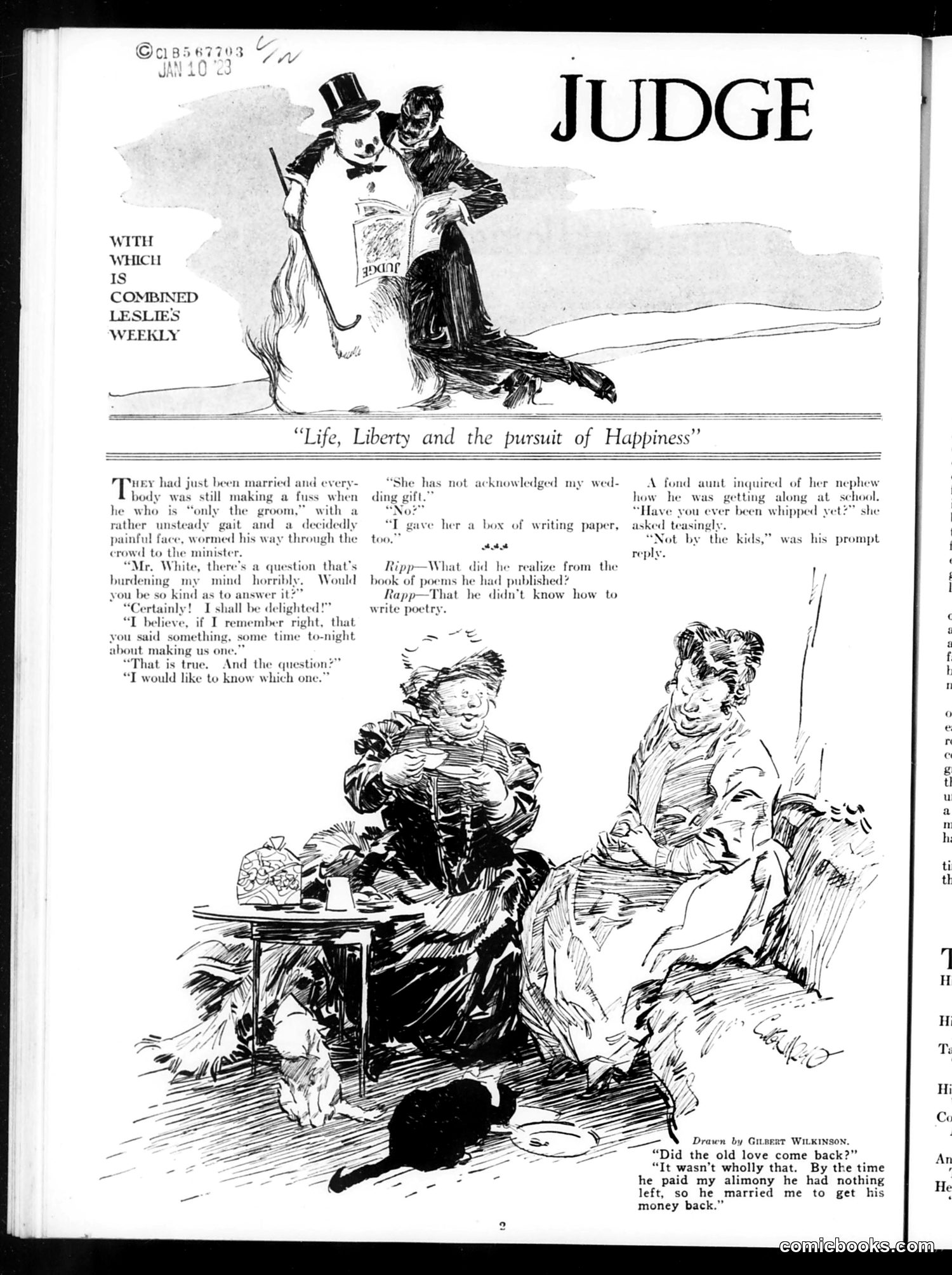
This page satirizes marriage dynamics through two vignettes. The top illustration shows a newlywed couple where the husband complains his wife is "only the groom" in their union, while she dominates. The dialogue suggests she controls decisions about making a baby. The main cartoon depicts a wife confronting her husband about his published poetry, which she hasn't acknowledged. A male relative asks if the husband's been "whipped yet," establishing the page's theme: wives as dominant, emasculating figures. The bottom caption jokes that the husband married her to recover alimony money from a previous relationship—presenting marriage as a financial transaction where women manipulate men. The satire reflects early 20th-century anxieties about changing gender roles and female assertiveness in marriage.
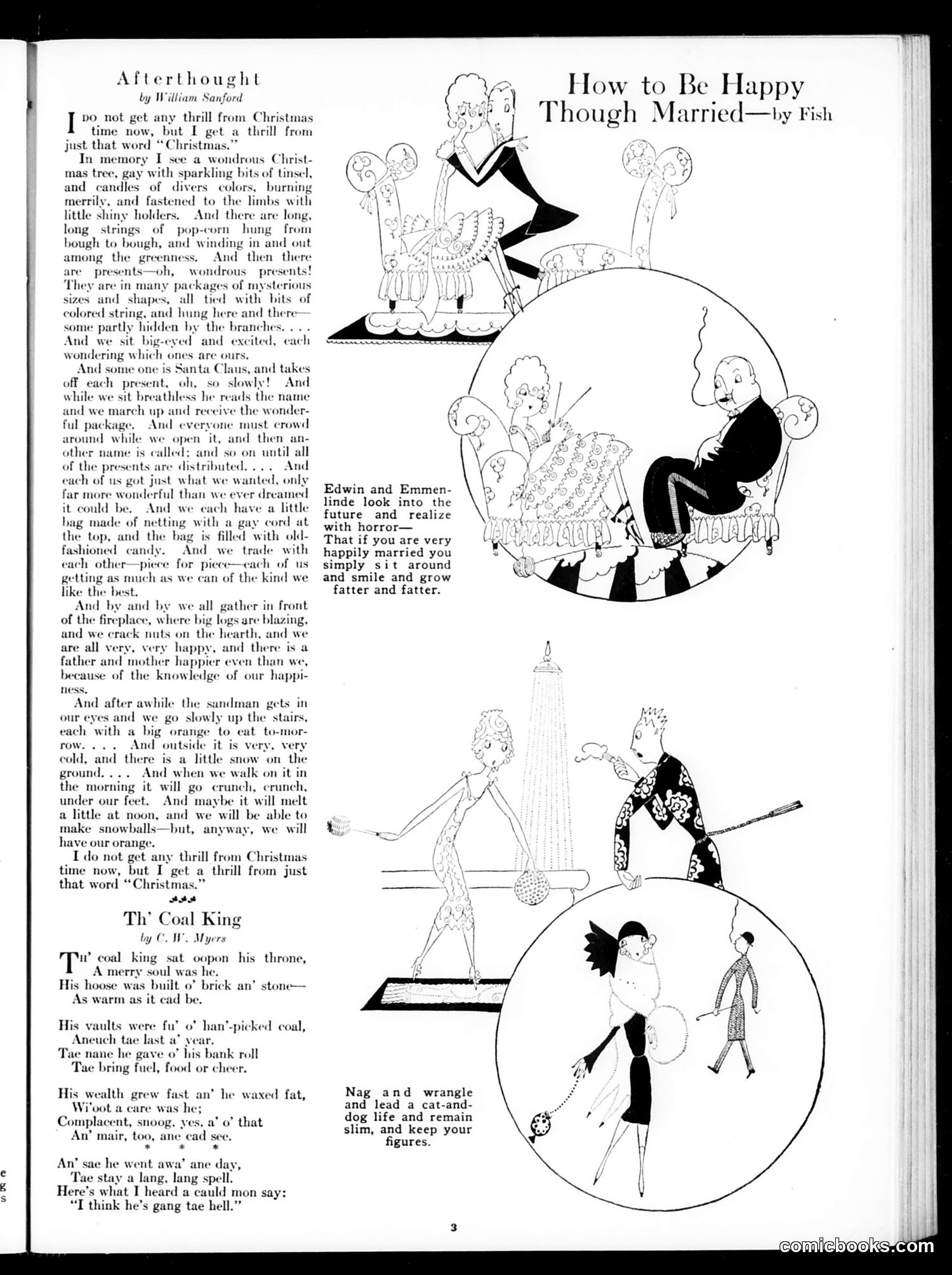
This page contains three distinct pieces: 1. **"Afterthought" by William Sanford**: A nostalgic essay about Christmas traditions—decorations, presents, and family gatherings around the fireplace. It's sentimental rather than satirical. 2. **"How to Be Happy Though Married—by Fish"**: A satirical cartoon series depicting married life. The illustrations show couples in various domestic situations with a humorous, slightly cynical tone—suggesting that happiness in marriage comes from accepting mundane domesticity (sitting around, growing "fatter and fatter"). 3. **"Th' Coal King" by C.W. Myers**: A Scottish dialect poem about a wealthy coal baron, satirizing his sudden wealth and pretentious lifestyle. The dialect and mocking tone suggest class commentary on nouveau riche industrialists. The page mixes nostalgic sentiment with social satire typical of Judge magazine's approach.
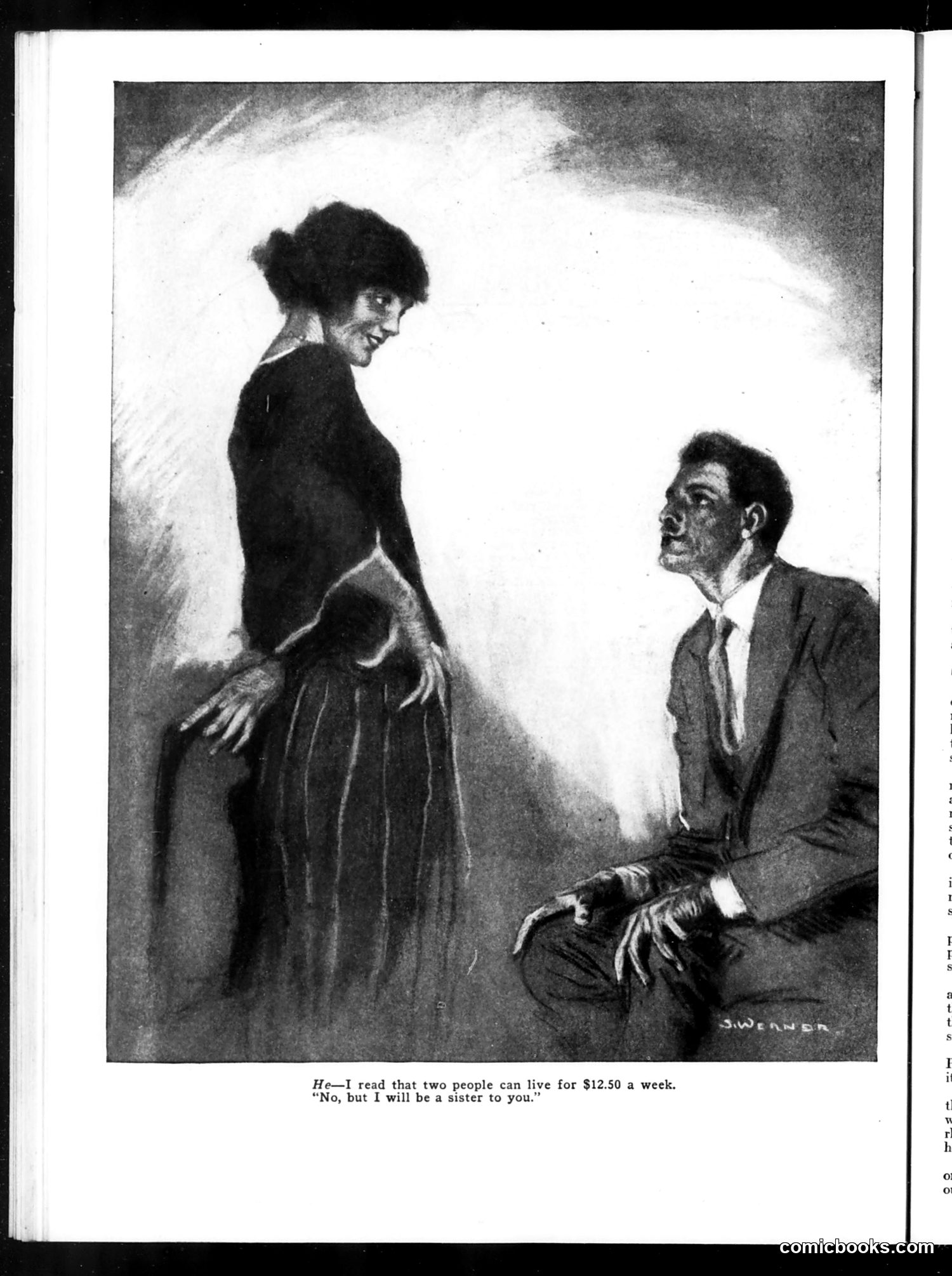
This cartoon satirizes economic inequality and gender dynamics during the early 20th century. A man and woman discuss living affordably—he mentions reading that "two people can live for $12.50 a week" (roughly equivalent to ~$400 today). The woman's response, "No, but I will be a sister to you," is the joke's punchline. The satire works on two levels: First, it mocks the absurd notion that poverty wages could support a couple. Second, it plays on the woman's refusal of romantic/marital commitment while remaining emotionally involved—a common trope suggesting women wouldn't marry for financial security alone, yet also highlighting the precarious economic conditions working-class couples faced.
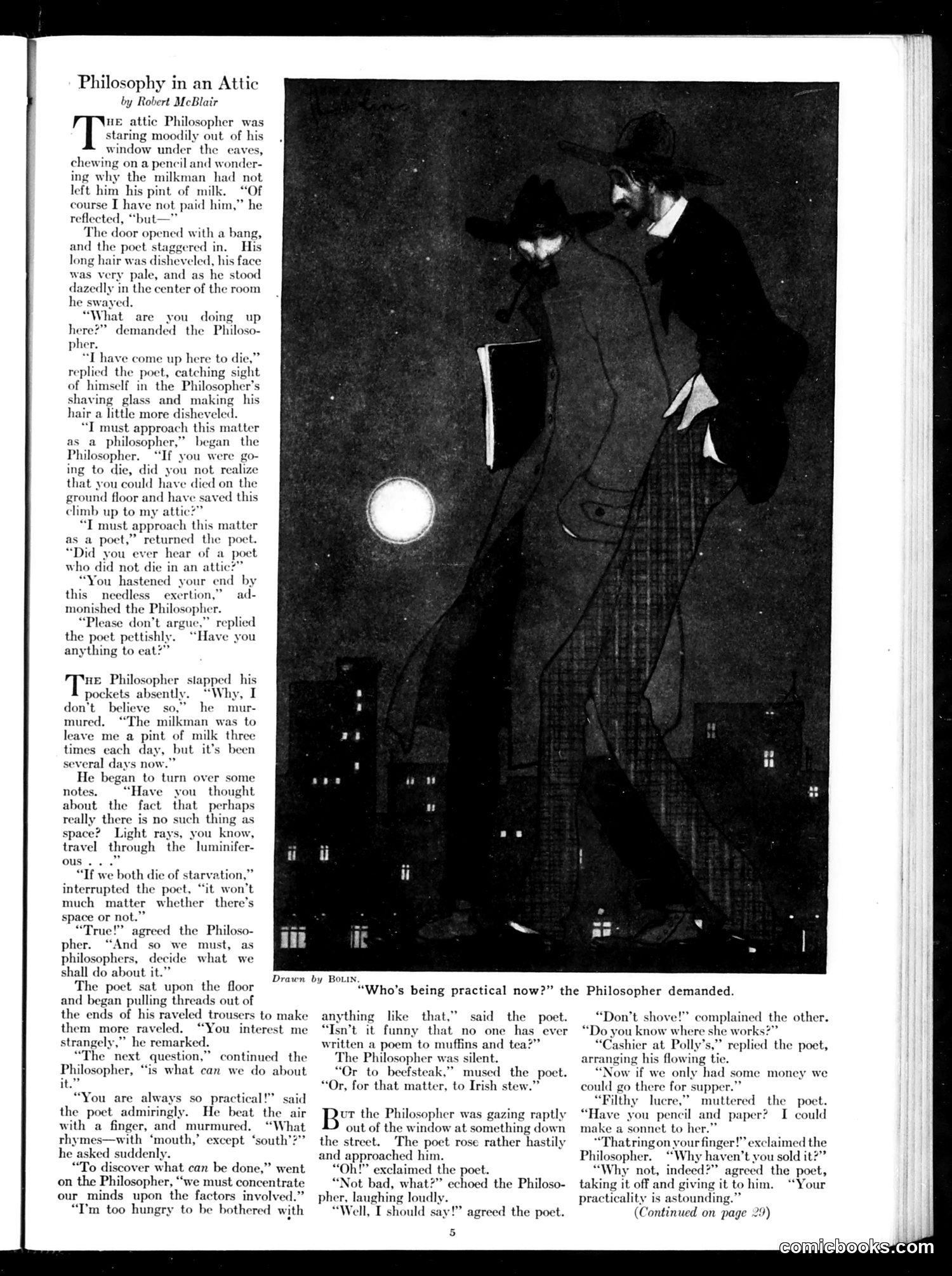
This is a humorous short story (not a political cartoon) satirizing the romantic poverty of bohemian artists and intellectuals. A starving "Philosopher" and a "Poet" inhabit an attic—the traditional dwelling of broke creative types. The satire mocks both characters: the Philosopher approaches life through abstract reasoning (debating whether space exists while hungry), while the Poet romanticizes suffering (insisting poets "must die in attics"). The joke targets their impracticality—when they spot an attractive woman from the window, the Philosopher wants to sell his ring for money to court her, while the Poet immediately offers to write her a sonnet instead. Their conflicting approaches (practical vs. artistic) and shared destitution reflect period stereotypes about struggling artists choosing noble poverty over mundane employment. The humor lies in how both characters philosophize about starvation rather than simply getting jobs.
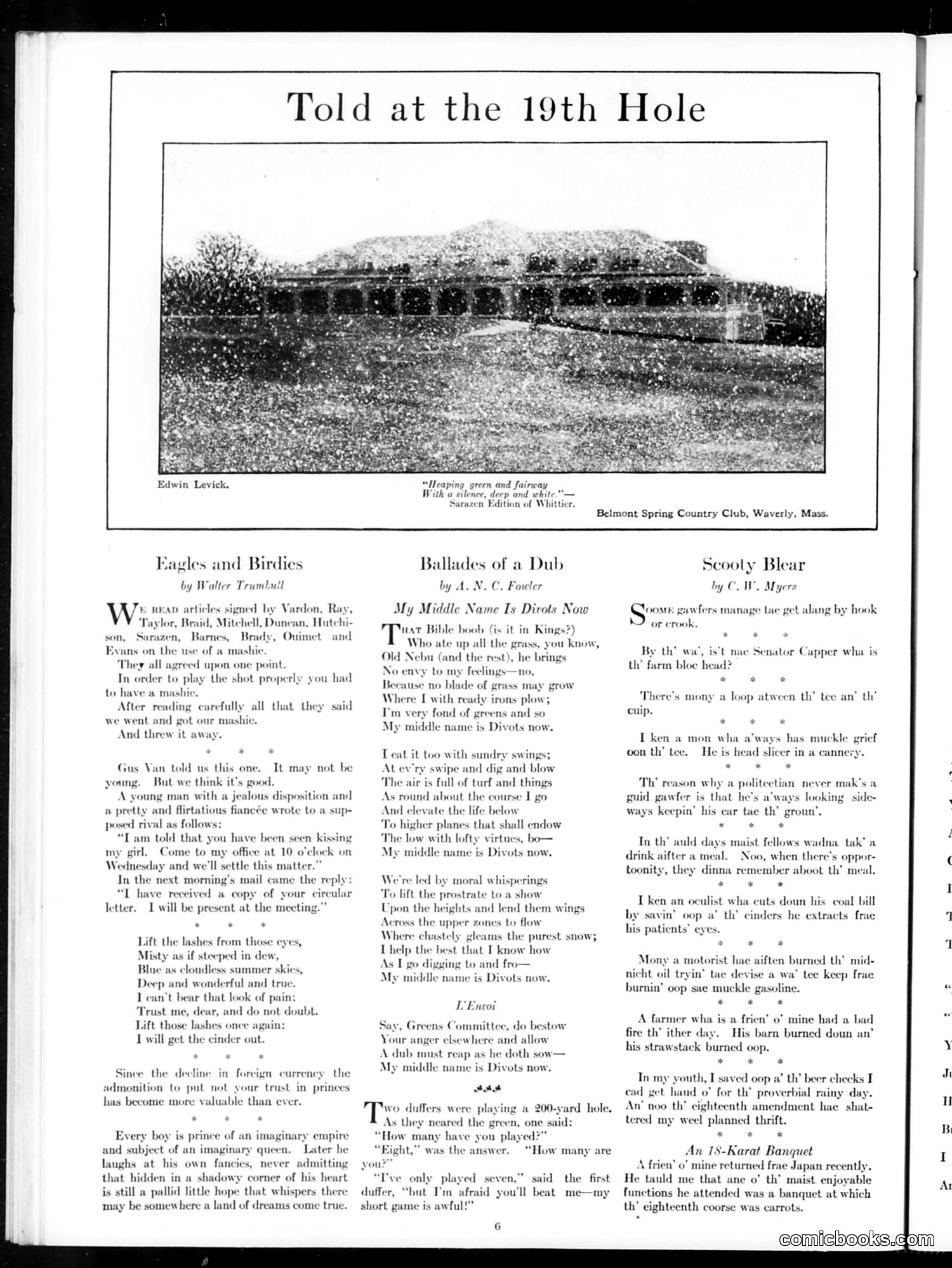
This page collects humorous anecdotes and verses centered on golf, presented as stories "told at the 19th hole" (golf's traditional gathering spot after play). The page features three separate humor columns: **"Eagles and Birdies"** references famous professional golfers of the era (Vardon, Ray, Taylor, Braid, etc.), then presents unrelated jokes, including one about a man who followed their advice too literally. **"Ballades of a Dub"** is a comic poem about an inept golfer whose defining characteristic is creating massive divots (torn-up grass patches) everywhere he plays—turning "divots" into his "middle name." **"Scooty Blear"** uses Scottish dialect humor to deliver golf-related quips and observations. The page is primarily **light entertainment**, not political satire. It's aimed at Judge's affluent readership who golfed at country clubs. The humor relies on the gap between professional skill and amateur incompetence, a timeless comedic target. Senator Capper's brief mention appears incidental to the golf jokes.
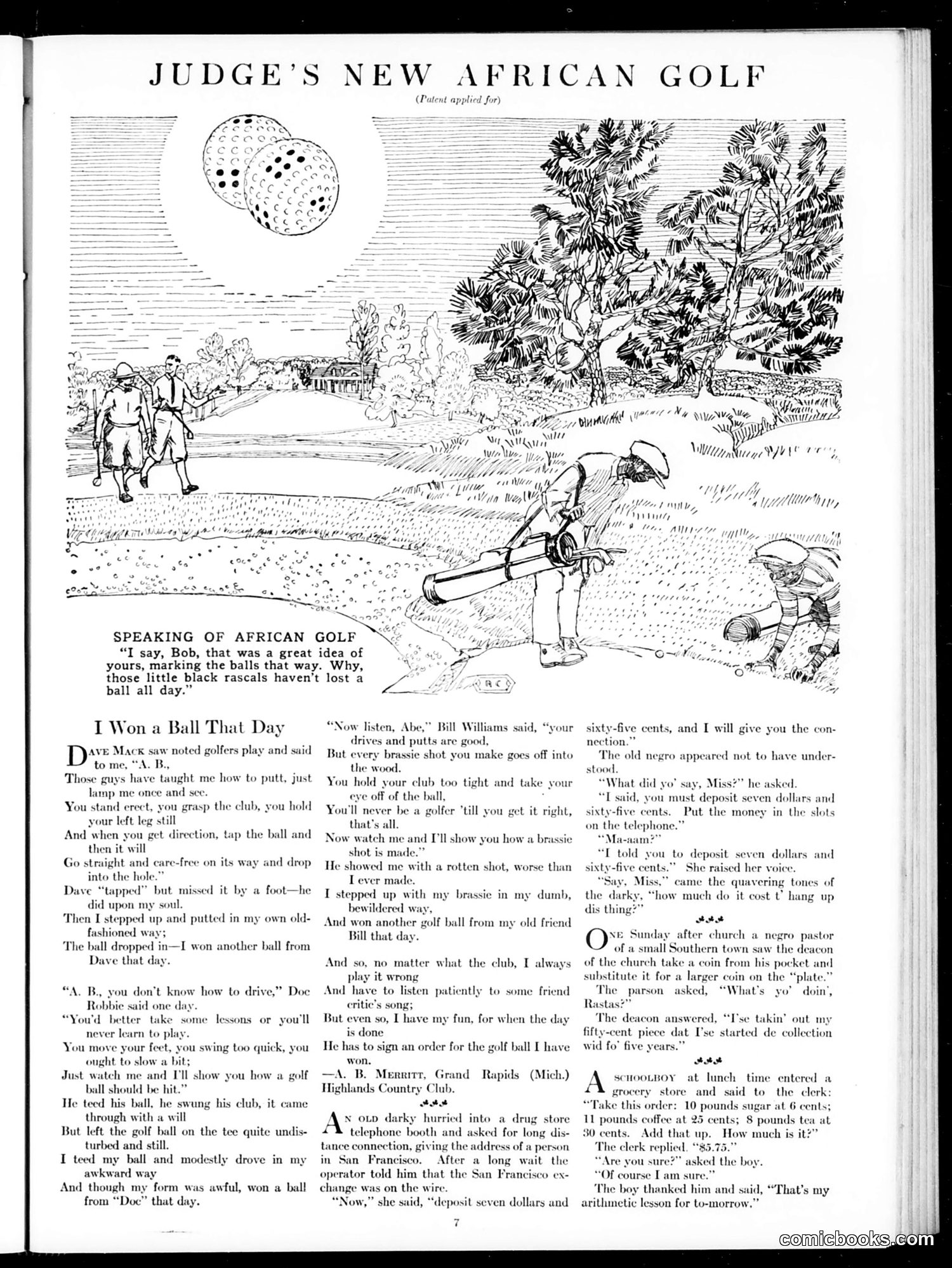
This page contains satirical stories mocking African Americans and presenting racial stereotypes common to early 20th-century American humor magazines. **"I Won a Ball That Day"** depicts white golfers repeatedly losing to a narrator who plays badly but wins their golf balls through bets—the joke being these skilled golfers are repeatedly outsmarted. **"Speaking of African Golf"** opens with a racist aside about "little black rascals" not losing balls, establishing the magazine's crude racial humor baseline. The remaining anecdotes feature African American characters ("darky," "old negro," "schoolboy") portrayed as dim-witted: - A Black man confused by telephone deposit instructions - A church deacon removing money from the collection plate - A schoolboy tricking a clerk with false arithmetic These stories present Black characters as foolish, thieving, or incompetent—typical of *Judge*'s editorial stance. The satire targets not these characters but reinforces white superiority through their portrayed ignorance. This reflects the racist attitudes embedded in mainstream American media of the era.
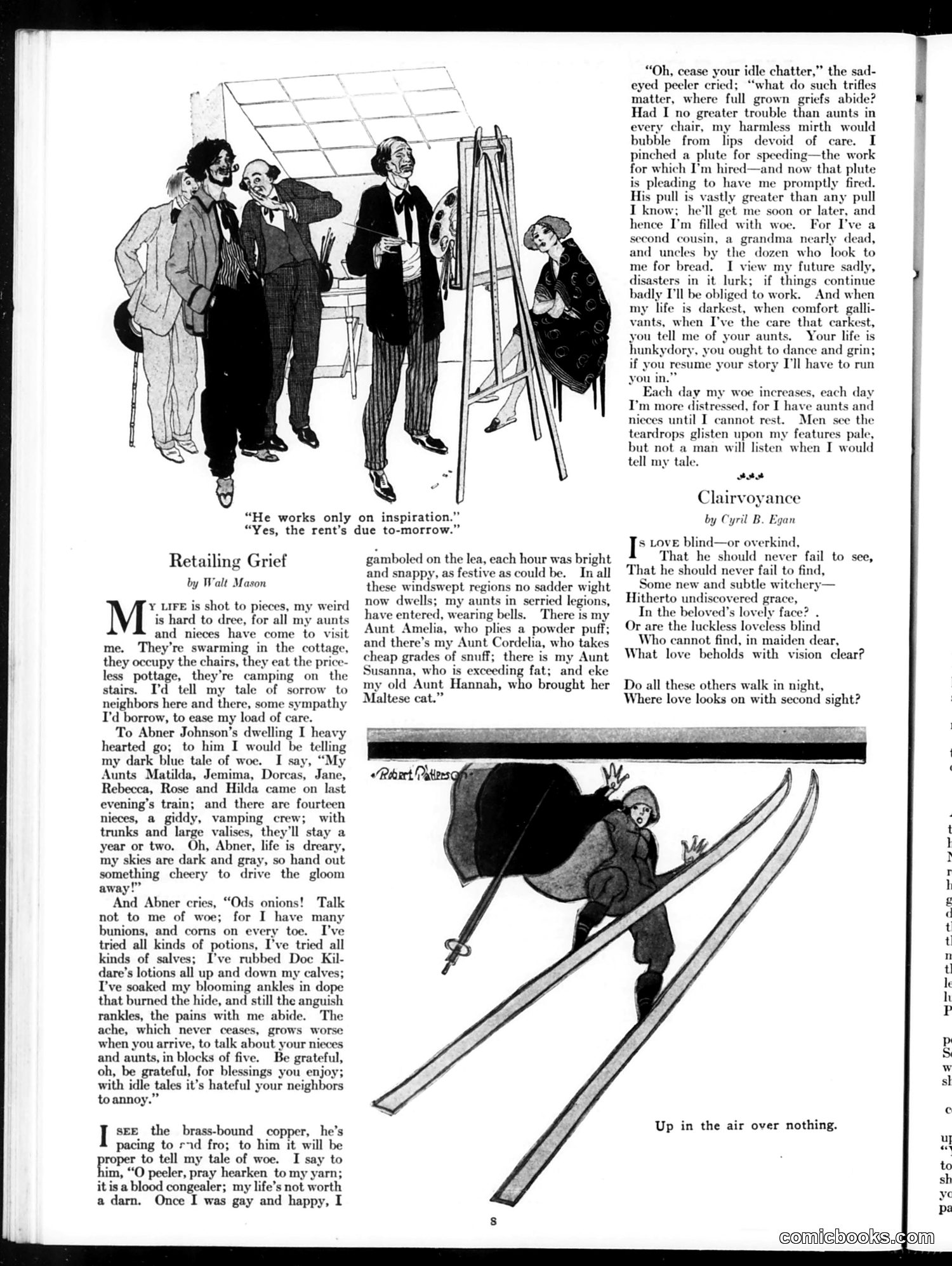
This page contains two satirical pieces mocking common complaints about life's burdens. **"Retailing Grief"** by Walt Mason is a humorous poem about a man so desperate to share his woes (being overrun by visiting aunts and nieces) that he approaches strangers—a friend, a policeman—seeking sympathy. Each person he encounters dismisses his complaints, countering with their own greater troubles: the friend has painful bunions and corns; the policeman (peeler) has been cited for speeding and risks losing his job, plus family dependents relying on him. The joke satirizes how people use complaints as social currency while ignoring others' real hardships. The cartoon above shows three figures seemingly complaining to an artist at his easel, illustrating the caption's joke: "He works only on inspiration" / "Yes, the rent's due to-morrow"—mocking the cliché of struggling artists who claim artistic motivation while facing financial desperation. **"Clairvoyance"** by Cyril B. Egan (lower right) is a brief romantic poem questioning whether love grants special vision to see beauty others miss, or blinds people to reality.
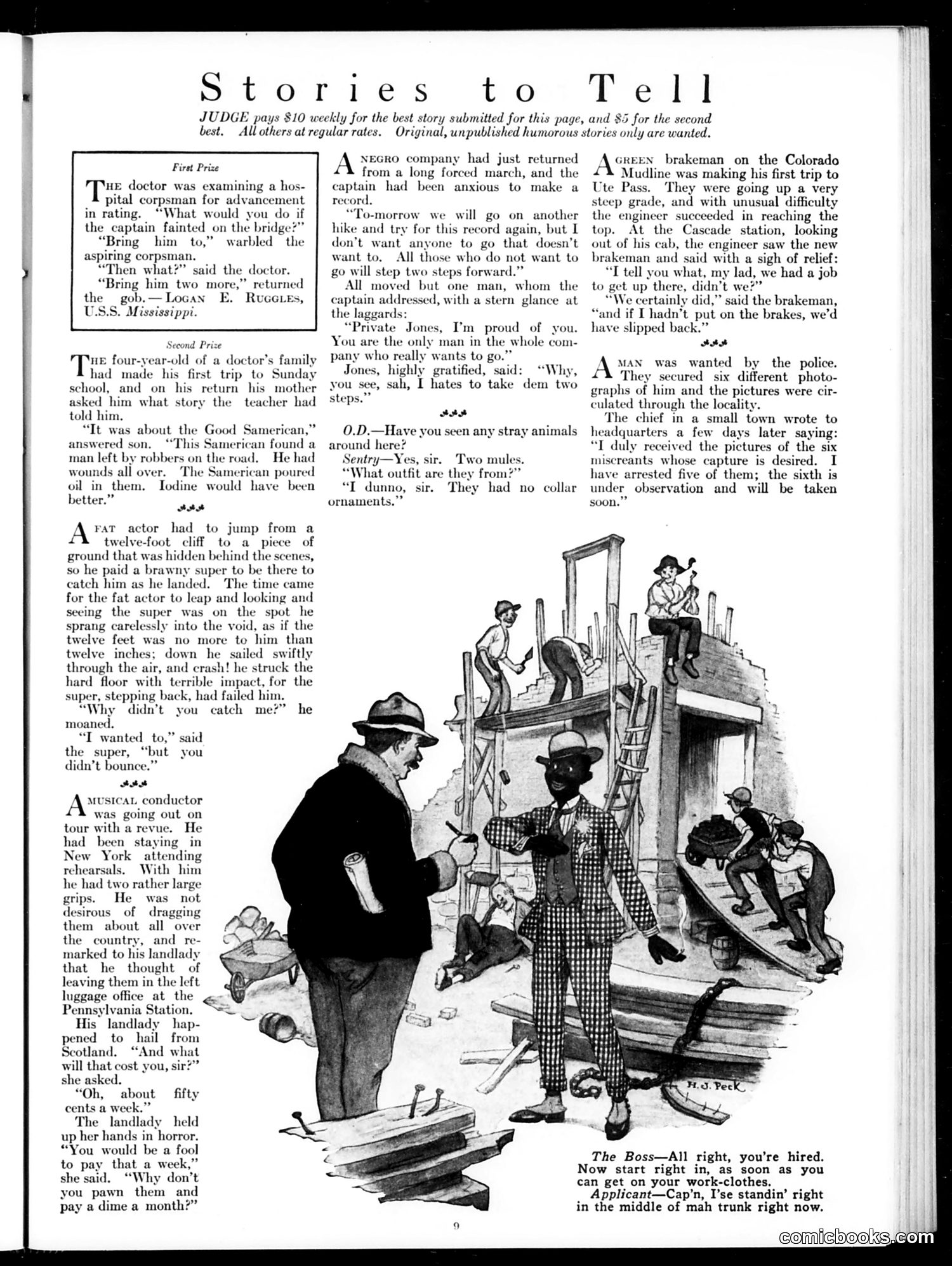
This is a humor submission page from Judge magazine featuring several short comic stories, plus one illustrated cartoon below. The stories use classic early-20th-century comedic tropes: military mishaps (a Navy corpsman misunderstanding orders), children's malapropisms ("Good Samerican" instead of "Samaritan"), slapstick theater mishaps, and racial humor (a Black soldier's misunderstanding of "forward" as retreat). One story mocks Scottish thriftiness through a landlady character. The cartoon below depicts a construction or building site where a boss hires a ragged applicant who's literally standing in an open trunk—visual slapstick humor about poverty and desperation during what appears to be an economic downturn (likely Depression-era). The page reflects period attitudes toward class, ethnicity, and racial caricature now considered offensive, while the humor style emphasizes wordplay and physical comedy typical of early Judge magazine.
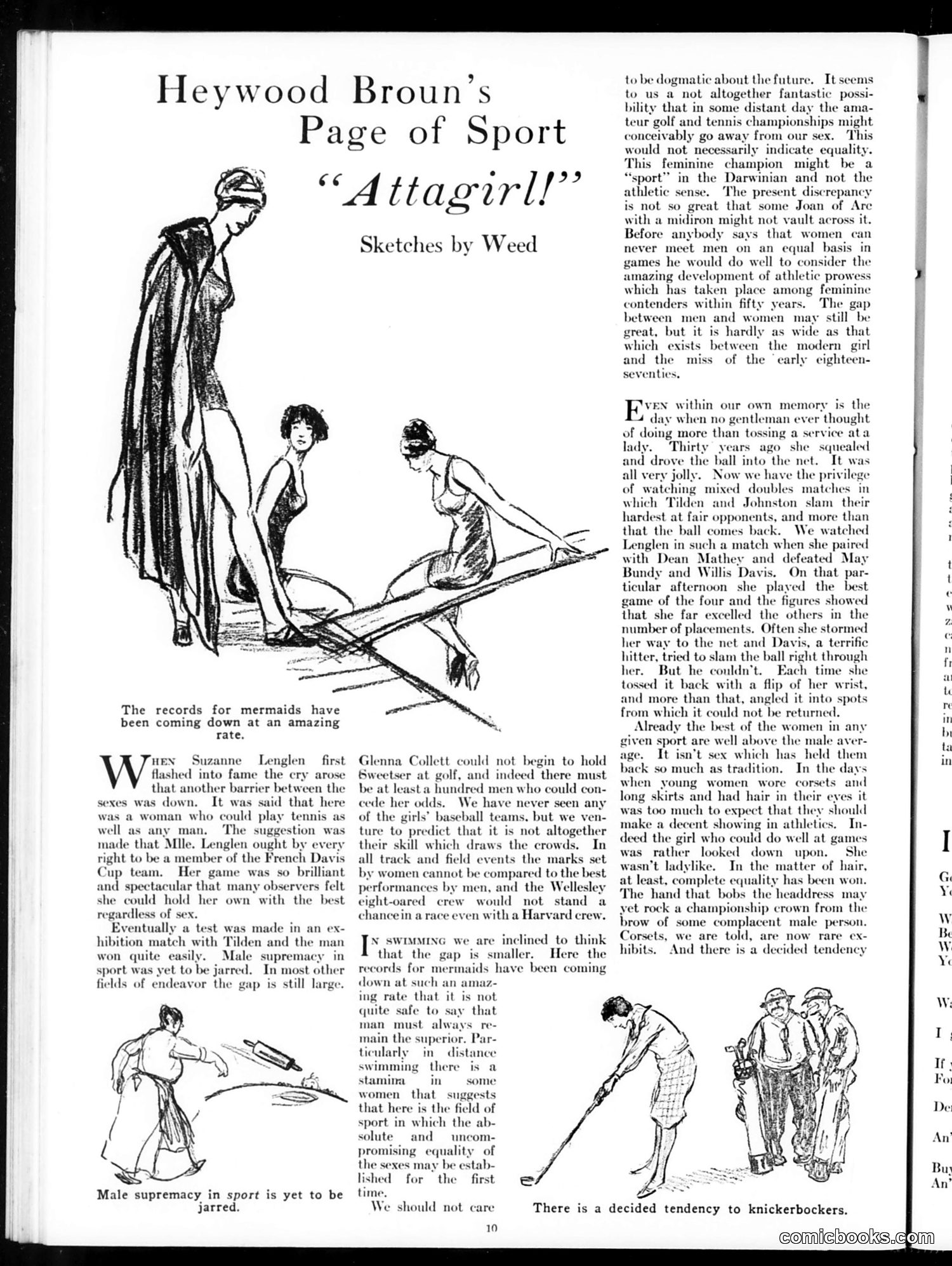
This is Heywood Broun's sports column commentary on women's athletic advancement, illustrated with sketches. The piece argues that the gap between male and female athletic performance, while still significant, has narrowed considerably and may continue to close. Broun references specific female athletes: **Suzanne Lenglen** (tennis champion) and **Glenna Collett** (golfer), noting they proved women could compete at high levels. He acknowledges men still dominate most sports—citing examples like Harvard crew versus Wellesley's eight-oared team—but argues women's records in swimming are improving at remarkable rates. The satire targets those who assume male superiority is permanent. Broun suggests women's historical underperformance reflected restrictive clothing (corsets, long skirts) and social tradition rather than inherent ability. He provocatively suggests women might eventually win amateur tennis or golf championships, though notes this wouldn't prove "equality"—a woman champion might simply be exceptionally talented. The cartoons show women in various athletic poses, emphasizing their increasing participation in sports previously considered male domains.
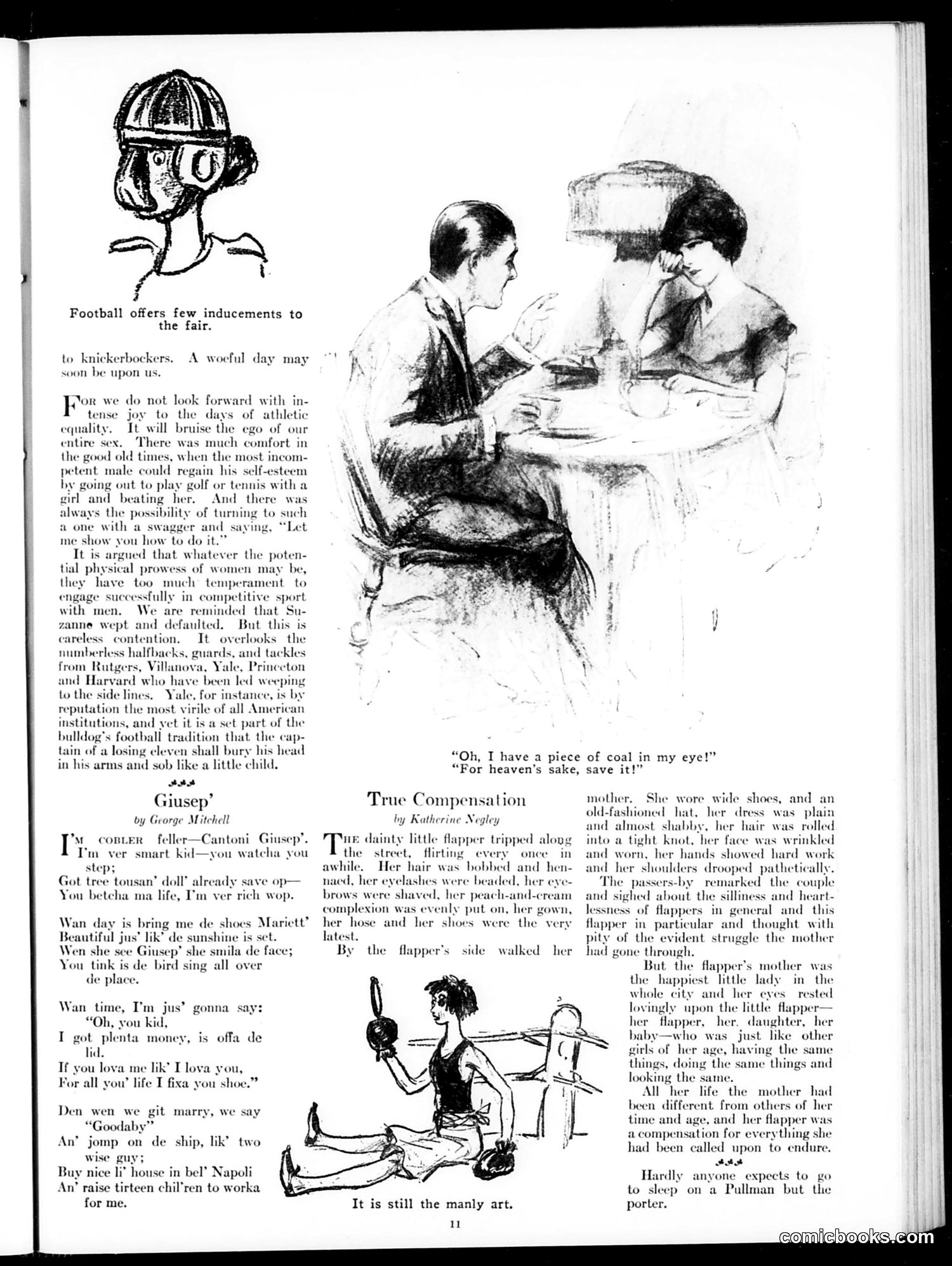
This page contains three distinct pieces satirizing early 20th-century social attitudes: **Top Section**: A commentary opposing women's athletic participation. The text argues that male ego derives from beating women at sports, and warns that female athletic competence threatens male self-esteem. It dismisses concerns about women's competitive temperament by noting that elite male institutions (Yale, Harvard, Princeton football) produce weeping players—implying men are equally emotional, undermining the argument against women's sports. **"Giusep'" (lower left)**: A dialect poem featuring an Italian immigrant character saving money to court and marry "Marictt," then return to Naples with thirteen children. This plays on period stereotypes about Italian immigrants: broken English, large families, and economic aspiration. **"True Compensation" (right)**: A sketch contrasting a fashionable young "flapper" with her plain, worn mother. The narrative reveals the mother is actually content—her daughter's modernity and happiness compensate for the mother's own hardship and conformity. This sympathetically portrays intergenerational social change during the Jazz Age.
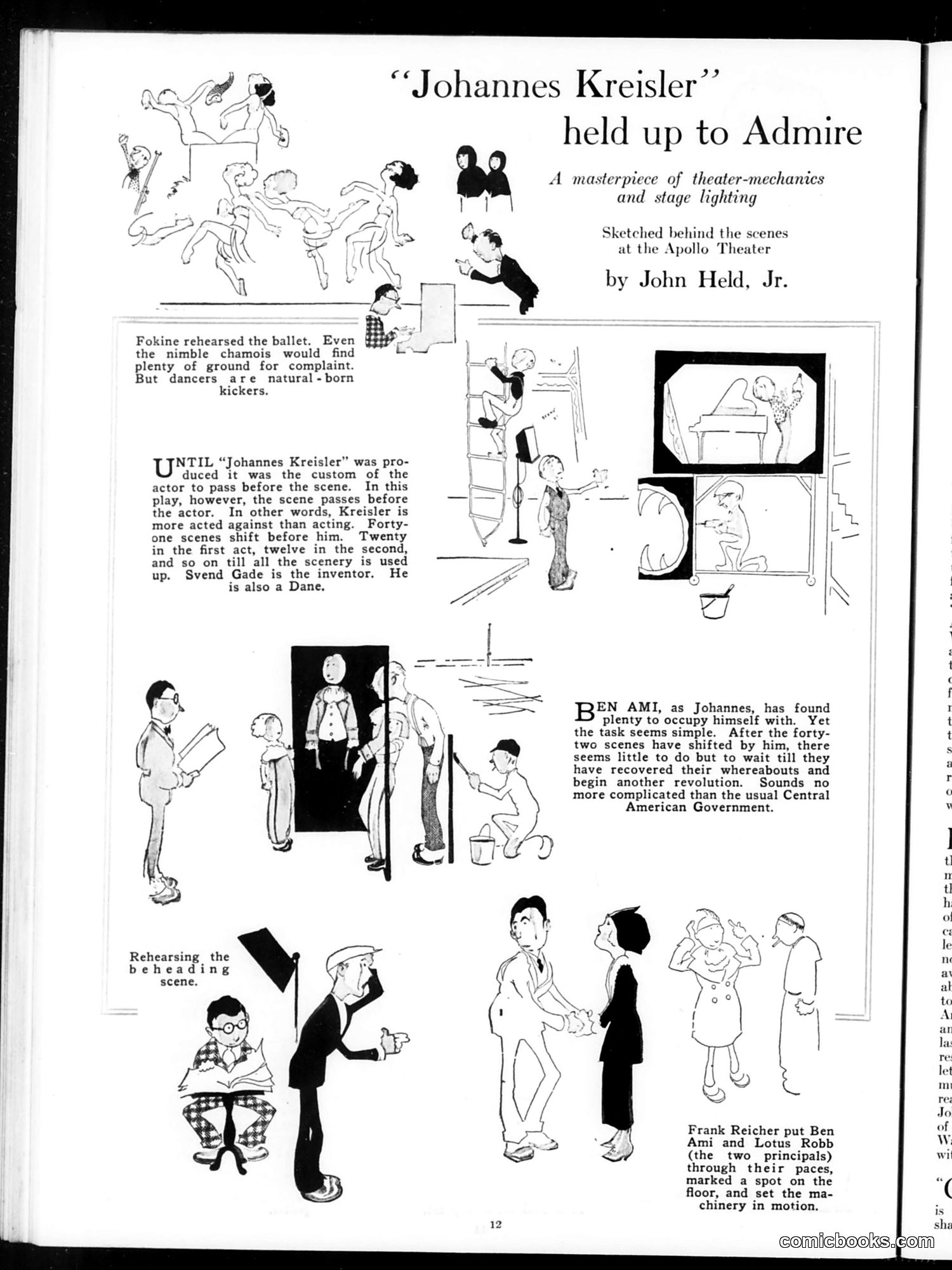
This page by cartoonist John Held Jr. sketches behind-the-scenes details from the Apollo Theater's production of "Johannes Kreisler," praising its innovative stage mechanics. The satire centers on the production's novel approach: instead of actors moving across static scenery (standard theater practice), the scenery shifts past a stationary actor—forty-one scene changes in two acts. The humor lies in how passive this makes the lead actor Ben Ami, leading to a topical political joke comparing the resulting chaos to "the usual Central American Government"—a jab at political instability in that region, a common subject of 1920s American satire. The sketches show rehearsal scenes, including choreographer Fokine's ballet rehearsals and director Frank Reicher blocking the principals through precisely marked positions. The overall tone celebrates theatrical innovation while gently mocking both the actor's minimal role and contemporary Central American politics.
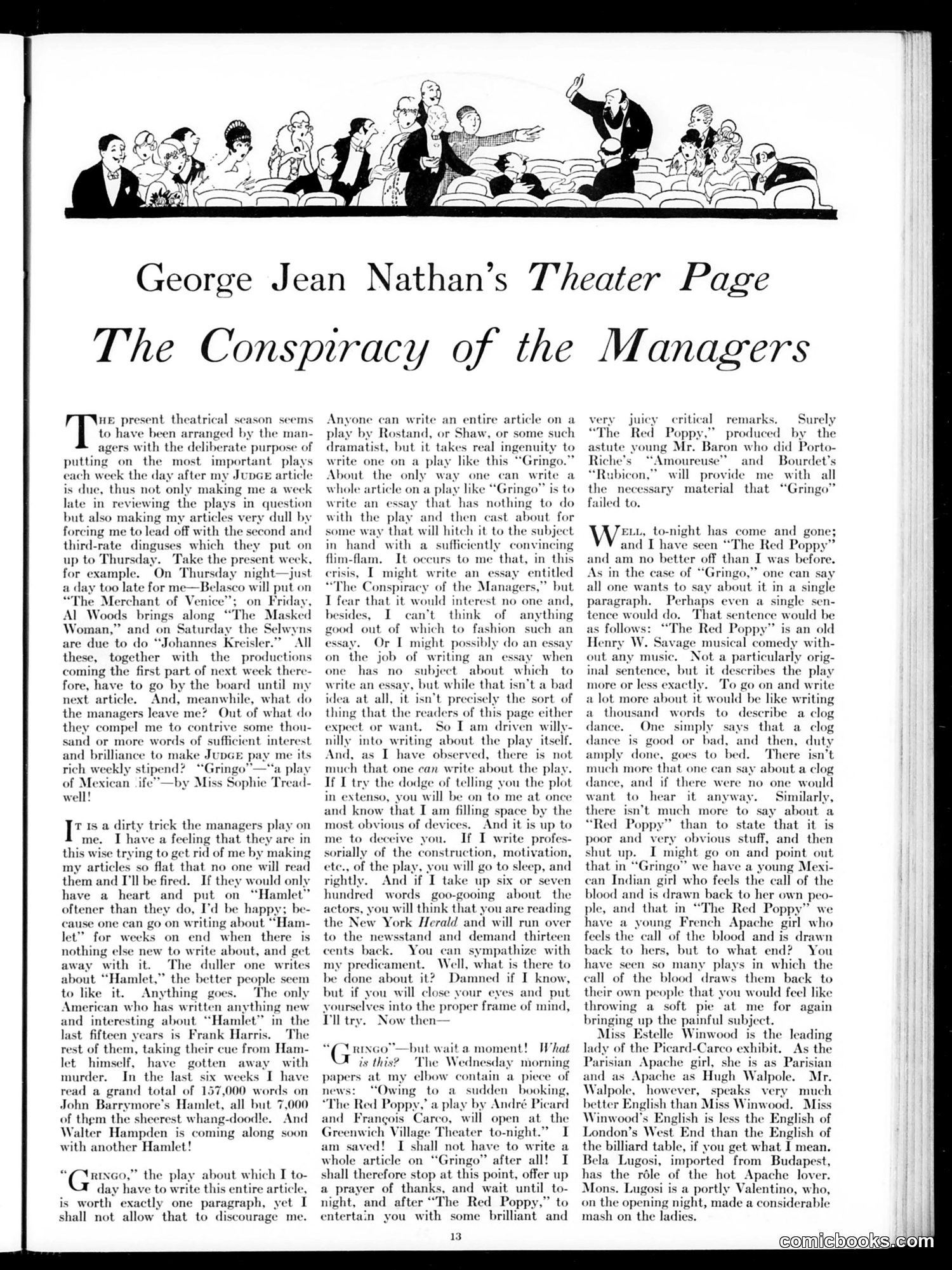
This is George Jean Nathan's theater column, a meta-satirical piece where Nathan complains that theatrical managers deliberately schedule important new plays the day *after* his Judge article deadline, forcing him to review only mediocre productions. The cartoon header depicts theater-goers and managers in an audience, illustrating the theatrical world he's critiquing. Nathan's central joke: he's assigned to review "Gringo"—a play so trivial it merits only one paragraph—yet must fill his entire column. He ironically catalogs the dishonest tricks critics use to pad reviews of bad plays: writing essays unrelated to the actual work, describing plots tediously, discussing "construction and motivation" to bore readers into submission, or praising actors excessively. The satire targets both theatrical managers (for scheduling conflicts) and theater critics' intellectual dishonesty. Nathan's complaint about endless "Hamlet" productions and interpretations adds contemporary Broadway context—multiple "Hamlet" productions were indeed running simultaneously in the 1920s. The piece is fundamentally meta-commentary: a critic admitting the absurd gymnastics required to manufacture credible reviews of worthless plays.
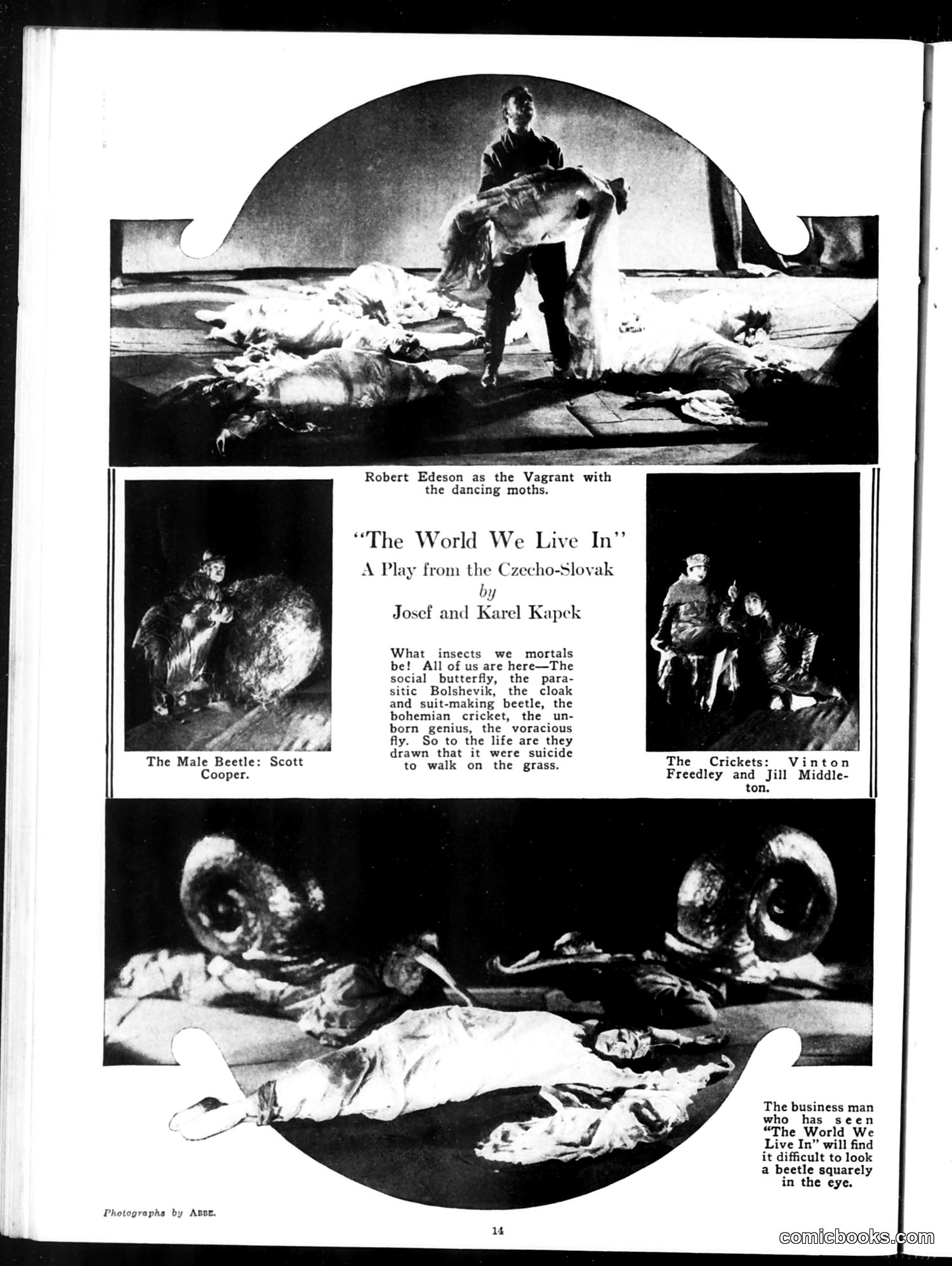
This page promotes a Czechoslovak play by the Kapek brothers using insect characters as social satire. The production features actor Robert Edeson as "the Vagrant" alongside dancing moths and various insect characters representing human types. The satire is explicit: insects symbolize different social classes and archetypes—"the social butterfly, the parasitic Bolshevik, the cloak and suit-making beetle, the bohemian cricket." The Bolshevik reference dates this to the post-1917 Red Scare era when American publications frequently portrayed communists as dangerous outsiders. The final joke suggests the play's power: a businessman who watches it will find it difficult to look a beetle in the eye afterward—implying the production successfully makes audiences recognize their own shallow materialism and social pretension reflected in these insect metaphors. It's sophisticated theatrical satire attacking both capitalism and Bolshevism through allegory.
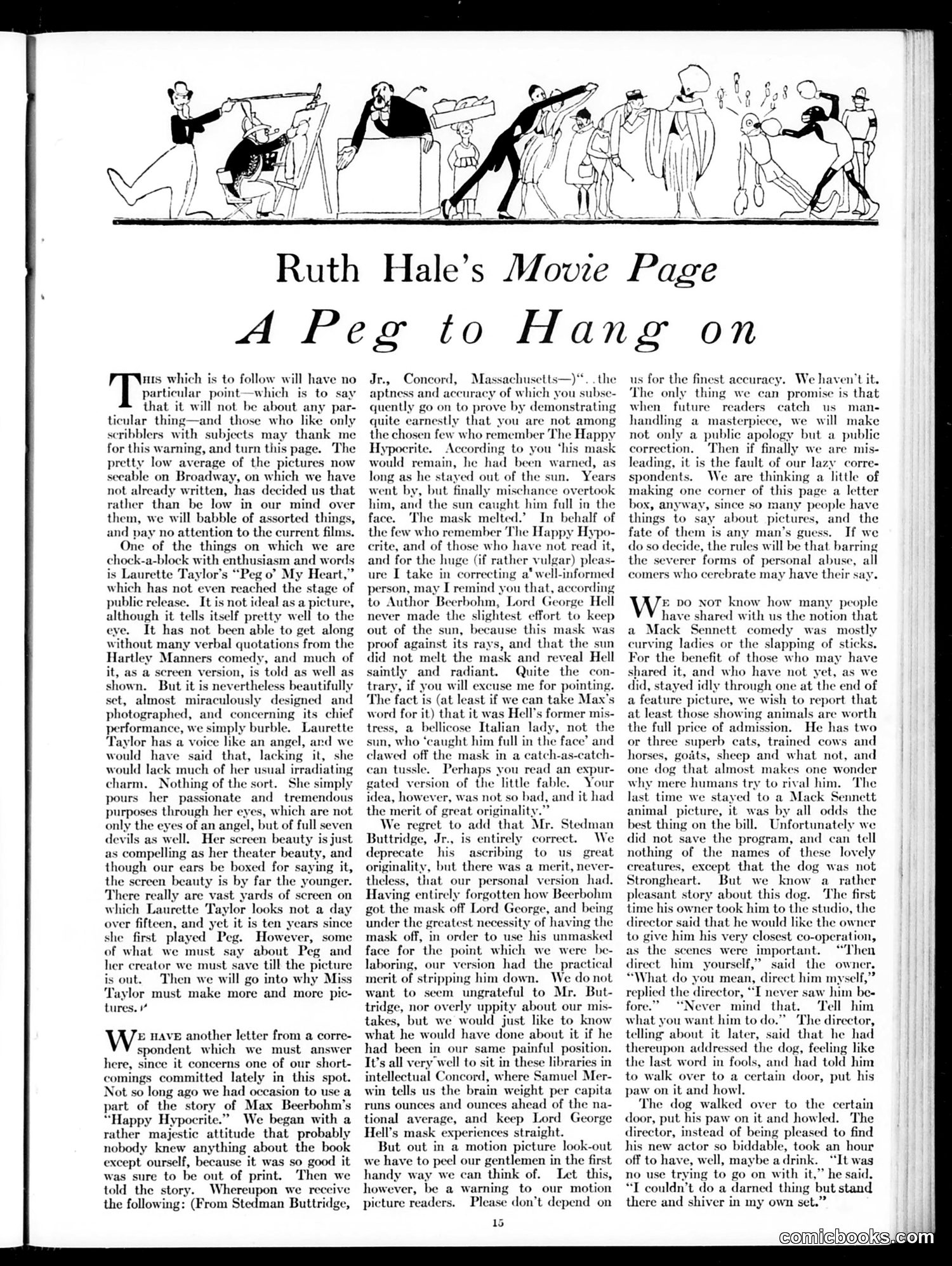
This is a film criticism column, not a political cartoon. Ruth Hale critiques Laurette Taylor's screen adaptation of "Peg o' My Heart" (a Hartley Manners stage comedy), praising Taylor's beauty and expressive eyes while noting the film relies too heavily on dialogue from the original play rather than being cinematic. The page also includes a correction letter from a reader in Concord, Massachusetts, pointing out that Hale misrepresented Max Beerbohm's "The Happy Hypocrite" in a previous column. The reader corrects that the mask wasn't melted by sunlight but clawed off by an Italian woman during a physical struggle. The tone is witty and self-aware—Hale admits she initially assumed the Beerbohm story was out of print and unknown to readers, then graciously accepts the correction.
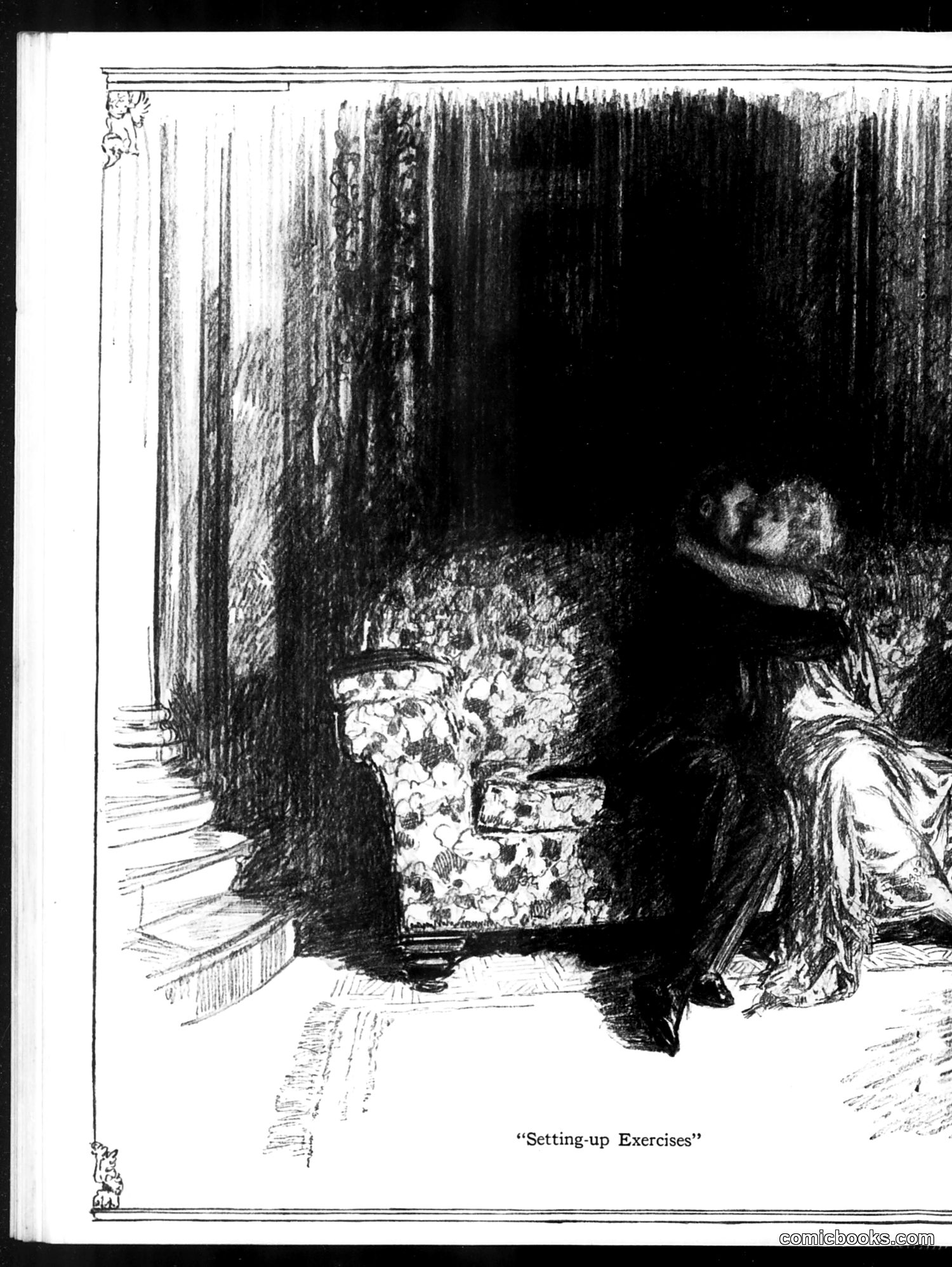
This cartoon depicts a woman in a corset performing stretching exercises in what appears to be a confined interior space. The title's double meaning is the joke: "setting-up exercises" refers both to physical fitness routines (a contemporary health trend) and the literal act of "setting up" or arranging oneself in a corset. The satire targets the restrictive fashion of women's corsetry, which was simultaneously promoted as healthful while being physically constraining. The cramped pose and dark, claustrophobic setting suggest the absurdity of claiming health benefits from garments that severely limit movement and breathing. This reflects turn-of-the-century debates about women's fashion, health reform, and the tension between fashion expectations and physical wellbeing.
This appears to be an interior design illustration rather than a political cartoon. The sketch, signed by "Angus MacDonnell," depicts an elegant garden room or conservatory viewed through tall windows. The scene shows ornamental urns, potted plants, a decorative pedestal table, and an umbrella or parasol structure overhead, with a water feature visible in the background landscape. The illustration likely accompanied an article about interior decoration, garden design, or architecture—common content in *Judge* magazine, which published satirical commentary alongside lifestyle and design features. Without accompanying OCR text explaining the context, the specific satirical or social commentary intended remains unclear. The style suggests this is from the early-to-mid 20th century.
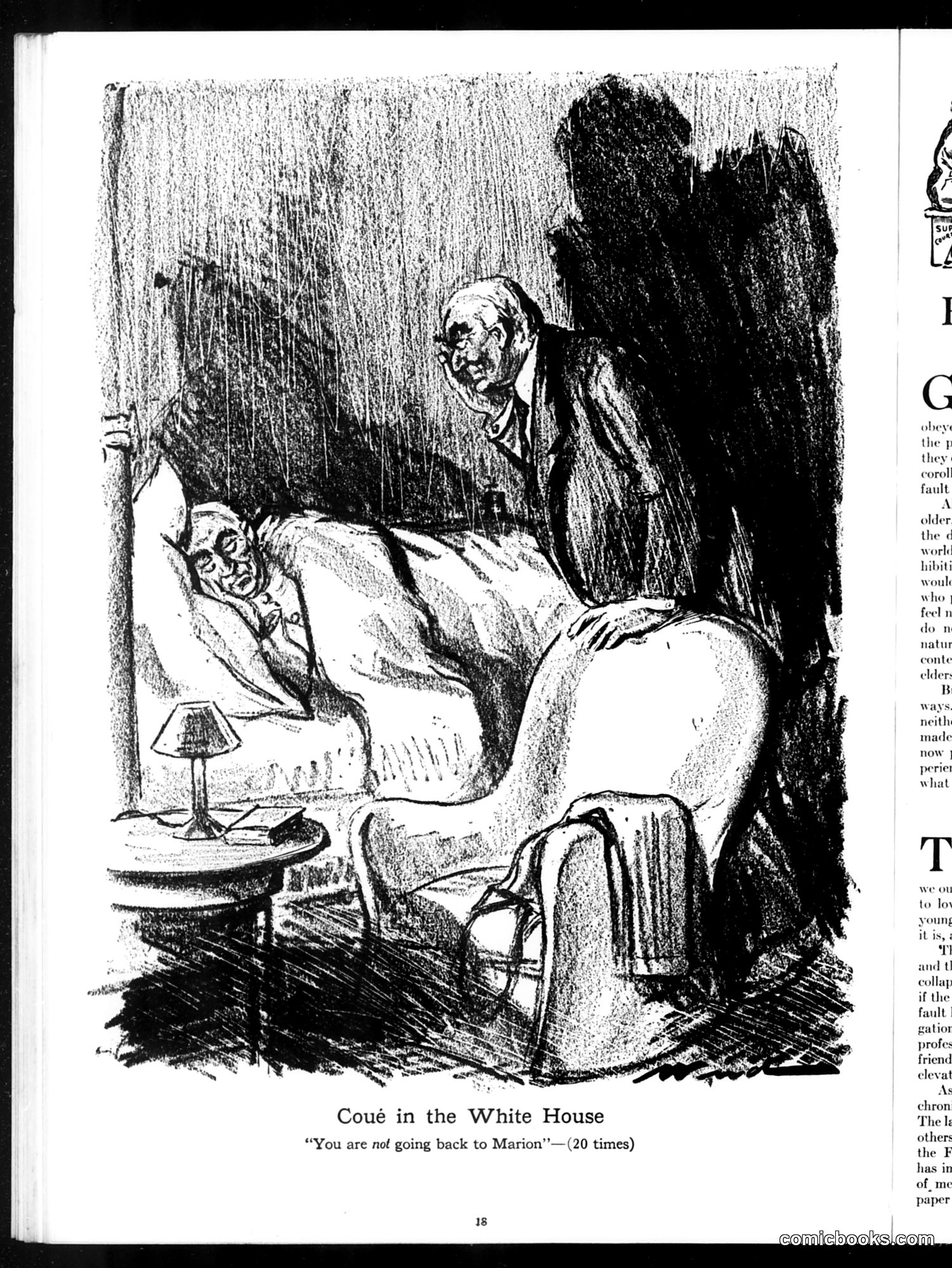
This cartoon satirizes **Émile Coué**, a French psychotherapist famous for his "autosuggestion" method—repeating positive affirmations to achieve desired results. His most famous phrase was "Day by day, in every way, I am getting better and better." The cartoon depicts what appears to be a political figure (likely a U.S. President, given "White House" in the title) lying in bed while repeating the affirmation "You are not going back to Marion"—(20 times). This references **Marion, Ohio**, apparently a place the figure wishes to avoid or escape from. The satire mocks both Coué's therapeutic method as ineffective wishful thinking and, simultaneously, criticizes the political figure for attempting to use mere repetition and self-delusion rather than genuine action to solve problems or escape consequences. The joke suggests that saying something repeatedly won't make it true—a pointed jab at political denial or avoidance.
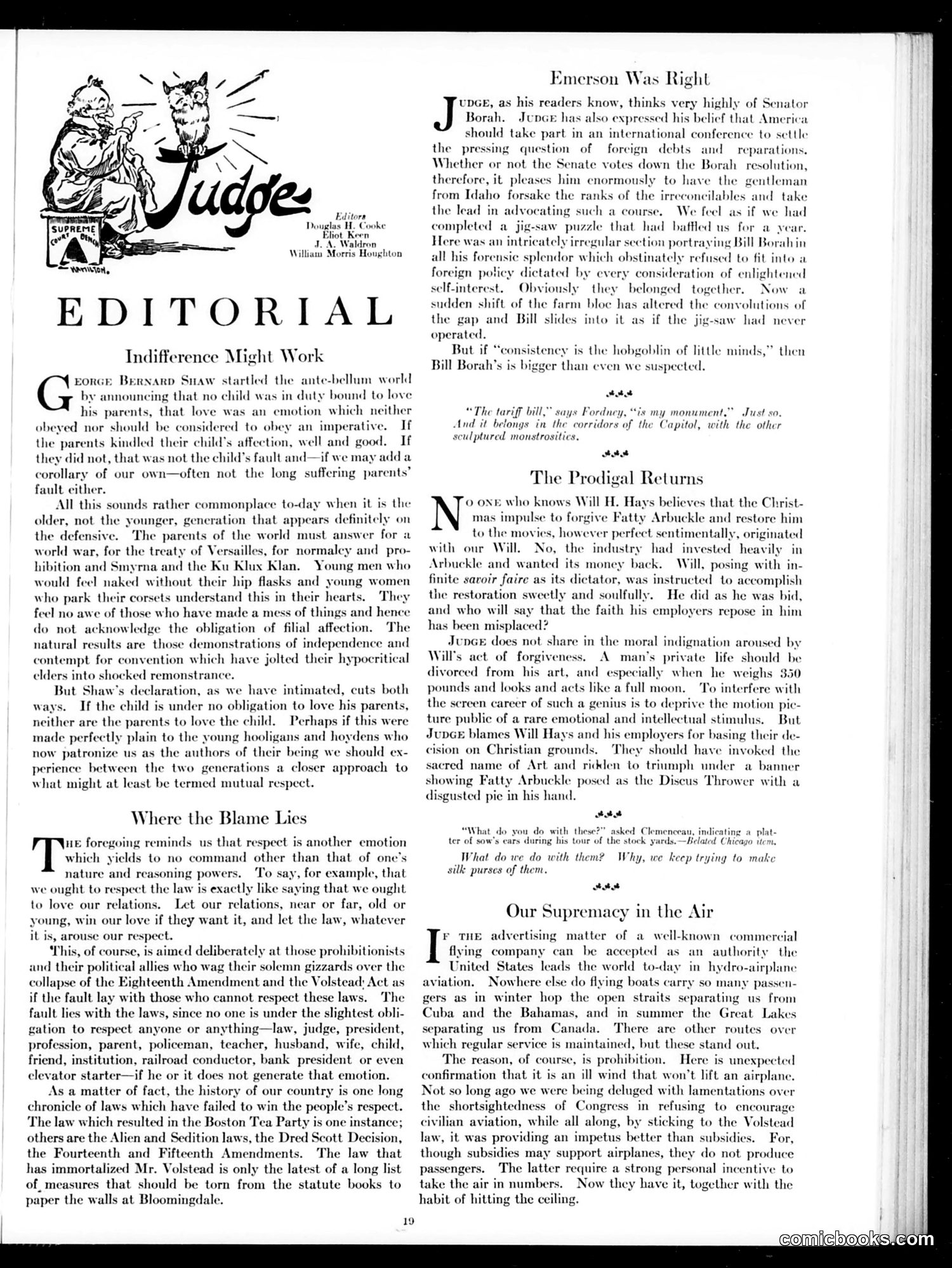
**The Cartoon**: The small illustration shows a figure labeled "Judge" holding a cat, with motion lines suggesting the cat is scratching or resisting. This is the masthead for the magazine itself. **Main Editorial Content**: This page contains three opinion pieces criticizing American social and political attitudes of the 1920s: 1. **"Indifference Might Work"** argues young people have no obligation to respect parents who created postwar disorder, citing WWI, the Treaty of Versailles, Prohibition, and the KKK as failures of the older generation. 2. **"Where the Blame Lies"** attacks Prohibition, arguing the Volstead Act itself (not violators) deserves blame. It references the Boston Tea Party and other historically-rejected laws to suggest unjust laws cannot command respect. 3. **"Emerson Was Right"** praises Senator Borah (Idaho) for supporting an international debt conference, positioning this as wisdom analogous to Emerson's philosophy. The page reflects 1920s cultural friction between generations and debates over Prohibition's legitimacy and America's international role.
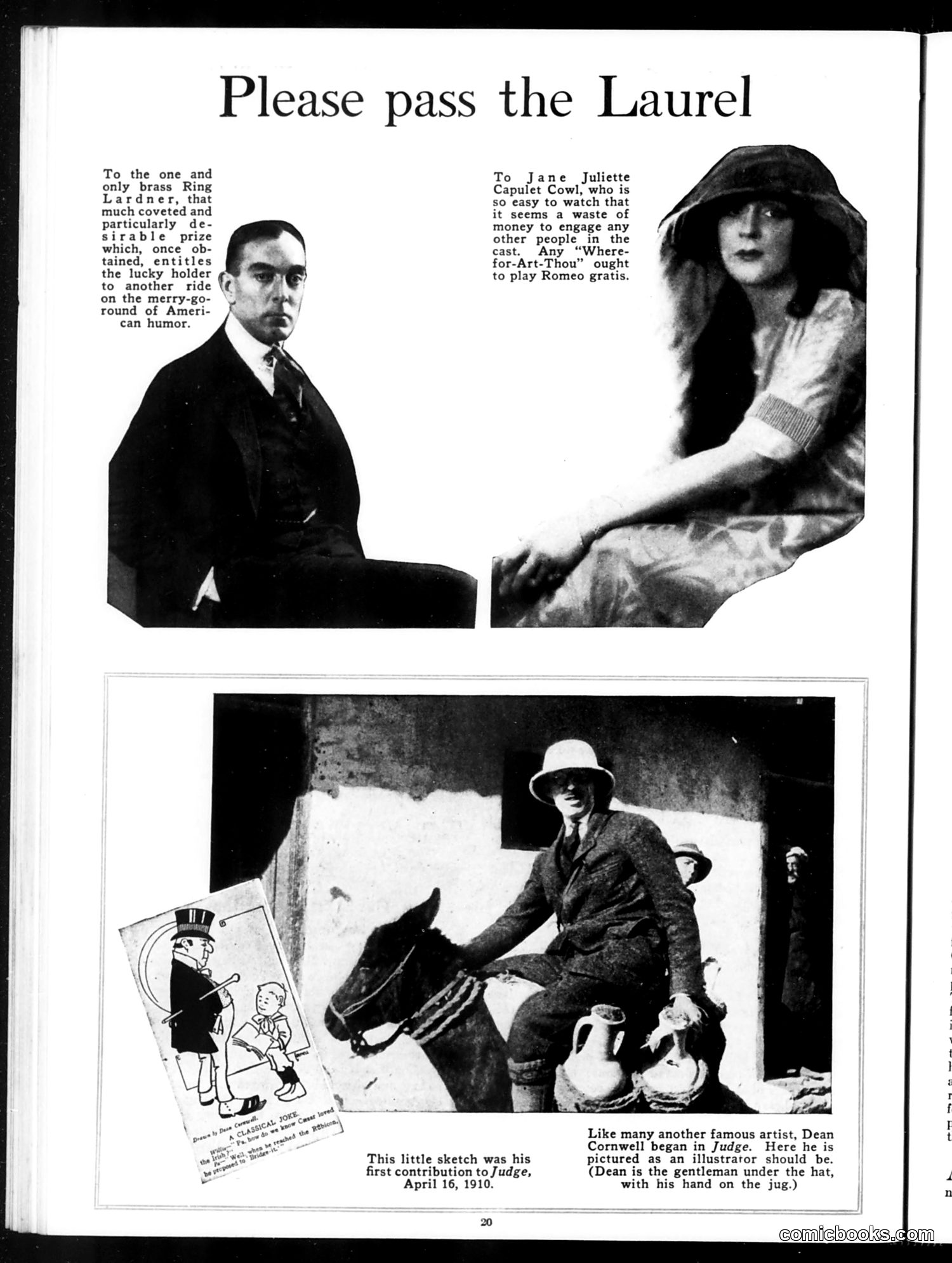
This page awards satirical "laurels" (honors) to three figures in American entertainment circa 1910: **Ring Lardner** (left, top) receives mockery as a humorist whose brass ring prize entitles him to "another ride on the merry-go-round of American humor"—suggesting his comedic work is repetitive and circular. **Jane Juliette Capulet Cowl** (right, top) is criticized as an actress so dull that hiring her for Shakespeare's *Romeo and Juliet* would waste money; the male lead should perform gratis rather than be paid for acting opposite her. **Dean Cornwell** (bottom) is celebrated as an illustrator whose work Judge is publishing. The sketch shows him as a gentleman-artist with a jug, likely referencing his contribution to the magazine's April 16, 1910 issue—his first Judge appearance. The page blends celebrity roasting with professional recognition, typical of Judge's satirical approach to entertainment figures of the era.
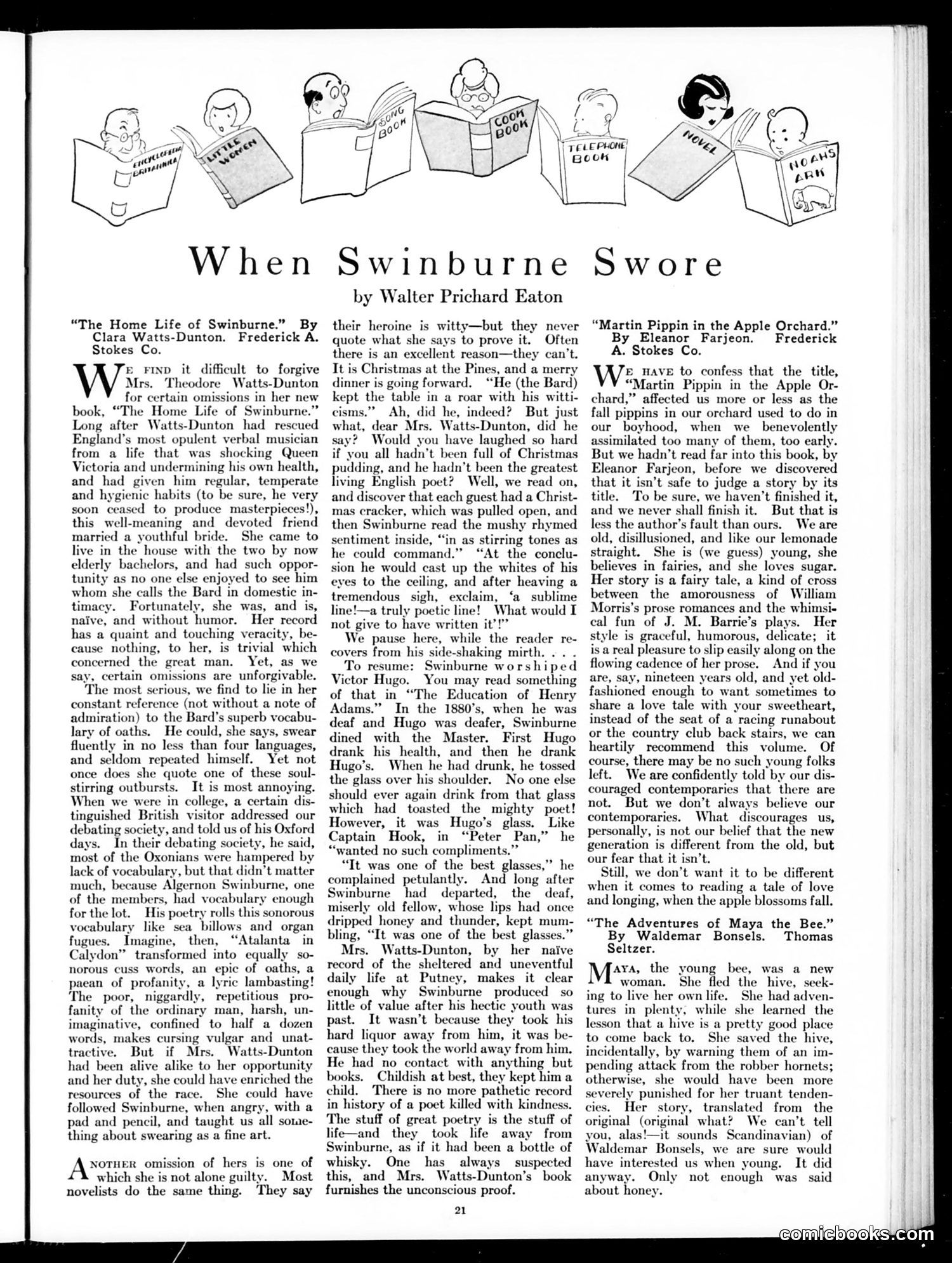
This is a literary review by Walter Prichard Eaton critiquing Clara Watts-Dunton's biography *The Home Life of Swinburne*. The cartoon header shows various people reading different books, illustrating contemporary reading habits. The review satirizes Watts-Dunton's omissions from her memoir of the Victorian poet Algernon Charles Swinburne. Eaton's central joke: she celebrates Swinburne's legendary profanity—he could swear fluently in four languages without repetition—yet quotes *none* of his actual oaths. This represents a broader literary failing: biographers and novelists claim their subjects were witty or charming but never provide actual evidence. The satire targets both Swinburne's rehabilitation (Watts-Dunton had domesticated the dissolute poet) and Victorian literary hagiography's tendency toward vague praise rather than concrete demonstration. Eaton suggests such biographical timidity wastes an opportunity to document Swinburne's linguistic artistry in its most colorful form.
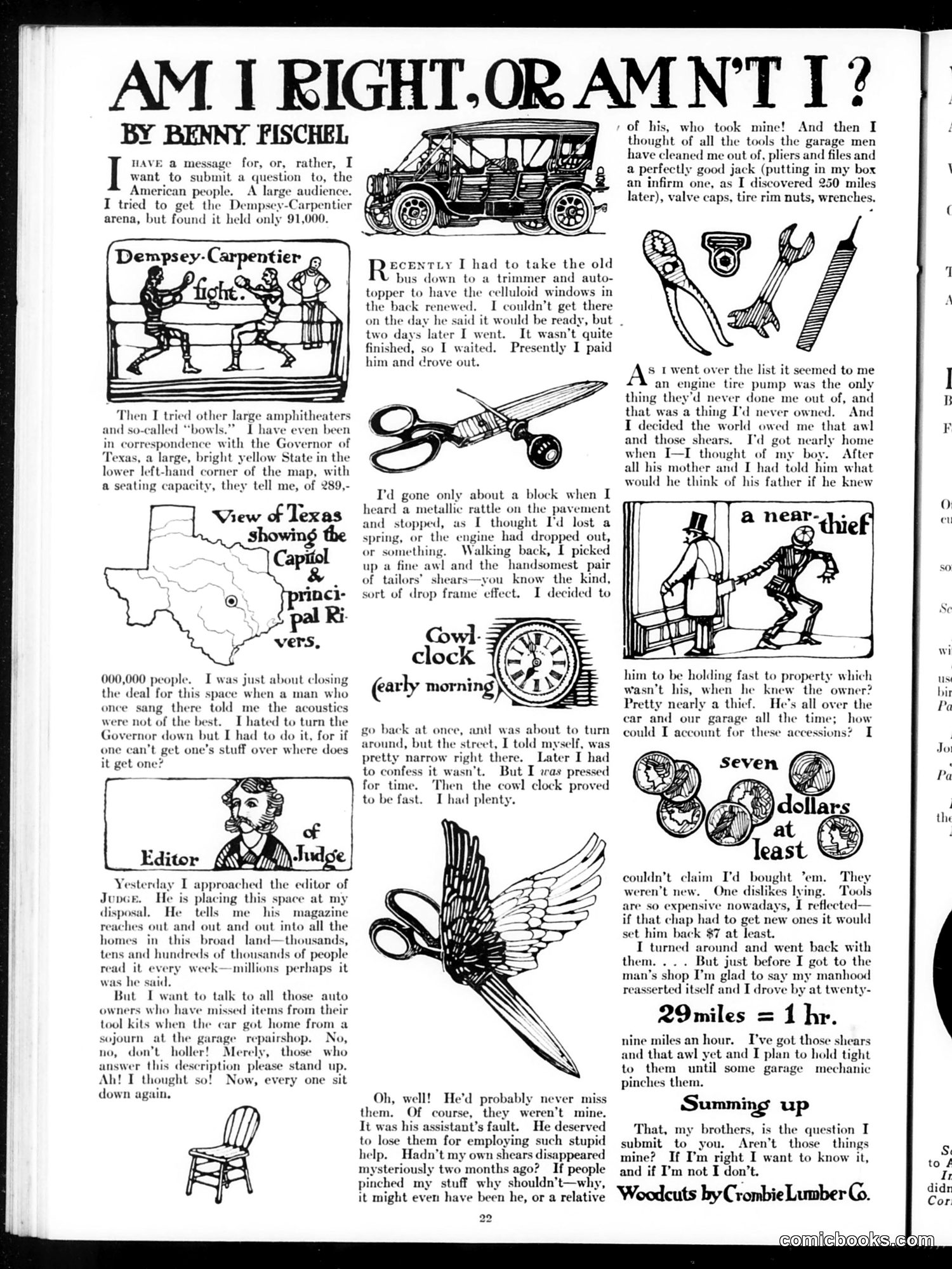
This is a humorous essay by Benny Fischel about stolen tools. The author describes trying to find a venue large enough to address "the American people" about a pressing issue—then reveals his actual concern: auto owners who've had tools disappear at repair shops. The narrative describes finding an awl and shears left on the street, apparently from a garage, and debating whether to return them. He wrestles with the moral question: keeping found property versus setting a good example for his son. He ultimately drives past without returning the tools. The satire mocks the grandiose setup (comparing a personal grievance to needing a massive public arena) and highlights petty dishonesty—how people rationalize small thefts by blaming garages for losing their items first. The "cowl clock" anecdote and other details emphasize his self-justifying reasoning. The conclusion ironically frames his failure to return the tools as a question for readers' judgment, inviting them to recognize their own moral compromises.
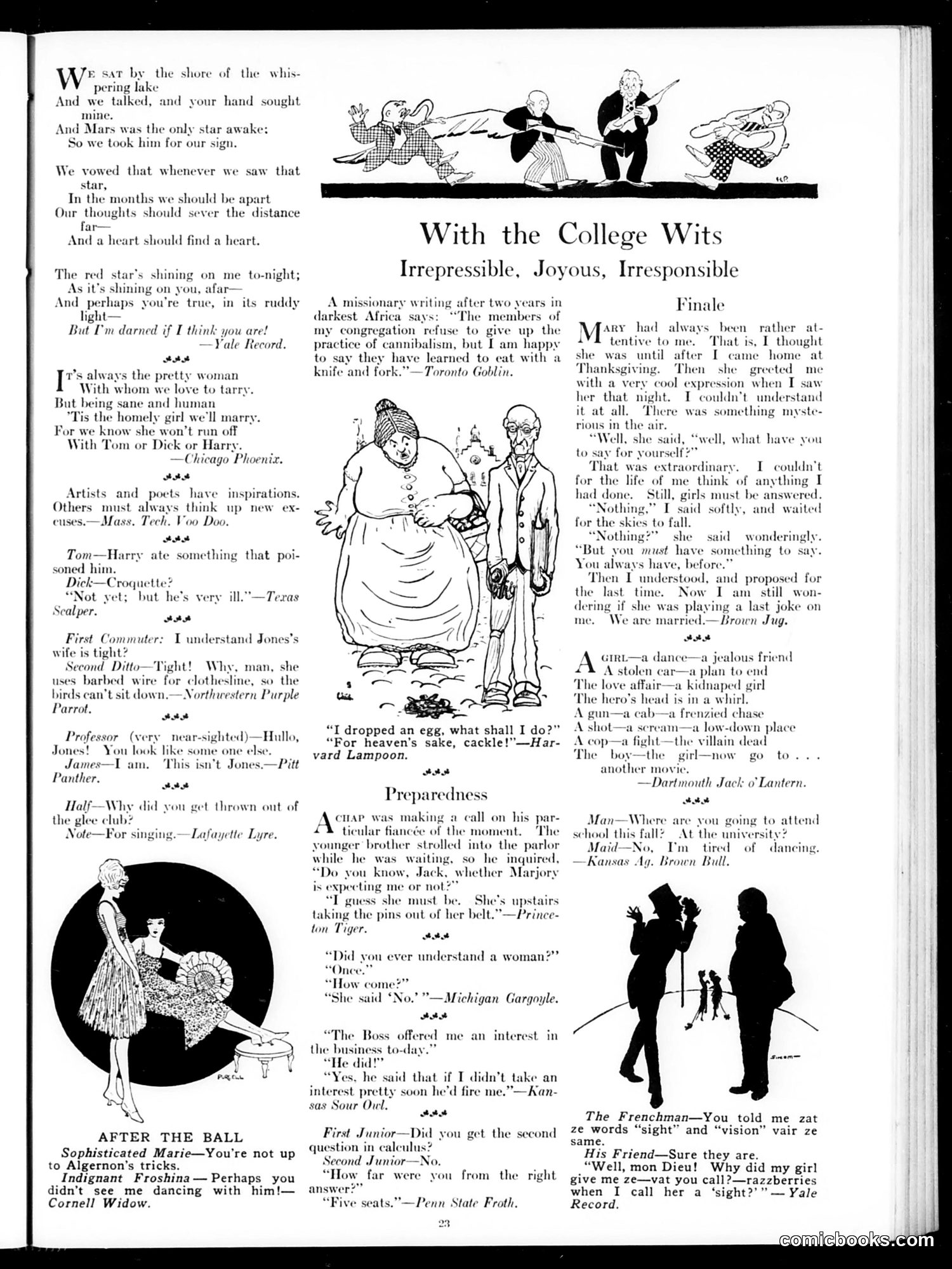
This page collects humorous short jokes and anecdotes from various college humor magazines (Yale Record, Chicago Phoenix, Harvard Lampoon, etc.). The content reflects early-20th-century collegiate wit targeting recognizable social situations: courtship anxieties, academic struggles, workplace dynamics, and romantic misunderstandings. Key recurring themes include gender relations (women as mysterious or manipulative), marriage as inevitable compromise, and gentle mockery of authority figures like professors. The "Finale" narrative illustrates period dating customs—a young man confused by his fiancée's coldness until proposing resolves the mystery, ending with self-aware uncertainty about whether she was "playing a last joke." The accompanying illustrations depict typical college-life scenarios: dancing, socializing, and romantic encounters. The humor relies on wordplay, ironic reversals, and observations about human nature that would have resonated with college readers of the era. The tone is lighthearted rather than genuinely satirical or political.
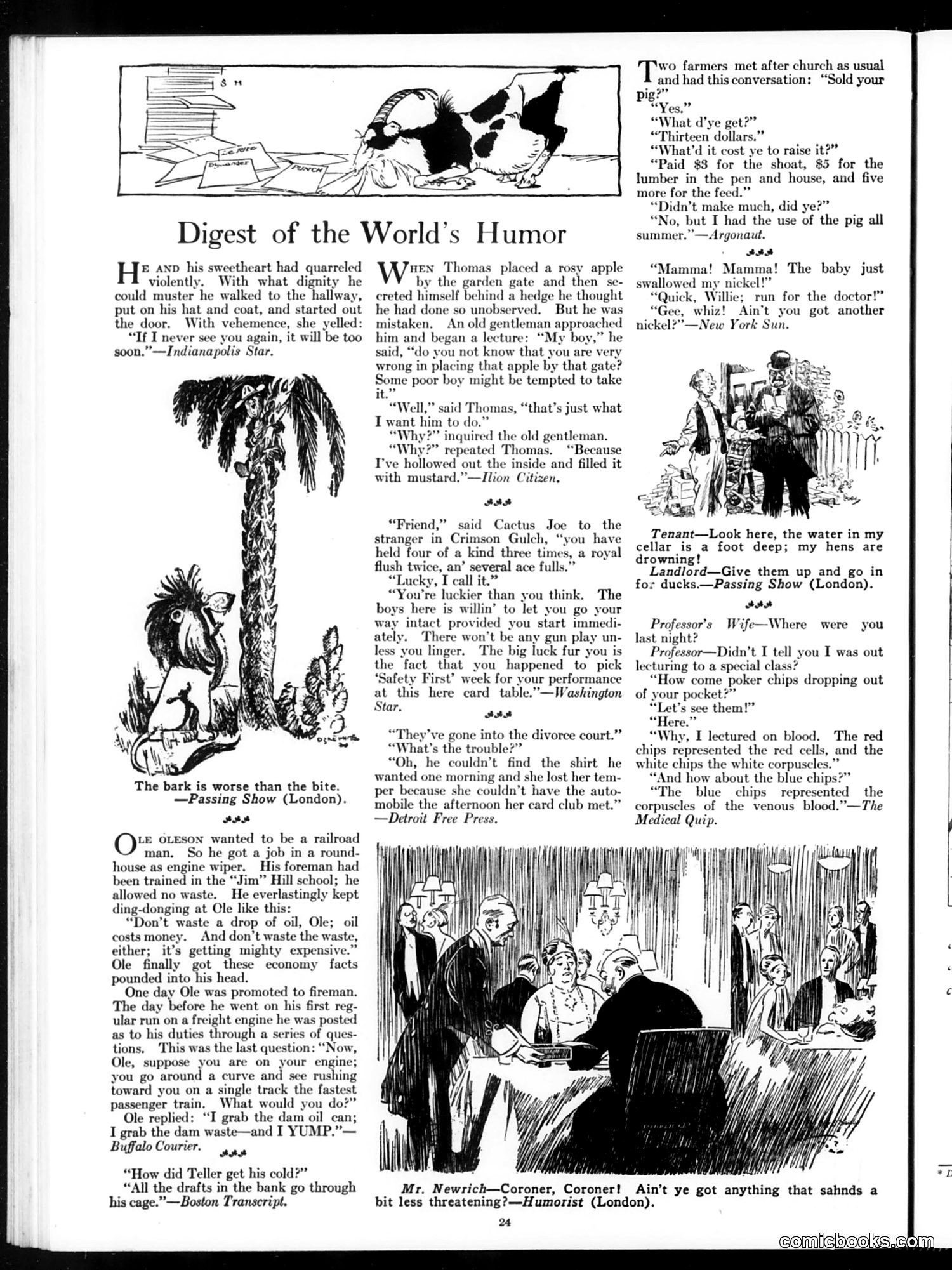
This page from *Judge* magazine presents a collection of brief humorous anecdotes and jokes organized under the heading "Digest of the World's Humor," drawn from various contemporary newspapers and magazines. The cartoons and jokes reflect early 20th-century American humor. Notable examples include: - **Ole Oleson story**: satirizes railroad management's obsession with efficiency and cost-cutting, culminating in Ole's panicked response to an oncoming train - **Thomas and the apple**: a moral lesson about temptation, with a twist—the apple contains mustard as bait - **Cactus Joe anecdote**: Wild West card-game humor about luck and timing - **Divorce court joke**: critiques the trivial domestic disputes leading to legal action - **Various domestic jokes**: baby swallowing a nickel, water in cellars, professorial absent-mindedness The illustrations, including a figure hugging a cactus ("The bark is worse than the bite"), are simple line drawings typical of period humor magazines. The content emphasizes wordplay, unexpected reversals, and social observation rather than political satire.
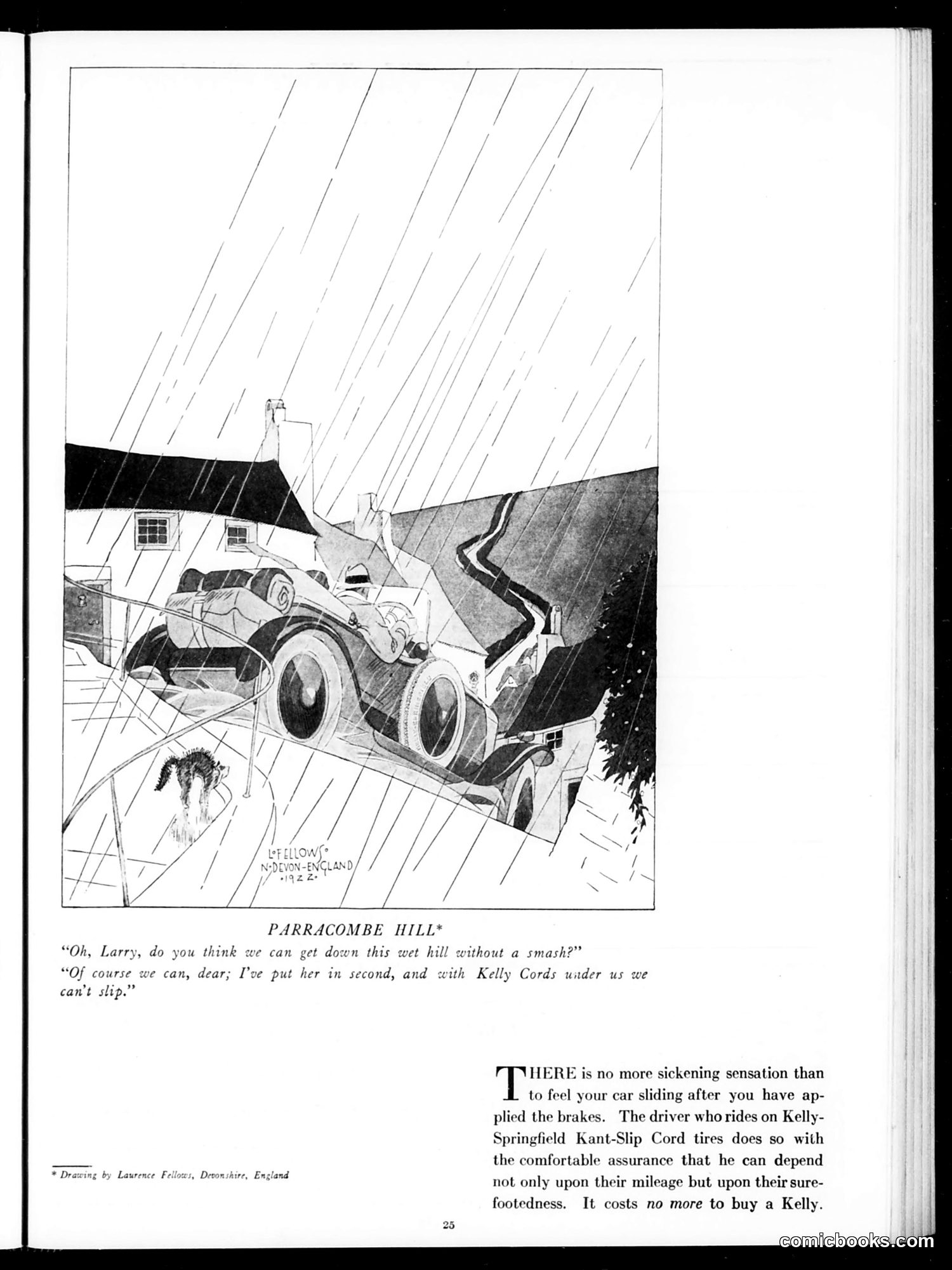
This is a **tire advertisement** disguised as editorial content in Judge magazine. The cartoon depicts a couple in a car descending a steep, rain-soaked hill. The driver confidently assures his companion they'll safely navigate the dangerous descent because he's equipped the car with Kelly-Springfield "Kant-Slip Cord" tires. The "joke" or sales pitch: the advertisement contrasts the anxiety of skidding brakes with the security provided by these tires. The text emphasizes that Kelly tires offer both durability and crucial traction—making them worth the investment on hazardous roads. This represents early 20th-century automotive advertising strategy: using Judge's satirical platform and illustrative style to present product testimonials as humorous scenarios rather than straightforward pitches. The casual dialogue between characters makes the sales message feel like editorial commentary on contemporary driving concerns.
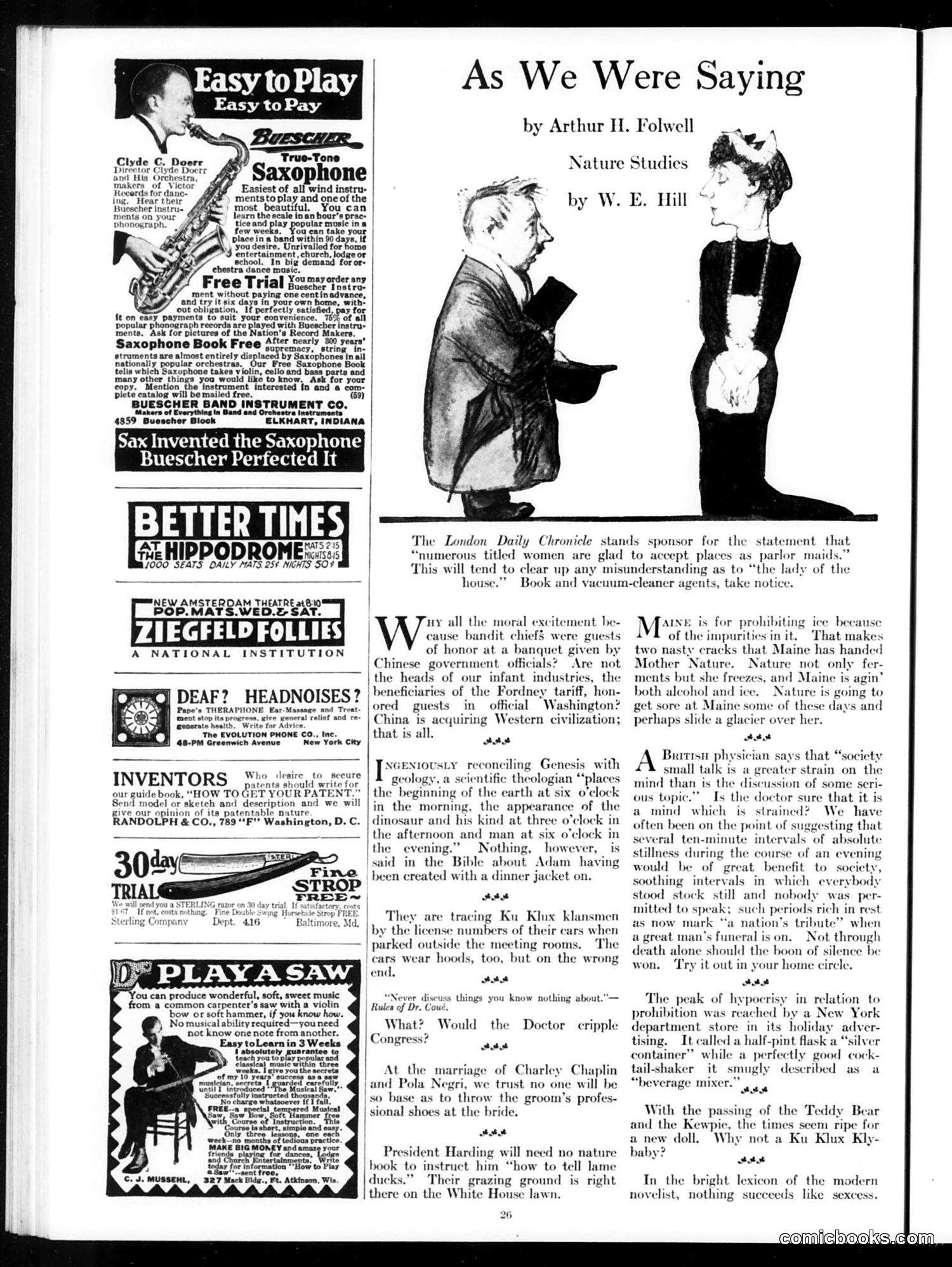
This page is primarily **advertising and miscellaneous content** rather than a unified political cartoon. Key elements: **Main Illustration**: "As We Were Saying" by Arthur H. Folwell depicts a poorly-dressed man showing a woman (appearing to be a domestic servant or maid) an empty pocket, illustrating the accompanying text about "titled women" accepting positions as "parlor maids." **Social Commentary**: The article references a London Daily Chronicle claim that upper-class women are taking domestic work—satirizing economic hardship among British nobility post-WWI. **Other Satirical Notes**: - Comparing bandit-chief guests at Chinese government banquets to Western industrialists honored in Washington (mocking American hypocrisy about "civilization") - Ku Klux Klan members being traced by car license numbers - Maine's prohibition stance - Charles Chaplin's recent marriage to Pola Negri The page also contains numerous product advertisements (saxophones, patent services, musical saws), typical of 1920s Judge magazine. The satire targets economic inequality, political hypocrisy, and social pretension of the era.
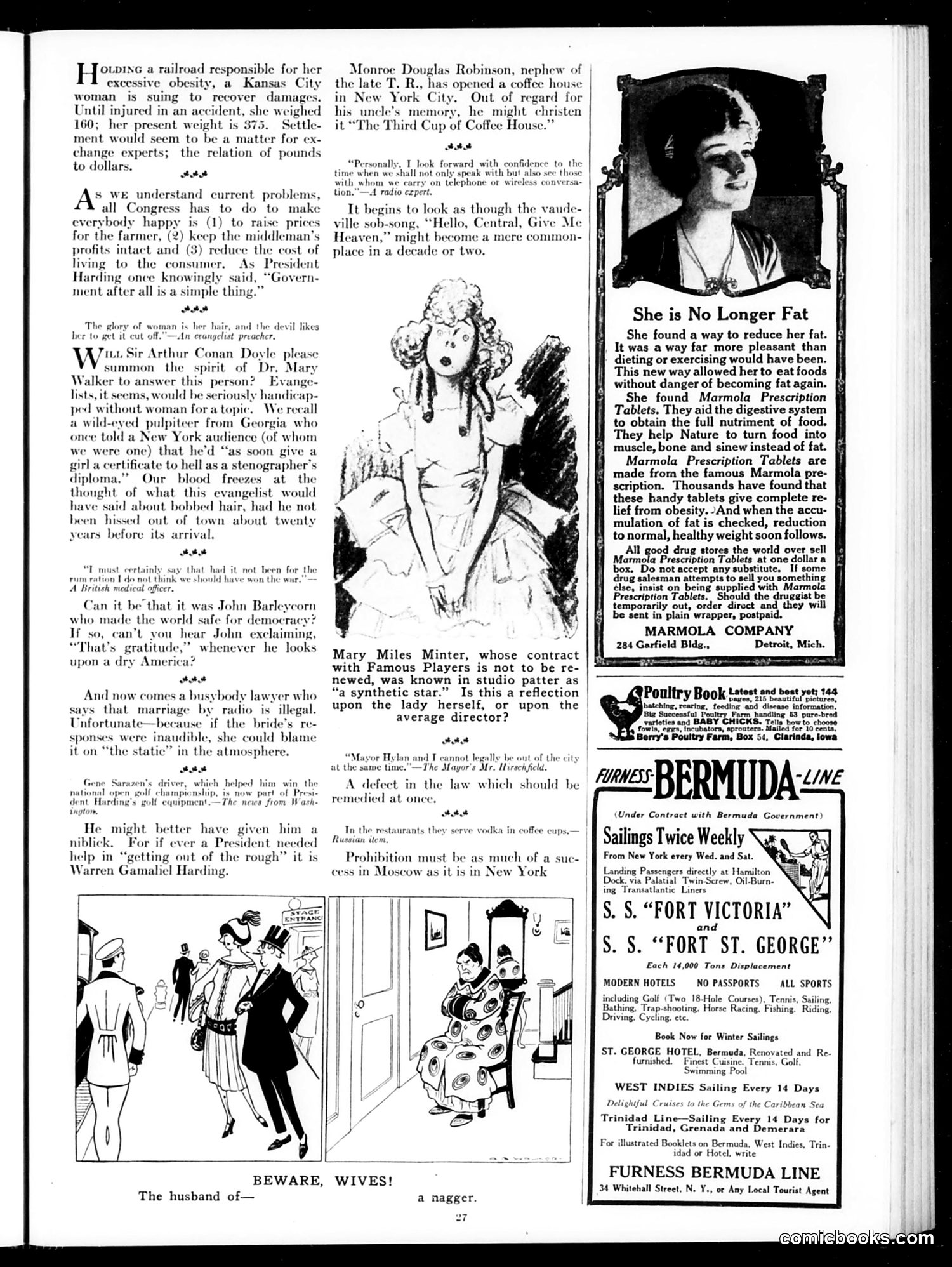
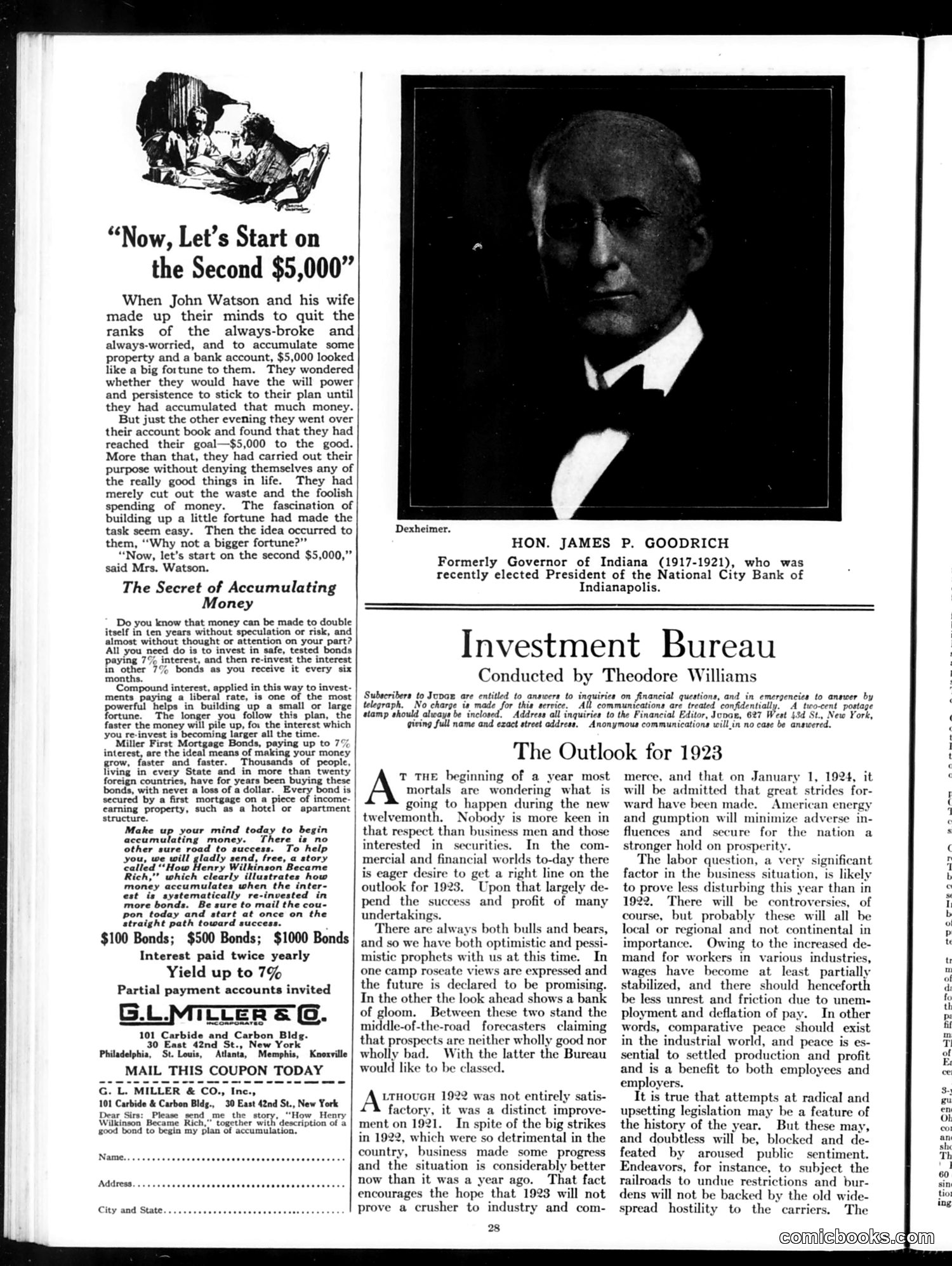
This page combines financial advice advertising with editorial content about economic outlook for 1923. **Main Content:** The cartoon "Now, Let's Start on the Second $5,000" depicts an ordinary couple (John and Mrs. Watson) who've saved their first $5,000 by eliminating wasteful spending—then immediately plan to save another $5,000. The satire targets middle-class aspiration and the psychological appeal of financial accumulation: once people taste modest wealth-building, they're driven to pursue perpetual growth. **Context:** This reflects 1920s prosperity narratives—the post-WWI economic boom when thrift and compound interest were celebrated as paths to security. The accompanying investment advertisement (G.L. Miller bonds) and Theodore Williams's "Investment Bureau" reinforce this optimistic financial messaging. **Supporting Figure:** James P. Goodrich, recently elected president of Indianapolis's National City Bank, appears as a credibility endorsement for financial institutions. **The Satire's Point:** The joke reveals that financial satisfaction is never truly achieved—the goalpost perpetually shifts upward, making the accumulation impulse endless rather than liberating.
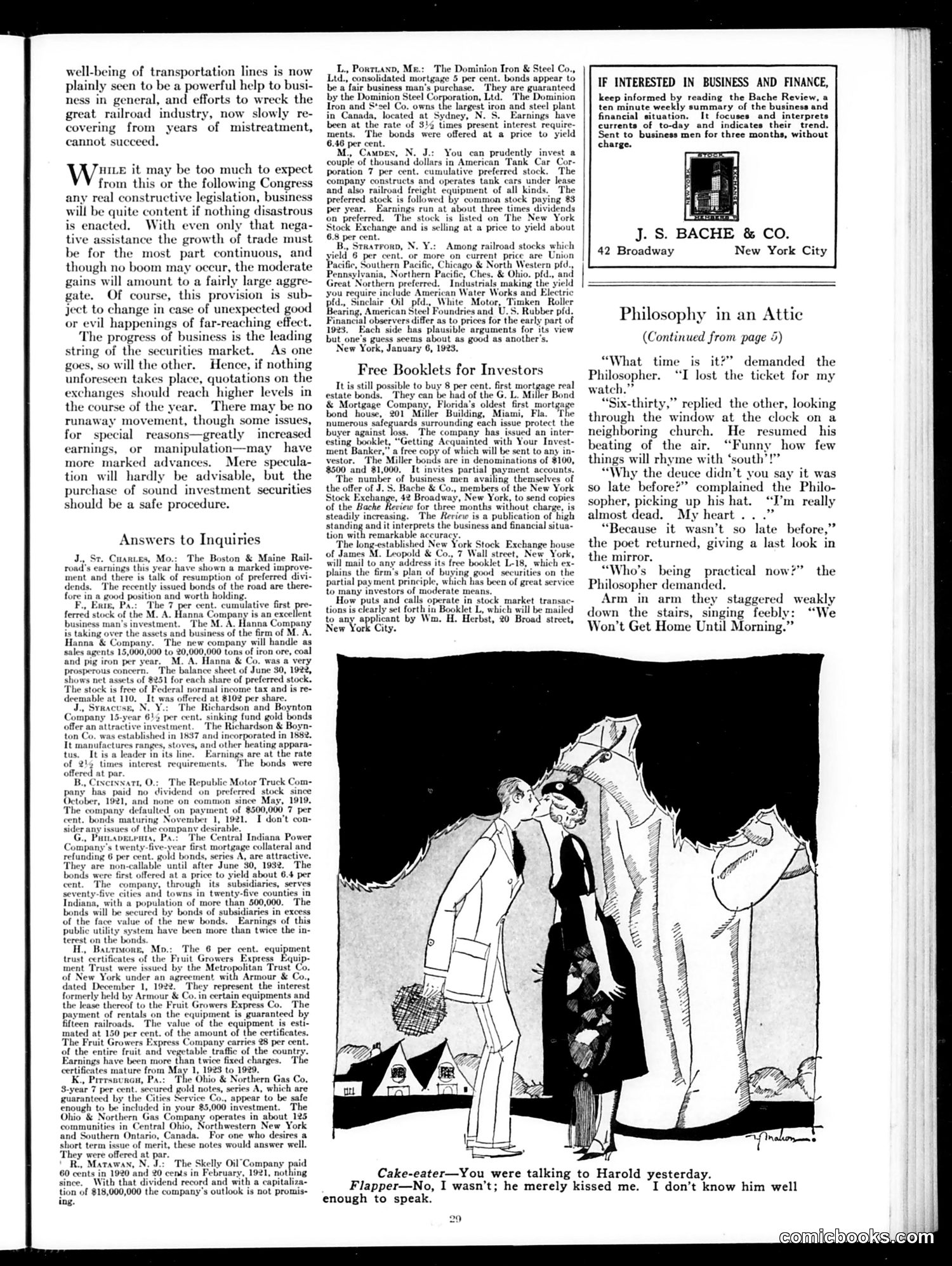
This single-panel cartoon depicts two well-dressed men in what appears to be a social setting. The caption reads: "Cake-eaters we were talking to Harold yesterday. Flapper—No, I wasn't; he merely kissed me. I don't know him well enough to speak." The satire targets the social behavior of "cake-eaters"—a 1920s slang term for idle, fashionable young men who pursued leisure and romance without substance. The joke hinges on the absurdity of the flapper's response: she's willing to kiss a man but claims insufficient familiarity to *converse* with him. This inverts normal social conventions, mocking both the superficiality of Jazz Age courtship rituals and the contradictory values of the era's youth culture. The cartoon ridicules how physical intimacy could occur between virtual strangers while actual social interaction seemed unnecessary or inappropriate.
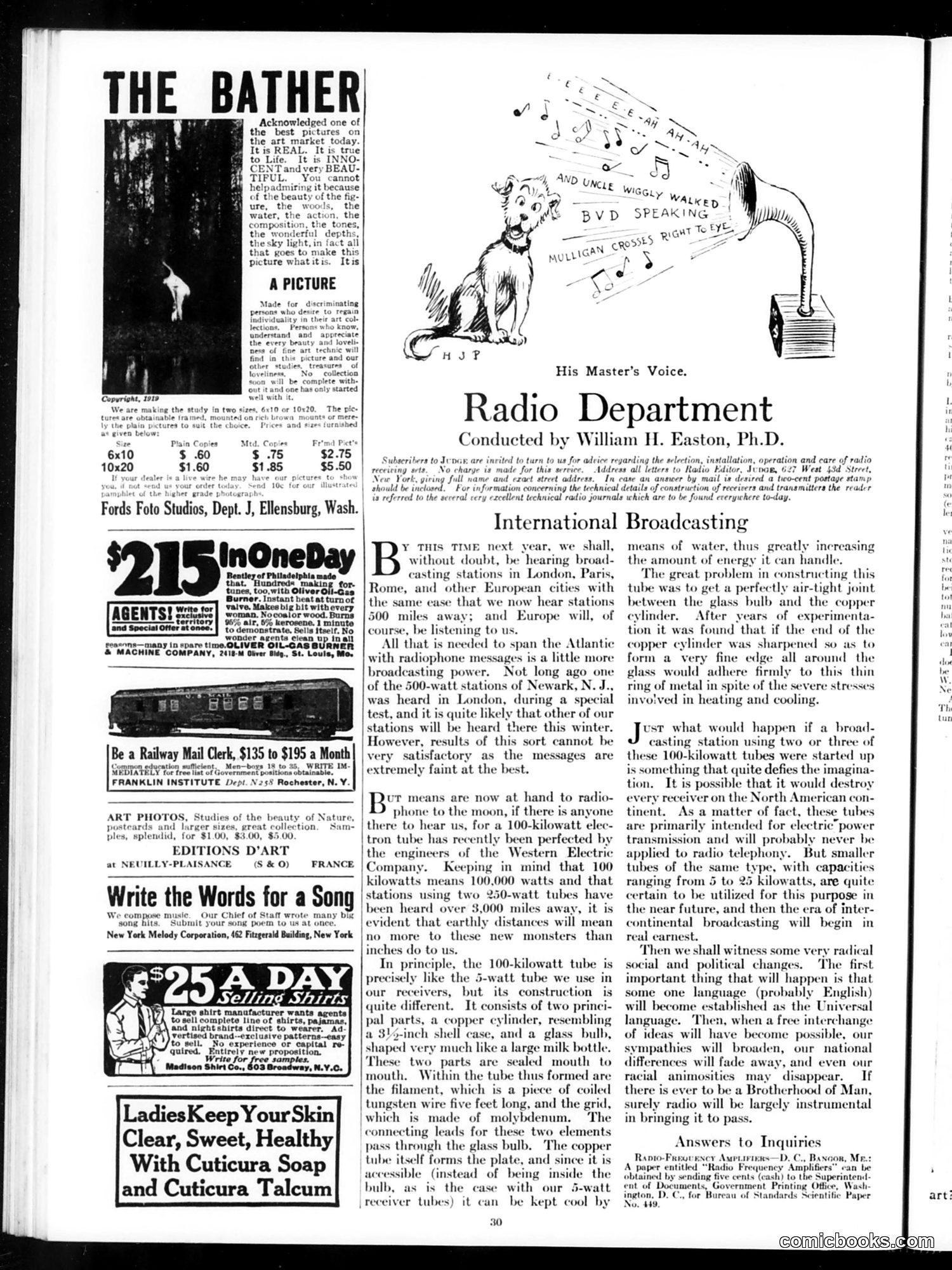
This Judge magazine page mixes editorial and advertising content. "The Bather" appears to be a photograph praised as fine art—the text emphasizes its realism and beauty, though the actual image is quite small and dark, making the satirical point unclear without additional context. The main editorial content is the "Radio Department" column discussing international broadcasting advancement. It describes plans for European radio stations and a newly-perfected 100-kilowatt transmission tube, comparing its principle to smaller 5-watt tubes. The author explains technical details about copper cylinders and tungsten filaments, predicting radio will soon span the Atlantic and theoretically reach the moon. The remainder is period advertising for various products: photography, song-writing services, shirt sales, and Cuticura products—typical early 1920s classified-style advertisements.
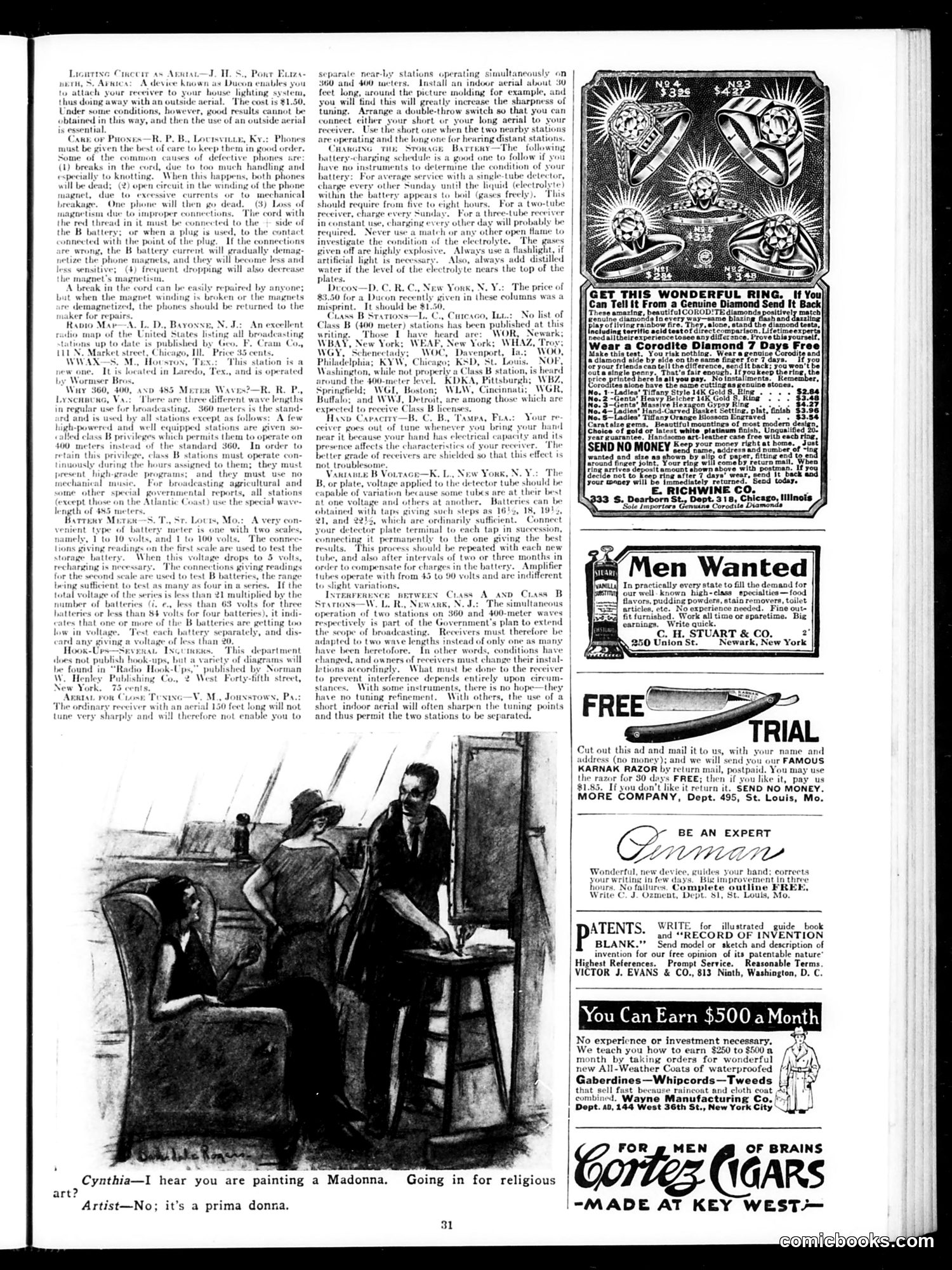
The visible cartoon depicts two figures in conversation about art. One man, identified as an artist, tells another that he's "painting a Madonna" for "religious art." The other responds skeptically: "No; it's a prima donna"—a pun suggesting the artist is actually painting an opera singer, not a religious subject. This is satirizing artistic pretension: the joke implies the artist is disguising commercial or frivolous work (portraiture of famous singers) under the guise of serious religious painting to seem more dignified or important. The page itself is primarily **technical radio advice columns** from Judge magazine, addressing listener questions about wireless equipment, batteries, and broadcasting stations—content typical of the 1920s radio boom era. The advertisements surrounding the cartoon promote various consumer products and services of that period.
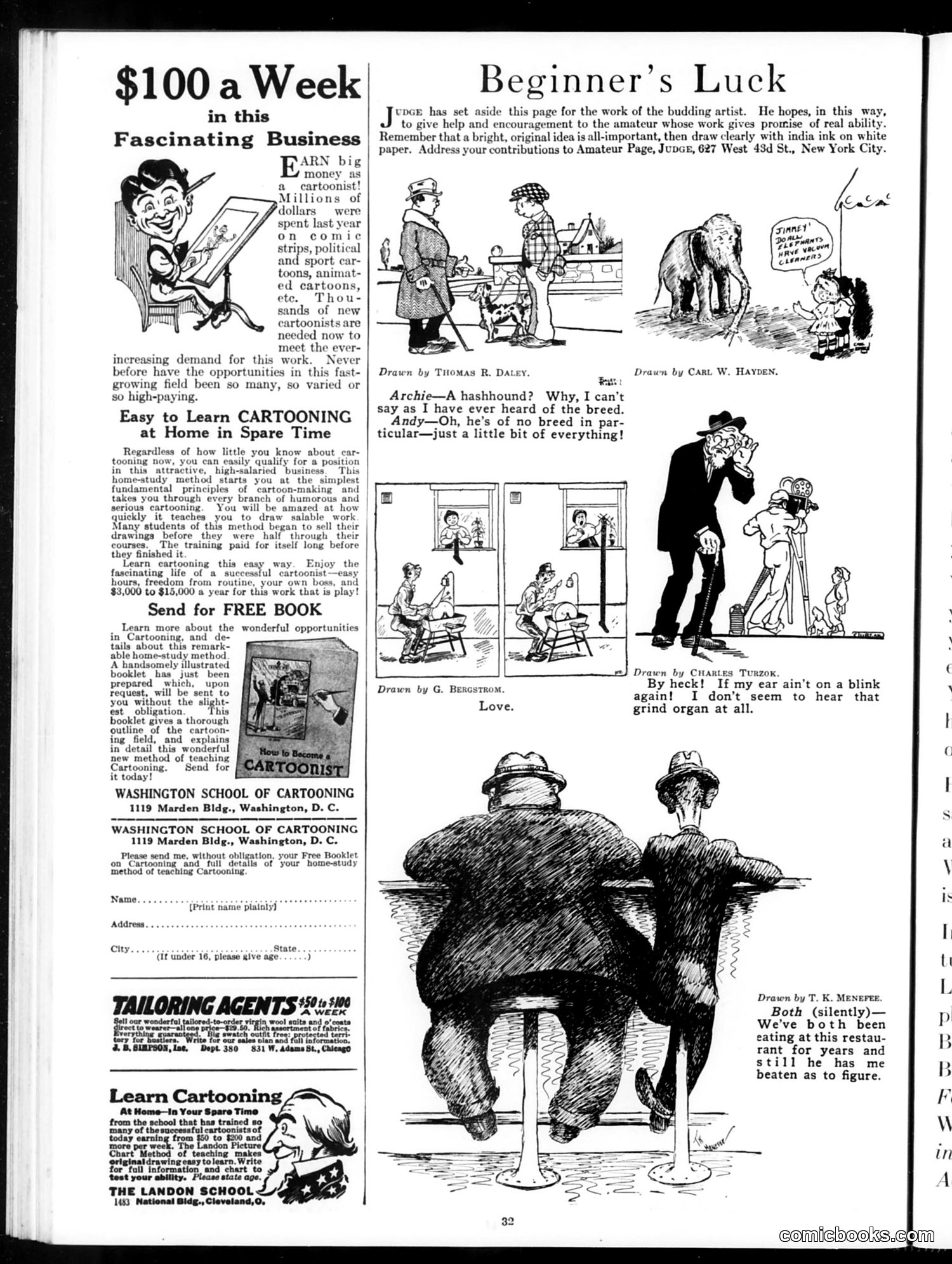
This page showcases amateur cartoons submitted to Judge's "Beginner's Luck" section, which published work by aspiring artists. The page is framed by advertisements for cartooning correspondence schools, reflecting booming demand for cartoonists in the early 20th century. The three cartoons use simple, observational humor typical of the era: 1. **"Archie"** (Daley/Hayden): A pun about a mongrel dog—it's "of no breed in particular—just a little bit of everything." 2. **"Love"** (Bergstrom): A man complains he can't hear a street organ grinder. 3. **"Both (silently)"** (Menefee): Two overweight men at a restaurant—each has long patronized it yet remains unable to figure out why the other stays so heavy (implicit self-awareness of their own size). The humor is gentle and domestic. The ads promise "$100 a week" and "$3,000-$15,000 yearly," reflecting cartoons' genuine commercial viability during this period.
This is a **naming contest advertisement** for *Film Fun* magazine, not a political cartoon. The page promotes a $50 prize (substantial money in the 1920s) for readers who submit the best stage name for an unnamed new film actress. The contest works as a marketing tool: readers must purchase the February issue to see photographs of the mystery starlet on pages 28-29, then submit name suggestions. The ad appeals to readers' creativity ("You've all had experience naming babies, boats and automobiles") and fantasizes about seeing their chosen name credited on screen. The lower section lists the magazine's contents—photo stories and portraits of silent film stars including Constance Talmadge, Pearl White, and Wallace Reid, representing major celebrities of the silent film era. This reflects early 1920s **fan culture and magazine marketing**, where reader participation contests drove subscriptions. The unnamed actress remains unidentified in this advertisement.
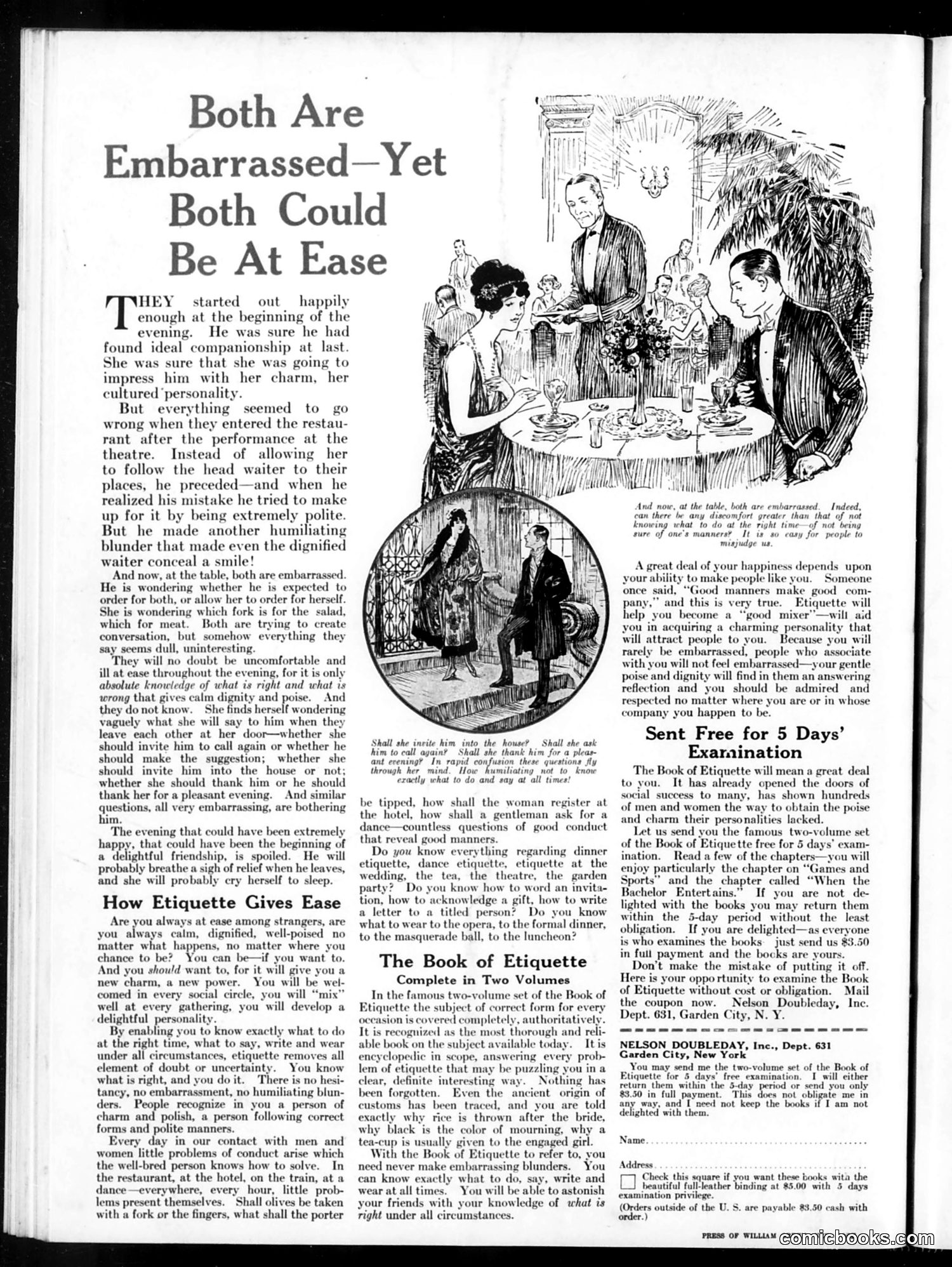
This page depicts a common social anxiety of the early 20th century: a young couple on a date who are mutually embarrassed by their uncertainty about proper conduct. The man makes a misstep by preceding the woman to their table at a restaurant, then overcompensates with excessive politeness. Both worry obsessively about trivial etiquette questions—which fork to use, whether to invite the other inside at evening's end—causing their promising evening to become awkward and tense. The accompanying text argues that knowledge of etiquette rules eliminates such embarrassment by providing clear behavioral guidelines. The page promotes *The Book of Etiquette*, a two-volume reference guide sold via mail order, as the solution to their social anxiety. The cartoon satirizes how rigid adherence to formal social rules—rather than genuine connection—governed dating and social interaction in this era. It reflects period anxieties about class status and respectability being determined by mastery of arbitrary conventions.