
Judge, 1923-01-13 · page 15 of 36
Judge — January 13, 1923 — page 15: what you’re looking at
What you’re looking at
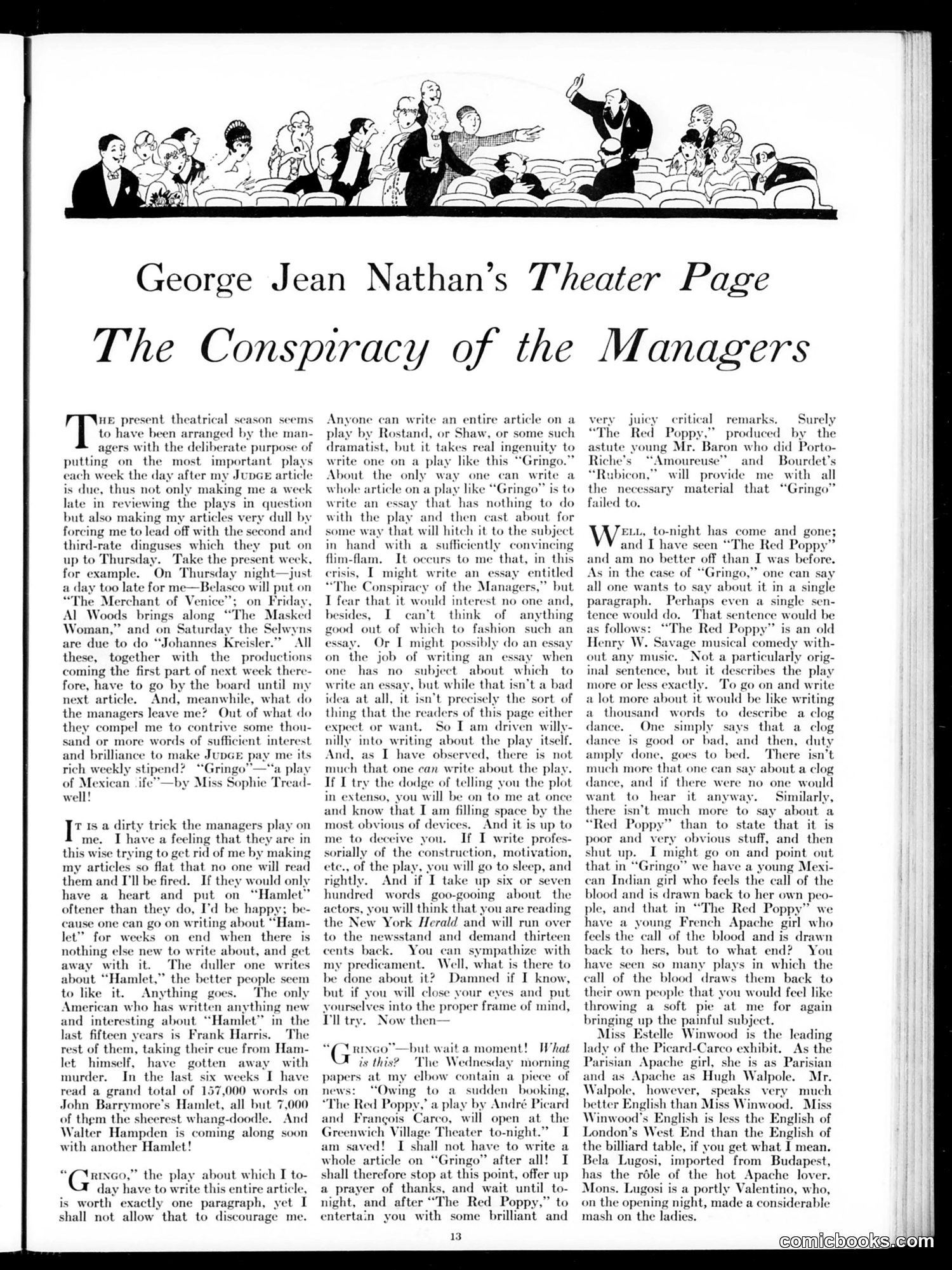
This is George Jean Nathan's theater column, a meta-satirical piece where Nathan complains that theatrical managers deliberately schedule important new plays the day *after* his Judge article deadline, forcing him to review only mediocre productions. The cartoon header depicts theater-goers and managers in an audience, illustrating the theatrical world he's critiquing. Nathan's central joke: he's assigned to review "Gringo"—a play so trivial it merits only one paragraph—yet must fill his entire column. He ironically catalogs the dishonest tricks critics use to pad reviews of bad plays: writing essays unrelated to the actual work, describing plots tediously, discussing "construction and motivation" to bore readers into submission, or praising actors excessively. The satire targets both theatrical managers (for scheduling conflicts) and theater critics' intellectual dishonesty. Nathan's complaint about endless "Hamlet" productions and interpretations adds contemporary Broadway context—multiple "Hamlet" productions were indeed running simultaneously in the 1920s. The piece is fundamentally meta-commentary: a critic admitting the absurd gymnastics required to manufacture credible reviews of worthless plays.
📄 Transcribed text from this page (OCR, searchable)
Machine-transcribed from the original scan — historical spelling and the odd misread are preserved.
George Jean Nathan’s Theater Page The Conspiracy of the Managers HE present theatrical season seems to have been arranged by the man- rs with the deliberate purpose of putting on the most important plays each week the day after my JupGe article is due, thus not only making me a week late in reviewing the plays in question but also making my articles very dull by forcing me to lead off with the second and third-rate dinguses which they put on up to Thursday. Take the present week, for example. On Thursday night—just a day too late for me—Belasco will put on “The Merchant of Venic on Friday, Al Woods brings along “The Masked Woman,” and on urday the Selwyns are due to do “Johannes Kreisler.”” All these, together with the productions coming the first part of next week there- fore, have to go by the board until my next article. And, meanwhile, what do the managers leave me? Out of what do they compel me to contrive some thou- sand or more words of sufficient interest and brilliance to make JupGE pay me its i ly stipend? “Gringo” —“a y an .ife’—by Miss Sophie Trez visa dirty trick the managers play a feeling that th this wise trying to get rid of me by mz my articles so flat that no one will r them and I'll be fired. If they would only have a heart and put on “Hamlet” oftener than they do, I'd be happy; be- cause one can go on writing about ‘“Ham- let” for sks on end when there is nothing else new to write about, and get away with it. The duller one writes about “Hamlet,” the better people seem to like it. Anything goes. The only American who has written anything new and interesting about “Hamiet” in the last fifteen s is Frank Harris. The rest of them, taking their cue from Ham- let himself, have gotten away with murder. In the last six weeks I have read a grand total of 157,000 words on John Barrymore's Hamlet, all but 7,000 of thym the sheerest whang-doodle. And Walter Hampden is coming along soon with another Hamlet! a the play about which I to- day have to write this entire article, is worth exactly one paragraph, yet I shall not allow that to discourage me. entire article on a Rostand, or Shaw, or some such t, but it al ingenuity to write one on a play like this “Gringo.” About the only way one can write a whole article ona play like “Gringo” is to write an essay that has nothing to do with the play and then cast about for some way that will hitch it to the subject in hand with a sufficiently convincing flim-flam. It occurs to me that, in this crisis, I might write an essay entitled “The Conspiracy of the Managers,” but I fear that it would interest no one and, besides, I can’t think of anything good out of which to fashion such an essay. Or I might possibly do an essay on the job of writing an essay when one has no subject about which to write an essay, but while that isn’t a bad idea at all, it isn’t precisely the sort of thing that the readers of this page either expect or want. So T am driven willy- nilly into writing about the play itself. And, as I have observed, there is not much that one can write about the play. If I try the dodge of telling you the plot in extenso, you will be on to me at once and know that I am filling space by the most obvious of devices. And it is up to me to deceive you. If I write profes- sorially of the construction, motivation, etc., of the play, you will go to sleep, and rightly. And if I take up six or seven hundred words goo-gooing about the actors, you will think that you are reading the New York Herald and will run over to the newsstand and demand thirteen cents back. You ean sympathize with my predicament. Well, what is there to be done about it? Damned if I know, but if you will close your eyes and put yourselves into the proper frame of mind, Til try. Now then— “(Gece hut wait a moment! What I is this? The Wednesday morning papers at my elbow contain a piece of news: “Owing to a sudden booking, “The Red Poppy,’ a play by André Picard and Frangois Carco, will open at the Greenwich Village Theater to-night.” 1 am saved! I shall not have to write a whole article on “Gringo” after all! I shall therefore stop at this point, offer up a prayer of thanks, and wait until to- night, and after “The Red Poppy,” to entertain you with some. brilliant’ and yone can write ar 13 remarks. Surely juicy critical produced by the Phe Red Poppy,” astute young Mr. Baron who did Porto- Riche’s. “Amoureuse” and Bourdet’s “Rubicon,” will provide. me with all the necessary material that “Gringo” failed to. Wii to-night has come and gone; and I have seen “The Red Poppy” and am no better off than I was before. As in the case of “Gringo,” one can say all one wants to say about it in a single paragraph. Perhaps even a single sen- tence would do. That sentence would be as follows: “The Red Poppy” is an old Henry W. Savage musical comedy with- out any music. Not a particularly orig- inal sentence, but it describes the play more or less exactly. To go on and write a lot more about it would be like writing a thousand words to describe a clog dance. One simply says that a clog dance is good or bad, and then, duty amply done, goes to bed. There isn’t much more that one ean say about a clog dance, and if there were no one would want to hear it anyway. Similarly, there isn’t much more to say about a “Red Poppy” than to state that it is poor and very obvious stuff, and then shut up. I might go on and point out that in “Gringo” we have a young Mexi- can Indian girl who feels the call of the blood and is drawn back to her own peo- ple, and that in “The Red Poppy” we have a young French Apache girl who feels the call of the blood and is drawn to hers, but to what end? You ye seen so many plays in which the call of the blood draws them back to their own people that you would feel like throwing a soft pie at me for again bringing up the painful subject. Miss Estelle Winwood is the ling lady of the Picard-Carco exhibit. the Parisian Apache girl eis as Parisian and as Apache as Hugh Walpole. Mr. Walpole, however, speaks very much better English than Miss Winwood. Miss Winwood’s English is less the English of London’s West End than the English of the billiard table, if you get what I mean. Bela Lugosi, imported from Budapest, has the réle of the hot Apache lover. Mons. Lugosi is a portly Valentino, who, on the opening night, made a considerable mash on the ladies.