
Judge, 1923-01-13 · page 7 of 36
Judge — January 13, 1923 — page 7: what you’re looking at
What you’re looking at
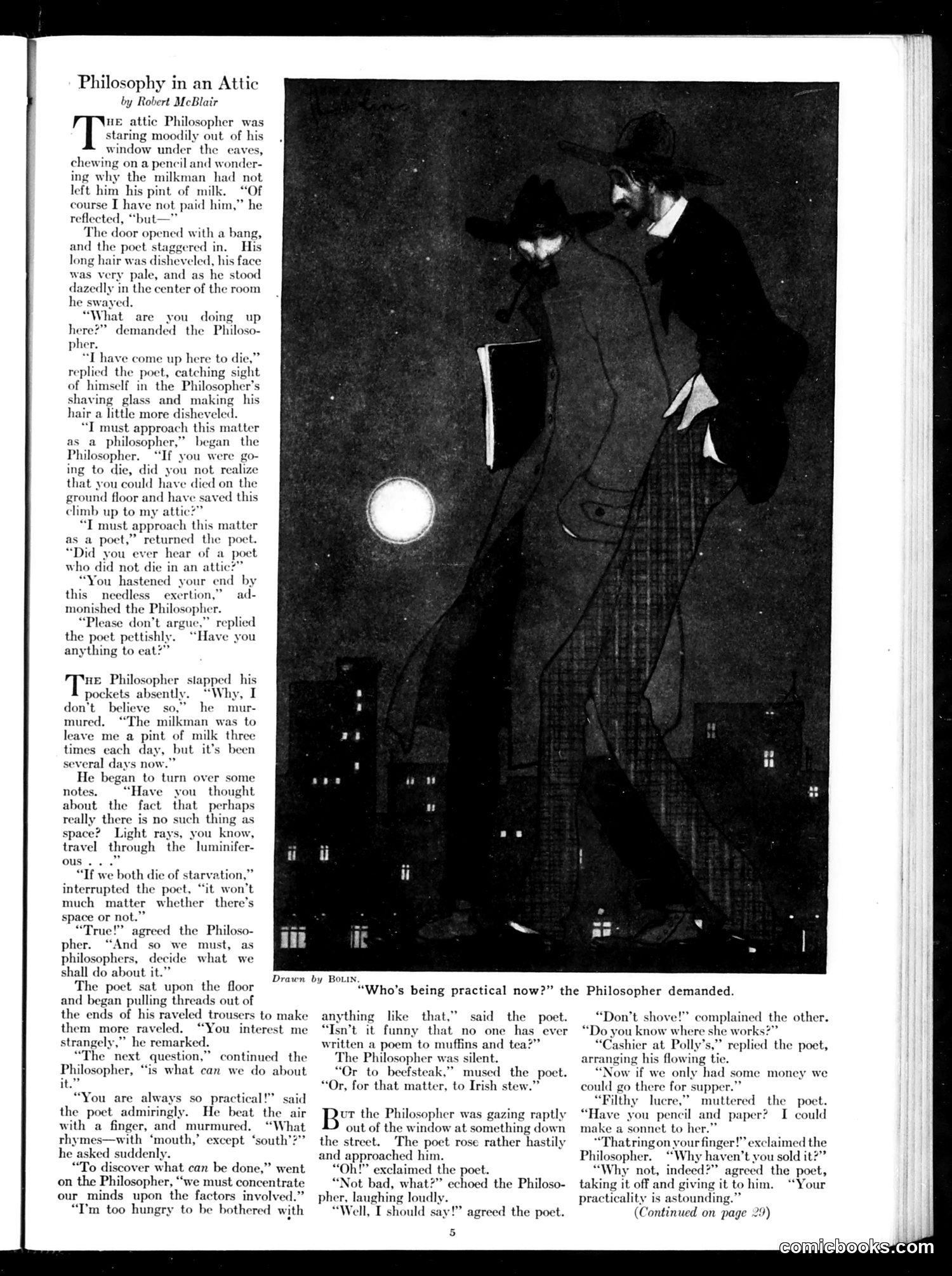
This is a humorous short story (not a political cartoon) satirizing the romantic poverty of bohemian artists and intellectuals. A starving "Philosopher" and a "Poet" inhabit an attic—the traditional dwelling of broke creative types. The satire mocks both characters: the Philosopher approaches life through abstract reasoning (debating whether space exists while hungry), while the Poet romanticizes suffering (insisting poets "must die in attics"). The joke targets their impracticality—when they spot an attractive woman from the window, the Philosopher wants to sell his ring for money to court her, while the Poet immediately offers to write her a sonnet instead. Their conflicting approaches (practical vs. artistic) and shared destitution reflect period stereotypes about struggling artists choosing noble poverty over mundane employment. The humor lies in how both characters philosophize about starvation rather than simply getting jobs.
📄 Transcribed text from this page (OCR, searchable)
Machine-transcribed from the original scan — historical spelling and the odd misread are preserved.
Philosophy in an Attic by Robert McBlair NE attic Philosopher was staring moodily out of his window under the eaves, chewing on a penci ing why the milkman had not left him his pint of milk. “Of e I have not paid him,” he ted, “but— The door opened with a bang, and the poet staggered in. His long hair was disheveled, his fac as very pale, and as he stood edly in the center of the room he sw “What here?” pher. I and wonder- doing up Philoso- are demanded you the ave come up here to di replied the poet, catching sight of himself in the Philosopher's shaving glass and r hair a little more dishe’ T must approach this 1 as a philosopher,” began the Philosopher. “If you were go- ing to die, did you not realize that you could have died on the ground floor and have saved this climb up to my attic? “T must approach this matter as a poet,” returned the poet. “Did you ever hear of a poet who did not die in an attic? “You hastened your end by this needless exertion,” monished the Philosopher. “Please don’t argue,” replied the poet pettishly. “Have you anything to eat?” HE Philosopher slapped his poc Why, I don’t eso,” he mur- mured. he milkman was to leave me a pint of milk three but it’s been He began to turn over some notes. “Have you thought about the that perhaps you knov travel sean the * luminife ation,” ‘it won't there’s “If we both die of st interrupted the poct, much matter whether space or not.” ’ agreed the Philoso- so we must, as ide what we shall do The poet sat upon the floor and began pulling threads out of the ends of his raveled trousers to make them more raveled. You interest me strangely,” he remark “The next question,” continued the Philosopher, “is what can we do about at.” so_practical!” said He beat the air What ou are alway the poet admiringly. finger, and murmured. —with ‘mouth,’ suddenly. iscover what can be done,” went on the Philosopher, “we must cone entrate our minds upon the factors invol “I'm too hungry to be bothered with Drawn by Bou anything like aid the “Isn't it funny that written a poem to muffins and tea?” The Philosopher was silent. ‘Or to beefsteak,” mused the poet. “Or, for that matter, to Irish ste poet. tT the Philosopher was gazing raptly out of the window at something down the street. The poet rose rather hastily and approached him. “Oh!” med the poet. “Not bad, what?” echoed the Philoso- pher, laughing loud! “Well, I should ” agreed the poet. no one has ever “Don’t shove!” complained the other. “Do you know where she works?” Cashier at Pol replied the poct, arranging his flowing tie. “Now if we only had s could go there for supper. “Filthy lucre,” muttered “Have you pencil and paper? sonnet to her. atringon your finger!” exclaimed the Philosophe r. “Wh ven’t you sold it?” “Why not, i greed the poet, taking it off giving it to him. practicalit stounding.” (Continued on page 29) »yme money we the poet. I could