
Judge, 1923-01-13 · page 13 of 36
Judge — January 13, 1923 — page 13: what you’re looking at
What you’re looking at
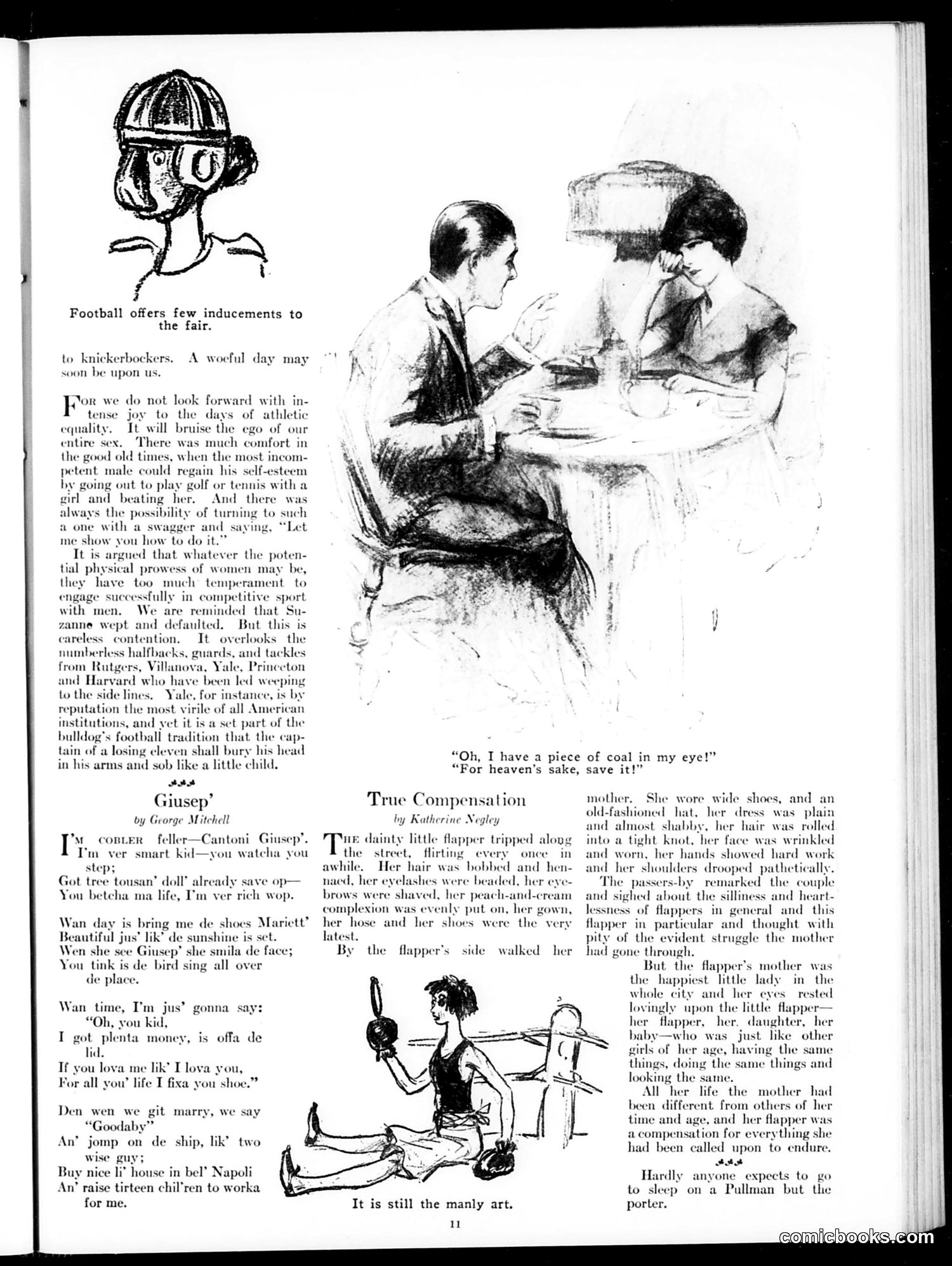
This page contains three distinct pieces satirizing early 20th-century social attitudes: **Top Section**: A commentary opposing women's athletic participation. The text argues that male ego derives from beating women at sports, and warns that female athletic competence threatens male self-esteem. It dismisses concerns about women's competitive temperament by noting that elite male institutions (Yale, Harvard, Princeton football) produce weeping players—implying men are equally emotional, undermining the argument against women's sports. **"Giusep'" (lower left)**: A dialect poem featuring an Italian immigrant character saving money to court and marry "Marictt," then return to Naples with thirteen children. This plays on period stereotypes about Italian immigrants: broken English, large families, and economic aspiration. **"True Compensation" (right)**: A sketch contrasting a fashionable young "flapper" with her plain, worn mother. The narrative reveals the mother is actually content—her daughter's modernity and happiness compensate for the mother's own hardship and conformity. This sympathetically portrays intergenerational social change during the Jazz Age.
📄 Transcribed text from this page (OCR, searchable)
Machine-transcribed from the original scan — historical spelling and the odd misread are preserved.
@ Football offers few inducements to i the fair. } to knickerbockers. soon be upon us. A woeful day may | Jor we do not look forward with ing tense joy to the days of athletic equali It will bruise the ego of our entire se There was much comfort in the good old times, when the most incom- petent male could regain his self-esteem by going out to play golf or tennis with a girl and beating her. And there was always the possibility of turning to such a one with a swag and saying, “Let me show you how to do it.” It is aed that whatever the poten- tial pl 1 prowess of women may be, they have too much temperament to engage successfully in competitive sport with men. We are reminded that Su- zanne wept and defaulted, But this is careless contention. It overlooks the numberless halfbacks, guards, and tackles from Rutgers, Villanova, Yale, Princeton and Harvard who have been led weeping to the side lines. Y nstance, is by reputation the most virile of all American institutions, and yet it is a set part of the bulldog’s football tradition that the cap- tain of a losing ele shall bury his head in his arms and sob like a little child. Rad Giusep’ by George Mitchell ’ copLer feller—Cantoni Giusep’. I'm ver smart kid—you watcha you step; Got tree tousan’ doll’ already save op— You betcha ma life, I'm ver rich wop. Wan day is bring me de shoes Marictt’ Beautiful jus’ lik’ de sunshine is set. Wen she see Giusep” she smila de You tink is de bird sing all over Wan time, I’m jus’ gonna say: “Oh, you kid, T got plenta money, is offa de lid. If you lova me lik’ I lov: For all you’ life T fixs a you, nu shoe.” Den wen we “Goodaby An’ jomp on de ship, lik’ two wise guy; Buy nice li’ house in bel’ Napoli An’ raise tirteen chil’ren to worka for me. git marry, we say “Oh, I have a piece of coal in my eye!” “For heaven's sake, True Compensation by Katherine Negley HE dainty little flapper tripped along the str flirting ev once in awhile. Her hair was bobbed and hen- naed, her e: brows were s| F complexion was evenly put on, her gown, her hose and her shoes were the very latest. By the flapper’s side walked her s — It is still the manly art. u aN is save it!” mother. She wore wide shoes, and an old-fashioned hat, her dress was plain and almost shabby, her hair was rolled into a tight knot, her face was wrinkled and worn, her hands showed hard work and her shoulders drooped pathetically. The passers-by remarked the couple and sighed about the silliness and heart- lessness of flappers in general and. this flapper in particular and thought. with pity of the evident struggle the mother had gone through. But the flapper’s mother was the happiest little lady in the whole city and her eyes rested lovingly upon the little flapper— her flapper, her. daughter, her baby—who was just like other girls of het . having the same things, doing the same things and looking the same. All her life the mother been different from others of her time and age, and her flapper was acompensation for everything she had been called upon to endure. tt Hardly anyone expects to go to sleep on a Pullman but the porter,