
Judge, 1923-01-13 · page 21 of 36
Judge — January 13, 1923 — page 21: what you’re looking at
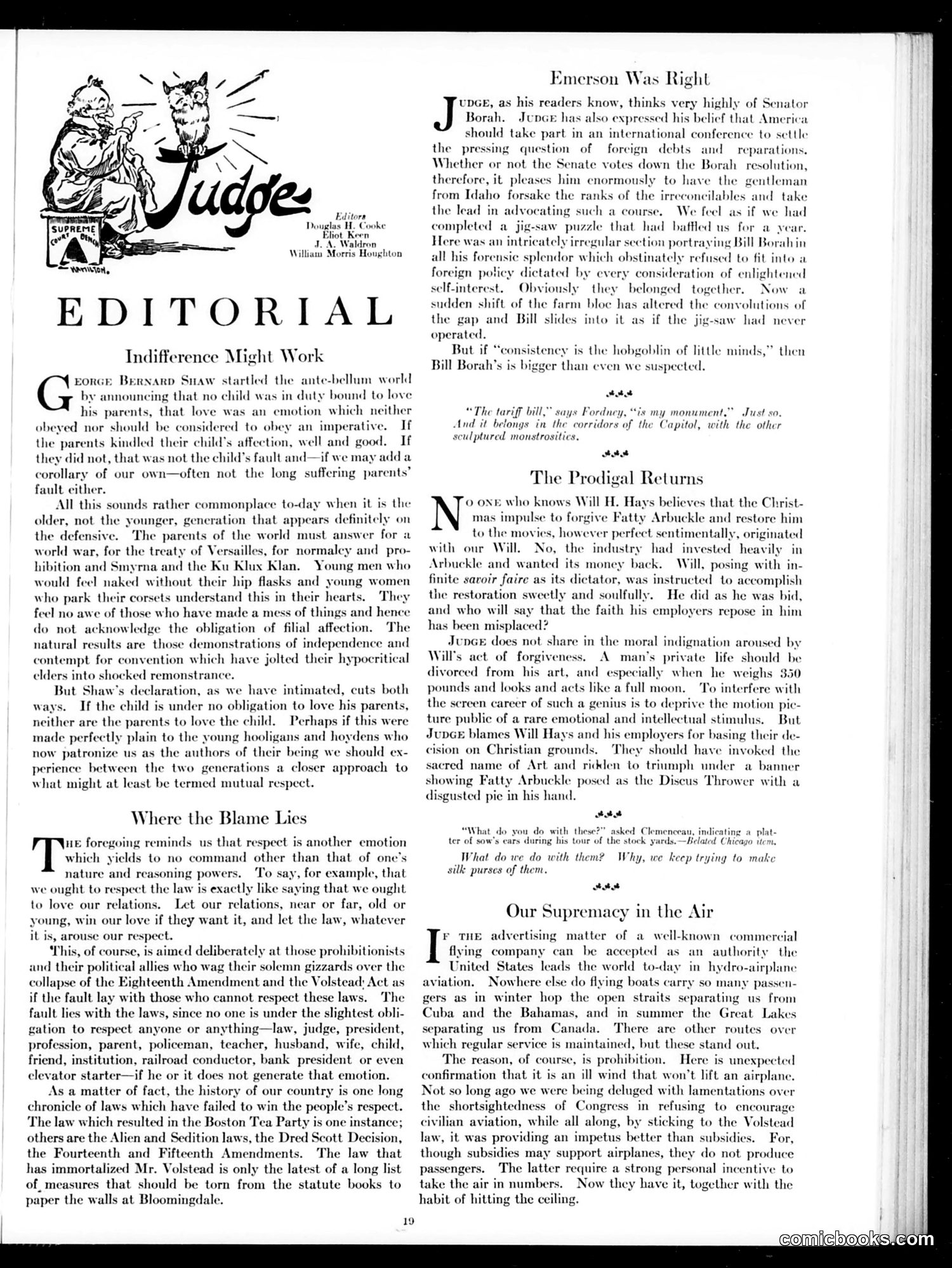
What you’re looking at
**The Cartoon**: The small illustration shows a figure labeled "Judge" holding a cat, with motion lines suggesting the cat is scratching or resisting. This is the masthead for the magazine itself. **Main Editorial Content**: This page contains three opinion pieces criticizing American social and political attitudes of the 1920s: 1. **"Indifference Might Work"** argues young people have no obligation to respect parents who created postwar disorder, citing WWI, the Treaty of Versailles, Prohibition, and the KKK as failures of the older generation. 2. **"Where the Blame Lies"** attacks Prohibition, arguing the Volstead Act itself (not violators) deserves blame. It references the Boston Tea Party and other historically-rejected laws to suggest unjust laws cannot command respect. 3. **"Emerson Was Right"** praises Senator Borah (Idaho) for supporting an international debt conference, positioning this as wisdom analogous to Emerson's philosophy. The page reflects 1920s cultural friction between generations and debates over Prohibition's legitimacy and America's international role.
📄 Transcribed text from this page (OCR, searchable)
Machine-transcribed from the original scan — historical spelling and the odd misread are preserved.
“Bliot Keen A. Waldron Morris Houghton Willia EDITORIAL Indifference Might Work EoRGE Bernarp Suaw startled the ante-bellum world by announcing that no child was in duty bound to love his parents, that love was an emotion which neither obeyed nor should be considered to obey an impe the parents kindled their child’s affection, well and they did not, that was not the child’s fault and—if we 1 corollary of our own—often not the long suffering ] fault cither. ‘All this sounds rather commonplace to-day when it is the older, not the younger, generation that appears definitely on the defensive. The parents of the world must answer for a world war, for the treaty of Versailles, for normalcy and_ pro- hibition and Smyrna and the Ku Klux Klan. Young men who would feel naked without their hip flasks and young women who park their corsets understand this in their hearts, They feel no awe of those who have made a mess of things and hence do not acknowledge the obligation of filial affection. The natural results are those demonstrations of independence and contempt for convention which have jolted their hypocritical elders into shocked remonstrance. But Shaw’s declaration, as we have intimat cuts both If the child is under no obligation to love his parents, Perhaps if this were ; and hoydens who good. wa neither are the parents to love the child. made perfectly plain to the young hooli now patronize us as the authors of their being we should ex- perience between the two generations a closer approach to what might at least be termed mutual respect. Where the Blame Lies foregoing reminds us that respect is another emotion ch yields to no command other than that of one’s soning powe To say, for example, that we ought to respect the law is exactly like saying that we ought to love our relations. Let our relations, 1 or far, old or young, win our love if they want it, and let the law, whatever it is, arouse our respect. ‘This, of course, is aimed deliberately at those prohibitionists and their political allies who wag their solemn gizzards over the collapse of the Eighteenth Amendment and the Volstead: Act as if the fault lay with those who cannot respect these laws. The fault lies with the laws, since no one is under the slightest obli- gation to respect anyone or anything—law, judge, president, profession, parent, policeman, teacher, husband, wife, child, friend, institution, railroad conductor, bank president or even elevator starter—if he or it does not generate that emotion. As a matter of fact, the history of our country is one long chronicle of laws which have failed to win the people’s respect. The law which resulted in the Boston Tea Party is one instance; others are the Alien and Sedition laws, the Dred Scott Decision, the Fourteenth and Fifteenth Amendments. The law that has immortalized Mr. Volstead is only the latest of a long list of, measures that should be torn from the statute books to paper the walls at Bloomingdale. 19 Emerson Was Right s his readers know, thinks very highly of Senator JvpGE has also expressed his belicf that America UDGE, Borah. should take part in an international conference to settle the pressing question of foreign debts and reparations. Whether or not the Senate votes down the Borah resolution, therefore, it pleases him enormously to have the gentleman from Idaho forsake the ranks of the irreconcilables and take the lead in advocating such a course. We feel as if we had completed a jig-saw puzzle that had bated us for a year. Here was an intricately irregular section portraying Bill Borah in all his forensic splendor which obstinately refused to fit into a foreign policy dictated by every consideration of enlightened self-interest. Obviously — the Now sudden shift of the farm bloc has altered the convolutions of the gap and Bill slides into it as if the jig-saw had never operated. But if “consistency is the hobgoblin of little minds,” then Bill Borah’s is bi belon, together, a er than even we suspected. 2 “The tariff bill,” says Fordney, “is my monument.” Just so. And it belongs in the corridors of the Capitol, with the other se ulptured monstrositics, N mas impulse to forgive Fatty Arbuckle to the movies, however perfect sentimentally, originated with our Will, No, the industry had invested heavily in Arbuckle and wanted its money Will, posing with in- finite savoir faire as its dictator, was instructed to accomplish the restoration sweetly and soulfully. He did as he was bid, and who will say that the faith his employers repose in him has been misplaced? JcnGE does not share in the moral indignation aroused by Will's act of forgiveness. A man’s private life should be divorced from his art, and especially when he weighs pounds and looks and acts like a full moon. To interfere with the screen career of such a genius is to deprive the motion pic- ture public of a rare emotional and intellectual stimulus. But JvvcE blames Will Hays and his employers for basing their de- cision on Christian grounds. ‘They should have invoked the sacred name of Art and ridden to triumph under a banner showing Fatty Arbuckle posed as the Discus Thrower with a disgusted pie in his hand. st The Prodigal Returns 0 oxE who knows Will H. Hays believes that the Christ- nd restore him sas a ph hicago item, do with these 1 Clemence: during his tour of the stock yards. “What dh ter of sow's ¢ What do we do with them? silk purses of them. Why, we keep trying to make ere Our Supremacy in the Air F THE advertising matter of a well-known commercial flying company can be accepted as an authority the United States leads the world to-day in hydro-airplane aviation. Nowhere else do flying boats carry so many pi gers as in winter hop the open straits separating us f Cuba and the Bahamas, and in summer the Great Lakes separating us from Canada. which regular service is maintaine The reason, of course, is prohibition. Here is unexpected ronfirmation that it is an ill wind that won't lift an airpl 0 we were being deluged with lamentations ov ss in refusing to cncou one om There are other routes over 1, but these stand out. Ie. ation, while all along, by sticking to the Volst as providing an impetus better than subsidies, though subsidies may support airplanes, they do not produce engers. The latter require a strong personal incentive to » air in number Now they it, together with the habit of hitting the ceiling.