
Judge, 1923-01-13 · page 12 of 36
Judge — January 13, 1923 — page 12: what you’re looking at
What you’re looking at
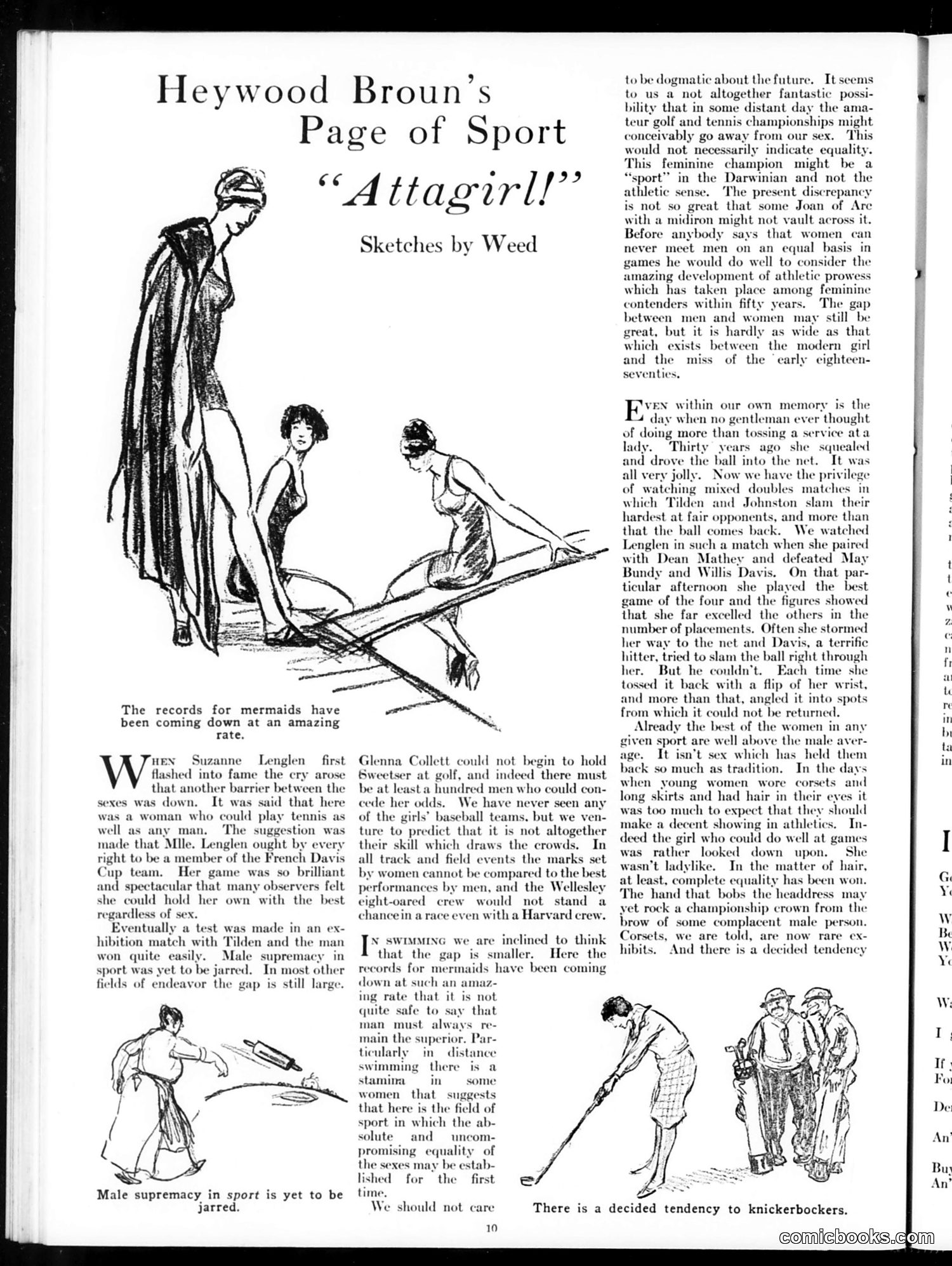
This is Heywood Broun's sports column commentary on women's athletic advancement, illustrated with sketches. The piece argues that the gap between male and female athletic performance, while still significant, has narrowed considerably and may continue to close. Broun references specific female athletes: **Suzanne Lenglen** (tennis champion) and **Glenna Collett** (golfer), noting they proved women could compete at high levels. He acknowledges men still dominate most sports—citing examples like Harvard crew versus Wellesley's eight-oared team—but argues women's records in swimming are improving at remarkable rates. The satire targets those who assume male superiority is permanent. Broun suggests women's historical underperformance reflected restrictive clothing (corsets, long skirts) and social tradition rather than inherent ability. He provocatively suggests women might eventually win amateur tennis or golf championships, though notes this wouldn't prove "equality"—a woman champion might simply be exceptionally talented. The cartoons show women in various athletic poses, emphasizing their increasing participation in sports previously considered male domains.
📄 Transcribed text from this page (OCR, searchable)
Machine-transcribed from the original scan — historical spelling and the odd misread are preserved.
Heywood Broun’s Page of Sport “A ttagirl!” The records for mermaids have been coming down at an amazing rate. ne Lenglen _ first sated into fame the arose t another barrier between the It was said that here was a woman who could play tennis well any man, The suggestion made that Mlle. Lenglen ought by every right to be a member of the Frenc! iT Cup team. Her game was so bri and spectacular that Ran GbacEverE felt she could hold her own with the best regardless of se Eventually a test was hibition match with Tild won quite easily. Male supremacy in sport was yet to be jarred. In most other fields of endeavor the gap is still large. de in an ex- n and the man Male supremacy in sport is yet to be jarred. Sketches by Weed Glenna Collett could not begin to hold Sweetser at golf, and indeed there must be at leasta hundred men who could con- cede her odds. We have er seen any of the girls’ baseball teams. but we ven- ture to predict that it is not altogether their skill which draws the crowds, In all track and field events the marks set by women cannot be compared to the best performances by men, and the Wellesley eight-oared would not stand a chancein a ri ven with a Harvard crew. Is SWIMMING we are inclined to think that the gap is smaller. Here the records for mermaids have been coming down at such an amaz- ing rate that it is not quite safe to say that man mu always re- main the superior. Par- ticularly in’ distance swimming there is a stamina in some women that suggests that here is the field of sport in which the al solute and promising equality of the sexes may be estab- lished for the — first time. We should not care Se 10 to be dogmatic about the future. Tt seems to us a not altogether fantastic possi- bility that in some distant day the ama- teur golf and tennis championships might conceivably go away from our sex. ‘This would not necessarily indicate equality. This feminine champion might be a “sport” in the Darwinian and not the athletic sense. The present discrepancy is not so great that some Joan of Are with a midiron might not vault across it. Before anybody says that women can never meet men on an equal b: in games he would do well to consider the amazing development of athletic prowess which has taken place among feminine contenders within fifty years. The gap between men and women may still be but it is hardly as wide as that which exists between the modern girl and the miss of the ‘early cighteen- seventies. EF within our own memory is the day when no gentleman ever thought of doing more than tossing a service ata lady. Thirty y go she squealed and drove the I into the net. It vy all very jolly. Now we have the priv of watching mixed doubles matches in which Tilden and Johnston slam their hardest at fair opponents, and more than that the ball comes bac Lenglen in such a match when she with Dean Mathey and defeated May Bundy and Willis Davis. ticular afternoon she pl game of the four and the figures showed that she far excelled the others in the number of placements. Often she stormed her way to the net and Davis, a terrific hitter, tried to slam the ball right through But he couldn't. Each time tossed it back with a flip of her wrist, and more than that, angled it into spots from which it could not be returned. Already the best of the women in any 1 sport are well above the male aver- It isn’t sex which has held them so much as tradition. In the days when young women wore corsets 1 long skirts and had hair in their e it uch to expect that they should make a decent showing in athletics. In- deed the girl who could do well at games looked down upon. She i In the matter of hair, at least, complete equality has been won. The hand that bobs the headdress may npionship crown from the brow of some complacent male person. Corsets, we are told, are now rare ex- hibits. And there is a decided tendency There is a decided tendency to knickerbockers. comichooks.com