
Judge, 1923-01-13 · page 23 of 36
Judge — January 13, 1923 — page 23: what you’re looking at
What you’re looking at
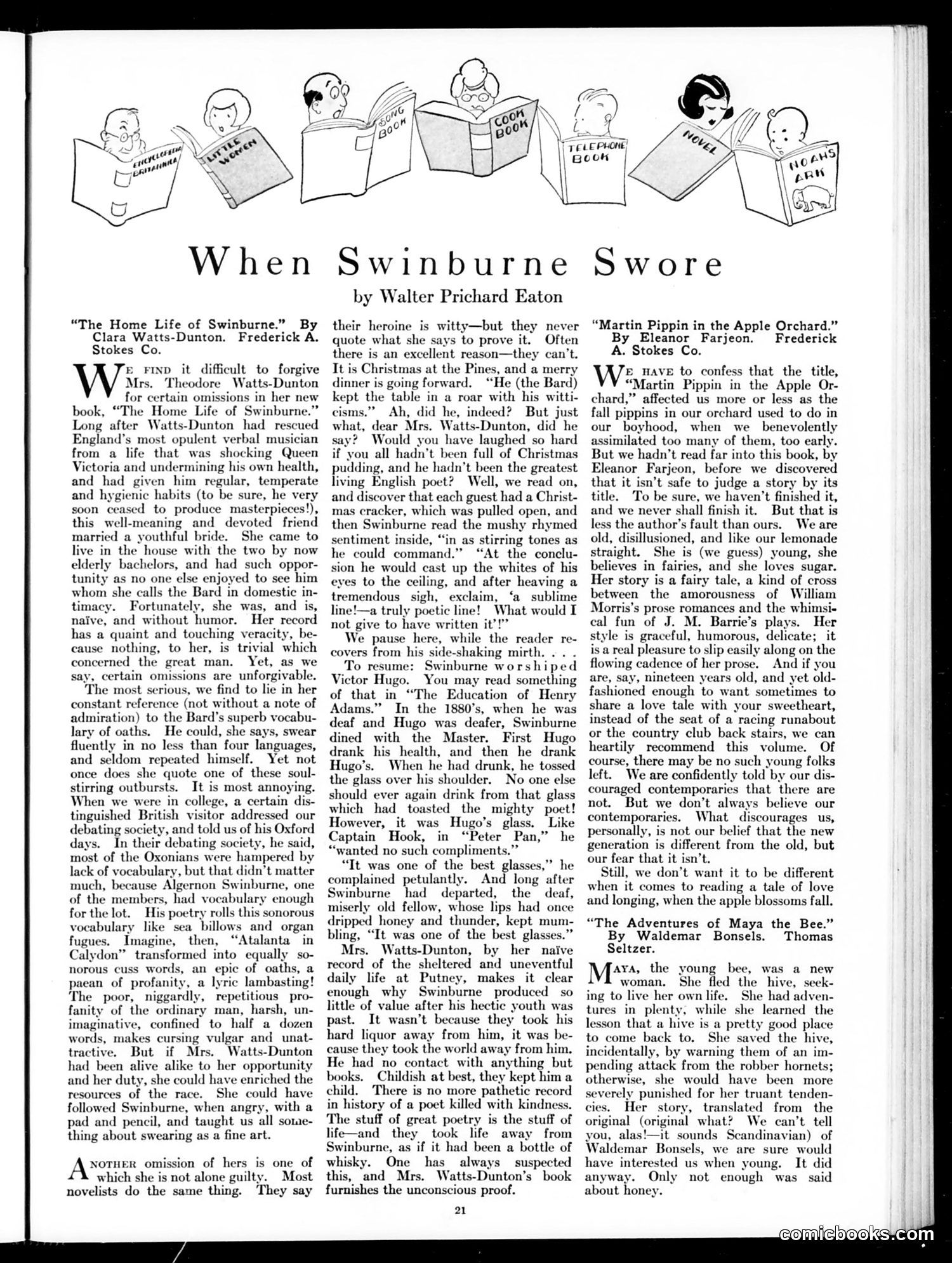
This is a literary review by Walter Prichard Eaton critiquing Clara Watts-Dunton's biography *The Home Life of Swinburne*. The cartoon header shows various people reading different books, illustrating contemporary reading habits. The review satirizes Watts-Dunton's omissions from her memoir of the Victorian poet Algernon Charles Swinburne. Eaton's central joke: she celebrates Swinburne's legendary profanity—he could swear fluently in four languages without repetition—yet quotes *none* of his actual oaths. This represents a broader literary failing: biographers and novelists claim their subjects were witty or charming but never provide actual evidence. The satire targets both Swinburne's rehabilitation (Watts-Dunton had domesticated the dissolute poet) and Victorian literary hagiography's tendency toward vague praise rather than concrete demonstration. Eaton suggests such biographical timidity wastes an opportunity to document Swinburne's linguistic artistry in its most colorful form.
📄 Transcribed text from this page (OCR, searchable)
Machine-transcribed from the original scan — historical spelling and the odd misread are preserved.
When Swinburne Swore “The Home Life of Swinburne.” By Clara Watts-Dunton. Frederick A. Stokes Co. EF it difficult to forgive Mrs. Theodore Watts-Dunton for certain omissions in her new book, “The Home Life of Swinburne.” Long after Watts-Dunton had rescued England’s most opulent verbal musician from a life that was shocking Queen Victoria and undermining his own health, and had given him peales, temperate and hygienic habits (to be sure, he very soon ceased to produce masterpieces this well-meaning and devoted friend married a youthful bride. She came to live in the house with the two by now elderly bachelors, and had such oppor- tunity as no one else enjoyed to see him whom she calls the Bard in domestic in- timacy. Fortunately, she was, and is, naive, and without humor. Her record has a quaint and touching veracity, be- cause nothing, to her, is trivial which concerned the great man. Yet, as we say, certain omissions are unforgivable. The most serious, we find to lie in her constant reference (not without a note of admiration) to the Bard’s superb vocabu- lary of oaths. He could, she says, swear fluently in no less than four languages, and seldom repeated himself. Yet not once does she quote one of these soul- stirring outbursts. It is most annoying. When we were in college, a certain dis- tinguished British visitor addressed our debating society, and told us of his Oxford " bating society, he said, of the Oxonians were hampered by k of vocabulary, but that didn’t matter much, because Algernon Swinburne, one of the membe ad vocabulary enough for the lot. I Imagine, then, talanta in transformed into equally so- ss words, an epic of oaths, a paean of profanity, a lyric lambasting! The poor, niggardly, repetitious pro- fanity of the ordinary man, harsh, un- imaginative, confined to half a dozen words, makes cursing vulgar and_unat- tract But if Mrs. Watts-Dunton had been alive alike to her opportunity and her duty, she could have enriched the resources of the race. She could have followed Swinburne, when angry, with a pad and pencil, and taught us all some- thing about swearing as a fine art. A NOTHER omission of hers is one of vhich she is not alone guilty. Most novelists do the same thing. They say by Walter Prichard Eaton their heroine is witty—but they never quote what she says to prove it. Often there is an excellent reason—they can’t. It is Christmas at the Pines, and a merry dinner is going forward. “He (the Bard) kept the table in a roar with his witti- cisms.” Ah, did he, indeed? But just what, dear Mrs. Watts-Dunton, did he Would you have laughed so hard if you all hadn’t been full of Christmas pudding, and he hadn’t been the greatest living English poet? Well, we read on, and discover that each guest had a Christ- mas cracker, which was pulled open, and then Swinburne read the mushy rhymed sentiment inside, “in as stirring tones as he could command.” “At the conclu- sion he would cast up the whites of his eyes to the ceiling, and after heaving a tremendous sigh, exclaim, ‘a sublime line!—a truly poetic line! What would I not give to have written it’!” We pause here, while the reader re- covers from his side-shaking mirth. . . . To resume inburne worshiped Victor Hugo. You may read something of that in “The Education of Henry Adams.” In the 1880’s, when he was deaf and Hugo was deafer, Swinburne dined with the Master. First Hugo drank his health, and then he drank Hugo’s. When he had drunk, he tossed the glass over his shoulder. No one else should ever n drink from that glass which ted the mighty poet! Howev. Hugo’s glass. Like Captain “Peter Pan,” he “wanted no such compliments.” “It was one of the best glasses,” he complained petulantly. And long after Swinburne had departed, the d miserly old fellow, whose lips had once dripped honey and thunder, kept mun bling, “It was one of the best glass Mrs. Watts-Dunton, by her naive record of the sheltered and uneventful daily life at Putney, makes it clear enough why Swinburne produced so little of value after his hectic youth w: past. It wasn’t because they took 1} hard liquor away from him, it was be- cause they took the world away from him. He had no contact with anything but books. Childish at best, they kept him a child. There is no more pathetic record in history of a poet killed with kindness. The stuff of great poetry is the stuff of life—and they took life away from Swinburne, as if it had been a bottle of whisky. One has always suspected this, and Mrs. Watts-Dunton’s book furnishes the unconscious proof. 21 “Martin Pippin in the Apple Orchard.” By Eleanor Farjeon. Frederick A. Stokes Co. E HAVE to confess that the title, “Martin Pippin in the Apple Or- chard,” affected us more or less as the fall pippins in our orchard used to do in our boyhood, when we benevolently assimilated too many of them, too early. But we hadn’t read far into this book, by Eleanor Farjeon, before we discovered that it isn’t safe to judge a story by its title. To be sure, we haven't finished it, and we never shall finish it. But that is less the author's fault than ours. We are old, disillusioned, and like our lemonade straight. She is (we guess) young, she believes in fairies, and she loves sugar. Her story is a fairy tale, a kind of cross between the amorousness of William Morris's prose romances and the whimsi- cal fun of J. M. Barrie’s plays. Her style is graceful, humorous, delicate; it is a real pleasure to slip e: along on the flowing cadence of her pro: And if you are, say, nineteen years old, and yet old- fashioned enough to want sometimes to share a love tale with your sweetheart, instead of the seat of a racing runabout or the country club back stairs, we can heartily recommend this volume. Of course, there may be no such young folks left. We are confidently told by our dis- couraged contemporaries that there are not. But we don’t always believe our contemporaries. What discourages us, personally, is not our belief that the new generation is different from the old, but our fear that it isn’t. Still, we don’t want it to be different when it comes to reading a tale of love and longing, when the apple blossoms fall. “The Adventures of Maya the Bee.” By Waldemar Bonsels. Thomas Seltzer. AYA, the young bee, woman. She fled the hive, s ing to live her own life. She had adve tures in plenty, while she learned the lesson that a hive is a pretty good place to come back to, She saved the hive, incidentally, by warning them of an im- pending attack from the robber hornets; otherwise, she would have been more severely punished for her truant tenden- Her translated from the original (original what? We can’t tell you, alas!—it sounds Scandinavian) of Waldemar Bonsels, we are sure would have interested us when young. It did anyway. Only not enough was said about honey.