
Judge, 1923-01-13 · page 32 of 36
Judge — January 13, 1923 — page 32: what you’re looking at
What you’re looking at
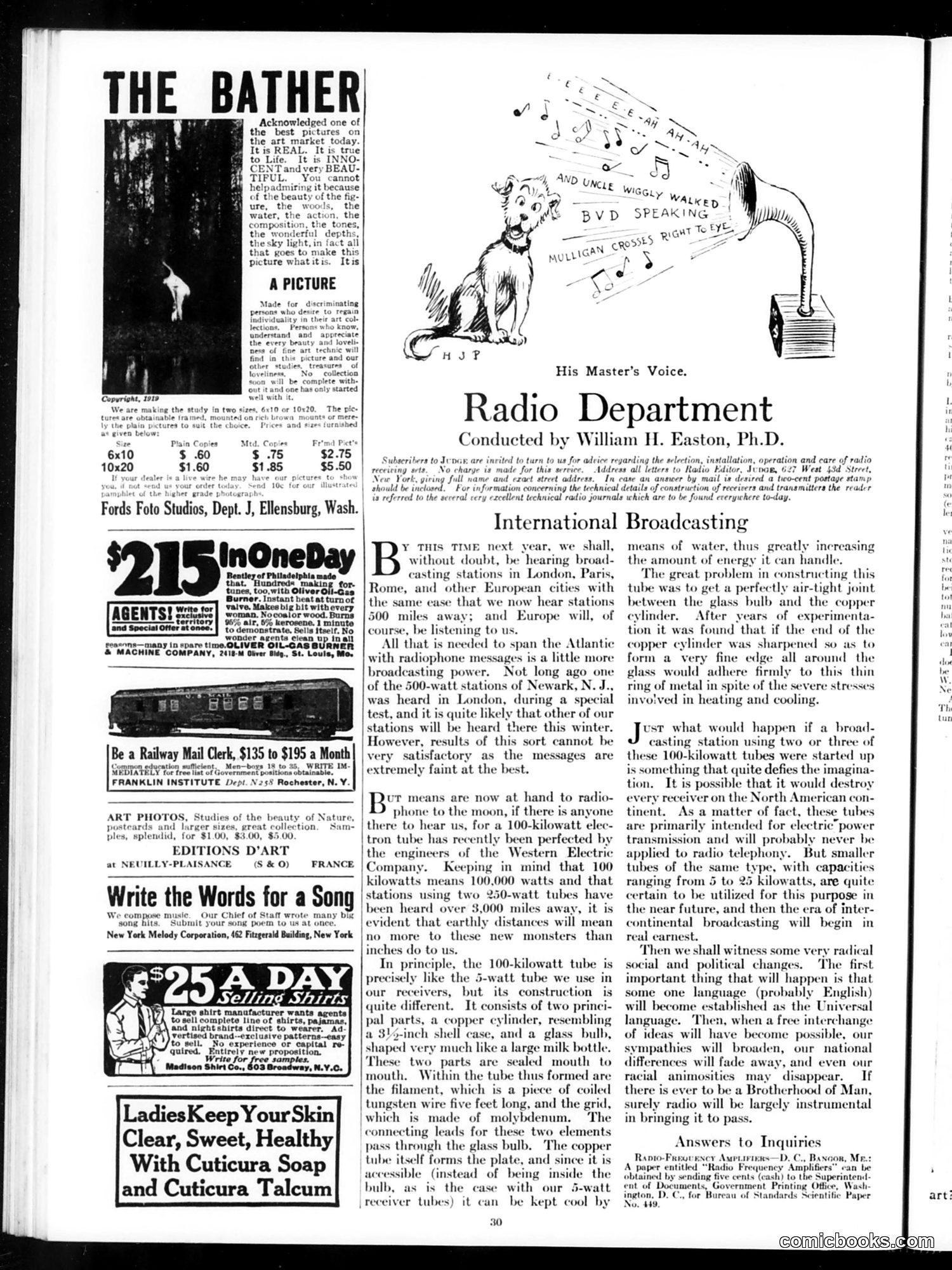
This Judge magazine page mixes editorial and advertising content. "The Bather" appears to be a photograph praised as fine art—the text emphasizes its realism and beauty, though the actual image is quite small and dark, making the satirical point unclear without additional context. The main editorial content is the "Radio Department" column discussing international broadcasting advancement. It describes plans for European radio stations and a newly-perfected 100-kilowatt transmission tube, comparing its principle to smaller 5-watt tubes. The author explains technical details about copper cylinders and tungsten filaments, predicting radio will soon span the Atlantic and theoretically reach the moon. The remainder is period advertising for various products: photography, song-writing services, shirt sales, and Cuticura products—typical early 1920s classified-style advertisements.
📄 Transcribed text from this page (OCR, searchable)
Machine-transcribed from the original scan — historical spelling and the odd misread are preserved.
THE BATHER Acknowledged one of the best pictures the art market today. B It is REAL. to Life. CE: cannot it because of the beaut: ure, the wo compost that goes th picture what itis. Itis A PICTURE Fords Foto Siu, Dept J, Flensburg, W Wash. Rentleyof Philadetphie mado ) tunes, toorwith Oliver Oll-Ses Burner. Instant heat at turn ot (MENTS e| Ses Soman. Nocoslor wood. Burns W% alr, 6% kerosene. 1 tm! to demonstrate, Sells iteclt. No sican up 0 all feacons—many et ‘OIL-GAS BURNER, S°MACHING COMPANY, 210M Cure Bly, St- Louley Mar education suficient SEEBEATELY Yor free lint of Government bo FRANKLIN INSTITUTE Dept. N258 ART PHOTOS, Studies of the beauty of Nature, posteards and larger sizes, great collection. Sam- ples, splendid, for $1.00, $3.00, $5.00. EDITIO D’ART at NEUILLY-PLAISANC (S & 0) Write the Words for a Song We compose music. Our Chief o e bls song hits, Submit your song poem to us at New York Melody Corporation, 462 Fitzgerald Building, £°25 A DAY Selling VY Large shirt manufacturer wants agen’ to sell complete line of shirts, Dalamas, FRANCE 4) and night shirts dire we g Ae) a re are oe? quired. Entirely new Proportion: ite for free samy Madison Shirt Co., 60: 1 MY.C. Clear, Sweet, Healthy With Cuticura Soap and Cuticura Talcum | very s | extremely | tron tube |stations using two }no more to these new | the filament, His Master’s Voice. Radio Department Conducted by William H. Easton, Ph.D. Subscribers to Jenax: are invited to turn to us for advice regarding the selecti No charye is made for this service ing full name and exact street address For information concerning the technical details of construct eral cery excellent technical radio journals which are to be found er n and care of radio 7 Weat 43d Street, . installation, opera nt postage stamp ivers and transmitters the reader ryichere today International Broadcasting Y THIS TIME next year, we shall, without doubt, be hearing broad- asting stations in London, Paris, Rome, and other European cities with the same ease that we now hear stations 500 miles away; and Europe will, of course, be listening to us. All that is needed to s} » Atlantic with radiophone messages is a little more broadcasting power. Not long ago one )0-watt stations of Newark, N. J. : : i test, and it is quite likely that other of our stations will be heard there this winter. However, results of this sort cannot be tory as the messages are nt at the best. B' ‘T means are now at hand to radio- phone to the moon, if there is anyone there to hear us, for a 100-kilowatt elec- as recently been perfected by the engineers of the Western Electric pany. Keeping in mind that 100 ywatts means 100,000 watts and that been heard over 3,000 miles away, it i: evident that earthly distances will mean monsters than inches do to us. In principle, the 100-kilowatt tube is precisely like the 5-watt tube we use in our rece » but its construction is quite different. It consists of two princi- parts, a copper cylinder, resembling s-inch shell case, and a glass bulb, shaped very much like a large milk bottle. These two parts are sealed mouth to mouth. Within the tube thus formed are which is a piece of coiled tungsten wire five feet long, and the grid, which is made of molybdenum. The connecting leads for these two elements pass through the glass bulb. The copper tube itself forms the plate, and since it is accessible (instead of being inside the bulb, as is the case with our 5-watt receiver tubes) it can be kept cool by atly increasing n handle, means of water, thus gre: the amount of energy it he great proble structing this tube was to get a perfectly air-tight joint between the glass bulb and the copper cylinder. After years of experimenta- tion it was found that if the end of the copper cylinder was sharps form a Very fine edge all around the s would adhere firmly to this thin ring of metal in spite of the severe stresses involved in heating and cooling. ed sous to J w would happen if a broad- casting station using two or three of these 100-kilowatt tubes were started up is something that quite defies the imagina- tion, It is possible that it would destre every receiver on the North American con- tinent. As a matter of fact, these tubes are primarily intended for electric” power transmission and will probably never be applied to radio telephony. But smaller tubes of the s type, with capaciti ranging from 5 t« kilowatts, are qui certain to be utilized for this purpose in the near future, and then the era of 5 ntal broadcasting will begin in nest. en_we shall witness some very radical social and political changes. ‘The first important thing that will happen is that language (probably English) lished as the Universal ave become possible, our will broaden, our national I fade away, and even our animosities may disappear. — If er to be a Brotherhood of Man, lio will be largely instrumental in bringing it to pass. racial there is e Answers to Inquiries ington, No. 449. art! comichooks.gom