
A complete issue · 36 pages · 1922
Judge — September 16, 1922
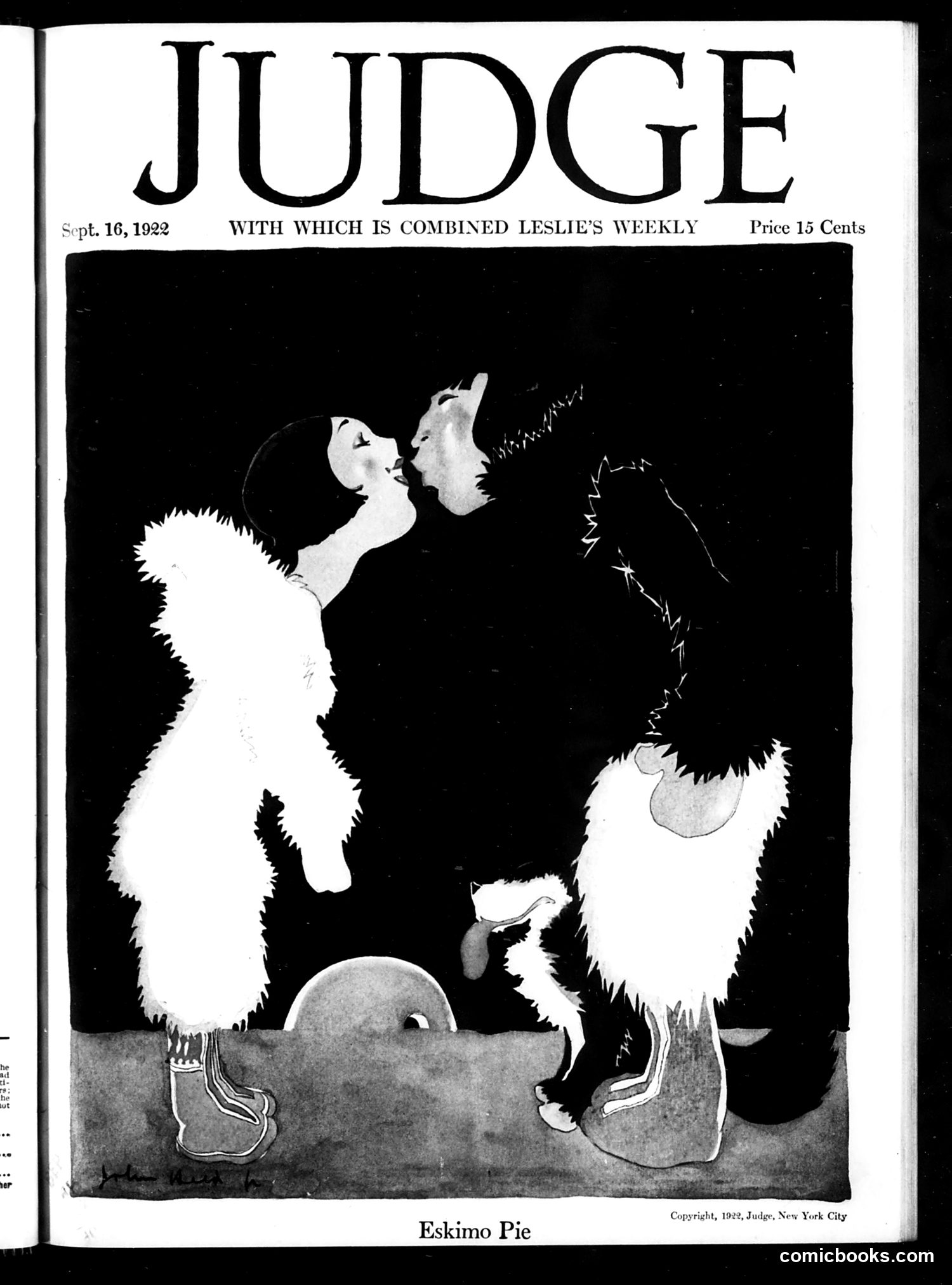
This cartoon depicts two figures in Eskimo/Arctic attire kissing. The title "Eskimo Pie" is a playful double entendre—likely referencing both the actual dessert (a vanilla ice cream product) and the romantic scene shown. The humor appears to rest on visual puns: the "icy" nature of both Eskimos and ice cream, combined with the incongruity of a passionate kiss in such cold conditions. The fluffy fur clothing and exaggerated facial features are typical of 1920s cartoonist style. This reflects early 20th-century American humor's reliance on ethnic/cultural stereotypes, which are now considered offensive. The cartoon is primarily comedic rather than politically satirical, typical of Judge's entertainment focus during this era.
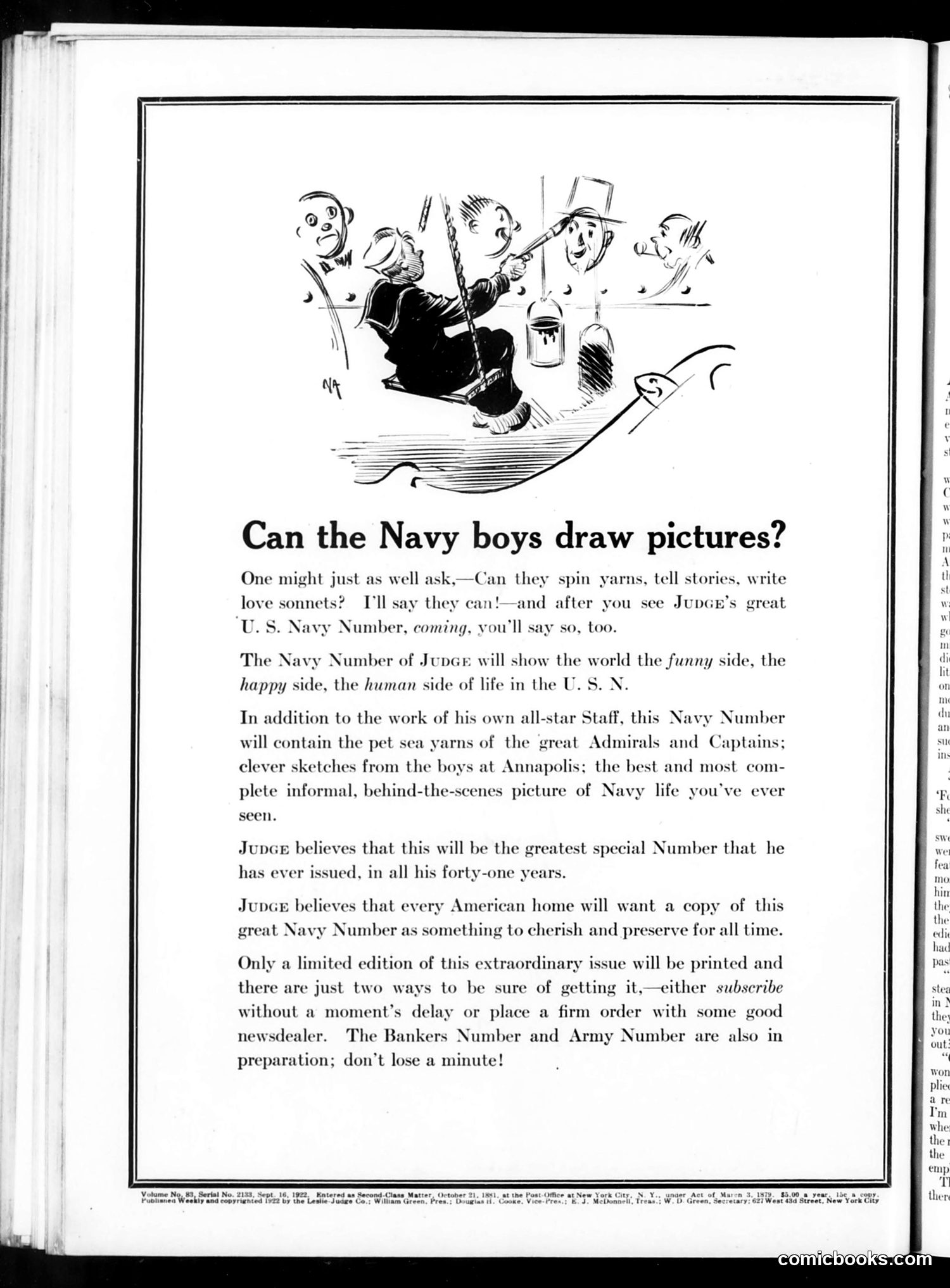
This page is primarily **promotional advertising** rather than satire or editorial cartoon. The headline "Can the Navy boys draw pictures?" introduces a coming special Navy-themed issue of *Judge* magazine. The illustration shows a sailor sitting in a giant hand, surrounded by approving faces—a visual metaphor emphasizing the Navy's artistic talents and human interest. The text promises this "Navy Number" will reveal "the funny side, the happy side, the human side of life in the U.S.N." The promotion highlights contributions from Naval Academy students at Annapolis and stories from "great Admirals and Captains," positioning the issue as an insider's perspective on Navy life. The urgency ("don't lose a minute!") and appeal to patriotism ("every American home will want a copy") were typical early 20th-century magazine marketing tactics.
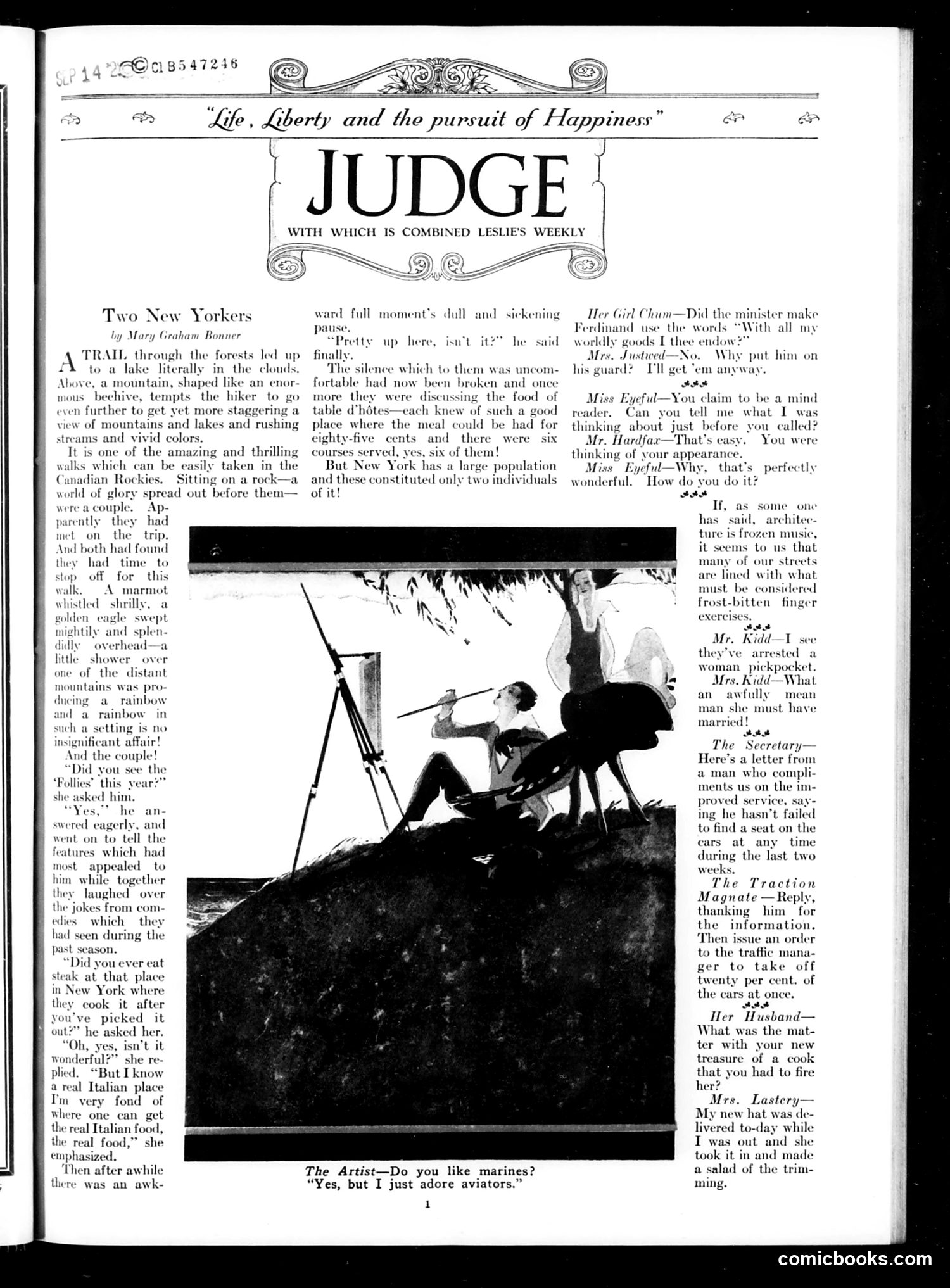
This page from *Judge* magazine contains a short story titled "Two New Yorkers" by Mary Graham Bonner about a couple hiking in the Canadian Rockies, plus a section of humorous letters to the editor. The central illustration depicts two figures in a mountainous landscape—one seated in a chair with surveying or artistic equipment, the other standing. The caption reads: "The Artist—Do you like marines? 'Yes, but I just adore aviators.'" This appears to be a visual pun playing on the double meaning of "marines" (soldiers vs. seascapes) and "aviators" (pilots vs. aviation-themed artwork). The humor relies on the woman's preference for aviators as romantic subjects rather than as paintings or military subjects, reflecting early-20th-century fascination with aviation as a modern, glamorous pursuit.
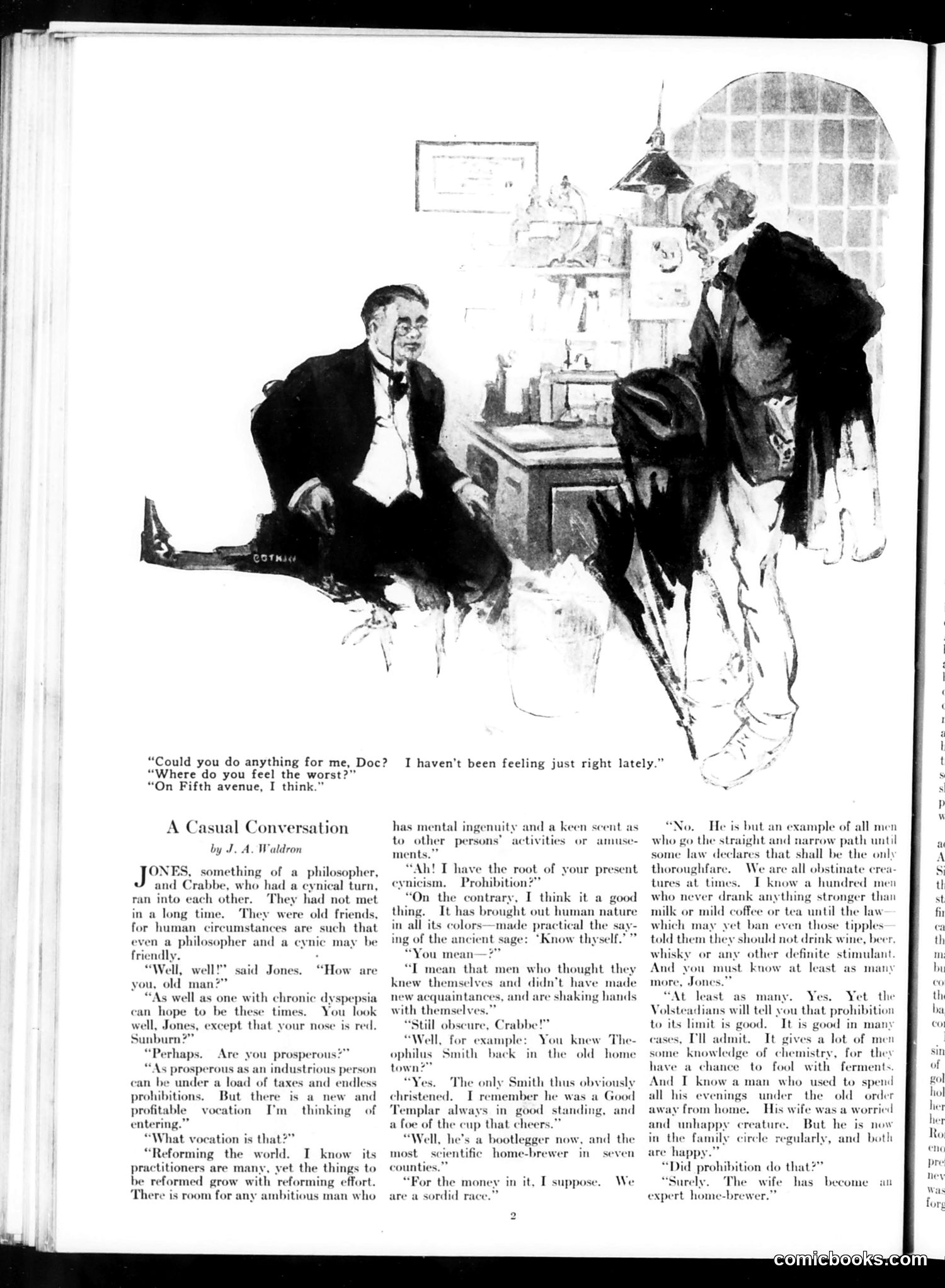
This appears to be a humorous dialogue between two well-dressed men in what looks like a study or office, with a cityscape visible through the window behind them. The satire centers on **Prohibition**—the characters discuss home-brewing and alcohol consumption during the dry era. One man mentions feeling unwell and asks his doctor friend for help; the doctor suggests Fifth Avenue as a cure. The conversation then pivots to the "old Smith" being a "Good Templar" (a temperance advocate) who nonetheless enjoyed drinking and hosting parties. The joke targets the **hypocrisy of Prohibition's era**—respectable citizens and even temperance advocates secretly consumed alcohol while publicly supporting the ban. The cartoon mocks the gap between stated moral principles and actual behavior during this period.
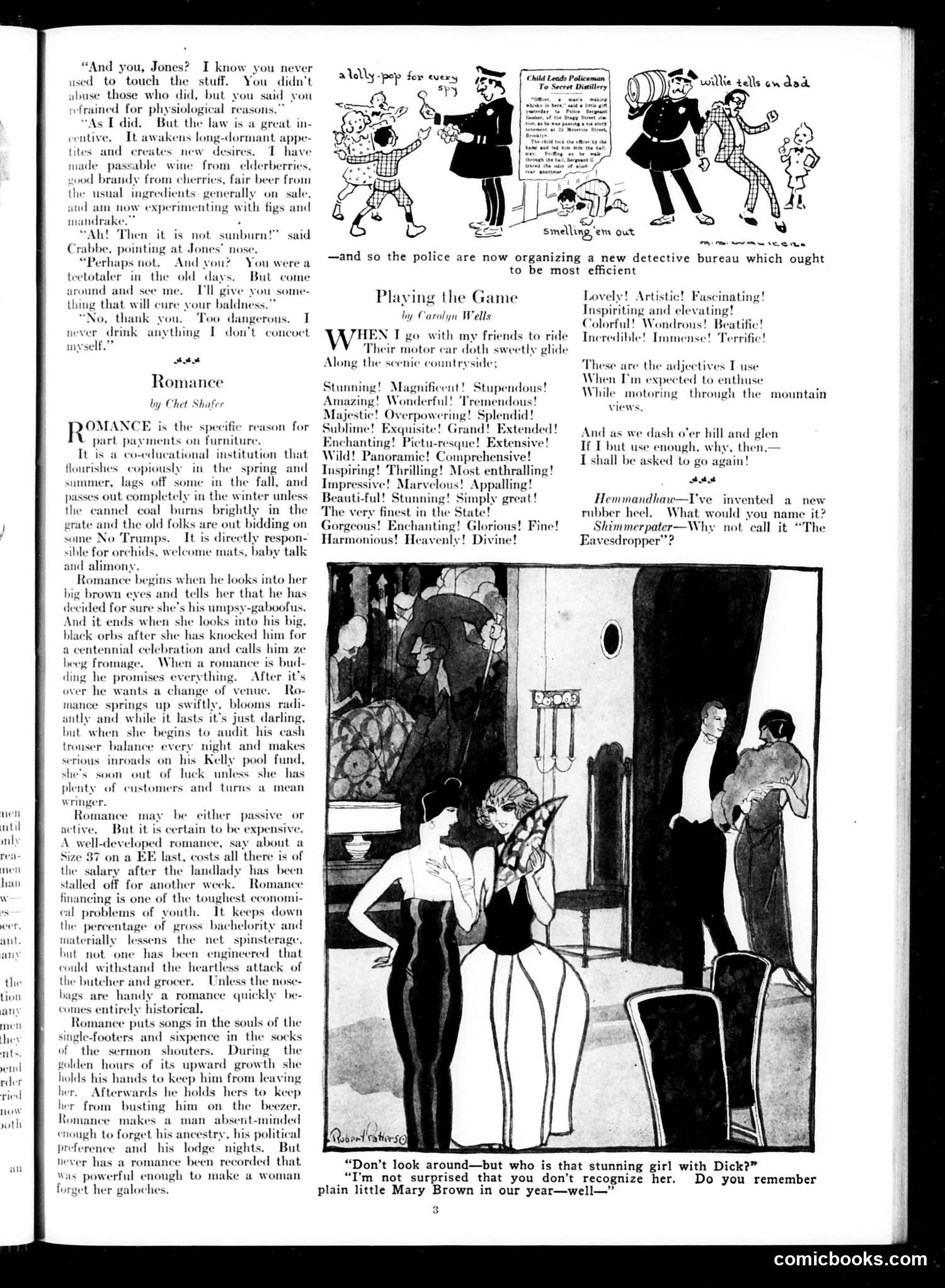
This page contains three distinct pieces: 1. **"Romance" by Chet Shafer** - A humorous essay defining romance in practical terms, emphasizing its financial burdens and domestic complications rather than sentimentality. 2. **"Playing the Game" by Carolyn Wells** - Light verse about motoring through countryside, celebrating the experience with flowery adjectives. 3. **Bottom illustration** - A social comedy scene showing a man encountering an attractive woman at what appears to be a formal gathering. The caption suggests the woman is someone he should recognize ("plain little Mary Brown") but doesn't initially. This plays on the common trope of unrecognizable transformations through beauty, fashion, or social advancement—a satirical jab at superficiality and vanity in social circles. The overall tone is gentle domestic satire typical of Judge's humor.
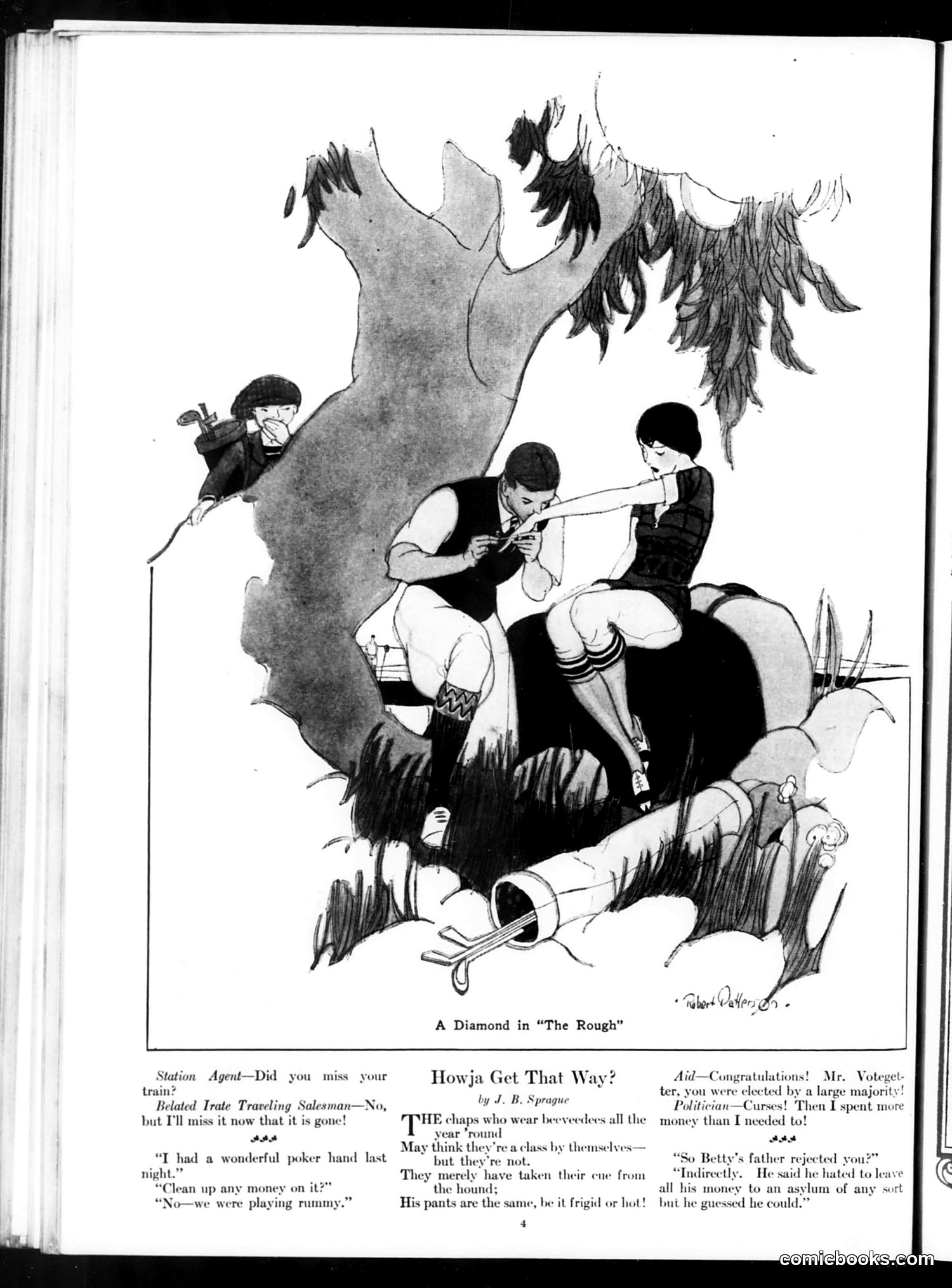
The main cartoon, titled "A Diamond in 'The Rough,'" depicts three children engaged in roughhousing near a tree. The accompanying text jokes about working-class behavior and social pretensions. The bottom section contains three separate comic anecdotes: 1. A conversation between a Station Agent and a traveling salesman about a missed train and lost poker winnings 2. "How'ja Get That Way?" - commentary on young men wearing monocles, suggesting they ape upper-class affectations while wearing identical trousers 3. A brief dialogue about someone named Betty's father rejecting a suitor, apparently due to financial circumstances The satire targets working and middle-class attempts at mimicking wealthy mannerisms and the economic anxieties underlying social mobility in early 20th-century America.
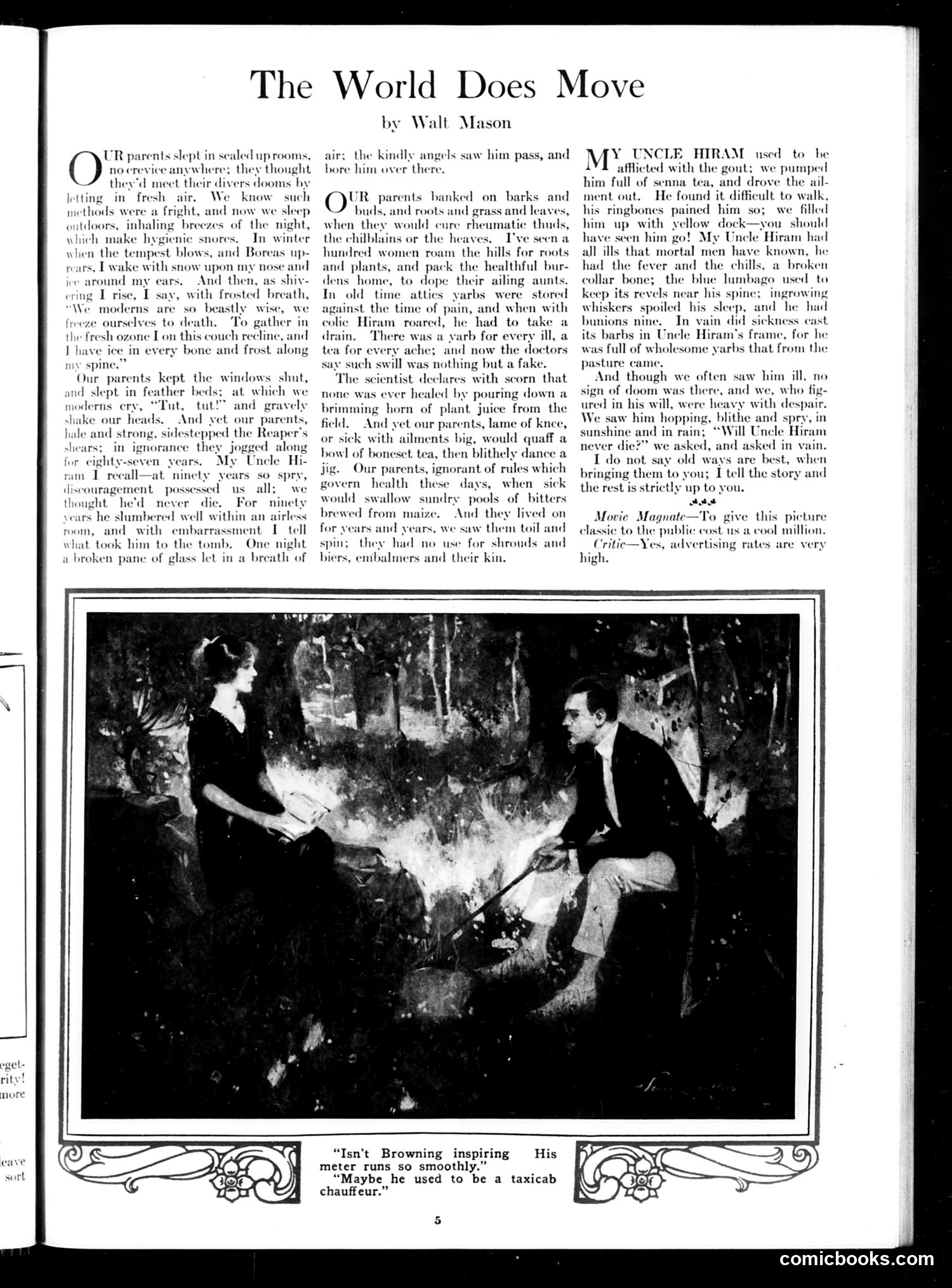
This is Walt Mason's humorous essay-poem contrasting modern and old-fashioned approaches to health and living. The satire mocks contemporary fads while paradoxically showing they're no better than outdated remedies. **The joke:** Mason's parents sealed their rooms against fresh air (thought dangerous), yet lived long; moderns sleep outdoors in freezing conditions, thinking it healthier. His Uncle Hiram, dosed with herbal remedies ("yarbs") and folk treatments despite numerous ailments, lived to 90 in vigorous health. The implication: both approaches work equally well—suggesting modern health obsessions are as baseless as old superstitions. **The bottom image** shows a dialogue between a "Movie Magnate" and "Critic" debating a film's artistic merit—a typical Judge advertisement satire, implying inflated production costs and advertising rates determine critical praise, not actual quality. The overall message reflects early-20th-century skepticism toward medicalization and consumerism masquerading as progress.
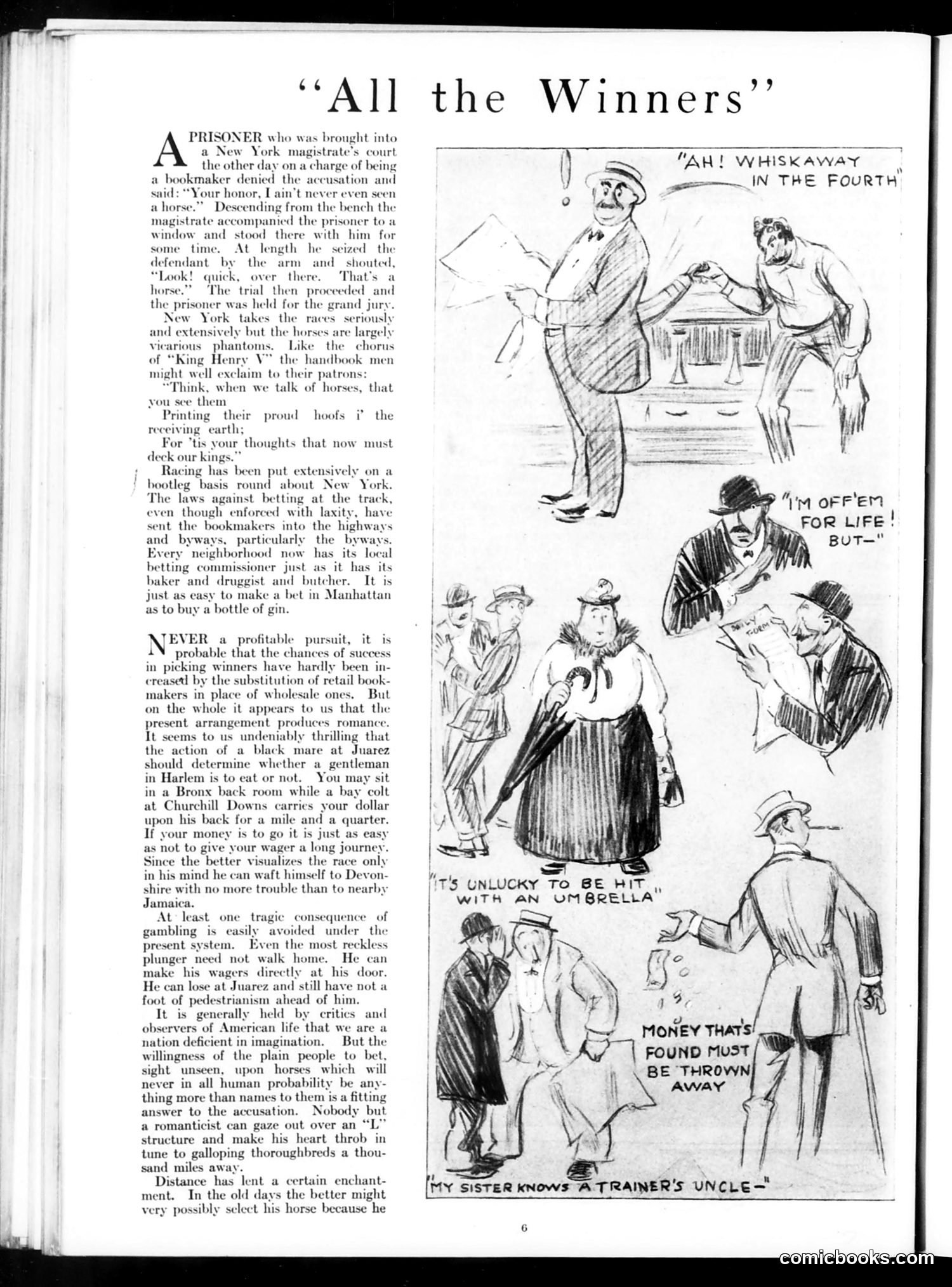
This page satirizes New York's widespread illegal horse-race gambling in the Prohibition era. The text describes how betting laws, though "enforced with laxity," drove bookmakers underground into neighborhood "bootleg" operations—paralleling illegal gin sales. The cartoons mock the absurd logic of amateur bettors. They depict working-class men in a Bronx back room making bets on distant races at Juarez or Churchill Downs based on hearsay: "My sister knows a trainer's uncle," "I'm off'em for life but—," "It's unlucky to be hit with an umbrella," and "Money that's found must be thrown away." The satirist argues this "produces romance"—bettors visualize races only mentally, wagering sight-unseen on horses they'll never see, demonstrating American imagination rather than recklessness. The piece treats underground gambling with bemused tolerance, presenting it as an inevitable consequence of Prohibition-style enforcement.
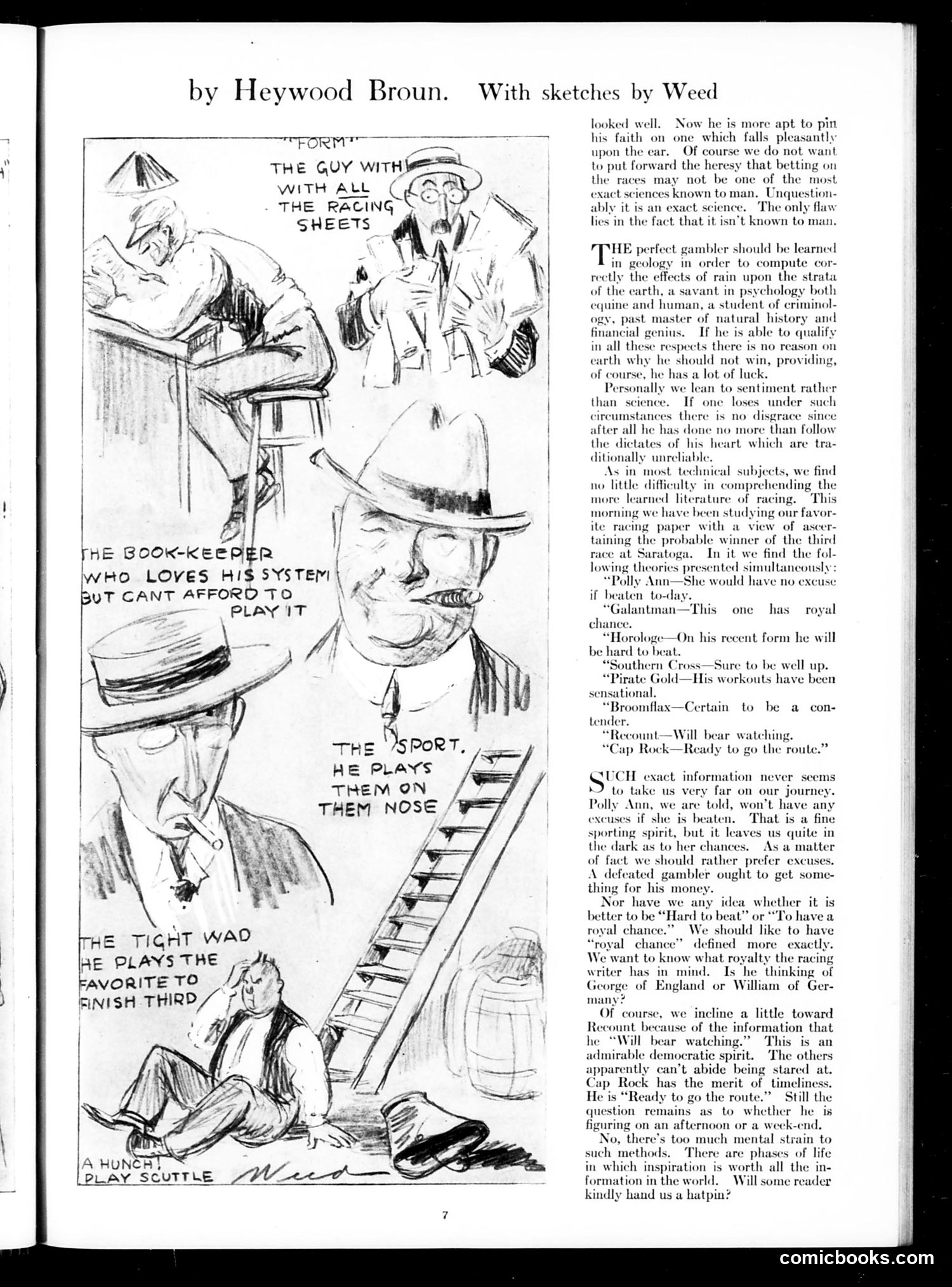
This piece by Heywood Broun satirizes the absurdity of horse-race gambling prediction. The cartoon depicts various types of bettors: the optimistic "guy with the racing sheets," the bookkeeper who loves his system but can't afford to play it, and others who employ different betting strategies ("plays them on the nose," "plays the favorite to finish third," etc.). Broun's essay mocks the pretense that horse racing is a "science." He argues that while people claim betting requires expertise in geology, psychology, criminology, and finance, actual racing predictions are nonsensical. The humor lies in the absurdly contradictory expert tips provided for horses at Saratoga—each claiming certainty while conveying nothing useful ("Polly Ann—She would have no excuse if beaten"; "Cap Rock—Ready to go the route"). Broun concludes that gambling succeeds through sentiment and luck, not learning, and asks readers to simply provide him a hatpin—suggesting he'd rather abandon the whole frustrating enterprise.
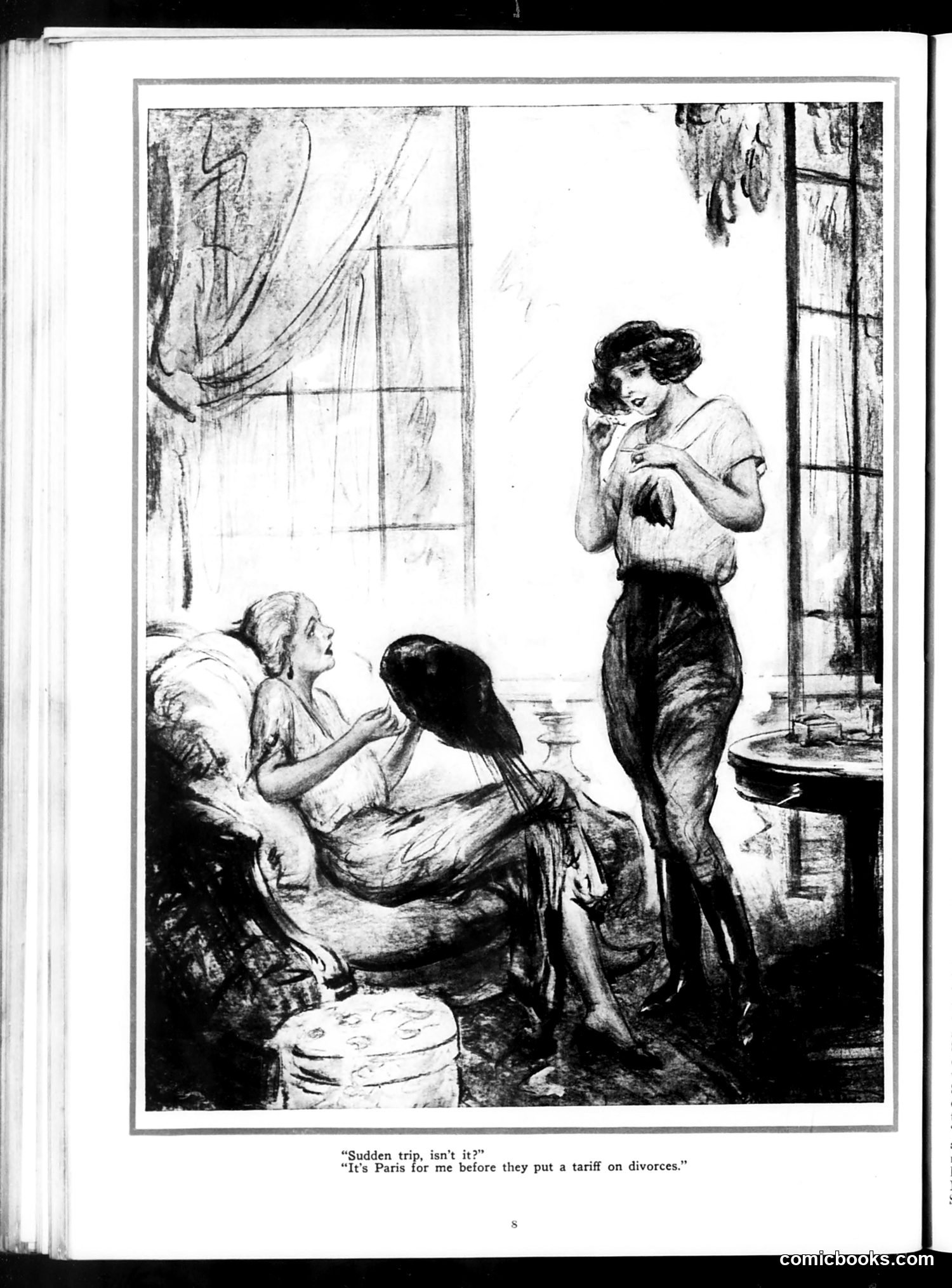
This illustration satirizes hasty marriages followed by divorce. The dialogue reads: "Sudden trip, isn't it?" / "It's Paris for me before they put a tariff on divorces." The cartoon jokes about the ease of obtaining divorces in Paris compared to America. A woman appears to be fleeing to France to secure a quick divorce before hypothetical new U.S. tariffs or legal restrictions could be imposed. The scene depicts what seems to be a domestic interior with other figures present. The satire targets both the prevalence of "Paris divorces" among wealthy Americans and anxieties about potential government regulation of divorce. This reflects early-20th-century social attitudes: divorce was scandalous and legally difficult in many U.S. states, making Paris a popular destination for Americans seeking separation. The joke assumes readers would find humor in someone's desperation to access easy divorce before legal barriers increase.
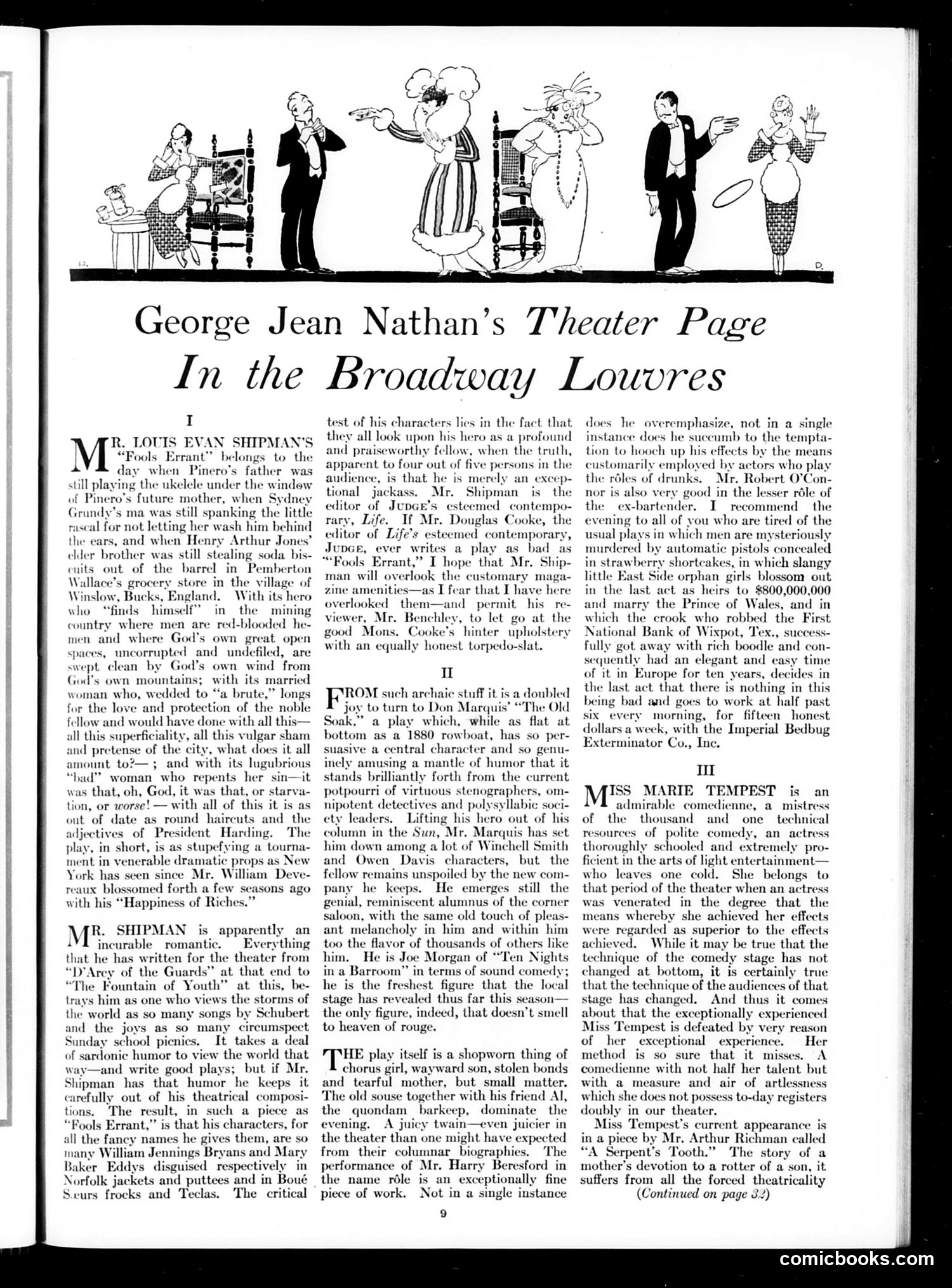
This is a theater criticism column by George Jean Nathan, a prominent drama critic of the 1920s. The header illustration depicts various theatrical characters and scenes in a decorative strip. Nathan reviews two Broadway plays: **"Fools Errant"** by Louis Evan Shipman—Nathan dismisses it as hopelessly outdated, written in the style of Victorian-era playwrights (Pinero, Grundy, Henry Arthur Jones). He mocks its clichéd plot: a noble hero in mining country, an unhappy married woman longing for true love, and a "bad woman" seeking redemption. He sarcastically compares Shipman's characters to William Jennings Bryan and Mary Baker Eddy—apparently suggesting they embody naive, earnest sentimentality rather than authentic human complexity. **"The Old Soak"** by Don Marquis—Nathan praises this play enthusiastically. Though structurally simple, it succeeds through its vivid central character (Joe Morgan) lifted from Marquis's newspaper column, who retains authentic charm despite being placed among conventional theatrical stock characters. The satire critiques both Shipman's romantic sentimentality and theatrical cliché.
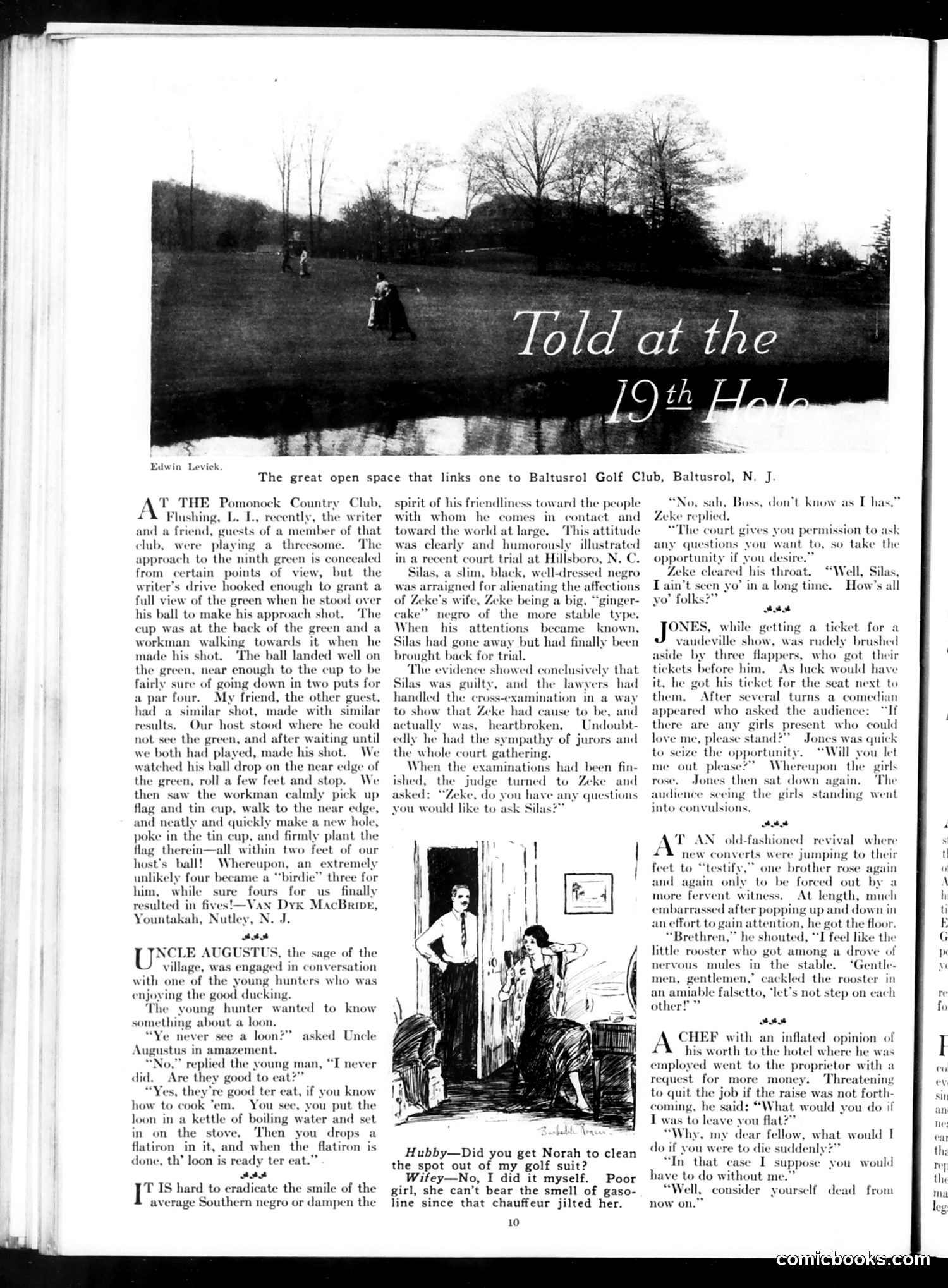
This page from Judge presents three humorous anecdotes targeting different social groups through exaggeration and stereotype. **"The Ninth Green"** mocks wealthy country-club golfers' sense of entitlement, depicting a greenskeeper secretly moving a flag to give the club owner a better score—highlighting class privilege masquerading as skill. **"The Loon Recipe"** ridicules rural/Southern ignorance through Uncle Augustus, who describes cooking a loon by boiling it with a flatiron until the flatiron is "done," implying the bird becomes edible only after the iron cooks through—absurd logic presented as rustic wisdom. **"The Court Trial"** relies on racist caricature of a Black defendant named Zeke, portraying him as emotionally simple and grateful for courtroom attention. The judge's patronizing permission to ask questions, and Zeke's inability to formulate any, reinforce stereotypes of Black inferiority and docility. These stories exemplify early-20th-century satirical humor targeting class pretension, rural simplicity, and racial stereotypes—reflecting period attitudes now recognized as offensive.
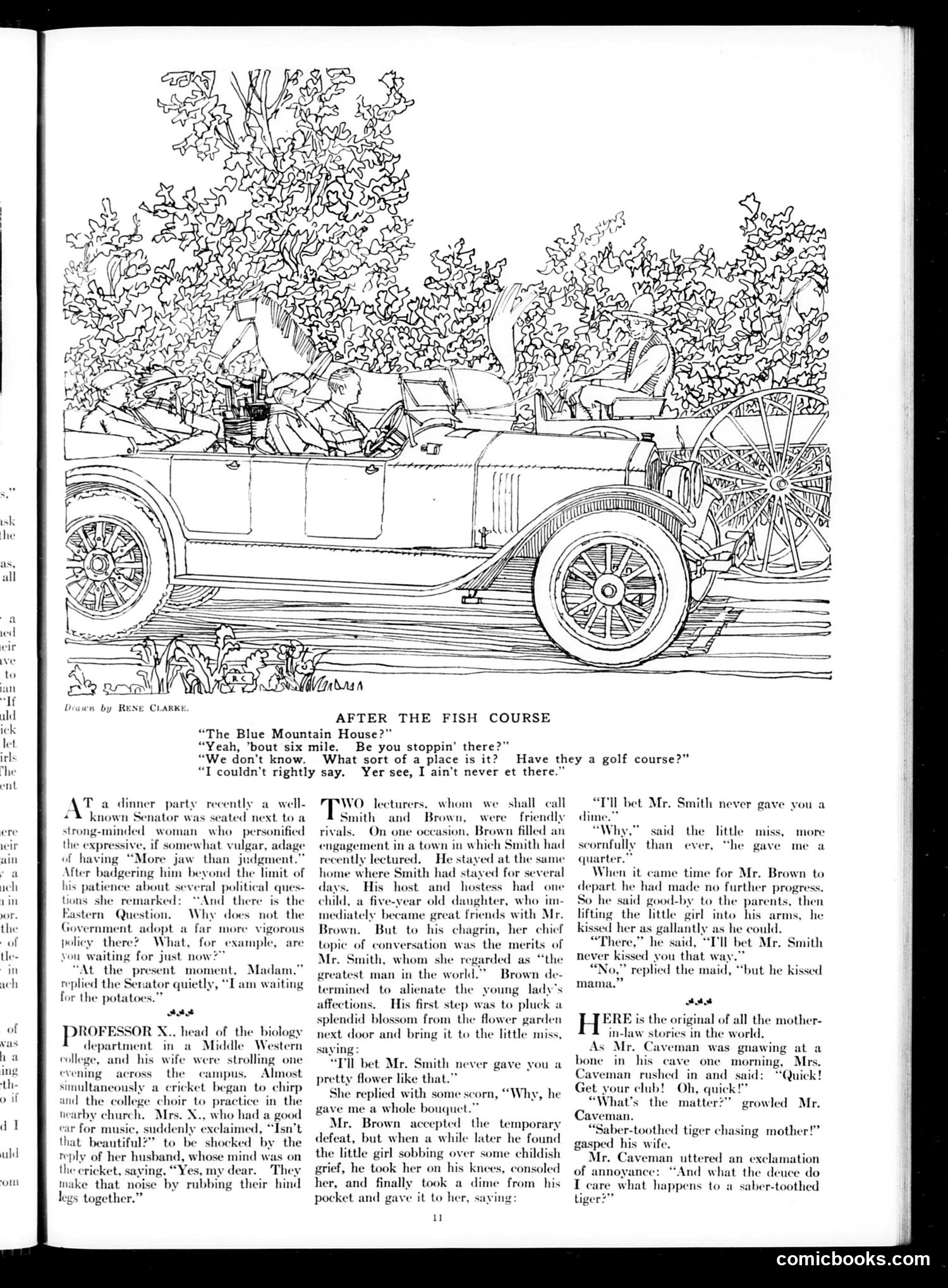
This page contains three separate humorous anecdotes satirizing social pretension and human nature: **"After the Fish Course"**: A dialogue joke mocking rural simplicity. A traveler asks directions to "The Blue Mountain House," and a local admits he's never eaten there—suggesting he lacks the sophistication or means to dine at establishments. **The Senator story**: A dinner guest badgers a Senator about foreign policy ("the Eastern Question"). His witty comeback—saying he's currently waiting for "the potatoes"—satirizes how politicians deflect from serious matters with polite evasion. **The Lecturers' Rivalry**: Two academics (Smith and Brown) compete for a child's affection. Brown's attempts to win her with flowers and money fail because she's already impressed by Smith's superior gifts, mocking academic vanity and failed social manipulation. **The Caveman origin story**: A brief final joke suggesting prehistoric origins of mother-in-law complaints, humorously claiming the concept is ancient. The cartoons illustrate these verbal jokes, with the automobile scene drawn by René Clarke showing an early 1900s setting. The humor relies on class distinctions, male ego, and domestic dynamics typical of Judge's satirical approach.
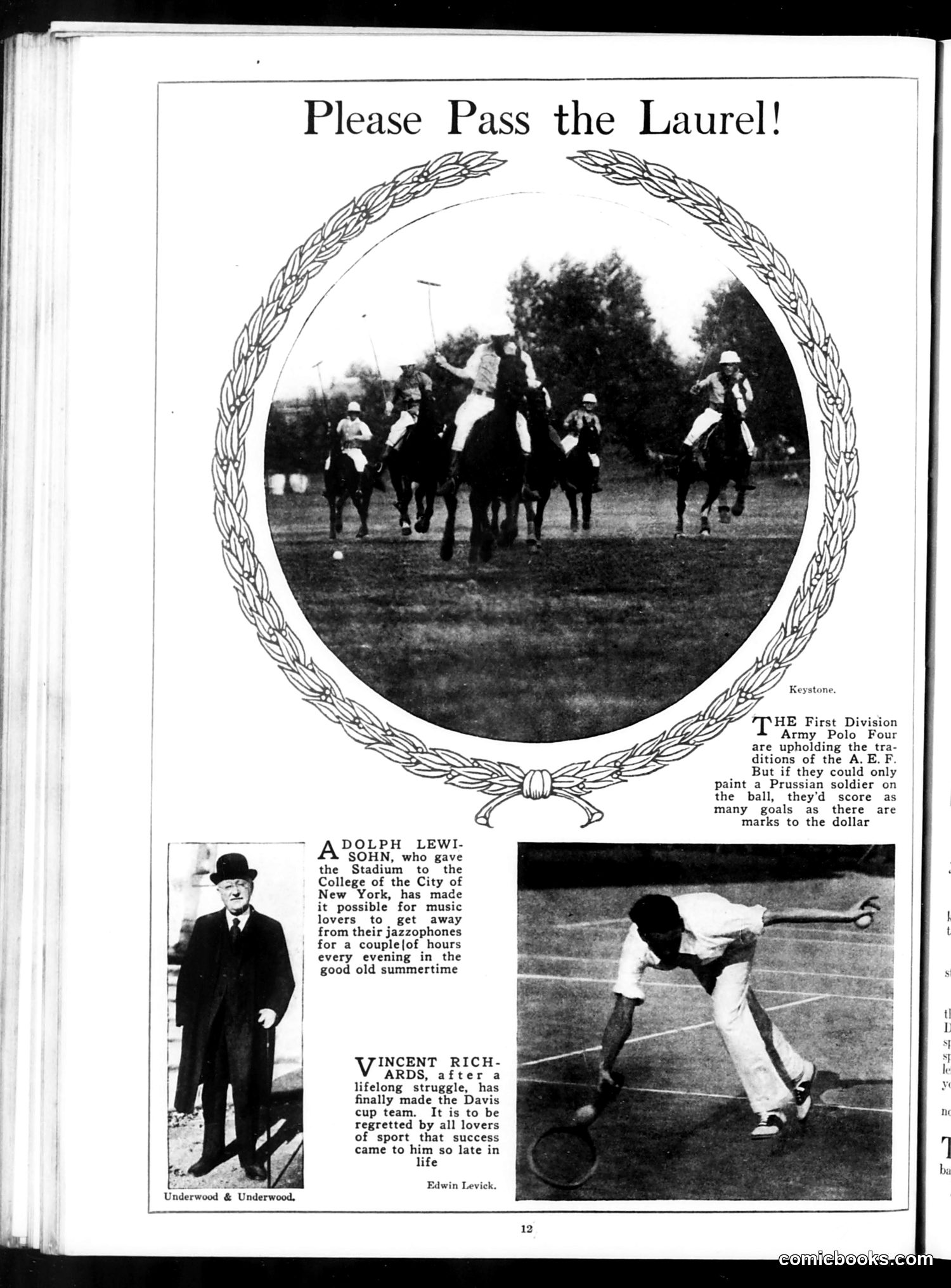
This page celebrates sporting and cultural achievements of wealthy American figures. The main image shows Army polo players—a prestigious sport associated with military elites and the wealthy. The caption jokes that if they could paint a "Prussian soldier" on the ball, they'd score prolifically, a reference to post-WWI anti-German sentiment still prevalent in the 1920s. The sidebar features **Adolph Lewisohn**, a wealthy philanthropist who donated a stadium to City College (presented as a cultural patron), and **Vincent Richards**, a tennis player who finally achieved the prestigious Davis Cup team despite a lifetime of effort. The satire gently mocks how success and recognition come easily to the privileged (Army polo players) while deserving athletes like Richards struggle for years. The page reflects Jazz Age anxieties about leisure, elitism, and American sporting achievement during the prosperous 1920s.
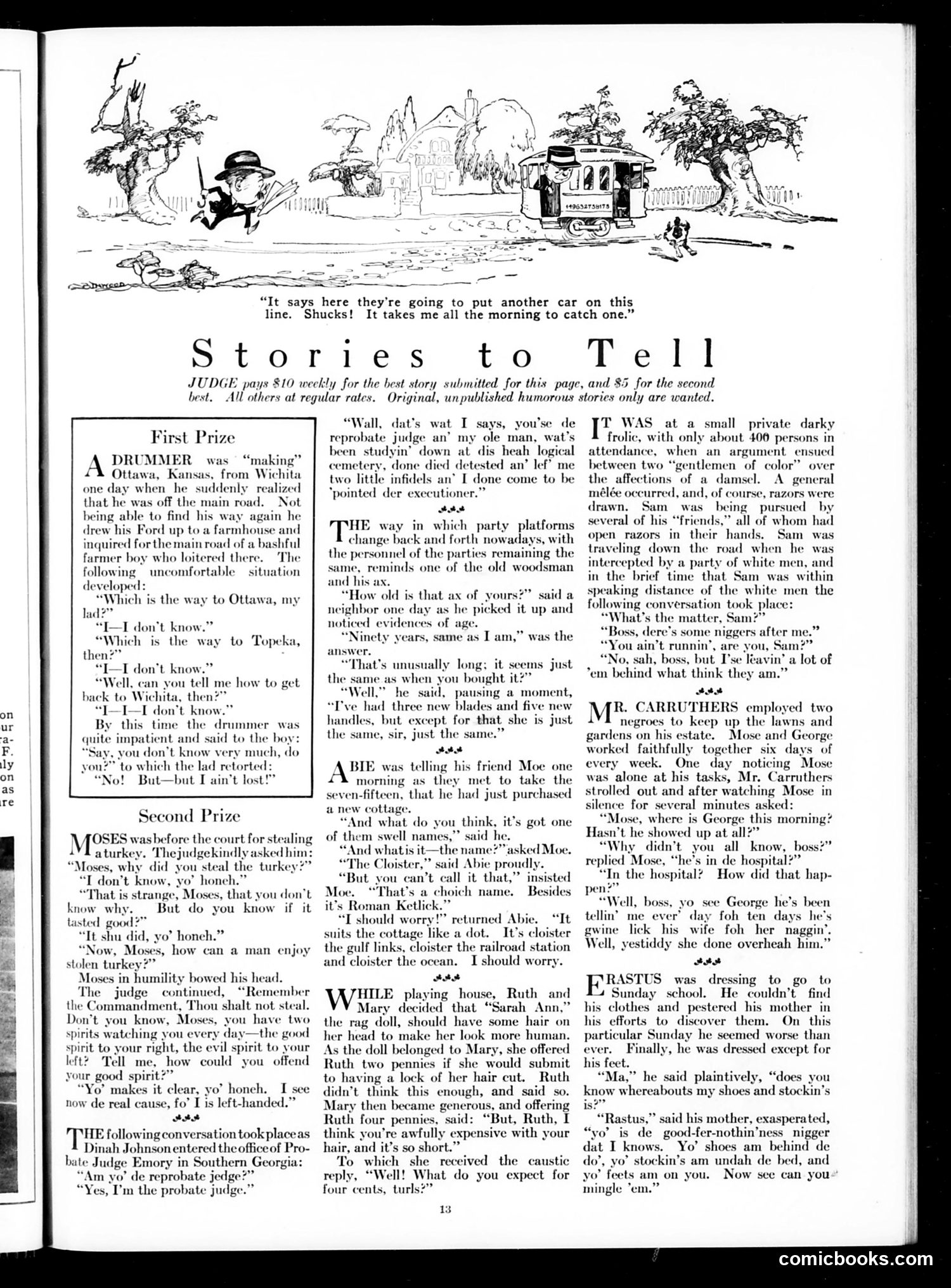
This page from *Judge* magazine presents humorous short stories organized as a contest, with prizes of $10 and $5 for submissions. The cartoon at the top depicts a man complaining about infrequent streetcar service—a relatable complaint about urban transportation in the early 20th century when electric trolleys were common but unreliable. The stories themselves employ period humor: 1. **First Prize**: A traveling salesman (drummer) gets lost and repeatedly asks a shy farm boy for directions, only to discover the boy himself is lost—a setup-punchline joke about rural simplicity. 2. **Second Prize**: A Black defendant named Moses appears before a judge accused of stealing a turkey. The humor relies on dialect comedy and the punchline that Moses committed the crime using his left hand, which he blames on having "two spirits" (good and evil) watching him—satirizing both the defendant's superstition and the judge's moralizing. 3. **Additional stories** include wordplay confusion ("reprobate" vs. "probate judge"), an analogy about political platforms, and children's dialogue about hair-cutting wages. The humor reflects early 20th-century attitudes, including racial stereotypes common to the era.
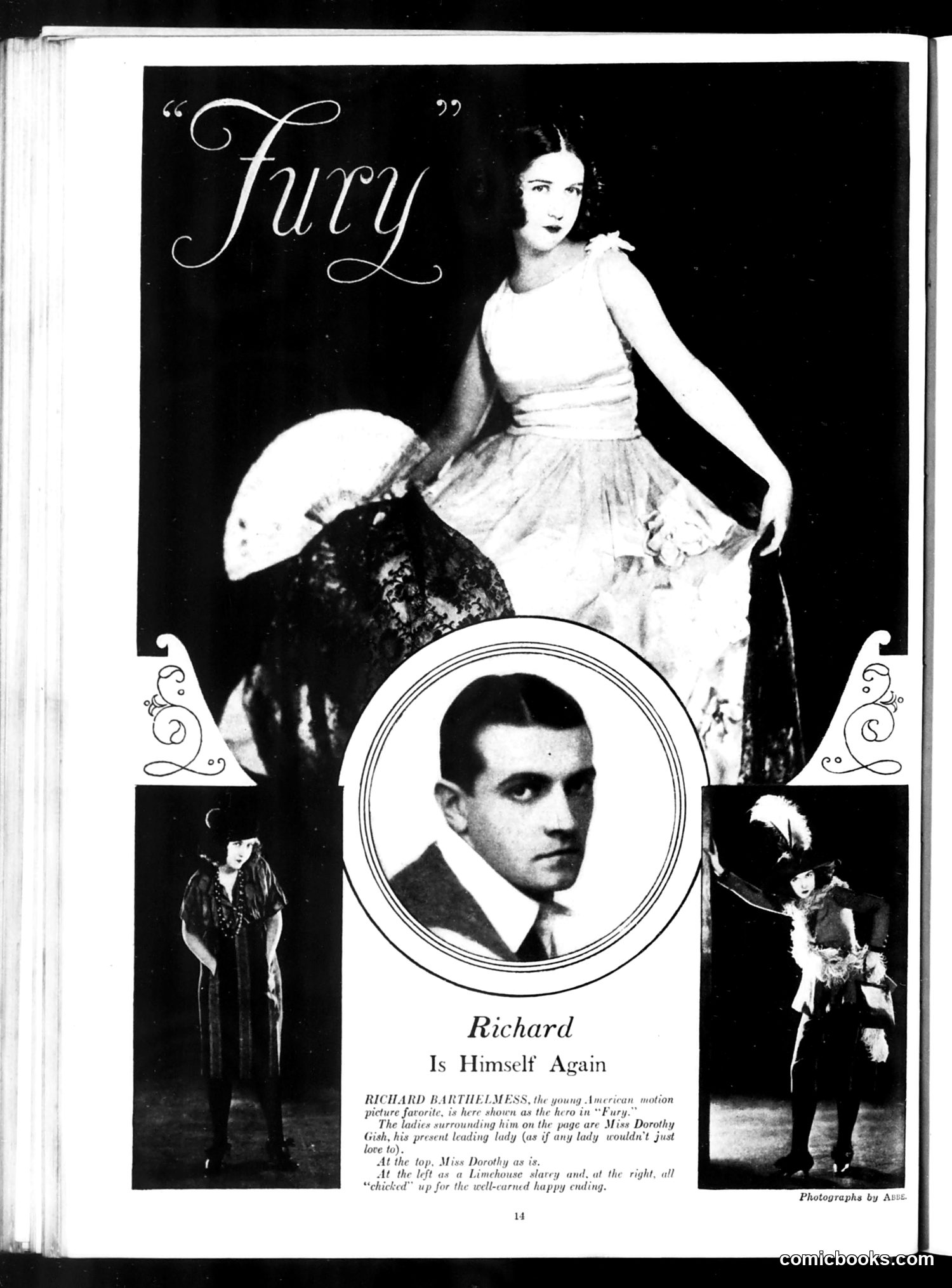
This is a promotional page for the silent film "Fury," featuring actor Richard Barthelmess. The layout showcases Barthelmess in a central circular portrait, surrounded by images of his co-star Dorothy Gish in different costume roles and scenes from the film. The text humorously notes that Gish plays multiple characters—a "Limehouse slarey" (a woman from London's poor dockside district) on the left, and a glamorously dressed woman on the right in the film's "happy ending." The joke appears to be gentle ribbing about Gish's versatility and Barthelmess's romantic leading-man status, with a wink about actresses naturally being attracted to him. This is essentially an entertainment advertisement using light satire typical of Judge magazine's approach to Hollywood content.
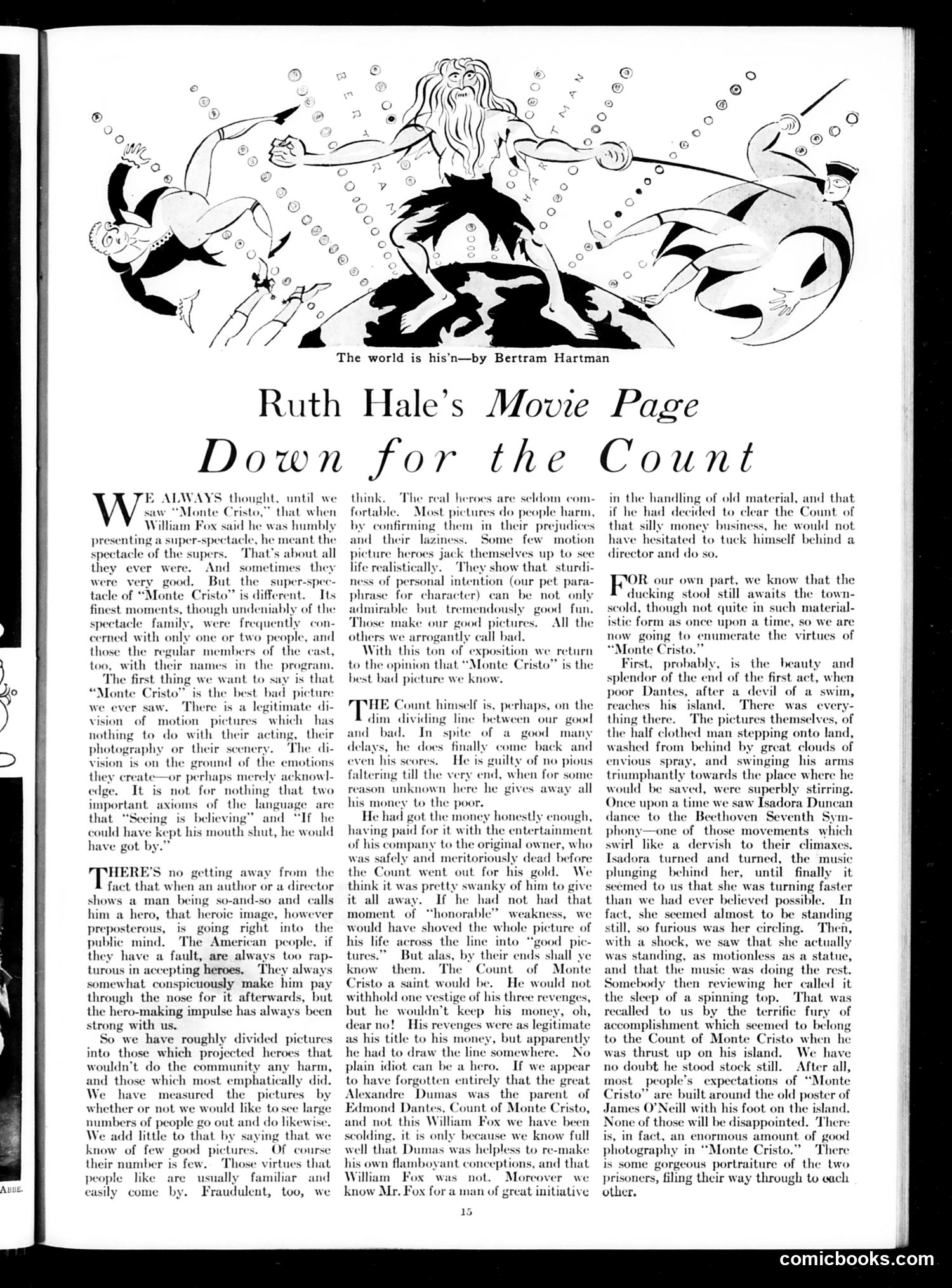
This is a film review by Ruth Hale of William Fox's film adaptation of *The Count of Monte Cristo*. The Bertram Hartman cartoon at top depicts the film's dramatic action—figures in dynamic poses surrounded by bubbles, illustrating the "super-spectacle" nature of the production. Hale's critique distinguishes between "good" and "bad" pictures based on whether they promote harmful behavior in audiences. She classifies *Monte Cristo* as "the best bad picture we know"—technically impressive but morally problematic because it glorifies a hero driven by revenge. The central tension: the Count's vengeful actions are entertaining and dramatically compelling, but Hale worries about the film's influence on viewers. She notes his final charitable act (giving money to the poor) undermines the film's moral coherence—it converts him into a saint, contradicting his ruthless character throughout. The satire critiques Fox's filmmaking as prioritizing spectacle and emotional impact over ethical storytelling, reflecting 1920s anxieties about cinema's power to shape public morality.
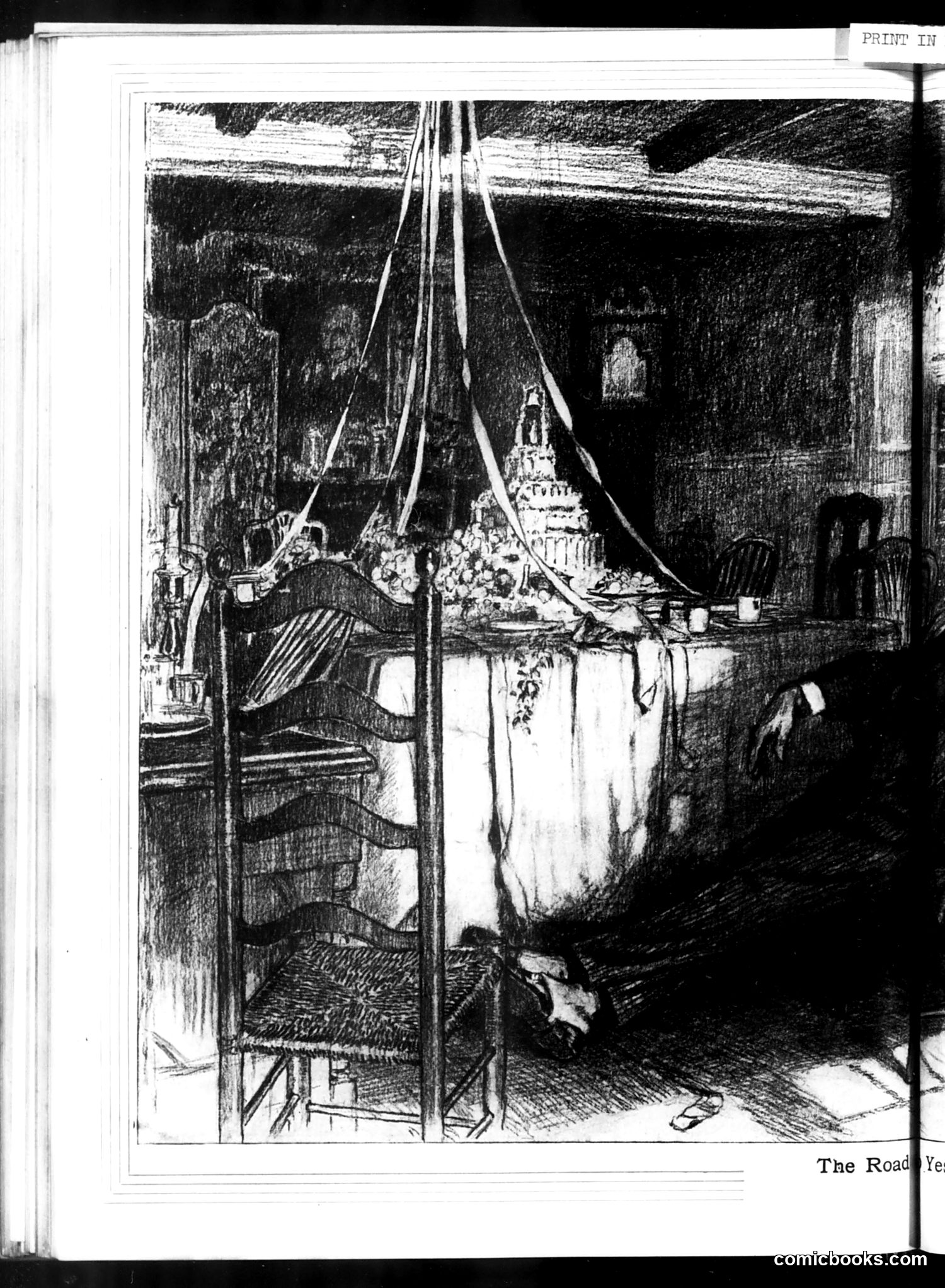
This appears to be an illustration from *Judge* magazine showing an ornate four-poster bed with elaborate drapes and decorative elements. The scene depicts what seems to be a bedroom interior with period furnishings and detailed cross-hatching typical of late 19th or early 20th-century satirical artwork. The partial caption "The Road Ye" is incomplete, making it difficult to determine the specific satirical point or political/social commentary intended. Without the full caption or additional context, I cannot reliably identify what figures or social critique this cartoon targets. The artistic style and composition suggest social satire about domestic life or class, but the specific subject matter remains unclear from the visible portion of the page.
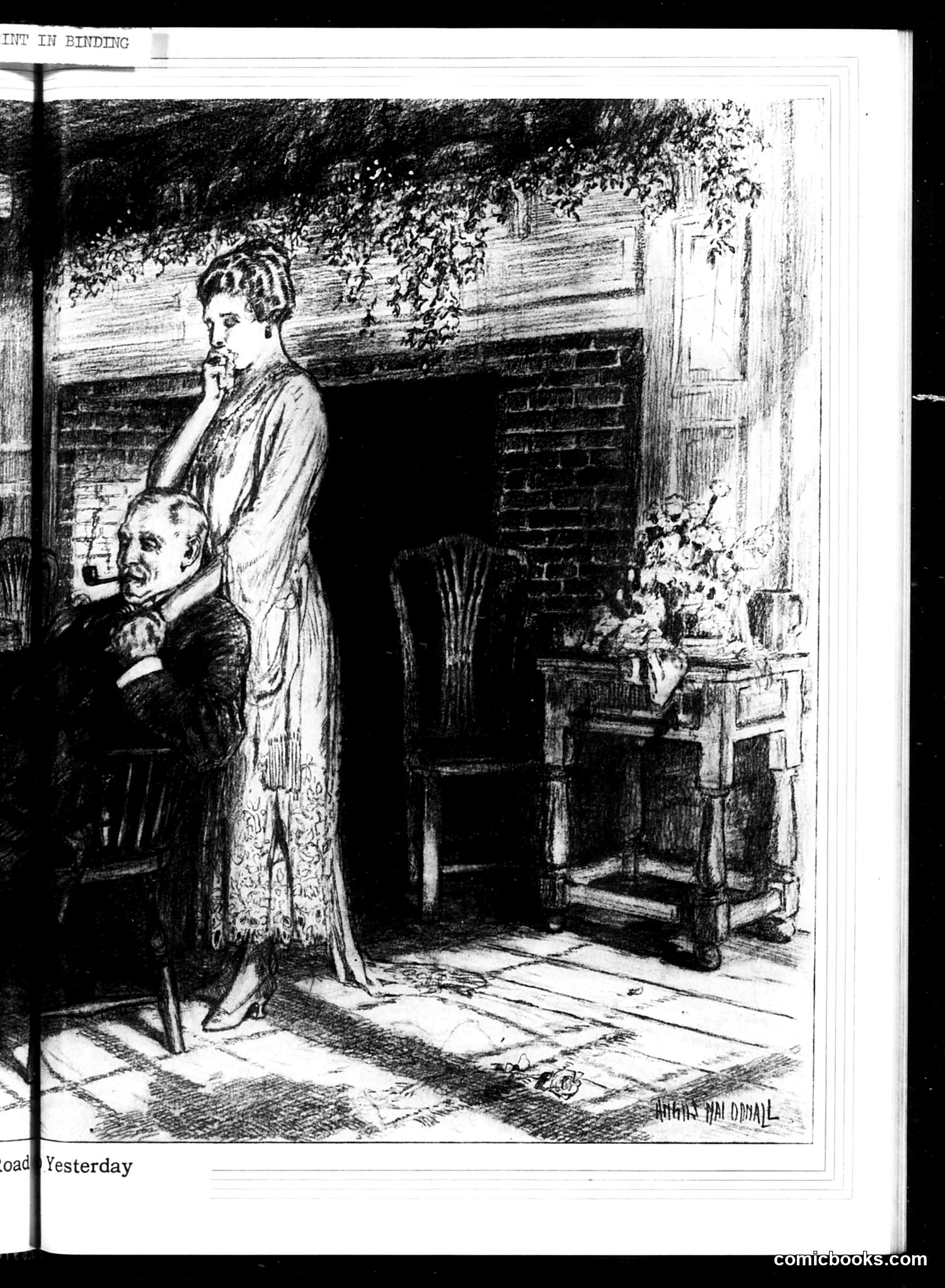
This sketch depicts an intimate domestic scene titled "Yesterday," signed by what appears to be "Hedley Hal Doodall" (signature unclear). The cartoon shows a woman standing pensively with hand to face, while a seated man gazes up at her. A fireplace with ivy-covered exterior, flowers on a side table, and modest furnishings suggest a comfortable home interior. The image appears to be sentimental rather than overtly satirical—likely commenting on romantic nostalgia or marital domesticity. The title "Yesterday" suggests themes of memory, lost time, or retrospective longing. Without additional context or clearer text, the specific satirical target remains unclear, though Judge typically lampooned social customs, relationships, and contemporary manners. The aesthetic suggests early-to-mid 20th century illustration style.
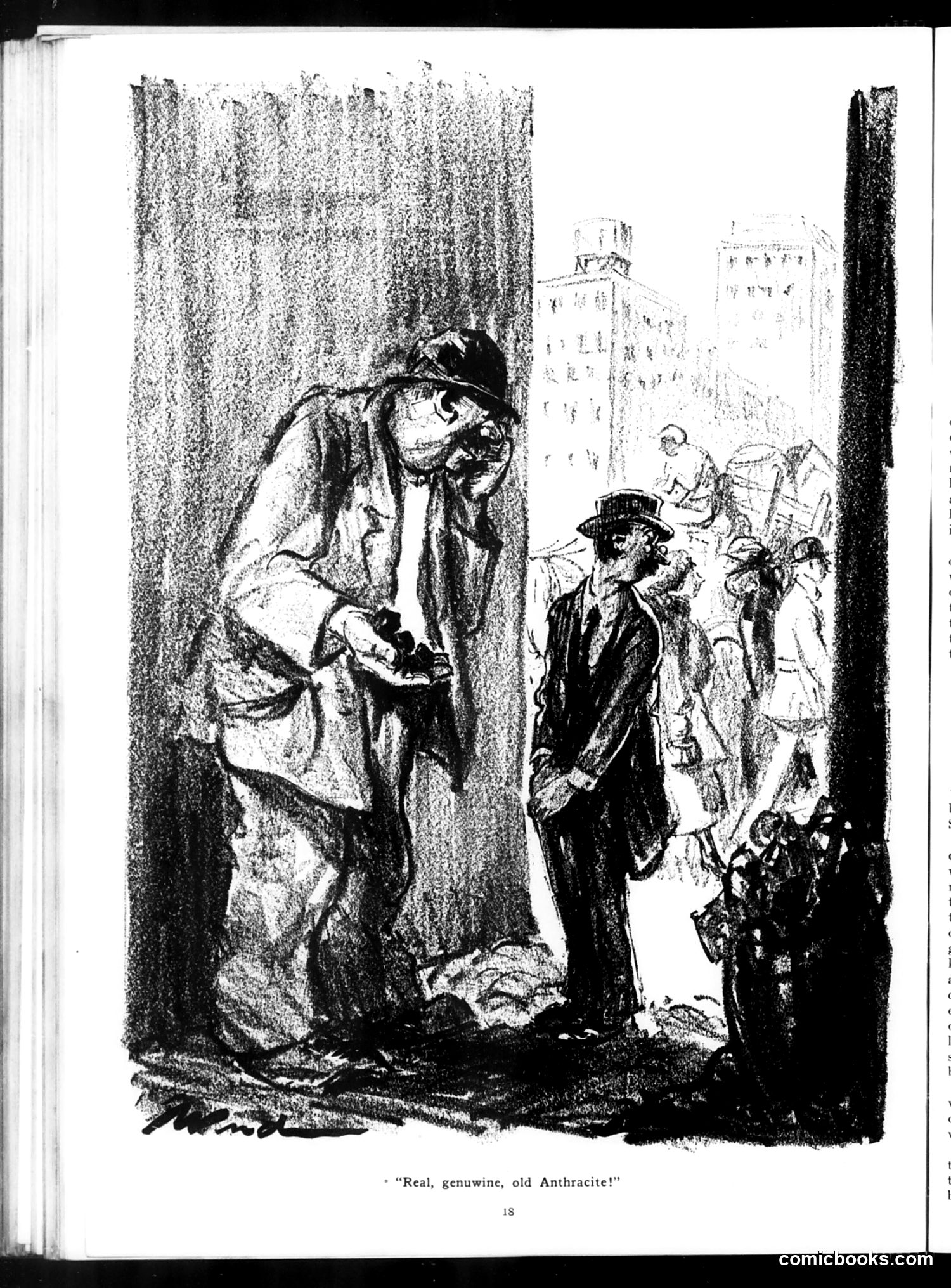
This cartoon satirizes the anthracite coal trade, likely during a period of coal scarcity or price inflation in America. A large, disheveled figure on the left—appearing to be a coal merchant or seller—hawks "real, genuine, old Anthracite!" to a well-dressed gentleman and his companions on a city street. The ragged appearance and exaggerated features of the merchant suggest he's a con artist or profiteer. The satire likely targets merchants exploiting consumers by selling inferior coal as premium anthracite, or capitalizing on fuel shortages through inflated prices. The contrast between the merchant's shabby appearance and his polished customers underscores the class dimension of the fraud. This reflects public frustration with unscrupulous dealers during coal crises.
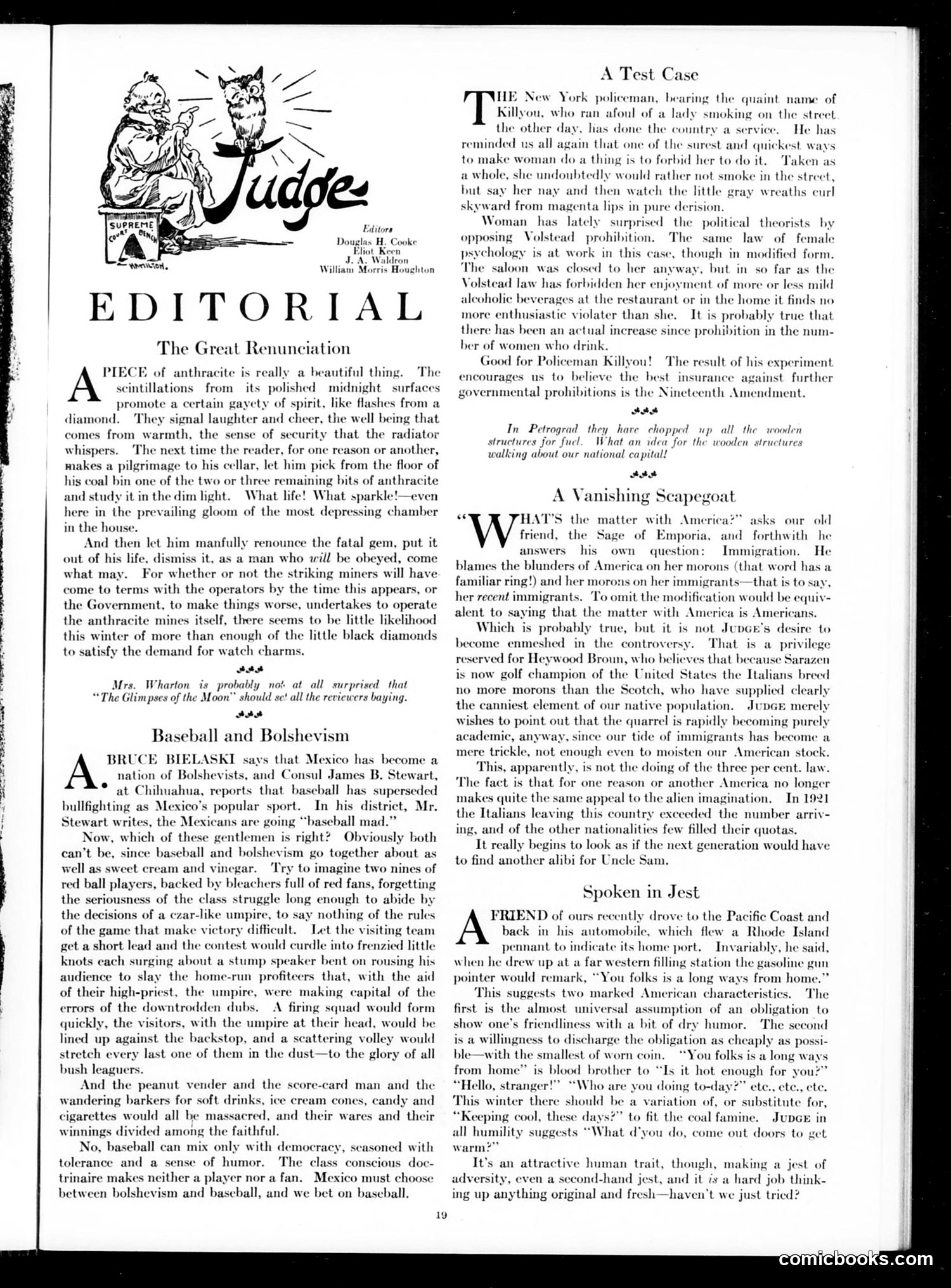
This page contains three editorials satirizing contemporary 1920s American issues: **"The Great Renunciation"** mocks the anthracite coal shortage by urging readers to renounce coal as a noble sacrifice—since there won't be enough anyway due to striking miners and government intervention. **"Baseball and Bolshevism"** argues Mexico cannot simultaneously embrace both baseball and Bolshevism. The satire suggests Bolshevists would abandon baseball's rules and democratic spirit, instead forming firing squads over disputes. The piece sarcastically claims baseball requires democracy and tolerance—qualities incompatible with revolutionary ideology. **"A Test Case"** describes a policeman named "Killyou" arresting a woman smoking on a New York street. The editorial sardonically notes that prohibiting women from smoking will inevitably make them smoke more—a jab at female psychology and, by extension, Prohibition itself (recently enacted in 1920). The satire questions whether legal prohibition actually works. The cartoon header shows a judge figure, reinforcing the magazine's satirical tone on legal/social matters.
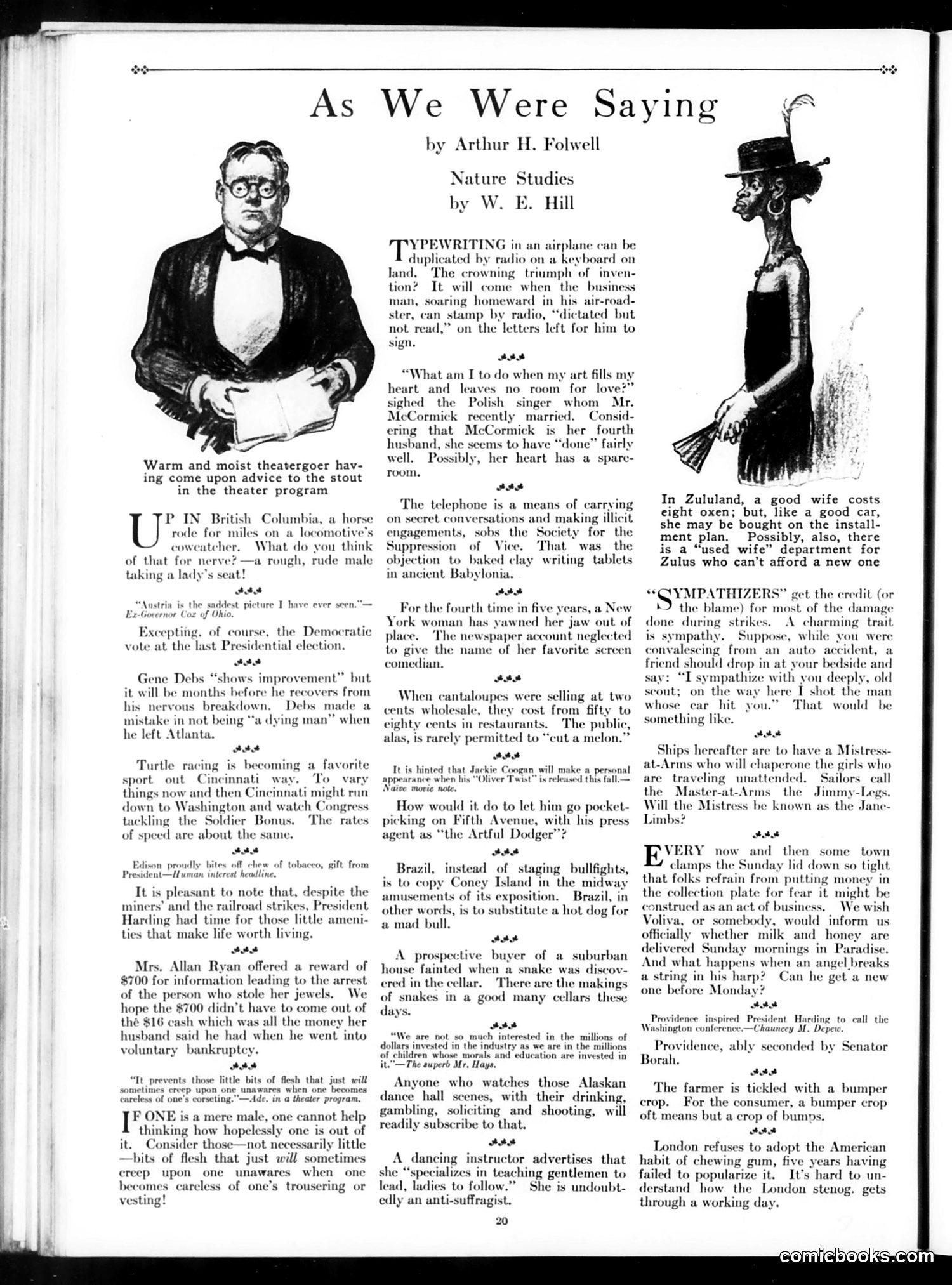
This page from Judge presents a series of brief satirical commentary pieces on contemporary 1920s American life. The left column features a gentleman in formal attire reading a newspaper—the archetypal "Judge" reader observing society with bemused commentary. Key targets include: **Political figures**: Gene Debs (Socialist leader, recently released from prison) and President Harding are gently mocked for perceived weakness or scandal. **Modern technology**: Typewriters in airplanes and radio-dictation are satirized as unnecessarily complicated "progress." **Social hypocrisy**: Restaurant markups on cheap cantaloupe, theatrical morality-policing, and the double standards of corseting (women criticized for "careless" flesh, but men's similar issues ignored). **Celebrity gossip**: References to a Polish opera singer's multiple marriages and Jackie Coogan child actor appearances mock entertainment culture. The humor relies on readers recognizing contemporary scandals and absurdities. Most specific references—names, events—are now obscure, but the satirical method (mocking technological excess, political pretension, and social double standards) remains timeless.
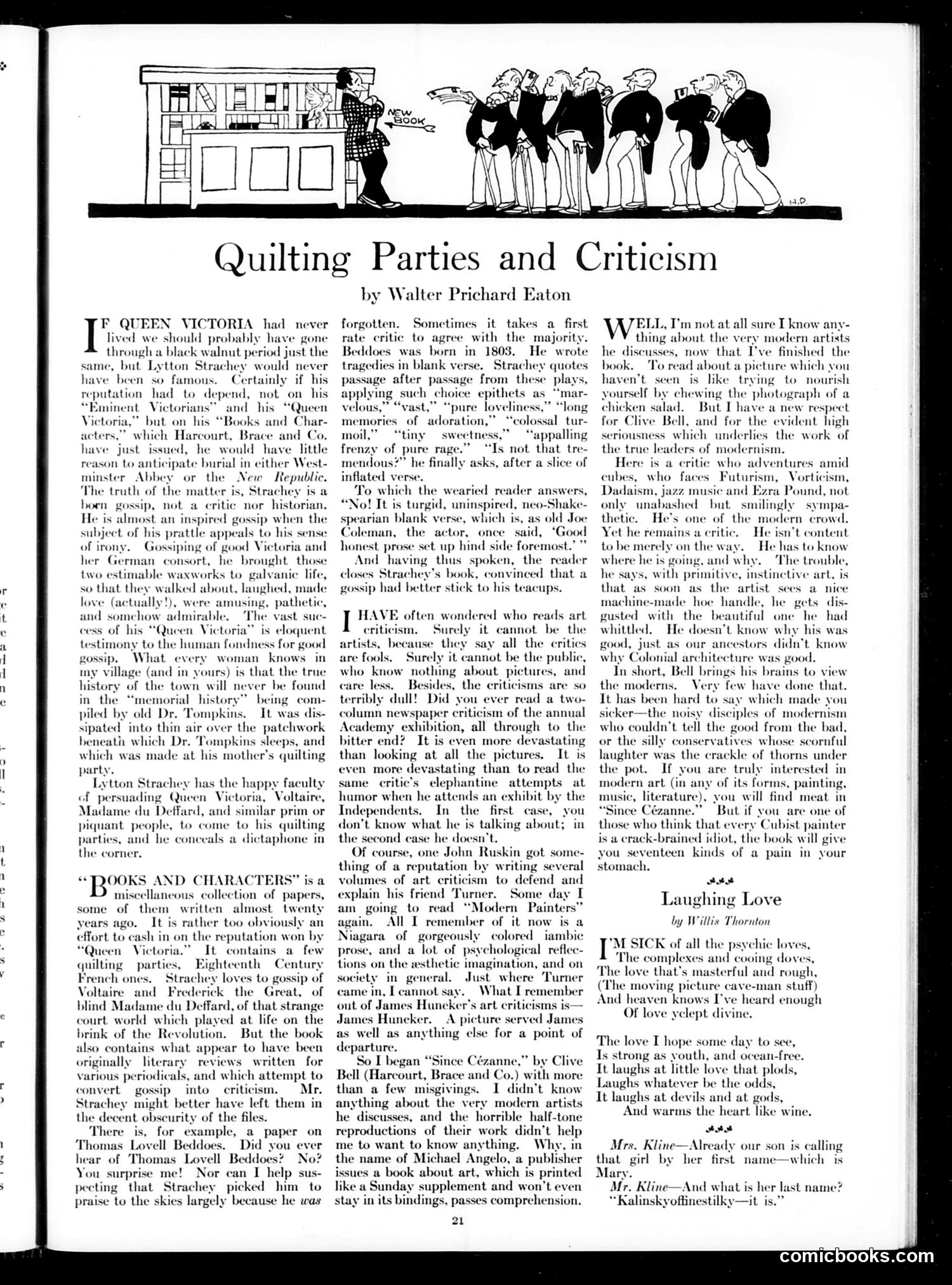
The illustration shows a woman in a checkered dress pointing at a dollhouse-like structure, with six men in formal attire standing to the right—a visual metaphor for Eaton's essay about literary critic Lytton Strachey. Eaton compares Strachey's biographical method to "quilting parties"—informal gatherings where women shared gossip disguised as innocent conversation. The satire suggests Strachey presents himself as a serious historian and critic, but actually traffics in entertaining gossip about famous figures (Queen Victoria, Voltaire, Madame du Deffard). Eaton criticizes Strachey's recent book "Books and Characters" for attempting to disguise gossip as literary criticism. He mocks Strachey's extravagant praise of the obscure poet Thomas Lovell Beddoes, suggesting Strachey champions forgotten figures precisely because they're forgotten—inverting genuine critical judgment. The underlying point: Strachey is a skilled raconteur, not a serious intellectual, and should stick to what he does best rather than pretending to serious literary analysis.
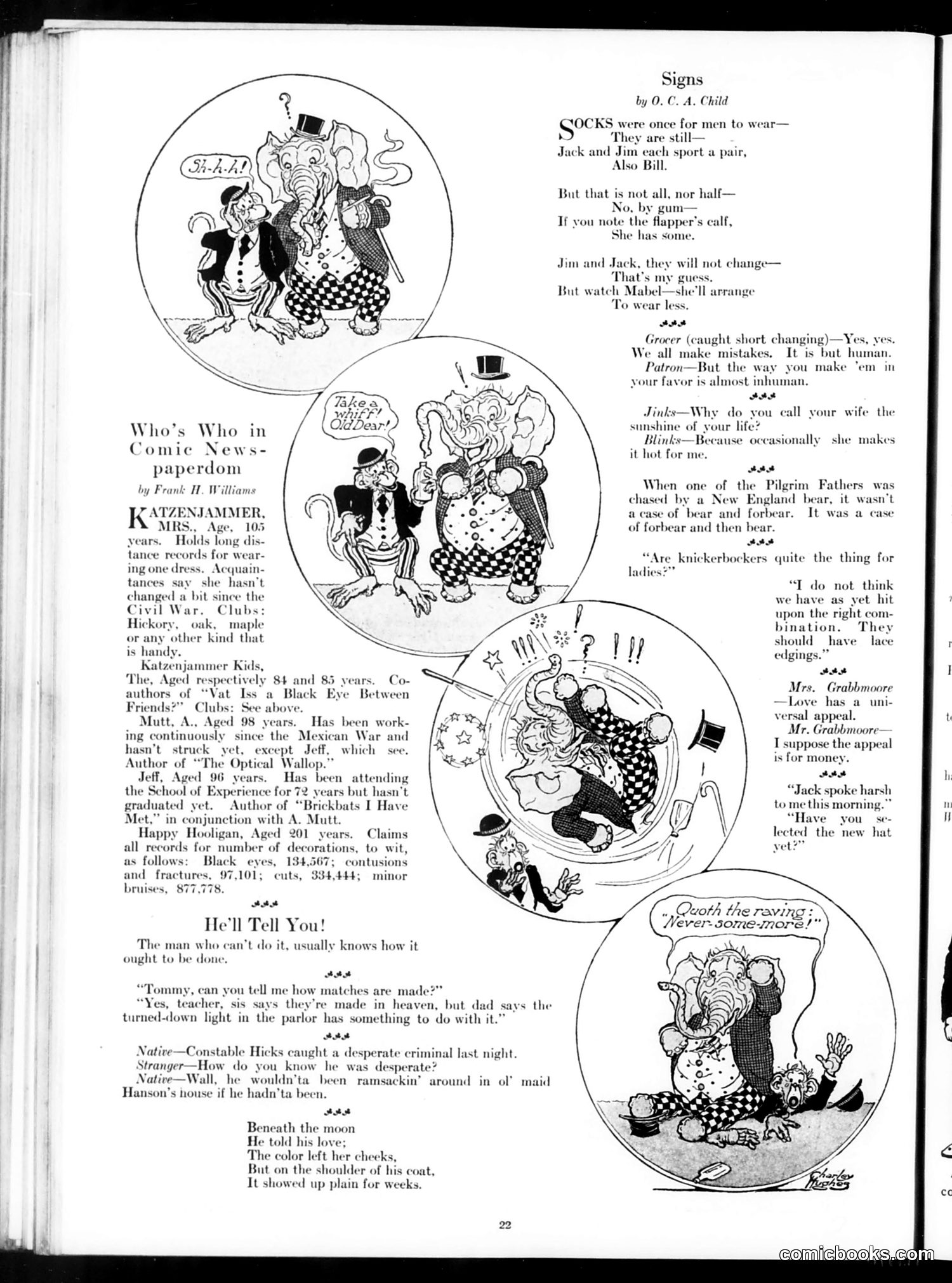
This page from Judge magazine (a major American satirical weekly) contains several distinct humor pieces: **"Who's Who in Comic Newspaperdom"** profiles famous comic strip characters as if they were real people with biographical details. The Katzenjammer Kids are described as 84-85 years old, having worn the same dress since the Civil War—mocking the strip's stagnant, unchanging nature across decades. **"Signs"** by O.C.A. Child satirizes 1920s social changes, particularly women's fashion. It notes women now wear socks (previously men-only), references "flapper's calf" visibility, and jokes about shortened hemlines—reflecting post-WWI anxiety about women's changing roles and increasingly revealing clothing standards that conservative readers found scandalous. **Other jokes** employ common period humor: a child asking how matches are made; wordplay about "desperation"; romantic/marital comedy. The overall tone reflects Judge's middle-class, mildly conservative readership concerned with modern social disruptions while enjoying gentle mockery of contemporary culture.
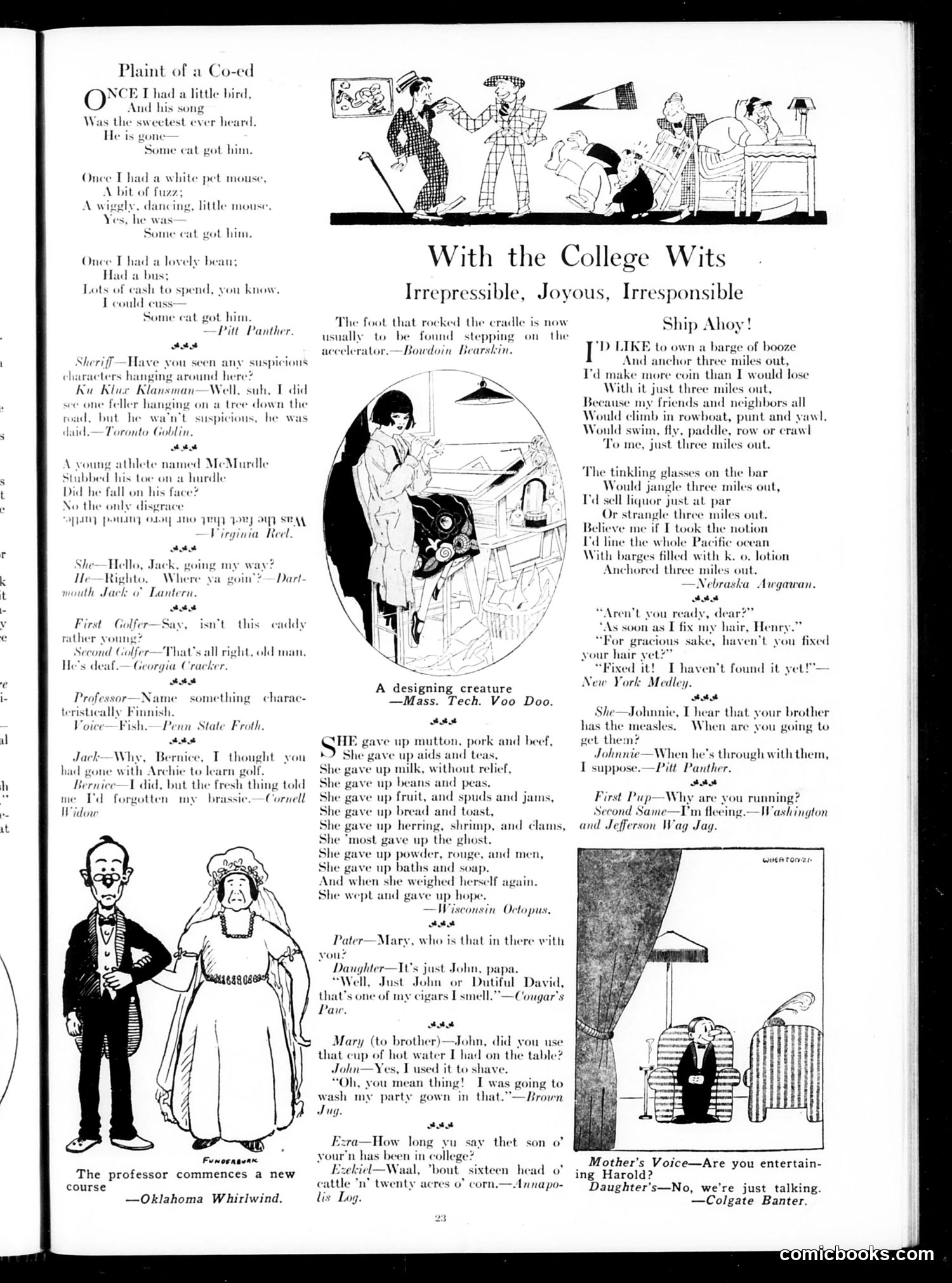
This page collects college humor and social commentary typical of Judge's "College Wits" section. Key content includes: **"Plaint of a Co-ed"**: A poem mocking young women's dating losses—comparing romantic disappointments to pets "got" by cats. The title suggests women's complaints about romantic misfortune. **"Ship Ahoy!"**: Satirizes Prohibition-era speculation about opening illegal offshore bars (beyond the three-mile legal limit). The speaker fantasizes about profiting from Americans' willingness to travel for alcohol—a timely reference given Prohibition began in 1920. **College humor sections**: Brief jokes from campus publications targeting typical college life: golf etiquette, dating, family interactions, and students' financial losses. **Social commentary**: References include a Ku Klux Klan reference and jokes about gender roles (women abandoning "unfeminine" pursuits like golf). Overall, the page reflects 1920s college culture and Prohibition-era anxieties, presenting lighthearted ridicule of contemporary social norms.
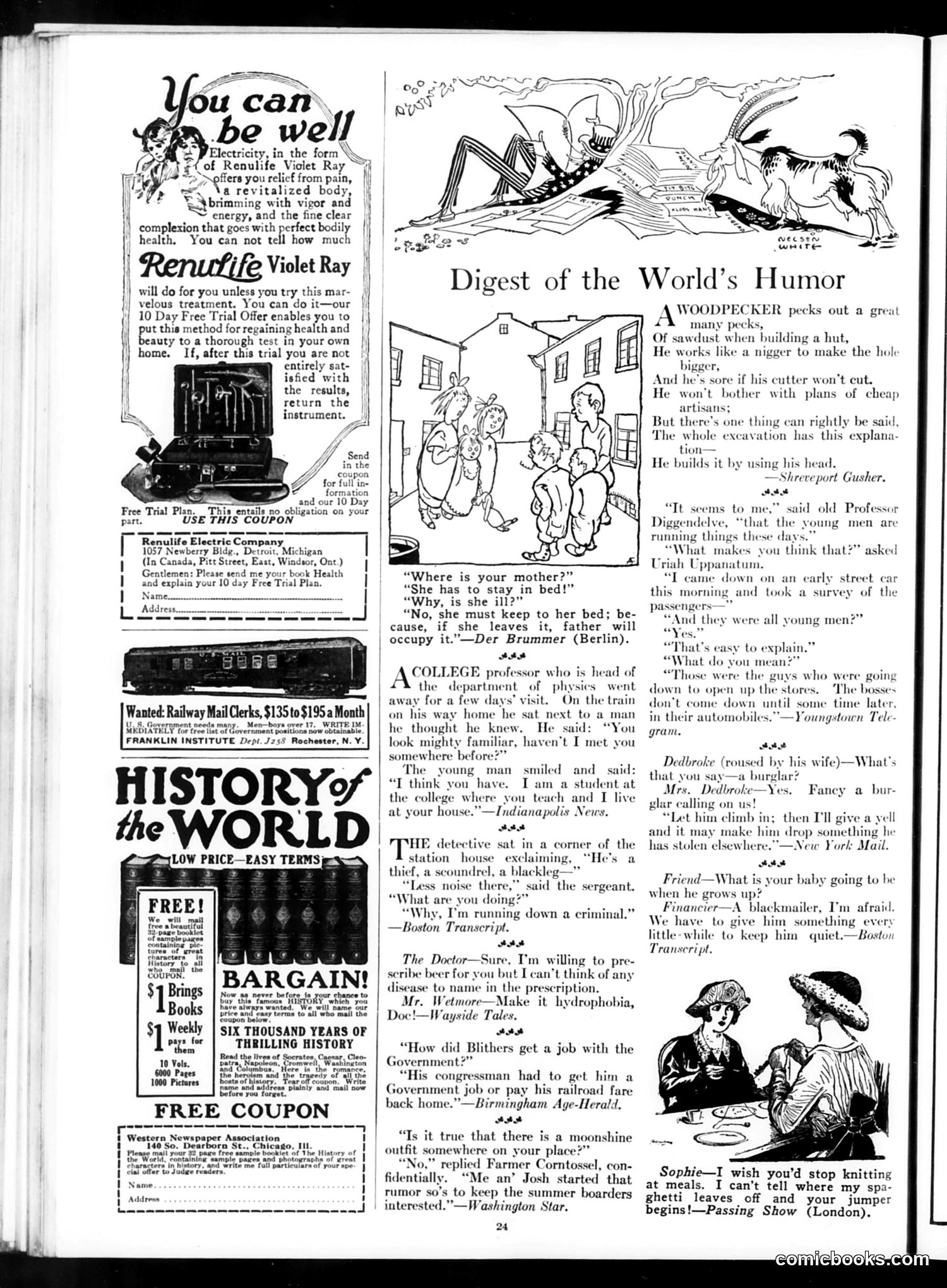
This page is primarily **advertisements and humor columns** with minimal political content. The main cartoon at top depicts a **grasshopper and insects**, accompanying a poem mocking a woodpecker's work habits—pure nature humor with no political message. The "**Digest of the World's Humor**" section collects brief jokes from international sources (Berlin, Indianapolis, Boston). Notable is one joke using a racial slur casually in reference to hard labor—period language reflecting attitudes of that era that would be offensive today. The humor targets familiar subjects: **absent mothers confined to beds** (marital dynamics), **absent-minded professors**, **working-class mobility** (streetcars vs. automobiles), and **rural moonshining** during Prohibition. The bulk of the page consists of advertisements: a "Renulife Violet Ray" electric health device (dubious medical claims), government railroad jobs, and a "History of the World" book offer—typical period marketing without political satire. **No significant political cartoons or commentary appears on this page.**
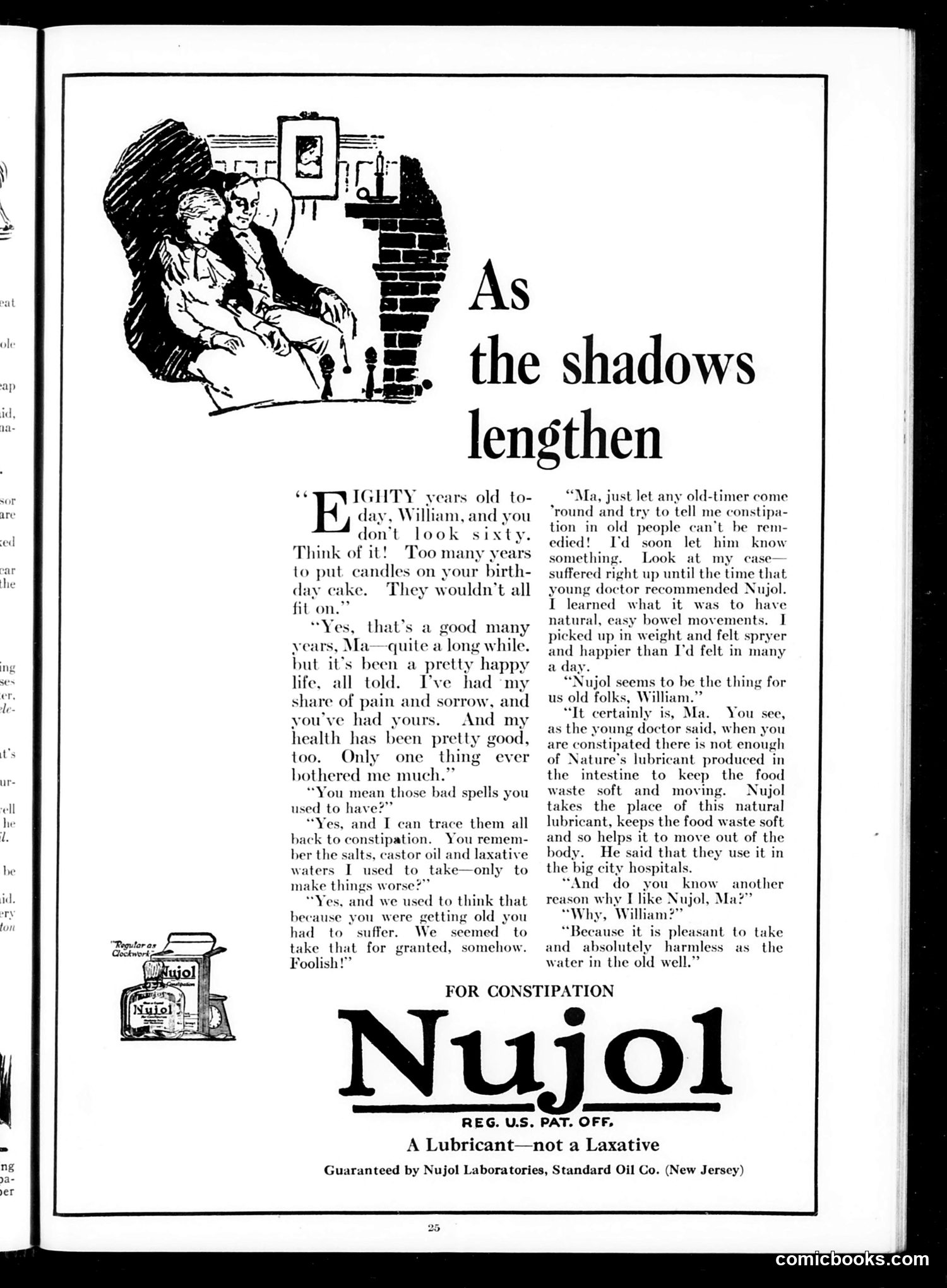
This is primarily a **pharmaceutical advertisement**, not political satire. It features a domestic scene between an elderly couple (William and "Ma") discussing constipation remedies. The "joke" or narrative hook reflects early 20th-century attitudes: constipation was once considered an inevitable burden of aging, treated with harsh laxatives (salts, castor oil) that worsened the problem. The advertisement's selling point is that **Nujol offers a gentler alternative**—a mineral oil "lubricant" rather than a laxative, positioned as natural and harmless. The poetic title "As the Shadows Lengthen" suggests aging's inevitable decline, but the narrative offers redemption through modern medicine: William's discovery of Nujol improved his health, weight, and spirits in old age. This reflects early-to-mid 20th century advertising's frank approach to bodily functions and the era's optimistic faith in commercial solutions to human ailments.
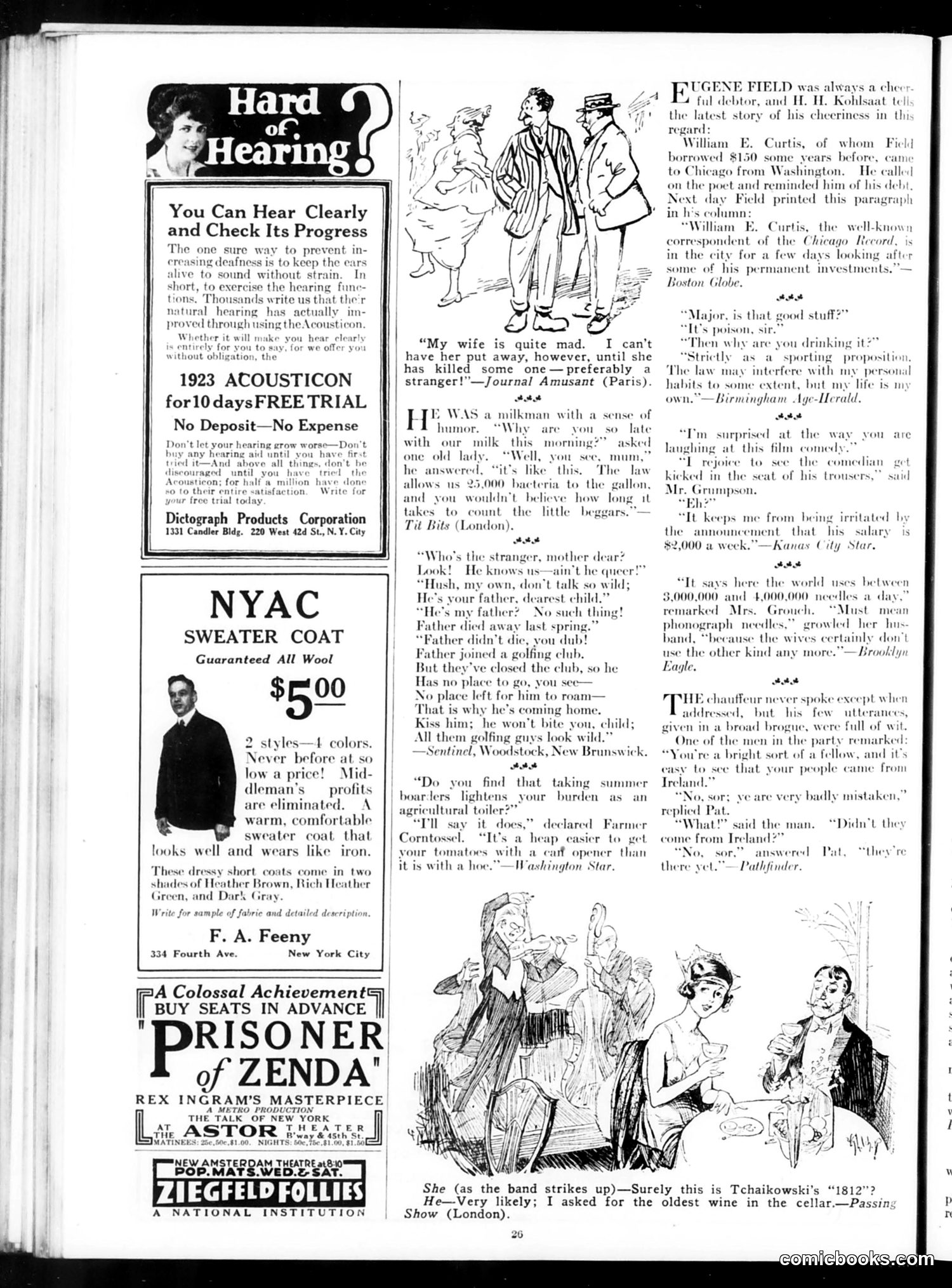
This page is primarily **advertisements and humor filler**, typical of Judge magazine's format. Key elements: **Advertisements**: The Acousticon hearing device (1923), NYAC wool sweater coat ($5), theater promotion for "Prisoner of Zenda," and F.A. Feeny clothing store dominate the layout. **Humor Section** (right column): A collection of short jokes and anecdotes, mostly non-political: - A husband's dark joke about his "mad" wife needing to kill someone before institutionalization - A milkman's excuse about counting bacteria (satirizing absurd delays) - A father absent from family due to golf club membership (gentle family comedy) - A farmer discussing summer boarders - Eugene Field anecdotes about debts and cheerfulness - Various workplace and domestic jokes **The Cartoons**: Sketched illustrations accompany stories about mistaken identity (an Irishman), restaurant/wine humor, and salary complaints—typical early-20th-century social comedy without sharp political bite. The page reflects Judge's mixed editorial strategy: **serious advertising alongside gentle, apolitical domestic humor** aimed at middle-class readers.
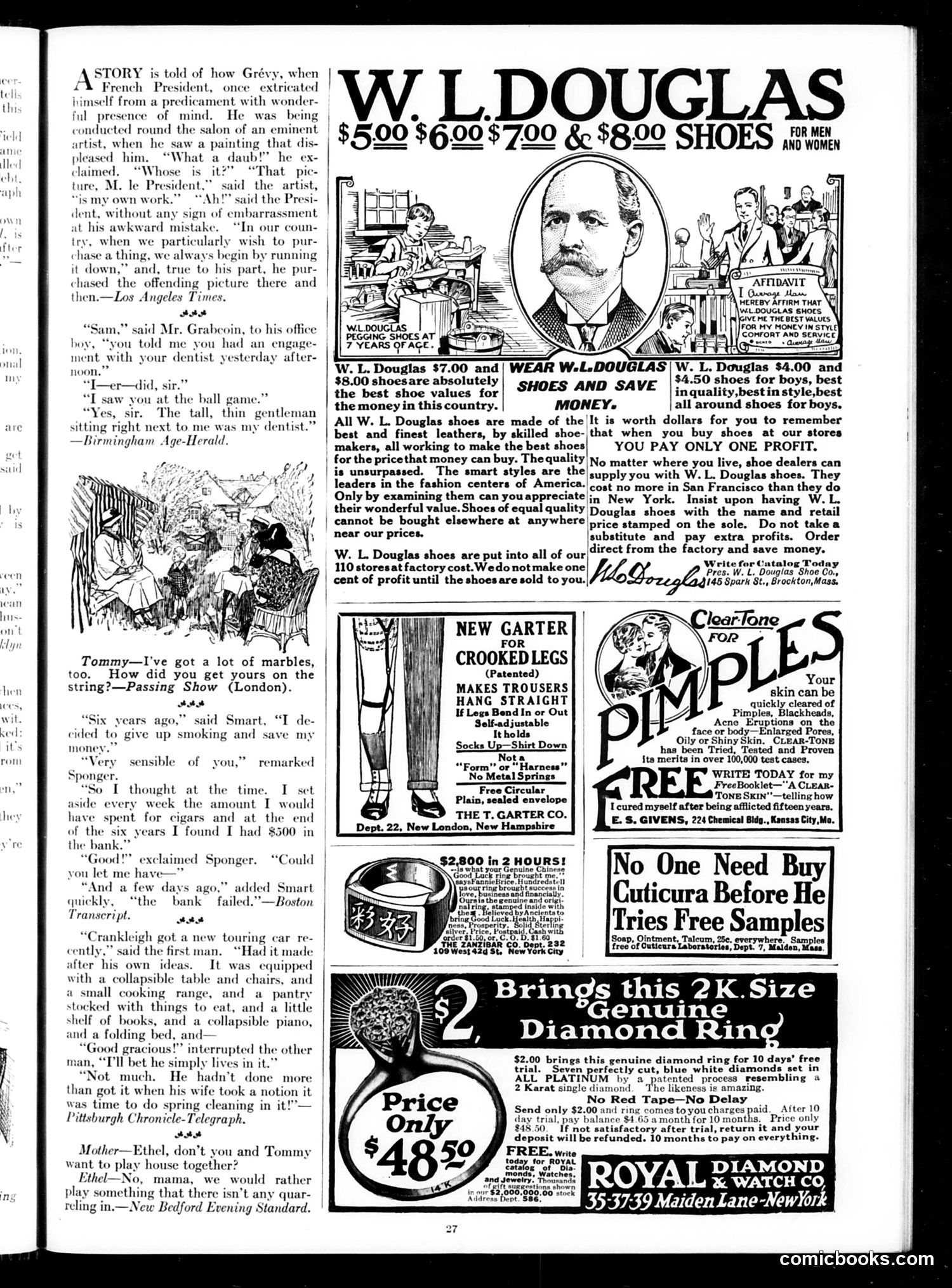
This page is primarily **advertising**, not satirical commentary. The dominant content consists of product advertisements (W.L. Douglas shoes, diamond rings, skin treatments) interspersed with brief humorous anecdotes. The small cartoons and jokes touch on relatable social themes: - A story about **French President Grévy** demonstrates diplomatic tact when caught insulting an artist's work - Office and domestic humor about **lying/excuses** (dentist appointment, smoking savings, touring car chaos) - A child's preference for games with **"no quarreling"** — light commentary on household peace These are gentle, non-partisan humor pieces typical of Judge magazine's general audience appeal. There's **no identifiable political satire or caricature** on this page — just advertisements and filler humor designed to entertain readers while selling products. The page reflects **early 20th-century consumer culture** and the normalization of advertising within editorial content.
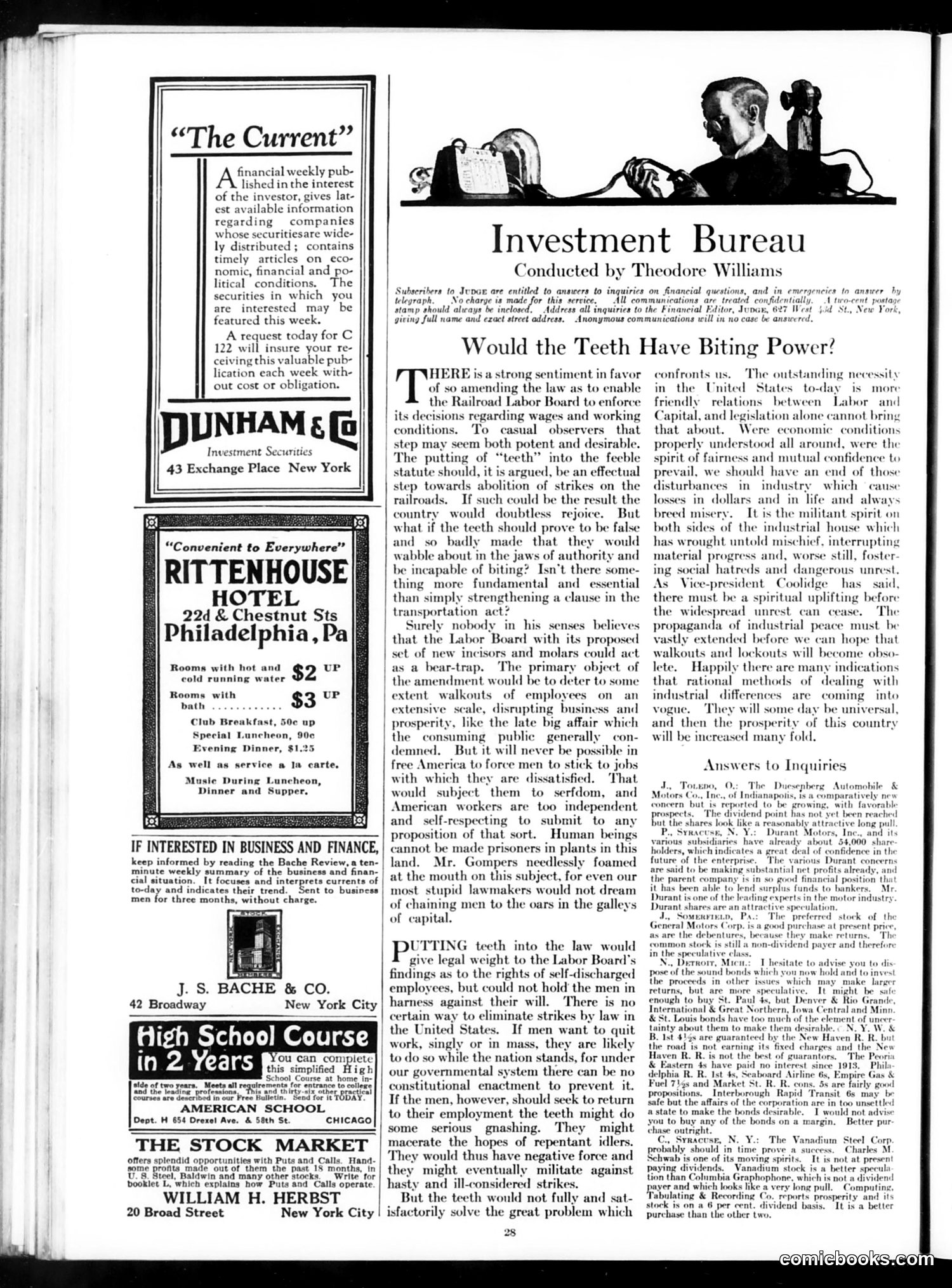
This page features an editorial essay debating whether giving the Railroad Labor Board legal enforcement power ("teeth") would actually prevent labor strikes. The cartoon illustration shows a man at a desk with what appears to be legislative documents. The argument warns against false optimism: while strengthening labor laws sounds appealing, it cannot force American workers to remain in jobs against their will. The essay argues that human beings cannot be made "prisoners in plants" and that independent American workers would never accept such conditions—comparing forced labor to "serfdom" and slavery in galleys. The satire's point: passing tough laws against strikes is futile because you cannot legally compel free people to work. True labor peace requires addressing workers' genuine grievances through fairness and "mutual confidence," not legal coercion. This reflects early 1920s debates over labor rights and railroad industry disputes.
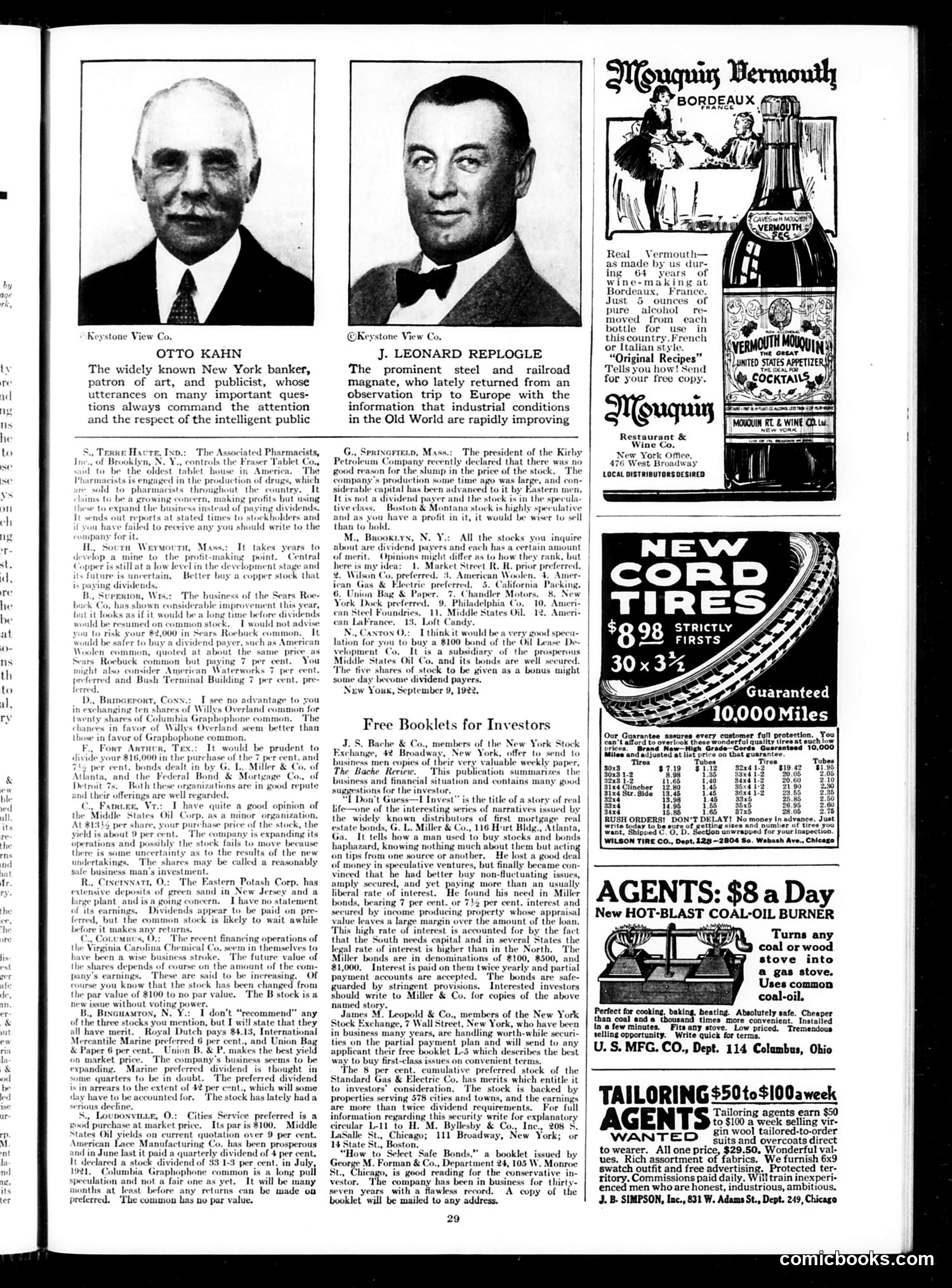
This page is primarily **investment advice**, not political satire. It features two portraits of prominent businessmen—Otto Kahn (New York banker and art patron) and J. Leonard Replogle (steel/railroad magnate)—presented as respected financial authorities. The bulk of the page consists of a **Q&A investment column** addressing readers' stock questions. The advice reflects 1920s financial concerns: dividend yields, copper stocks, and which securities are safe. There's a Mourquin Vermouth advertisement and ads for tires and tailoring services. The only satirical element appears minimal—the magazine presents these wealthy industrialists as trustworthy guides, which itself might be subtle commentary on how the public deferred to elite business judgment during the Roaring Twenties. The page represents Judge's mixed content model: combining celebrity profiles with practical financial guidance for middle-class investors seeking stock tips.
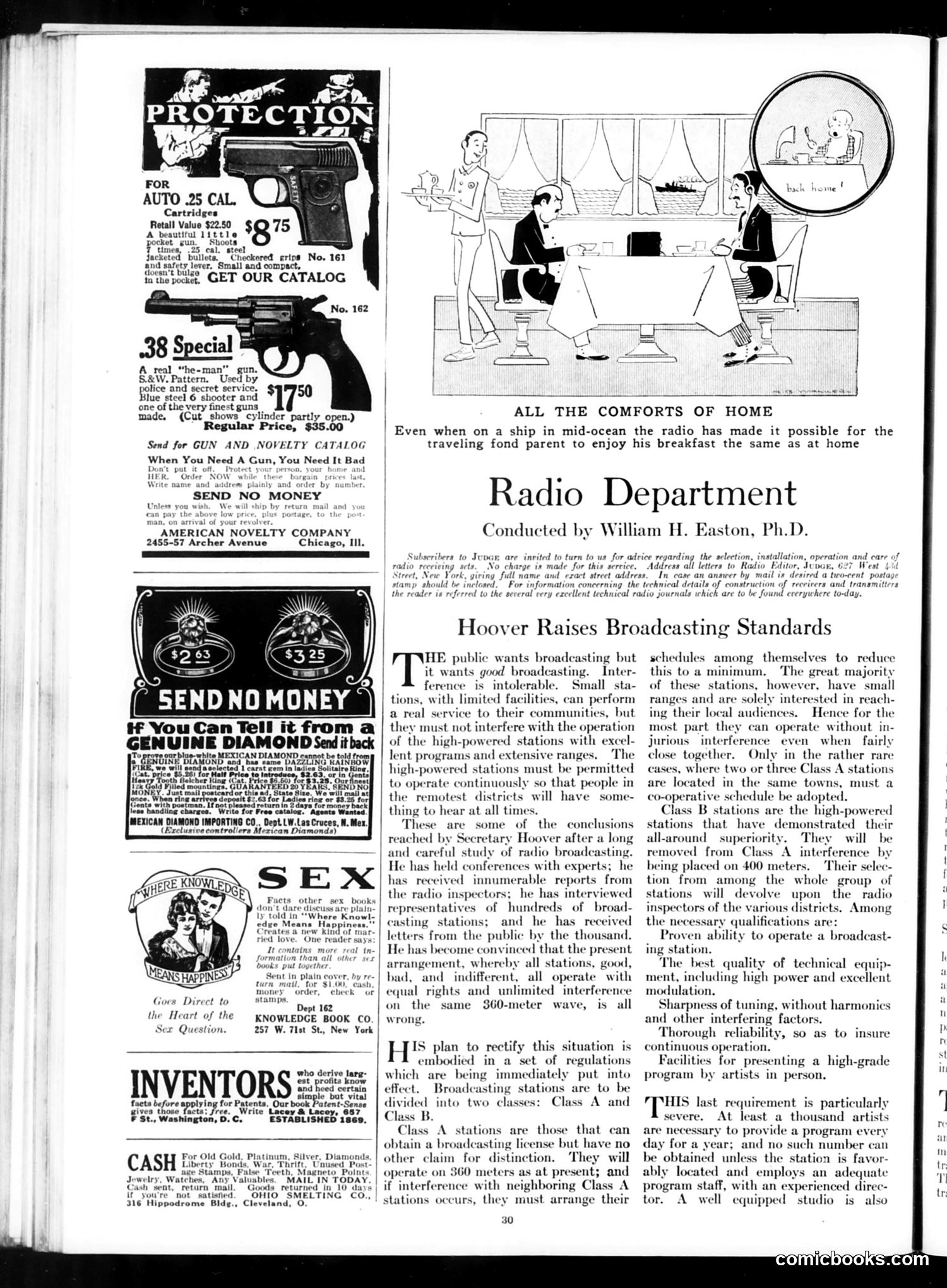
This page is primarily **advertising and editorial content**, not political satire. The main items are: **Advertisements:** Gun and ammunition sales (top left); diamond rings; a "sex question" advice book; and inventor services. **Editorial Content:** The "Radio Department" column discusses Secretary **Herbert Hoover's broadcasting standards initiative**. The accompanying cartoon shows a couple dining on a ship, with an inset showing them listening to radio—illustrating Hoover's vision that radio technology brings "comforts of home" even at sea. **The Context:** In the 1920s, radio broadcasting was chaotic, with stations interfering with each other on crowded frequencies. Hoover (then Commerce Secretary) advocated organizing broadcasting into Class A and Class B stations to reduce interference and improve service quality—a regulatory achievement before the FCC existed. The cartoon is promotional rather than satirical, celebrating technological progress and Hoover's modernizing efforts. There are no caricatures or political attacks visible.
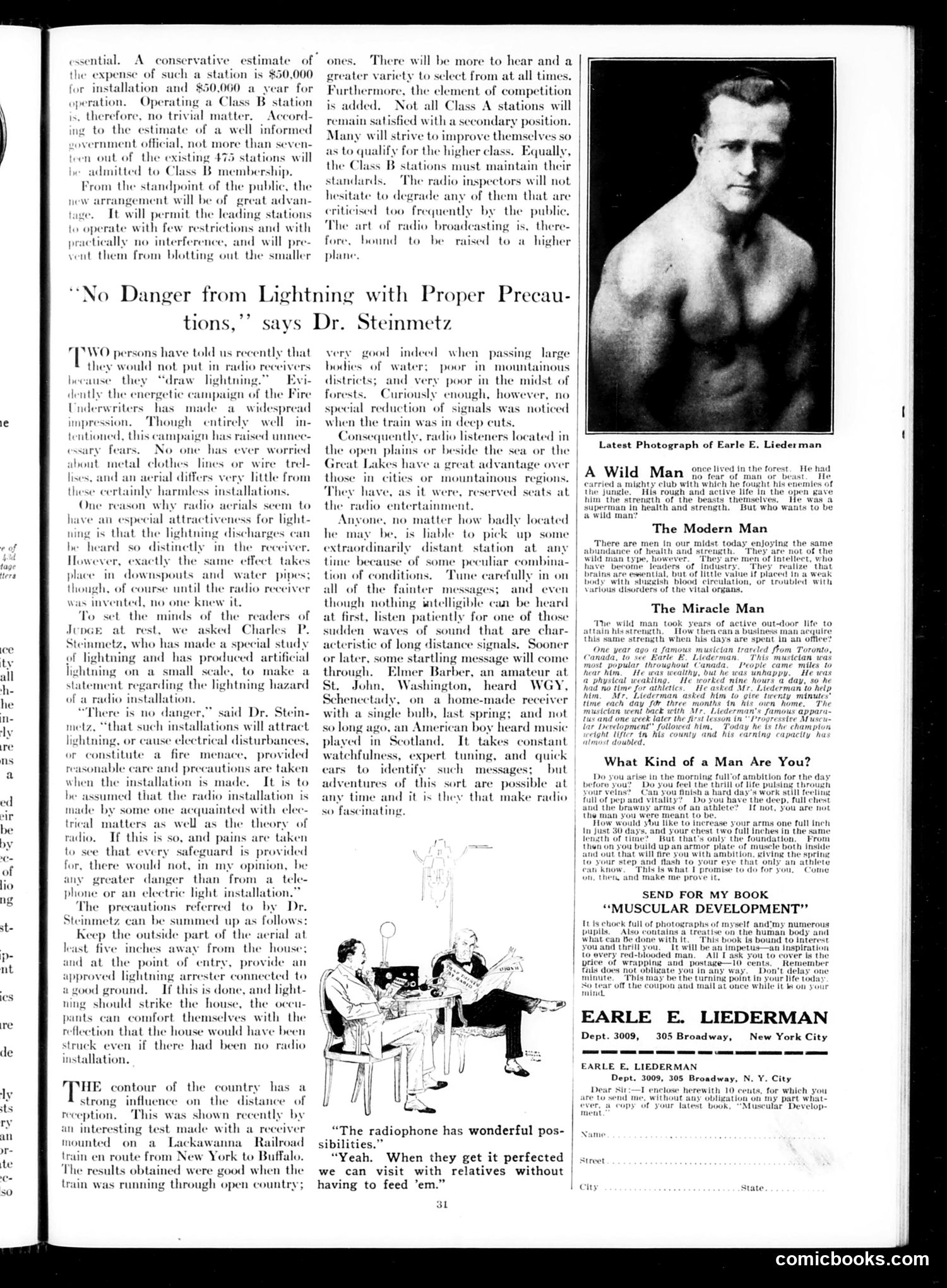
This page discusses early radio broadcasting regulation and lightning safety concerns. The main content features: **The Articles:** 1. **Radio Station Classification** — discussing newly established FCC classes (A and B) for radio stations, their operating costs, and standards 2. **Lightning Safety** — an article quoting Dr. Charles P. Steinmetz (a famous General Electric engineer) addressing public fears that radio aerials attract lightning strikes **The Satire/Context:** The lightning article addresses genuine 1920s anxiety about emerging radio technology. Listeners feared aerials would act as lightning rods. Steinmetz's reassurance emphasizes that proper grounding makes radio installations no more dangerous than telephone or electric lines—a logical argument meant to calm irrational fears about this new technology. **The Sidebar Advertisement:** "Earle E. Liederman's Muscular Development" — a mail-order bodybuilding course, typical of Judge's era advertising. The page reflects 1920s concerns: regulatory frameworks for new radio technology and public resistance to adopting unfamiliar inventions.
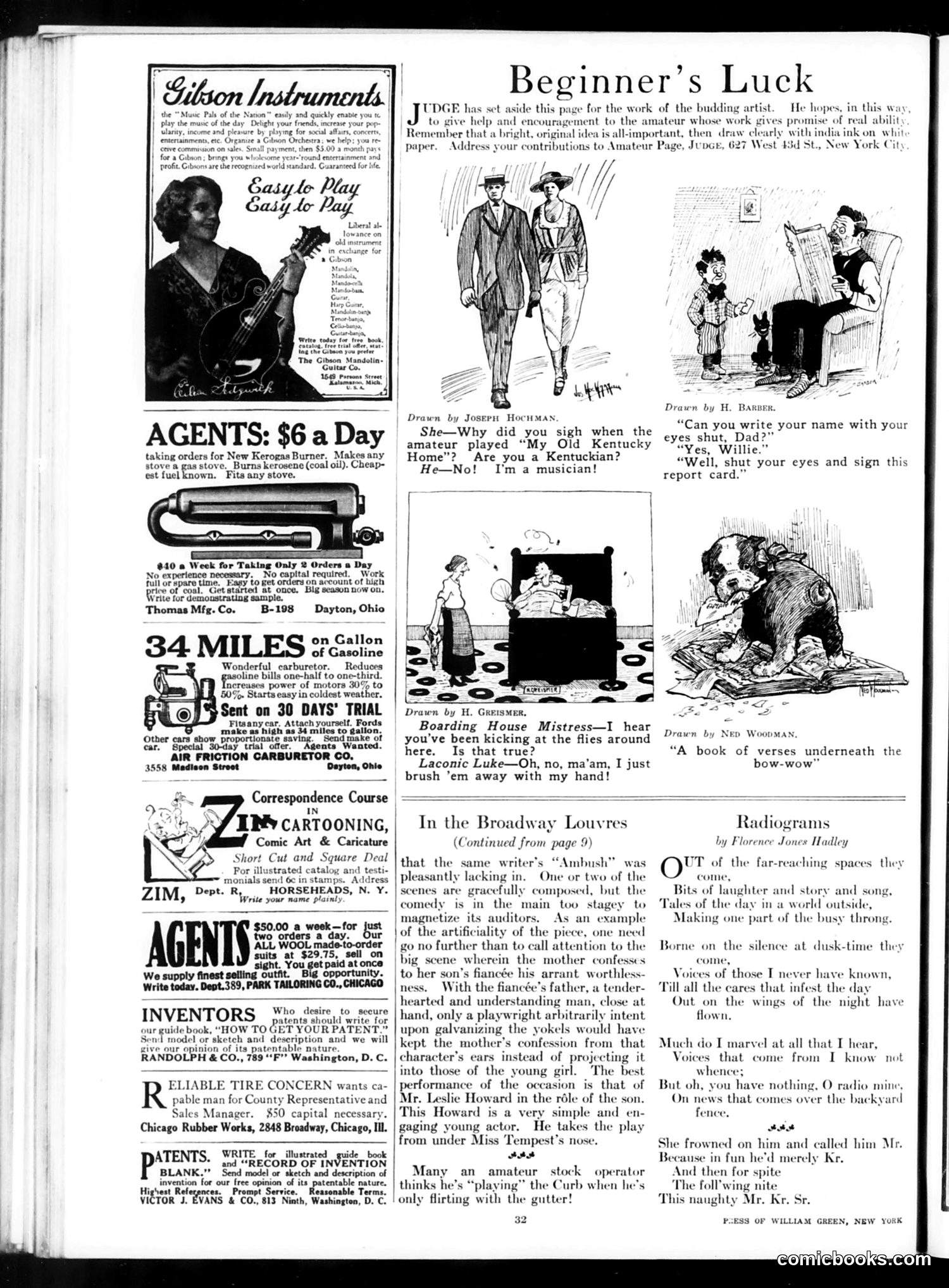
This is Judge's "Beginner's Luck" feature—a dedicated page showcasing amateur cartoonists' work. The page contains several small humorous comic strips and jokes drawn by aspiring artists, each credited to its creator (Barber, Hochman, Greismer, Woodman). The cartoons depict everyday domestic and social situations: a father unable to sign his daughter's report card with eyes closed; a boarding house mistress questioning a lodger about kicking flies; a musician husband sighing during amateur musical performance; a dog-eared book. The humor is gentle, pun-based, and situational rather than political. The editorial note explains Judge's purpose: encouraging amateur artists with promising ideas by publishing their work. The page also includes period advertisements (instruments, correspondence courses, patent services) typical of such magazines. This represents early 20th-century consumer culture mixed with grassroots artistic opportunity.
This is an editorial column celebrating Judge's reader-participation contest (closing August 15th). The editors note the contest has proven several things: **Main points:** - Judge is read globally and thoughtfully by diverse professionals—corporation counsels, congressmen, West Point cadets, bank presidents, newspaper editors, and business owners all submitted entries. - Many female readers participated, requesting "more pictures, more verse, more stories for the kiddies." - Some critical letters arrive anonymously, which the editor finds amusing—critics lack courage to sign their names. **Sidebar note:** Staff artist John Held Jr. traveled west to sketch a rodeo. The editor humorously notes that despite Held's Greenwich Village associations, he's actually a Connecticut farmer with 18 acres who'd prefer hoeing cucumbers to golfing. The piece frames Judge as a "family magazine" where readers become staff correspondents, discussing important social and political issues through humor. No specific political figures or events are referenced—this is primarily a self-congratulatory house column.
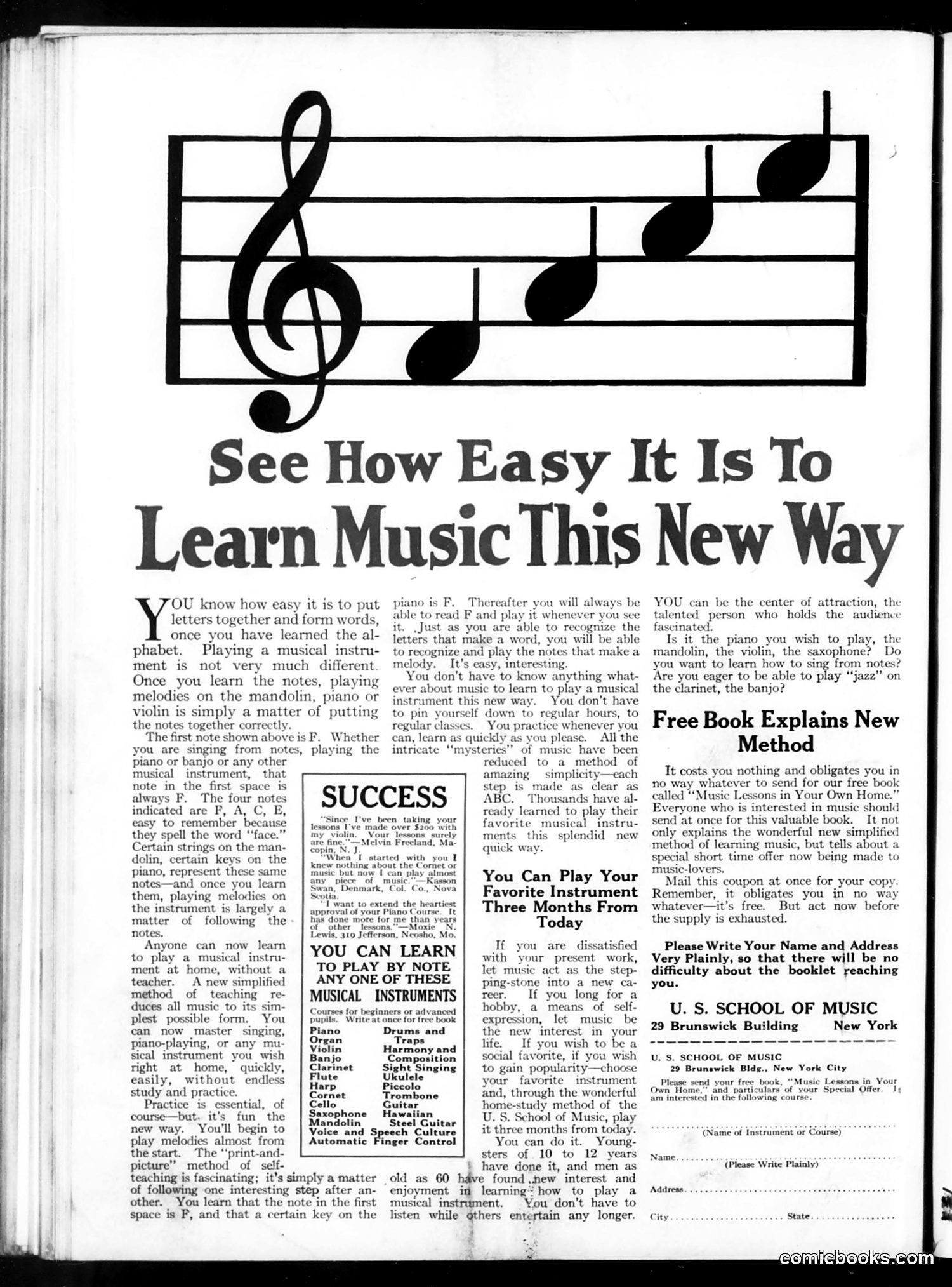
This page is primarily **advertising, not political satire**. It's a promotional piece for the U.S. School of Music's correspondence course in musical instruction. The ad uses a simple musical staff diagram at the top to demonstrate their teaching method: notes are reduced to a basic system (F, A, C, E spelling "FACE") to make learning accessible. The pitch is that *anyone* can learn an instrument at home without formal training or a teacher. The testimonial box labeled "SUCCESS" includes a quote from a student claiming rapid progress on the cornet. The satirical element, if any, is gentle and implicit: the ad gently mocks the *perceived* difficulty of music by suggesting it's as simple as learning the alphabet. For 1920s readers, this would have been genuinely novel—the democratization of music education through mail-order instruction was itself somewhat comic as a concept. This is a straightforward product advertisement with no political references or identifiable caricatures.