
Judge, 1922-09-16 · page 11 of 36
Judge — September 16, 1922 — page 11: what you’re looking at
What you’re looking at
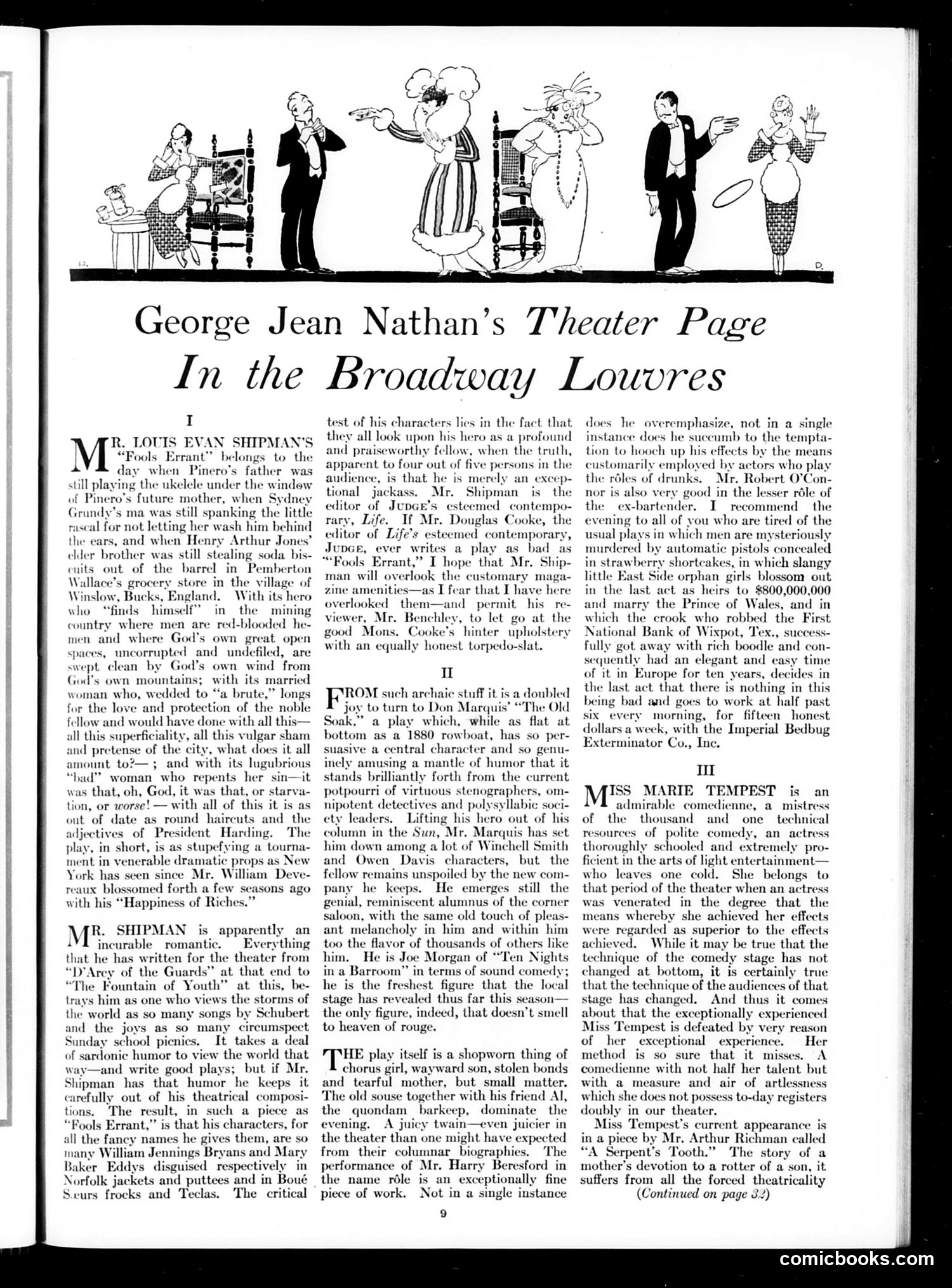
This is a theater criticism column by George Jean Nathan, a prominent drama critic of the 1920s. The header illustration depicts various theatrical characters and scenes in a decorative strip. Nathan reviews two Broadway plays: **"Fools Errant"** by Louis Evan Shipman—Nathan dismisses it as hopelessly outdated, written in the style of Victorian-era playwrights (Pinero, Grundy, Henry Arthur Jones). He mocks its clichéd plot: a noble hero in mining country, an unhappy married woman longing for true love, and a "bad woman" seeking redemption. He sarcastically compares Shipman's characters to William Jennings Bryan and Mary Baker Eddy—apparently suggesting they embody naive, earnest sentimentality rather than authentic human complexity. **"The Old Soak"** by Don Marquis—Nathan praises this play enthusiastically. Though structurally simple, it succeeds through its vivid central character (Joe Morgan) lifted from Marquis's newspaper column, who retains authentic charm despite being placed among conventional theatrical stock characters. The satire critiques both Shipman's romantic sentimentality and theatrical cliché.
📄 Transcribed text from this page (OCR, searchable)
Machine-transcribed from the original scan — historical spelling and the odd misread are preserved.
George Jean Nathan’s Theater Page In the Broadway Louvres I R. LOUIS EVAN SHIPMAN’S “Fools Errant” belongs to the day when Pinero’s father was still playing the ukelele under the window of Pinero’s future mother, when Sydney Grundy’s ma was still spanking the little rascal for not letting her wash him behind the ears, and when Henry Arthur Jones’ elder brother was still stealing soda bis- cuits out of the barrel in| Pemberton Wallace’s grocery store in the village of Winslow, Bucks, England. With its hero who “finds himself in the mining country where men are red-blooded he- men and where God’s own great open spaces, uncorrupted and undefiled, are swept clean by God’s own wind from God's own mountains; with its married woman who, wedded to “a brute,” longs for the love and protection of the noble fellow and would have done with all thi — all this superficiality and pretense of the city, what doc amount to?— 3 and with its lugubrious “bad” woman who repents her sin—it was that, oh, God, it was that, or starva- tion, or worse! — with all of this it is as out of date as round reuts and the adjectives of President Harding. The play, in short, is as stupefying a tourna- ment in venerable dramatic props as New York has seen since Mr. William Deve- reaux blossomed forth a few seasons ago with his “Happiness of Riches.” Vv R. SHIPMAN is apparently LVI incurable romantic. Everything that he has written for the theater from “D'Arcy of the Guards” at that end to outh” at this, be- trays ki as one who views the storms of the world as so many songs by Schubert and the joys as so many circumspect Sunday school F It takes a deal of sardonic humor to view the world that and write good plays; but if Mr. Shipman has that humor he keeps it carefully out of his theatrical compc tions. ‘The result, in such a piece as “Fools Errant,” is that his characters, for all the fancy names he gives them, are so many William Jennings Bryans and Mary Baker Eddys disguised pectively in Norfolk jackets and puttees and in Boué S.eurs frocks and Teclas. The critical “Fools E test of his characters lies in the fact that they all look upon his hero as a profound and praiseworthy fellow, when the truth, apparent to four out of five persons in the audience, is that he is merely an excep- tional jackass. Mr. Shipman is the editor of JupGe’s esteemed contempo- rary, Life. If Mr. Douglas Cooke, the editor of Life’s esteemed contemporary, JupGe, ever writes ay Errant,” I hope tl man will overlook the customary maga- zine amenities—as I fear that I have here tlooked = them—and permit his re- viewer, Mr. Benchley, to let go at the good Mons. Cooke’s hinter upholstery with an equally honest torpedo-slat. II ROM such archaic stuff it is a doubled joy to turn to Don Marquis’ “The Old Soak,” a play which, while as flat at bottom as a 1880 rowboat, has so per- suasive a central character and so genu- inely amusing a mantle of humor that it stands brilliantly forth from the current potpourri of virtuous stenographers, om- nipotent detectives and polysyllabic soci- cty leaders, Lifting his hero out of his column in the Sun, Mr. Marquis has set him down among a lot of Winchell Smith and Owen Davis characters, but the fellow remains unspoiled by the new com- pany he keeps. He emerges still the genial, reminiscent alumnus of the corner saloon, with the same old touch of pleas- ant melancholy in him and within him too the flavor of thousands of others like him, He is Joe Morgan of “Ten Nights in a Barroom” in terms of sound comedy; he is the freshest figure that the local stage has revealed thus far this season— the only figure, indeed, that doesn’t smell to heaven of rouge. HE play itself is a shopworn thing of chorus girl, wayward son, stolen bonds and tearful mother, but small matter. ‘The old souse together with his friend Al, the quondam barkeep, dominate the evening. A juicy twain—even juicier in the theater than one might hav from their columnar_biographic performance of Mr. Harry Bei the name réle is an exceptionally fine piece of work. Not in a single instance 9 does he overemphasize, not in a single instance does he succumb to the tempta- tion to hooch up his effects by the means customarily employed by actors who p the réles of drunks. Mr. Robert O’Con- nor is also very good in the lesser réle of the ex-bartender.. I recommend _ the evening to all of you who are tired of the usual plays in which men are mysteriously murdered by automatic pistols concealed in strawberry shortcakes, in which slangy ast Side orphan girls blossom out ast act as heirs to $800,000,000 ry the Prince of Wales, and in which the crook who robbed the First National Bank of Wixpot, Tes fully got away with rich boodle and con- sequently had an elegant and easy time of it in Europe for ten years, decides in the last act that there is nothing in this being bad and goes to work at half past six every morning, for fifteen honest dollars a week, with the Imperial Bedbug Exterminator Co., Inc, Til MSS MARIE TEMPEST is an admirable comedienne, a mistress success- of the thousand and one techn resources of polite comedy, an actress thoroughly schooled and extremely pro- ficient in the arts of light entertainment— who leaves one cold. She belongs to that period of the theater when an actress was venerated in the degree that the she achieved her effects were regarc s superior to the effects achieved. While it may be true that the technique of the comedy stage has not changed at bottom, it is certainly true that the technique of the audiences of that stage has changed. And thus it comes about that the exceptionally experienced Miss Tempest is defeated by very reason of her tional experien Her method is so sure that it misses. A comedienne with not half her talent but with a measure and air of artlessness which she does not possess to-day registers doubly in our theater. Miss Tempest’s current appearance is in a piece by Mr. Arthur Richman called “A Serpent’s Tooth.” The story of a mother’s devotion to a rotter of a son, it suffers from all the forced theatricality (Continued on page 32) comicbooks.com