
Judge, 1922-09-16 · page 17 of 36
Judge — September 16, 1922 — page 17: what you’re looking at
What you’re looking at
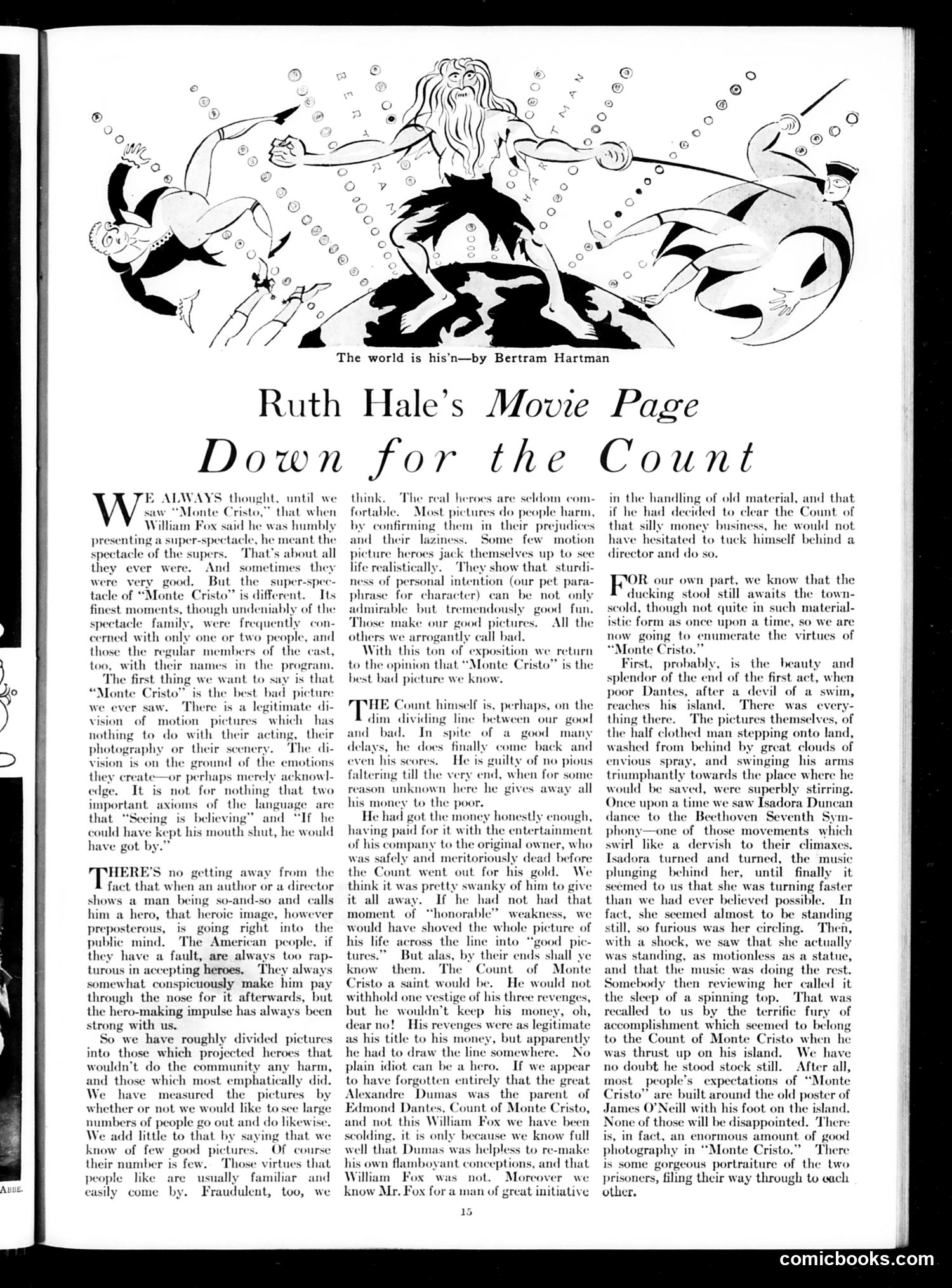
This is a film review by Ruth Hale of William Fox's film adaptation of *The Count of Monte Cristo*. The Bertram Hartman cartoon at top depicts the film's dramatic action—figures in dynamic poses surrounded by bubbles, illustrating the "super-spectacle" nature of the production. Hale's critique distinguishes between "good" and "bad" pictures based on whether they promote harmful behavior in audiences. She classifies *Monte Cristo* as "the best bad picture we know"—technically impressive but morally problematic because it glorifies a hero driven by revenge. The central tension: the Count's vengeful actions are entertaining and dramatically compelling, but Hale worries about the film's influence on viewers. She notes his final charitable act (giving money to the poor) undermines the film's moral coherence—it converts him into a saint, contradicting his ruthless character throughout. The satire critiques Fox's filmmaking as prioritizing spectacle and emotional impact over ethical storytelling, reflecting 1920s anxieties about cinema's power to shape public morality.
📄 Transcribed text from this page (OCR, searchable)
Machine-transcribed from the original scan — historical spelling and the odd misread are preserved.
The world is his’n—by Bertram Hartman Ruth Hale Movie Page Down for the Count ‘ X TE ALWAYS thought, until we saw “Monte Cristo,” that when William Fox said he was humbly . he meant the That's about all sometimes they presenting a super-spec spectacle of the supers. they ever were. And were very good. But the super-spec- tacle of “Monte Cristo” is different. Its finest moments, though undeniably of the spectacle family, were frequently con- cerned with only one or two people, and those the regular members of the too, with their names in the program. he first thing we want to say is that Ionte Cristo” is the best bad picture we ever saw. There is a legitimate di- vision of motion pictures which has nothing to do with their acting, their photography or their scenery. The di- vision is on the ground of the emotions they create—or perhaps merely acknowl- edge. It is not for nothing that two important axioms of the language are that “Seeing is believing” and “If he could have kept his mouth shut, he would have got by HERE'S no getting away from the fact that when an author or a director shows a man being so-and-so and Is him a hero, that heroic image, however preposterous, is going right into the public mind. The American people, if they hav fault, are always too rap- turous in accepting heroes, ‘They al somewhat conspicuously make him pay through the nose for it afterwards, but the here ng impulse has always been strong with us. So we have roughly divided pictures into those which projected heroes that wouldn’t do the community harm, and those which most emphatically did. We have measured the pictures by whether or not we would like to see large numbers of people go out and do likewise. We add little to that by saying that we know of few good pictures. Of course their number is few. Those virtues that like are usually miliar and come by. Fraudulent, too, we cast, people easily think. The real heroes are seldom com- fortable. Most pictures do people harm, by confirming them in their prejudices and their laziness. Some few motion picture heroes jack themselves up to see life realistically. ‘They show that sturdi- ness of personal intention (our pet para- phrase for character) can be not only admirable but tremendously good. fun. Those make our good pictures. All the others we arrogantly call bad. With this ton of exposition we return to the opinion that “Monte Cristo” is the best bad picture we know. HE Count himself is, perhaps, on the dim dividing line between our good and bad. In spite of a good y d » he does finally come back and even his scores. He is guilty of no pious faltering till the very end, when for some reason unknown here he gives away all his money to the poor. He had got the money honestly enough, having paid for it with the entertainment of his company to the original owner, who was safely and meritoriously dead before the Count went out for his gold. We think it was pretty swanky of him to give it all a If he had not had that moment of “honorable” weakness, we would have shoved the whole picture of his life across the line into “good pic- tures.” But alas, by their ends shall ye know them. The Count of Monte Cristo a saint would be. He would not withhold one vestige of his three revenges, but he wouldn't keep his money, oh, dear no! His revenges were as legitimate as his title to his mon y he had to draw the lin plain idiot can be a her to have forgotten entirely that the grea Alexandre Dumas was the parent of Edmond Dantes, Count of Monte Cristo, and not this William Fox we have been it is only because we know full Dumas was helpless to re-make his own flamboyant conceptions, and that William Fox was not. Moreover we know Mr. Fox for a man of great initiative 15 in the handling of old material, and that if he had decided to clear the Count of that silly money business, he would not have hesitated to tuck himself behind a director and do so. OR our own part, we know that the ducking stool still awaits the town- scold, though not quite in such material- istic form as once upon a time, so we are now going to enumerate the virtues of “Monte Cristo.” First, probably, is the beauty and splendor of the end of the first » when poor Dantes, after a devil of a swim, reaches his island. There was_ ever. thing there. The pictures themselves, 0 the half clothed man stepping onto land, washed from behind by great clouds of envious spray, and swinging his arms triumphantly towards the place where he would be saved, were superbly stirring. Once upon a time we saw Isadora Duncan dance to the Beethoven Seventh Sym- phony—one of those movements which swirl like a dervish to their climaxes. Isadora turned and turned, the music plunging behind her, until finally it seemed to us that she was turning faster 1 ever believed possible. In A almost to be standi still, so furious was her circlin; with a shock, we saw that she actually was standing, as motionless as a statue, and that the music was doing the rest. Somebody then reviewing her « i the sleep of a spinning top. T! recalled to us by the terrific fury of accomplishment which seemed to belong to the Count of Monte Cristo when ho was thrust up on his island. We ha no doubt he stood stock still. After all, most people's expectations of “Monte Cristo” are built around the old poster of James O'Neill with his foot on the island. None of those will be disappointed. ‘There is, in fact, an enormous amount of photography in “Monte Cristo.” is some gorgeous portraiture of the two prisoners, filing their way through to each other. comicbooks.com