
Judge, 1922-09-16 · page 21 of 36
Judge — September 16, 1922 — page 21: what you’re looking at
What you’re looking at
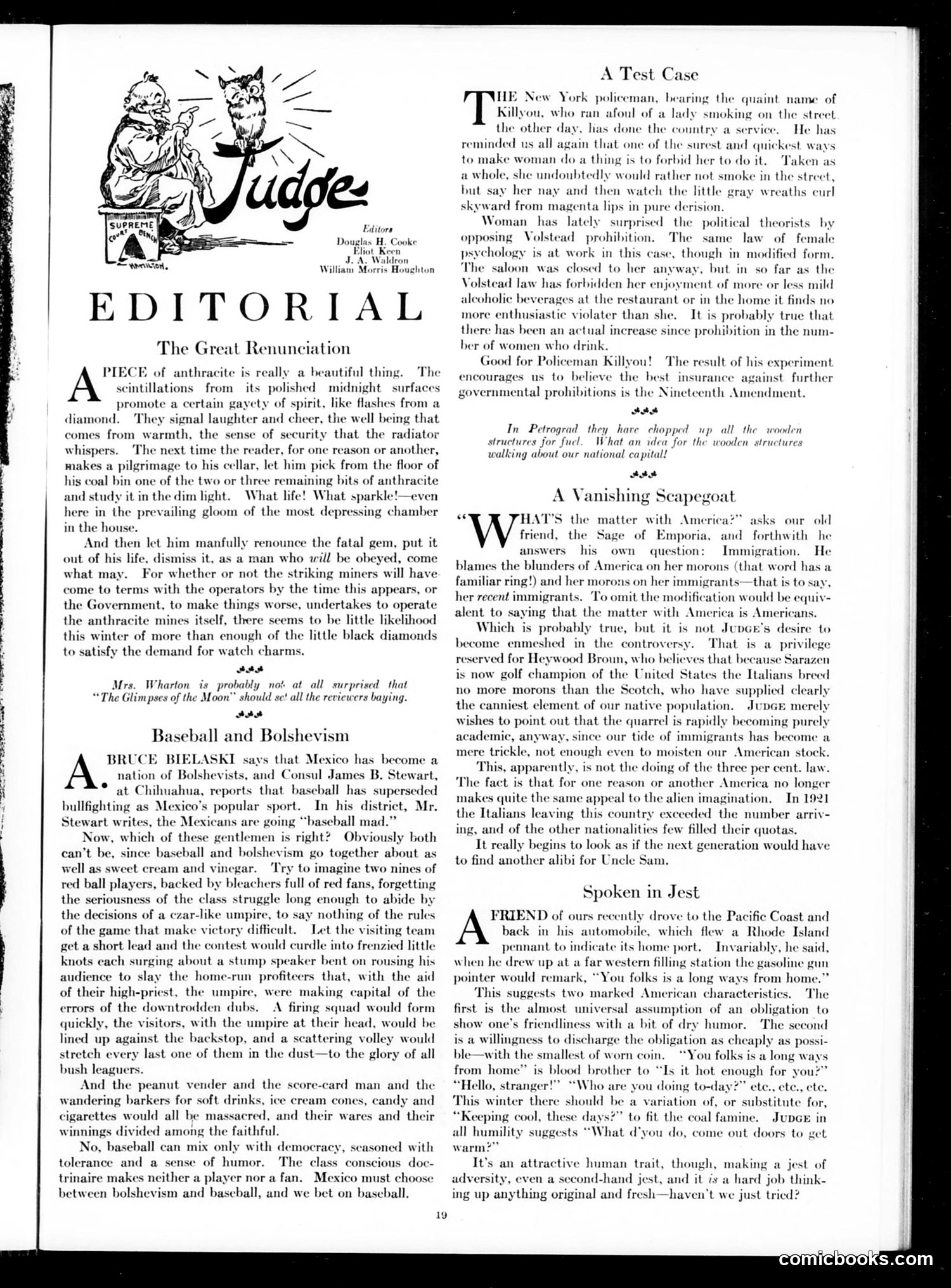
This page contains three editorials satirizing contemporary 1920s American issues: **"The Great Renunciation"** mocks the anthracite coal shortage by urging readers to renounce coal as a noble sacrifice—since there won't be enough anyway due to striking miners and government intervention. **"Baseball and Bolshevism"** argues Mexico cannot simultaneously embrace both baseball and Bolshevism. The satire suggests Bolshevists would abandon baseball's rules and democratic spirit, instead forming firing squads over disputes. The piece sarcastically claims baseball requires democracy and tolerance—qualities incompatible with revolutionary ideology. **"A Test Case"** describes a policeman named "Killyou" arresting a woman smoking on a New York street. The editorial sardonically notes that prohibiting women from smoking will inevitably make them smoke more—a jab at female psychology and, by extension, Prohibition itself (recently enacted in 1920). The satire questions whether legal prohibition actually works. The cartoon header shows a judge figure, reinforcing the magazine's satirical tone on legal/social matters.
📄 Transcribed text from this page (OCR, searchable)
Machine-transcribed from the original scan — historical spelling and the odd misread are preserved.
ples Douglas H, Cooke Eliot Keen William EDITORIAL The Great Renunciation PIECE of anthracite is really a beautiful thing. ‘The A scintillations from its polished midnight surfaces promote a certain gayety of spirit, like flashes from a diamond. ‘They signal laughter and cheer, the well being that comes from warmth, the sense of security that the radiator whispers. ‘The next time the reader, for one reason or another, makes a pilgrimage to his cellar, let him pick from the floor of his coal bin one of the two or three remaining bits of anthracite and study it in the dim light. What life! What sparkle!—even here in the prevailing gloom of the most depressing chamber in the house. And then let him manfully renounce the fatal gem, put it out of his life, dismiss it, as a man who will be obeyed, come what may. For whether or not the striking miners will have come to terms with the operators by the time this appears, the Government, to make things worse, undertakes to operate the anthracite mines itself, there seems to be little likelihood this winter of more than enough of the little black diamonds to satisfy the demand for watch charms. tat Mrs. Wharton is probably not at all surprised that “The Glimpses of the Moon” should se! all the reviewers baying. tae Baseball and Bolshevism BRUCE BIELASKI says that Mexico has become a A nation of Bolshevists, and Consul James B. Stewart, * at Chihuahua, reports that baseball has superseded bullfighting as Mexico’s popular sport. In his district, Mr. Stewart writes, the Mexic: going “baseball mad.” Now, which of these gentlemen is right? Obviously both can’t be, since baseball and bolshevism go together about a well as sweet cream and vinegar. ‘Try to imagine two nines of red ball players, backed by bleachers full of red fans, forgetting the seriousness of the class struggle long enough to abide by the decisions of a czar-like umpire, to say nothing of the rules of the game that make victory difficult. Let the visiting team get a short lead and the contest would curdle into frenzied little knots each surging about a stump speaker bent on rousing his audience to slay the home-run profiteers that, with the aid of their high-priest, the umpire, were making capital of the errors of the downtrodden dubs. A firing squad would form quickly, the visitors, with the umpire at their head, would be lined up against the backstop, and a scattering volley would stretch every last one of them in the dust—to the glory of all bush leaguers. And the peanut vender and the score-card man and the wandering barkers for soft drinks, ice cream cones, candy and rettes would all be massacred, and their wares and their divided among the faithful. No, baseball can mix only with democ tolerance and a sense of humor. The trinaire makes neither a player nor a fan. between bolshevism and baseball, and we bet on baseball. or ns d seasoned with Ass conscious doc- Mexico must choose A Test Case HE New York policeman, bearing the quaint: name of Killyou, who ran afoul of a lady smoking on the street the other day, has done the country a service. He has reminded us all in that one of the surest and quickest: ways to make woman do a thing is to forbid her to do it. Taken as a whole, she undoubtedly would rather not smoke in the street, but say her nay and then wateh the little gray wreaths curl skyward from magenta lips in pure derision. Woman lately opposing has surprised the political theorists by The law of female psychology is at work in this case, though in modified form. The saloon was closed to her anyway, but in so far as the Volste: Volstead prohibition. same 1 law has forbidden her enjoyment of more or less mild ic beverages at the restaurant or in the home it finds no It is probably true that there has been an actual increase since prohibition in the num- violater than she. ber of women who drink. Good for Policeman Killyou! encourages us to believe the best insurance governmental prohibitions is the Nineteenth Amendment. tot The result of his experiment further gainst In Petrograd they hare chopped up all the wooden structures for fucl. What an idea for the wooden structures walking about our national capital! ae A Vanishing Scapegoat $§ HAT’S the matter with America?” asks our old friend, the Sage of Emporia, and forthwith he his own Immigration. He blames the blunders of America on her morons (that word has a familiar ring!) and her morons on her immigrants—that is to say her recent immigrants. To omit the modification would be equiv- alent to saying that the matter with America is Americans. Which is probably true, but it is not Jupce’s desire to become enmeshed in the controversy. That is a privilege sserved for Heywood Broun, who believes that t answers question: is now golf champion of the United States the Italians br no more morons than the Scotch, who have supplied cl the canniest clement of our native population. arly JupGe merely wishes to point out that the quarrel is rapidly becoming purely academic, anyway, since our tide of immigrants has become a mere trickle, not enough even to moisten our American stock. This, apparently, is not the doing of the three per cent. law. The fact is that for one reason or another America no longer makes quite the same appeal to the alien imagination. In 1921 the Italians leaving this country exceeded the number arriv- ing, and of the other nationalities few filled their quotas. It really begins to look as if the next generation would have to find another alibi for Uncle Sam. Spoken in Jest A FRIEND of ours recently drove to the Pacific Coast and back in his automobile, which flew a Rhode Island pennant to indicate its home port. Invariably, he said, when he drew up at a far western filling station the gasoline gun pointer would remark, “You folks is a long ys from home.” This suggests two marked American characteristics. The first is the almost assumption of an obligation to show one’s friendliness with a bit of dry humor. The second universa is a willingness to discharge the obligation as cheaply ble—with the smallest of worn coin. “You folks is a long ways is blood brother to “Is it hot enough for you?” S possi- from home a “Who are you doing to-da This winter there should be a variation of, or substitute for, “Keeping cool, these days?” to fit the coal famine. Jun i all humility suggests “What d'you do, come out doors to get warm?” It’s an attractive human trait, though, making a jest of adversit and it ts a hard job think- ing up anything original and fresh—haven’t we just tried? + even a second-hand jest, icbooks.com