
Judge, 1922-09-16 · page 8 of 36
Judge — September 16, 1922 — page 8: what you’re looking at
What you’re looking at
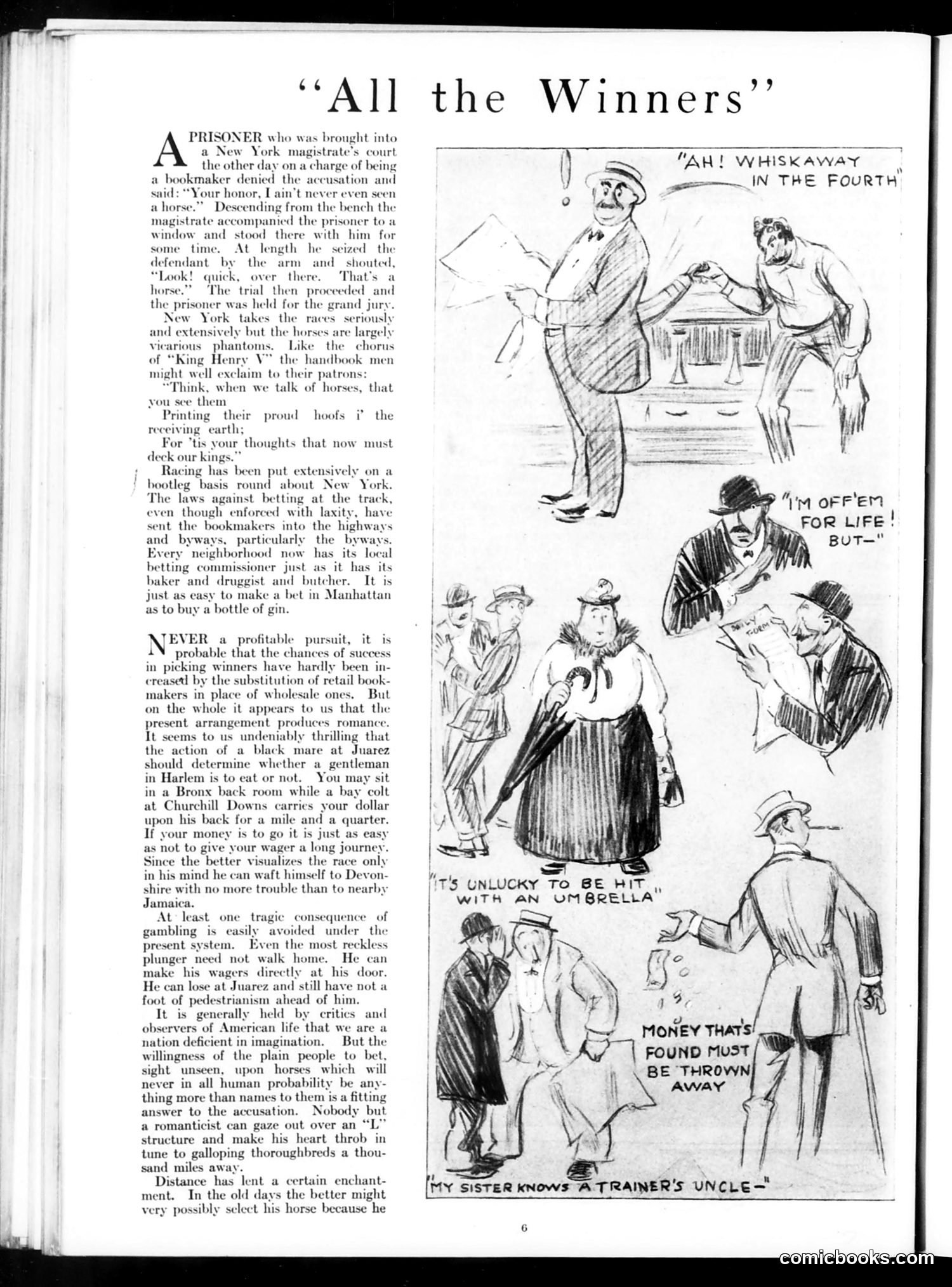
This page satirizes New York's widespread illegal horse-race gambling in the Prohibition era. The text describes how betting laws, though "enforced with laxity," drove bookmakers underground into neighborhood "bootleg" operations—paralleling illegal gin sales. The cartoons mock the absurd logic of amateur bettors. They depict working-class men in a Bronx back room making bets on distant races at Juarez or Churchill Downs based on hearsay: "My sister knows a trainer's uncle," "I'm off'em for life but—," "It's unlucky to be hit with an umbrella," and "Money that's found must be thrown away." The satirist argues this "produces romance"—bettors visualize races only mentally, wagering sight-unseen on horses they'll never see, demonstrating American imagination rather than recklessness. The piece treats underground gambling with bemused tolerance, presenting it as an inevitable consequence of Prohibition-style enforcement.
📄 Transcribed text from this page (OCR, searchable)
Machine-transcribed from the original scan — historical spelling and the odd misread are preserved.
; A. PRISONER who was brought into the other day on'a charge of being a bookmaker denied the accusation and said: “Your honor, [ ain't never even seen ahorse.”” Descending from the bench the magistrate accompanied the prisoner to a window and stood there with him for some time. At length he seized the defendant’ by the arm and shouted, “Look! quick, over there. That's a horse.” The trial then proceeded and the prisoner was held for the grand jury. New York takes the races seriously and extensively but the he are largely vicarious phantoms. I the chorus of “King Henry V" the handbook men might well exclaim to their patrons: hink, when we talk of horses, that you see them Printing their proud hoofs i’ the receiving earth; For ‘tis your thoughts that now must deck our kings.” Racing has been put extensively on a bootleg t round about New) York. The laws ainst betting a the tra even though enforced with sent the bookmakers into the highways and byways, particularly the byways. Every neighborhood now has its local betting commissioner just as it has its baker and druggist and butcher. It is just as easy to make a bet in Manhattan as to buy a bottle of gin. TEVER a profitable pursuit, it is AN probable that the chances of success in picking winners have hardly been in- creased by the substitution of retail book- makers in place of wholesale ones. But on the whole it appears to us that the present arrangement produces romance. It seems to us undeniably thrilling that the action of a black mare at Juarez should determine whether a_ gentleman in Harlem is to eat or not. Youn in a Bronx back room while a ba) at Churchill Downs carries your dollar upon his back for a mile and a quarter. If your money is to go it is just as easy as not to give your wager a long journey. Since the better visualizes the race only in his mind he can waft himself to Devon- shire with no more trouble than to nearby Jamaica. At least one tragic consequence of gambling is easily avoided under the present system. Even the most reckless plunger need not walk home. He can make his wagers directly at his door. He can lose at Juarez and still have not a foot of pedestrianism ahead of him. It is generally held by critics and observers of American life that we are a nation deficient in imagination. But the willingness of the plain people to bet, sight unseen, upon horses which will never in all human probability be any- thing more than names to them is a fitting answer to the accusation. Nobody but a romanticist can gaze out over an “L” structure and make his heart throb in tune to galloping thoroughbreds a thou- sand miles away. Distance has lent a certain enchant- ment. In the old days the better might very possibly select his horse because he ue | | | | t ‘All the Winners’’ t's UNLUCKY To BE HIT A Wire AN UMBRELLA a FOUND MUST E THROWN ed r B x i} Ny AWAY ke Se ee - MY SISTER KNOWS A TRAINER'S UNCLE— TAN! WHISKAWAY = ——_IN THE FOURTH’ “'™ oFF'EM For LiFe! BuT—"