
Judge, 1922-09-16 · page 7 of 36
Judge — September 16, 1922 — page 7: what you’re looking at
What you’re looking at
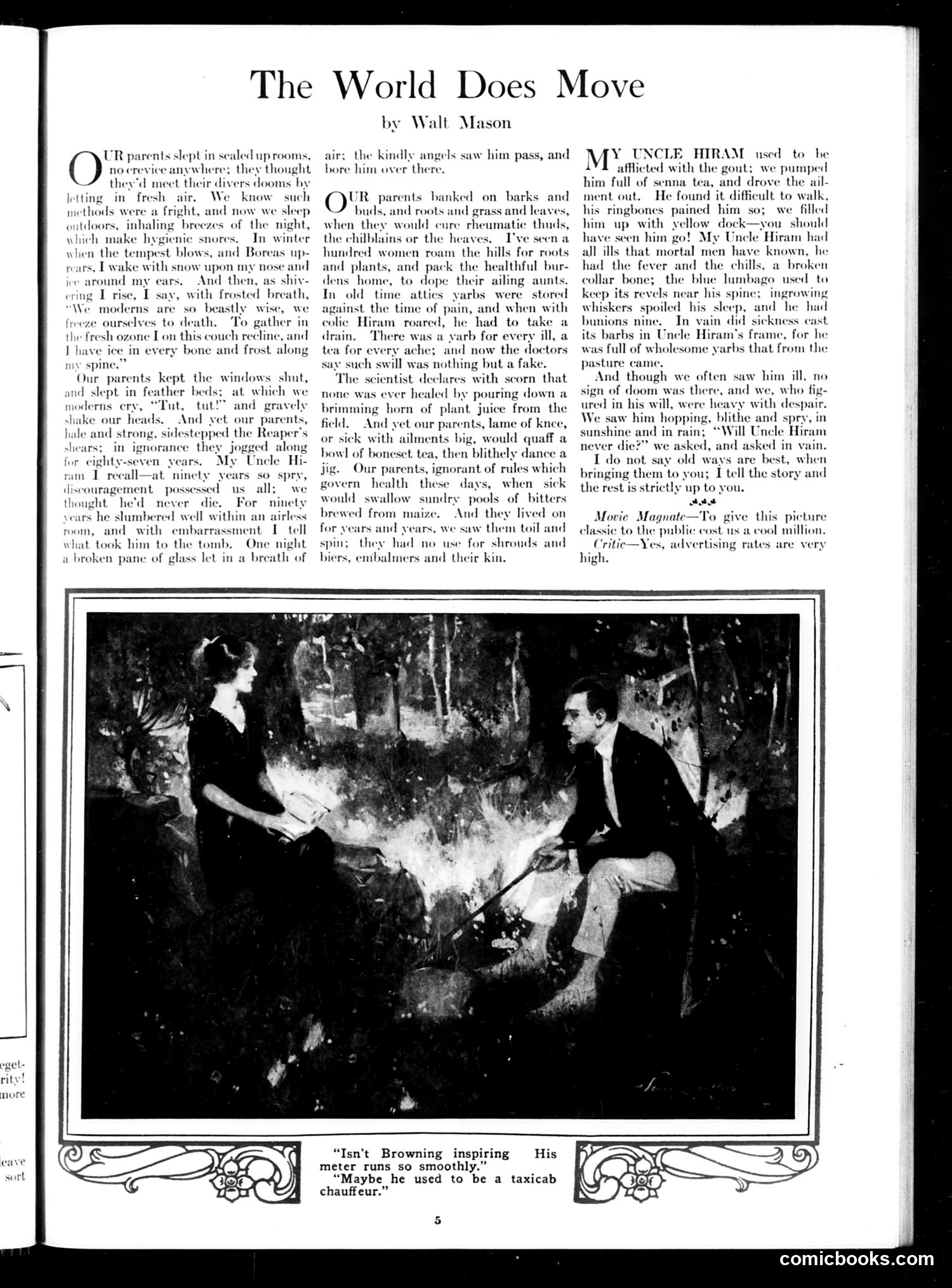
This is Walt Mason's humorous essay-poem contrasting modern and old-fashioned approaches to health and living. The satire mocks contemporary fads while paradoxically showing they're no better than outdated remedies. **The joke:** Mason's parents sealed their rooms against fresh air (thought dangerous), yet lived long; moderns sleep outdoors in freezing conditions, thinking it healthier. His Uncle Hiram, dosed with herbal remedies ("yarbs") and folk treatments despite numerous ailments, lived to 90 in vigorous health. The implication: both approaches work equally well—suggesting modern health obsessions are as baseless as old superstitions. **The bottom image** shows a dialogue between a "Movie Magnate" and "Critic" debating a film's artistic merit—a typical Judge advertisement satire, implying inflated production costs and advertising rates determine critical praise, not actual quality. The overall message reflects early-20th-century skepticism toward medicalization and consumerism masquerading as progress.
📄 Transcribed text from this page (OCR, searchable)
Machine-transcribed from the original scan — historical spelling and the odd misread are preserved.
\ — pgel- rit more The UR parents slept in sealed up rooms, no crevice anywhere; they thought they'd meet their divers dooms by Jetting in fresh air. We know such methods were a fright, and now we sleep outdoors, inhaling breezes of the night, which make hygienic snores. In winter when the tempest blows, and Boreas up- rears, I wake with snow upon my nose and «around my ears, And then, as shiv- ering I rise, I say, with frosted breath, “We moderns are so beastly wise, we eze ourselves to death. To gather in the fresh ozone I on this couch recline, and LT have ice in every bone and frost along my spin Our parents ind slept in fed moderns ery, shake our he: and strong. kept the windows shut, ther beds; at which we Tut, tut!” and gravely And yet our parents, stepped the Reaper's cars: in ignorance they jogged along 1r eighty-seven years. My Uncle Hi- ram I ll—at ninety years so. spry, discouragement possessed us. all; we thought he'd) never die. For ninety years he slumbered well within an airless room, and with embarrassment I tell what took him to the tomb. One night a broken pane of glass let in a breath of World Does Move by Walt Mason air; the kindly angels saw him pass, and bore him over there. Over parents banked on barks and buds, and roots and grass and leaves, when they would cure rheumatic thuds, the chilblains or the heaves. I’ve seen a hundred women roam the hills for roots and plants, and pack the healthful bur- dens home, to dope their ailing aunts. In old time attics yarbs were stored against. the time of pain, and when with colic Hiram roared, he had to take a drain. There was a yarb for every ill, a for every ache; and now the doctors such swill was nothing but a fake. ‘The scientist declares with scorn that hone was ever healed by pouring down a brimming horn of plant juice from the field. And yet our parents, lame of knee, or sick with ailments big, would quaff a bowl of boneset tea, then blithely dance a jig. Our parents, ignorant of rules which govern health these days, when sick would swallow sundry pools of bitters brewed from maize. And they lived on for years and years, we saw them toil and spin; they had no use for shrouds and biers, embalmers and their kin. M Y UNCLE HIRAM used to he 4 afflicted with the gout; we pumped him full of senna tea, and drove the ment out. He found it difficult to his ringbones pained him so; we him up with yellow dock—you should have seen him go! My Uncle Hiram had all ills that mortal men have known, he had the fever and the chills, a broken collar bone; the blue lumbago used to keep its revels near his spine; ingrowing whiskers spoiled his slee} id he had bunions nine. In vain did sickness cast its barbs in Uncle Hiram’s frame, for he was full of wholesome yarbs that from the pasture came. ‘And though we often saw him ill, no sign of doom was there, and we, who fig- ured in his will, were he: with despair. We saw him hopping, blithe and spry, in sunshine and in rain; “Will Uncle Hiram never die?” we asked, and asked in vain. I do not say old ways are best, when bringing them to you; I tell the story and the rest is strictly up to you. * Movie Magnate—To give this picture classic to the public cost us a cool million. Critic—Yes, advertising rates are very high. “Isn't Browning inspiring meter runs so smoothly.” “Maybe he used to be a taxicab chauffeur.” comicbooks.com