
Judge, 1922-09-16 · page 15 of 36
Judge — September 16, 1922 — page 15: what you’re looking at
What you’re looking at
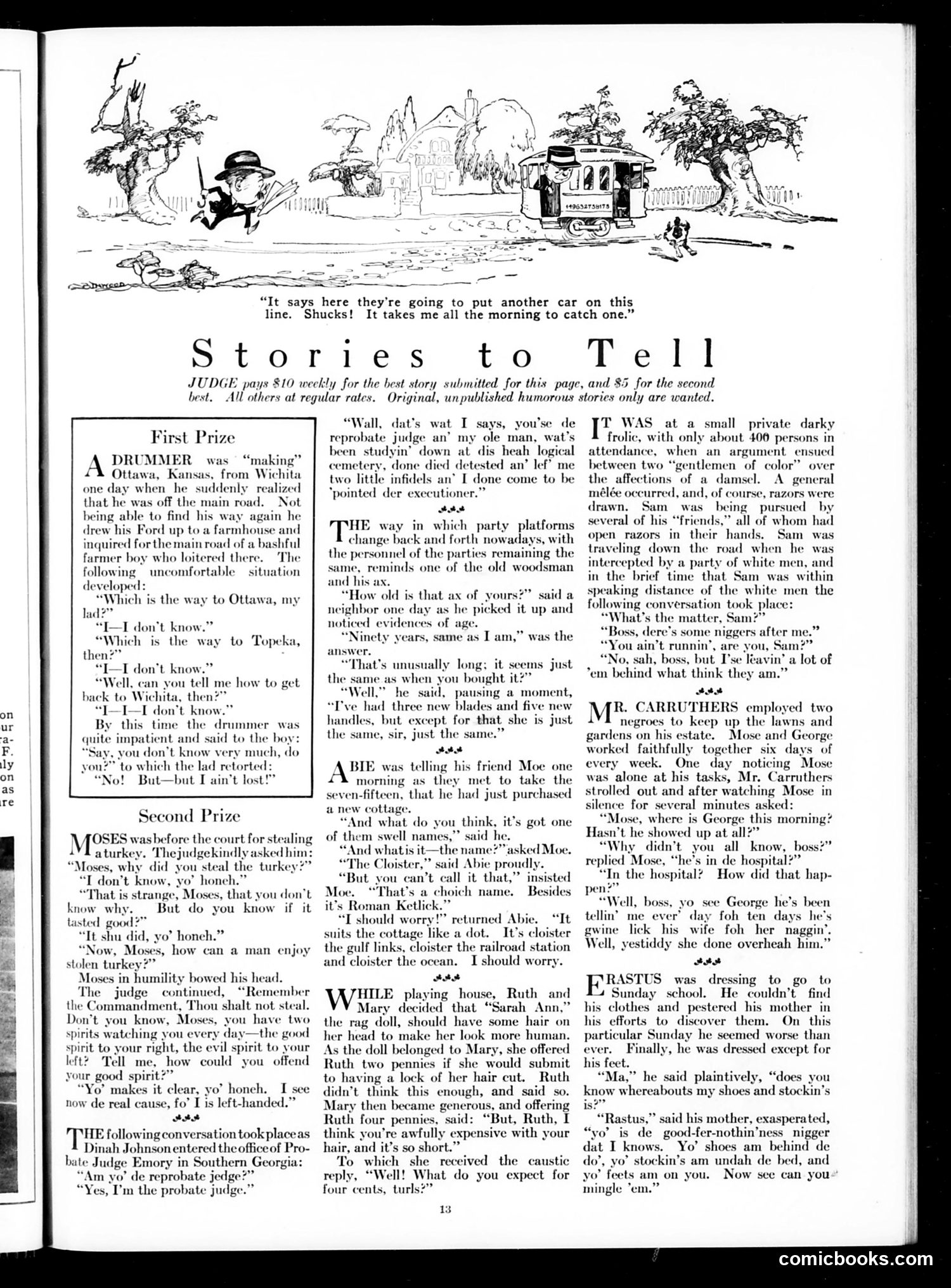
This page from *Judge* magazine presents humorous short stories organized as a contest, with prizes of $10 and $5 for submissions. The cartoon at the top depicts a man complaining about infrequent streetcar service—a relatable complaint about urban transportation in the early 20th century when electric trolleys were common but unreliable. The stories themselves employ period humor: 1. **First Prize**: A traveling salesman (drummer) gets lost and repeatedly asks a shy farm boy for directions, only to discover the boy himself is lost—a setup-punchline joke about rural simplicity. 2. **Second Prize**: A Black defendant named Moses appears before a judge accused of stealing a turkey. The humor relies on dialect comedy and the punchline that Moses committed the crime using his left hand, which he blames on having "two spirits" (good and evil) watching him—satirizing both the defendant's superstition and the judge's moralizing. 3. **Additional stories** include wordplay confusion ("reprobate" vs. "probate judge"), an analogy about political platforms, and children's dialogue about hair-cutting wages. The humor reflects early 20th-century attitudes, including racial stereotypes common to the era.
📄 Transcribed text from this page (OCR, searchable)
Machine-transcribed from the original scan — historical spelling and the odd misread are preserved.
“It says here they’re going to put another car on this line. Shucks! It takes me all the morning to catch one.” Stories to VFelt] JUDGE pays $10 weekly for the best story submitted for this page, and $5 for the second best. First Prize DRUMMER was) “making” Ottawa, Kansas, from Wichi one day when he suddenly. ree that he was off the main ls ot being able to find his way again he drew tis Ford upsioia farmihiuseand inquired forthe main road of a bashful farmer boy who loitered there. The following uncomfortable | situation developed: Which is the way to Ottawa, my —I don’t know.” “Which is the way then?” “I—I don’t know.” “Well, can you tell me how to get back to Wichita, then? “J—I—I don't know.” By this time the drummer was i tient and said to the boy: you don’t know very much, do to which the lad retorted: But—but I ain’t lost!” to Topeka, Second Prize 1V 3 was before the court for stealing aturkey. Thejudgekindly asked him: “Moses, why did you steal the turke I don’t know, yo’ honch.” “That is strange, Moses, that you don’t know why. But do you know if it tasted good?” “It shu did, yo’ hone! Now, Moses, how stolen turkey? Moses in humility bowed his head. The judge continued, “Remember the Commandment, Thou shalt not steal. Don’t you know, Moses, you have two spirits watching you every —the good spirit to your right, the evil spirit to your left? Tell me, how could you offend your good spirit?” “Yo’ makes it clear, yo’ honeh. I see now de real cause, fo’ I is left-handed.” Rad TH following conversation took placeas Dinah Johnson entered the office of Pro- bate Judge Emory in Southern Georgia: “Am yo’ de reprobate jedge?” “Yes, I’m the probate judge.” n a man enjoy All others at regular rates. “Wall, dat’s wat I says, you’se de reprobate judge an’ my ole man, wat’s been studyin’ down at dis heah logical cemetery, done died detested an’ lef? me two little infidels an’ I done come to be ‘pointed der executioner.” tae HE way in which party platforms change back and forth nowadays, with the personnel of the parties remaining the same, reminds one of the old woodsman and his ax. “How old is that ax of yours?” neighbor one day as he picked it up and idences of age. irs, same as I am,” said a noticed ev was the answer. “That's unusually long; it the same handles, but except for that she is just the same, sir, just the same.” tat A BIE was telling his friend Moe one LX morning as they met to take the seven-fifteen, that he had just purchased a new cottage. “And what do you think, it’s got one of them swell names,” said he. nd whatis it—the name?”'asked Moe. “The Cloister,” said Abie proudly. “But you can’t call it that,” insisted Moe. “That's a choich name. Besides it’s R n Ketl “I should worry!” returned Abie. “It suits the cottage like a dot. _ It’s cloister the gulf links, cloister the railroad station and cloister the ocean. I should worry. soe HILE playing house, Ruth and Mary decided that “Sarah Ann,” the rag doll, should have some hair on her head to make her look more human. As the doll belonged to Mary, she offered Ruth two pennies if she would submit to having a lock of her hair cut. Ruth didn’t think this enough, and said so. Mary then became generous, and offering Ruth four pennies “But, Ruth, I think you’re awfully expensive with your hair, and it’s so short.” To which she received the caustic reply, “Well! What do you expect for four cents, turls?” 13 Original, unpublished humorous stories only are wanted. T WAS at a small private darky frolic, with only about 400 persons in attendance, when an argument ensued between two “gentlemen of color” over the affections of a damsel. A general mélée occurred, and, of course, razors were drawn. Sam being pursued by several of his “friends,” all of whom had open razors in their hands. m was traveling down the road when he was intercepted by a party of white men, and in the brief time that Sam was within ing distance of the white men the ing conversation took place: t's the matter, Sam? "3 some nigge “You ain’t runnin’, are cae No, sah, boss, but T’se leavin’ a lot of *em behind what think they am.” set M R. CARRUTHERS employed two gardens on his estate. negroes to keep up the lawns and Mose and George worked faithfully together six days of every week. One day noticing Mose was alone at his tasks, Mr. Carruthers strolled out and after watching Mose in nce for several minute: ed: Jose, where is George this morning? Hasn’t he showed up at all?” “Why didn’t you all know, boss?” replied Mose, “he’s in de hospital?” “In the hospite How did that hap- was ou, § » see George he’s been * day foh ten days he gwine lick his wife foh her naggit Well, yestiddy she done overheah him. st RASTUS was dressing to go to 4 Sunday school. He couldn’t find his clothes and pestered his mother in his efforts to discover them. On_ this particular Sunday he seemed worse than ever. Finally, he was dressed except for his feet. “N he said plaintively, “does know whereabouts my shoes and stoc Rastus,” said his mother, exasperated, “yo’_is de good-fer-nothin’n nigger dat I knows. Yo’ shoes am behind de do’, yo” stockin’s am undah de bed, and yo’ feets am on you. Now see can you mingle “em.” comicbooks.com